
Economics for CED Nomi Giszpenc Spring 2004 Lecture
- Slides: 19
Economics for CED Noémi Giszpenc Spring 2004 Lecture 1: General Intro February 10, 2004 2/10/04 Economics for CED: Lecture 1, Noémi Giszpenc
First, some questions for you • What does “economics” mean? • What’s an economic activity? • What sorts of generalizations do you think can be made about people and economic activity? 2/10/04 Economics for CED: Lecture 1, Noémi Giszpenc 2
Why do people do what they do? • To get the most juice/stuff from what they’ve got – Maximize utility/profits subject to constraint • To do the best they can – Optimization • To get something they can live with and move on – Satisficing (Herbert Simon) • People are crazy and do whatever the @#$% 2/10/04 Economics for CED: Lecture 1, Noémi Giszpenc 3
“Had we but world enough, and time” • Can we have everything we want? • No. We are subject to constraints: – – – 2/10/04 Time Money Energy Attention Talent – – – Supplies Bandwidth Physical laws Space … Economics for CED: Lecture 1, Noémi Giszpenc 4
There are many definitions of “economics” • “A social science concerned with the way society chooses to employ its limited resources--which have alternative uses--to produce goods and services for present and future consumption. ” – Teaching Economics As If People Mattered, 2000 2/10/04 Economics for CED: Lecture 1, Noémi Giszpenc 5
A neoclassical definition: • “the science which studies human behaviour as a relationship between ends and scarce means which have alternative uses” – Lionel Robbins, The Scope and Method of Economic Science, 1932 2/10/04 Economics for CED: Lecture 1, Noémi Giszpenc 6
Economics is about questions like… • What resources do people have and how do they use them to do what? But also like. . . • How have modern economic systems developed, and how do they work? How do they change? • Who gets what? How? Why? – Hugh Stretton, Economics: A New Introduction, 1999 – I will be using Stretton heavily for the next few slides 2/10/04 Economics for CED: Lecture 1, Noémi Giszpenc 7
Different people see it differently • The science of “choice under scarcity” – Standard, neoclassical • How to conserve resources for continuing human life on Earth – Environmental • The study of provisioning: how we supply our material needs and organize our mutual interdependence – Feminist ? Close to the origins of the word: • Economy comes from Greek oikonomos, household manager (oikos, house + nemein, manage) 2/10/04 Economics for CED: Lecture 1, Noémi Giszpenc 8
How to study it, then? • Economics, like other social sciences, is part study and part debate. – Mc. Cain calls it a “rational dialog” • “Understanding economics is more like understanding politics or history or psychology than it is like understanding physics. ” – There are still rules, but they’re rougher 2/10/04 Economics for CED: Lecture 1, Noémi Giszpenc 9
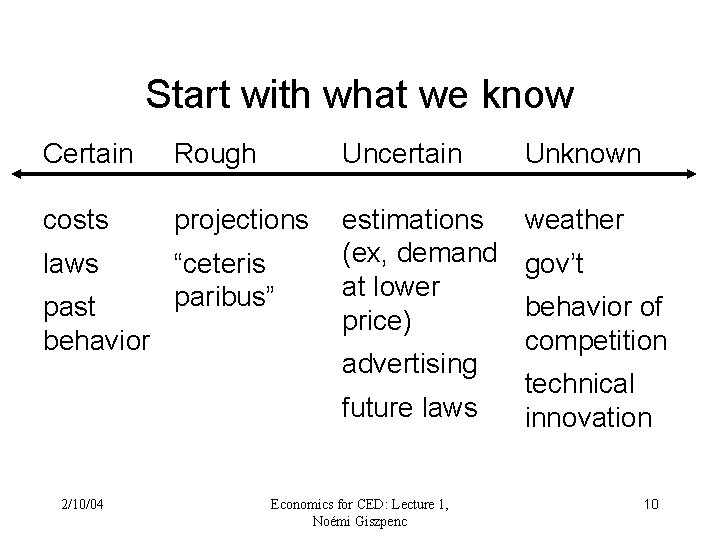
Start with what we know Certain Rough Uncertain costs projections laws “ceteris paribus” estimations weather (ex, demand gov’t at lower behavior of price) competition advertising technical future laws innovation past behavior 2/10/04 Economics for CED: Lecture 1, Noémi Giszpenc Unknown 10
How do we know things? Cause and Effect • “Different causal relations have to be known by different methods of observation, understanding, and choice. ” – – Simple arithmetic (ceteris paribus calculations) Regular association (experience) Knowing rules and regulations Understanding people’s thoughts and feelings (strategy and marketing) – Historical explanations – Experiments – Models 2/10/04 Economics for CED: Lecture 1, Noémi Giszpenc 11
Also, what we study depends on who wants to know • Ex: What will be the economic effects of a technological change? On… – – Manufacturers Workers (union/non-union) Workers’ families National government • National accounts, small business, employment… • Their question is: how are our gov policies working? – Local government • Location, pollution, traffic, services/utilities, jobs… 2/10/04 Economics for CED: Lecture 1, Noémi Giszpenc 12
Positive and Normative • positive economics deals with “what is” – A social science based on evidence • normative economics deals with “what ought to be" – goes beyond science and has moral or ethical aspect • Stretton finds distinction unhelpful – “Economics is controversial chiefly because it deals with such complex activity that its simplifications are necessarily selective. ” 2/10/04 Economics for CED: Lecture 1, Noémi Giszpenc 13
Economic Assumptions 1 • Scarcity – Leads to key question: how to allocate resources under scarcity to meet many needs and wants • • What will be produced? By what methods? Using what resources (land, labor, man-made capital)? For whom? – Entails “opportunity cost”: (trade-offs) • The value of the other goods and services we must give up in order to produce something 2/10/04 Economics for CED: Lecture 1, Noémi Giszpenc 14
Economic Assumptions 2 • Self-interested, rational individuals? – Acting according to individual values – Acting as if they were rational, on average • Irrationalities are random, and cancel out? – Useful starting place for trying to figure out why people do what they do, or what you think they would be likely to do 2/10/04 Economics for CED: Lecture 1, Noémi Giszpenc 15
Economic Models • Tend to consist of a list of variables and the relations among them – Often designed to be analytically solvable, static – Can also be dynamic -- involve time and use calculations to solve – Are the simplifications too much? Can models be refined to reflect reality? 2/10/04 Economics for CED: Lecture 1, Noémi Giszpenc 16
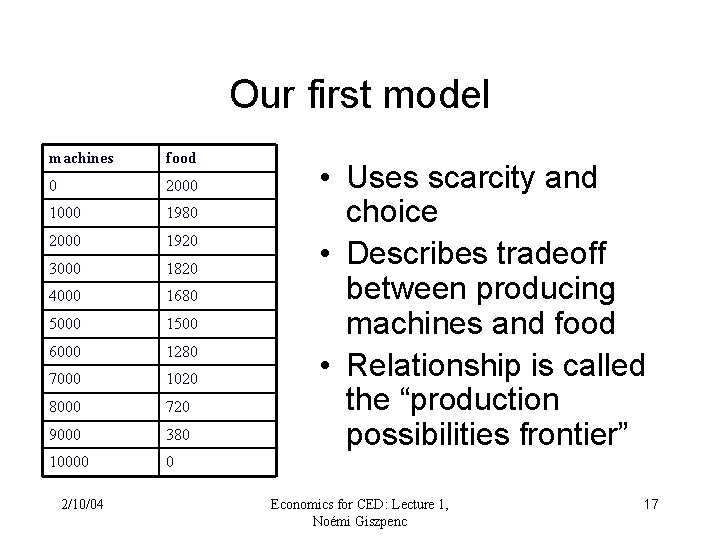
Our first model machines food 0 2000 1980 2000 1920 3000 1820 4000 1680 5000 1500 6000 1280 7000 1020 8000 720 9000 380 10000 0 2/10/04 • Uses scarcity and choice • Describes tradeoff between producing machines and food • Relationship is called the “production possibilities frontier” Economics for CED: Lecture 1, Noémi Giszpenc 17
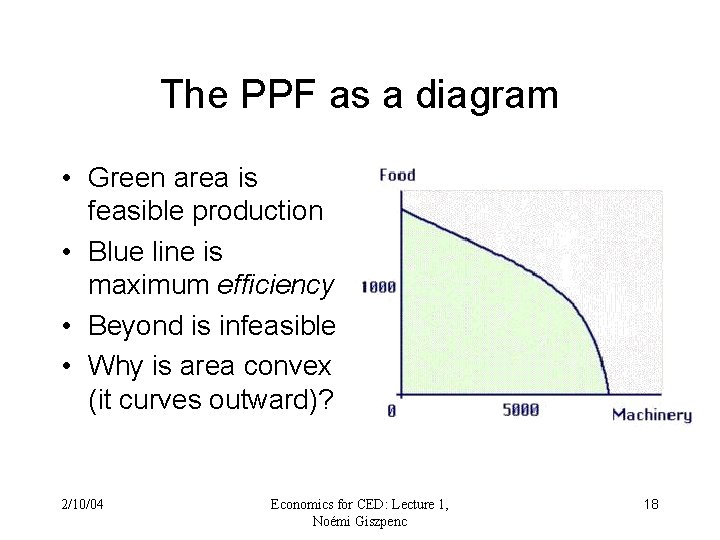
The PPF as a diagram • Green area is feasible production • Blue line is maximum efficiency • Beyond is infeasible • Why is area convex (it curves outward)? 2/10/04 Economics for CED: Lecture 1, Noémi Giszpenc 18
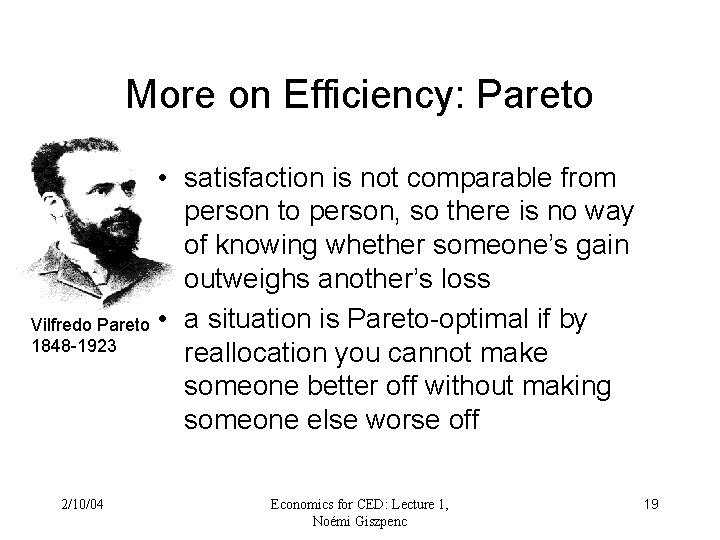
More on Efficiency: Pareto • satisfaction is not comparable from person to person, so there is no way of knowing whether someone’s gain outweighs another’s loss Vilfredo Pareto • a situation is Pareto-optimal if by 1848 -1923 reallocation you cannot make someone better off without making someone else worse off 2/10/04 Economics for CED: Lecture 1, Noémi Giszpenc 19