
ECONOMICS EXPLORE APPLY by Ayers and Collinge Chapter
ECONOMICS: EXPLORE & APPLY by Ayers and Collinge Chapter 26 “Public Choice” © 2004 Prentice Hall Publishing Ayers/Collinge, 1/e 1
Learning Objectives 1. Explain why democracy is imperfect, but still likely the best political system. 2. Point why it is reasonable to accept some inefficiencies within government. 3. Identify the median voter model and explain why that voter holds the key to political outcomes. 4. Discuss why legislators engage in vote trading that leads to excessive government spending. © 2004 Prentice Hall Publishing Ayers/Collinge, 1/e 2
Learning Objectives 5. Describe rent seeking and how it can lead to inefficiency in the political process. 6. Explain how both self interest and the public interest motivate excessive spending within administrative agencies. 7. Resolve the apparent contradiction between the public’s desire for a smaller government and the data showing increasing government spending over time. © 2004 Prentice Hall Publishing Ayers/Collinge, 1/e 3
26. 1 CHOOSING A POLITICAL SYSTEM • Government failure involves inefficiencies within the government itself. • The field of public choice looks at economic incentives within government, including those that face voters, politicians, and the administrators of government programs. • There is no way to entirely get rid of government failure. © 2004 Prentice Hall Publishing Ayers/Collinge, 1/e 4

The Idea of a Benevolent Dictator 1. Economist define a benevolent dictatorship as a form of government in which well-meaning and well informed officials make all of the best choices. 1. Obviously since people make up government there is no such thing. 2. Real world dictatorships do not look so benevolent, as they have little incentive to follow the wishes of the public or to avoid waste in government actions. 3. The prosperous countries of the world are not characterized by dictatorships. © 2004 Prentice Hall Publishing Ayers/Collinge, 1/e 5
Democracy- A Messy Process Towards Efficiency 1. Democracy is an answer to the inefficiencies of dictatorship. 2. It provides for a representative government that responds to the wishes of the public. 1. The processes of democracies are costly and messy. 2. Despite the cost, democracies lead the world in standards of living. 3. The challenge in economics is to understand offer guidance on how to improve incentives within the democratic process. © 2004 Prentice Hall Publishing Ayers/Collinge, 1/e 6
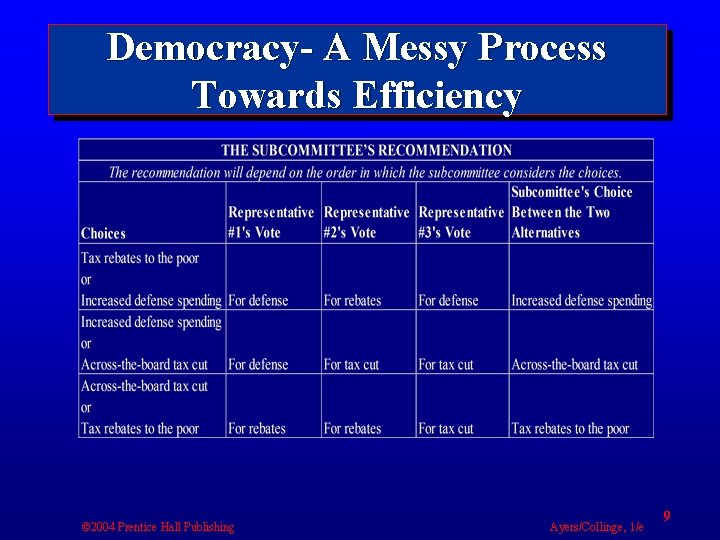
Democracy- A Messy Process Towards Efficiency q The political process does not provide definitively efficient answers. q The problem of cycling occurs when the order of political choices determines the outcomes. q The possibility of cycling illustrates how important it can be to set the agenda. q Cycling also illustrates a certain irrationality within the collective choice process. © 2004 Prentice Hall Publishing Ayers/Collinge, 1/e 7

Democracy- A Messy Process Towards Efficiency © 2004 Prentice Hall Publishing Ayers/Collinge, 1/e 8
Democracy- A Messy Process Towards Efficiency © 2004 Prentice Hall Publishing Ayers/Collinge, 1/e 9
Federalism – Experimenting With Multiple Ways v Democracy in the U. S. is characterized by federalism, meaning that there are multiple layers of government. v. The economic basis for this arrangement is that it allows those citizens to vote who are most directly affected by the consequences of the choice. v Fiscal federalism examines the design of a federal system of government from an economic standpoint. v. It suggest that decisions should be made by the level of government most directly affected by those decisions. © 2004 Prentice Hall Publishing Ayers/Collinge, 1/e 10
Federalism – Experimenting With Multiple Ways Ø Even when federal government does not directly control policies at the state and local level, it often influences these policies through financial incentives. Ø Another benefit of levels of government is that policies can be tried out on a small scale before they are enacted on a large scale. Ø There is sometimes conflict between the federal and state governments over which has the final say. Ø With federalism, different states and localities conduct elections in different manners. © 2004 Prentice Hall Publishing Ayers/Collinge, 1/e 11
26. 2 CHOICES BY THE VOTERS Ø Because we delegate decisions collectively, none of us gets exactly what we want. Ø Each candidate for office represents a bundled good, meaning that the voter can’t pick and choose which item’s on a candidate’s agenda to support, and which to oppose. Ø One vote buys all. Ø A second source of concern over government action is the principle-agent problem. Ø Public servants are agents of the public (principles). Ø This generalized accountability provides a great deal of leeway on the part of the agents to do as they please. © 2004 Prentice Hall Publishing Ayers/Collinge, 1/e 12
The Median Voter Model 1. The median voter model says that candidates will seek the support of the decisive swing voter that can tilt the balance from one candidate to the other. 2. The median voter is the one for whom 50% prefer further to the right on the spectrum, and 50% prefer further to the left. 3. In an election the candidate chosen by the median voter will win by garnering a minimum of just over 50% of the vote. © 2004 Prentice Hall Publishing Ayers/Collinge, 1/e 13
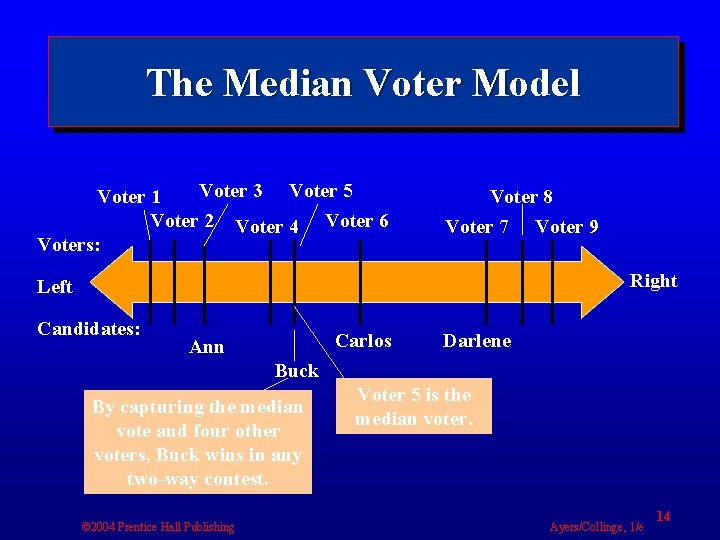
The Median Voter Model Voter 3 Voter 5 Voter 1 Voter 2 Voter 4 Voter 6 Voters: Voter 8 Voter 7 Voter 9 Right Left Candidates: Carlos Ann Darlene Buck By capturing the median vote and four other voters, Buck wins in any two-way contest. © 2004 Prentice Hall Publishing Voter 5 is the median voter. Ayers/Collinge, 1/e 14
Rational Ignorance • Rational ignorance on the part of voters means that they make a rational choice to remain uninformed on many public choices. • Many voting choices are for people rather than specific policy actions. • Voters delegate authority to politicians, who in turn delegate to the administrative bureaucracy. • Political parties are in part a response to the rational ignorance of voters. © 2004 Prentice Hall Publishing Ayers/Collinge, 1/e 15
26. 3 CANDIDATES AND COALITIONS 1. To achieve the results constituents expect, the holder of a political office will often find it necessary to compromise and bargain with other elected representatives. 2. Incumbent politicians routinely get reelected. 3. Achieving reelection can be accomplished through logrolling – vote trading- in order to obtain projects of direct benefit to constituents. 4. Logrolling results in massive spending packages that contain numerous local spending projects of questionable merit. 5. These projects are often called pork. © 2004 Prentice Hall Publishing Ayers/Collinge, 1/e 16
Candidates and Coalitions • When voters focus on visible benefits from projects and ignore the less obvious cost it is referred to as fiscal illusion. • Fiscal illusion tends to bring about excessive spending. • One check on log-rolling is the line-item veto powers of many state governors. • The line-item veto allows a governor to veto parts of appropriations bills rather than veto the bills in their entirety. © 2004 Prentice Hall Publishing Ayers/Collinge, 1/e 17
Interest Groups – They Pay Attention § The U. S. prides itself on majority rule, yet legislation is often influenced by small, well organized minorities. § Special-interest groups are characterized by a tightly focused agenda and lobbyist , who are agents who promote that agenda within the political system. § The agendas of the special interest groups often conflict with the interest of most voters. § The special interest groups are usually able to get their way by paying close attention to the details of legislator’s votes. © 2004 Prentice Hall Publishing Ayers/Collinge, 1/e 18
Interest Groups – They Pay Attention • Legislators who favor special interest know they lose votes and campaign contributions. – Although they vote against the wishes of the majority they often face no adverse consequences. • When the benefits of an action are spread broadly and the cost are concentrated, special interest are frequently successful at preventing the action from occurring. • Lobbying by special interest is efficient when it prevents legislative errors. © 2004 Prentice Hall Publishing Ayers/Collinge, 1/e 19
Interest Groups – They Pay Attention Special interest lobbying is frequently inefficient because it involves wasteful rent seeking. Rent seeking occurs when lobbyist or others expend resources in an effort to come out a winner in the political process. An emerging trend in congress reduces the problems of special interest by replacing federal programs with block grants. Block grants represent sums of money designated to go towards a range of state administered programs. © 2004 Prentice Hall Publishing Ayers/Collinge, 1/e 20
26. 4 GOVERNMENT BUREAUCRACY o The employees of the many agencies of government are commonly referred to as government bureaucrats. o The employees of government agencies have personal agendas that sometimes conflict with the intent of voters and their elected representatives. o For both public spirited and self serving reasons, bureaucrats almost always desire budgets for their agencies that exceed what the average citizen and elected official would prefer. © 2004 Prentice Hall Publishing Ayers/Collinge, 1/e 21
Incentives within Agencies q There are several self serving reasons why government employees want larger budgets for their agencies. q A larger budget is seen as good job protection. q It opens up job opportunities and reduces the threat of lay-offs. q The larger the budget, the more power and prestige you enjoy. q To achieve economic efficiency, the agency budget should equal the amount for which the marginal net benefit is zero. © 2004 Prentice Hall Publishing Ayers/Collinge, 1/e 22
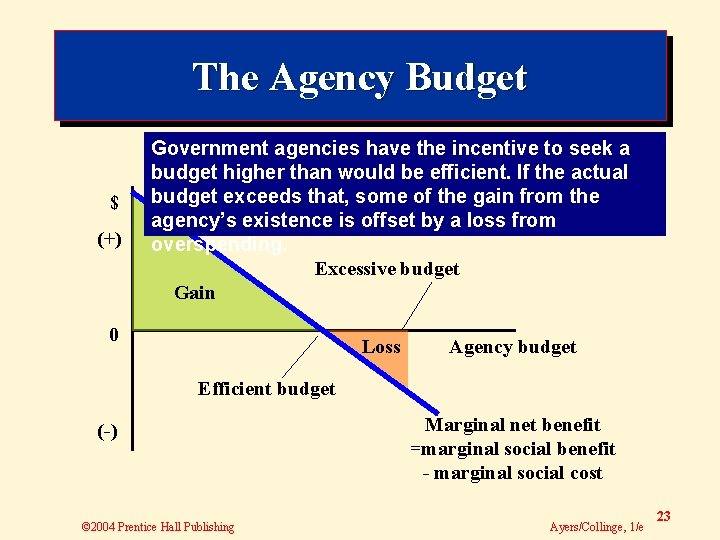
The Agency Budget $ (+) Government agencies have the incentive to seek a budget higher than would be efficient. If the actual budget exceeds that, some of the gain from the agency’s existence is offset by a loss from overspending. Excessive budget Gain 0 Loss Agency budget Efficient budget (-) © 2004 Prentice Hall Publishing Marginal net benefit =marginal social benefit - marginal social cost Ayers/Collinge, 1/e 23
Turf-Building v The struggle over the size of the agency budget is rather one-sided, because the agency is best positioned to know what its spending options are. v Such asymmetric information, in which one party to a transaction knows more than the other, puts legislators at a disadvantage in overseeing agencies. v. To preserve your budget, many agencies suggest cutting something that people would in fact not want you to cut. © 2004 Prentice Hall Publishing Ayers/Collinge, 1/e 24
Turf-Building 1. The strategy of selecting widely supported projects for potential cuts has been used so often that it has acquired its own name – the Washington Monument strategy. 2. Using this strategy the agency bluffs by offering a bare bones budget that cuts most popular functions. 3. There is no easy way to provide the proper incentives for efficiency within the government. 4. If the government were efficient there would be no reason to adopt competitive free markets. © 2004 Prentice Hall Publishing Ayers/Collinge, 1/e 25
26. 5 ADDRESSING GOVERNMENT FAILURE o What can citizens do to counter all of the incentives within government to spend too much? o Term limits is one possible alternative. o However, term limits deprive the government of experienced legislators. o They also raise the danger that legislator’s will focus their attention on personal profit opportunities once they leave office, rather than their public duties. © 2004 Prentice Hall Publishing Ayers/Collinge, 1/e 26
26. 6 EXPLORE &APPLY GROWING THE GOVERNMENT ü The size of government and its proper role has been debated in the U. S. from the day of its founding. ü Most recently, President George W. Bush has pushed through significant increases in government spending and powers to combat terrorism. ü The constitution obligates government to promote the public welfare. © 2004 Prentice Hall Publishing Ayers/Collinge, 1/e 27
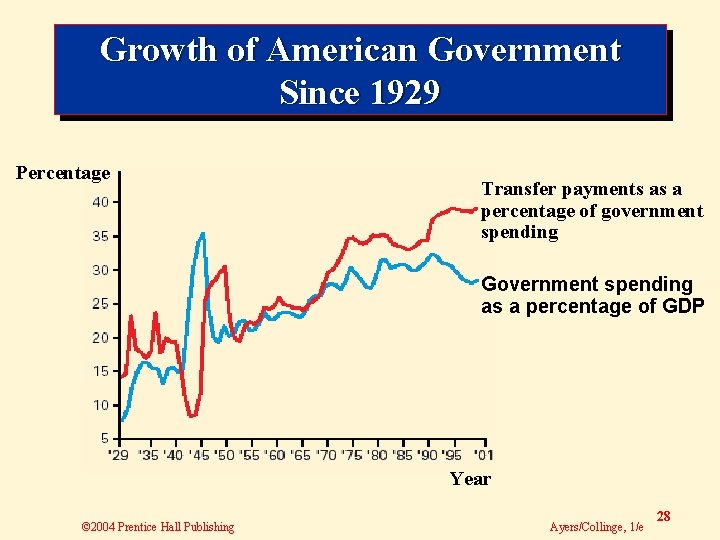
Growth of American Government Since 1929 Percentage Transfer payments as a percentage of government spending Government spending as a percentage of GDP Year © 2004 Prentice Hall Publishing Ayers/Collinge, 1/e 28
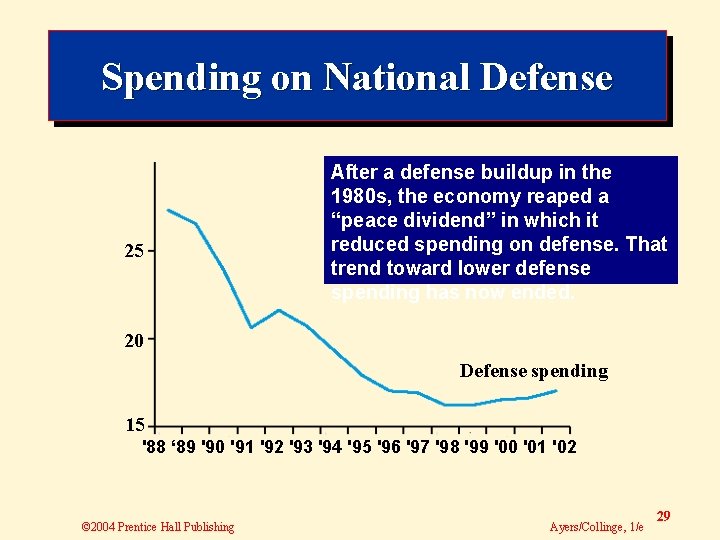
Spending on National Defense 25 After a defense buildup in the 1980 s, the economy reaped a “peace dividend” in which it reduced spending on defense. That trend toward lower defense spending has now ended. 20 Defense spending 15 '88 ‘ 89 '90 '91 '92 '93 '94 '95 '96 '97 '98 '99 '00 '01 '02 © 2004 Prentice Hall Publishing Ayers/Collinge, 1/e 29
Terms Along the Way ü government failure ü public choice ü cycling ü fiscal federalism ü bundled good ü principle-agent problem ü median voter model ü rational ignorance ü median voter model © 2004 Prentice Hall Publishing ü rational ignorance ü logrolling ü fiscal illusion ü line-item veto ü lobbyist ü rent-seeking ü block grants ü Washington Monument strategy Ayers/Collinge, 1/e 30
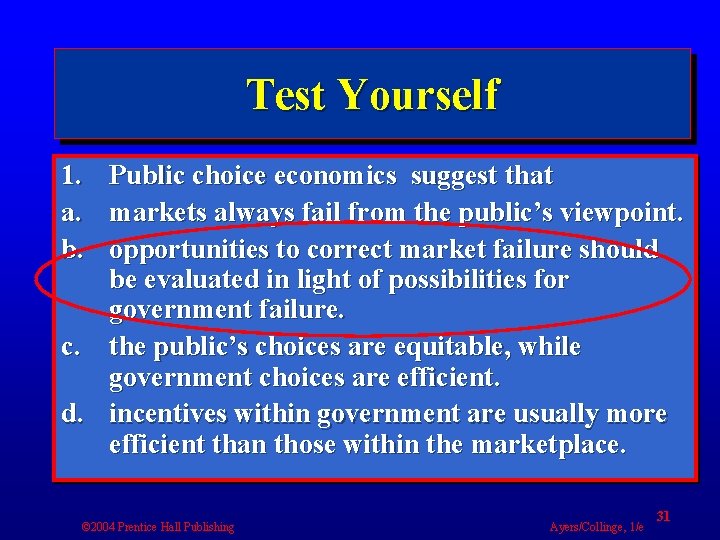
Test Yourself 1. a. b. Public choice economics suggest that markets always fail from the public’s viewpoint. opportunities to correct market failure should be evaluated in light of possibilities for government failure. c. the public’s choices are equitable, while government choices are efficient. d. incentives within government are usually more efficient than those within the marketplace. © 2004 Prentice Hall Publishing Ayers/Collinge, 1/e 31
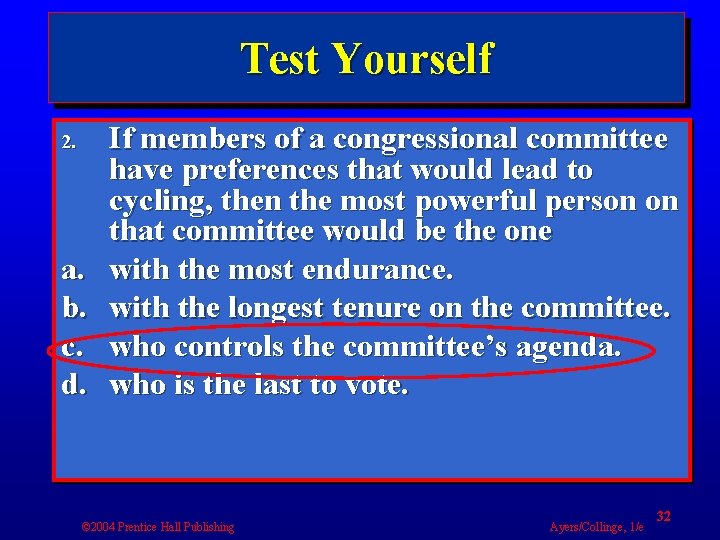
Test Yourself 2. a. b. c. d. If members of a congressional committee have preferences that would lead to cycling, then the most powerful person on that committee would be the one with the most endurance. with the longest tenure on the committee. who controls the committee’s agenda. who is the last to vote. © 2004 Prentice Hall Publishing Ayers/Collinge, 1/e 32
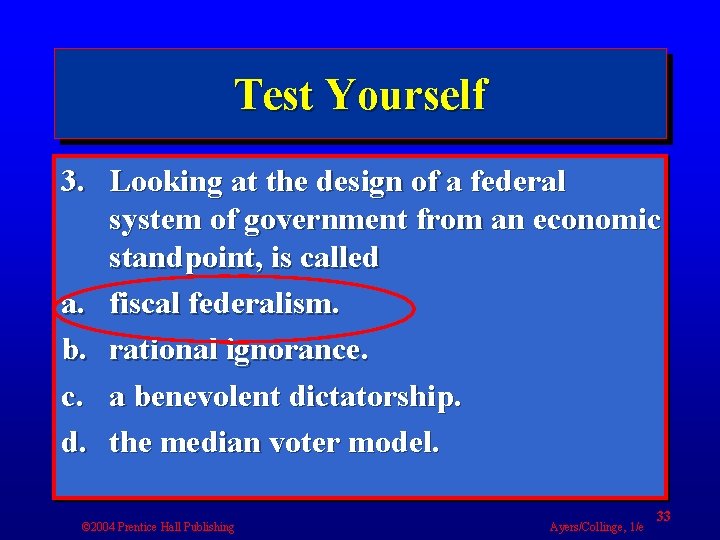
Test Yourself 3. Looking at the design of a federal system of government from an economic standpoint, is called a. fiscal federalism. b. rational ignorance. c. a benevolent dictatorship. d. the median voter model. © 2004 Prentice Hall Publishing Ayers/Collinge, 1/e 33
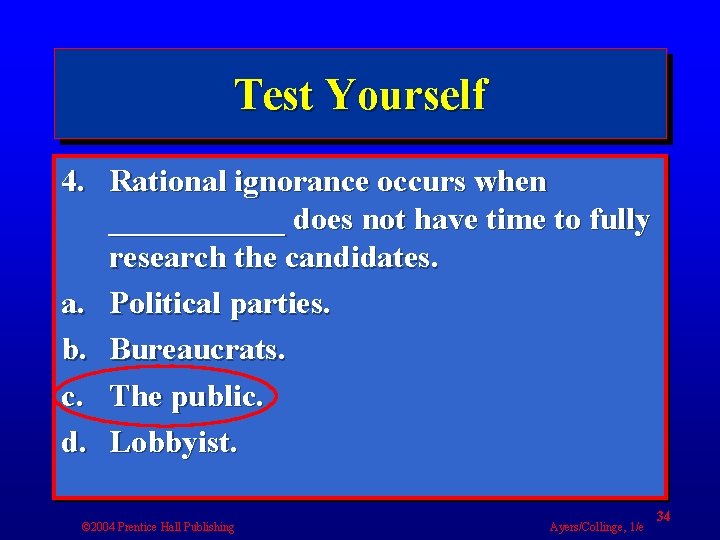
Test Yourself 4. Rational ignorance occurs when ______ does not have time to fully research the candidates. a. Political parties. b. Bureaucrats. c. The public. d. Lobbyist. © 2004 Prentice Hall Publishing Ayers/Collinge, 1/e 34
Test Yourself 5. a. b. c. d. The line-item veto provides a check on the median voter. fiscal illusion. a benevolent dictator. logrolling. © 2004 Prentice Hall Publishing Ayers/Collinge, 1/e 35
Test Yourself 6. a. b. c. Rent-seeking behavior involves real estate transactions. illegal government corruption. measuring the benefits from public housing. d. seeking favors from the government. © 2004 Prentice Hall Publishing Ayers/Collinge, 1/e 36
The End! Next Chapter 27 “Into the International Marketplace" © 2004 Prentice Hall Publishing Ayers/Collinge, 1/e 37
- Slides: 37