
ECONOMICS Chapter 18 3 Restrictions on World Trade

- Slides: 21
ECONOMICS Chapter 18. 3: Restrictions on World Trade Learning Target: Understand tariffs, embargos, trade agreements & restrictions (WTO, NAFTA, CAFTA, EU…)
ECONOMICS Chapter 18. 3: Restrictions on World Trade Learning Target: Understand tariffs, embargos, Trade agreements & restrictions (WTO, NAFTA, CAFTA, EU…) Success Criteria You should be able to… 1. Analyze the changing relationship between the U. S. economy and the global economy including a the impact of trade agreements 2. Assess the impact of trade policies such as tariffs 3. Assess the impact of trade policies including quotas, embargoes and other barriers
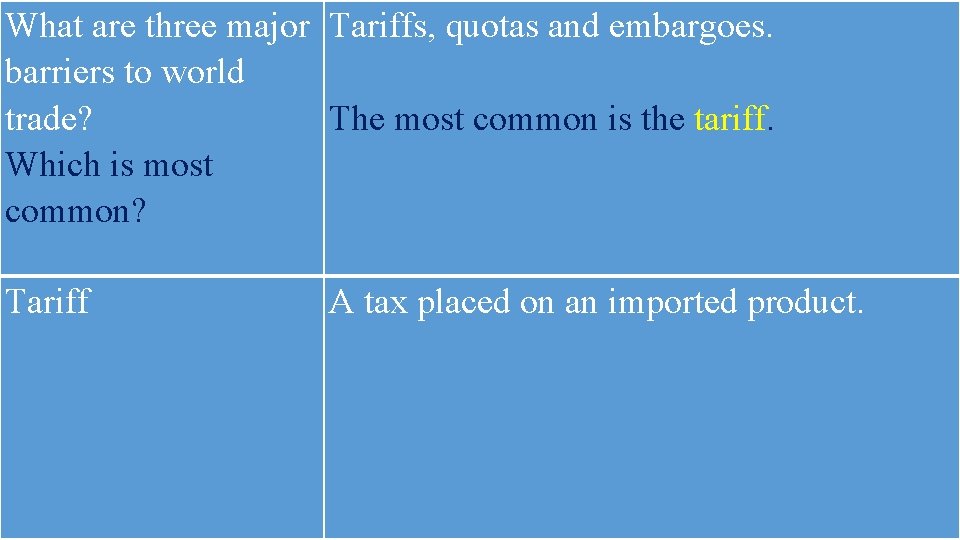
What are three major Tariffs, quotas and embargoes. barriers to world trade? The most common is the tariff. Which is most common? Tariff A tax placed on an imported product.
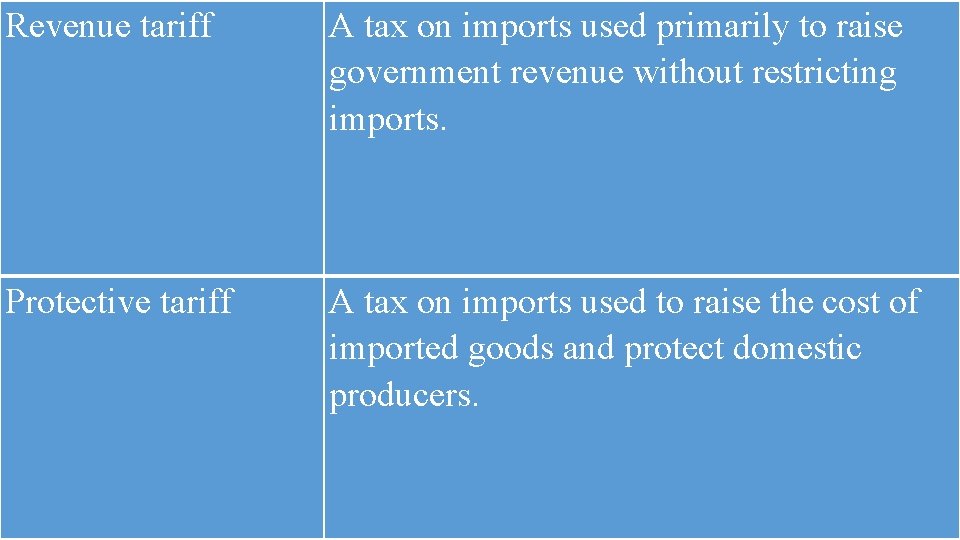
Revenue tariff A tax on imports used primarily to raise government revenue without restricting imports. Protective tariff A tax on imports used to raise the cost of imported goods and protect domestic producers.
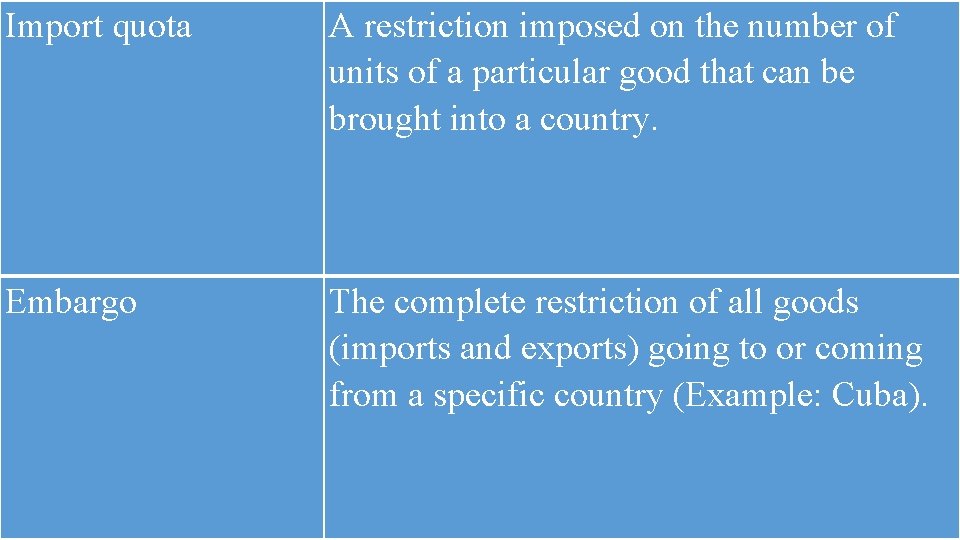
Import quota A restriction imposed on the number of units of a particular good that can be brought into a country. Embargo The complete restriction of all goods (imports and exports) going to or coming from a specific country (Example: Cuba).
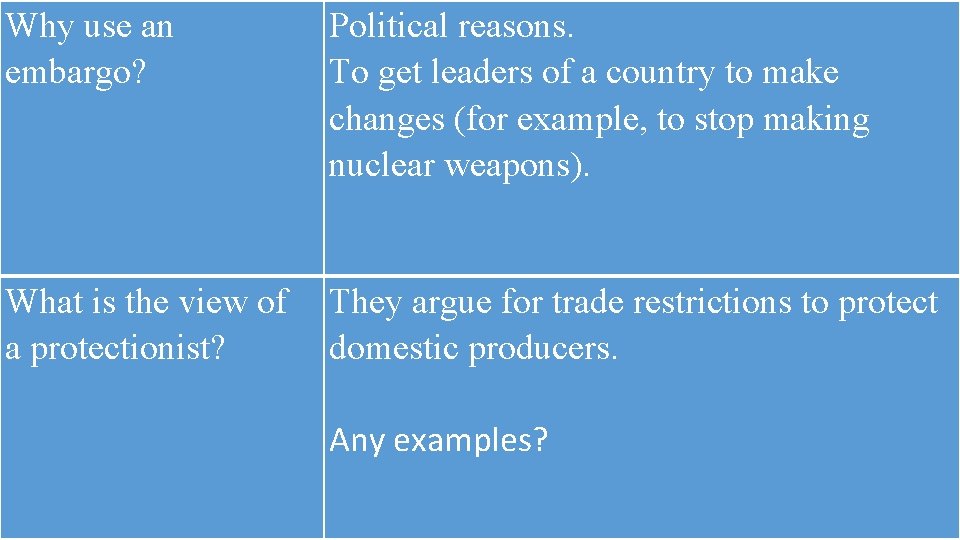
Why use an embargo? Political reasons. To get leaders of a country to make changes (for example, to stop making nuclear weapons). What is the view of a protectionist? They argue for trade restrictions to protect domestic producers. Any examples?
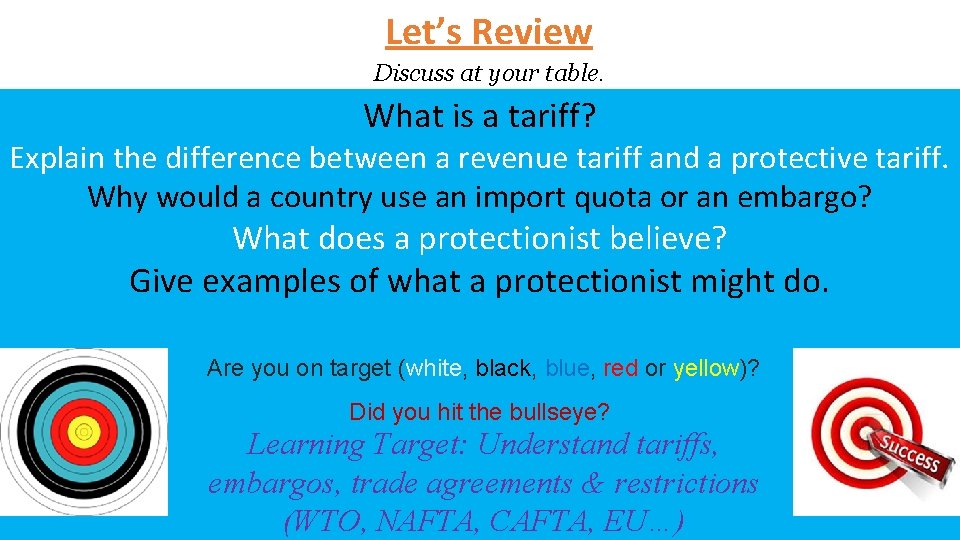
Let’s Review Discuss at your table. What is a tariff? Explain the difference between a revenue tariff and a protective tariff. Why would a country use an import quota or an embargo? What does a protectionist believe? Give examples of what a protectionist might do. Are you on target (white, black, blue, red or yellow)? Did you hit the bullseye? Learning Target: Understand tariffs, embargos, trade agreements & restrictions (WTO, NAFTA, CAFTA, EU…)
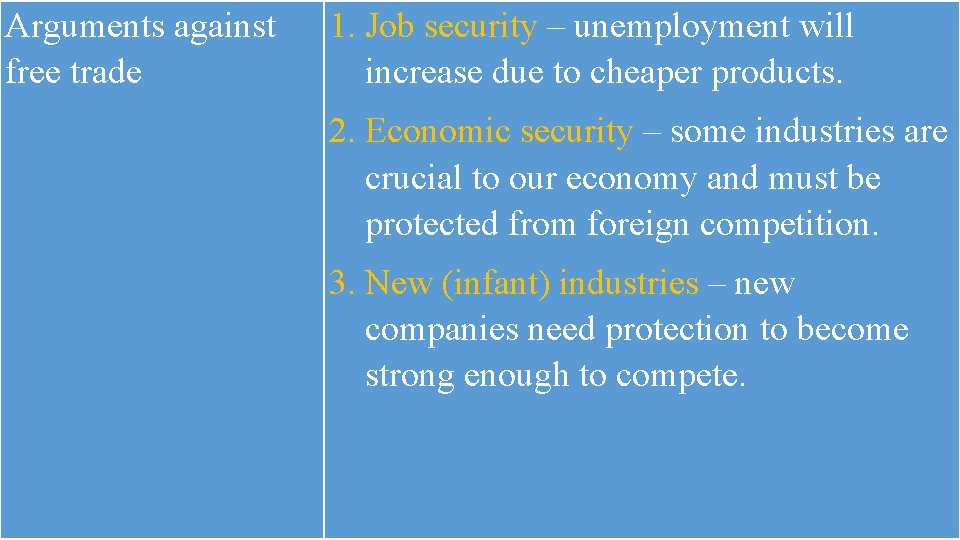
Arguments against free trade 1. Job security – unemployment will increase due to cheaper products. 2. Economic security – some industries are crucial to our economy and must be protected from foreign competition. 3. New (infant) industries – new companies need protection to become strong enough to compete.
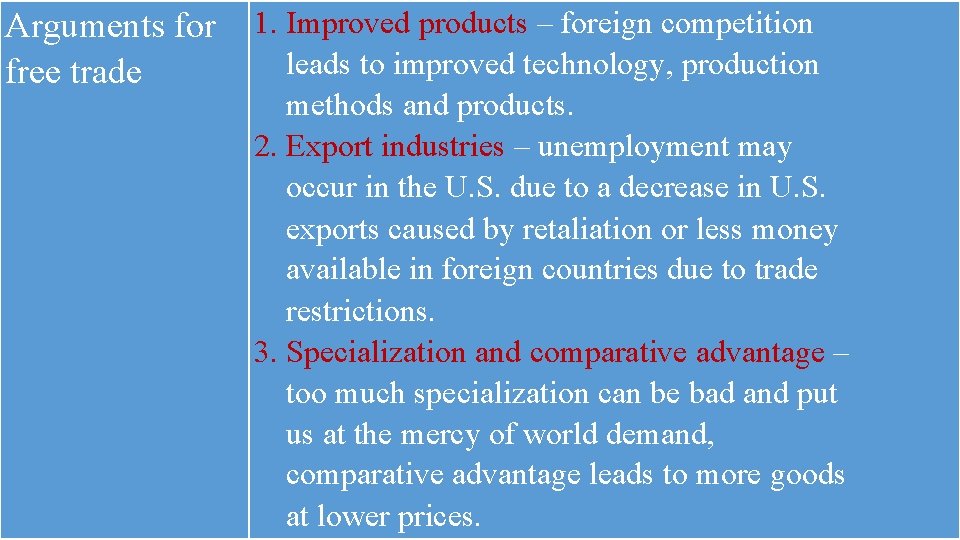
Arguments for free trade 1. Improved products – foreign competition leads to improved technology, production methods and products. 2. Export industries – unemployment may occur in the U. S. due to a decrease in U. S. exports caused by retaliation or less money available in foreign countries due to trade restrictions. 3. Specialization and comparative advantage – too much specialization can be bad and put us at the mercy of world demand, comparative advantage leads to more goods at lower prices.
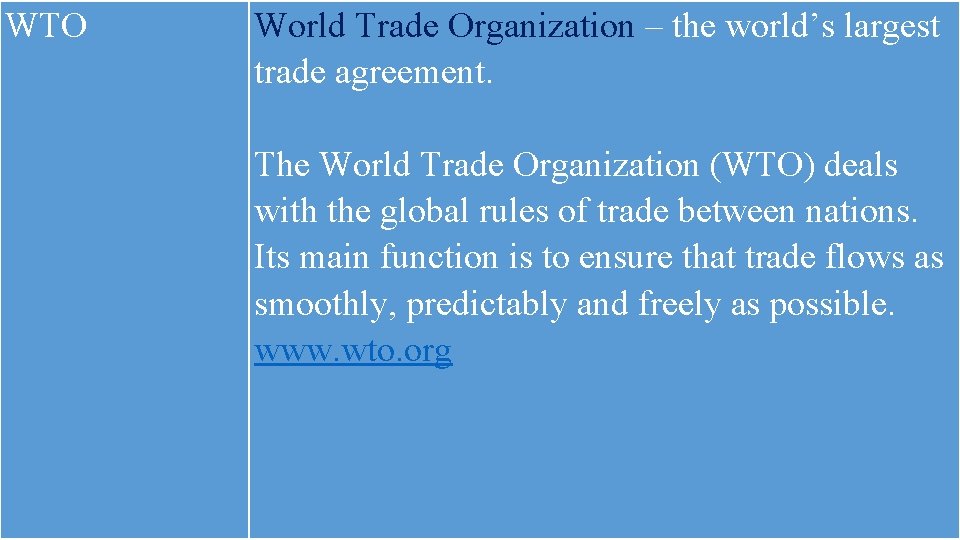
WTO World Trade Organization – the world’s largest trade agreement. The World Trade Organization (WTO) deals with the global rules of trade between nations. Its main function is to ensure that trade flows as smoothly, predictably and freely as possible. www. wto. org
UNDERSTANDING THE WTO: THE ORGANIZATION Members and Observers 164 members since 29 July 2016, with dates of WTO membership. Click any member to see key information on trade statistics, WTO commitments, disputes, trade policy reviews, and notifications. www. wto. org
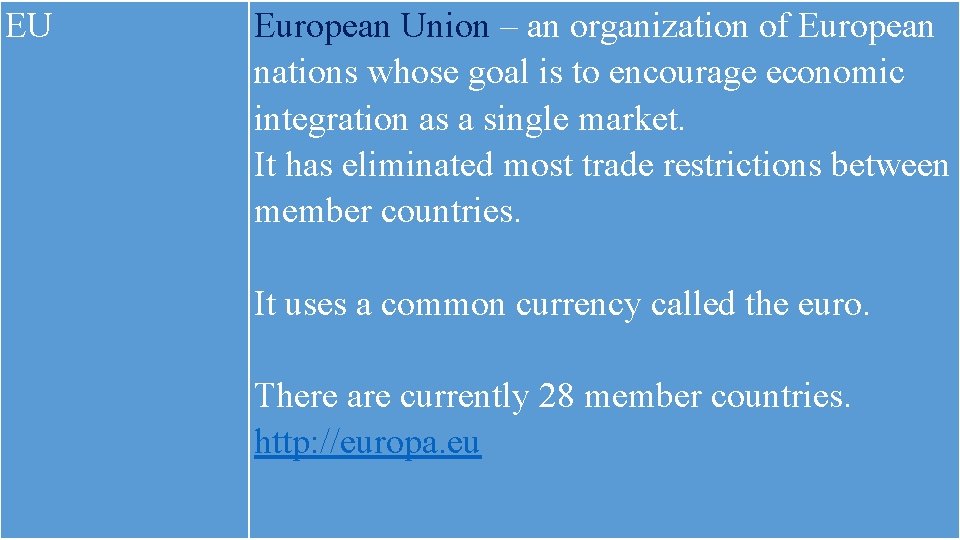
EU European Union – an organization of European nations whose goal is to encourage economic integration as a single market. It has eliminated most trade restrictions between member countries. It uses a common currency called the euro. There are currently 28 member countries. http: //europa. eu
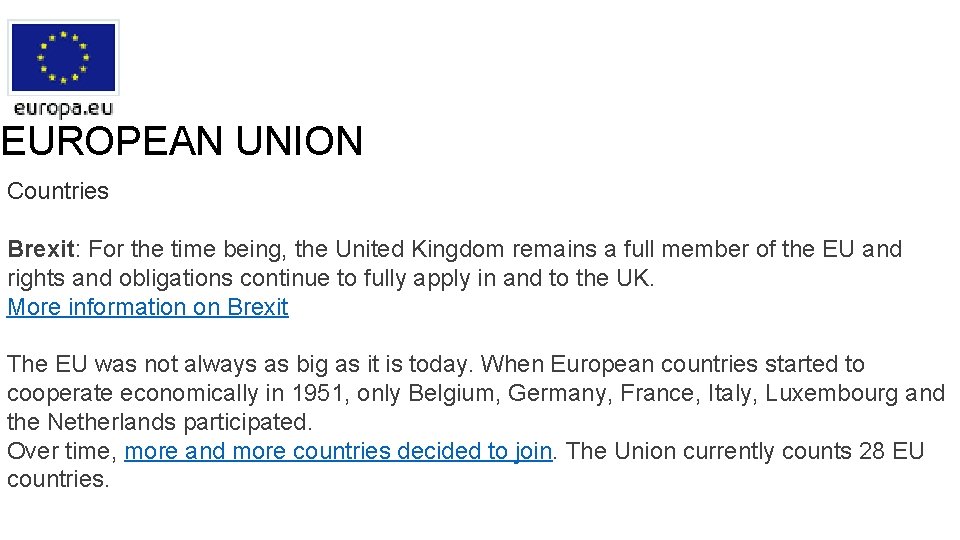
EUROPEAN UNION Countries Brexit: For the time being, the United Kingdom remains a full member of the EU and rights and obligations continue to fully apply in and to the UK. More information on Brexit The EU was not always as big as it is today. When European countries started to cooperate economically in 1951, only Belgium, Germany, France, Italy, Luxembourg and the Netherlands participated. Over time, more and more countries decided to join. The Union currently counts 28 EU countries.
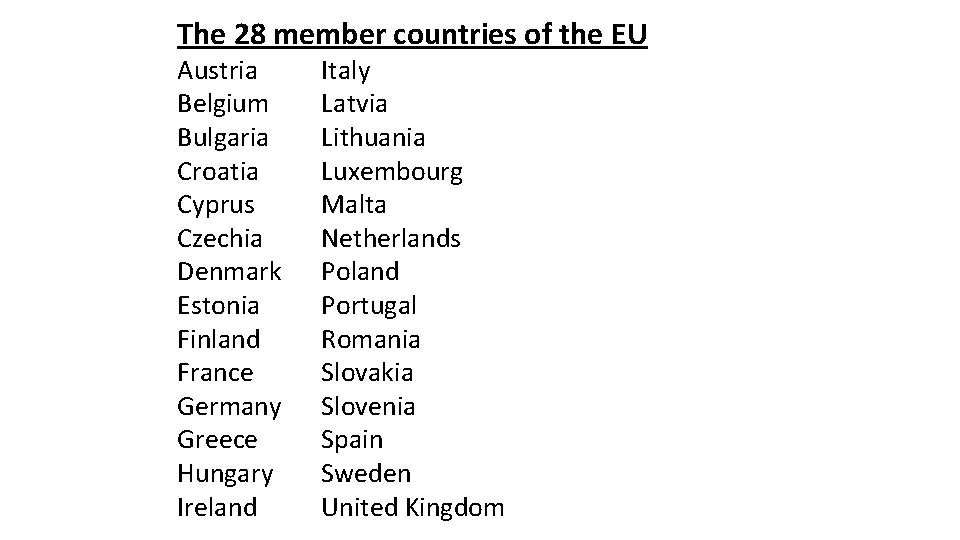
The 28 member countries of the EU Austria Belgium Bulgaria Croatia Cyprus Czechia Denmark Estonia Finland France Germany Greece Hungary Ireland Italy Latvia Lithuania Luxembourg Malta Netherlands Poland Portugal Romania Slovakia Slovenia Spain Sweden United Kingdom
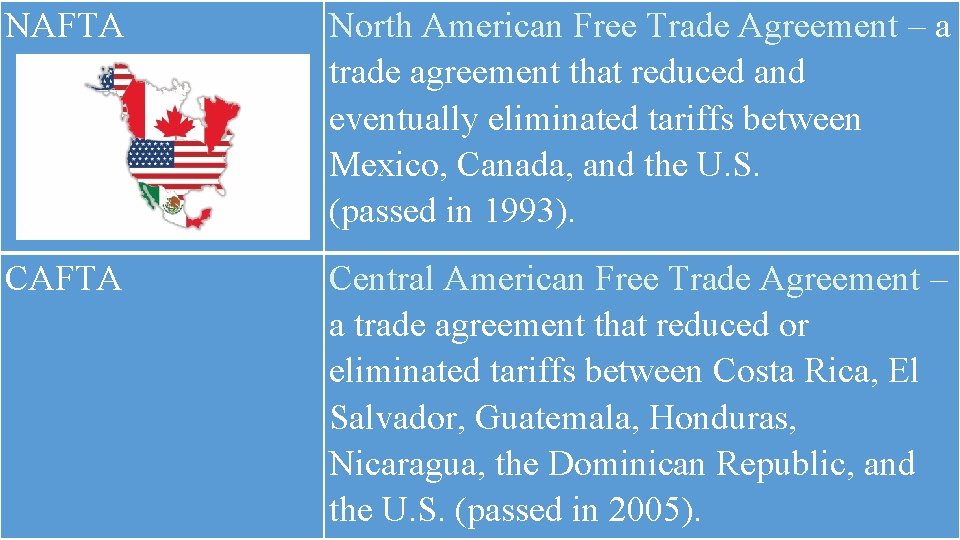
NAFTA North American Free Trade Agreement – a trade agreement that reduced and eventually eliminated tariffs between Mexico, Canada, and the U. S. (passed in 1993). CAFTA Central American Free Trade Agreement – a trade agreement that reduced or eliminated tariffs between Costa Rica, El Salvador, Guatemala, Honduras, Nicaragua, the Dominican Republic, and the U. S. (passed in 2005).
NAFTA’s Economic Impact President Trump has reached a deal with Canada and Mexico to restructure the North American Free Trade Agreement, hoping a new trilateral accord will reinvigorate the U. S. manufacturing sector. Backgrounder by James Mc. Bride and Mohammed Aly Sergie Last updated October 1, 2018 www. cfr. org/backgrounder/naftas-economic-impact
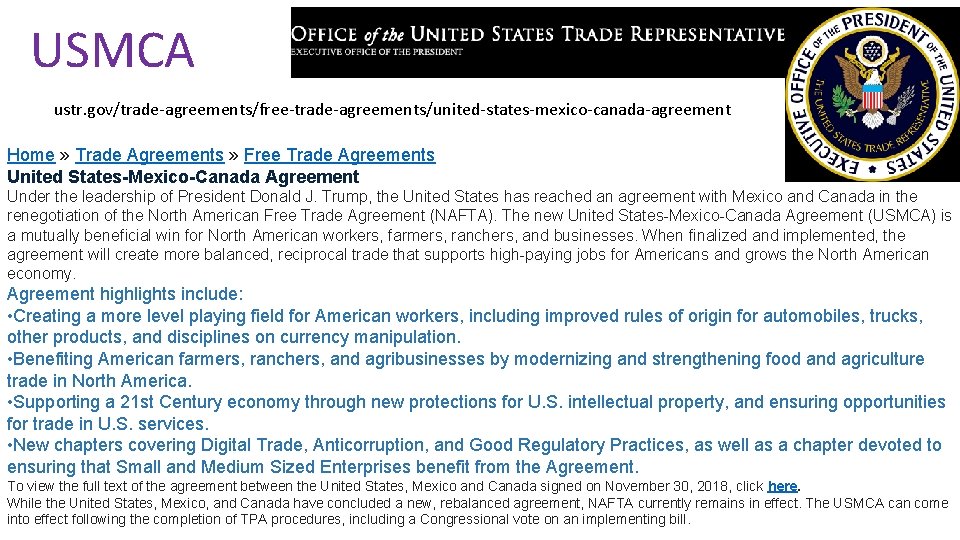
USMCA ustr. gov/trade-agreements/free-trade-agreements/united-states-mexico-canada-agreement Home » Trade Agreements » Free Trade Agreements United States-Mexico-Canada Agreement Under the leadership of President Donald J. Trump, the United States has reached an agreement with Mexico and Canada in the renegotiation of the North American Free Trade Agreement (NAFTA). The new United States-Mexico-Canada Agreement (USMCA) is a mutually beneficial win for North American workers, farmers, ranchers, and businesses. When finalized and implemented, the agreement will create more balanced, reciprocal trade that supports high-paying jobs for Americans and grows the North American economy. Agreement highlights include: • Creating a more level playing field for American workers, including improved rules of origin for automobiles, trucks, other products, and disciplines on currency manipulation. • Benefiting American farmers, ranchers, and agribusinesses by modernizing and strengthening food and agriculture trade in North America. • Supporting a 21 st Century economy through new protections for U. S. intellectual property, and ensuring opportunities for trade in U. S. services. • New chapters covering Digital Trade, Anticorruption, and Good Regulatory Practices, as well as a chapter devoted to ensuring that Small and Medium Sized Enterprises benefit from the Agreement. To view the full text of the agreement between the United States, Mexico and Canada signed on November 30, 2018, click here. While the United States, Mexico, and Canada have concluded a new, rebalanced agreement, NAFTA currently remains in effect. The USMCA can come into effect following the completion of TPA procedures, including a Congressional vote on an implementing bill.
Let’s Review Discuss at your table. Explain several arguments for and against free trade. What is the goal of the WTO? How many members does it have? Describe the EU. How many members does it have? How might its membership change? Name a member country. What is the purpose of NAFTA and CAFTA? Why has NAFTA been in the news? Are you on target (white, black, blue, red or yellow)? Did you hit the bullseye? Learning Target: Understand tariffs, embargos, trade agreements & restrictions (WTO, NAFTA, CAFTA, EU…)
SUCCESS CRITERIA #We. Love. To. Learn