
Economics 101 The Basics What is economics The

Economics 101 The Basics
What is economics? • The study of how people seek to satisfy their needs and wants by making choices • Economics is about CHOICE
You can’t always get what you want. Rolling Stones • Scarcity • Give three examples of scarce resource: • Both Goods & Services can be scarce • Note: Don’t confuse scarcity with a shortage. – Scarcity always exists – Shortages are usually temporary
A note on Resources • Economists divide them into three main categories – Land – Labor – Capital The three put together are the Factors of Production (L, L, & C) • Physical • Human • Entrepreneurs: – The people who combine land, labor, and capital to create new goods and services. – These are the people who start businesses.
Scarcity forces a choice • Trade-Offs – all the alternatives that we give up whenever we choose one course of action over another • Individuals: • Businesses: • Society: – Guns or butter
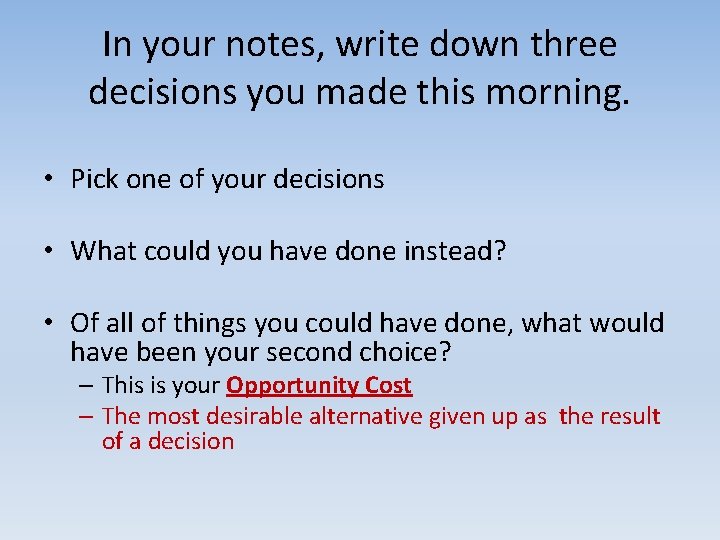
In your notes, write down three decisions you made this morning. • Pick one of your decisions • What could you have done instead? • Of all of things you could have done, what would have been your second choice? – This is your Opportunity Cost – The most desirable alternative given up as the result of a decision
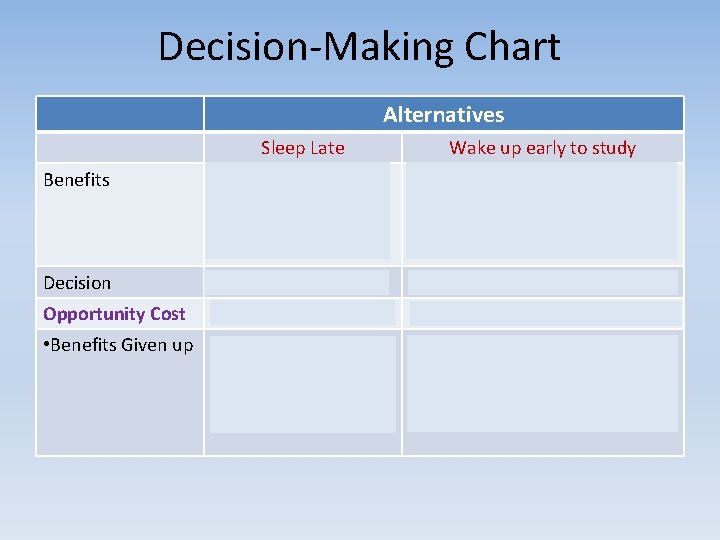
Decision-Making Chart Alternatives Sleep Late Wake up early to study Benefits Enjoy more sleep Have more energy • Better grades on test • Teacher and parental approval • Personal satisfaction Decision Extra sleep Wake up early to study for a test Opportunity Cost Extra study time Extra sleep • Benefits Given up • Better grades on test • Enjoy more sleep • Teacher and parental • Have more energy during the approval day • Personal satisfaction
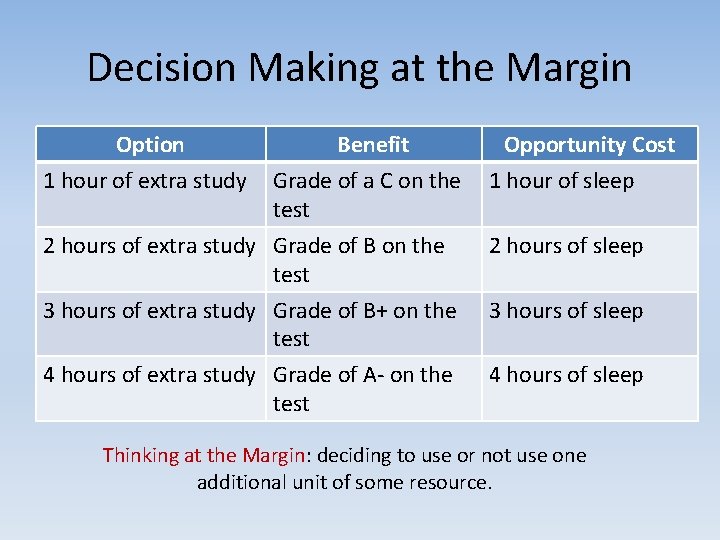
Decision Making at the Margin Option 1 hour of extra study Benefit Grade of a C on the test Opportunity Cost 1 hour of sleep 2 hours of extra study Grade of B on the test 2 hours of sleep 3 hours of extra study Grade of B+ on the test 4 hours of extra study Grade of A- on the test 3 hours of sleep 4 hours of sleep Thinking at the Margin: deciding to use or not use one additional unit of some resource.
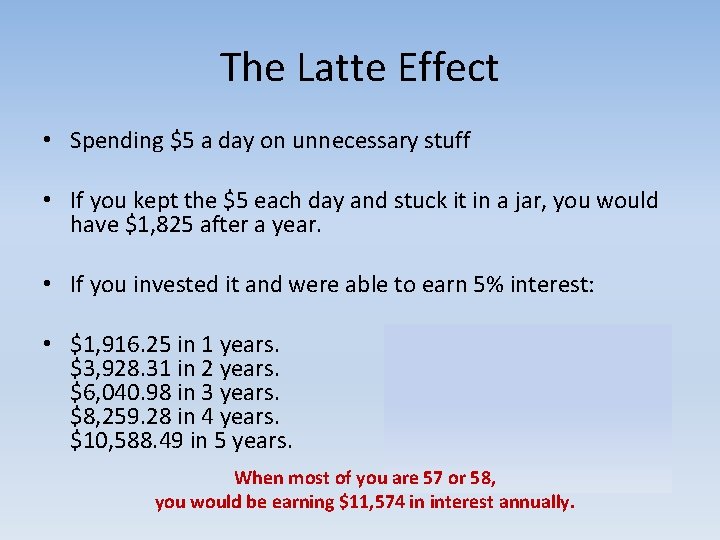
The Latte Effect • Spending $5 a day on unnecessary stuff • If you kept the $5 each day and stuck it in a jar, you would have $1, 825 after a year. • If you invested it and were able to earn 5% interest: • $1, 916. 25 in 1 years. $3, 928. 31 in 2 years. $6, 040. 98 in 3 years. $8, 259. 28 in 4 years. $10, 588. 49 in 5 years. $24, 102. 39 in 10 years. $41, 349. 92 in 15 years. $63, 362. 63 in 20 years. $127, 313. 44 in 30 years. $231, 482. 57 in 40 years. When most of you are 57 or 58, you would be earning $11, 574 in interest annually.
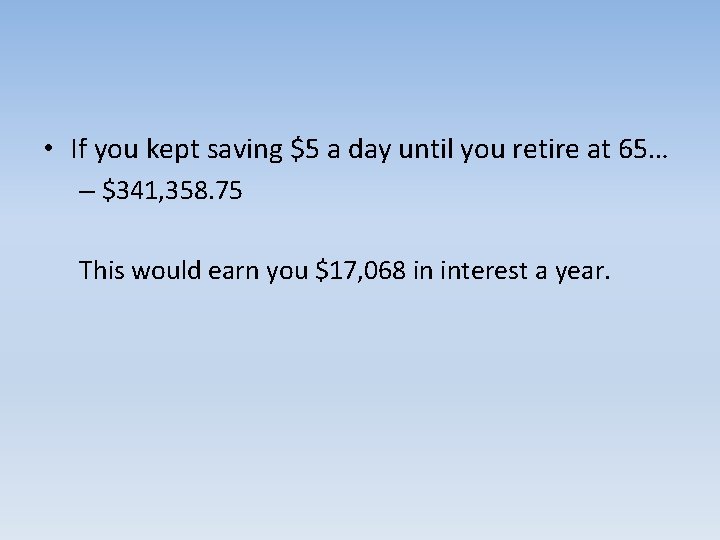
• If you kept saving $5 a day until you retire at 65… – $341, 358. 75 This would earn you $17, 068 in interest a year.
Vocab we’ve covered • • Need Want Economics Goods Services Scarcity Shortage Factors of production • • • Land Labor Capital Physical capital Human capital Entrepreneur Trade-off Opportunity Cost Thinking at the margin
- Slides: 11