
Economic Tussles in Federated Identity Management Tyler Moore
- Slides: 14
Economic Tussles in Federated Identity Management Tyler Moore tmoore@seas. harvard. edu joint work with Susan Landau susan. landau@privacyink. org WEIS 2011 June 14 th, 2011
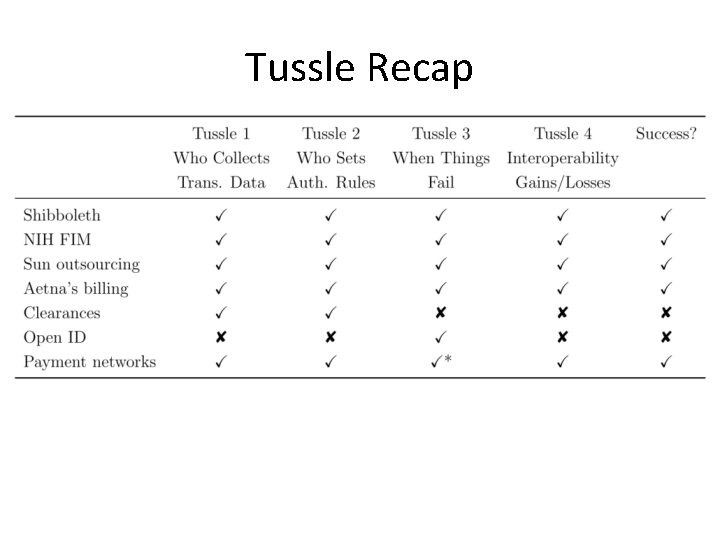
Outline • Federated identity management (FIM) – Users authenticate once and access information across multiple domains – Use case successes and failures • Identify 4 key economic tussles that may arise when engineering a FIM system – Provide empirical analysis of online-authentication adoption to support one tussle – Explain use case success/failure in terms of ability to overcome tussles
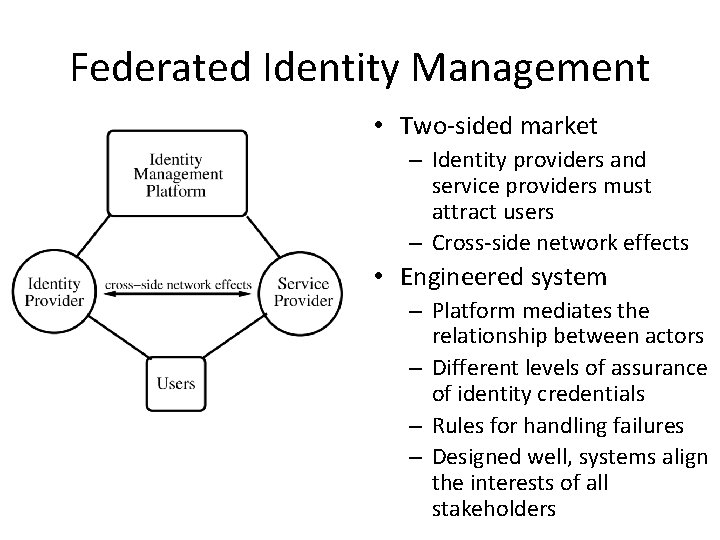
Federated Identity Management • Two-sided market – Identity providers and service providers must attract users – Cross-side network effects • Engineered system – Platform mediates the relationship between actors – Different levels of assurance of identity credentials – Rules for handling failures – Designed well, systems align the interests of all stakeholders
FIM Use Cases • Successful deployments – Shibboleth online sharing of library resources – In. Common/NIH research collaboration – Sun Microsystems outsourced services – Aetna’s medical billing system • Less successful deployments – Information sharing across law-enforcement agencies – Open. ID standard for online authentication
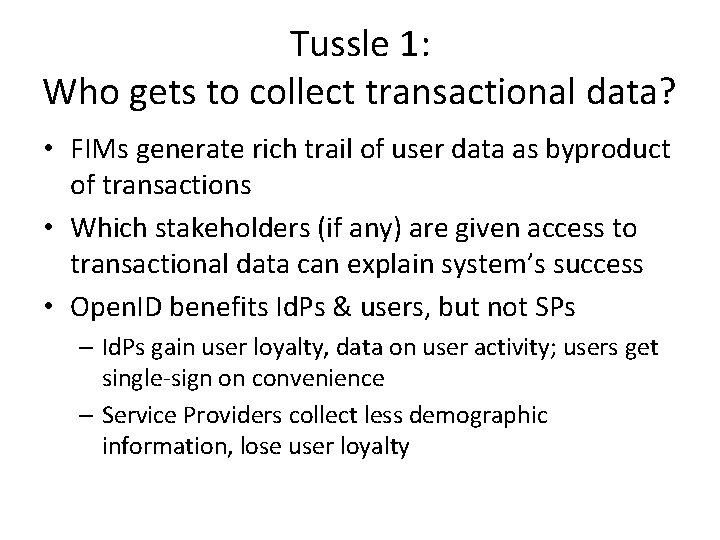
Tussle 1: Who gets to collect transactional data? • FIMs generate rich trail of user data as byproduct of transactions • Which stakeholders (if any) are given access to transactional data can explain system’s success • Open. ID benefits Id. Ps & users, but not SPs – Id. Ps gain user loyalty, data on user activity; users get single-sign on convenience – Service Providers collect less demographic information, lose user loyalty
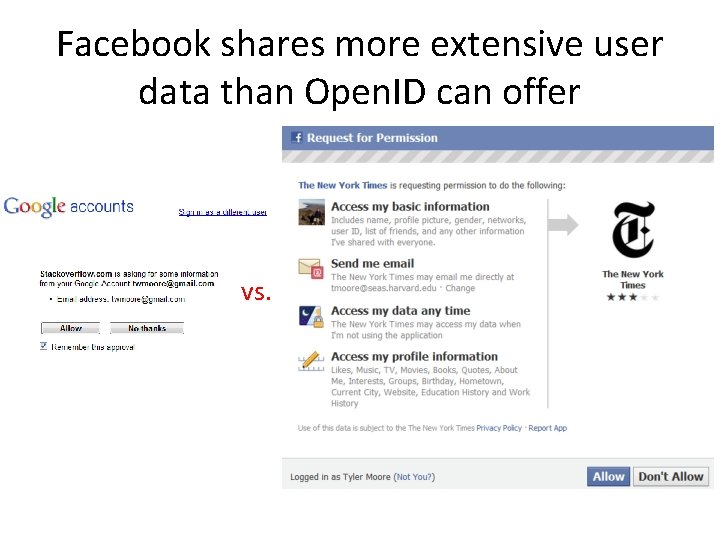
Facebook shares more extensive user data than Open. ID can offer vs.
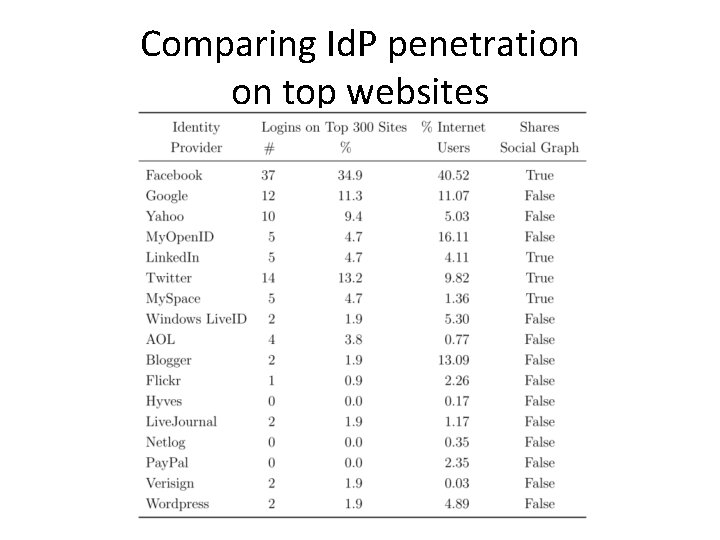
Comparing Id. P penetration on top websites
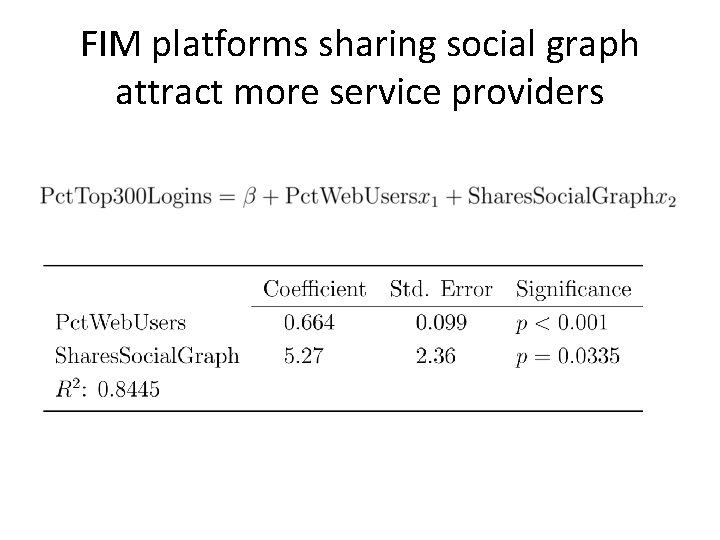
FIM platforms sharing social graph attract more service providers
Implications for user privacy • Government intervention can alter the dynamic of how private information is handled – Shibboleth’s library mechanism protects privacy in compliance with US law – FTC has leveraged authority to protect against deceptive trade practices to help shape privacy agenda • NSTIC has emphasized privacy as a guiding principle for the development of FIMs
Tussle 2: Who sets the rules of authentication? • Identity management platforms offer huge firstmover advantage – Time to market matters more than robustness of authentication – Entrenched payment networks may be willing to tolerate higher levels of fraud • Setting the right level of authentication is hard – Competitive Id. Ps want to attract users, and so want to make authentication easy (e. g. , Open. ID) – SPs may desire stronger authentication, and so ask for more stringent requirements that dampen uptake
Tussle 3: What happens when things go wrong? • Two types of failure – Id. P becomes unavailable, harming user-SP interaction – Unauthorized users incorrectly authenticated • Clear allocation of responsibility for failure is key – Shibboleth: library serving as Id. P clearly responsible – Payment cards: merchants and banks fight over who should pay for failure (e. g. , PCI compliance rules) • What’s at stake also matters – Low: clarity less essential (web auth. ) – Large but easy to measure: clarity essential (payments) – Large and poorly understood: clarity impossible?
Tussle 4: Who gains and who loses from interoperability? • Key benefit to FIMs is that users authenticated by one Id. P can be served by many SPs • Yet the benefit (or risk) of improved interoperability may vary by stakeholder • Global Federated Identity and Privilege Management (GFIPM) is designed to facilitate sharing among state and local law enforcement – Information sharing easy sell to Id. Ps – better access to intelligence – Yet sharing sensitive information with outsiders is a clear threat to SPs
Tussle Recap
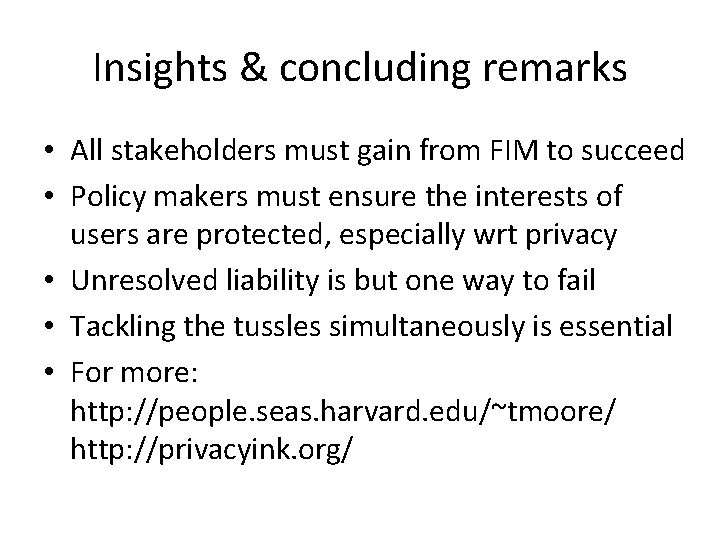
Insights & concluding remarks • All stakeholders must gain from FIM to succeed • Policy makers must ensure the interests of users are protected, especially wrt privacy • Unresolved liability is but one way to fail • Tackling the tussles simultaneously is essential • For more: http: //people. seas. harvard. edu/~tmoore/ http: //privacyink. org/