
Economic Thinkers of the Industrial Revolution Adam Smith


- Slides: 21
Economic Thinkers of the Industrial Revolution Adam Smith Thomas Malthus David Ricardo
Adam Smith (1723 -1790) n n n Scottish philosopher Influenced by the writings of the physiocrats (French economic thinkers of the Enlightenment) 1776 – The Wealth of Nations was published n Vehement attack of mercantilism
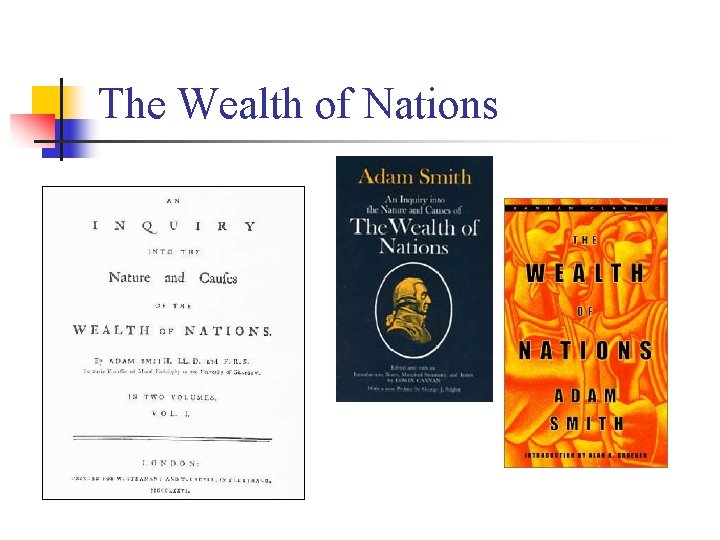
The Wealth of Nations
Basic Capitalist Principles Goods and services are produced for profitable exchange. n Human labor power is a commodity for sale n Labor is the Source of Value n
Basic Capitalist Principles n n Problem: How do we survive in a world where we must depend on many others, but where humans are by nature self-interested individuals? Solution: The basic market mechanism is selfregulating. In a free market society, individuals, while appearing chaotic and unrestrained, acting out of their own self interest, will be guided, as if by an Invisible Hand, to make socially beneficial economic decisions to produce the right amount and variety of goods
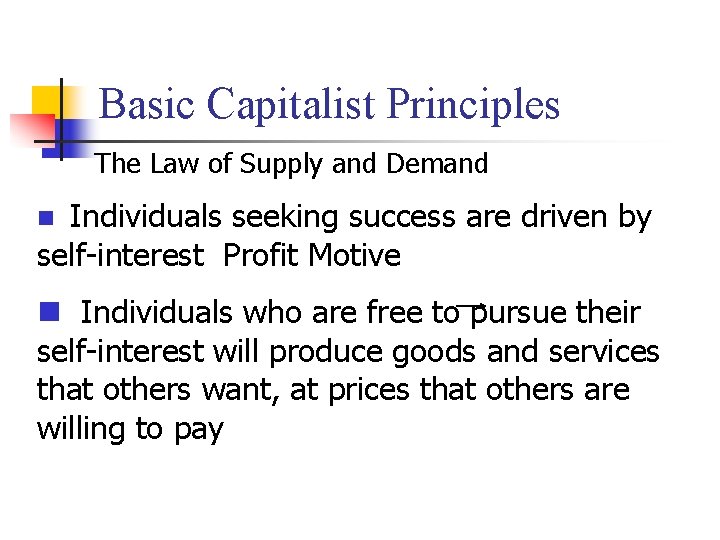
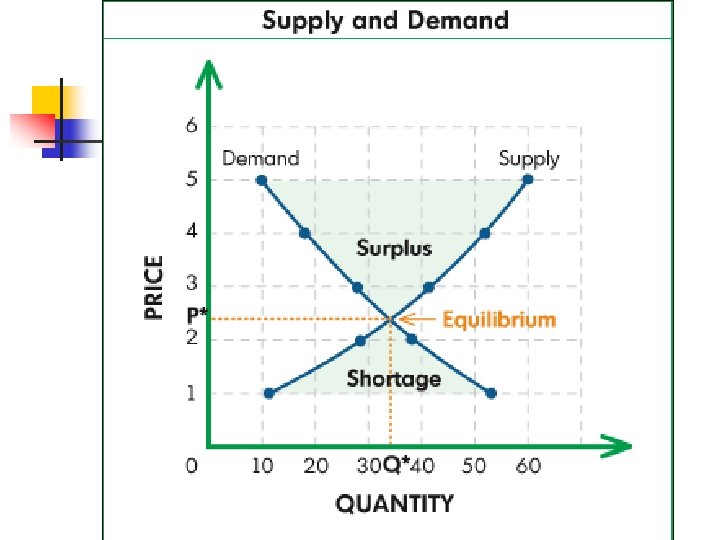
Basic Capitalist Principles The Law of Supply and Demand Individuals seeking success are driven by self-interest Profit Motive n n Individuals who are free to pursue their self-interest will produce goods and services that others want, at prices that others are willing to pay
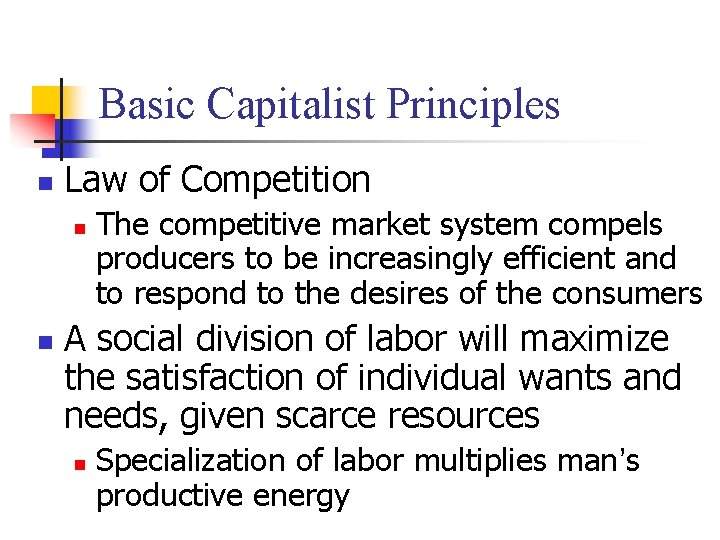
Basic Capitalist Principles n Law of Competition n n The competitive market system compels producers to be increasingly efficient and to respond to the desires of the consumers A social division of labor will maximize the satisfaction of individual wants and needs, given scarce resources n Specialization of labor multiplies man’s productive energy
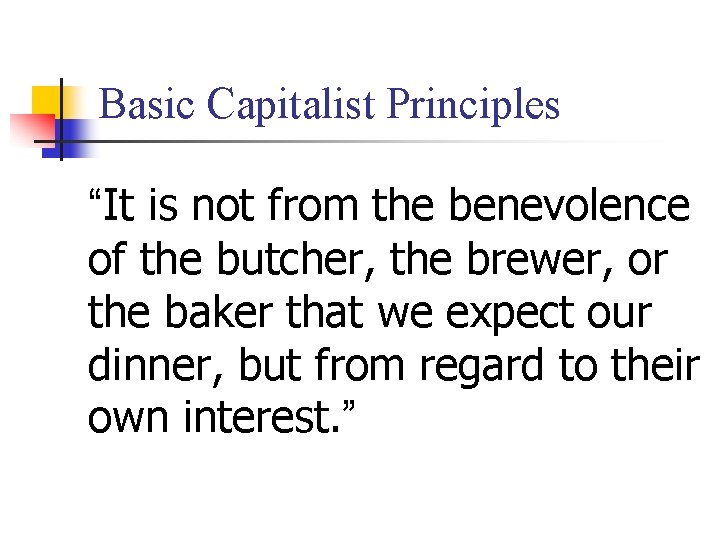
Basic Capitalist Principles “It is not from the benevolence of the butcher, the brewer, or the baker that we expect our dinner, but from regard to their own interest. ”
Basic Capitalist Principles Government should interfere minimally with the free and efficient workings of the market Laissez-faire [leave things alone] n Role of Government n Promote law and order n Prevent injustice and oppression n Protection of public health n
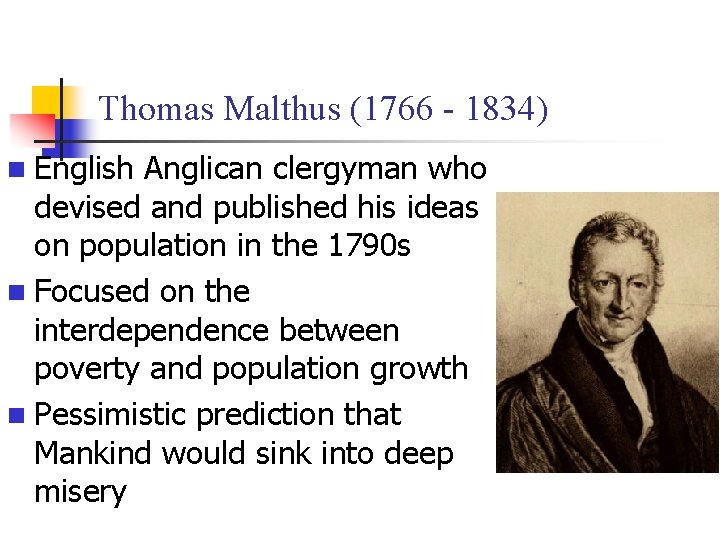
Thomas Malthus (1766 - 1834) n English Anglican clergyman who devised and published his ideas on population in the 1790 s n Focused on the interdependence between poverty and population growth n Pessimistic prediction that Mankind would sink into deep misery
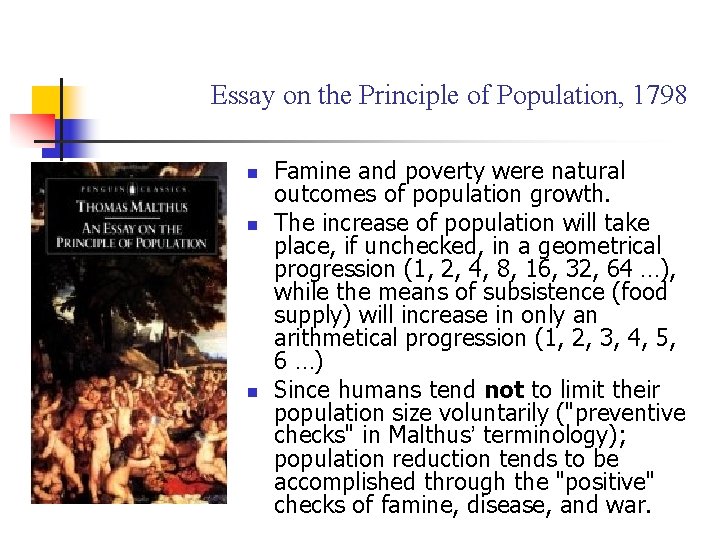
Essay on the Principle of Population, 1798 n n n Famine and poverty were natural outcomes of population growth. The increase of population will take place, if unchecked, in a geometrical progression (1, 2, 4, 8, 16, 32, 64 …), while the means of subsistence (food supply) will increase in only an arithmetical progression (1, 2, 3, 4, 5, 6 …) Since humans tend not to limit their population size voluntarily ("preventive checks" in Malthus’ terminology); population reduction tends to be accomplished through the "positive" checks of famine, disease, and war.
Why You Shouldn‘t Help the Poor. . . That is the cycle of poverty described in Thomas Malthus’s 1798 Essay on Population
Malthusian Thinking Malthus argued that it was ultimately going to be impossible to bring about permanent improvement in the quality of life: there will always be social inequality, poverty, and want. n Society is caught in a hopeless trap in which the human reproductive urge would inevitably shove humanity to the sheer brink of existence. n The poor should have fewer children n Food supply will then keep up with population. n The discipline of Economics became known as “The Dismal Science” n
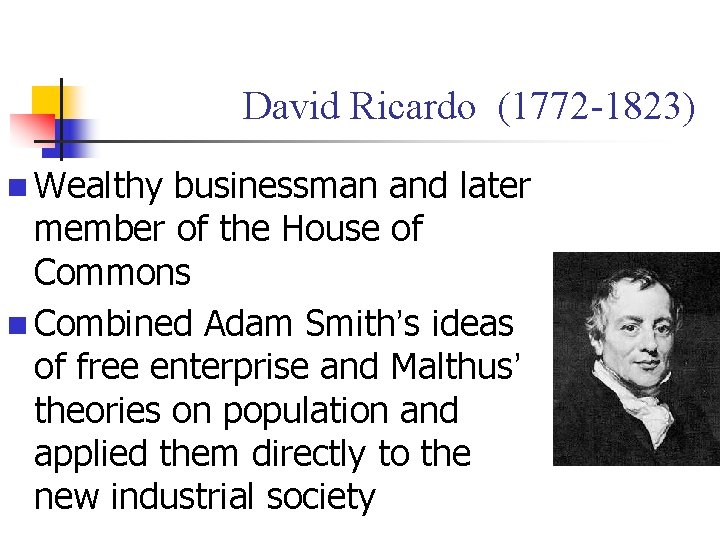
David Ricardo (1772 -1823) n Wealthy businessman and later member of the House of Commons n Combined Adam Smith’s ideas of free enterprise and Malthus’ theories on population and applied them directly to the new industrial society
On the Principles of Political Economy and Taxation (1817) n n There are n three factors of production—land, labor, and capital goods (such as shovels)—and n three classes of people: landlords, workers, and capitalists. n Landlords earn rent, workers earn wages, and capitalists earn profits. Ricardo wanted to show the total output of a society is distributed among wages, rent, and profits.
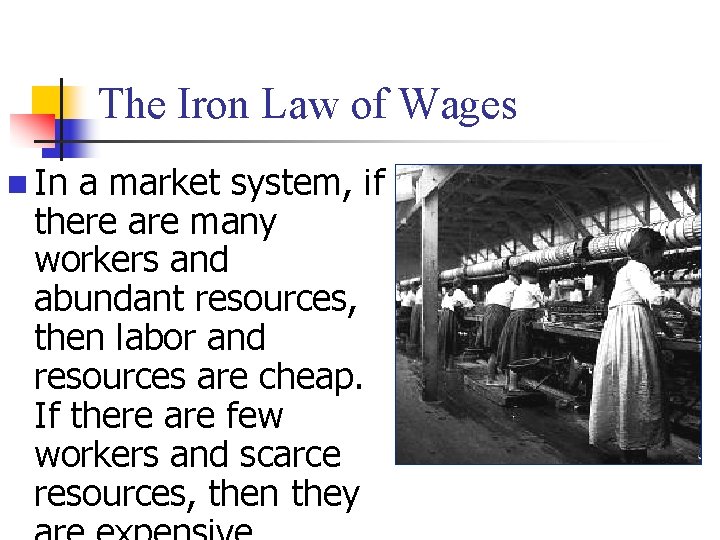
The Iron Law of Wages n In a market system, if there are many workers and abundant resources, then labor and resources are cheap. If there are few workers and scarce resources, then they
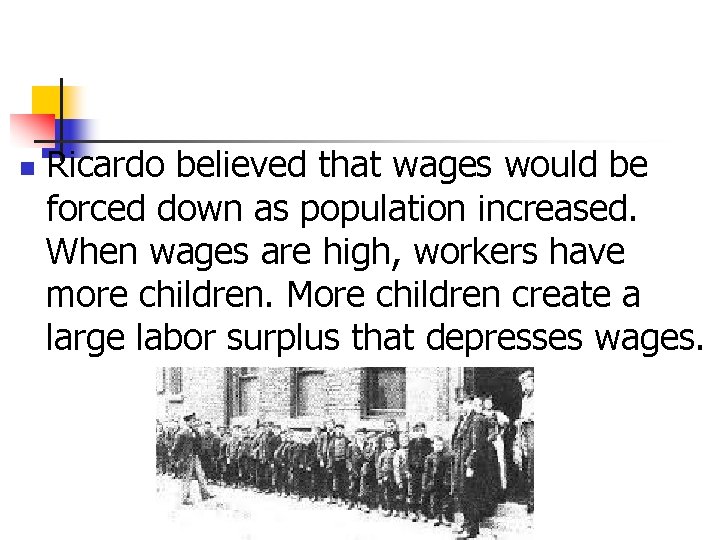
n Ricardo believed that wages would be forced down as population increased. When wages are high, workers have more children. More children create a large labor surplus that depresses wages.
The Iron Law of Wages n Ricardo argued that the wage would in the long run equal the subsistence wage, which is the bare minimum necessary for survival. n Ricardo believed that there would be a permanent underclass which would always be poor.
The Iron Law of Wages Ricardo opposed government efforts to help poor workers. n He thought that creating minimum wage laws and better working conditions would upset the free market system, lower profits, and undermine the production of wealth in society. n