
Economic Systems The Free Market Economy Essential Standards
- Slides: 31
Economic Systems & The Free Market Economy
Essential Standards n n n The student will compare and contrast different economic systems and explain how they answer the three basic economic questions of what to produce, how to produce and for whom to produce. The student will compare command, market and mixed economic systems with regard to private ownership, profit motive, consumer sovereignty, competition and government regulation. The student will evaluate how well each type of system answers the three economic questions and meets the broad social and economic goals of freedom, security, equity, growth, efficiency and stability.
Scarcity forces YOU to make difficult decisions… n And it forces nations to make difficult decisions. n Different economic systems have evolved in response to the problem of scarcity. n Economic System— the method used by a society to produce and distribute goods and services. n Back to Scarcity…
Three Key Economic Questions n 1. 2. 3. Because resources are limited, every society must answer these three questions: What goods and services should be produced? How should these goods and services be produced? Who consumes these goods and services?
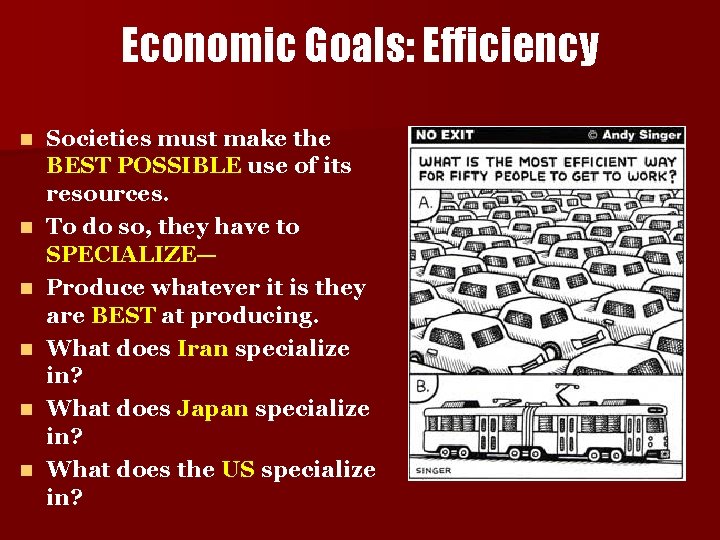
Economic Goals: Efficiency n n n Societies must make the BEST POSSIBLE use of its resources. To do so, they have to SPECIALIZE— Produce whatever it is they are BEST at producing. What does Iran specialize in? What does Japan specialize in? What does the US specialize in?
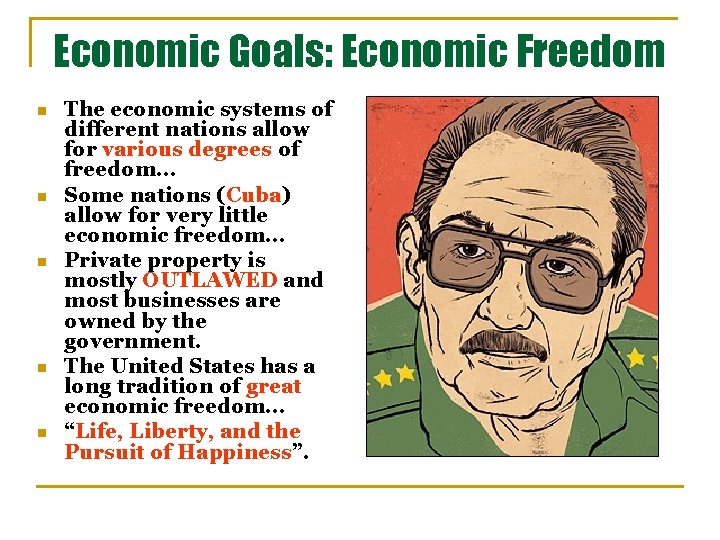
Economic Goals: Economic Freedom n n n The economic systems of different nations allow for various degrees of freedom… Some nations (Cuba) allow for very little economic freedom… Private property is mostly OUTLAWED and most businesses are owned by the government. The United States has a long tradition of great economic freedom… “Life, Liberty, and the Pursuit of Happiness”.
Which of the following countries would you most expect to find private property outlawed? A. ) Canada B. ) England C. ) North Korea
Economic Goals: Open Opportunity n n n Open Opportunity—the concept that everyone can compete in the marketplace. This allows for economic mobility—UP OR DOWN. No matter how much money you start out with, you can end up richer or poorer— It’s up to… YOU.
In America we have a high level of "open opportunity. " A. ) I agree B. ) I disagree
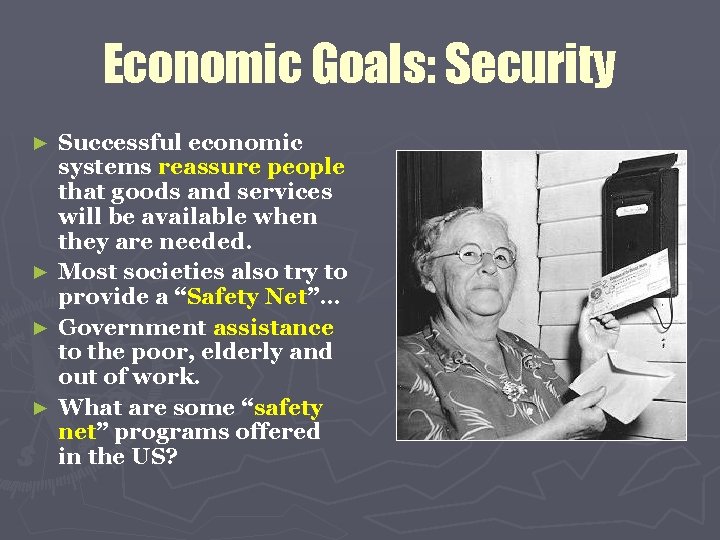
Economic Goals: Security ► ► Successful economic systems reassure people that goods and services will be available when they are needed. Most societies also try to provide a “Safety Net”… Government assistance to the poor, elderly and out of work. What are some “safety net” programs offered in the US?
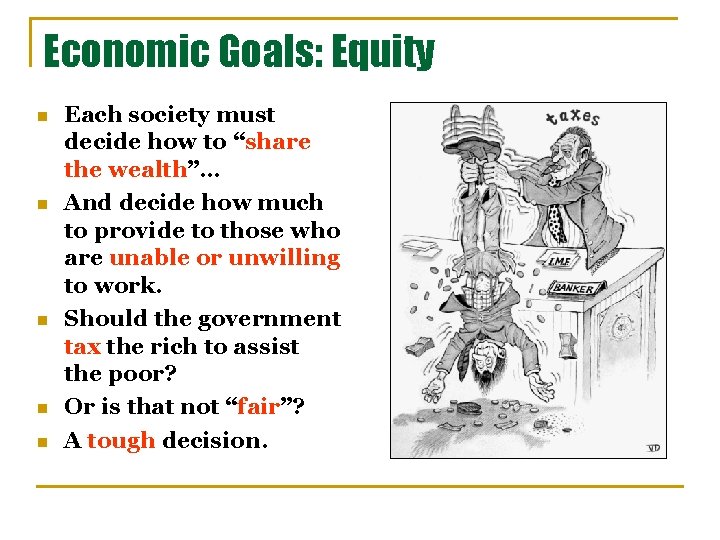
Economic Goals: Equity n n n Each society must decide how to “share the wealth”… And decide how much to provide to those who are unable or unwilling to work. Should the government tax the rich to assist the poor? Or is that not “fair”? A tough decision.
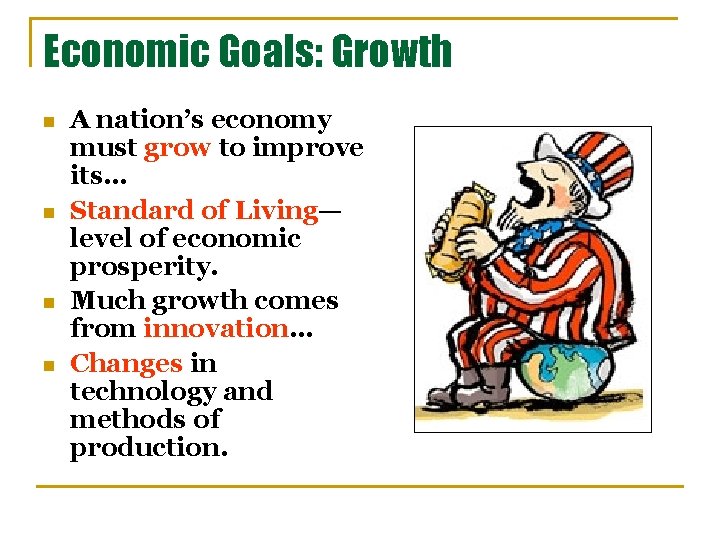
Economic Goals: Growth n n A nation’s economy must grow to improve its… Standard of Living— level of economic prosperity. Much growth comes from innovation… Changes in technology and methods of production.
Essential Standards n n n The student will explain how specialization and voluntary exchange between buyers and sellers increases the satisfaction of both parties. The student will give examples of how individuals and businesses specialize. The student will explain that both parties gain as a result of voluntary, non-fraudulent exchange.
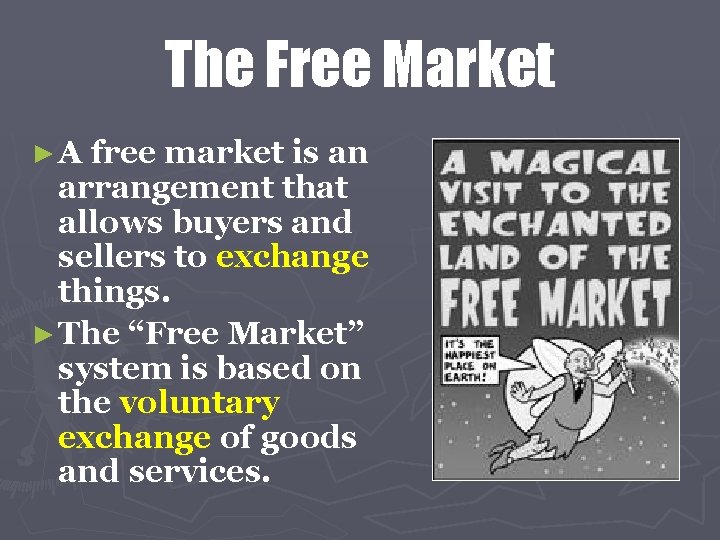
The Free Market ► A free market is an arrangement that allows buyers and sellers to exchange things. ► The “Free Market” system is based on the voluntary exchange of goods and services.
Voluntary Exchange ► ► ► The foundation of the free market is mutual gain… Trade moves goods from people who value them less to people who value them more… When you buy a gallon of milk from Kroger, you value the milk more than the $3… Kroger values the $3 more than the milk… So, both YOU and KROGER come away from the transaction MORE WEALTHY… Even though NOTHING NEW has been created.
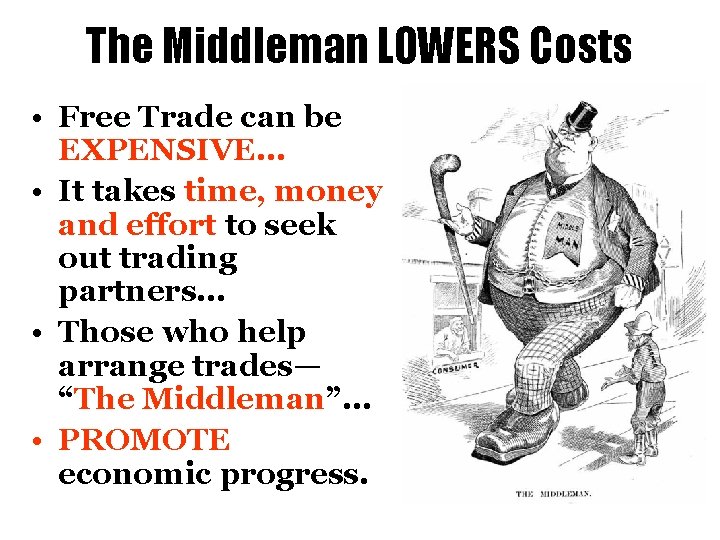
The Middleman LOWERS Costs • Free Trade can be EXPENSIVE… • It takes time, money and effort to seek out trading partners… • Those who help arrange trades— “The Middleman”… • PROMOTE economic progress.
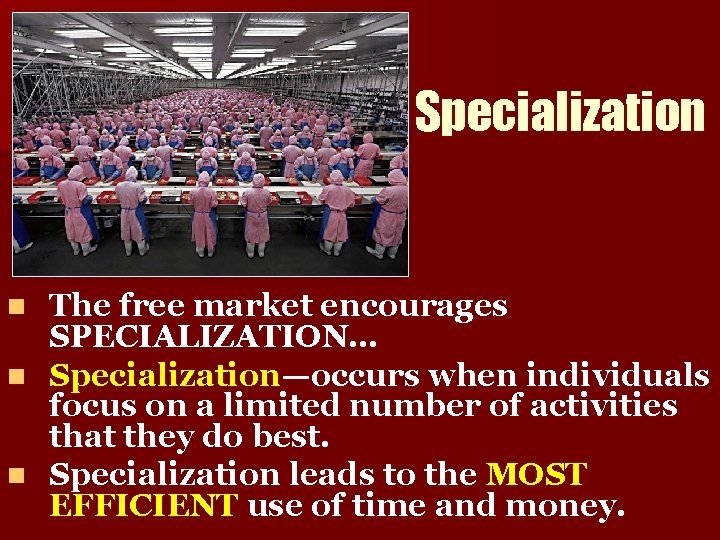
Specialization The free market encourages SPECIALIZATION… n Specialization—occurs when individuals focus on a limited number of activities that they do best. n Specialization leads to the MOST EFFICIENT use of time and money. n
Which of the following would involve the concept of specialization? A. ) Schools B. ) Wendy's C. ) An Assembly Line D. ) All of the above
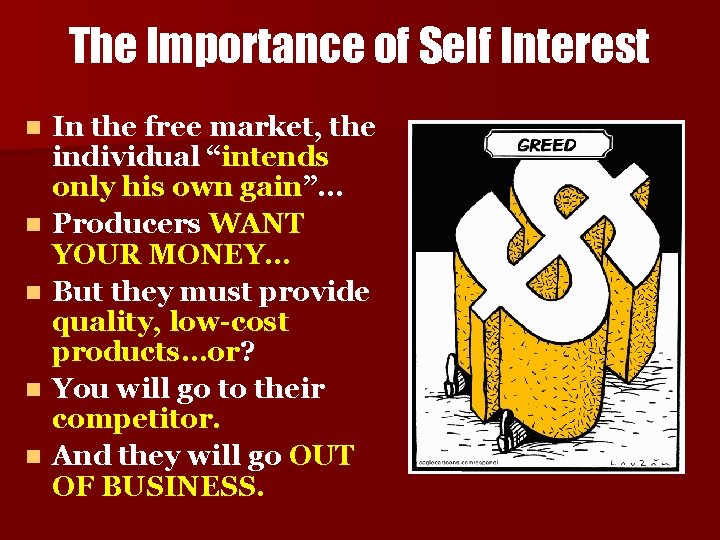
The Importance of Self Interest n n n In the free market, the individual “intends only his own gain”… Producers WANT YOUR MONEY… But they must provide quality, low-cost products…or? You will go to their competitor. And they will go OUT OF BUSINESS.
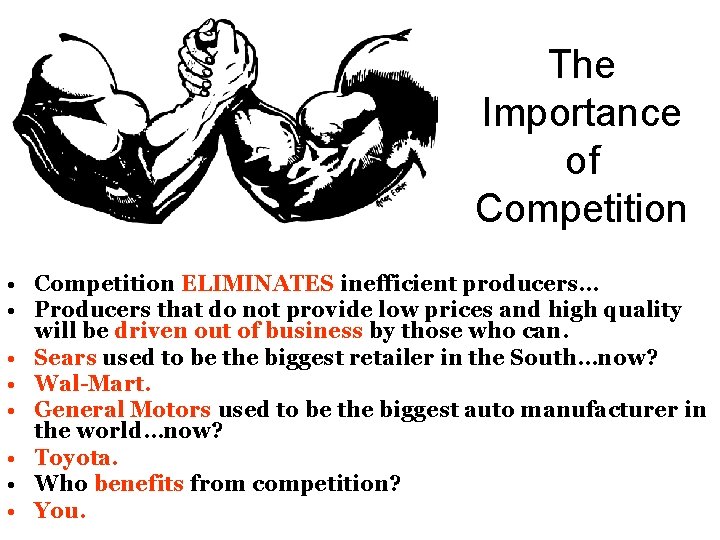
The Importance of Competition • Competition ELIMINATES inefficient producers… • Producers that do not provide low prices and high quality will be driven out of business by those who can. • Sears used to be the biggest retailer in the South…now? • Wal-Mart. • General Motors used to be the biggest auto manufacturer in the world…now? • Toyota. • Who benefits from competition? • You.
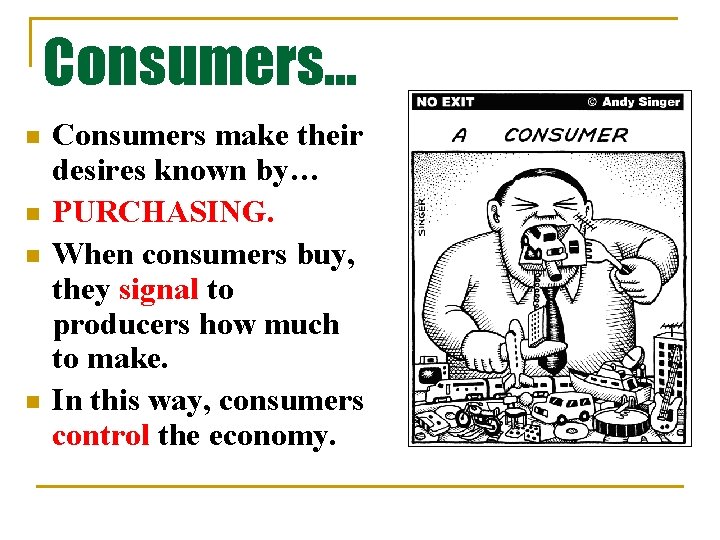
Consumers… n n Consumers make their desires known by… PURCHASING. When consumers buy, they signal to producers how much to make. In this way, consumers control the economy.
Which of the following is not a result of competition? A. ) Fewer Choices B. ) Lower Prices C. ) Better Quality Products
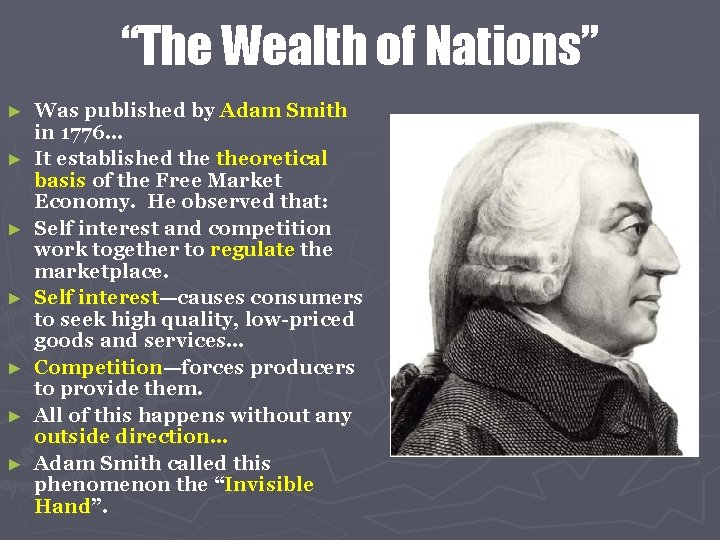
“The Wealth of Nations” ► ► ► ► Was published by Adam Smith in 1776… It established theoretical basis of the Free Market Economy. He observed that: Self interest and competition work together to regulate the marketplace. Self interest—causes consumers to seek high quality, low-priced goods and services… Competition—forces producers to provide them. All of this happens without any outside direction… Adam Smith called this phenomenon the “Invisible Hand”.
Laissez Faire ► Adam Smith believe the free market would provide the best standard of living… ► And preached Laissez Faire—HAND’S OFF!! ► The idea that the government should not interfere in the market.
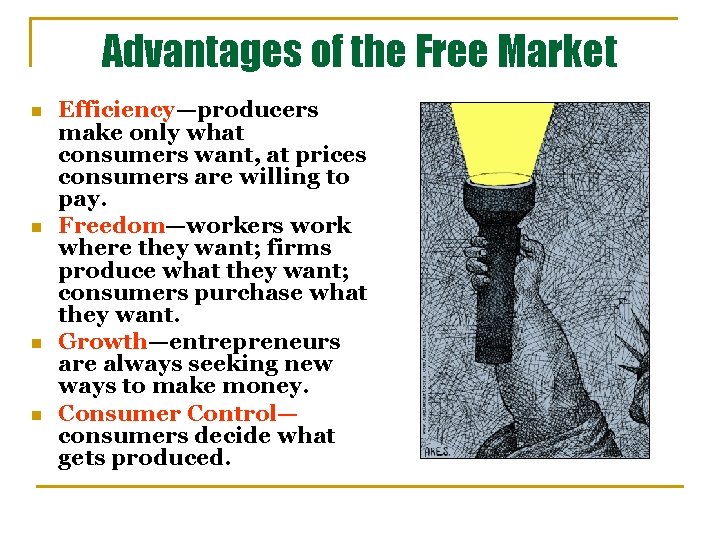
Advantages of the Free Market n n Efficiency—producers make only what consumers want, at prices consumers are willing to pay. Freedom—workers work where they want; firms produce what they want; consumers purchase what they want. Growth—entrepreneurs are always seeking new ways to make money. Consumer Control— consumers decide what gets produced.
Which of the following best describes "Laissez Faire. " A. ) The government should control all resources. B. ) The government should not regulate the market place. C. ) The government should ensure that all citizens have basic needs and services.
Essential Standards n n The student will describe how households, businesses and governments are interdependent and interact through flows of goods, services and money. The student will illustrate by means of a circular flow diagram the Product Market, the Factor Market, the real flow of goods and services between and among businesses, households and government.
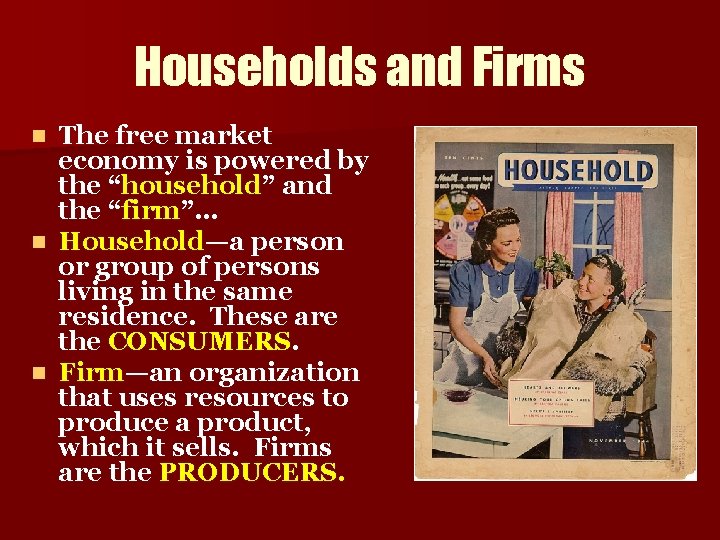
Households and Firms The free market economy is powered by the “household” and the “firm”… n Household—a person or group of persons living in the same residence. These are the CONSUMERS. n Firm—an organization that uses resources to produce a product, which it sells. Firms are the PRODUCERS. n
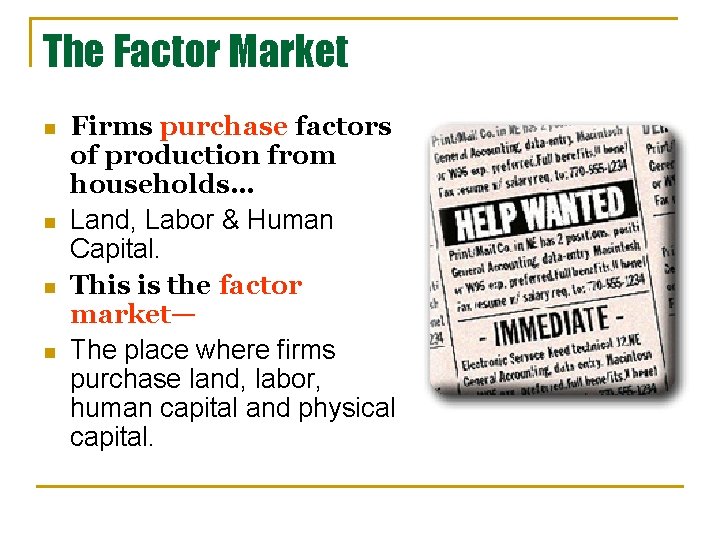
The Factor Market n n Firms purchase factors of production from households… Land, Labor & Human Capital. This is the factor market— The place where firms purchase land, labor, human capital and physical capital.
The Product Market ► The goods and services that firms produce… ► Are sold in the Product Market… ► And purchased by households… ► With the money they received from firms in the factor market.
Who determines what is produced in the United States? A. ) Producers B. ) Consumers