
Economic Systems Economics The production distribution and consumption
Economic Systems
Economics: The production, distribution, and consumption of goods and services Economic Systems: How a country decides the following: - What will be produced? - How will it be produced? - Who will it be produced for? …and who decides these questions?

1. Traditional Economy “Because that’s the way we’ve always done it!” -Economic decisions based on tradition and custom -Production done the way it has always been done -Examples: Rural, tribal areas of South America and Africa
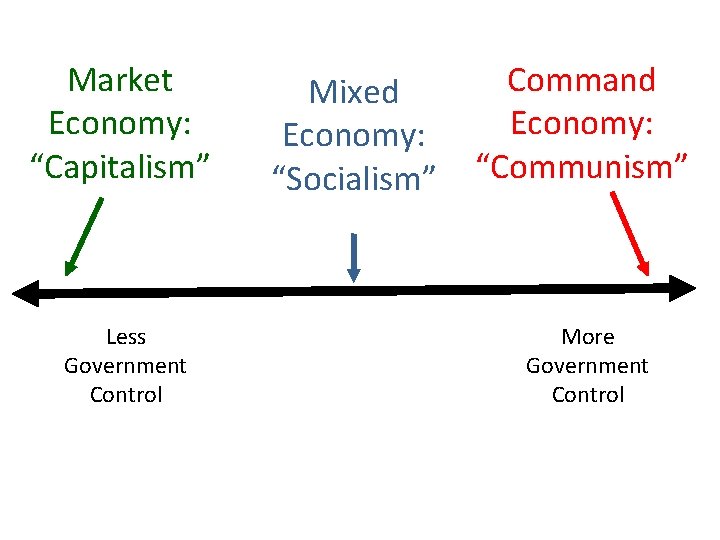
Market Economy: “Capitalism” Less Government Control Mixed Economy: “Socialism” Command Economy: “Communism” More Government Control

2. Command Economy: COMMUNISM “We do what we’re told!” -All economic decisions are made by the government -Government controls all economic activity -Father of Communism: Karl Marx -Examples today: North Korea, Cuba, old Soviet Union
3. Market Economy: CAPITALISM “We do whatever we think is best!” -All economic decisions are made according to the wishes of buyers and sellers - Individual choice, not government direction -Father of Capitalism: Adam Smith -Examples today: United States, Australia, Canada, Great Britain

4. Mixed Economy: SOCIALISM “We can usually do whatever we think is best, guided by the government -No system in the world is purely Communist or Capitalist - A mix of command market economies -The government is involved in some aspects of the economy -Examples today: France, India, Sweden, Venezuela
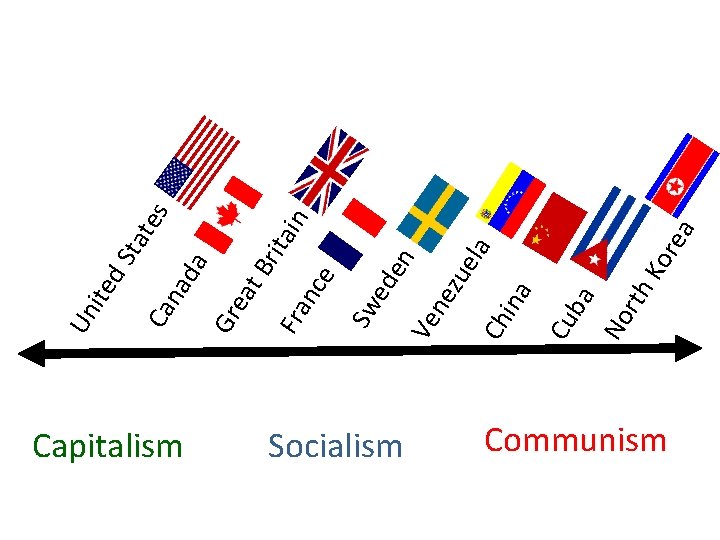
Capitalism Socialism Communism rth No ba Cu rea Ko d. S tat es Ca na da Gr ea t. B rit ain Fra nc e Sw ed en Ve ne zu ela Ch ina ite Un
- Slides: 8