
Economic Systems Chapter 3 Why are economic systems





- Slides: 51
Economic Systems Chapter 3
Why are economic systems needed? Rules of the game! n Standard incentives n Understanding of the rewards n
Economic Systems can allow for _____ A. Specialization n B. Comparative / Absolute advantage n
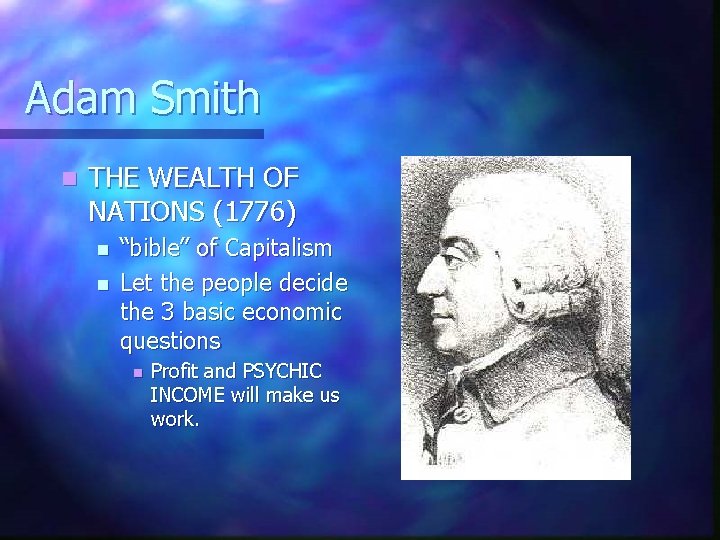
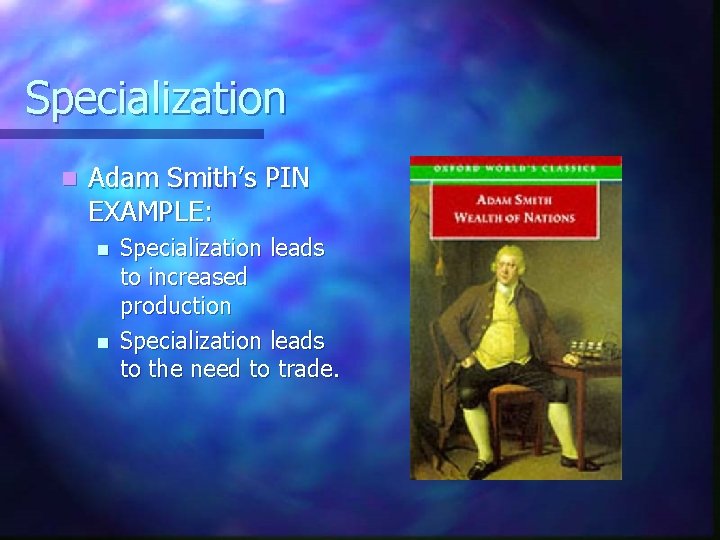
Adam Smith n THE WEALTH OF NATIONS (1776) n n “bible” of Capitalism Let the people decide the 3 basic economic questions n Profit and PSYCHIC INCOME will make us work.
Specialization n Adam Smith’s PIN EXAMPLE: n n Specialization leads to increased production Specialization leads to the need to trade.
Specialization leads to COMPARATIVE ADVANTAGE n "If a foreign country can supply us with a commodity cheaper than we ourselves can make it, better buy it of them with some part of the produce of our own industry, employed in a way in which we have some advantage. " (Book IV, Section ii, 12)
Definition: Absolute Advantage n A country has an absolute advantage over it trading partners if it is able to produce more of a good or service with the same amount of resources or the same amount of a good or service with fewer resources.
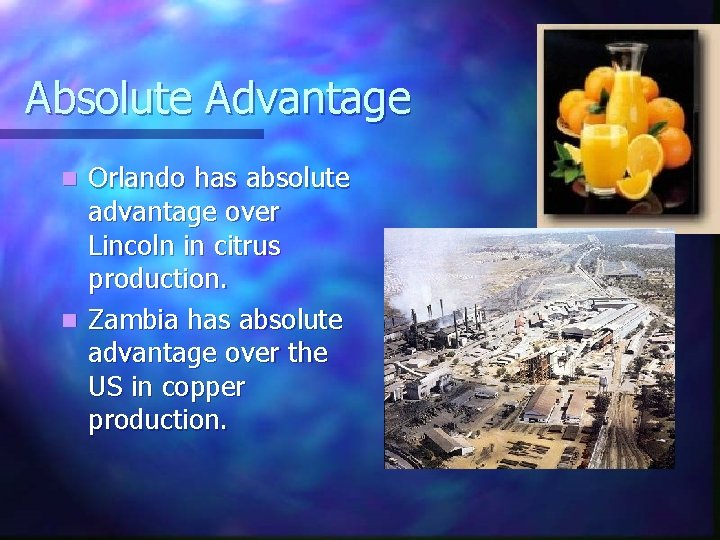
Absolute Advantage Orlando has absolute advantage over Lincoln in citrus production. n Zambia has absolute advantage over the US in copper production. n
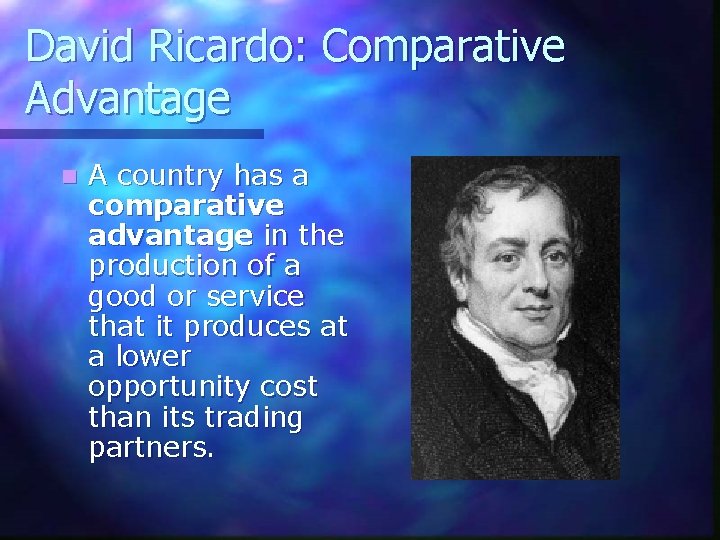
David Ricardo: Comparative Advantage n A country has a comparative advantage in the production of a good or service that it produces at a lower opportunity cost than its trading partners.
Ricardo: The tricky road of comparative / absolute advantage n Some countries have an absolute advantage in the production of many goods relative to their trading partners.
Ricardo: The tricky road of comparative / absolute advantage n Some have an absolute disadvantage. They are inefficient in producing anything, relative to their trading partners
RICARDO’S … BUT … n it is better for a country that is inefficient at producing a good or service to specialize in the production of that good it is least inefficient at, compared with producing other goods.
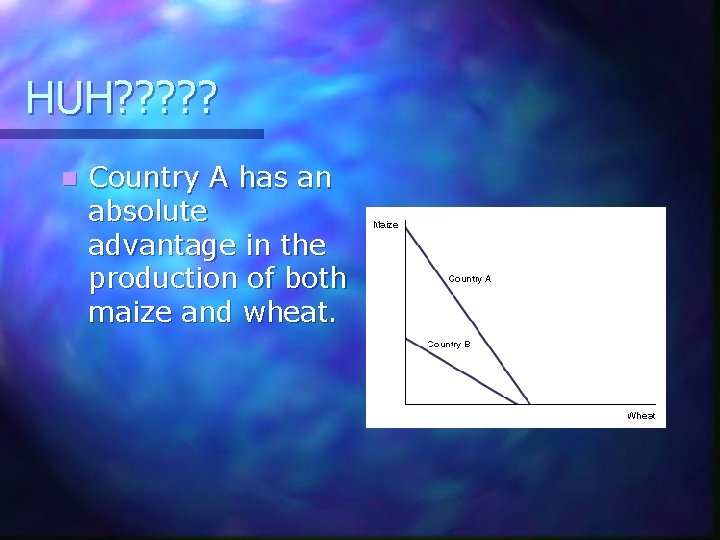
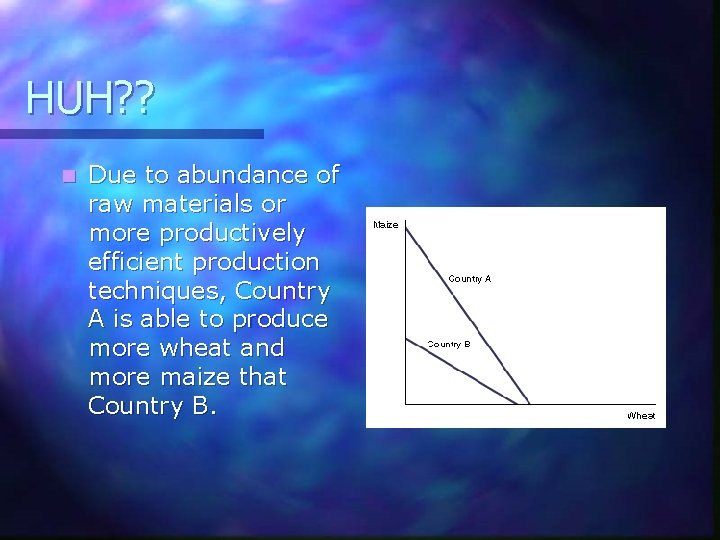
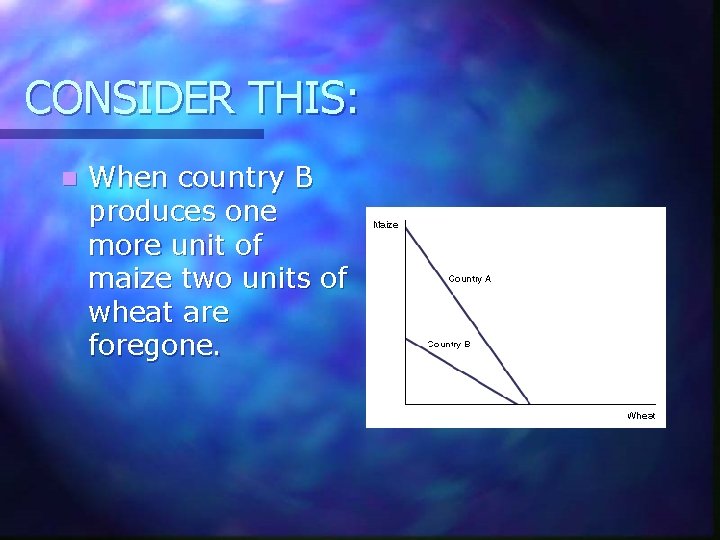
HUH? ? ? n Country A has an absolute advantage in the production of both maize and wheat.
HUH? ? ? n Country B has an absolute disadvantage.
HUH? ? n Due to abundance of raw materials or more productively efficient production techniques, Country A is able to produce more wheat and more maize that Country B.
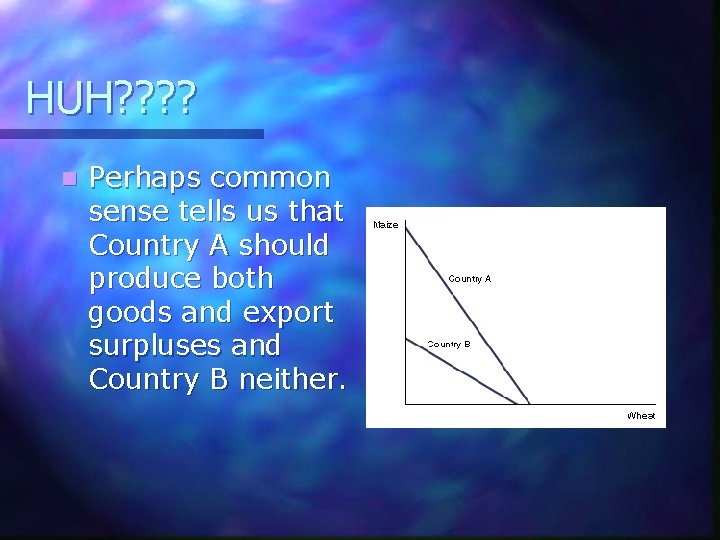
HUH? ? n Perhaps common sense tells us that Country A should produce both goods and export surpluses and Country B neither.
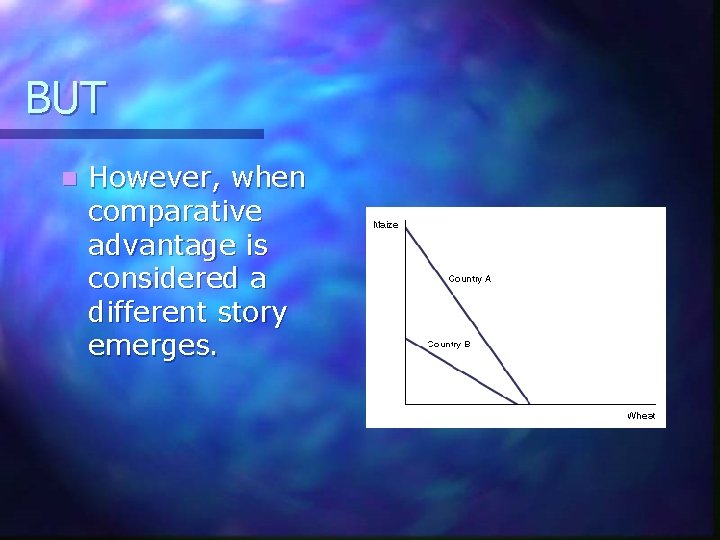
BUT n However, when comparative advantage is considered a different story emerges.
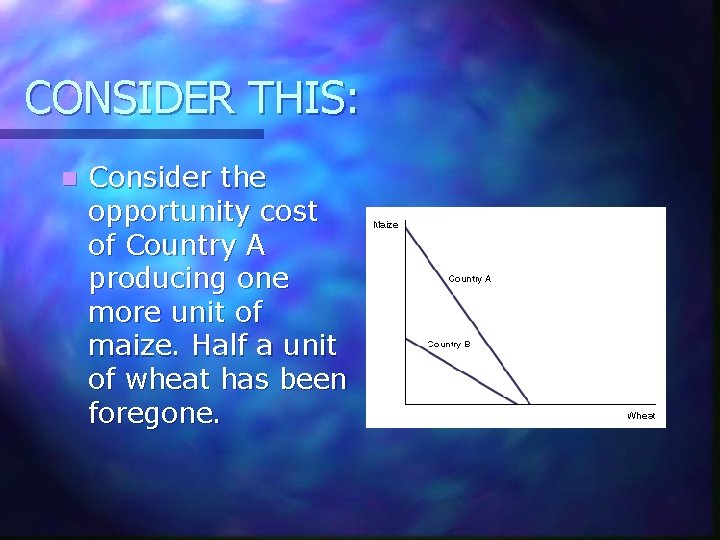
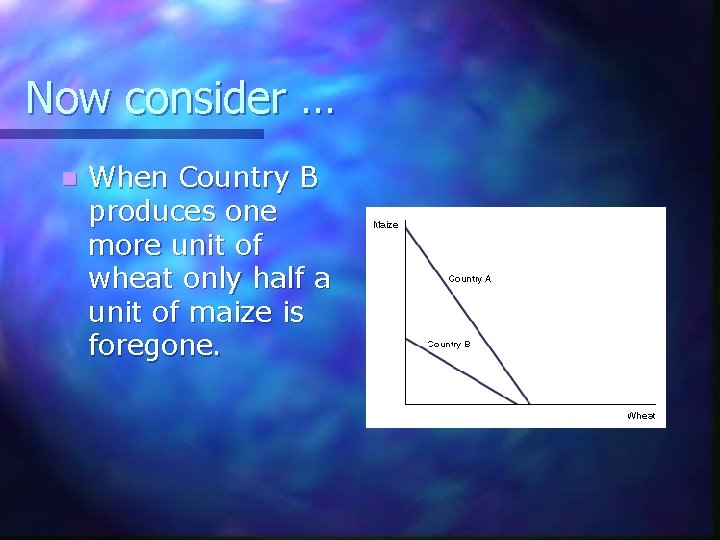
CONSIDER THIS: n Consider the opportunity cost of Country A producing one more unit of maize. Half a unit of wheat has been foregone.
CONSIDER THIS: n When country B produces one more unit of maize two units of wheat are foregone.
REMEMBER: n Economics is concerned with the allocation of scarce resources.
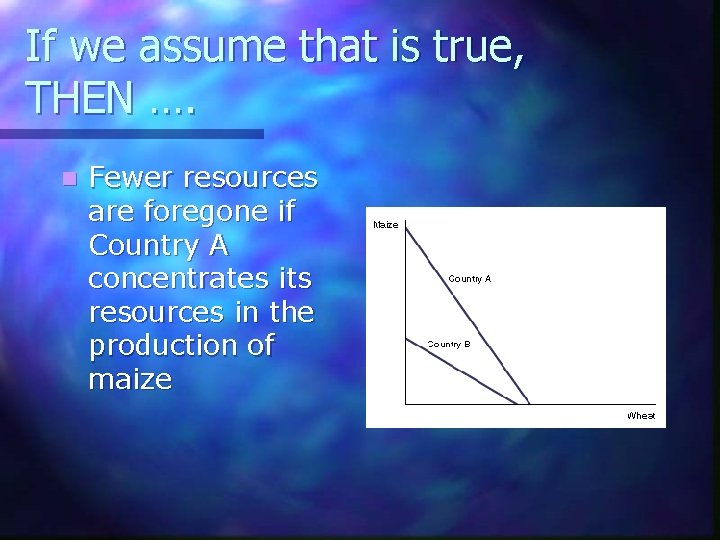
If we assume that is true, THEN …. n Fewer resources are foregone if Country A concentrates its resources in the production of maize
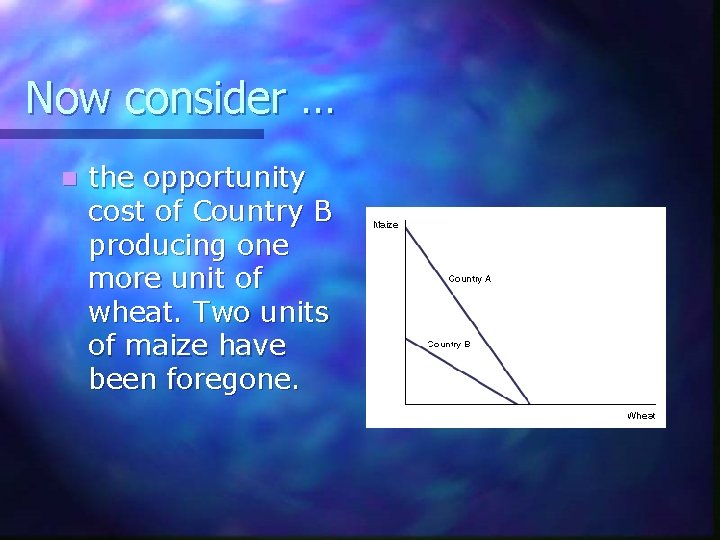
Now consider … n the opportunity cost of Country B producing one more unit of wheat. Two units of maize have been foregone.
Now consider … n When Country B produces one more unit of wheat only half a unit of maize is foregone.
So if that is true …. n Fewer resources are foregone if Country B specializes in the production of wheat
CONCLUSION OF COMPARATIVE ADVANTAGE n In the above case Country A should produce maize and Country B wheat. The surpluses produce should then be traded.
Comparative Advantage creates n n A. Headaches B. Interdependence C. Coordination problems D. Only B and C
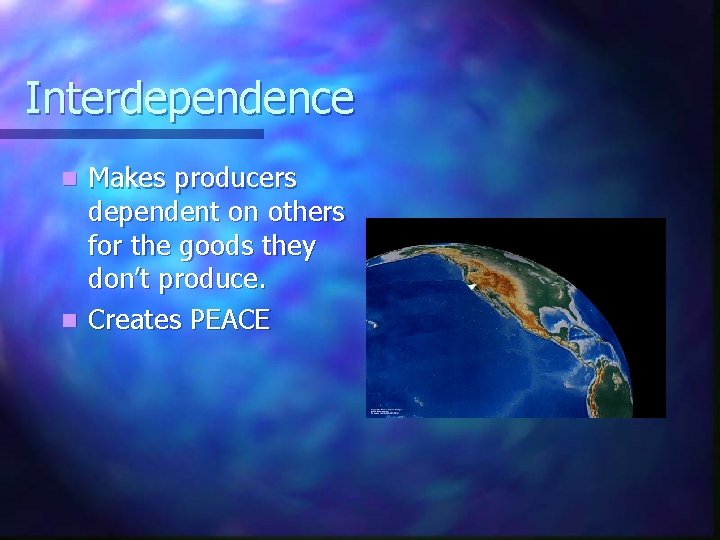
Interdependence Makes producers dependent on others for the goods they don’t produce. n Creates PEACE n
BUT: Interdependence can create coordination problems Specialization causes interdependence. n Interdependence requires an economic system to coordinate everyone’s various activities. n
BUT: Interdependence can create coordination problems n As specialization and interdependence increase, so does the complexity of coordinating all of the specialized activities of buyers and sellers.
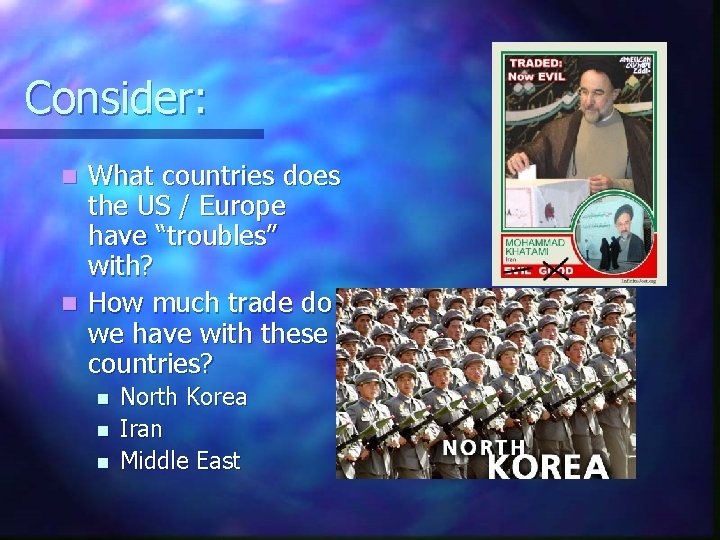
Consider: What countries does the US / Europe have “troubles” with? n How much trade do we have with these countries? n n North Korea Iran Middle East
What are the Principal Types of Economic Systems? n Market Economies n Centrally Directed Economies n Traditional Economies n Mixed Economies
Market Economies n Also called n n n Capitalism Free Enterprise Private Enterprise
Market Economies: Fundamental Principles Private property rights n Right to freely trade or sell property n Pursue self-interest. n
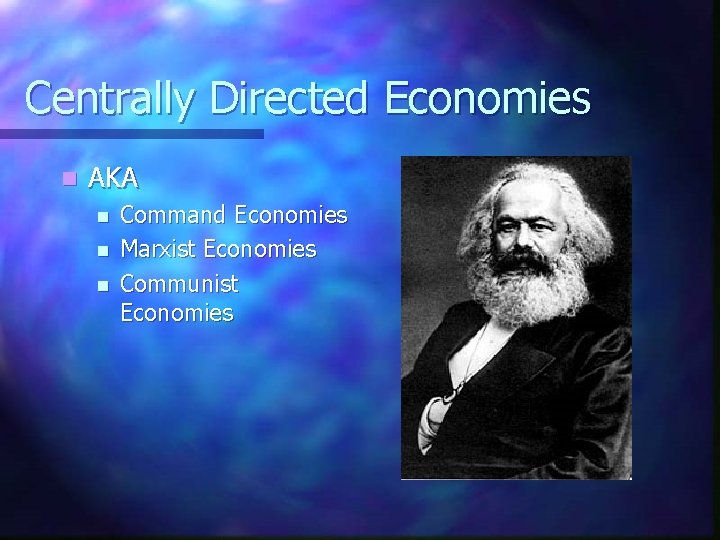
Centrally Directed Economies n AKA n n n Command Economies Marxist Economies Communist Economies
Features of Central Planning Decisions made by central planning commission n Draws up “master” plan n Government employs workers n
Features of Central Planning n Decides what, how and for whom to produce. n Determines how output is to be distributed
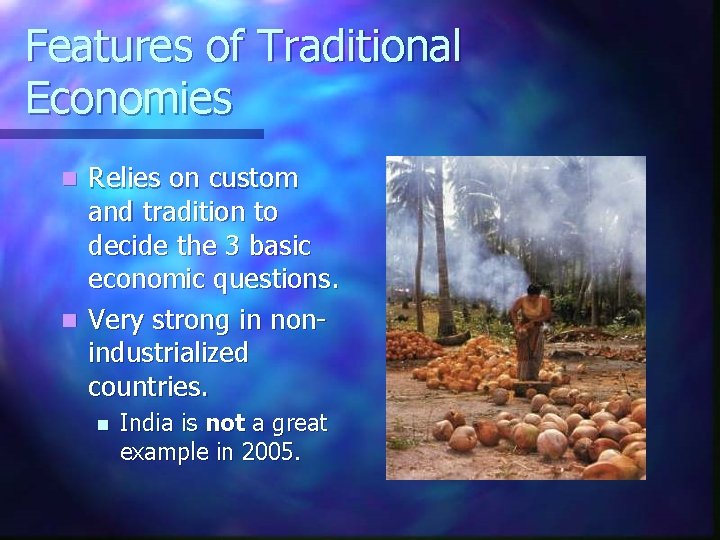
Features of Traditional Economies Relies on custom and tradition to decide the 3 basic economic questions. n Very strong in nonindustrialized countries. n n India is not a great example in 2005.
Mixed Economies AKA: Socialism n All economies are mixtures of government control and individual motivation. n
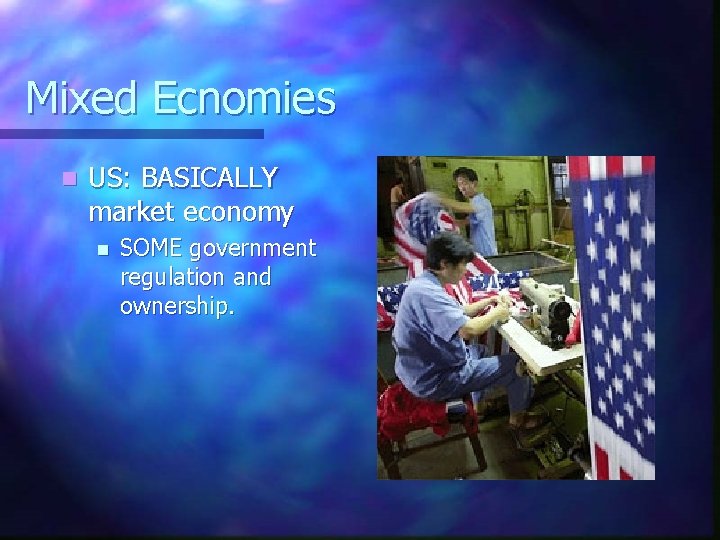
Mixed Ecnomies n US: BASICALLY market economy n SOME government regulation and ownership.
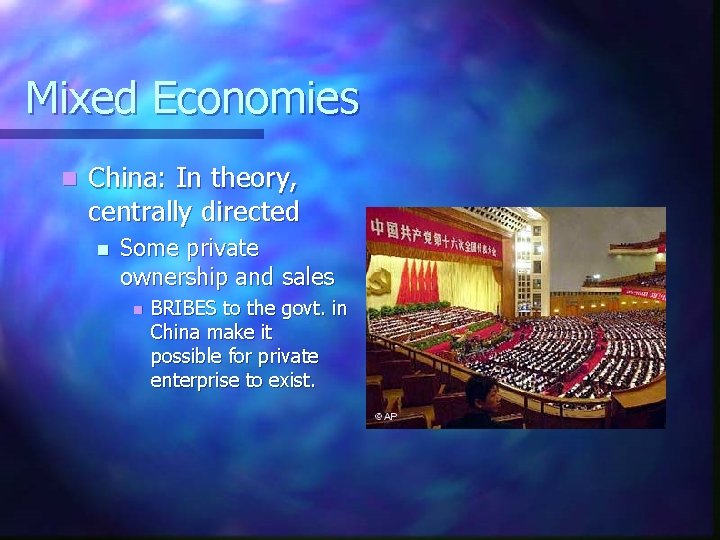
Mixed Economies n China: In theory, centrally directed n Some private ownership and sales n BRIBES to the govt. in China make it possible for private enterprise to exist.
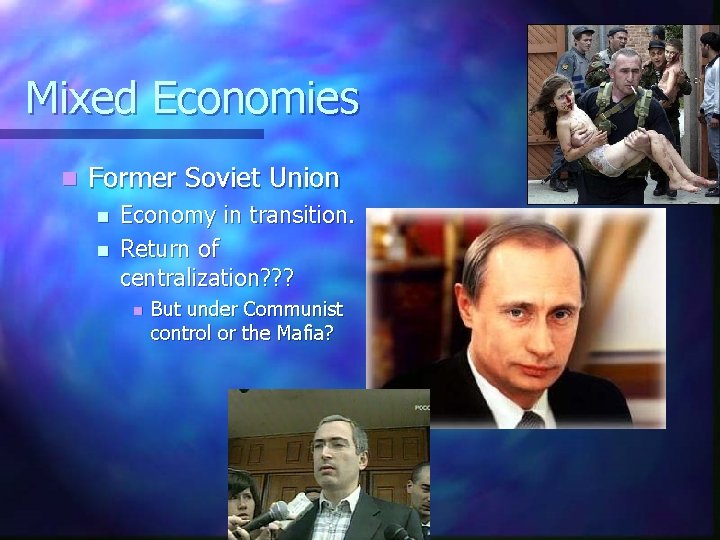
Mixed Economies n Former Soviet Union n n Economy in transition. Return of centralization? ? ? n But under Communist control or the Mafia?
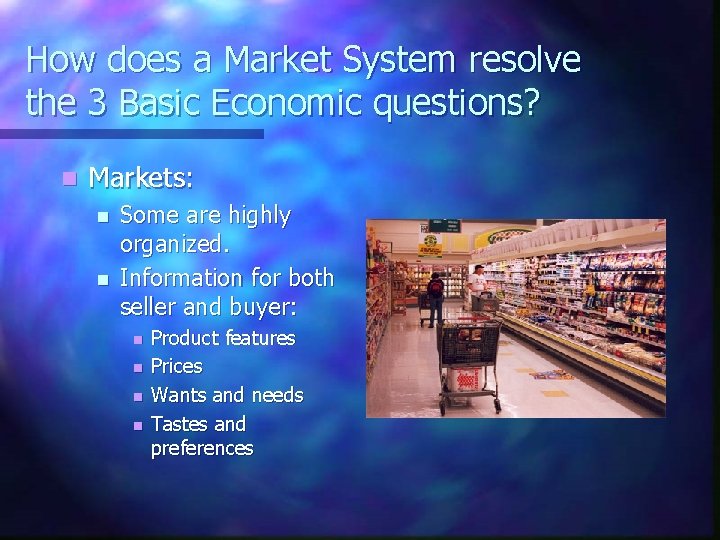
How does a Market System resolve the 3 Basic Economic questions? n Markets: n n Some are highly organized. Information for both seller and buyer: n n Product features Prices Wants and needs Tastes and preferences
Incentives in Market Economy $$$$$$$ n Psychic Income n
Incentives in a Market Economy n Price changes give incentives to change current production
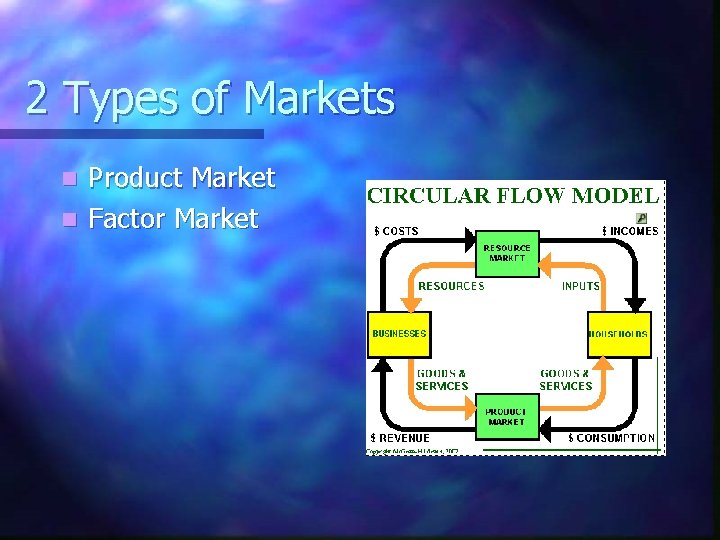
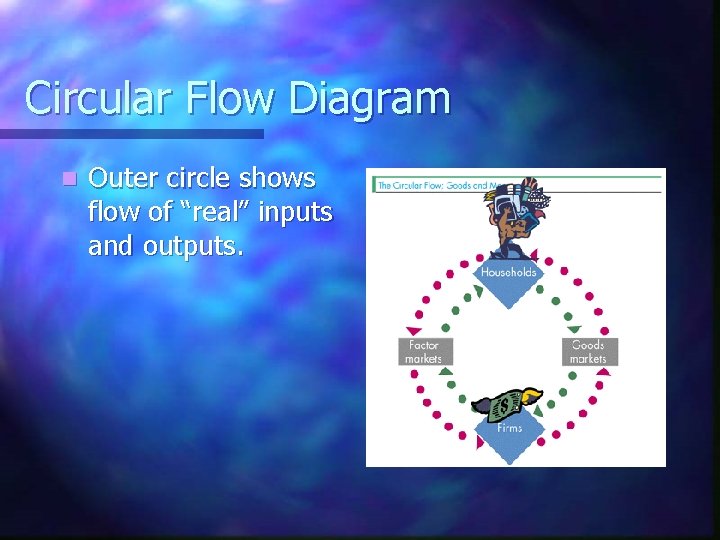
2 Types of Markets Product Market n Factor Market n
Product Market n Finished goods and services exchanged in product markets
Factor Markets n Land, labor, capital resources exchanged in the factor markets.
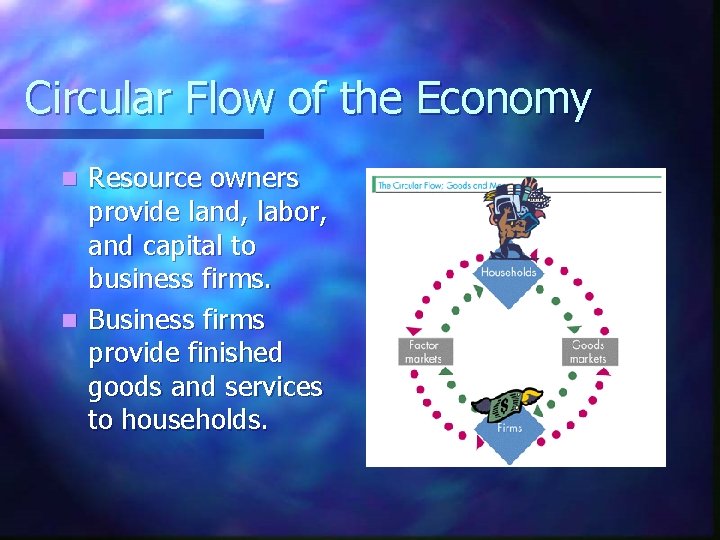
Circular Flow of the Economy Resource owners provide land, labor, and capital to business firms. n Business firms provide finished goods and services to households. n
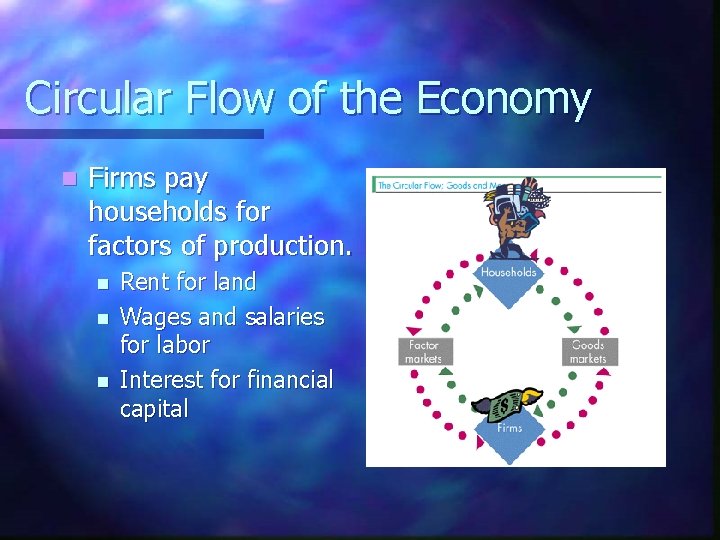
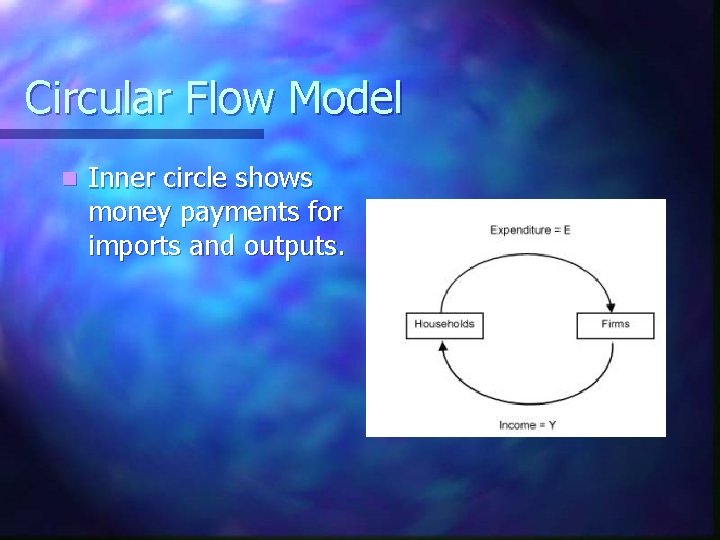
Circular Flow of the Economy n Firms pay households for factors of production. n n n Rent for land Wages and salaries for labor Interest for financial capital
Circular Flow Diagram n Outer circle shows flow of “real” inputs and outputs.
Circular Flow Model n Inner circle shows money payments for imports and outputs.