
Economic Systems Chapter 2 Economic Systems Chapter 2
- Slides: 30
Economic Systems Chapter 2
Economic Systems Chapter 2 Section 1
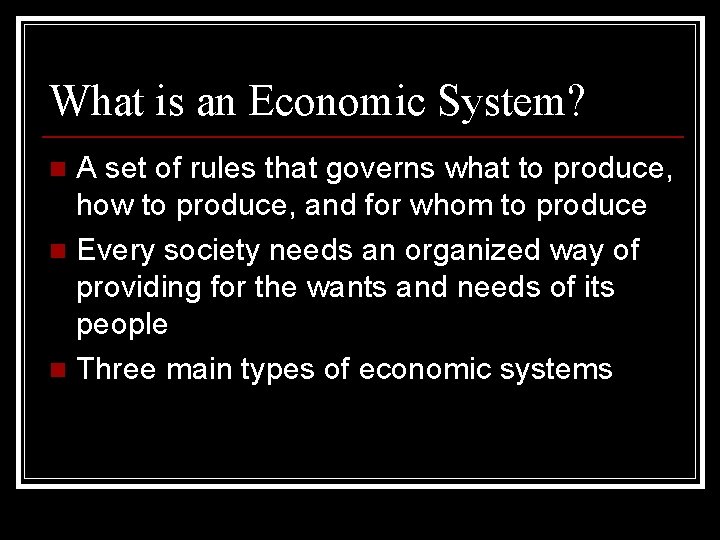
What is an Economic System? A set of rules that governs what to produce, how to produce, and for whom to produce n Every society needs an organized way of providing for the wants and needs of its people n Three main types of economic systems n
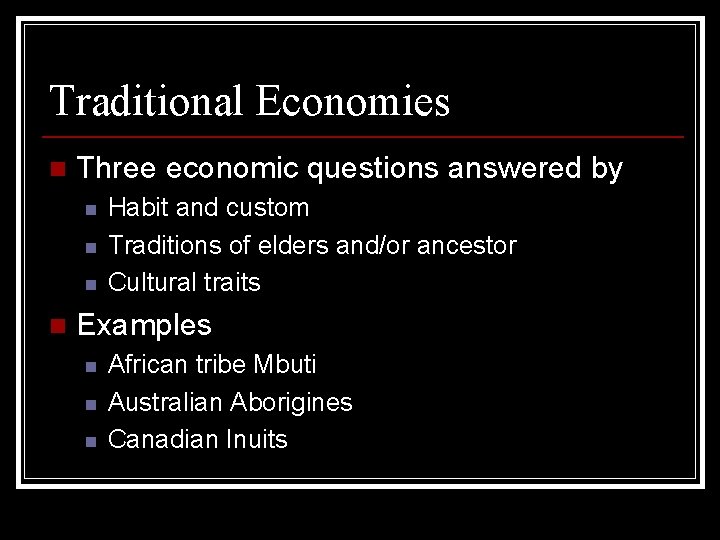
Traditional Economies n Three economic questions answered by n n Habit and custom Traditions of elders and/or ancestor Cultural traits Examples n n n African tribe Mbuti Australian Aborigines Canadian Inuits
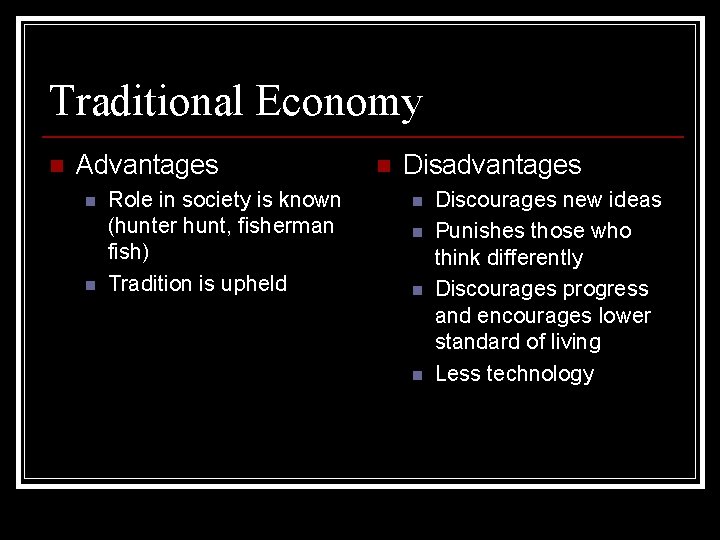
Traditional Economy n Advantages n n Role in society is known (hunter hunt, fisherman fish) Tradition is upheld n Disadvantages n n Discourages new ideas Punishes those who think differently Discourages progress and encourages lower standard of living Less technology
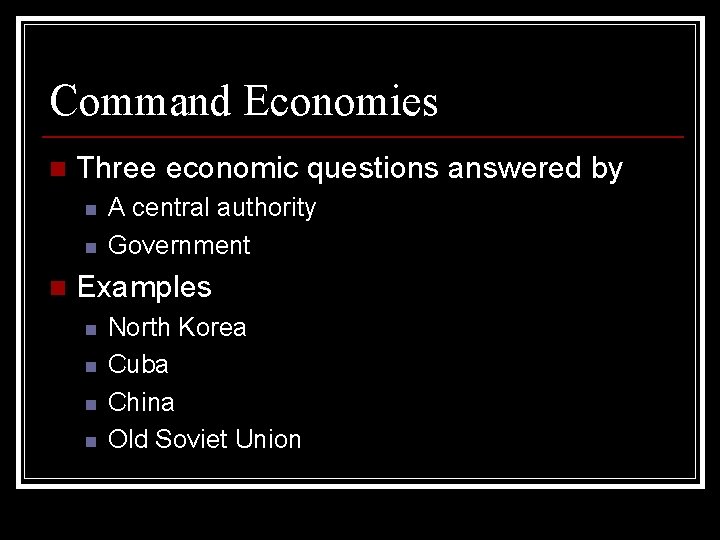
Command Economies n Three economic questions answered by n n n A central authority Government Examples n n North Korea Cuba China Old Soviet Union
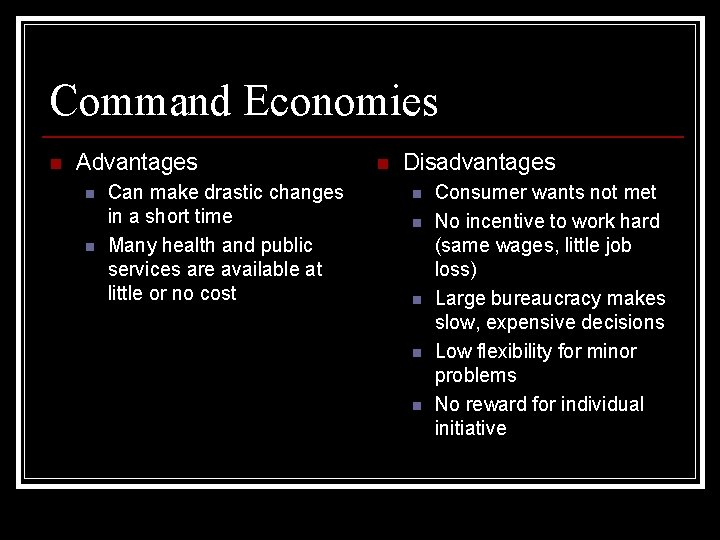
Command Economies n Advantages n n Can make drastic changes in a short time Many health and public services are available at little or no cost n Disadvantages n n n Consumer wants not met No incentive to work hard (same wages, little job loss) Large bureaucracy makes slow, expensive decisions Low flexibility for minor problems No reward for individual initiative
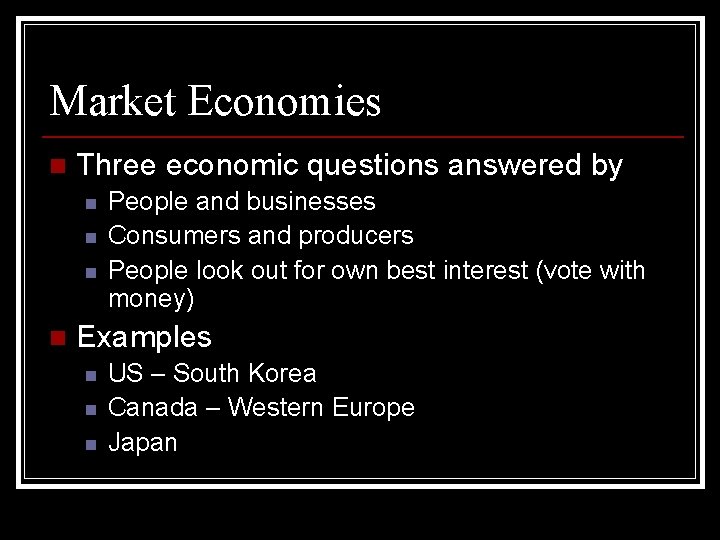
Market Economies n Three economic questions answered by n n People and businesses Consumers and producers People look out for own best interest (vote with money) Examples n n n US – South Korea Canada – Western Europe Japan
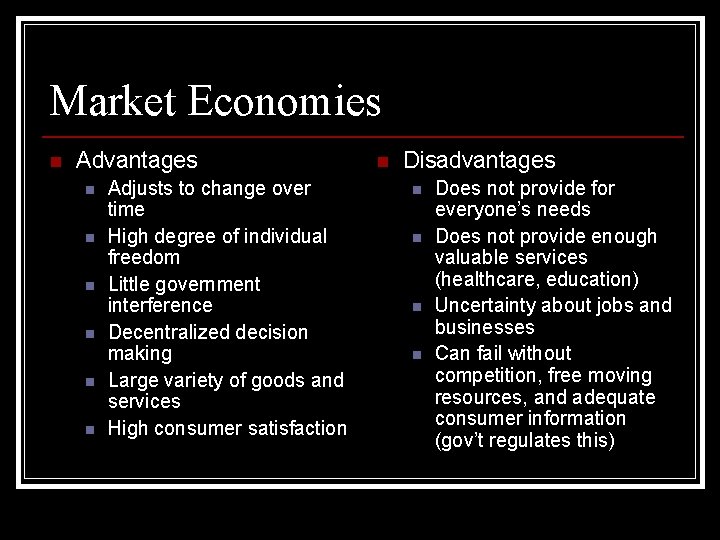
Market Economies n Advantages n n n Adjusts to change over time High degree of individual freedom Little government interference Decentralized decision making Large variety of goods and services High consumer satisfaction n Disadvantages n n Does not provide for everyone’s needs Does not provide enough valuable services (healthcare, education) Uncertainty about jobs and businesses Can fail without competition, free moving resources, and adequate consumer information (gov’t regulates this)
Evaluating Economic Performance Chapter 2 Section 2
Economic and Social Goals n People of the United States share 7 main economic and social goals n Goals serve as benchmarks that help economists determine how well a system meets our needs
Goal # 1 Economic Freedom n People have freedom to make their own decisions n n Occupation Employer Uses of money Business owners choose where and how to produce
Goal # 2 Economic Efficiency n Resources are scarce n Factors of production must be used wisely to maximize production of goods and services n Helps ensure benefits outweigh costs
Goal # 3 Economic Equity n Sense of justice, impartiality, fairness n Equal pay for equal work n No employment discrimination based on age, sex, race, religion, disability n Advertisers should not make false claims
Goal # 4 Economic Security n Protection from layoffs and illnesses n Examples n n Social Security and Medicare at national level Insurance plans that cover injuries or illness
Goal # 5 Full Employment n People with jobs earn income while producing goods and services n People without jobs are not producing good or services (hurts others) and are not able to provide for themselves
Goal # 6 Price Stability n It is desirable for prices to stay the same n n If inflation occurs, people need more money n n Makes budgeting easier, certainty People on a fixed income find dealing with inflation difficult Inflation also tends to create higher interest rates, which discourage businesses from borrowing and spending
Goal # 7 Economic Growth n Most people hope for growth n n n Better job, car, clothes Buy a home As population grows, economic growth is necessary to meet everyone’s needs
Future Goals n As society evolves, new goals may be added n Anything most of society agrees on can become a goal
Trade-Offs Among Goals n Different ideas about how to reach a goal n Goals themselves conflict with each other n n Economic policies have opportunity cost Resolution comes when people, businesses, and government weigh costs and benefits and compromise
Capitalism and Economic Freedom Chapter 2 Section 3
Free Enterprise System n n n Market Economies are usually based on capitalism, where private citizens own the factors of production The American economy is also described as free enterprise, where competition is allowed to flourish with minimum government interference A free enterprise economy has 5 main characteristics
Characteristic # 1 Economic Freedom n Possessed by individuals n n Occupation, employer, where and when to work, own a business or work for someone else, leave one job for another Possessed by businesses n Hire the best workers, produce most profitable goods and services, price control
Characteristic # 2 Voluntary Exchange n Buyers and sellers willingly engage in market transactions n Both buyer and seller are better off after the exchange
Characteristic # 3 Private Property Rights n People own and control their possessions as they wish n Can be tangible items (house, car) n Can be intangible items (skills, talents) n Gives people incentive to work, save, and invest
Characteristic # 4 Profit Motive People are free to risk their savings or any part of their wealth in a business venture n Profit does not have to be money n n Profit is the extent to which a person or business is better off than before Encourages people to improve material well -being n Largely responsible for growth n
Characteristic # 5 Competition n The struggle among sellers to attract consumers while lowering costs n Possible because private individuals own factors of production and have freedom to produce profitable products n Buyers compete to find the best products at the lowest cost
Role of the Entrepreneur n Organizes and manages land, labor, capital in order to seek profit n Risk resources to start new businesses n Successful entrepreneurs share success through jobs, products, and taxes
Role of the Consumer n Consumers have a great deal of power n Consumer purchases determine what is produced n Consumer sovereignty describes the idea that the consumer rules the market
Role of Government n n n Reflects the desires and goals of citizens Can be local, state, or national level Government’s role falls into 1 of 5 categories n n n Protector: ensures fairness, efficiency Provider: provides goods/services Consumer: purchases goods/services Regulator: preserve competition, oversee interstate commerce Promoter of National Goods: functions reflect people’s desire to modify the economic system