
ECONOMIC STRATIFICATION Stratificationranking of people in groups according






- Slides: 61
ECONOMIC STRATIFICATION
Stratification—ranking of people in groups according to their unequal access to scarce resources. Strata—layers
Wealth—total value of money and other assets, minus outstanding debt. Stocks, estate bonds, real
Income—wages or salary from work and earnings from investments. 1998—median $47, 000 What US income is it today?
GOVERNMENT DEFINITION Families with income below the poverty level Family of 4: $23, 000
MAX WEBER Economic-based stratification too simplistic Class (economics) Prestige Power
Local official could have a great deal of power without a large amount of economic wealth
POWER VERSES PRESTIGE Power—the ability to control the behavior of others. Prestige—recognition, respect, and admiration attached to social positions
RANK Rank the jobs according to prestige.
STRUCTURAL-FUNCTIONAL Davis-Moore thesis—social stratification has beneficial consequences for the operation of society. What does this mean?
THE KING AND THE FIREMAN https: //www. youtube. com/watch? v=QRed. Qmf. QBx. Q
Society needs someone to fill every position.
The positions a society considers very important carry enough reward to draw talent away from less important work.
Meritocracy—social stratification based on merit. (you worked for it)
CRITICISM Melvin Tumin—How do we assess the importance of an occupation? How do we determine the wages a person recieves?
Do rewards truly reflect the contributions to society? Think about actors and athletes. Can you think of other “overpaid” professions?
KARL MARX Class conflict—struggle between the proletariat and the bourgeoisie Bourgeoisie—those who own the means of production Proletariat—work for the bourgeoisie
False consciousness—believe all is fair Class consciousness—realization that the arrangement is unfair; lead to an uprising.
SOCIAL CONFLICT Wealth is passed from generation to generation. Legal system defends private property and inheritance. Elite children attend school together and create new social ties.
IN OTHER WORDS Capitalist society reproduces class structure in each new generation.
Classless society— Would it ever work? Why or why not?
WHY NO MARXIST REVOLUTION? . The fragmentation of the capitalist class— corporations belong to stockholders instead of powerful families. 1
2. Higher standard of living—most workers do not work in factories; do not relate to the proletariat and the workers.
3. More worker organizations. Labor unions
4. More extensive legal protection. OSHA, Social Security, unemployment insurance
SYMBOLIC-INTERACTION Status is symbolized by the purchases people make.
What symbols (trademarks) symbolize wealth? Why are some people willing to pay more for something just because of the label?
$2, 495 OR $38. 95
$36. 00 $4, 430
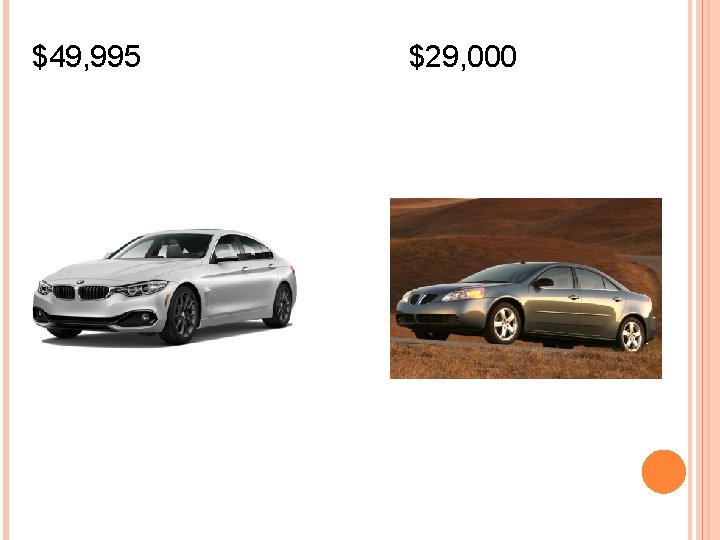
$49, 995 $29, 000
Conspicuous consumption—buying and using products because of the “statement” they make about a social position.
What is the purpose of a wrist watch? How much do you pay for a wrist watch?
Classism—prejudice against or in favor of people belonging to a particular social class
Inequality—unequal opportunities and rewards for different social positions or statuses within a group or society
Social class—a segment of the population whose members hold similar amounts of scarce resources and share values, norms, and identifiable lifestyle.
REMEMBER Ascribed status—from birth Achieved status—what you work for and achieve
Caste system—social stratification based on ascription (you were born into a caste, and you can’t leave).
Elements of the caste system are seen in India and South Africa
BIRTH SHAPES LIVES 1. 2. 3. 4. Occupation Marriage within the caste; endogamous Stay in the company “of their own kind. ” Powerful cultural beliefs
INDIA Brahmin—priests Kshatriya—ruler, warrior, landowner Vaishya—merchants Shudra—artisans, agriculture Harijan--outcaste
MOST SOCIETIES HAVE. . . Class system— based on birth and individual achievement.
A caste system is a closed system of stratification (you can’t move up or down) A class system is an open system of stratification (you can move up and down).
Socioeconomic status (SES)—composite ranking based on various dimensions of social inequality
Social mobility—change in one’s position in the social hierarchy
Vertical mobility—move up or down significantly in the income ladder Upward social mobility—Poor family has a son; earns a scholarship; goes to college and becomes a lawyer
Downward social mobility—son inherits money; mismanages, becomes addicted to drugs, looses it all. Downward turn in the stock market; family looses a business
horizontal mobility—change jobs for a less stressful or more satisfying career; income stays about the same
COMPARISON Intergenerational social mobility— upward or downward mobility of children in relation to their parents Intragenerational social mobility— a change in social position occurring in a person’s lifetime
Structural social mobility— a shift in the social position of large numbers of people due more to changes in society itself than to individuals.
SOVIET UNION Russian Revolution 1917— ended feudal system Transferred private control of farms and factories to the state Said they had created a classless society
IN REALITY Some say the Soviet Union was not classless. Power structure by job
1985 Mikhail Gorbachev Glasnost (openness) Perestroika (restructuring) Centralized control inefficient
1989 -1991 Eastern European communist countries and the Soviet Union collapsed
SOVIET UNION When communism fell, what changes took place in the Russia and the Eastern countries that had been communist?
Social Darwinism— Individuals, groups, and peoples are subject to the same Darwinian laws of natural selection in plants and animals.
American Dream--A philosophy that with hard work, courage and determination, anyone can prosper and achieve success
Individualism--A view that stresses the importance and worth of each person. In economics, it is the doctrine that individuals best serve the public interest by pursuing their own self-interest.
HORATIO ALGER Author—wrote books about poor children who, through hard work and character, overcame poverty
Perpetuate the myth that anyone can become wealthy. What other stories do the same?