
Economic Restructuring ERIK CHEVRIER JANUARY 8 T H
- Slides: 23
Economic Restructuring ERIK CHEVRIER JANUARY 8 T H , 2019
About Me Erik Chevrier Website: www. erikchevrier. ca Office hours: By request (Monday & Wednesday 2: 45 – 4 PM by request) Office location: H-1125. 12 E-Mail: professor@erikchevrier. ca Post-Capitalist Possibilities Website: Post-Capitalist Possibilities Research Project: Concordia Food Groups Research Project Facebook Group: Concordia Food Groups Facebook Group for the Class: https: //www. facebook. com/groups/economicrestructuring/ Another project I started: Co-op Collective Vision
Food and Culture Write-Up This course examines the nature of firm restructuring in late capitalism and the implications that industrial restructuring trends are having for the geography of industries, the structure of firms, workplace relations and workers’ rights. It examines the new challenges that restructuring presents for both economic development prospects and labour market policies, as well as looks at contemporary initiatives to promote more socially and environmentally sustainable development paths. In the course, students will learn how to critically analyze leading theories about political, economic and social relations by reading relevant literature as well as discussing and debating these topics with fellow classmates. We will focus on themes related to labour, capitalism, alternatives to capitalism, theories of transition, ecological economies, diverse economies, alternative markets, among others. Students will take action by creating a community project and/or by joining and enhancing a project that already exists. This will allow students to gain direct experience in creating alternative/non-capitalist enterprises as well as experiment with post-capitalist methods by applying what they learn in class to a project they develop. Hopefully, some of these experiments will become viable community projects that continue to sustain even after the course is done. Students will report about their project by publishing a summary of the project on the website www. postcapitalistpossibilibies. org. These reports will provide information about the project for anyone who is interested in perpetuating the project once the course is done. It will also provide a first-hand account of what can be possible in the realm of postcapitalist development – students may discover new ways to create sharing networks over and above what has already been discovered. Students will attend conferences and/or meetings that take place in the community and write blog posts that will be posted on the postcapitalist possibilities website. This will give students insight about how democratic organizations function and provide an opportunity to learn new skills. Furthermore, the blogposts will inform the community about what is happening in their neighborhoods. Students will critically evaluate their own roles as political, social and economic agents by recognizing and evaluating their own consumption habits, environmental footprint, labour practices, community involvement, and/or political participation.
Class Rules Required Books: Students are expected to complete ALL the required readings BEFORE EACH CLASS. Students are also expected to attend ALL classes and participate in class discussions. Olin Wright, E. (2010) Envisioning Real Utopias, Verso Roelvink, G. , Martin, K. S. , Gibson-Graham, J. K. , (2015) Making Other Worlds Possible: Performing Diverse Economies, University of Minnesota Press Brown and Timmerman (2015) Ecological Economics for the Anthropocene, Columbia University Press Recommended readings: URLs and other electronic sources may be posted on the course website from time to time. Please visit the course website to get this material. These are only for interest and are not required.
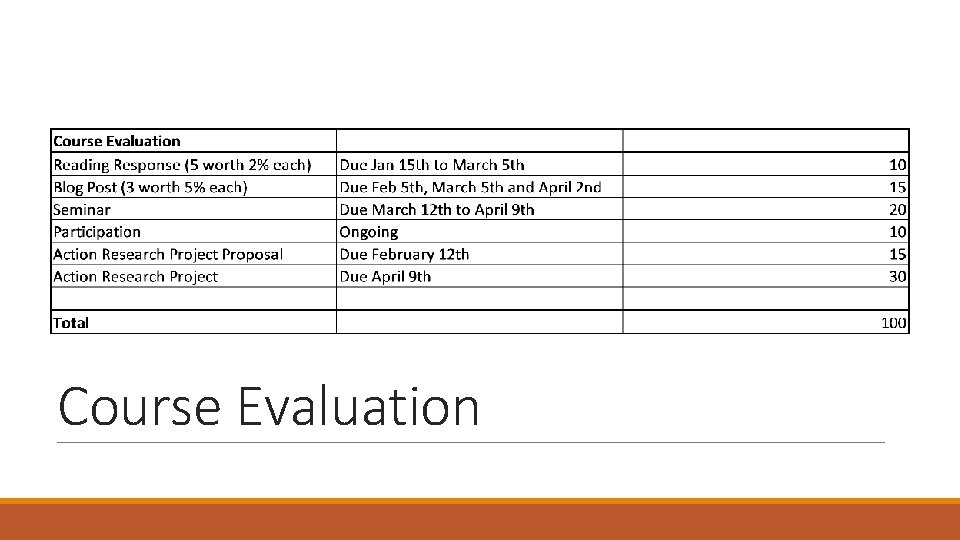
Course Evaluation
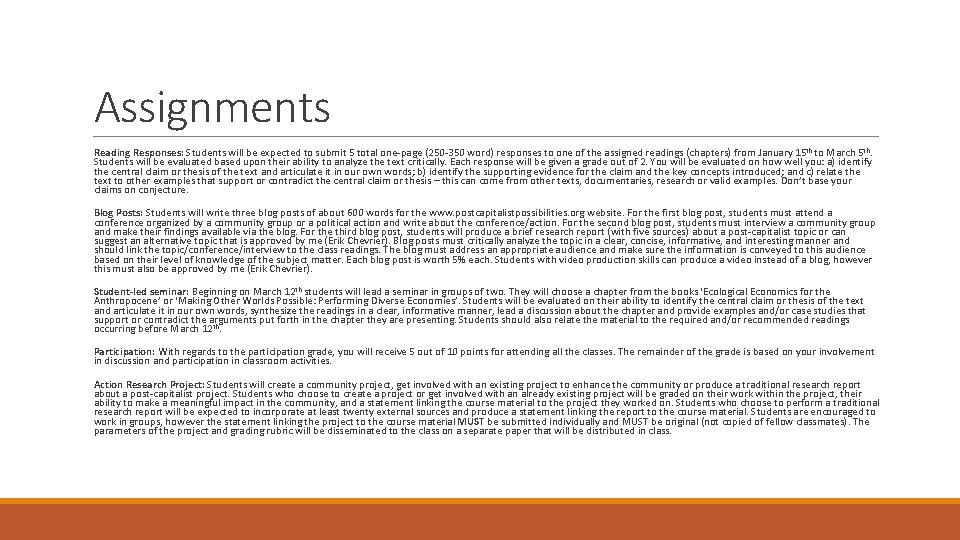
Assignments Reading Responses: Students will be expected to submit 5 total one-page (250 -350 word) responses to one of the assigned readings (chapters) from January 15 th to March 5 th. Students will be evaluated based upon their ability to analyze the text critically. Each response will be given a grade out of 2. You will be evaluated on how well you: a) identify the central claim or thesis of the text and articulate it in our own words; b) identify the supporting evidence for the claim and the key concepts introduced; and c) relate the text to other examples that support or contradict the central claim or thesis – this can come from other texts, documentaries, research or valid examples. Don’t base your claims on conjecture. Blog Posts: Students will write three blog posts of about 600 words for the www. postcapitalistpossibilities. org website. For the first blog post, students must attend a conference organized by a community group or a political action and write about the conference/action. For the second blog post, students must interview a community group and make their findings available via the blog. For the third blog post, students will produce a brief research report (with five sources) about a post-capitalist topic or can suggest an alternative topic that is approved by me (Erik Chevrier). Blog posts must critically analyze the topic in a clear, concise, informative, and interesting manner and should link the topic/conference/interview to the class readings. The blog must address an appropriate audience and make sure the information is conveyed to this audience based on their level of knowledge of the subject matter. Each blog post is worth 5% each. Students with video production skills can produce a video instead of a blog, however this must also be approved by me (Erik Chevrier). Student-led seminar: Beginning on March 12 th students will lead a seminar in groups of two. They will choose a chapter from the books ‘Ecological Economics for the Anthropocene’ or ‘Making Other Worlds Possible: Performing Diverse Economies’. Students will be evaluated on their ability to identify the central claim or thesis of the text and articulate it in our own words, synthesize the readings in a clear, informative manner, lead a discussion about the chapter and provide examples and/or case studies that support or contradict the arguments put forth in the chapter they are presenting. Students should also relate the material to the required and/or recommended readings occurring before March 12 th. Participation: With regards to the participation grade, you will receive 5 out of 10 points for attending all the classes. The remainder of the grade is based on your involvement in discussion and participation in classroom activities. Action Research Project: Students will create a community project, get involved with an existing project to enhance the community or produce a traditional research report about a post-capitalist project. Students who choose to create a project or get involved with an already existing project will be graded on their work within the project, their ability to make a meaningful impact in the community, and a statement linking the course material to the project they worked on. Students who choose to perform a traditional research report will be expected to incorporate at least twenty external sources and produce a statement linking the report to the course material. Students are encouraged to work in groups, however the statement linking the project to the course material MUST be submitted individually and MUST be original (not copied of fellow classmates). The parameters of the project and grading rubric will be disseminated to the class on a separate paper that will be distributed in class.
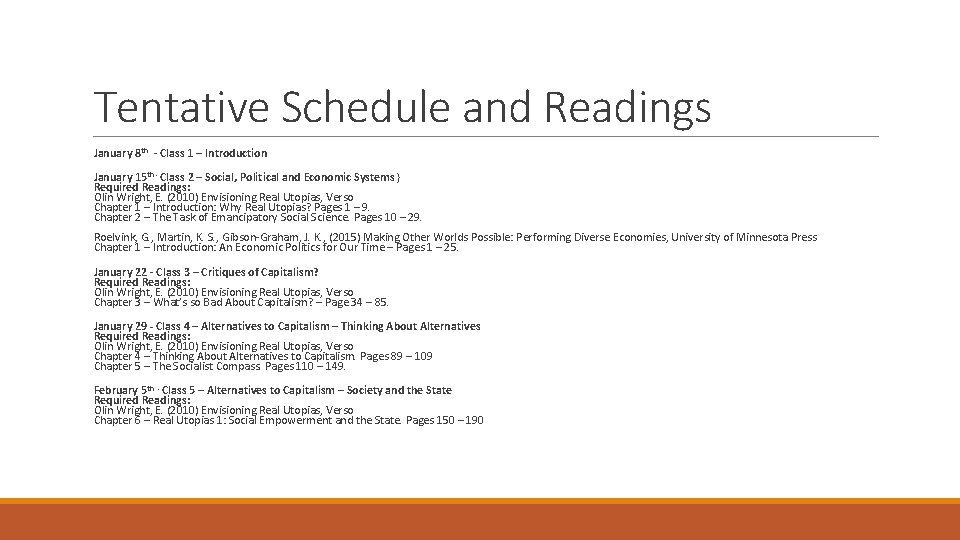
Tentative Schedule and Readings January 8 th - Class 1 – Introduction January 15 th - Class 2 – Social, Political and Economic Systems} Required Readings: Olin Wright, E. (2010) Envisioning Real Utopias, Verso Chapter 1 – Introduction: Why Real Utopias? Pages 1 – 9. Chapter 2 – The Task of Emancipatory Social Science. Pages 10 – 29. Roelvink, G. , Martin, K. S. , Gibson-Graham, J. K. , (2015) Making Other Worlds Possible: Performing Diverse Economies, University of Minnesota Press Chapter 1 – Introduction: An Economic Politics for Our Time – Pages 1 – 25. January 22 - Class 3 – Critiques of Capitalism? Required Readings: Olin Wright, E. (2010) Envisioning Real Utopias, Verso Chapter 3 – What’s so Bad About Capitalism? – Page 34 – 85. January 29 - Class 4 – Alternatives to Capitalism – Thinking About Alternatives Required Readings: Olin Wright, E. (2010) Envisioning Real Utopias, Verso Chapter 4 – Thinking About Alternatives to Capitalism. Pages 89 – 109 Chapter 5 – The Socialist Compass. Pages 110 – 149. February 5 th - Class 5 – Alternatives to Capitalism – Society and the State Required Readings: Olin Wright, E. (2010) Envisioning Real Utopias, Verso Chapter 6 – Real Utopias 1: Social Empowerment and the State. Pages 150 – 190
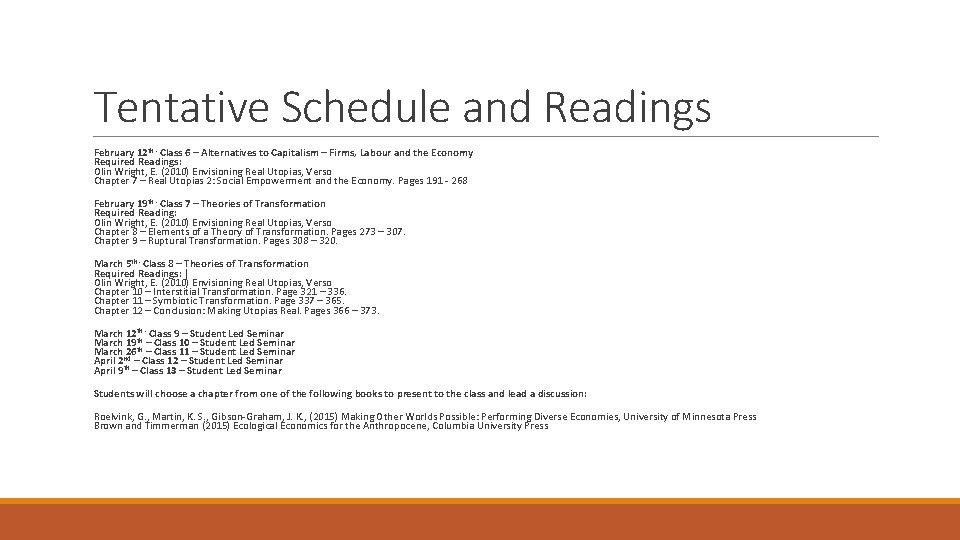
Tentative Schedule and Readings February 12 th - Class 6 – Alternatives to Capitalism – Firms, Labour and the Economy Required Readings: Olin Wright, E. (2010) Envisioning Real Utopias, Verso Chapter 7 – Real Utopias 2: Social Empowerment and the Economy. Pages 191 - 268 February 19 th - Class 7 – Theories of Transformation Required Reading: Olin Wright, E. (2010) Envisioning Real Utopias, Verso Chapter 8 – Elements of a Theory of Transformation. Pages 273 – 307. Chapter 9 – Ruptural Transformation. Pages 308 – 320. March 5 th - Class 8 – Theories of Transformation Required Readings: | Olin Wright, E. (2010) Envisioning Real Utopias, Verso Chapter 10 – Interstitial Transformation. Page 321 – 336. Chapter 11 – Symbiotic Transformation. Page 337 – 365. Chapter 12 – Conclusion: Making Utopias Real. Pages 366 – 373. March 12 th - Class 9 – Student Led Seminar March 19 th – Class 10 – Student Led Seminar March 26 th – Class 11 – Student Led Seminar April 2 nd – Class 12 – Student Led Seminar April 9 th – Class 13 – Student Led Seminar Students will choose a chapter from one of the following books to present to the class and lead a discussion: Roelvink, G. , Martin, K. S. , Gibson-Graham, J. K. , (2015) Making Other Worlds Possible: Performing Diverse Economies, University of Minnesota Press Brown and Timmerman (2015) Ecological Economics for the Anthropocene, Columbia University Press
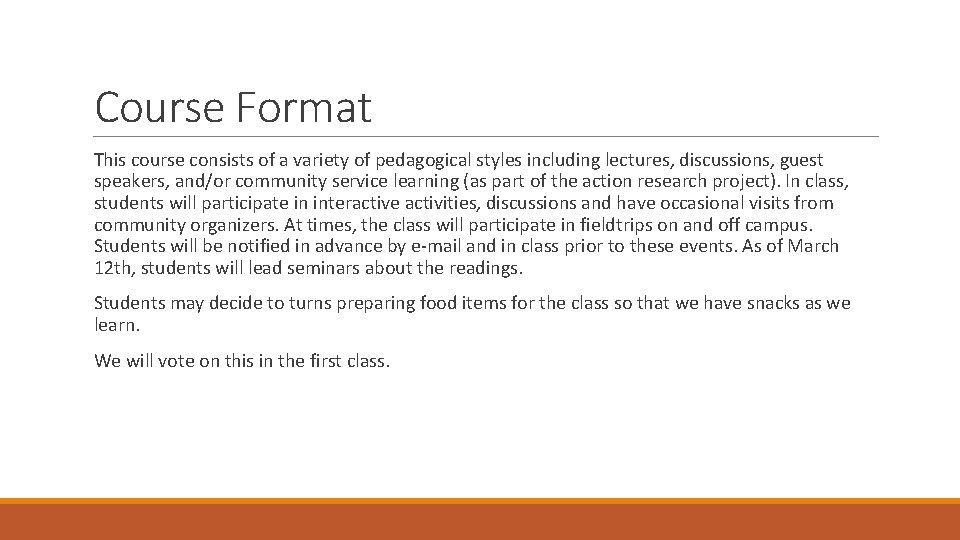
Course Format This course consists of a variety of pedagogical styles including lectures, discussions, guest speakers, and/or community service learning (as part of the action research project). In class, students will participate in interactive activities, discussions and have occasional visits from community organizers. At times, the class will participate in fieldtrips on and off campus. Students will be notified in advance by e-mail and in class prior to these events. As of March 12 th, students will lead seminars about the readings. Students may decide to turns preparing food items for the class so that we have snacks as we learn. We will vote on this in the first class.
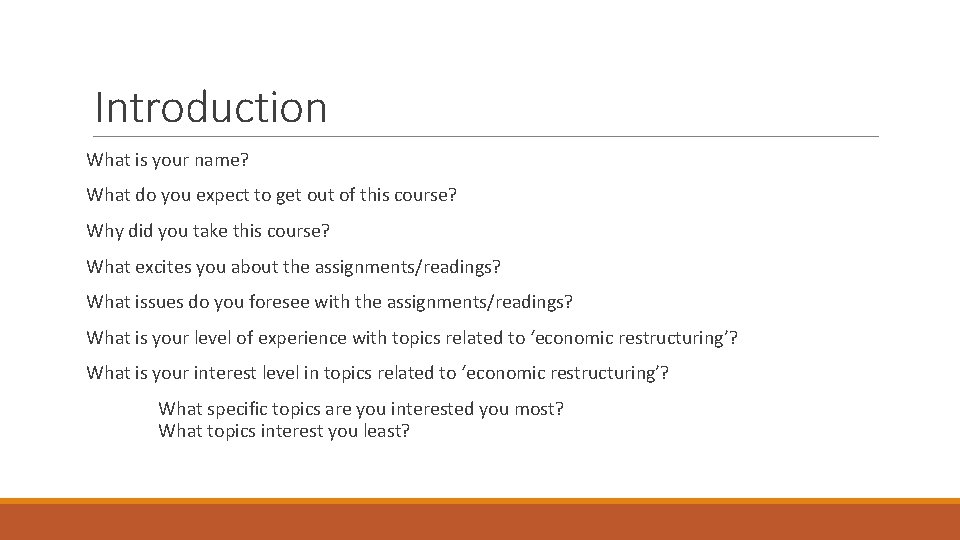
Introduction What is your name? What do you expect to get out of this course? Why did you take this course? What excites you about the assignments/readings? What issues do you foresee with the assignments/readings? What is your level of experience with topics related to ‘economic restructuring’? What is your interest level in topics related to ‘economic restructuring’? What specific topics are you interested you most? What topics interest you least?
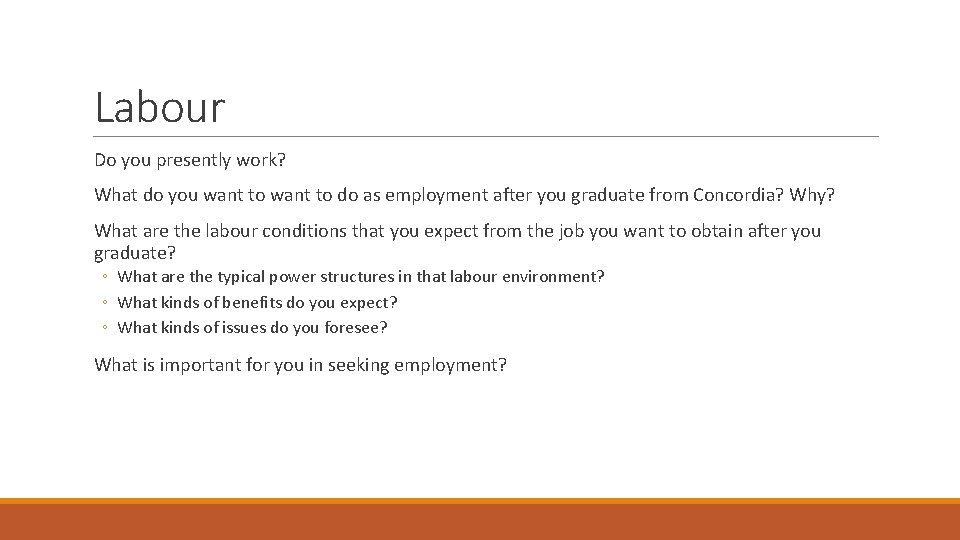
Labour Do you presently work? What do you want to do as employment after you graduate from Concordia? Why? What are the labour conditions that you expect from the job you want to obtain after you graduate? ◦ What are the typical power structures in that labour environment? ◦ What kinds of benefits do you expect? ◦ What kinds of issues do you foresee? What is important for you in seeking employment?
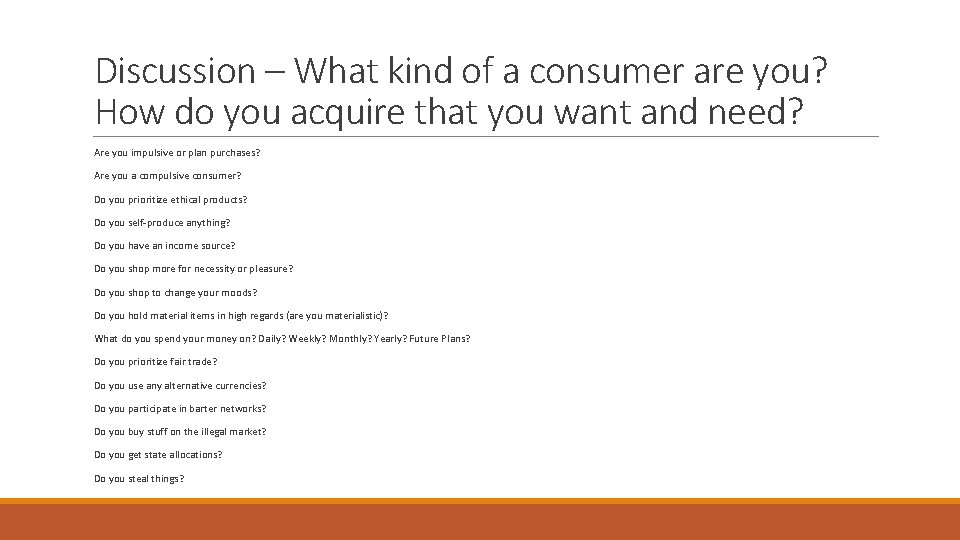
Discussion – What kind of a consumer are you? How do you acquire that you want and need? Are you impulsive or plan purchases? Are you a compulsive consumer? Do you prioritize ethical products? Do you self-produce anything? Do you have an income source? Do you shop more for necessity or pleasure? Do you shop to change your moods? Do you hold material items in high regards (are you materialistic)? What do you spend your money on? Daily? Weekly? Monthly? Yearly? Future Plans? Do you prioritize fair trade? Do you use any alternative currencies? Do you participate in barter networks? Do you buy stuff on the illegal market? Do you get state allocations? Do you steal things?
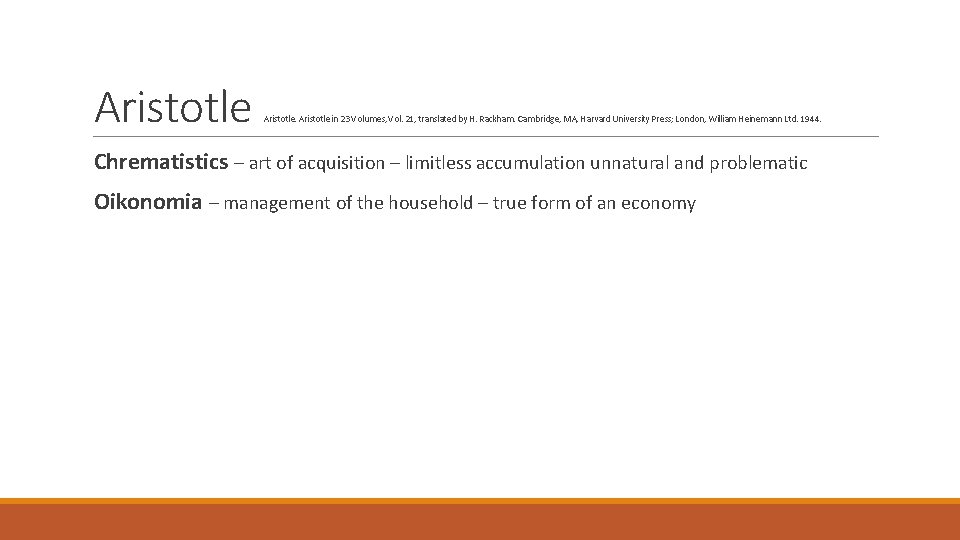
Aristotle in 23 Volumes, Vol. 21, translated by H. Rackham. Cambridge, MA, Harvard University Press; London, William Heinemann Ltd. 1944. Chrematistics – art of acquisition – limitless accumulation unnatural and problematic Oikonomia – management of the household – true form of an economy
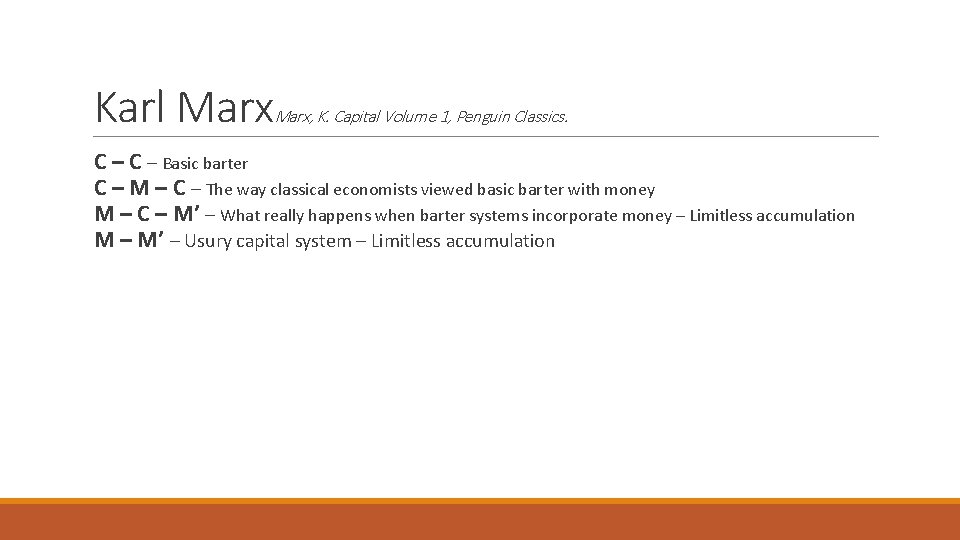
Karl Marx, K. Capital Volume 1, Penguin Classics. C – Basic barter C – M – C – The way classical economists viewed basic barter with money M – C – M’ – What really happens when barter systems incorporate money – Limitless accumulation M – M’ – Usury capital system – Limitless accumulation
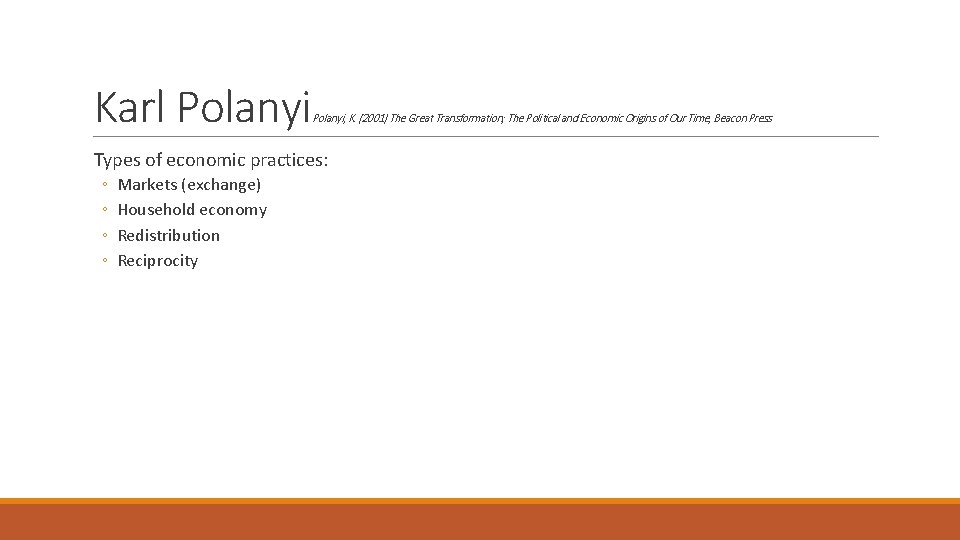
Karl Polanyi, K. (2001) The Great Transformation; The Political and Economic Origins of Our Time, Beacon Press Types of economic practices: ◦ ◦ Markets (exchange) Household economy Redistribution Reciprocity
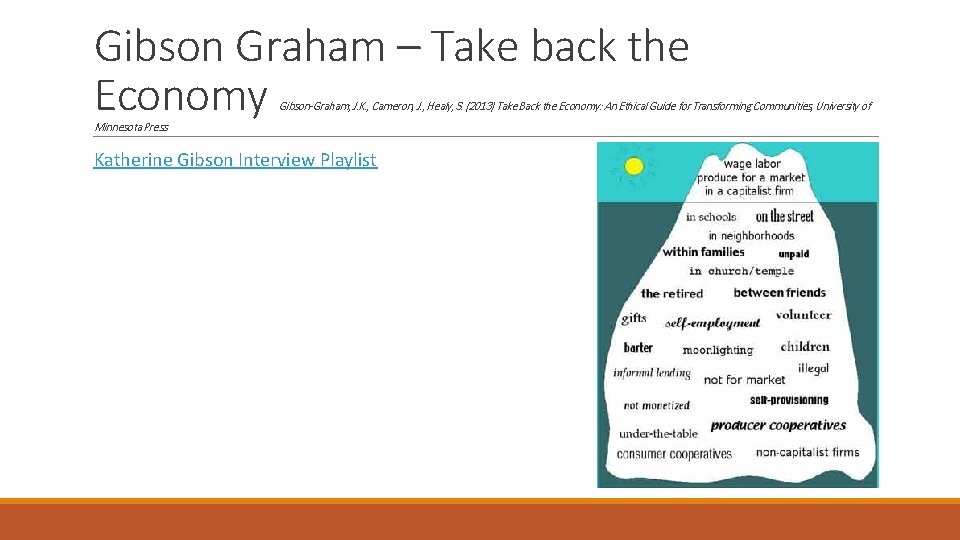
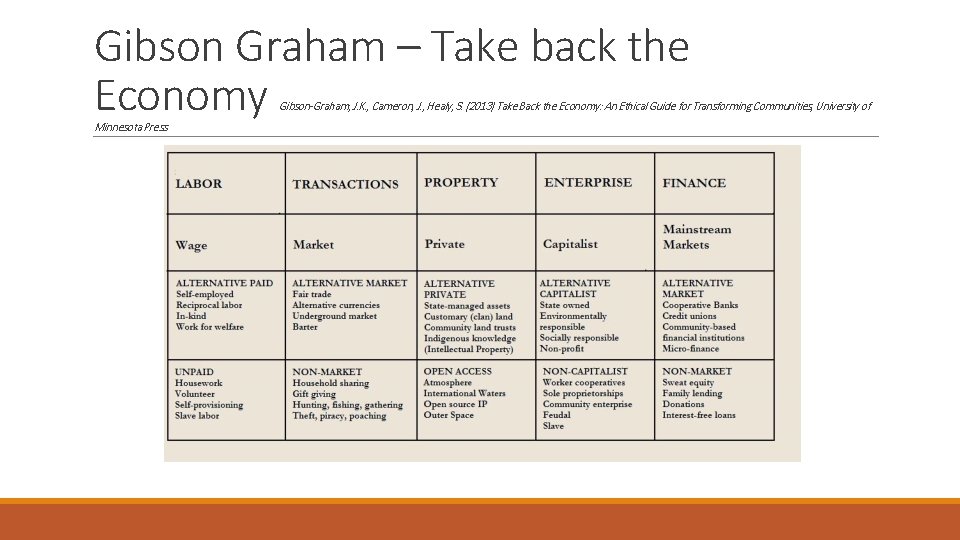
Gibson Graham – Take back the Economy Gibson-Graham, J. K. , Cameron, J. , Healy, S. (2013) Take Back the Economy: An Ethical Guide for Transforming Communities, University of Minnesota Press Katherine Gibson Interview Playlist
Gibson Graham – Take back the Economy Gibson-Graham, J. K. , Cameron, J. , Healy, S. (2013) Take Back the Economy: An Ethical Guide for Transforming Communities, University of Minnesota Press
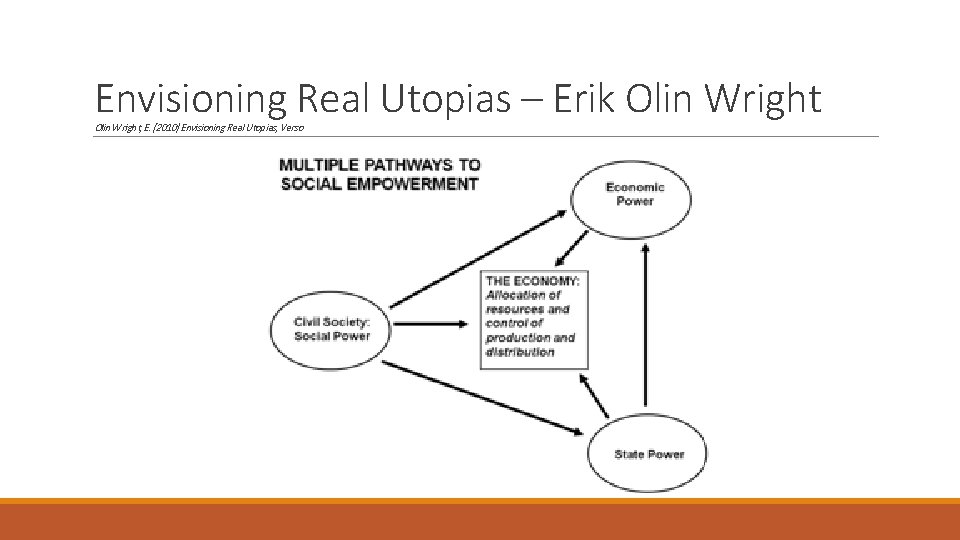
Envisioning Real Utopias – Erik Olin Wright, E. (2010) Envisioning Real Utopias, Verso
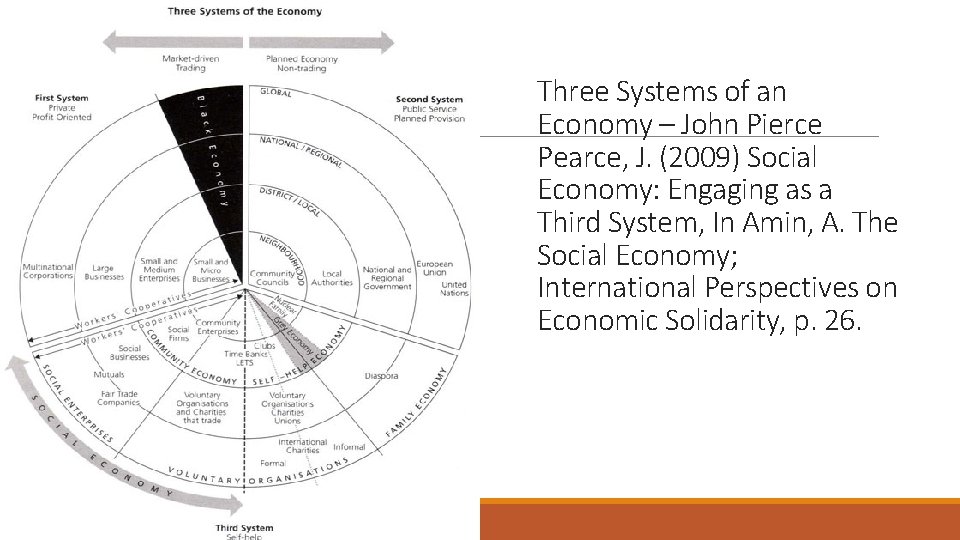
Three Systems of an Economy – John Pierce Pearce, J. (2009) Social Economy: Engaging as a Third System, In Amin, A. The Social Economy; International Perspectives on Economic Solidarity, p. 26.
Importance of Action Based Research Why are action based projects important? ◦ It is important to challenge the problematic dominant epistemological understandings of food. ◦ Instead we should produce ontological formations of the world we want by co-creating and corecreating social relations that produce positive outcomes on people and the planet. ◦ Action based learning theories incorporate students and facilitators as co-learners and co-collaborators. Together, they learn by doing. They also connect with the community. Epistemology – A term meaning “theory of knowledge, ” which gets at the how we know about the social world that lies behind all theoretical approaches. (Frampton, Kinsman, Thompson, Tileczek, (2006)) Ontology – Assumptions relating to how the social comes into being that inform all theories and ways of writing the social. (Frampton, Kinsman, Thompson, Tileczek, (2006))
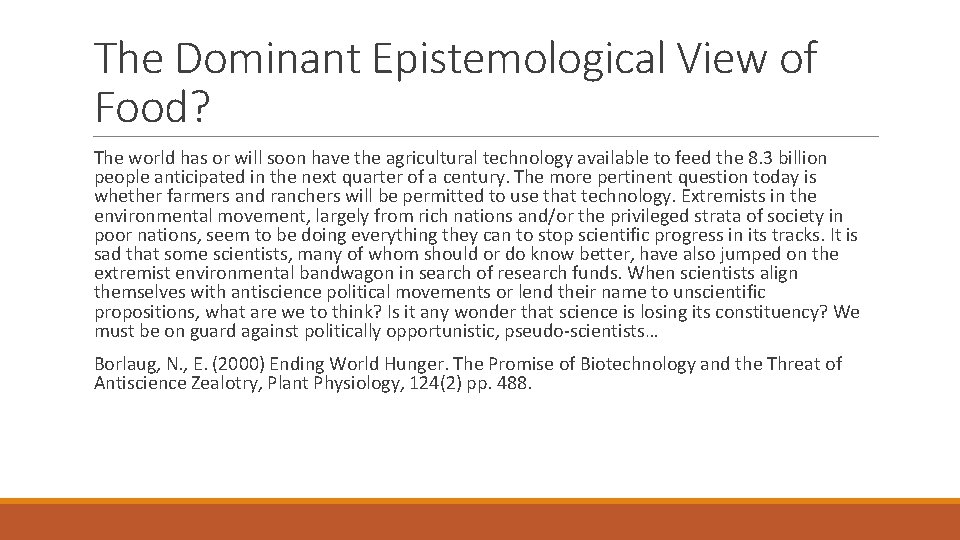
The Dominant Epistemological View of Food? The world has or will soon have the agricultural technology available to feed the 8. 3 billion people anticipated in the next quarter of a century. The more pertinent question today is whether farmers and ranchers will be permitted to use that technology. Extremists in the environmental movement, largely from rich nations and/or the privileged strata of society in poor nations, seem to be doing everything they can to stop scientific progress in its tracks. It is sad that some scientists, many of whom should or do know better, have also jumped on the extremist environmental bandwagon in search of research funds. When scientists align themselves with antiscience political movements or lend their name to unscientific propositions, what are we to think? Is it any wonder that science is losing its constituency? We must be on guard against politically opportunistic, pseudo-scientists… Borlaug, N. , E. (2000) Ending World Hunger. The Promise of Biotechnology and the Threat of Antiscience Zealotry, Plant Physiology, 124(2) pp. 488.
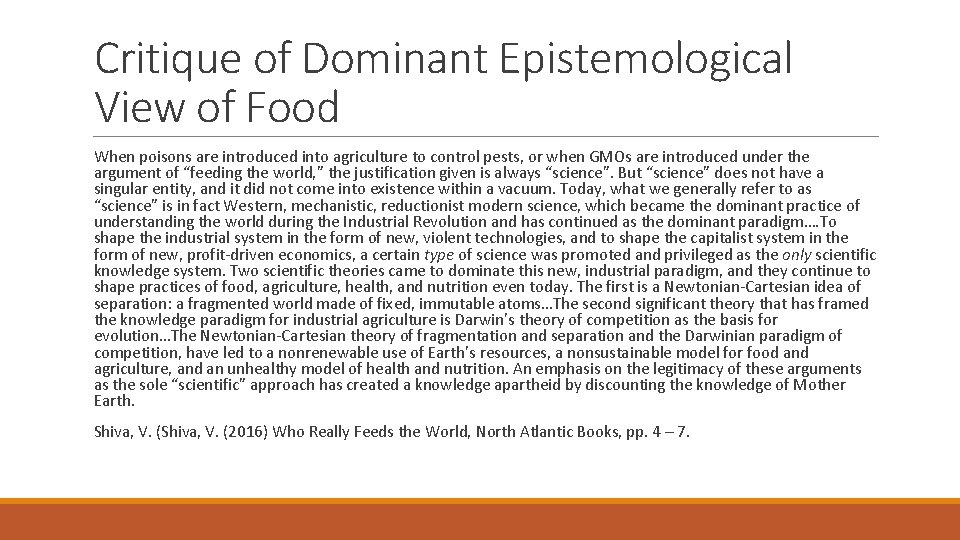
Critique of Dominant Epistemological View of Food When poisons are introduced into agriculture to control pests, or when GMOs are introduced under the argument of “feeding the world, ” the justification given is always “science”. But “science” does not have a singular entity, and it did not come into existence within a vacuum. Today, what we generally refer to as “science” is in fact Western, mechanistic, reductionist modern science, which became the dominant practice of understanding the world during the Industrial Revolution and has continued as the dominant paradigm…. To shape the industrial system in the form of new, violent technologies, and to shape the capitalist system in the form of new, profit-driven economics, a certain type of science was promoted and privileged as the only scientific knowledge system. Two scientific theories came to dominate this new, industrial paradigm, and they continue to shape practices of food, agriculture, health, and nutrition even today. The first is a Newtonian-Cartesian idea of separation: a fragmented world made of fixed, immutable atoms…The second significant theory that has framed the knowledge paradigm for industrial agriculture is Darwin’s theory of competition as the basis for evolution…The Newtonian-Cartesian theory of fragmentation and separation and the Darwinian paradigm of competition, have led to a nonrenewable use of Earth’s resources, a nonsustainable model for food and agriculture, and an unhealthy model of health and nutrition. An emphasis on the legitimacy of these arguments as the sole “scientific” approach has created a knowledge apartheid by discounting the knowledge of Mother Earth. Shiva, V. (2016) Who Really Feeds the World, North Atlantic Books, pp. 4 – 7.
Questions or Concerns? Thanks! Have a great day!