
Economic Regulator Options and Models Report Definition scope




- Slides: 30
Economic Regulator: Options and Models Report Definition, scope, functions and options 15 February 2013
Content 1. 2. 3. 4. Definition of Economic Regulation Scope of Economic Regulation Regulatory Models/ Options Criteria for assessment
Problem statement • • Current tariff and charge setting process lacks regulation; Raw water: Ø Conflict of interest (DWA determines raw water pricing strategy, sets raw water tariffs, is infrastructure developer and operator, spends revenue from tariffs) Ø Difficult to correlate expenditure with charge elements Ø TCTA charge not effectively regulated Ø WRM charge to be determined by CMAs – will need regulation to avoid uneccesary escalation • Water services Ø Weak regulation of water board tariffs • may result in over-pricing (consumer pays more than is appropriate) or • under-pricing (with associated under-funding of operation, maintenance and refurbishment) Ø Local government tariffs • Section 10 regulations – poorly enforced? • Little ring-fencing of water services budgets • Many WSAs do not know their full costs to budget against
Definition of ER • “setting the rules to control, monitor, enforce and change allowed tariffs and service standards for the water sector whilst giving due regard to social, environmental and economic imperatives”
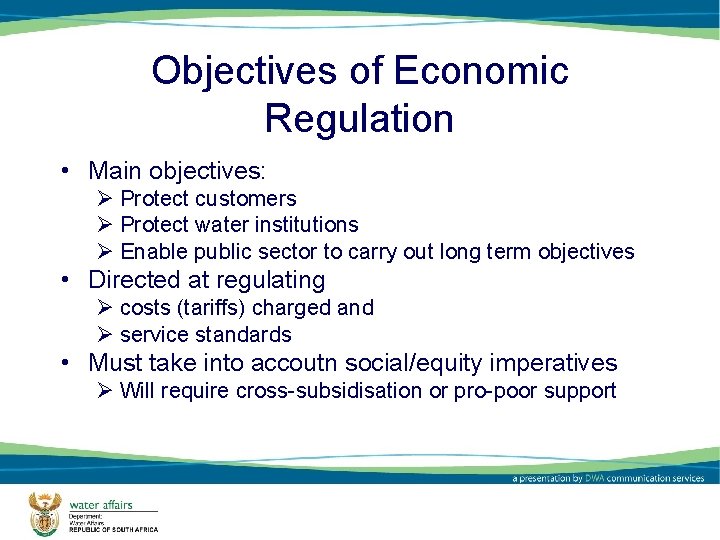
Objectives of Economic Regulation • Main objectives: Ø Protect customers Ø Protect water institutions Ø Enable public sector to carry out long term objectives • Directed at regulating Ø costs (tariffs) charged and Ø service standards • Must take into accoutn social/equity imperatives Ø Will require cross-subsidisation or pro-poor support
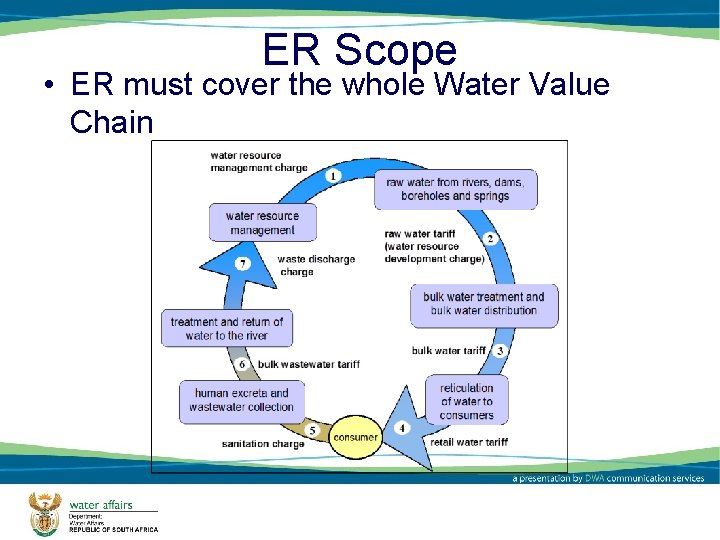
ER Scope • ER must cover the whole Water Value Chain
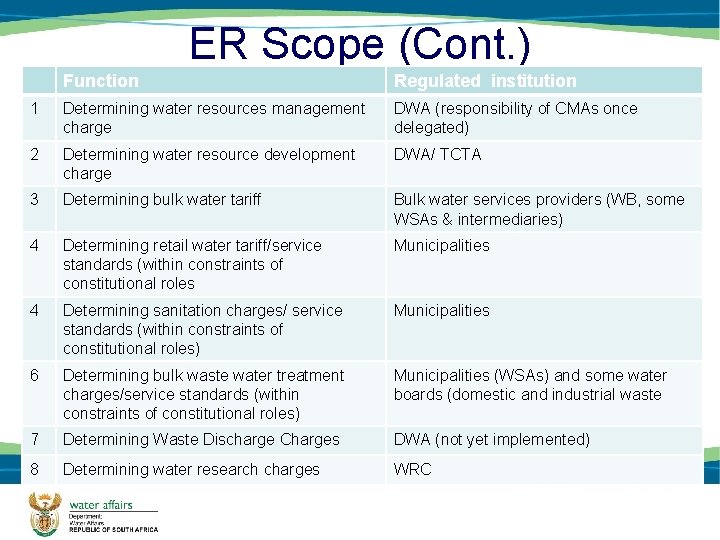
ER Scope (Cont. ) Function Regulated institution 1 Determining water resources management charge DWA (responsibility of CMAs once delegated) 2 Determining water resource development charge DWA/ TCTA 3 Determining bulk water tariff Bulk water services providers (WB, some WSAs & intermediaries) 4 Determining retail water tariff/service standards (within constraints of constitutional roles Municipalities 4 Determining sanitation charges/ service standards (within constraints of constitutional roles) Municipalities 6 Determining bulk waste water treatment charges/service standards (within constraints of constitutional roles) Municipalities (WSAs) and some water boards (domestic and industrial waste 7 Determining Waste Discharge Charges DWA (not yet implemented) 8 Determining water research charges WRC
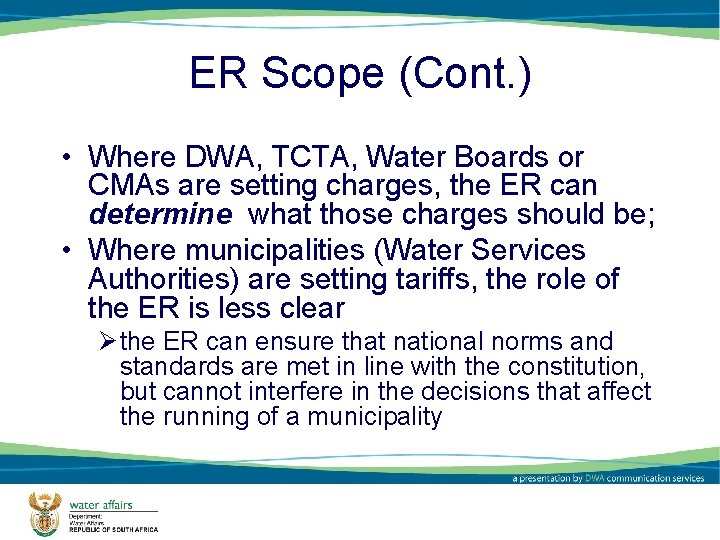
ER Scope (Cont. ) • Where DWA, TCTA, Water Boards or CMAs are setting charges, the ER can determine what those charges should be; • Where municipalities (Water Services Authorities) are setting tariffs, the role of the ER is less clear Ø the ER can ensure that national norms and standards are met in line with the constitution, but cannot interfere in the decisions that affect the running of a municipality
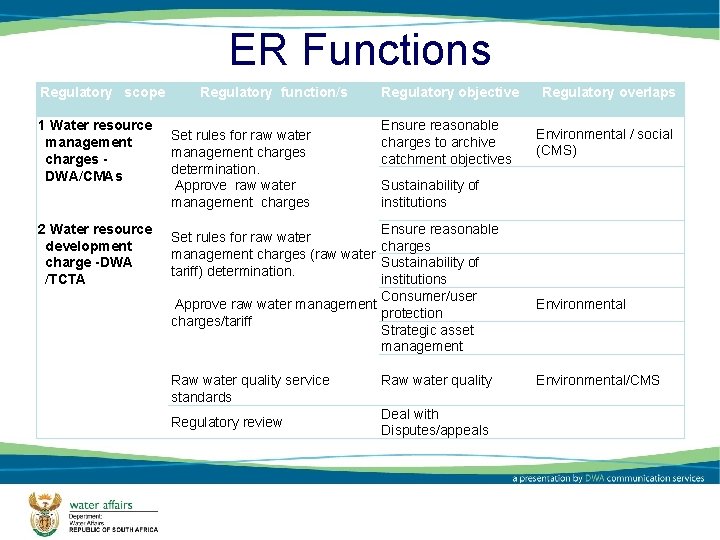
ER Functions Regulatory scope 1 Water resource management charges DWA/CMAs 2 Water resource development charge -DWA /TCTA Regulatory function/s Set rules for raw water management charges determination. Approve raw water management charges Regulatory objective Ensure reasonable charges to archive catchment objectives Regulatory review Environmental / social (CMS) Sustainability of institutions Ensure reasonable Set rules for raw water charges management charges (raw water Sustainability of tariff) determination. institutions Consumer/user Approve raw water management protection charges/tariff Strategic asset management Raw water quality service standards Regulatory overlaps Raw water quality Deal with Disputes/appeals Environmental/CMS
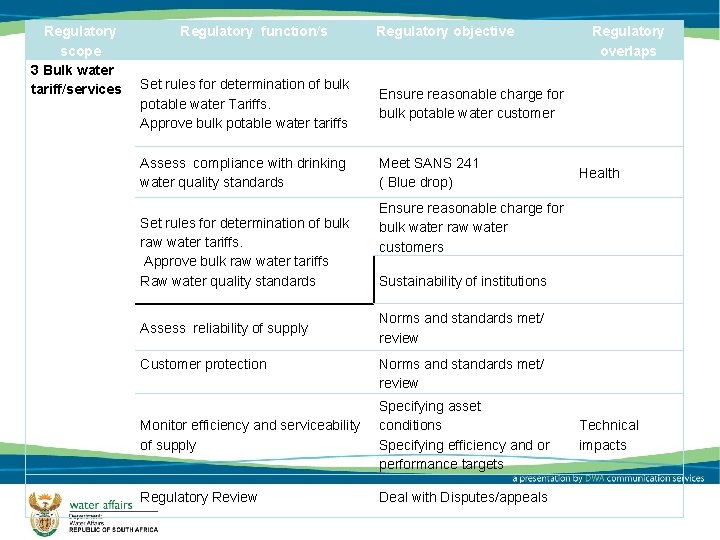
Regulatory scope 3 Bulk water tariff/services Regulatory function/s Regulatory objective Set rules for determination of bulk potable water Tariffs. Approve bulk potable water tariffs Ensure reasonable charge for bulk potable water customer Assess compliance with drinking water quality standards Meet SANS 241 ( Blue drop) Set rules for determination of bulk raw water tariffs. Approve bulk raw water tariffs Raw water quality standards Assess reliability of supply Customer protection Regulatory overlaps Health Ensure reasonable charge for bulk water raw water customers Sustainability of institutions Norms and standards met/ review Monitor efficiency and serviceability of supply Specifying asset conditions Specifying efficiency and or performance targets Regulatory Review Deal with Disputes/appeals Technical impacts
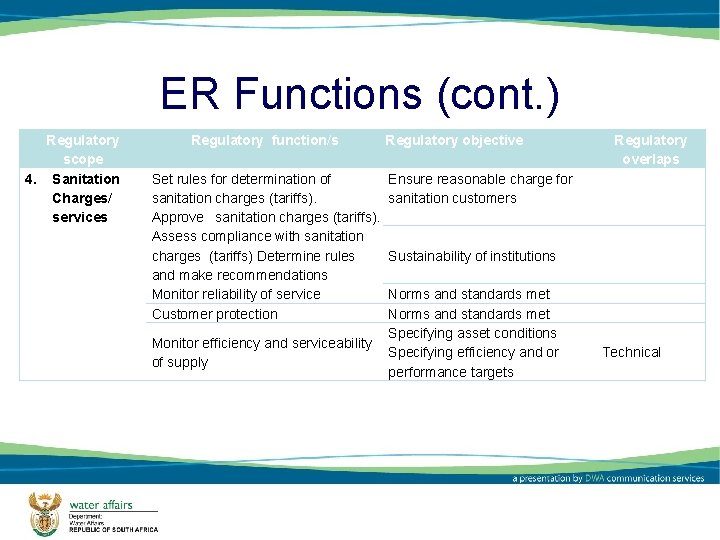
ER Functions (cont. ) Regulatory scope 4. Sanitation Charges/ services Regulatory function/s Set rules for determination of sanitation charges (tariffs). Approve sanitation charges (tariffs). Assess compliance with sanitation charges (tariffs) Determine rules and make recommendations Monitor reliability of service Customer protection Monitor efficiency and serviceability of supply Regulatory objective Regulatory overlaps Ensure reasonable charge for sanitation customers Sustainability of institutions Norms and standards met Specifying asset conditions Specifying efficiency and or performance targets Technical
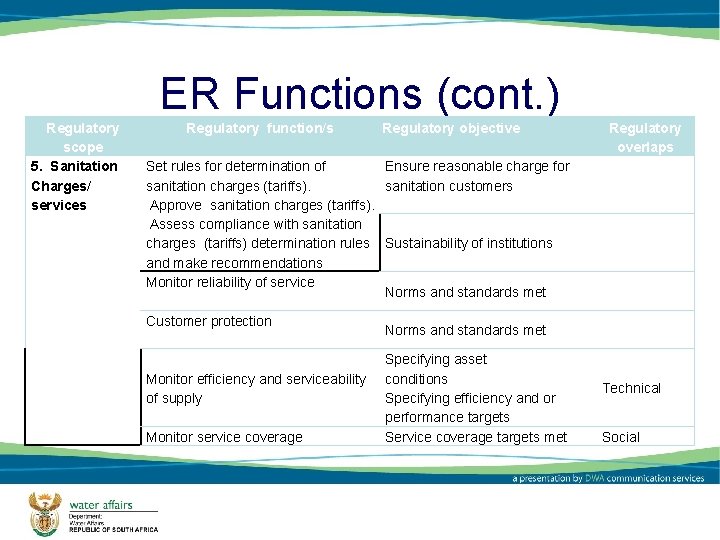
ER Functions (cont. ) Regulatory scope 5. Sanitation Charges/ services Regulatory function/s Regulatory objective Regulatory overlaps Set rules for determination of Ensure reasonable charge for sanitation charges (tariffs). sanitation customers Approve sanitation charges (tariffs). Assess compliance with sanitation charges (tariffs) determination rules Sustainability of institutions and make recommendations Monitor reliability of service Norms and standards met Customer protection Monitor efficiency and serviceability of supply Monitor service coverage Norms and standards met Specifying asset conditions Specifying efficiency and or performance targets Service coverage targets met Technical Social
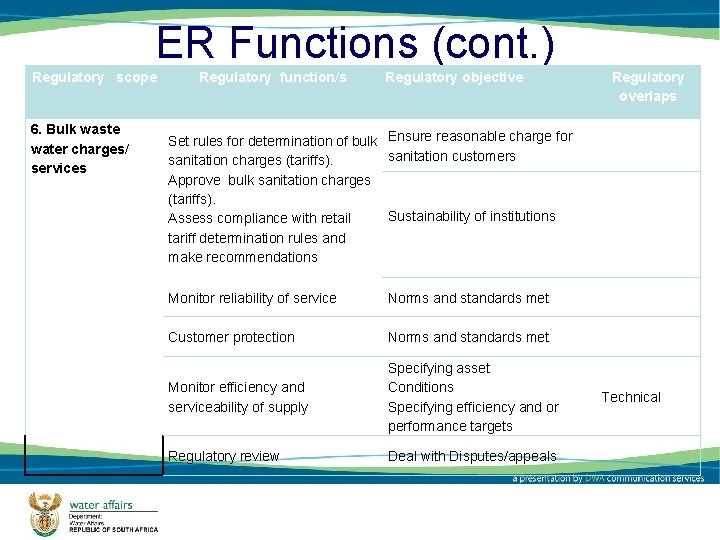
ER Functions (cont. ) Regulatory scope 6. Bulk waste water charges/ services Regulatory function/s Regulatory objective Regulatory overlaps Set rules for determination of bulk Ensure reasonable charge for sanitation customers sanitation charges (tariffs). Approve bulk sanitation charges (tariffs). Sustainability of institutions Assess compliance with retail tariff determination rules and make recommendations Monitor reliability of service Norms and standards met Customer protection Norms and standards met Monitor efficiency and serviceability of supply Specifying asset Conditions Specifying efficiency and or performance targets Regulatory review Deal with Disputes/appeals Technical
ER Functions (cont. ) Regulatory function/s Regulatory objective scope 7. Waste Set rules for waste discharges Ensure reasonable charges discharge determination. Approve waste discharge management Sustainability of institutions charges (Green Drop) Deal with Disputes/appeals Regulatory review Regulatory overlaps Environmental 8. International agreements/ charges Environmental Set rules for review existing raw water tariff charges Ensure reasonable charges Set rules for determination of raw water tariffs for new schemes/ agreements Approve new raw water tariffs Ensure reasonable charges Regulatory review Sustainability of institutions Deal with Disputes/appeals Environmental
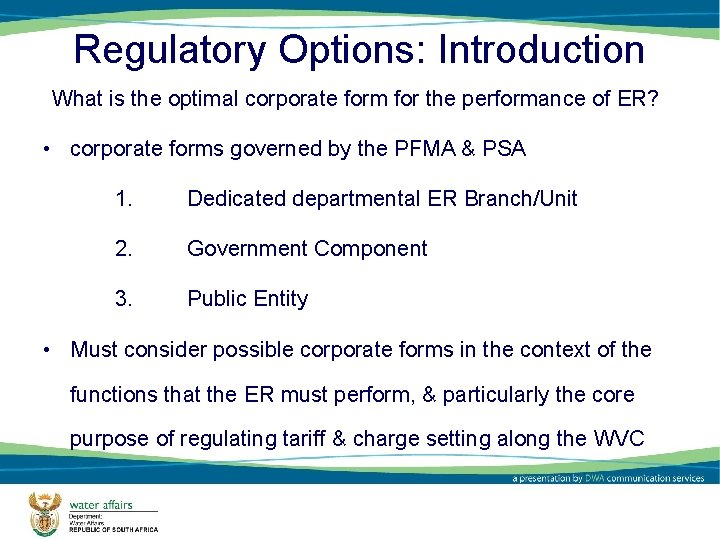
Regulatory Options: Introduction What is the optimal corporate form for the performance of ER? • corporate forms governed by the PFMA & PSA 1. Dedicated departmental ER Branch/Unit 2. Government Component 3. Public Entity • Must consider possible corporate forms in the context of the functions that the ER must perform, & particularly the core purpose of regulating tariff & charge setting along the WVC
Regulatory Option 1: Internal to DWA • ER function performed by DWA • No change to corporate form • Internal restructuring to create dedicated ER branch/unit within branch • Establishment of dedicated regulatory branch – approved in Jan 13 with separate units for the following domains – CDs for each regulatory domain » Compliance monitoring » Enforcement » Waters services regulation
Regulatory Option 1: Internal to DWA • The new branch does not have a dedicated ER branch targeting charges/institutions along the entire WVC • 2 options under Option 1ØOption 1 a – ER Branch • Branch headed by DDG ØOption 1 b – an ER unit within the newly established branch • Unit headed by Chief Director
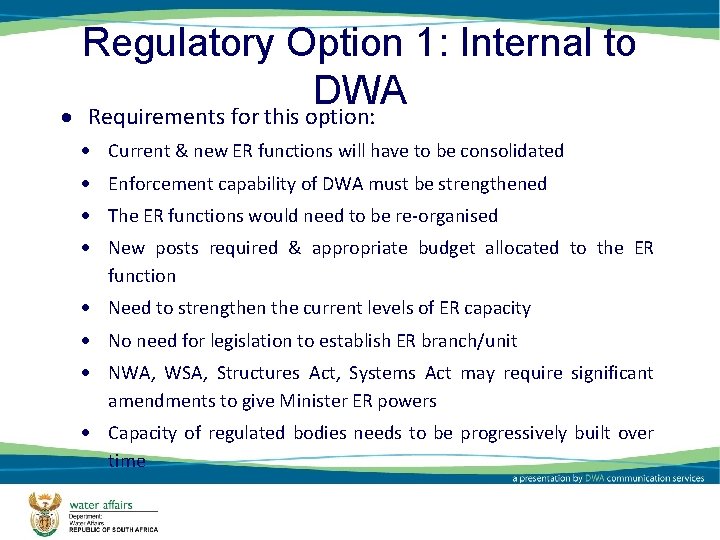
Regulatory Option 1: Internal to DWA Requirements for this option: Current & new ER functions will have to be consolidated Enforcement capability of DWA must be strengthened The ER functions would need to be re-organised New posts required & appropriate budget allocated to the ER function Need to strengthen the current levels of ER capacity No need for legislation to establish ER branch/unit NWA, WSA, Structures Act, Systems Act may require significant amendments to give Minister ER powers Capacity of regulated bodies needs to be progressively built over time
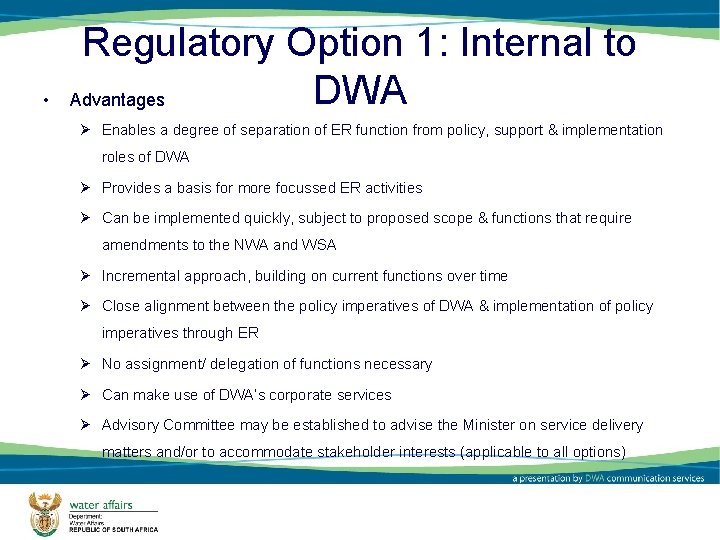
• Regulatory Option 1: Internal to DWA Advantages Ø Enables a degree of separation of ER function from policy, support & implementation roles of DWA Ø Provides a basis for more focussed ER activities Ø Can be implemented quickly, subject to proposed scope & functions that require amendments to the NWA and WSA Ø Incremental approach, building on current functions over time Ø Close alignment between the policy imperatives of DWA & implementation of policy imperatives through ER Ø No assignment/ delegation of functions necessary Ø Can make use of DWA’s corporate services Ø Advisory Committee may be established to advise the Minister on service delivery matters and/or to accommodate stakeholder interests (applicable to all options)
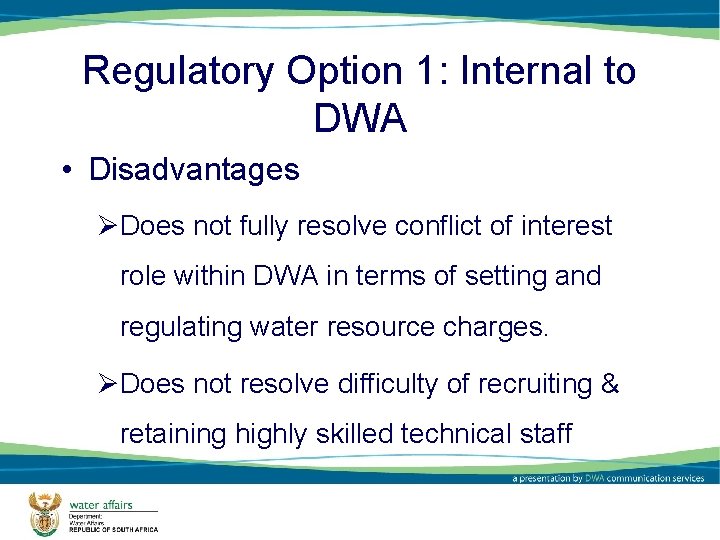
Regulatory Option 1: Internal to DWA • Disadvantages ØDoes not fully resolve conflict of interest role within DWA in terms of setting and regulating water resource charges. ØDoes not resolve difficulty of recruiting & retaining highly skilled technical staff
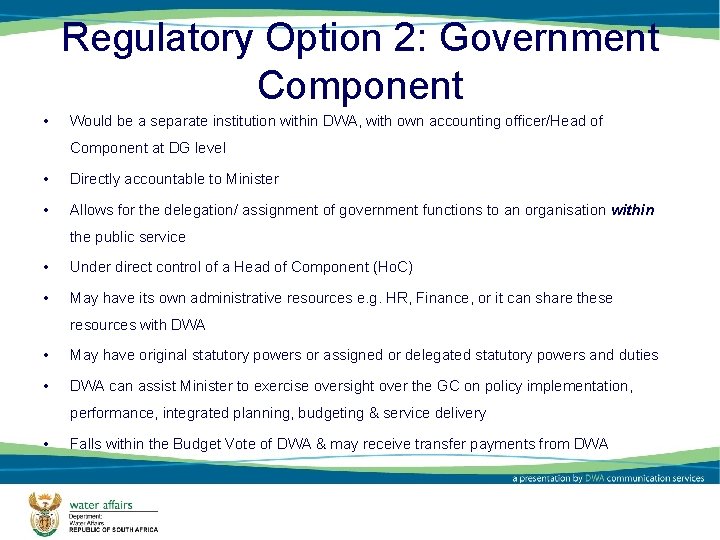
Regulatory Option 2: Government Component • Would be a separate institution within DWA, with own accounting officer/Head of Component at DG level • Directly accountable to Minister • Allows for the delegation/ assignment of government functions to an organisation within the public service • Under direct control of a Head of Component (Ho. C) • May have its own administrative resources e. g. HR, Finance, or it can share these resources with DWA • May have original statutory powers or assigned or delegated statutory powers and duties • DWA can assist Minister to exercise oversight over the GC on policy implementation, performance, integrated planning, budgeting & service delivery • Falls within the Budget Vote of DWA & may receive transfer payments from DWA
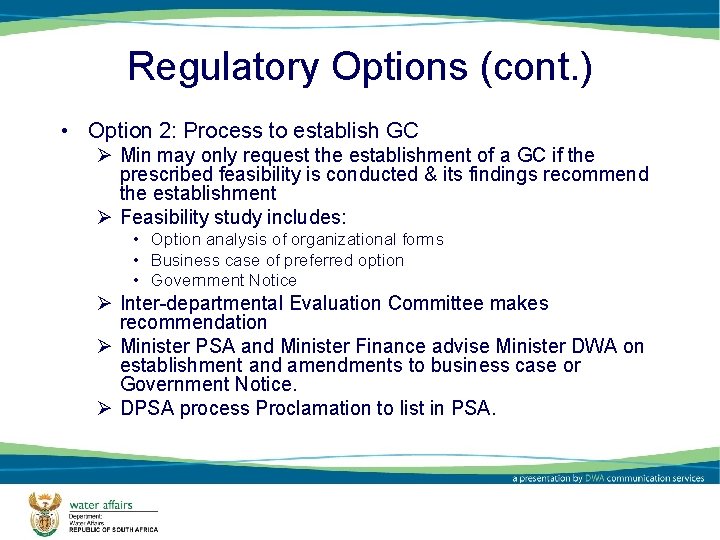
Regulatory Options (cont. ) • Option 2: Process to establish GC Ø Min may only request the establishment of a GC if the prescribed feasibility is conducted & its findings recommend the establishment Ø Feasibility study includes: • Option analysis of organizational forms • Business case of preferred option • Government Notice Ø Inter-departmental Evaluation Committee makes recommendation Ø Minister PSA and Minister Finance advise Minister DWA on establishment and amendments to business case or Government Notice. Ø DPSA process Proclamation to list in PSA.
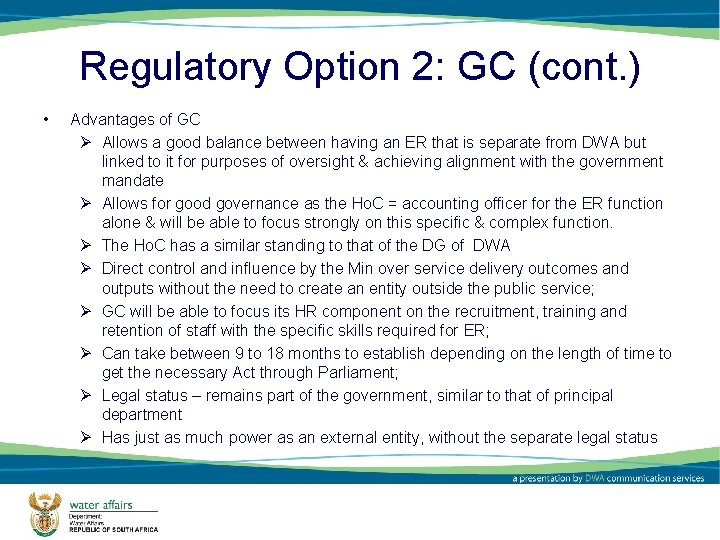
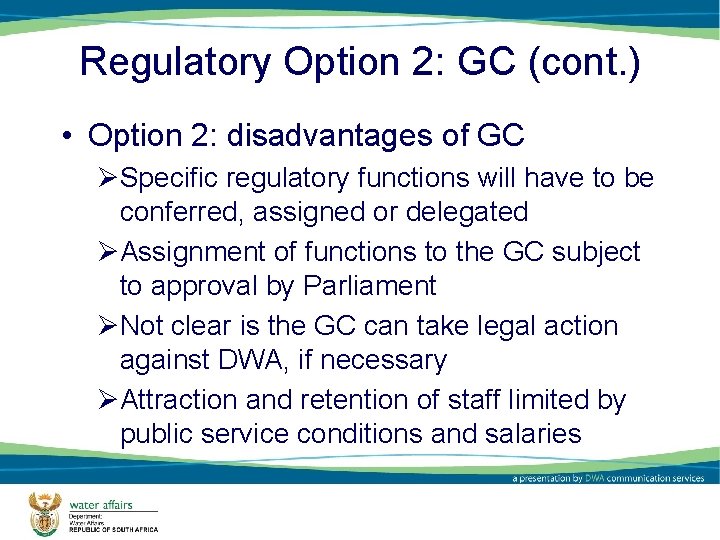
Regulatory Option 2: GC (cont. ) • Advantages of GC Ø Allows a good balance between having an ER that is separate from DWA but linked to it for purposes of oversight & achieving alignment with the government mandate Ø Allows for good governance as the Ho. C = accounting officer for the ER function alone & will be able to focus strongly on this specific & complex function. Ø The Ho. C has a similar standing to that of the DG of DWA Ø Direct control and influence by the Min over service delivery outcomes and outputs without the need to create an entity outside the public service; Ø GC will be able to focus its HR component on the recruitment, training and retention of staff with the specific skills required for ER; Ø Can take between 9 to 18 months to establish depending on the length of time to get the necessary Act through Parliament; Ø Legal status – remains part of the government, similar to that of principal department Ø Has just as much power as an external entity, without the separate legal status
Regulatory Option 2: GC (cont. ) • Option 2: disadvantages of GC ØSpecific regulatory functions will have to be conferred, assigned or delegated ØAssignment of functions to the GC subject to approval by Parliament ØNot clear is the GC can take legal action against DWA, if necessary ØAttraction and retention of staff limited by public service conditions and salaries
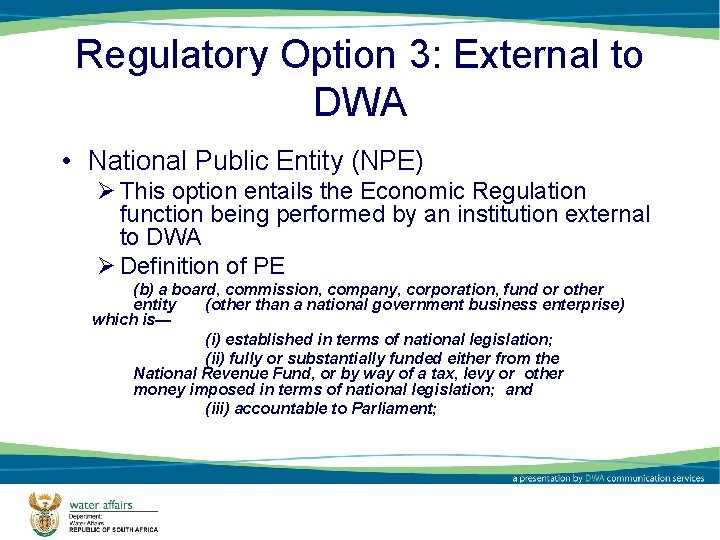
Regulatory Option 3: External to DWA • National Public Entity (NPE) Ø This option entails the Economic Regulation function being performed by an institution external to DWA Ø Definition of PE (b) a board, commission, company, corporation, fund or other entity (other than a national government business enterprise) which is— (i) established in terms of national legislation; (ii) fully or substantially funded either from the National Revenue Fund, or by way of a tax, levy or other money imposed in terms of national legislation; and (iii) accountable to Parliament;
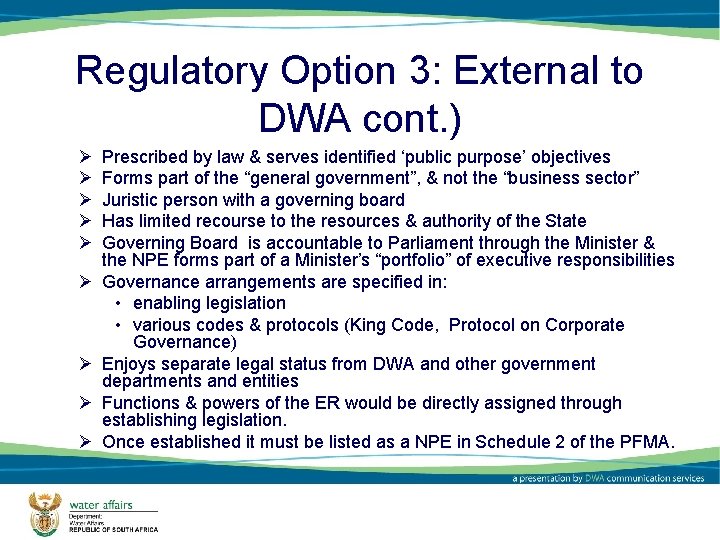
Regulatory Option 3: External to DWA cont. ) Ø Ø Ø Ø Ø Prescribed by law & serves identified ‘public purpose’ objectives Forms part of the “general government”, & not the “business sector” Juristic person with a governing board Has limited recourse to the resources & authority of the State Governing Board is accountable to Parliament through the Minister & the NPE forms part of a Minister’s “portfolio” of executive responsibilities Governance arrangements are specified in: • enabling legislation • various codes & protocols (King Code, Protocol on Corporate Governance) Enjoys separate legal status from DWA and other government departments and entities Functions & powers of the ER would be directly assigned through establishing legislation. Once established it must be listed as a NPE in Schedule 2 of the PFMA.
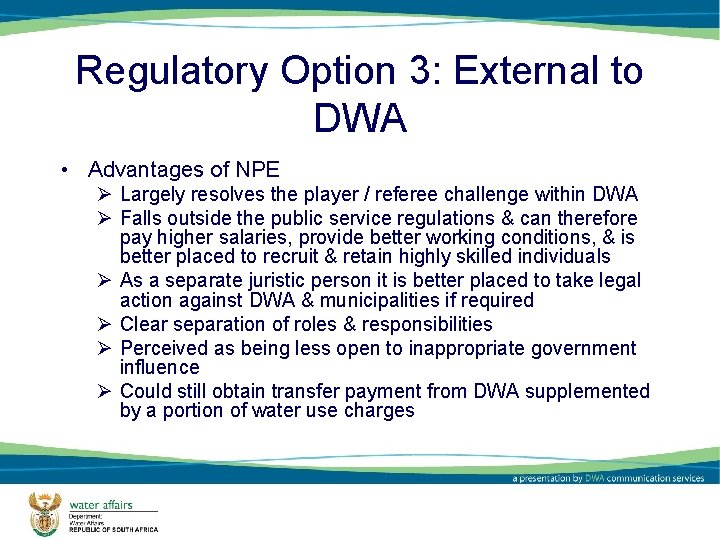
Regulatory Option 3: External to DWA • Advantages of NPE Ø Largely resolves the player / referee challenge within DWA Ø Falls outside the public service regulations & can therefore pay higher salaries, provide better working conditions, & is better placed to recruit & retain highly skilled individuals Ø As a separate juristic person it is better placed to take legal action against DWA & municipalities if required Ø Clear separation of roles & responsibilities Ø Perceived as being less open to inappropriate government influence Ø Could still obtain transfer payment from DWA supplemented by a portion of water use charges
Regulatory Option 3: External to DWA • Disadvantages of NPE ØMore complicated to establish & may take between 2 to 3 years ØGenerally more expensive than the options internal to the public service
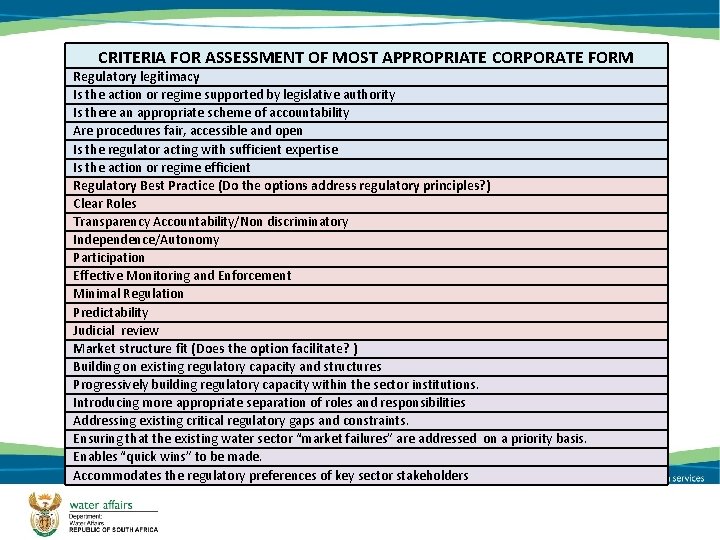
CRITERIA FOR ASSESSMENT OF MOST APPROPRIATE CORPORATE FORM Regulatory legitimacy Is the action or regime supported by legislative authority Is there an appropriate scheme of accountability Are procedures fair, accessible and open Is the regulator acting with sufficient expertise Is the action or regime efficient Regulatory Best Practice (Do the options address regulatory principles? ) Clear Roles Transparency Accountability/Non discriminatory Independence/Autonomy Participation Effective Monitoring and Enforcement Minimal Regulation Predictability Judicial review Market structure fit (Does the option facilitate? ) Building on existing regulatory capacity and structures Progressively building regulatory capacity within the sector institutions. Introducing more appropriate separation of roles and responsibilities Addressing existing critical regulatory gaps and constraints. Ensuring that the existing water sector “market failures” are addressed on a priority basis. Enables “quick wins” to be made. Accommodates the regulatory preferences of key sector stakeholders
THANK YOU