
Economic Regulation and Social Regulation November 26 2007
Economic Regulation and Social Regulation November 26, 2007 Eric Rasmusen, Indiana University, visitor, Nuffield College, Oxford 200708 1
When should the state use coercion? ``Health, safety, morals, and the general welfare'' are the traditional subjects of the police power of the state. Health, safety, and morals might be ends in themselves, but they also might be means to “the general welfare”. Economics adopts a particular definition of “general welfare” called efficiency, or, as I prefer it, surplus maximization. We can use surplus maximization as a test for 2 what regulations are desirable.

The Economist’s Method—The Rational Actor Model 1. Analyze a situation in terms of players, possible actions, information available to each player. 2. Figure out each player’s objectives– his payoff function– usually a matter of trading off different goods. 3. Figure out the equilibrium--- what happens as a result of the interaction of the players. 4. See if different actions or rules to constrain actions would increase the equilibrium payoffs. 3
Usefulness of the Rational-Actor Model 1. Anonymous interactions in goods markets (supply and demand) 2. Strategic interactions in goods markets (game theory) 3. Sociological interactions (marriage, racial discrimination) 4. Political interactions (elections, committee agendas) 4
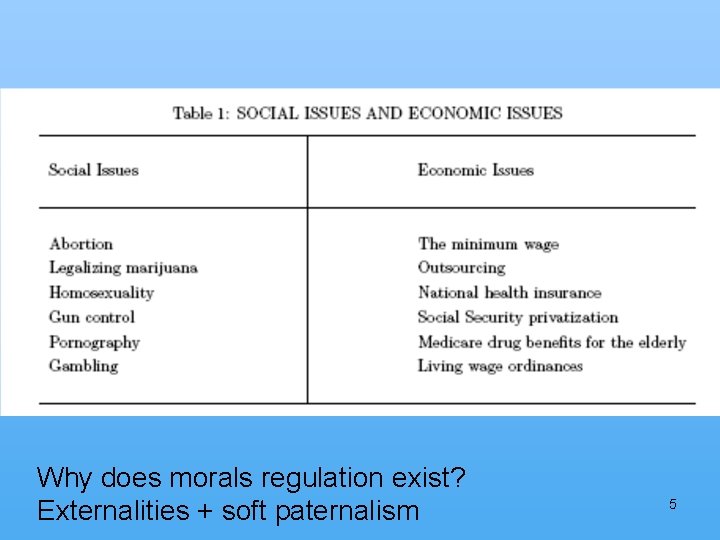
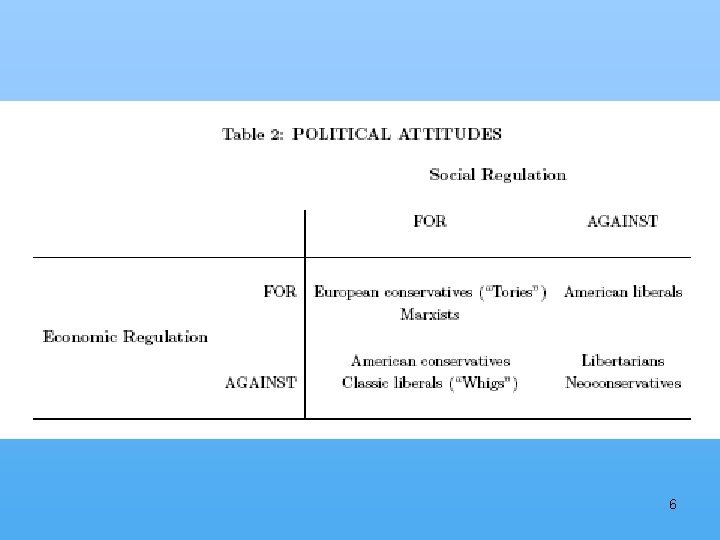
Why does morals regulation exist? Externalities + soft paternalism 5
6
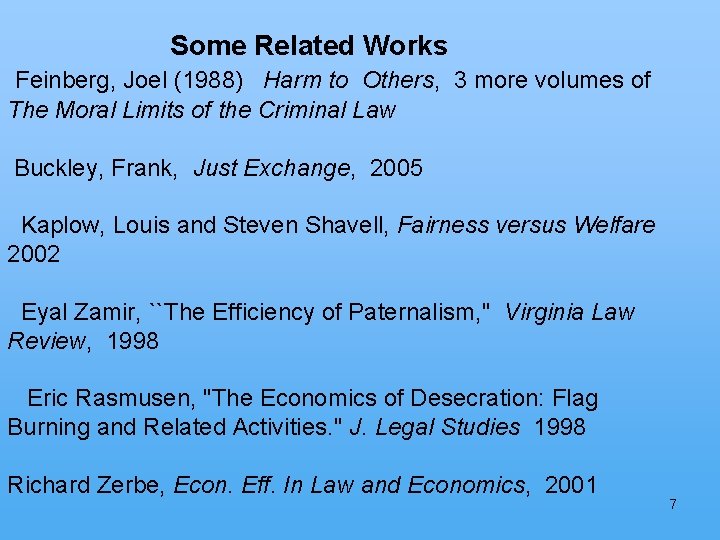
Some Related Works Feinberg, Joel (1988) Harm to Others, 3 more volumes of The Moral Limits of the Criminal Law Buckley, Frank, Just Exchange, 2005 Kaplow, Louis and Steven Shavell, Fairness versus Welfare 2002 Eyal Zamir, ``The Efficiency of Paternalism, '' Virginia Law Review, 1998 Eric Rasmusen, "The Economics of Desecration: Flag Burning and Related Activities. " J. Legal Studies 1998 Richard Zerbe, Econ. Eff. In Law and Economics, 2001 7
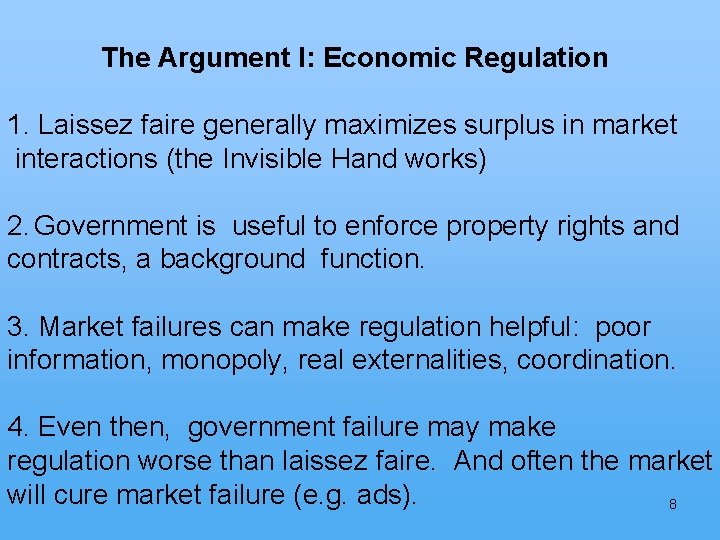
The Argument I: Economic Regulation 1. Laissez faire generally maximizes surplus in market interactions (the Invisible Hand works) 2. Government is useful to enforce property rights and contracts, a background function. 3. Market failures can make regulation helpful: poor information, monopoly, real externalities, coordination. 4. Even then, government failure may make regulation worse than laissez faire. And often the market will cure market failure (e. g. ads). 8
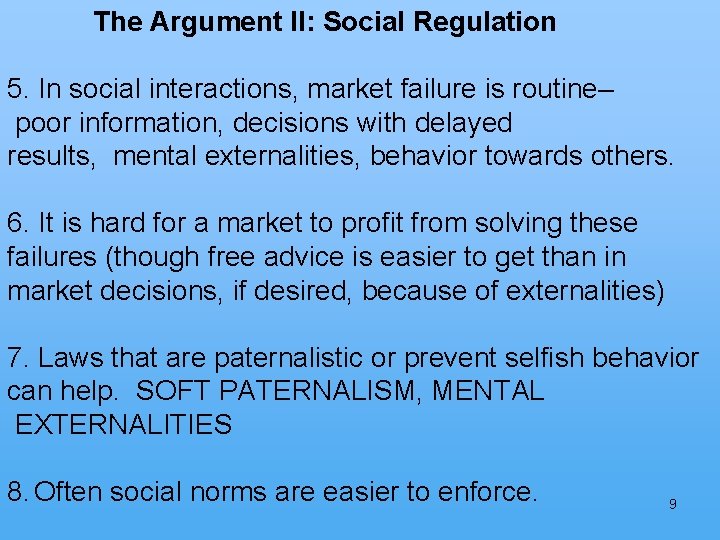
The Argument II: Social Regulation 5. In social interactions, market failure is routine– poor information, decisions with delayed results, mental externalities, behavior towards others. 6. It is hard for a market to profit from solving these failures (though free advice is easier to get than in market decisions, if desired, because of externalities) 7. Laws that are paternalistic or prevent selfish behavior can help. SOFT PATERNALISM, MENTAL EXTERNALITIES 8. Often social norms are easier to enforce. 9
The Argument III- Government Failure 9. Government failure in the form of capture by special interests is less of a danger than in economic regulation because usually there is less profit opportunity. 10. Government failure due to “honest” bad decisions is more of a danger than in economic regulation, since we understand social interactions less well (precisely because they are more complicated). 11. Hence, governments should be cautious either in changing traditional social regulation or imposing new regulation. 10
A Paradigmatic Example Buyer approaches Seller and asks if Seller will sell a bottle of whisky for £ 10. Seller agrees, and the whisky changes hands. Is the transfer of the bottle from Seller to Buyer a good thing? Surplus maximization says that it is. 11
Surplus Maximization Is Consequentialist It is not based on consent. We could have Government force Seller to give the bottle to Buyer, and force Buyer to leave £ 10 with Seller. The result would be the same. Or, we could have Buyer steal the bottle from Seller. The result would be the same. Assumption: we maintain the high value of the Buyer and the low value of the Seller, and ignore incentive effects and transaction costs. 12
Market Background Government is useful to define property. This is a necessary background to the regulation against theft. Government is useful to enforce contracts. Then the money and the bottle need not change hands simultaneously. 13
Market Failure-- Information What if the bottle might be filled with coloured water instead of whisky, and Buyer can’t tell in advance? --- regulations against fraud are useful. --- even without them, seller reputation, warranties, samples can help, at some cost 14
Market Failure--Externalities What if we can predict Buyer will smash the empty bottle on the sidewalk, something Third Party would pay £ 2 to prevent? This is an externality. 1. Give Third Party the property right (or liability right) over bottle-smashing. He must give permission or be paid. 2. Ban whisky sales. (OK if Buyer’s value is £ 11, Seller’s is £ 9. 50). 3. Tax the transaction £ 2. 15
Market Failure– Information, Paternalistic What if whisky is bad for Buyer, in the sense that 10 years later he would be thankful for not having bought it? What if whisky is bad for Buyer in the sense that if he bought it now, he would wish 10 years later that he had been stopped? This is like the JS Mill argument for higher pleasures. He seems to be thinking of informationprocessing failure, though, and he does not respect 16 tastes.
Market Failure-- Externalities What if Third Party would pay £ 2 to prevent Buyer from drinking? Possible reasons: 1. Buyer will be unpleasant or neutral to Third Party when drunk. 2. Third Party cares about Buyer’s health, even though Buyer does not. 3. Third Party thinks drinking whisky is an offense against God. (Is this in itself an information failure? ) 17 (n. b. : the planner take tastes as given)
How Do We Measure Tastes? The externality argument is based on Third Parties caring more in aggregate than Buyer about his behavior. How can we tell? -- The democratic process is helpful. People must decide which laws they care about– they cannot get everything they want. -- This is the same as the problem of public-good spending. There must be one level for everyone. -- In a dictatorship, the dictator, even if benevolent, has trouble knowing tastes. -- A court has the additional problem that it cannot trade its power over laws for money, so 18 inefficiency can result.
Political Regulation What if Smith would pay £ 10 to stop Jones from voting, but Jones would only pay £ 7 to be able to vote? (power) What if Smith would pay £ 5 to stop Jones from arguing for legalization of homosexuality, and Jones would only pay £ 2 to so argue? (public good, binding future) What if Smith would pay £ 9 to stop Jones from burning a flag, and Jones would only pay £ 3 to do it? (time and place regulation) 19
Federalism: Different Laws for Different Places People care most about what happens in their own neighborhoods. This argues for local regulation. The Scotch Sabbath; dry counties in the U. S. , red-light districts. Why don’t we see housing covenants that restrict behavior? – Would the courts allow it? 20
Asymmetric or Libertarian Paternalism (pro, con: Camerer, Issacharoff, Loewenstein, O’Donoghue, Rabin, Sunstein, Thaler, Glaeser) Information disclosure is a relatively harmless form of regulation. So are some regulations aimed at poor decisionmaking. 1. Choice of pension plan default rules. 2. Cooling off periods for door-to-door sales 3. Mandatory disclosure of interest rates, charges. 4. Deadlines to prevent procrastination. 21
Federalism: Different Laws for Different Places People care most about what happens in their own neighborhoods. This argues for local regulation. The Scotch Sabbath; dry counties in the U. S. , red-light districts. Why don’t we see housing covenants that restrict behavior? – Would the courts allow it? 22
Some Financial Regulations 1. Usury laws (Glaeser and Scheinkman) 2. Bankruptcy law (Elizabeth Warren– cut off credit to the poor) 3. Mandatory savings for old age (social security, Deborah Weiss 1998) 4. Anti-discrimination laws (framing problem: is it unjust to charge a woman more than a man for a lifetime annuity? ) 5. Required diversification in 401 -K plans (Enron) 23
Some Other Topics 1. Dynamic inconsistency in preferences. Akrasia, self-control. 2. Discounting and future selves. 3. When does a democracy generate efficient laws? 24
- Slides: 24