
Economic Planning Lecture 3 Types of Planning Continued

- Slides: 19
Economic Planning Lecture 3: Types of Planning Continued
Planning by Inducement • Planning by inducement is often referred to as ‘indicative planning’ or ‘market incentives’. • In such type of planning, the market is manipulated through incentives and inducements. • Accordingly, in this system there is persuasion rather than compulsion or deliberate enforcement of orders. • Consumers are free to consume whatever they like, producers are free to produce whatsoever they wish. • But such freedom of consumption and production are subject to certain controls and regulations.
Planning by Inducement Contd. • The consumers, producers and other factors of production are induced with the help of various fiscal and monetary devices. • For example, if the planning authority wishes to boost the production of cocoa in Ghana it will provide subsidies on agricultural inputs to farmers. • To encourage savings and investment and discourage consumption a suitable package of fiscal and monetary policies can be introduced in the market. • Therefore, the desirable results can be attained with the help of incentives and without the imposition of orders and instructions.
Forms of Planning by Inducement • (a) Forecasting Approach: Under forecasting approach, the individuals are provided with the information, through making certain forecasts which serve as a guide to their decision making. The forecasting not only indicate about the feasible future, but they also specify a desirable future in terms of growth rate of the economy. • (b) Policy Approach: The second component of the indicative planning is concerned with policy approach. Through policy approach, the inconsistent policies of government departments are co-ordinated within a coherent model framework keeping in view the set objectives. Moreover, when once the policies are co-ordinated, they will provide guidelines to the people, consumers and producers. • (c) Corporate Approach: The third way to demonstrate indicative planning is through corporative approach. This approach is practised in France. Here the coordination function of indicative planning is at two levels. In the first place, it requires co-ordination of the behaviour of economic groups like business enterprises and trade unions, etc. which hold power in the market. In the second place, it co-ordinates the relation between private and public activities.
Planning by Direction • This is also known as imperative planning. • This type of planning is practised in socialist countries like China, Former USSR, Cuba, North Korea. • Under planning by direction, there is one central authority which plans, directs and orders the execution of the plan in accordance with the pre-determined targets and priorities. • It determines the production figures, delivery schedules, quotas regarding the production of the goods, price controls, use of foreign exchange and allocation of resources like labour, etc. amongst different competing uses. • Planning by directions is similar to military or defence plans which are carried through orders and instructions. Thus the strategy of planning through directions coincides with the military strategy.
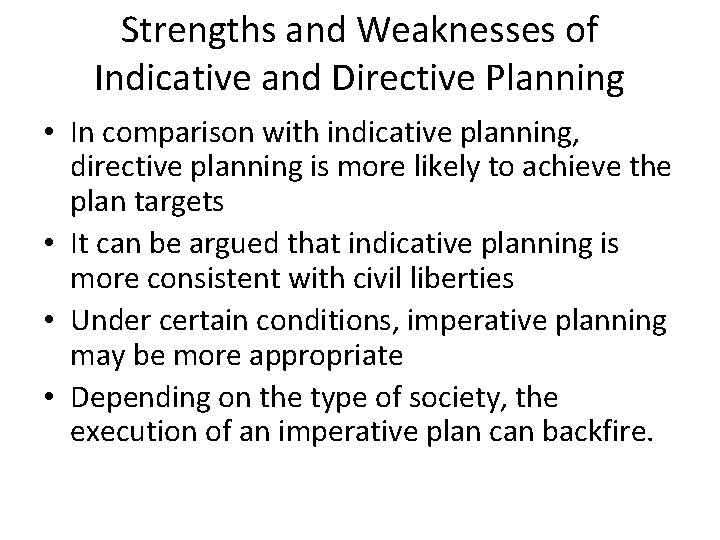
Strengths and Weaknesses of Indicative and Directive Planning • In comparison with indicative planning, directive planning is more likely to achieve the plan targets • It can be argued that indicative planning is more consistent with civil liberties • Under certain conditions, imperative planning may be more appropriate • Depending on the type of society, the execution of an imperative plan can backfire.
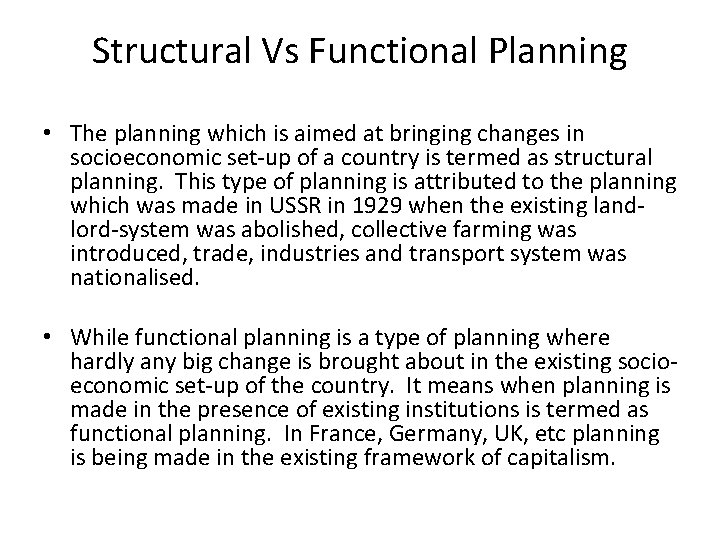
Structural Vs Functional Planning • The planning which is aimed at bringing changes in socioeconomic set-up of a country is termed as structural planning. This type of planning is attributed to the planning which was made in USSR in 1929 when the existing landlord-system was abolished, collective farming was introduced, trade, industries and transport system was nationalised. • While functional planning is a type of planning where hardly any big change is brought about in the existing socioeconomic set-up of the country. It means when planning is made in the presence of existing institutions is termed as functional planning. In France, Germany, UK, etc planning is being made in the existing framework of capitalism.
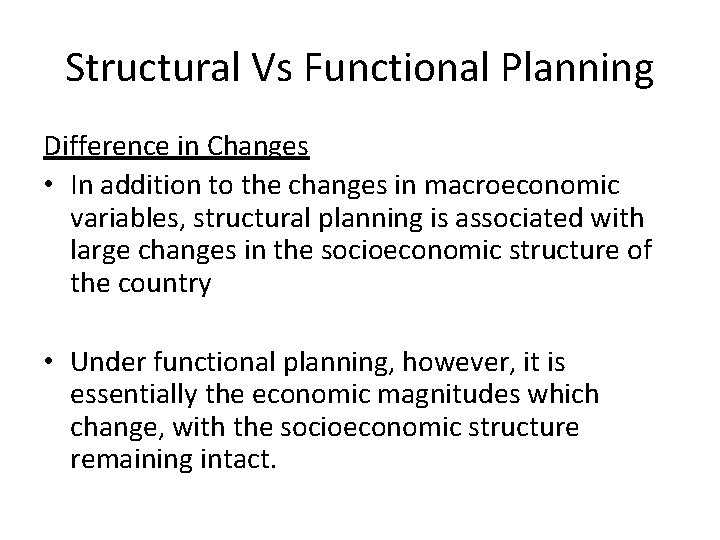
Structural Vs Functional Planning Difference in Changes • In addition to the changes in macroeconomic variables, structural planning is associated with large changes in the socioeconomic structure of the country • Under functional planning, however, it is essentially the economic magnitudes which change, with the socioeconomic structure remaining intact.
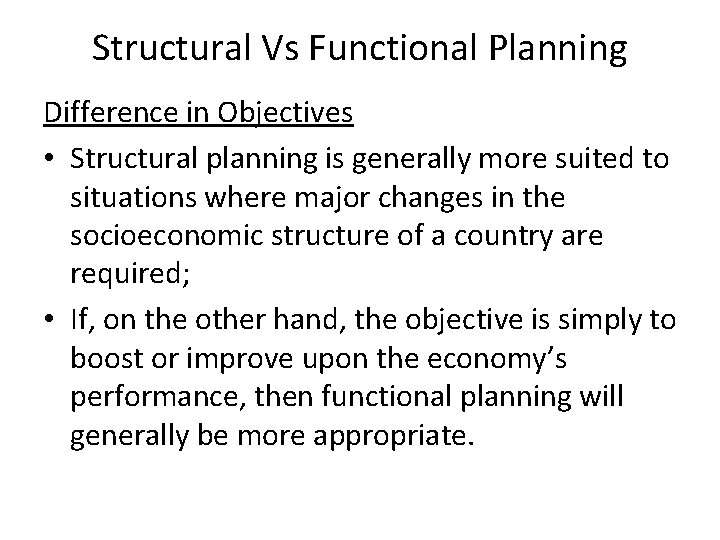
Structural Vs Functional Planning Difference in Objectives • Structural planning is generally more suited to situations where major changes in the socioeconomic structure of a country are required; • If, on the other hand, the objective is simply to boost or improve upon the economy’s performance, then functional planning will generally be more appropriate.
Structural Vs Functional Planning Difference in Requirements • With structural planning, the requirements for plan implementation are many and significant: – A pool of administrative personnel which is adequate to manage new situations – Public support for the plan – A huge amount of financial resources – A tier of leadership capable of successfully implementing the plan. • Functional planning is relatively less demanding.
Structural Vs Functional Planning Possibility of Convergence • In the case of structural planning, the new setup that emerges from the plan’s implementation can provide a stable system within which functional planning can thrive; • Similarly, a period of functional planning can eventually give way to structural planning on the socioeconomic dynamics of the country.
Structural Vs Functional Planning: Are Convergence and Co-existence Possible? Possibility of Convergence • In the case of structural planning, the new set-up that emerges from the plan’s implementation can provide a stable system within which functional planning can thrive; • Similarly, a period of functional planning can eventually give way to structural planning on the socioeconomic dynamics of the country.
Convergence and Co-existence Possible? Possibility of Co-existence • Coexistence is also possible – Coexistence via different time phases of the economic plan; – Coexistence via different geographical areas of the plan; – Where both structural and functional planning occurs within the same plan the plan can be labelled structural or functional depending on which kind dominates
Centralized Vs Decentralized Planning • Centralised planning is mostly executed in socialist or communist countries. • Under centralised planning, all the economic decisions are taken by the central authority or the government. Eg. Decisions on consumption, production, wages and prices. What amount of investment is to be made? , What should be the price? , What should be the output? , How the products are to be distributed? , How much amount of loans is to be granted? , What should be the rate of interest? , etc. • It is the government which formulates economic plans, determines objectives, sets targets and priorities. Every member has simply to carry out the instructions without questioning about its viability. • There are more chances of failure as the individuals are not allowed to carryout the plans in accordance to their needs and preferences. • It is the government who takes responsibility of the success or failure of the plan.
Centralized Vs Decentralized Planning • Decentralised planning is connected with the capitalistic economies. • The decentralised planning is implemented through market mechanism. • Decentralised planning empowers the individuals or small groups to carryout their plans for achievement of a common goal. • Under decentralised planning, the operation is from bottom to top. The planning authority formulates the plan by having made consultation with different administrative units of the economy. • The plans regarding different industries are designed by the representatives of these industries. In such type of planning, the planning authority issues the instructions to central and local bodies regarding incentives given over to private sectors.
Fixed Plans Vs Rolling Plans • In a fixed plan, the contents of the plan are fixed in relation to a fixed time period. • These contents consisting of targets, priorities, strategies and resources, etc. will not be changed during the particular time period for which the plan has been prepared except for severe unforeseen events.
Merits/ Demerits of Fixed Plans Merits – There is a boldness in planning. This is the essence of planning that the planners and implementing machinery will not bow down before the obstacles. – There is effective implementation of plan. – The targets of fixed plan are certain and this certainty in objectives brings stability to the economy. – Fixed plans ensure discipline for the planning process. Demerit – Fixed plans are inflexible plan. They cannot be altered in later phases. – There is no revision of economic objectives and targets as there is no alteration allowed under fixed planning. – If the state is an under-developed country, the fixed plan would give the economy a hard time to achieve the basic objectives like employment, industrialisation, education, health, etc. – Fixed plans, if not properly formulated and implemented, lead to wastage of resources.
Rolling Plans Rolling planning refers to the rolling of a plan at intervals usually one year, so that it continues to be a plan of certain number of years. It is usually the medium term plan. Merits – Rolling plans are flexible and can be altered in later phases. – The rolling plan allows for revisions and adjustments. In rolling plan, review of the plan is a continuous exercise. – Rolling plans enable the planners to keep the time horizon moving, along with making revisions and adjustments so as to prepare a new plan every year in accordance with the changing circumstances. Demerits – Rolling plan is furnished with uncertainty, as there is no fixation of economic objectives. – In rolling plans, the planners are always reluctant in taking difficult decisions or taking courageous decisions. – Under rolling plan, there is a lack of commitment. As there is no fixity attached with the plans, the enthusiasm on the part of planning and administrative machinery will hardly be found.
Next Class • Read on Rationale for Planning