
Economic Measurements Chapter 2 Key Terms 2 1

- Slides: 28
Economic Measurements Chapter 2
Key Terms 2. 1 n Gross Domestic Product (GDP) GDP per capita Unemployment rate Productivity Personal income Retail sales n Read FOCUS ON REAL LIFE together n n n
What Is Economic Growth ? A steady increase in production of goods and services n High rate of employment and low rate of business failures = a good economy n Labor and consumer spending help economic growth n Use GDP to measure economic growth
Gross Domestic Product (GDP) $12. 4 trillion n n Total dollar value of all goods and services produced in a country in 1 yr 4 categories of economic activity – Spending on food, clothing, and housing – business spending on buildings, equipment, and inventory – gov’t spending on paying employees and buying supplies – The amount of exports of a country minus the imports n GDP should INCREASE year to year
What is NOT included in GDP n Only final goods are counted when we measure GDP (cars) —no materials n The value of the work you do yourself is not included – Cutting your own lawn, building your own storage shed
GDP Per Capita n The GDP of a country divided by its population; person GDP ÷ total population Increase in GDP per capita = economic growth n Decrease = economic trouble n
Labor Productivity n Employment – Over 145 million people work (over 16) – Students, retired people, and others who cannot or choose not to work are not considered part of the labor force – Unemployment rate is a concern n Portion of people in labor force NOT working n Main cause of is a reduced demand for the goods/services that actual workers make
Labor Productivity (cont) n Productivity is measured in terms of the number of items produced per worker n Productivity increase – More output from the same number of workers-which helps economic growth
Labor productivity (cont) n If salaries increase faster than items are produced, prices of goods/services also increase n n n So even though you make more money, you can’t live any better because costs go up for groceries, gas, bills People always want to produce items quickly High productivity makes it possible to reduce the number of hours in a workweek n Go home early!!
Consumer Spending The money you earn and spend is #1 factor in economic growth n Personal Income n – salaries/wages, government payments n Retail Sales – Sales of all goods bought by consumers – Can show consumer spending patterns – Increase in sales = economic growth
2. 1 Assessment Quiz
2. 2 Key Terms n n n n Business cycle Prosperity Recession Depression Recovery Inflation Price index Deflation
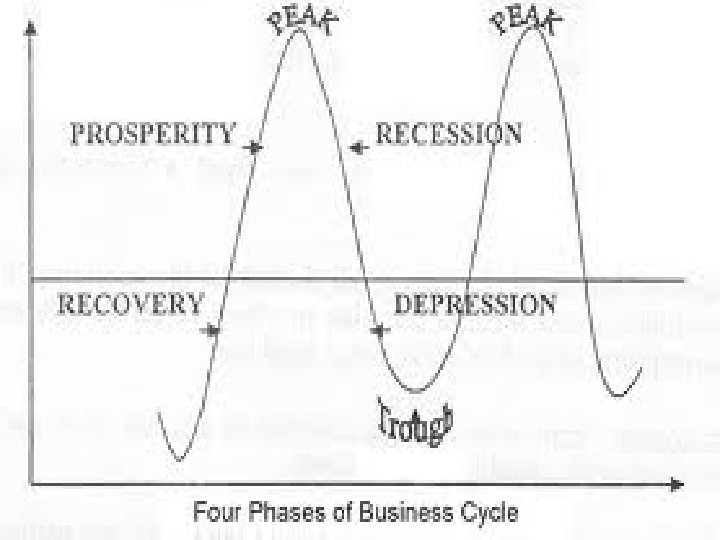
The Business Cycle Continuous ups and downs of GDP n How the economy moves from one condition, to another, and back again n 4 phases of the business cycle: n – Prosperity – Recession – Depression – Recovery
Prosperity LOTS of jobs n Businesses produce goods/services in record numbers n Wages are good and GDP increases n Demand for goods/services is high n Peak (high point) of business cycle n
Recession Economy slows down n Demand begins to decrease n businesses lower production of goods n unemployment rises n May not be serious, but trouble maybe n Causes the ripple effect – trouble for workers in a related business (Automobiles: sales, parts, service) n
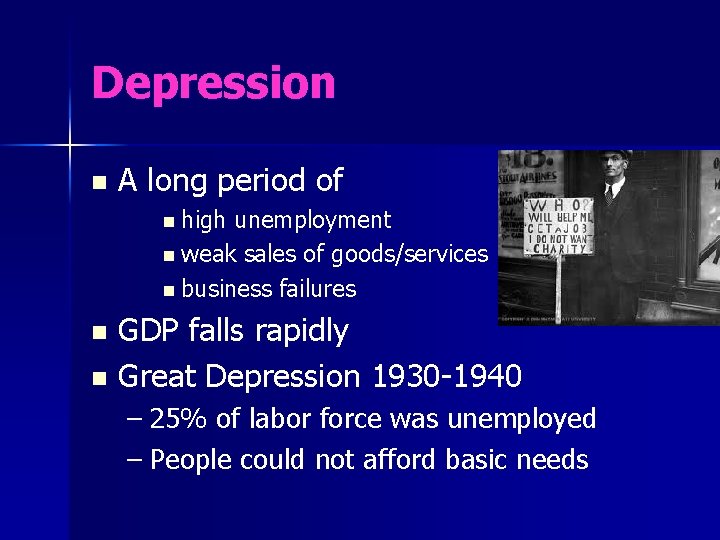
Depression n A long period of n high unemployment n weak sales of goods/services n business failures GDP falls rapidly n Great Depression 1930 -1940 n – 25% of labor force was unemployed – People could not afford basic needs
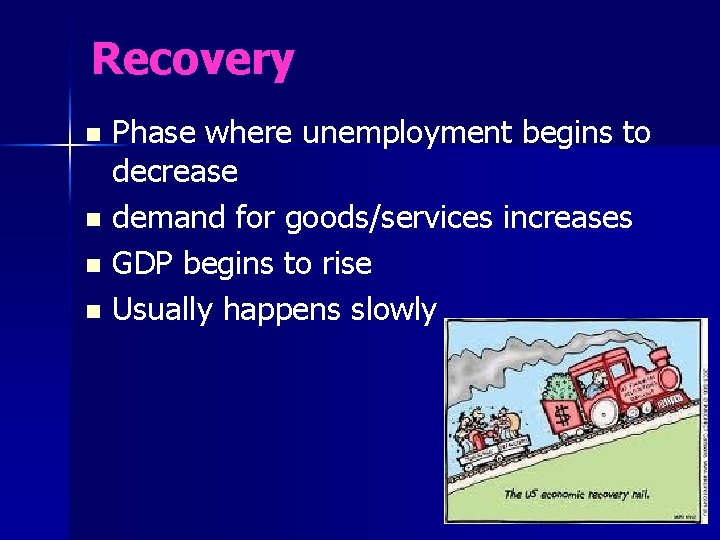
Recovery Phase where unemployment begins to decrease n demand for goods/services increases n GDP begins to rise n Usually happens slowly n
Inflation n Inflation- increase in the general level of prices over time – The buying power of the dollar decreases n EX: If prices increased 5% in the last year, items that cost $100 last year now cost $105. It now takes more money to buy the same amount of products n GAS!!
Causes of Inflation Demand for goods is greater than the supply n Workers must make more money but must keep the same standard of living because other prices increase n Most harmful to people on fixed incomes—not able to afford as much n
Measuring Inflation n How can you tell how fast prices rise? n Consumer Price Index – A number that compares numbers from one year to earlier years
Deflation A decrease in the level of prices n Occurs during recession or depression periods to make things affordable n Prices are lower, but wages are lower n During Great Depression, prices dropped 25% n Groupon n
Interest Rates How much you have to pay to borrow money from a bank or credit card n Bad credit=HIGH interest rate n The more people borrow, the higher the interest rates n
2. 2 Assessment
2. 3 Vocab n n n Capital projects Stock Bond Budget surplus Budget deficit National debt
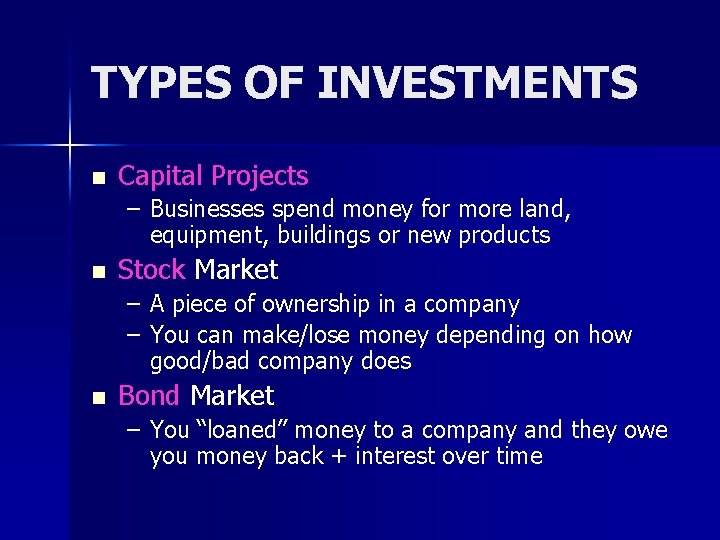
TYPES OF INVESTMENTS n Capital Projects – Businesses spend money for more land, equipment, buildings or new products n Stock Market – A piece of ownership in a company – You can make/lose money depending on how good/bad company does n Bond Market – You “loaned” money to a company and they owe you money back + interest over time
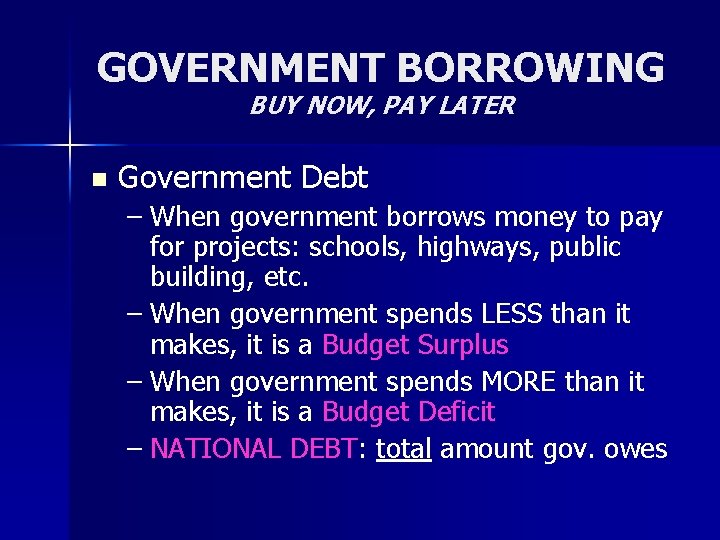
GOVERNMENT BORROWING BUY NOW, PAY LATER n Government Debt – When government borrows money to pay for projects: schools, highways, public building, etc. – When government spends LESS than it makes, it is a Budget Surplus – When government spends MORE than it makes, it is a Budget Deficit – NATIONAL DEBT: total amount gov. owes
2. 3 Assessment n CHAPTER 2 ASSESSMENT / DECISION MAKING STRATEGIES