
Economic Impact Payments Stimulus Checks https www irs


- Slides: 36
Economic Impact Payments “Stimulus Checks” https: //www. irs. gov/coronavirus/economic-impact-payments https: //www. irs. gov/coronavirus/economic-impact-payment-information-center June 23, 2020
Objectives • Know what the payment is and is not • Understand who gets the payment and who does not • Explain the different payment forms • Assist clients to obtain status of a payment • Explain the effect payments have on other benefits • Identify potential fraud scenarios • Recognize other potential issues
Stimulus vs. Unemployment Stimulus Unemployment • Federal • (almost) everyone is eligible • No application necessary • Set amounts: $1200/$500 • Federal and State • Only for loss/reduction of employment • Must apply • Amount based on circumstances
• U. S. citizens and U. S. resident aliens Who Is Eligible? • If they filed married filing jointly and if they are not a dependent of another taxpayer and have a work eligible Social Security number with adjusted gross income up to: • $150, 000 for married couples filing joint returns • $112, 500 for head of household filers and • $75, 000 for all other eligible individuals • Taxpayers will receive a 5% reduction in their payment for the amount their AGI is above these amounts.
Who is NOT Eligible? • Some high-income filers • If you can be claimed as a dependent on someone else’s return • If you do not have a Social Security number that is valid for employment • If you are a nonresident alien • If you filed Form 1040 -NR, 1040 NR-EZ, Form 1040 -PR, or Form 1040 -SS for 2019 • Incarcerated individuals • Deceased individuals (sometimes) • An estate or trust (see above)
Automatic vs. Registering for Payment • Recipients of Social Security retirement, survivor, or disability benefits (SSDI), Railroad Retirement benefits, Supplemental Security Income (SSI) and VA Compensation and Pension (C&P), who do not file a tax return, will receive a $1, 200 payment automatically • Eligible taxpayers who filed tax returns for 2019 or 2018 (should) receive the payments automatically • People who have little or no income and didn’t file a tax return or don’t receive any of the federal benefits listed above • Need to register with the Non-Filer tool
Non-Filers • You are not required to file a federal income tax return for 2019 for any reason, including • Income is less than $12, 200 • Married filing jointly and together your income is less than $24, 400 • No income
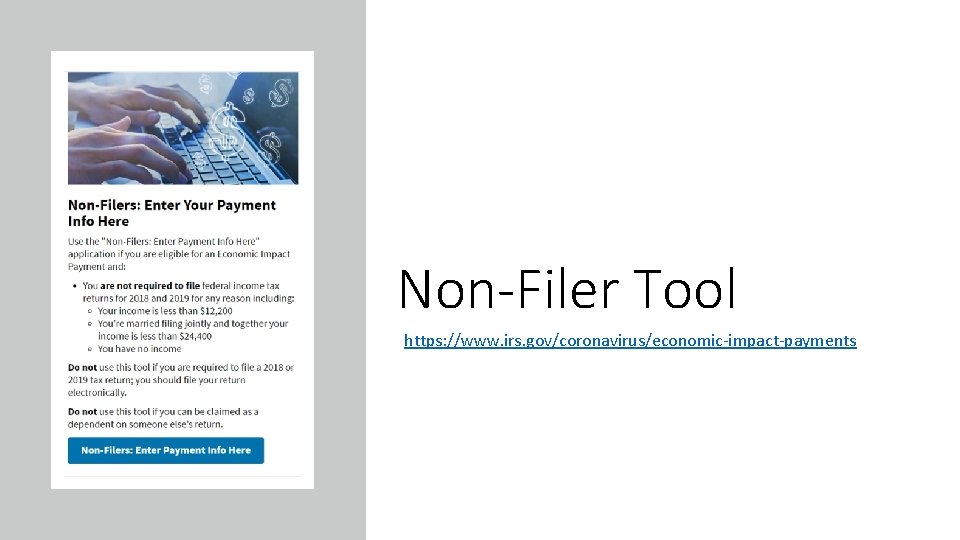
Non-Filer Tool https: //www. irs. gov/coronavirus/economic-impact-payments
Non-Filers – Information to Provide • Full name, current mailing address and an email address • Date of birth and SSN • Bank account number, type and routing number, if you have one • Identity Protection Personal Identification Number (IP PIN), if you have one • Driver’s license or state-issued ID, if you have one • For each qualifying child during 2019: • Name • SSN or Adoption Taxpayer Identification Number and relationship to you or your spouse
Forms of Payment DIRECT DEPOSIT PAPER CHECKS DEBIT CARDS
Direct Deposit • If you received direct deposit of your refund based on your 2019 tax return (or 2018 tax return if you haven’t filed your 2019 tax return), the IRS sends payment to the bank account provided on the most recent tax return
Paper Check • If you filed your 2019 or 2018 tax return but did not receive your refund by direct deposit, payments are mailed to the address the IRS has on file even if you also receive Social Security, Railroad Retirement or Veterans Affairs benefits by direct deposit • This is generally the address on the most recent tax return or as updated through the Postal Service
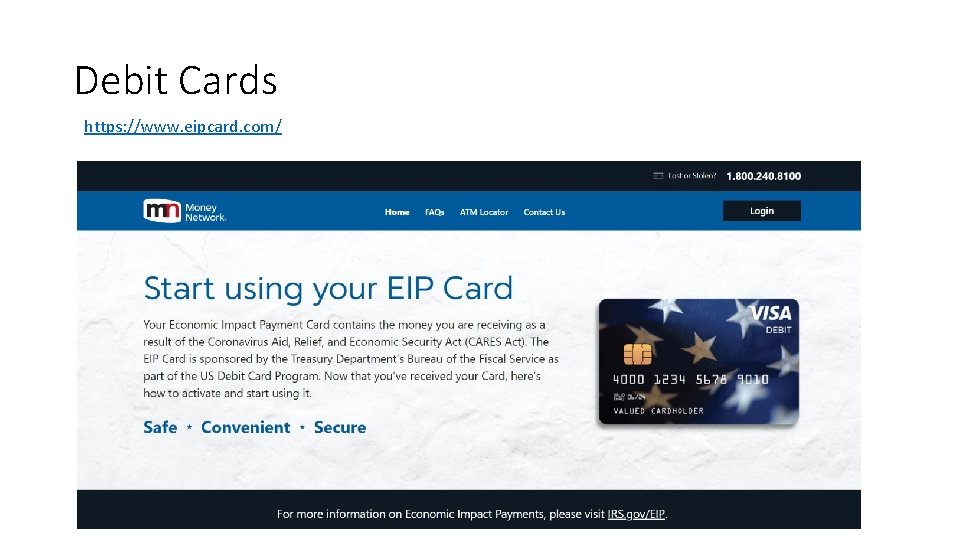
Debit Cards https: //www. eipcard. com/
Debit Cards – Potential Problems • Throwing Away (mailed in a plain white envelope) • See the EIP card website or IRS coronavirus website for how to get a replacement • Fees • Out-of-network ATM withdrawals and ATM operator fees • ATM balance inquiries • Replacement cards • Bank/teller over-the-counter withdrawals • Scams (below)
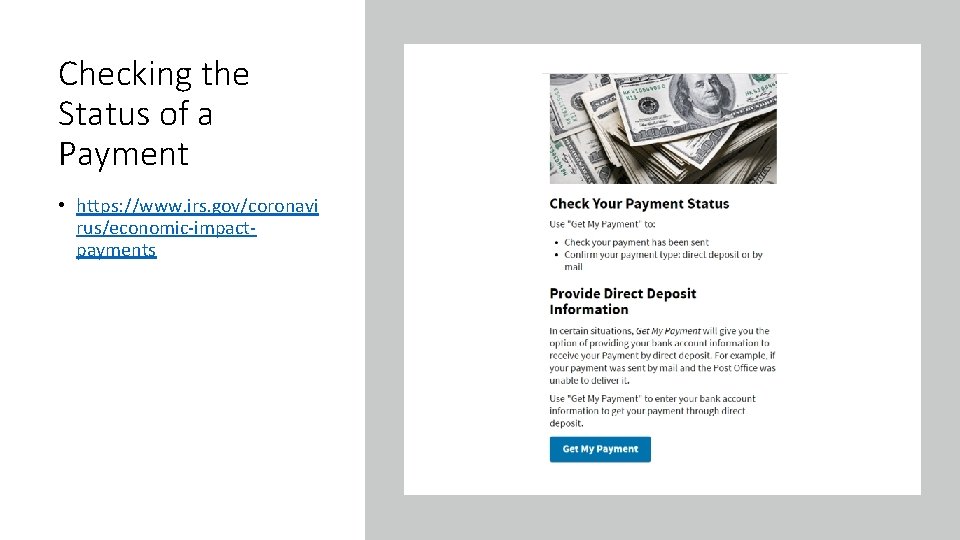
Checking the Status of a Payment • https: //www. irs. gov/coronavi rus/economic-impactpayments
Stimulus Check & Public Benefits • IS NOT COUNTED for • Food. Share (FSH 4. 3 and 4. 4. 1) • Medicaid • Tax refunds and advance tax credits are excluded from income and excluded from assets for the first 12 months after they’re received (26 USC § 6409) • SSI (POMS SI 00830. 060, SI 01130. 676)
• Fake Checks/Debit Cards • Unusual amount • Check that requires verification • Direction to deposit the check then send money back because the IRS paid you more than you were owed Scams • Social Security Number/Debit Card Number Requests • Scammers posing as the IRS to request Social Security numbers in order to receive your stimulus check (calling, emailing, texting, contacting on social media) • Processing Fees • Scammers promise to get your money quicker if you pay a fee
Avoiding stimulus payment scams • The IRS won’t contact you by phone, email, text message, or social media with information about your stimulus payment Scams • The IRS will not ask you for your Social Security number, bank account, or government benefits debit card account number • You don’t have to pay to get your stimulus money • Official correspondence will ONLY refer to the check or debit card as “Economic Impact Payment (EIP)” not “stimulus”
Miscellaneous Problems
Disclaimer • Information is still changing daily • These are our best troubleshooting suggestions as of today’s date
Missing Checks • 157 million checks issued through May 22 • As of June 5, an estimated 30 -35 million payments are yet to be issued, including payments for: • 13 -18 million taxpayers who file returns below the CARES Act income thresholds* • 7. 5 million Social Security and RRB recipients who do not file tax returns* • 10. 7 million taxpayers who are not required to file tax returns and who do not receive Federal government benefits • Millions (exact number unknown) of SSI-only or VA recipients who do not file tax returns* * Treasury Dept. should have the necessary information for most of these individuals • The IRS also has an estimated 10 million pieces of mail to open and process, including 4. 7 million tax returns. Some of these returns may be from first-time filers who would qualify for EIPs.
Possible Issues • Non-filers who did not complete non-filer tool • IRS missing correct bank account info – must wait for paper check • Threw out debit card because it looked like junk mail • Divorced spouse filed as married filing jointly in 2018 • Claimed as dependent in 2018 • Missing $500 payment for dependent children
General Troubleshooting • Confirm eligibility • If 2019 income was too high, but 2020 income is lower, will have to file 2020 tax return • If non-filer, was non-filer form filled out? • Remember that non-filers who started receiving SS benefits after Jan. 1, 2020 will not receive payments automatically! • Don’t fill out non-filer form if there’s still a chance of filing a 2019 tax return! • Check payment status online: https: //www. irs. gov/coronavirus/economic-impactpayments • Call EIP phone line 800 -919 -9835 to resolve various issues – • Be prepared for long wait! • IRS Form 3911 if check was lost, stolen, or sent to someone else: https: //www. irs. gov/pub/irs-pdf/f 3911. pdf
Divorced Spouses • Check payment status online first • Call EIP phone line - 800 -919 -9835 • Form 3911 to trace payment • May need to file paper superseding return by July 15 if listed on 2019 return by someone else • Wouldn’t affect how 2018 return was filed • Outside our scope, see a tax professional for more information, note upcoming deadline! • May need a legal fix to get payment – outside our scope!
Claimed as Dependent on 2018 Return • Check payment status online first • Call EIP phone line - 800 -919 -9835 • Form 3911 to trace payment • May need to file paper superseding return by July 15 if listed on 2019 return by someone else • Wouldn’t affect how 2018 return was filed • Outside our scope, see a tax professional for more information, note upcoming deadline!
Missing $500 Check for Dependent Child • Deadline for non-filers who receive SSR, SSDI, SS survivor benefits, RRB, SSI, VA benefits and who have minor children has passed; • Benefit payments for these individuals were scheduled for payment in mid-May (if not earlier) • If individuals who receive these benefits and have minor children did not complete the nonfiler form on time, they must file a 2020 tax return to claim any additional EIP amount they didn’t receive this year • Child may have been claimed by other parent on 2018 or 2019 return • • Clients should always check their own payment status online first Call EIP phone line - 800 -919 -9835 IRS Form 3911 to trace payment May need a legal fix to get payment if, for example, this violates divorce settlement – outside our scope!
Incorrect Bank Account Information • Banks that receive stimulus checks for closed or non-existent accounts should reject payments • Once the payment is rejected, the IRS will send a paper check • “Get My Payment” tool may allow someone to provide bank account information in order to receive payment by direct deposit
Checks Sent to Tax Preparers • Ask tax preparer if they have the money • Sometimes tax preparer accounts are temporary accounts that are closed after someone pays or receives their refund • These may have been closed when stimulus check was sent. Payment would eventually get returned to IRS, and the IRS would eventually send out a paper check
Checks Sent to Nursing Homes • FTC and CMS have clearly said that nursing homes, assisted living facilities, etc. cannot seize stimulus checks from residents: • https: //www. consumer. ftc. gov/blog/2020/05/did-nursing-home-or-assisted-living-facilitytake-your-stimulus-check • https: //www. cms. gov/newsroom/press-releases/nursing-home-residents-right-retain-federal -economic-incentive-payments • If you hear about a nursing home, assisted living, other care facility, Family. Care MCO, or other program that is asking residents to sign over their stimulus checks, contact your BSSA • It is NOT countable income and is not part of a patient liability or cost share. Likewise, it is NOT a countable asset until 12 months after the month of receipt. Therefore, it is inappropriate for staff to pressure residents into signing over their checks • May need to be reported to appropriate state agency, could be a violation of state or federal law
Deceased Recipients • When was the check received? • Prior to death: Recipient is eligible • After death: Recipient is not eligible, check should be returned • Check sent to deceased recipient and surviving spouse: • Return the portion of the payment made to the decedent. If check cannot be deposited, return the entire check. The IRS will reissue a check to the surviving spouse. • Case-specific, discuss with BSSA • Possible estate tax issues, personal representative issues, etc. • Consider surviving spouse’s goal and risk tolerance
Returning a Payment – Check or Direct Deposit • Paper check: • Write “VOID” in the endorsement section on the back of the check • Don't staple, bend, or paper clip the check • Include a brief explanation stating the reason for returning the check • Paper check that was cashed or payment was a direct deposit: • Send a personal check, money order, etc. • Make check/money order payable to “U. S. Treasury” and write 2020 EIP and the taxpayer identification number (SSN or ITIN) in the memo line • Include a brief explanation of the reason for returning the EIP • Mail to address listed for WI under “Returning the Economic Impact Payment” here: https: //www. irs. gov/coronavirus/economic-impactpayment-information-center
Returning a Payment – Debit Card • If you received your EIP as a debit card and want to return the money to the IRS and NOT have the payment re-issued, send the card along with a brief explanation stating you don’t want the payment and do not want the payment re-issued: Money Network Cardholder Services 5565 Glenridge Connector NE Mail Stop GH-52 Atlanta, GA 30342
Other Program Updates
• We are still working from home for the foreseeable future BSSA Whereabouts • Email is the best way to reach us • We are happy to schedule a time for a phone call – please email to schedule • Please keep us posted about any changes to your schedules, etc. during ADRC reconstitution process
• BC+/Medicaid copay limits effective July 1 BC+/Medicaid Updates • Notices went out to BC+/Medicaid members in June • These limits are the maximum someone might pay in a month for copays/premiums, not necessarily the amount they will pay every month • See July Benspectrum • New spousal impoverishment numbers effective July 1 • See July Benspectrum • MAPP changes effective August 1 • See May & July Benspectrum
Client Assistance Funds • Still available, must be spent by September 30 • Contact BSSA if you have a client who might benefit • Remember: • Amounts usually around $300 • We cannot pay clients directly • We will need a completed W-9 from the service provider in order to issue a check