
Economic Growth is a Path to Perdition Not






- Slides: 31
Economic Growth is a Path to Perdition, Not Prosperity Wayne Ellwood
Economic Growth is a Path to Perdition, Not Prosperity Unit 8 W arming up B ackground T ext Analysis R einforcement
Economic Growth is a Path to Perdition, Not Prosperity Unit 8 Questions / Activities Check-on Preview Warming up Objectives W B T R
Warming up Questions / Activities How do you understand the cartoon below? W B T R
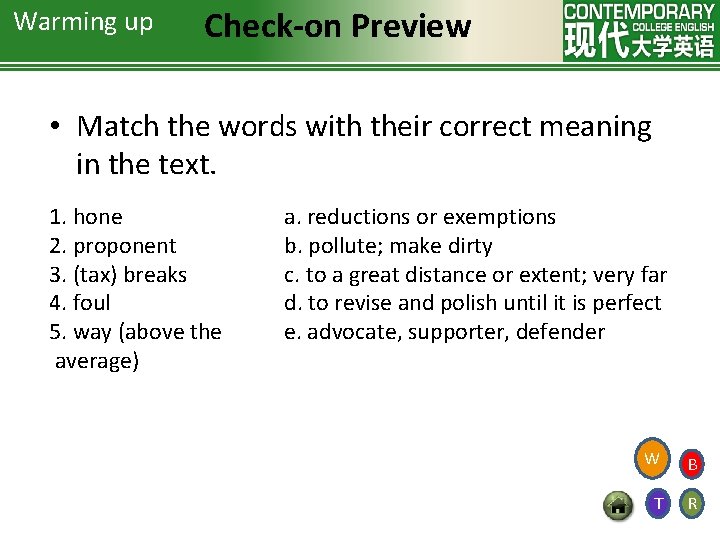
Warming up Check-on Preview • Match the words with their correct meaning in the text. 1. hone 2. proponent 3. (tax) breaks 4. foul 5. way (above the average) a. reductions or exemptions b. pollute; make dirty c. to a great distance or extent; very far d. to revise and polish until it is perfect e. advocate, supporter, defender W B T R
Warming up Objectives • Understand the arguments and reasoning in the text • Explore connections and possible conflicts between economic growth and environmental protection • Explore connections and possible conflicts between economic growth and social equality (well-being) W B T R
Economic Growth is a Path to Perdition, Not Prosperity Unit 8 Author Background W T B R
Background Author Wayne Ellwood ueditorial and feature writer for New Internationalist magazine ua wide variety of topics, most recently editing issues on free trade, privatization and transitional justice uthis article, first published in Oct. 2010, is entitled Nature’s Bottom Line uother articles: Redesigning the Global Economy, The World Trading System is Corrupt and Unjust, The No. W B nonsense Guide to Globalization, Life Beyond Growth, etc. T R
Economic Growth is a Path to Perdition, Not Prosperity Unit 8 Theme Structure Text Analysis Detailed Analysis W B T R
Text Analysis Theme • Economic growth v. environmental protection • Economic growth v. social equality and wellbeing W B T R
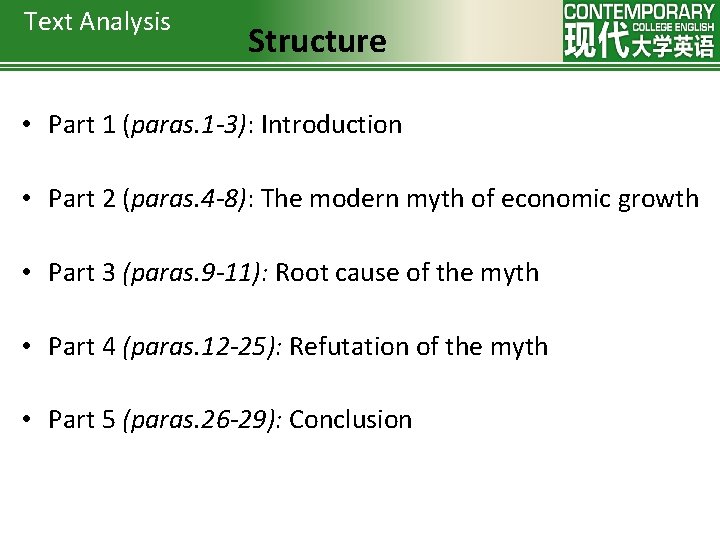
Text Analysis Structure • Part 1 (paras. 1 -3): Introduction • Part 2 (paras. 4 -8): The modern myth of economic growth • Part 3 (paras. 9 -11): Root cause of the myth • Part 4 (paras. 12 -25): Refutation of the myth • Part 5 (paras. 26 -29): Conclusion
Text Analysis Detailed Analysis Part I: Introduction (paras. 1– 3) Main Idea Ø What do you know about Darwin’s “long battle”? Ø Why does the author start the article with Darwin and his book? Ø How is this related to theme of the essay?
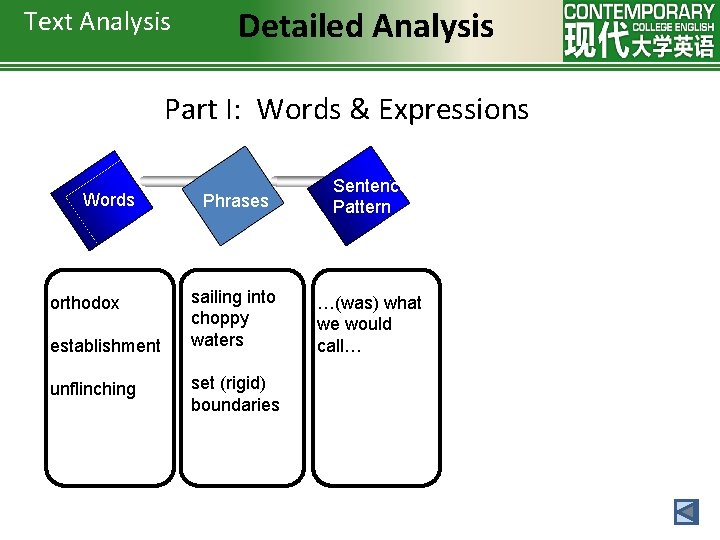
Text Analysis Detailed Analysis Part I: Words & Expressions Words orthodox establishment unflinching Phrases Sentence Pattern sailing into choppy waters …(was) what we would call… set (rigid) boundaries
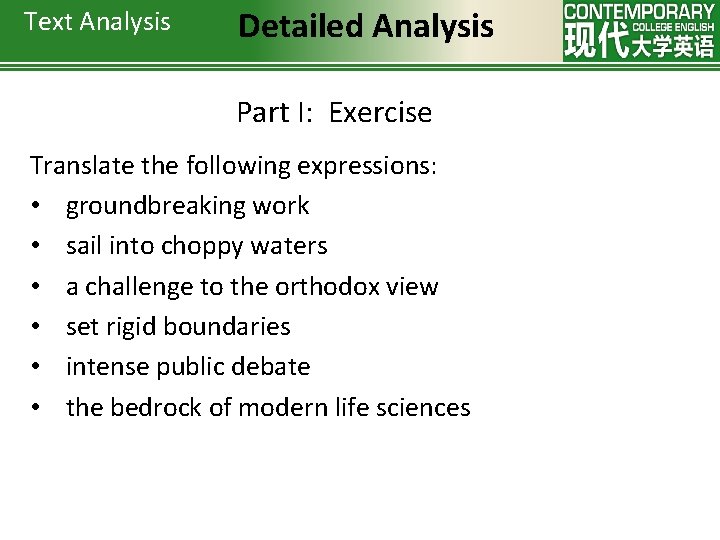
Text Analysis Detailed Analysis Part I: Exercise Translate the following expressions: • groundbreaking work • sail into choppy waters • a challenge to the orthodox view • set rigid boundaries • intense public debate • the bedrock of modern life sciences
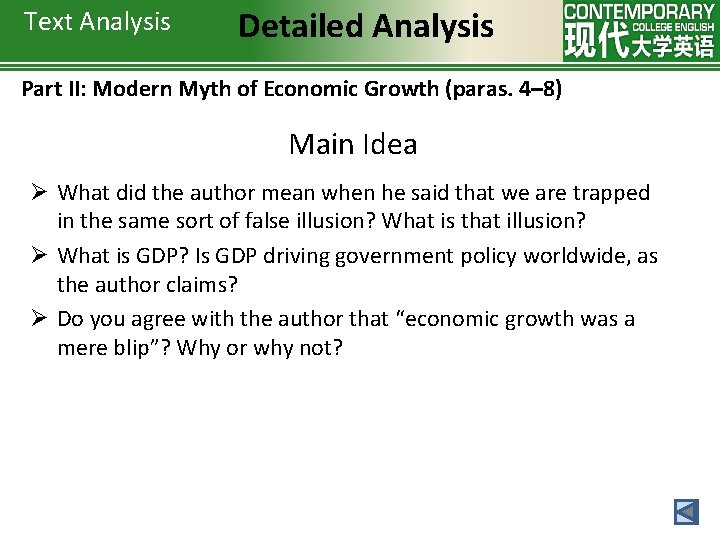
Text Analysis Detailed Analysis Part II: Modern Myth of Economic Growth (paras. 4– 8) Main Idea Ø What did the author mean when he said that we are trapped in the same sort of false illusion? What is that illusion? Ø What is GDP? Is GDP driving government policy worldwide, as the author claims? Ø Do you agree with the author that “economic growth was a mere blip”? Why or why not?
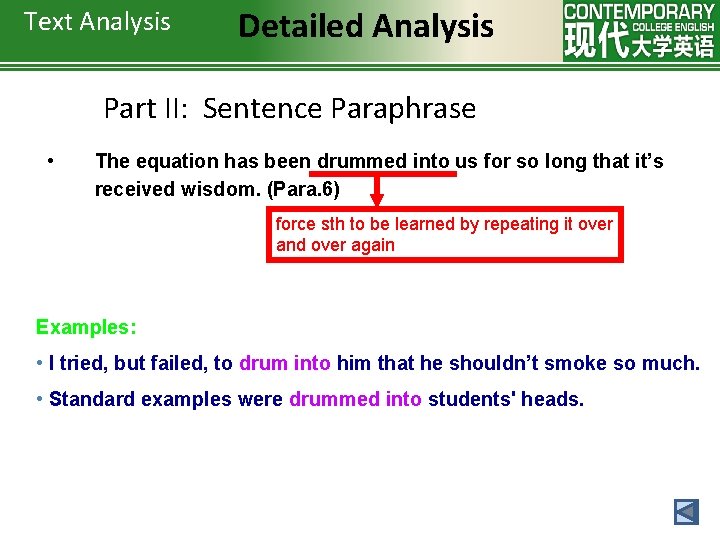
Text Analysis Detailed Analysis Part II: Sentence Paraphrase • The equation has been drummed into us for so long that it’s received wisdom. (Para. 6) force sth to be learned by repeating it over and over again Examples: • I tried, but failed, to drum into him that he shouldn’t smoke so much. • Standard examples were drummed into students' heads.
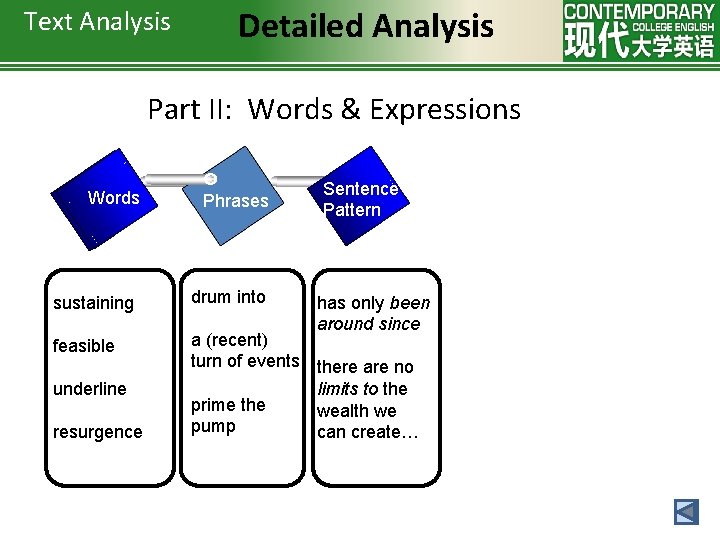
Text Analysis Detailed Analysis Part II: Words & Expressions Sentence Pattern Words Phrases sustaining drum into feasible a (recent) turn of events there are no limits to the prime the wealth we pump can create… underline resurgence has only been around since Grammar
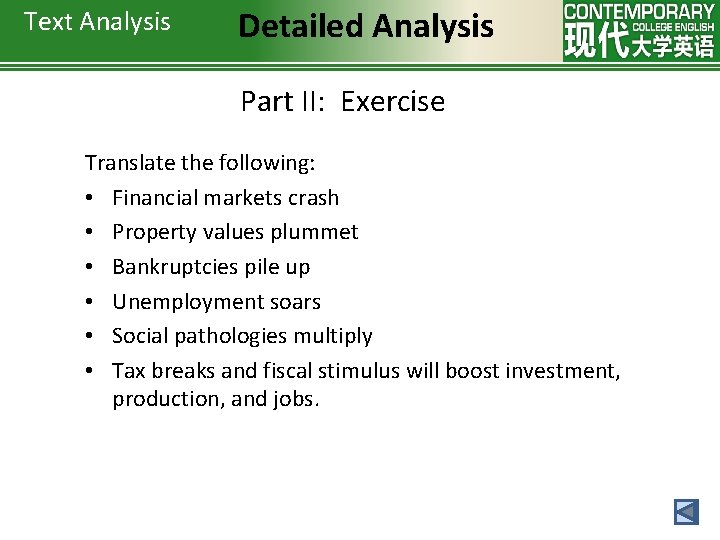
Text Analysis Detailed Analysis Part II: Exercise Translate the following: • Financial markets crash • Property values plummet • Bankruptcies pile up • Unemployment soars • Social pathologies multiply • Tax breaks and fiscal stimulus will boost investment, production, and jobs.
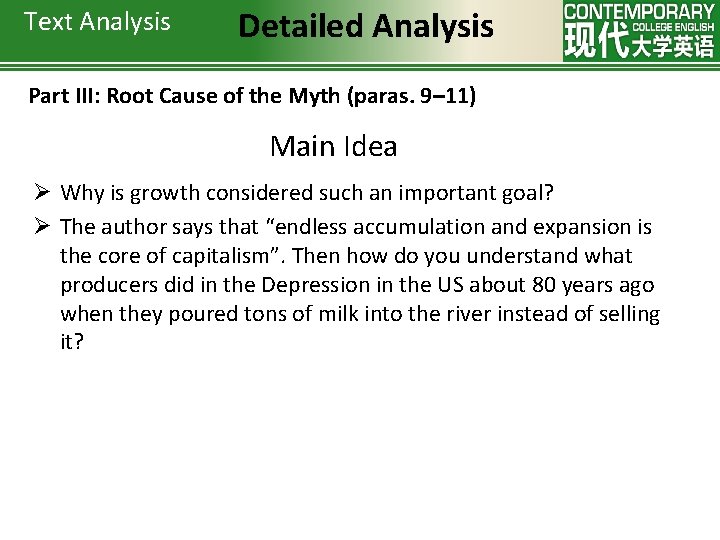
Text Analysis Detailed Analysis Part III: Root Cause of the Myth (paras. 9– 11) Main Idea Ø Why is growth considered such an important goal? Ø The author says that “endless accumulation and expansion is the core of capitalism”. Then how do you understand what producers did in the Depression in the US about 80 years ago when they poured tons of milk into the river instead of selling it?
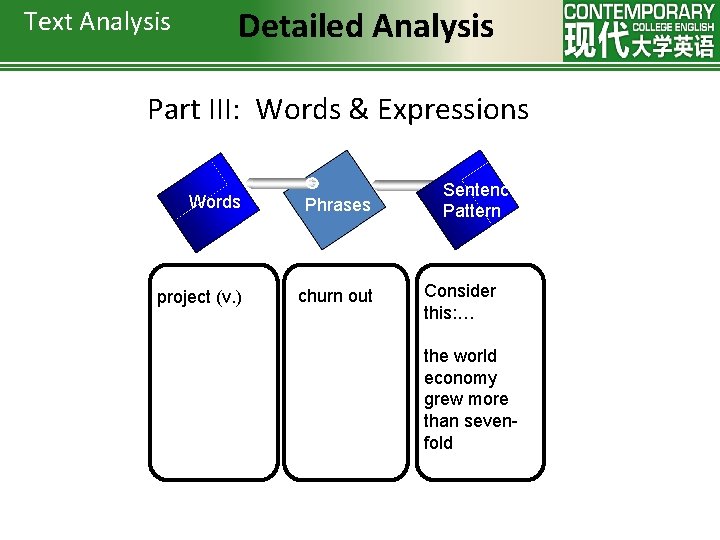
Text Analysis Detailed Analysis Part III: Words & Expressions Words Phrases project (v. ) churn out Sentence Pattern Consider this: … the world economy grew more than sevenfold
Text Analysis Detailed Analysis Part III: Exercise • Translate the following sentences into English, using words in the brackets. – 该公司预计每年的增长率为 3%。(project) – The company projected an annual growth rate of 3%. – 十多年来,他一直在大量粗制滥造侦探小说。 (churn out) – He has been churning out detective stories for more than ten years.
Text Analysis Detailed Analysis Part IV: Refutation of the Myth (paras. 12– 25) Main Idea Ø What is Ecological Footprint? What does it show? Ø What kind of problems can result from our reliance on GDP? Ø Can we solve these problems through further scientific and technological developments?
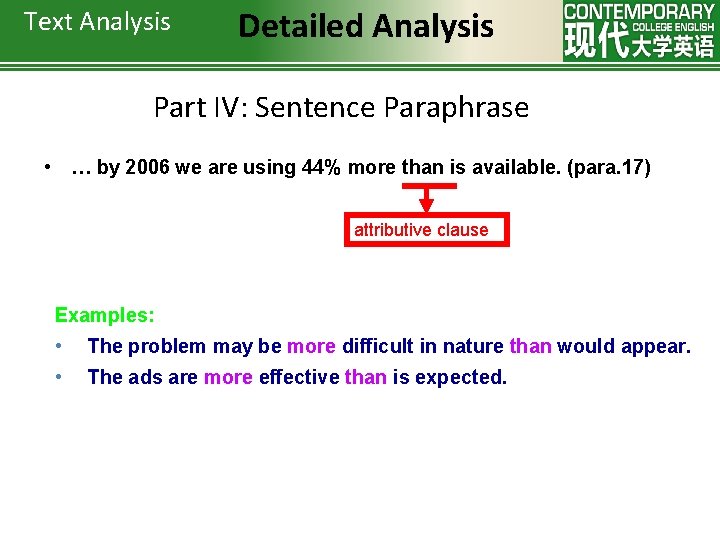
Text Analysis Detailed Analysis Part IV: Sentence Paraphrase • … by 2006 we are using 44% more than is available. (para. 17) attributive clause Examples: • The problem may be more difficult in nature than would appear. • The ads are more effective than is expected.
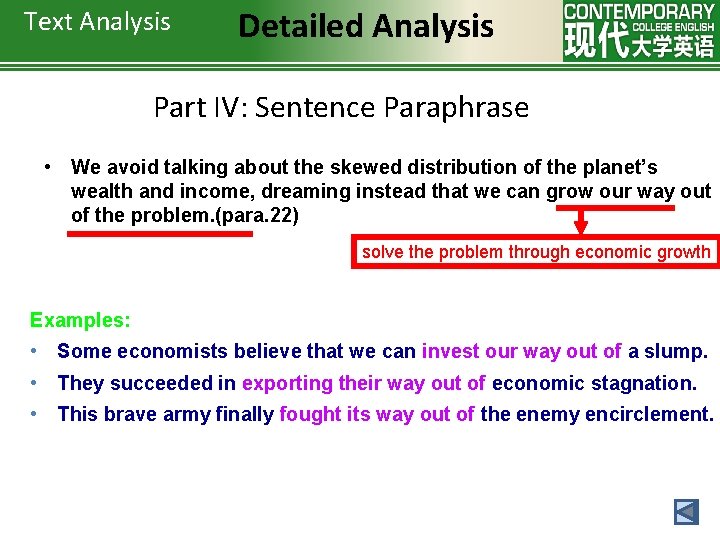
Text Analysis Detailed Analysis Part IV: Sentence Paraphrase • We avoid talking about the skewed distribution of the planet’s wealth and income, dreaming instead that we can grow our way out of the problem. (para. 22) solve the problem through economic growth Examples: • Some economists believe that we can invest our way out of a slump. • They succeeded in exporting their way out of economic stagnation. • This brave army finally fought its way out of the enemy encirclement.
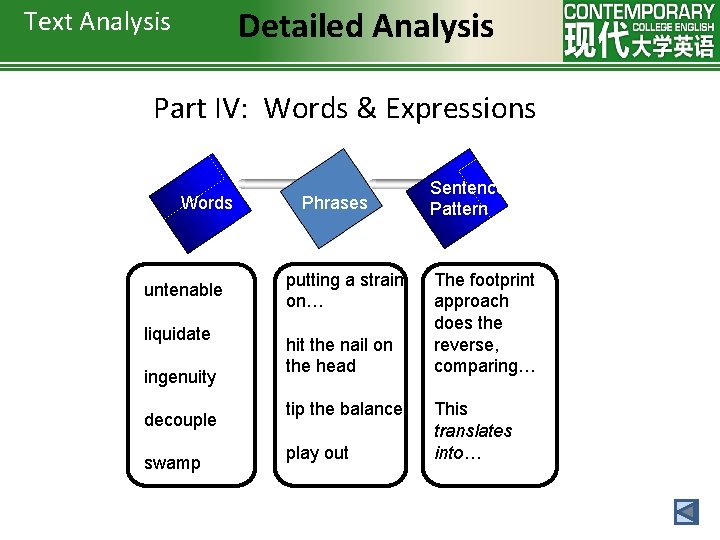
Detailed Analysis Text Analysis Part IV: Words & Expressions Words untenable liquidate ingenuity decouple swamp Phrases putting a strain on… hit the nail on the head tip the balance play out Sentence Pattern The footprint approach does the reverse, comparing… This translates into…
Text Analysis Detailed Analysis Part IV: Exercise • Translate the following sentences into Chinese. – We’re chewing through massive quantities of both renewable and non-renewable resources at a breakneck speed. – We’ve been drawing down the biosphere’s principal rather than living off its annual interest. – We avoid talking about the skewed distribution of the planet’s wealth and income, dreaming instead that we can grow our way out of the problem.
Text Analysis Detailed Analysis Part V: Conclusion (paras. 26– 29) Main Idea Ø What does the author mean by “Justice demands that we in the rich countries ratchet back our growth and clear some space for those who need it”? Do you agree with him on that? Ø Do you think we are up to the mission suggested by the author? And how can it be achieved?
Text Analysis Detailed Analysis Part V: Words & Expressions Words Phrases alluring captured by entrenched ratchet back construct Sentence Pattern we have … been living beyond our ecological means…
Economic Growth is a Path to Perdition, Not Prosperity Unit 8 Discussion Reinforcement Listening W T B R
Reinforcement Listening Please listen to (watch) the following video/audio clips • An Inconvinient Truth (an Oscar-winning documentary) • More on Global Warming (a VOA report on opposing views that global warming is not a real danger) W T B R
Reinforcement Discussion Work in groups of four: • What is the main idea of the documentary? • Do you find Al Gore’s arguments convincing? Any argument or reasoning you find not valid? • What is the main opposition presented in the second clip? Are you convinced? • What is your opinion on global warming: is it a real danger? W If it is, what should we do to tackle this problem? T B R