
ECONOMIC DIGITALIZATION IN OIC MEMBER COUNTRIES International Forum
ECONOMIC DIGITALIZATION IN OIC MEMBER COUNTRIES International Forum on Islamic Digital Economy “Islamic Economic Digitalization and Inclusion: Policy Development and Implementation in the OIC Countries” 29 October 2020 Jakarta, Indonesia Mazhar HUSSAIN Director Economic and Social Research Department Statistical, Economic and Social Research and Training Centre for Islamic Countries (SESRIC)
Outline 1. Digitalization 2 2. Digital 3 Economy 3. Prospects and Challenges 4. Way Forward 2

Digitization, Digitalization… Towards E-life Digitization is the process of converting information into a digital (computer-readable) format. Digitalization is the integration of digital technologies into everyday life. Developments in Information & E-mail Artificial Database Communication Technologies E-commerce Intelligence (ICT) Virtual E-trade Cloud Reality E-government Internet Online Computing Robotics Data E-banking CAD Mobile Devices E-learning 3 G… 4 G… 5 G Blockchain Big Data E-gazette Automation PDF Cybersecurity … Bluetooth Computers Internet Social Broadband Link Infrastructure of Things 3 Media
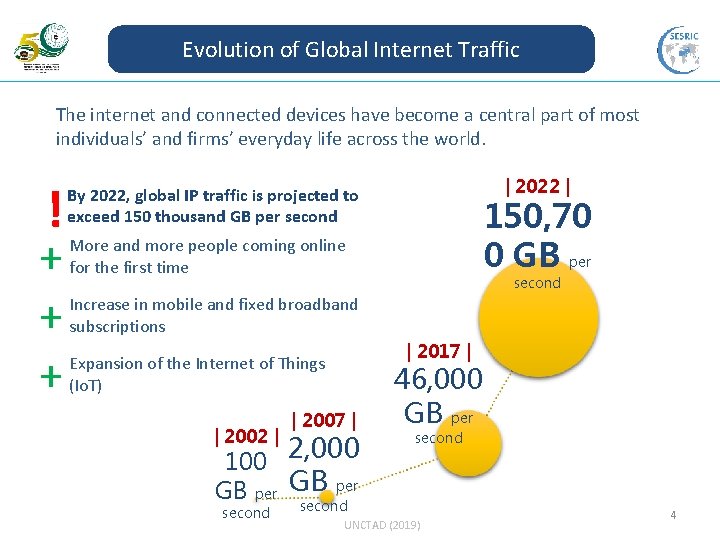
Evolution of Global Internet Traffic The internet and connected devices have become a central part of most individuals’ and firms’ everyday life across the world. ! + + + | 2022 | By 2022, global IP traffic is projected to exceed 150 thousand GB per second 150, 70 0 GB per More and more people coming online for the first time second Increase in mobile and fixed broadband subscriptions | 2017 | Expansion of the Internet of Things (Io. T) | 2002 | | 2007 | 2, 000 100 GB per GB second 46, 000 GB per second UNCTAD (2019) 4
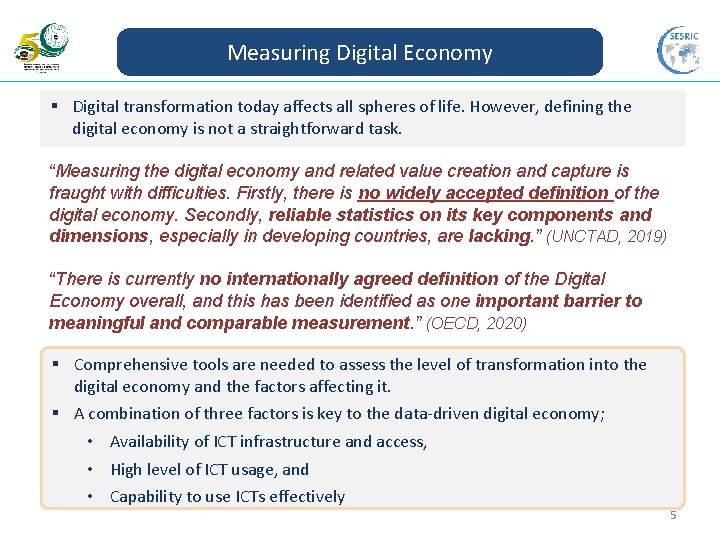
Measuring Digital Economy § Digital transformation today affects all spheres of life. However, defining the digital economy is not a straightforward task. “Measuring the digital economy and related value creation and capture is fraught with difficulties. Firstly, there is no widely accepted definition of the digital economy. Secondly, reliable statistics on its key components and dimensions, especially in developing countries, are lacking. ” (UNCTAD, 2019) “There is currently no internationally agreed definition of the Digital Economy overall, and this has been identified as one important barrier to meaningful and comparable measurement. ” (OECD, 2020) § Comprehensive tools are needed to assess the level of transformation into the digital economy and the factors affecting it. § A combination of three factors is key to the data-driven digital economy; • Availability of ICT infrastructure and access, • High level of ICT usage, and • Capability to use ICTs effectively 5

Definition of Digital Economy “The Digital Economy incorporates all economic activities reliant on, or significantly enhanced by the use of digital inputs, including digital technologies, digital infrastructure, digital services and data. It refers to all producers and consumers, including government, that are utilizing these digital inputs in their economic activities. ” (OECD, 2020) DIGITALIZATION • Conversion of information into digital form DIGITIZATION • Application of digital technologies • Economic activities using digital inputs DIGITAL ECONOMY 6
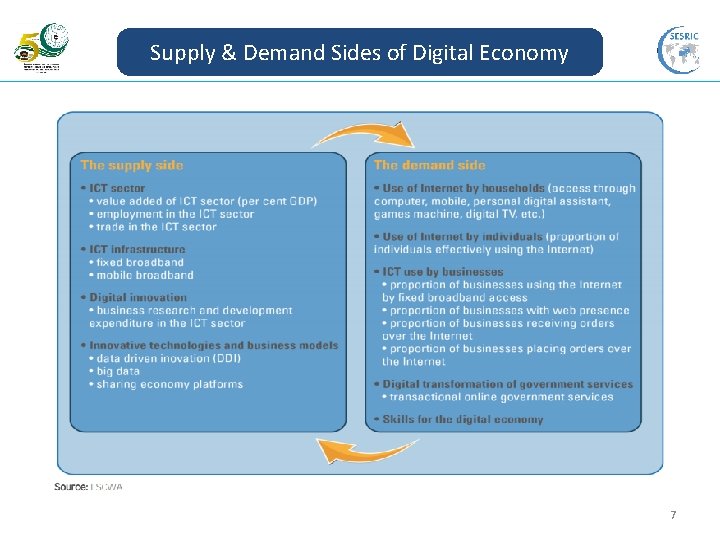
Supply & Demand Sides of Digital Economy 7
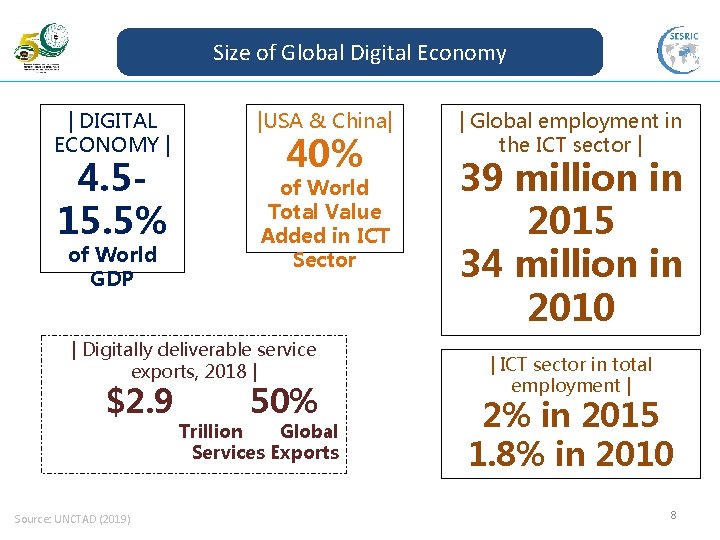
Size of Global Digital Economy | DIGITAL ECONOMY | 4. 515. 5% of World GDP |USA & China| 40% of World Total Value Added in ICT Sector | Digitally deliverable service exports, 2018 | $2. 9 Source: UNCTAD (2019) 50% Trillion Global Services Exports | Global employment in the ICT sector | 39 million in 2015 34 million in 2010 | ICT sector in total employment | 2% in 2015 1. 8% in 2010 8
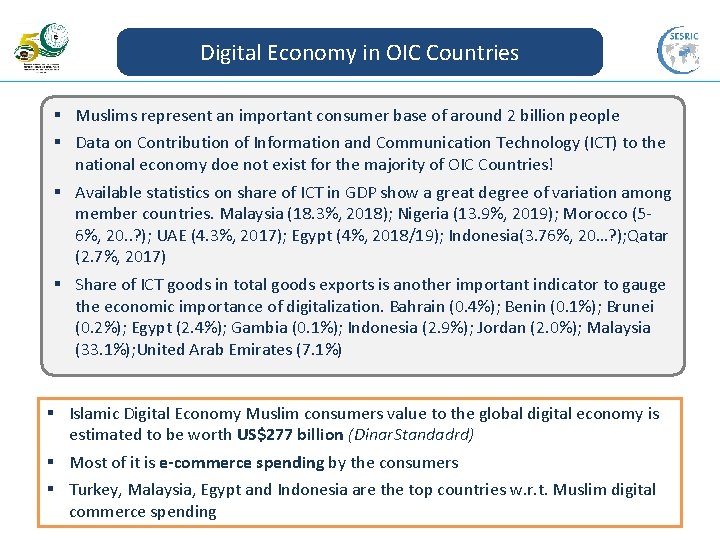
Digital Economy in OIC Countries § Muslims represent an important consumer base of around 2 billion people § Data on Contribution of Information and Communication Technology (ICT) to the national economy doe not exist for the majority of OIC Countries! § Available statistics on share of ICT in GDP show a great degree of variation among member countries. Malaysia (18. 3%, 2018); Nigeria (13. 9%, 2019); Morocco (56%, 20. . ? ); UAE (4. 3%, 2017); Egypt (4%, 2018/19); Indonesia(3. 76%, 20…? ); Qatar (2. 7%, 2017) § Share of ICT goods in total goods exports is another important indicator to gauge the economic importance of digitalization. Bahrain (0. 4%); Benin (0. 1%); Brunei (0. 2%); Egypt (2. 4%); Gambia (0. 1%); Indonesia (2. 9%); Jordan (2. 0%); Malaysia (33. 1%); United Arab Emirates (7. 1%) § Islamic Digital Economy Muslim consumers value to the global digital economy is estimated to be worth US$277 billion (Dinar. Standadrd) § Most of it is e-commerce spending by the consumers § Turkey, Malaysia, Egypt and Indonesia are the top countries w. r. t. Muslim digital commerce spending 9
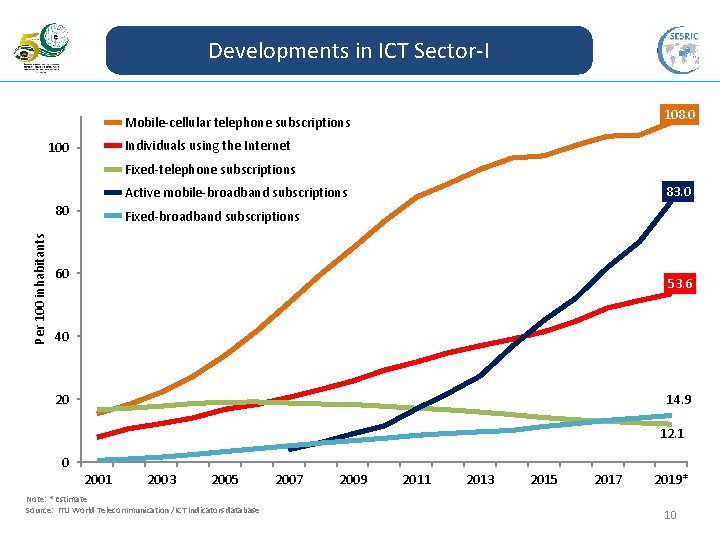
Developments in ICT Sector-I 108. 0 Mobile-cellular telephone subscriptions Individuals using the Internet 100 Fixed-telephone subscriptions 83. 0 Active mobile-broadband subscriptions Per 100 inhabitants 80 Fixed-broadband subscriptions 60 53. 6 40 20 14. 9 12. 1 0 2001 2003 2005 Note: * Estimate Source: ITU World Telecommunication /ICT Indicators database 2007 2009 2011 2013 2015 2017 2019* 10
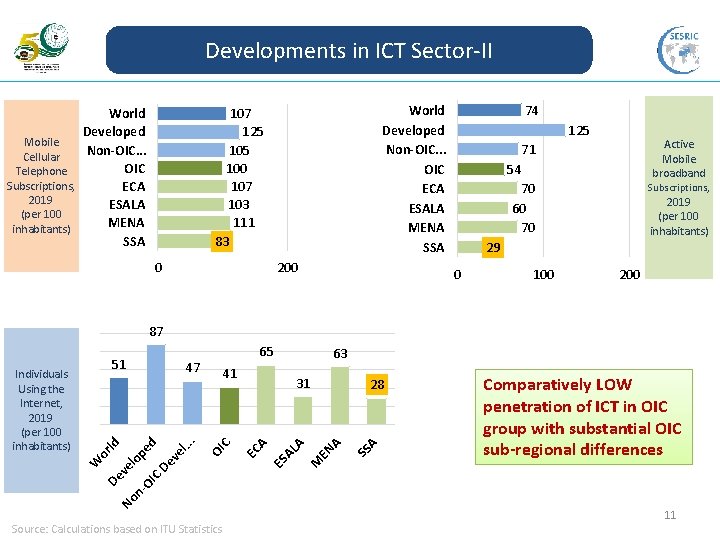
Developments in ICT Sector-II World Developed Mobile Non-OIC. . . Cellular OIC Telephone Subscriptions, ECA 2019 ESALA (per 100 MENA inhabitants) SSA World Developed Non-OIC. . . OIC ECA ESALA MENA SSA 107 125 100 107 103 111 83 0 200 74 125 Active Mobile broadband 71 54 70 60 70 Subscriptions, 2019 (per 100 inhabitants) 29 0 100 200 87 A SS A EN Comparatively LOW penetration of ICT in OIC group with substantial OIC sub-regional differences M A AL 28 No n- OI C ES A 31 EC C OI l. . . ve 63 41 De lo pe d ld 65 47 ve or De W Individuals Using the Internet, 2019 (per 100 inhabitants) 51 Source: Calculations based on ITU Statistics 11
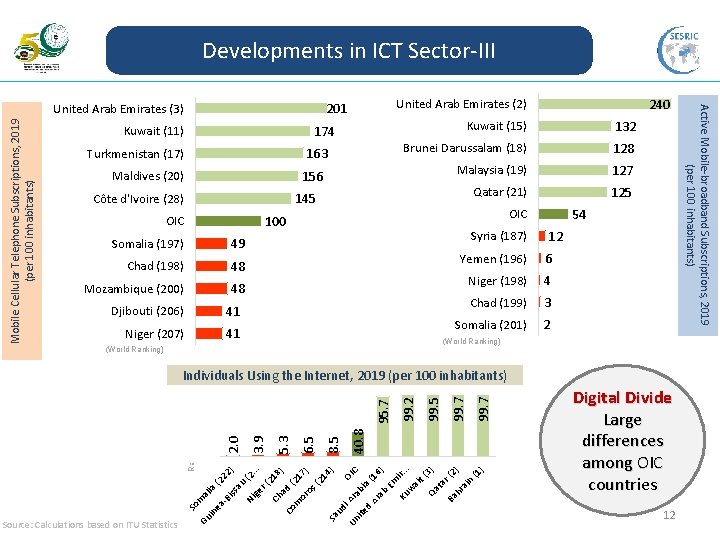
Developments in ICT Sector-III Mobile Cellular Telephone Subscriptions, 2019 (per 100 inhabitants) 132 163 Turkmenistan (17) Brunei Darussalam (18) 128 Malaysia (19) 127 Qatar (21) 125 156 Maldives (20) 145 Côte d'Ivoire (28) Somalia (197) 49 Chad (198) 48 Mozambique (200) 48 Djibouti (206) 41 Niger (207) 41 54 OIC 100 OIC Syria (187) 12 Yemen (196) 6 Niger (198) 4 Chad (199) 3 Somalia (201) 2 (World Ranking) Gu Source: Calculations based on ITU Statistics 99. 7 99. 5 99. 2 So (World Ranking) m al i in ea a (2 2 -B iss 2) 2. 0 au (2 Ni ge. . . 3. 9 r( 21 Ch 8) a 5. 3 Co d ( 21 m 7 or os ) 6. 5 (2 14 ) Sa 8. 5 ud i O A Un IC r ite abi 40. 8 a d Ar (16 ab ) Em Ku ir. . . w ai t( Qa 3) ta Ba r (2 ) hr ai n (1 ) 95. 7 Individuals Using the Internet, 2019 (per 100 inhabitants) Digital Divide Large differences among OIC countries 12 Active Mobile-broadband Subscriptions, 2019 (per 100 inhabitants) Kuwait (15) 174 Kuwait (11) 240 United Arab Emirates (2) 201 United Arab Emirates (3)
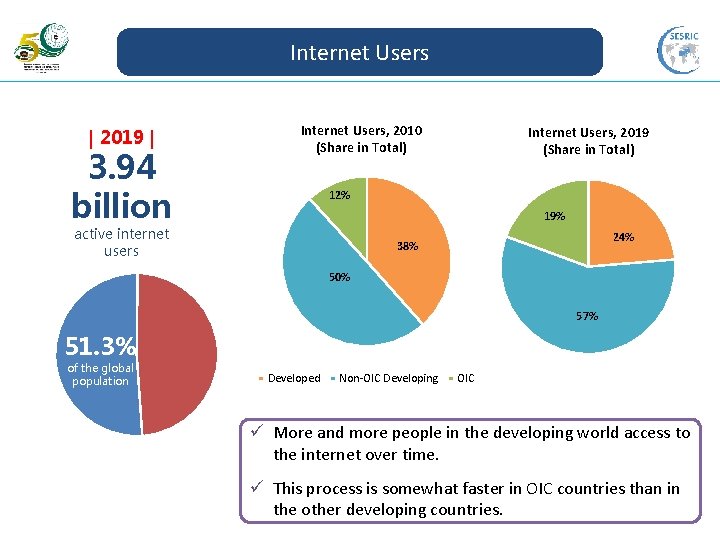
Internet Users | 2019 | 3. 94 billion Internet Users, 2010 (Share in Total) Internet Users, 2019 (Share in Total) 12% 19% active internet users 24% 38% 50% 57% 51. 3% of the global population Developed Non-OIC Developing OIC ü More and more people in the developing world access to the internet over time. ü This process is somewhat faster in OIC countries than in the other developing countries. 13
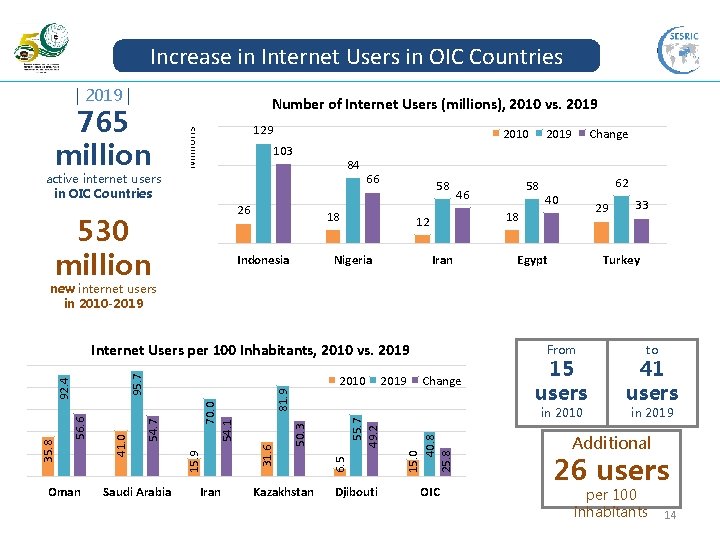
Increase in Internet Users in OIC Countries | 2019 | 129 Millions 765 million Number of Internet Users (millions), 2010 vs. 2019 2010 103 84 active internet users in OIC Countries 26 530 million 66 58 18 Indonesia 58 46 Change 62 40 29 18 12 Nigeria 2019 Iran Egypt 33 Turkey new internet users in 2010 -2019 Internet Users per 100 Inhabitants, 2010 vs. 2019 Iran Kazakhstan Change Djibouti 15 users in 2010 15. 0 40. 8 25. 8 55. 7 49. 2 6. 5 50. 3 31. 6 70. 0 54. 1 15. 9 54. 7 Saudi Arabia 2019 81. 9 95. 7 Oman 41. 0 56. 6 92. 4 35. 8 2010 From OIC to 41 users in 2019 Additional 26 users per 100 inhabitants 14
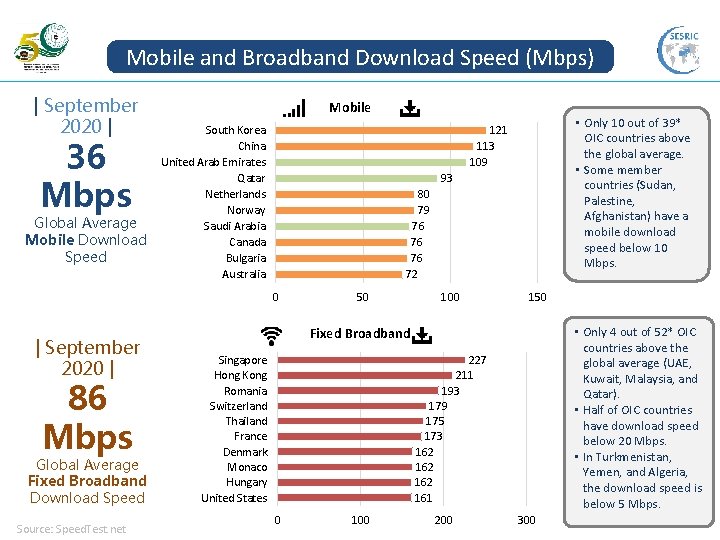
Mobile and Broadband Download Speed (Mbps) | September 2020 | 36 Mbps Global Average Mobile Download Speed Mobile South Korea China United Arab Emirates Qatar Netherlands Norway Saudi Arabia Canada Bulgaria Australia 93 80 79 76 76 76 72 0 | September 2020 | 86 Mbps Global Average Fixed Broadband Download Speed Source: Speed. Test. net • Only 10 out of 39* OIC countries above the global average. • Some member countries (Sudan, Palestine, Afghanistan) have a mobile download speed below 10 Mbps. 121 113 109 50 100 150 • Only 4 out of 52* OIC countries above the global average (UAE, Kuwait, Malaysia, and Qatar). • Half of OIC countries have download speed below 20 Mbps. • In Turkmenistan, Yemen, and Algeria, the download speed is below 5 Mbps. Fixed Broadband Singapore Hong Kong Romania Switzerland Thailand France Denmark Monaco Hungary United States 227 211 193 179 175 173 162 162 161 0 100 200 300 15
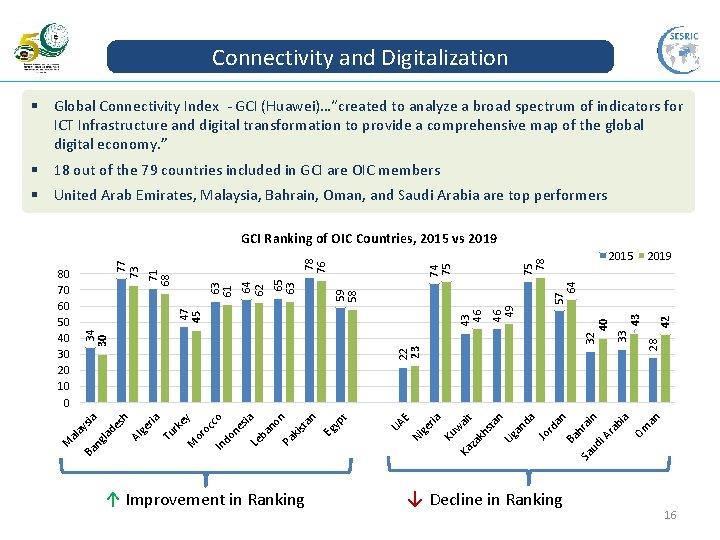
Connectivity and Digitalization § Global Connectivity Index - GCI (Huawei)…“created to analyze a broad spectrum of indicators for ICT Infrastructure and digital transformation to provide a comprehensive map of the global digital economy. ” § 18 out of the 79 countries included in GCI are OIC members § United Arab Emirates, Malaysia, Bahrain, Oman, and Saudi Arabia are top performers ↑ Improvement in Ranking 2015 75 78 2019 42 28 43 33 40 t ak hs ta n Ug an da Jo rd an Ba Sa hrai n ud i. A ra bi a Om an ai w Ka z Ku ge ria Ni UA E 22 23 32 43 46 46 49 59 58 57 64 74 75 78 76 65 63 64 62 47 45 63 61 71 68 34 30 M al a Ba ysia ng la de sh Al ge ria Tu rk ey M or oc co In do ne si Le a ba no n Pa kis ta n Eg yp t 80 70 60 50 40 30 20 10 0 77 73 GCI Ranking of OIC Countries, 2015 vs 2019 ↓ Decline in Ranking 16
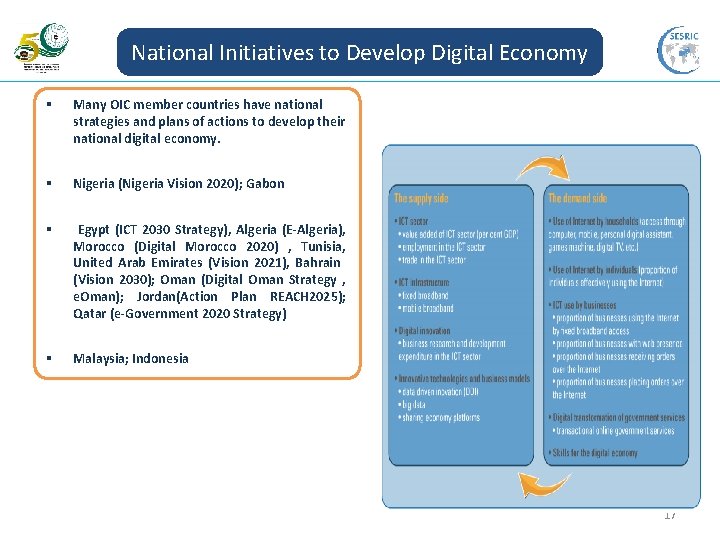
National Initiatives to Develop Digital Economy § Many OIC member countries have national strategies and plans of actions to develop their national digital economy. § Nigeria (Nigeria Vision 2020); Gabon § Egypt (ICT 2030 Strategy), Algeria (E-Algeria), Morocco (Digital Morocco 2020) , Tunisia, United Arab Emirates (Vision 2021), Bahrain (Vision 2030); Oman (Digital Oman Strategy , e. Oman); Jordan(Action Plan REACH 2025); Qatar (e-Government 2020 Strategy) § Malaysia; Indonesia 17
Regional Initiatives § § Digital Economy for Africa Initiative (DE 4 A) by World Bank • “Aims to ensure that every individual, business, and government in Africa will be digitally enabled by 2030 in support of the African Union “Digital Transformation Strategy for Africa. ” • To support this initiative, the World Bank intends to invest $25 billion by 2030. Asia-Pacific Regional Initiatives, Buenos Aires Action Plan, 2018 -2021 by ITU • ITU activities in Asia-Pacific are centred on regional initiatives designed to address specific priority areas of particular importance to the region. • The World Telecommunication Development Conference in Buenos Aires (Argentina) in October 2017 adopted the following five regional initiatives (2018 -2021) for Asia and the Pacific. 1. Addressing special needs of least developed countries, small island developing states, including Pacific island countries, and landlocked developing countries 2. Harnessing information and communication technologies to support the digital economy and an inclusive digital society 3. Fostering development of infrastructure to enhance digital connectivity 4. Enabling policy and regulatory environments 5. Contributing to a secure and resilient environment 18
Risks & Challenges § Although digitalization has the potential to support development, the outcomes are not likely to benefit all stakeholders equally. § Even if individuals, firms and countries do not − or only partially − take part in the digital economy, they can still be adversely affected indirectly. • Workers with limited digital skills • Local firms competing with digitalized domestic and foreign ones • Various jobs lost due to automation • Cyber security (cyber-attacks, viruses, and fraud) & privacy issues • … 19
Major Obstacles § Limited awareness of e-commerce relevance among policymakers and lawmakers, consumers and businesses. § Limited Internet access in rural/remote areas and costly access to fixed and mobile-broadband Internet. § Overreliance on cash-based transactions, plus low access to and limited experience with online payments and the use of credit cards. § Inadequate facilities for physical delivery of online purchases. § Weak legal and regulatory frameworks, including protection of consumers online. § Inappropriate education for the digital economy. § Lack of business development skills and adequate e-commerce skills for MSMEs. § Unsuitable financial mechanisms for start-up enterprises to engage in ecommerce. § Persistent barriers for women and youth to engage in e-commerce, preventing the leveling of playing fields through increased inclusivity. § Lack of statistical data on electronic commerce. Source: UNCTAD (2019) 20
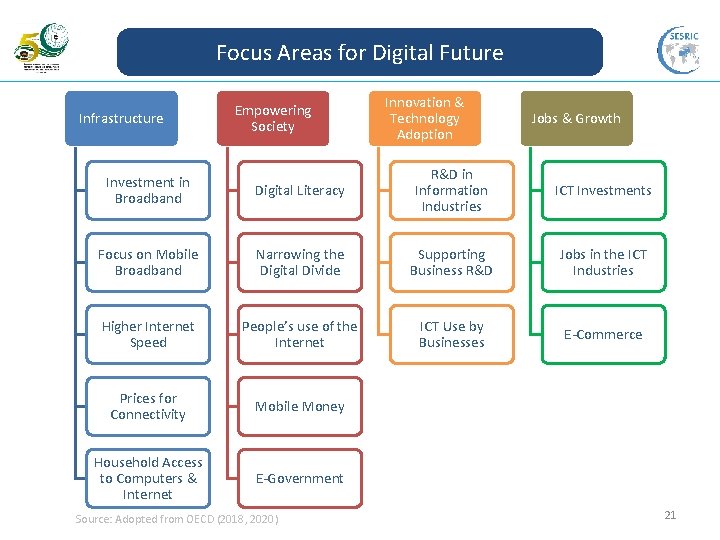
Focus Areas for Digital Future Infrastructure Empowering Society Innovation & Technology Adoption Jobs & Growth Digital Literacy R&D in Information Industries ICT Investments Focus on Mobile Broadband Narrowing the Digital Divide Supporting Business R&D Jobs in the ICT Industries Higher Internet Speed People’s use of the Internet ICT Use by Businesses E-Commerce Prices for Connectivity Mobile Money Household Access to Computers & Internet E-Government Investment in Broadband Source: Adopted from OECD (2018, 2020) 21
THANK YOU FOR YOUR ATTENTION www. sesric. org
- Slides: 22