
Economic Development of Japan No 6 WW 1
- Slides: 17
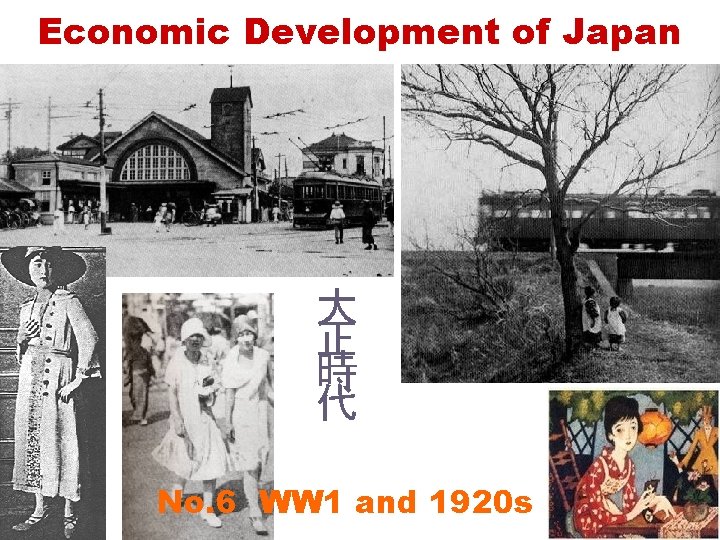
Economic Development of Japan 大 正 時 代 No. 6 WW 1 and 1920 s
Society, Economy, Diplomacy: 1910 s-20 s • WW 1 brought a huge export-led boom to Japan. This solved fiscal and BOP problems (for the moment). • The bubble burst in 1920 and a recession period began. • FDI and import substitution in heavy industries proceeded, and new zaibatsu emerged. • Taisho Democracy and the rise of social movements (labor, farmers, women, “outcasts, ” socialism) • Shidehara Diplomacy—use non-military means (diplomacy) to secure trade benefits, Japan-US friendship and Chinese interests.
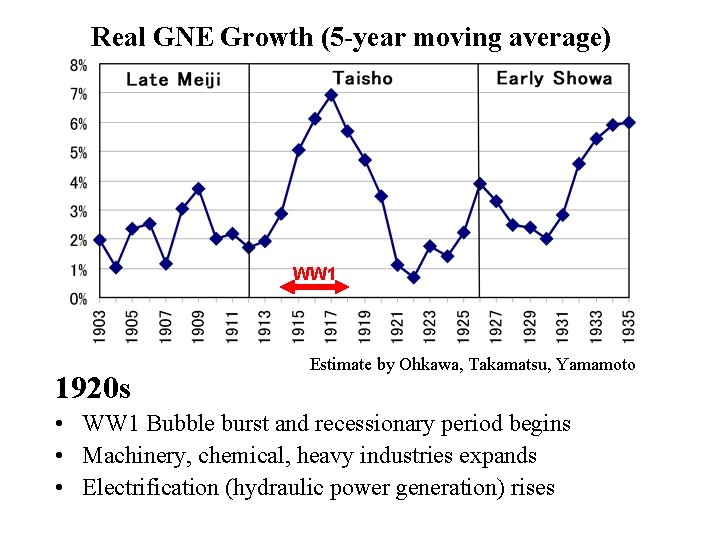
Real GNE Growth (5 -year moving average) WW 1 1920 s Estimate by Ohkawa, Takamatsu, Yamamoto • WW 1 Bubble burst and recessionary period begins • Machinery, chemical, heavy industries expands • Electrification (hydraulic power generation) rises
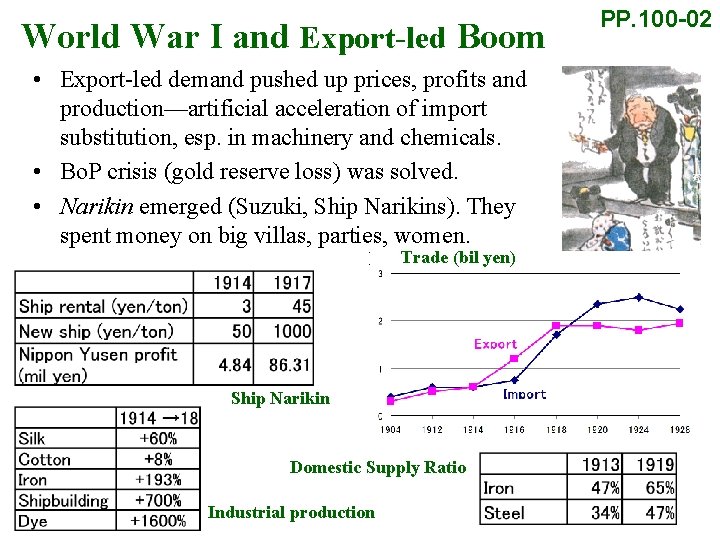
World War I and Export-led Boom • Export-led demand pushed up prices, profits and production—artificial acceleration of import substitution, esp. in machinery and chemicals. • Bo. P crisis (gold reserve loss) was solved. • Narikin emerged (Suzuki, Ship Narikins). They spent money on big villas, parties, women. Trade (bil yen) Production Ship Narikin Domestic Supply Ratio Industrial production PP. 100 -02
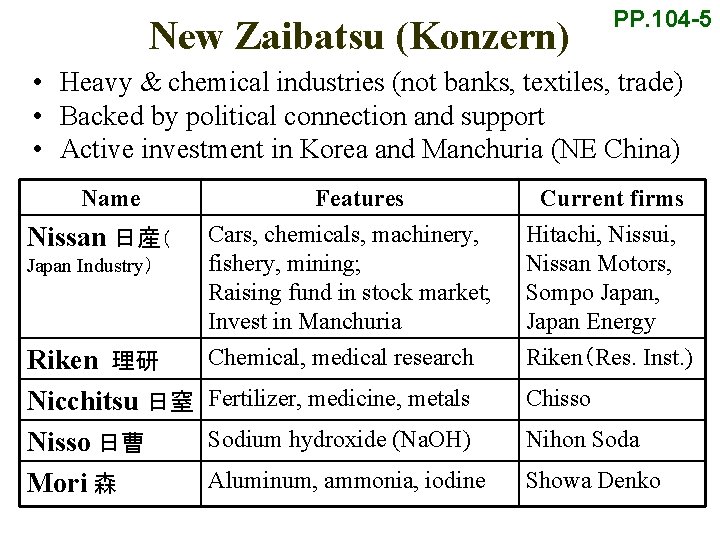
New Zaibatsu (Konzern) PP. 104 -5 • Heavy & chemical industries (not banks, textiles, trade) • Backed by political connection and support • Active investment in Korea and Manchuria (NE China) Name Nissan 日産( Japan Industry) Riken 理研 Nicchitsu 日窒 Nisso 日曹 Mori 森 Features Current firms Cars, chemicals, machinery, fishery, mining; Raising fund in stock market; Invest in Manchuria Hitachi, Nissui, Nissan Motors, Sompo Japan, Japan Energy Chemical, medical research Riken(Res. Inst. ) Fertilizer, medicine, metals Chisso Sodium hydroxide (Na. OH) Nihon Soda Aluminum, ammonia, iodine Showa Denko
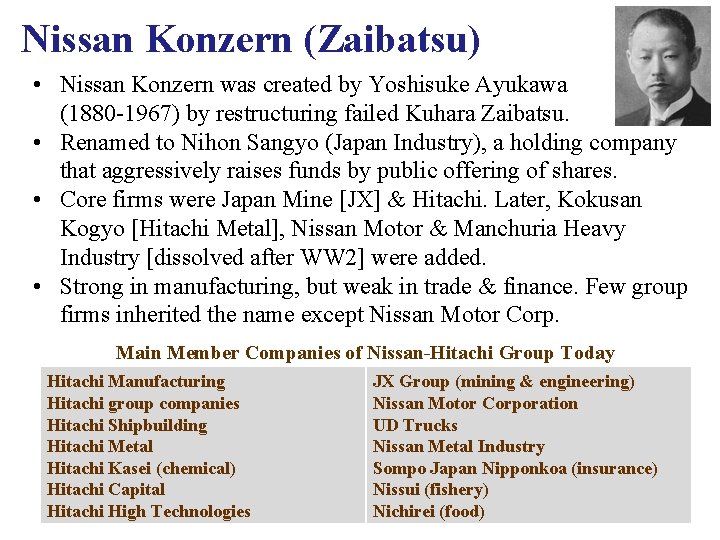
Nissan Konzern (Zaibatsu) • Nissan Konzern was created by Yoshisuke Ayukawa (1880 -1967) by restructuring failed Kuhara Zaibatsu. • Renamed to Nihon Sangyo (Japan Industry), a holding company that aggressively raises funds by public offering of shares. • Core firms were Japan Mine [JX] & Hitachi. Later, Kokusan Kogyo [Hitachi Metal], Nissan Motor & Manchuria Heavy Industry [dissolved after WW 2] were added. • Strong in manufacturing, but weak in trade & finance. Few group firms inherited the name except Nissan Motor Corp. Main Member Companies of Nissan-Hitachi Group Today Hitachi Manufacturing Hitachi group companies Hitachi Shipbuilding Hitachi Metal Hitachi Kasei (chemical) Hitachi Capital Hitachi High Technologies JX Group (mining & engineering) Nissan Motor Corporation UD Trucks Nissan Metal Industry Sompo Japan Nipponkoa (insurance) Nissui (fishery) Nichirei (food)
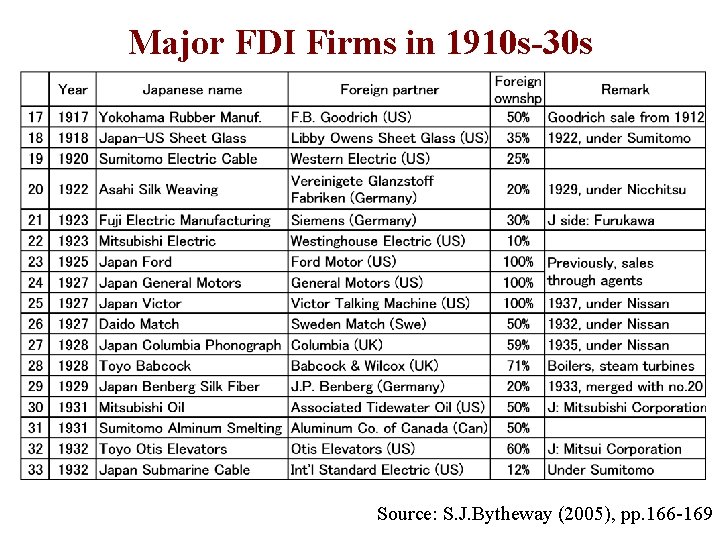
Major FDI Firms in 1910 s-30 s Source: S. J. Bytheway (2005), pp. 166 -169
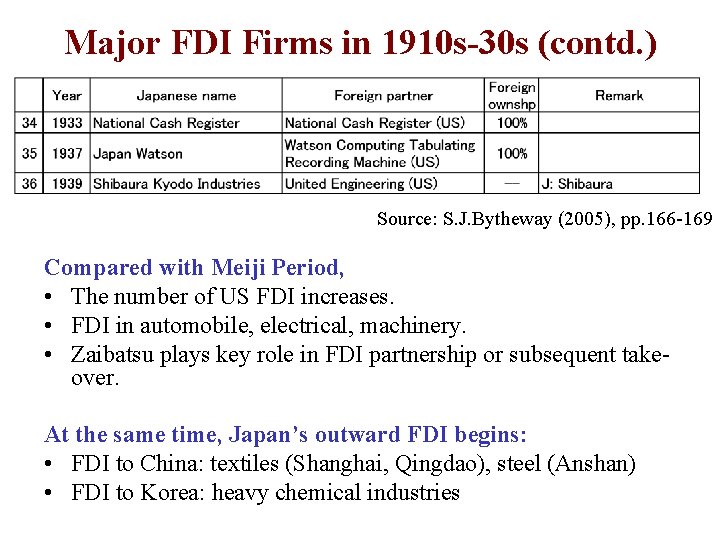
Major FDI Firms in 1910 s-30 s (contd. ) Source: S. J. Bytheway (2005), pp. 166 -169 Compared with Meiji Period, • The number of US FDI increases. • FDI in automobile, electrical, machinery. • Zaibatsu plays key role in FDI partnership or subsequent takeover. At the same time, Japan’s outward FDI begins: • FDI to China: textiles (Shanghai, Qingdao), steel (Anshan) • FDI to Korea: heavy chemical industries
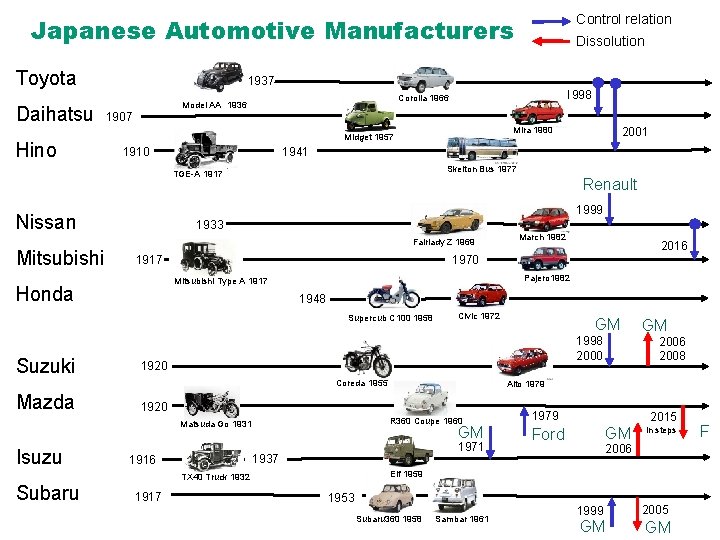
Control relation Japanese Automotive Manufacturers Toyota Daihatsu Hino 1937 1998 Corolla 1966 Model AA 1936 1907 Mira 1980 Midget 1957 Skelton Bus 1977 Renault 1999 Nissan 1933 Fairlady Z 1969 1948 Civic 1972 1920 R 360 Coupe 1960 GM 1971 1937 1916 2008 1979 2015 GM Ford in steps 2006 Elf 1959 TX 40 Truck 1932 1917 GM Alto 1979 1920 Matsuda Go 1931 Subaru GM 1998 2000 Coreda 1955 Isuzu 2016 Pajero 1982 Mitsubishi Type A 1917 Supercub C 100 1958 Mazda March 1982 1970 1917 Honda Suzuki 2001 1941 1910 TGE-A 1917 Mitsubishi Dissolution 1953 Subaru 360 1958 Sambar 1961 1999 2005 GM GM F
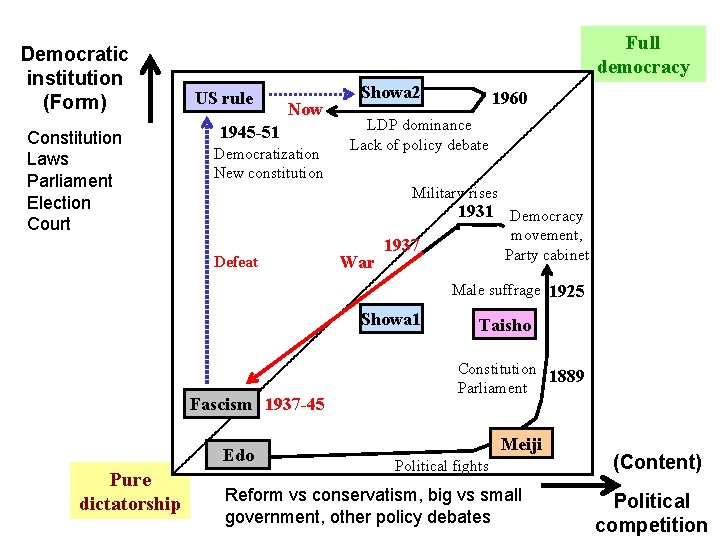
Democratic institution (Form) Constitution Laws Parliament Election Court Full democracy US rule Now 1945 -51 Democratization New constitution Showa 2 1960 LDP dominance Lack of policy debate Military rises 1931 Democracy Defeat War movement, Party cabinet 1937 Male suffrage 1925 Showa 1 Fascism 1937 -45 Edo Pure dictatorship Taisho Constitution 1889 Parliament Meiji Political fights Reform vs conservatism, big vs small government, other policy debates (Content) Political competition
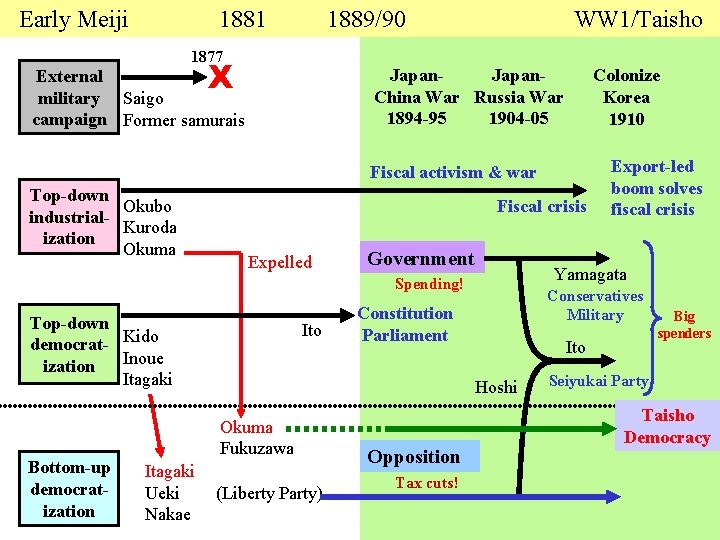
Early Meiji 1881 1889/90 1877 X WW 1/Taisho Japan. China War Russia War 1894 -95 1904 -05 External military Saigo campaign Former samurais Colonize Korea 1910 Fiscal activism & war Top-down Okubo industrial. Kuroda ization Okuma Fiscal crisis Expelled Government Yamagata Spending! Top-down democrat- Kido Inoue ization Itagaki Bottom-up democratization Ito Itagaki Ueki Nakae Conservatives Military Constitution Parliament Ito Hoshi Okuma Fukuzawa (Liberty Party) Opposition Tax cuts! Export-led boom solves fiscal crisis Big spenders Seiyukai Party Taisho Democracy
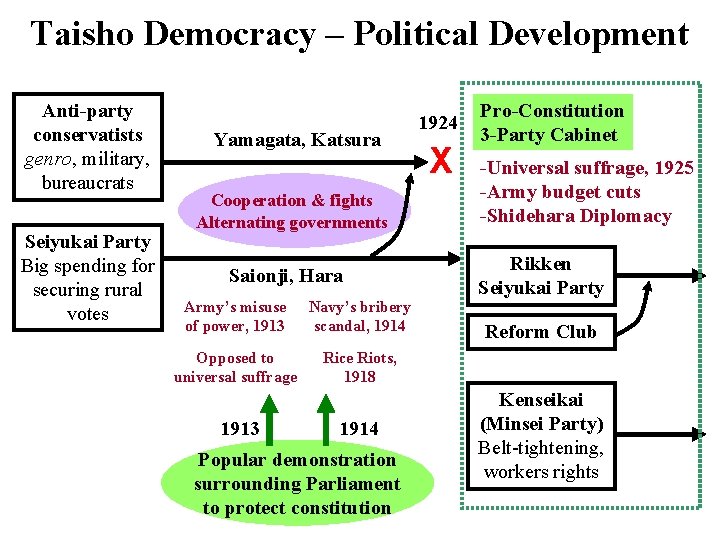
Taisho Democracy – Political Development Anti-party conservatists genro, military, bureaucrats Seiyukai Party Big spending for securing rural votes Yamagata, Katsura Cooperation & fights Alternating governments Saionji, Hara Army’s misuse of power, 1913 Navy’s bribery scandal, 1914 Opposed to universal suffrage Rice Riots, 1918 1913 1914 Popular demonstration surrounding Parliament to protect constitution 1924 X Pro-Constitution 3 -Party Cabinet -Universal suffrage, 1925 -Army budget cuts -Shidehara Diplomacy Rikken Seiyukai Party Reform Club Kenseikai (Minsei Party) Belt-tightening, workers rights
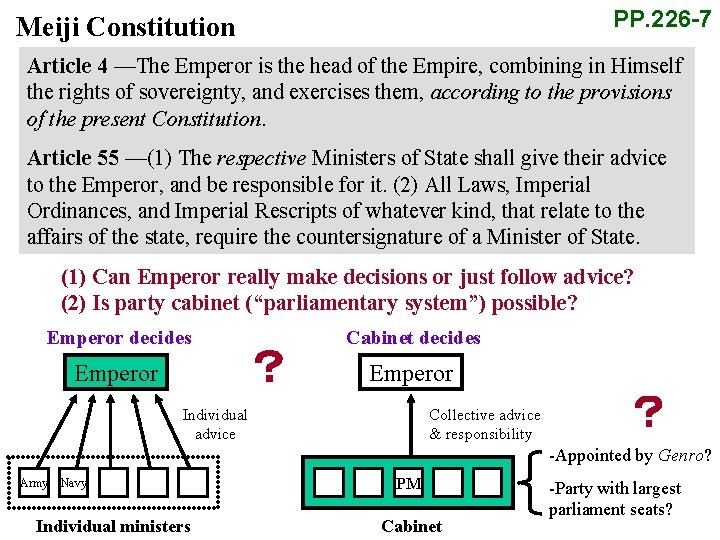
PP. 226 -7 Meiji Constitution Article 4 —The Emperor is the head of the Empire, combining in Himself the rights of sovereignty, and exercises them, according to the provisions of the present Constitution. Article 55 —(1) The respective Ministers of State shall give their advice to the Emperor, and be responsible for it. (2) All Laws, Imperial Ordinances, and Imperial Rescripts of whatever kind, that relate to the affairs of the state, require the countersignature of a Minister of State. (1) Can Emperor really make decisions or just follow advice? (2) Is party cabinet (“parliamentary system”) possible? Emperor decides Emperor ? Cabinet decides Emperor Individual advice Collective advice & responsibility ? -Appointed by Genro? Army Navy Individual ministers PM Cabinet -Party with largest parliament seats?
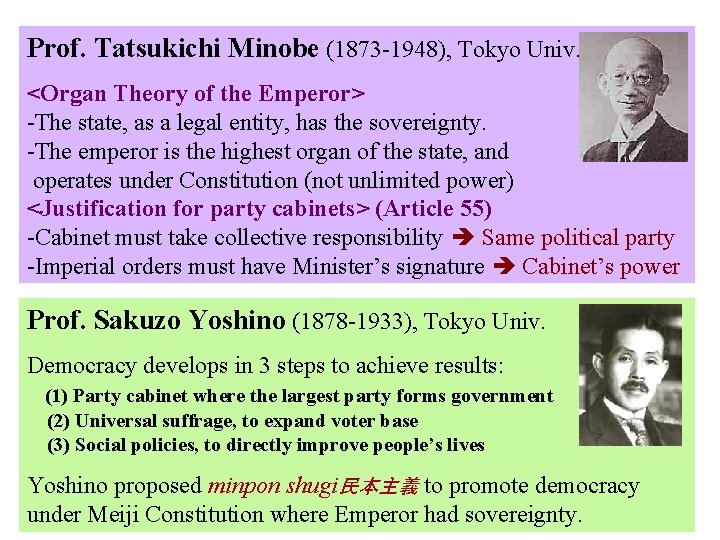
Prof. Tatsukichi Minobe (1873 -1948), Tokyo Univ. <Organ Theory of the Emperor> -The state, as a legal entity, has the sovereignty. -The emperor is the highest organ of the state, and operates under Constitution (not unlimited power) <Justification for party cabinets> (Article 55) -Cabinet must take collective responsibility Same political party -Imperial orders must have Minister’s signature Cabinet’s power Prof. Sakuzo Yoshino (1878 -1933), Tokyo Univ. Democracy develops in 3 steps to achieve results: (1) Party cabinet where the largest party forms government (2) Universal suffrage, to expand voter base (3) Social policies, to directly improve people’s lives Yoshino proposed minpon shugi民本主義 to promote democracy under Meiji Constitution where Emperor had sovereignty.
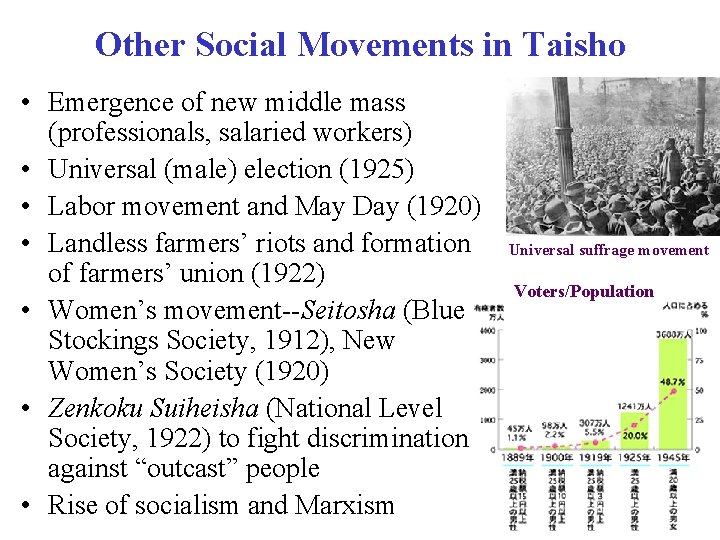
Other Social Movements in Taisho • Emergence of new middle mass (professionals, salaried workers) • Universal (male) election (1925) • Labor movement and May Day (1920) • Landless farmers’ riots and formation of farmers’ union (1922) • Women’s movement--Seitosha (Blue Stockings Society, 1912), New Women’s Society (1920) • Zenkoku Suiheisha (National Level Society, 1922) to fight discrimination against “outcast” people • Rise of socialism and Marxism Universal suffrage movement Voters/Population
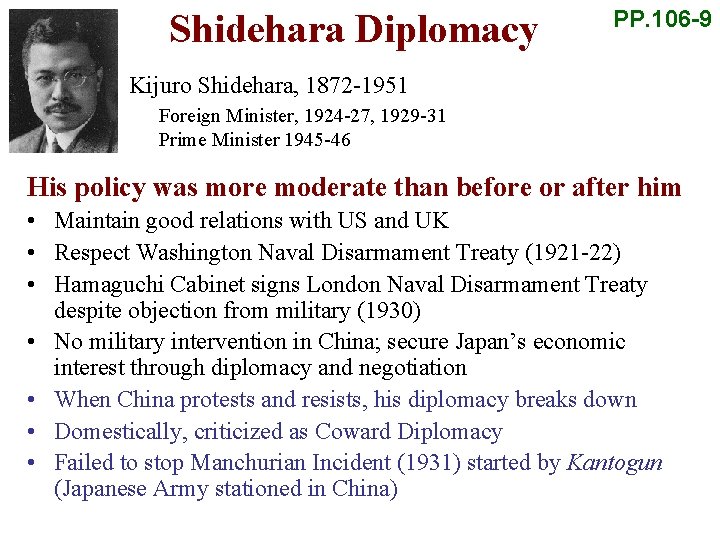
Shidehara Diplomacy PP. 106 -9 Kijuro Shidehara, 1872 -1951 Foreign Minister, 1924 -27, 1929 -31 Prime Minister 1945 -46 His policy was more moderate than before or after him • Maintain good relations with US and UK • Respect Washington Naval Disarmament Treaty (1921 -22) • Hamaguchi Cabinet signs London Naval Disarmament Treaty despite objection from military (1930) • No military intervention in China; secure Japan’s economic interest through diplomacy and negotiation • When China protests and resists, his diplomacy breaks down • Domestically, criticized as Coward Diplomacy • Failed to stop Manchurian Incident (1931) started by Kantogun (Japanese Army stationed in China)
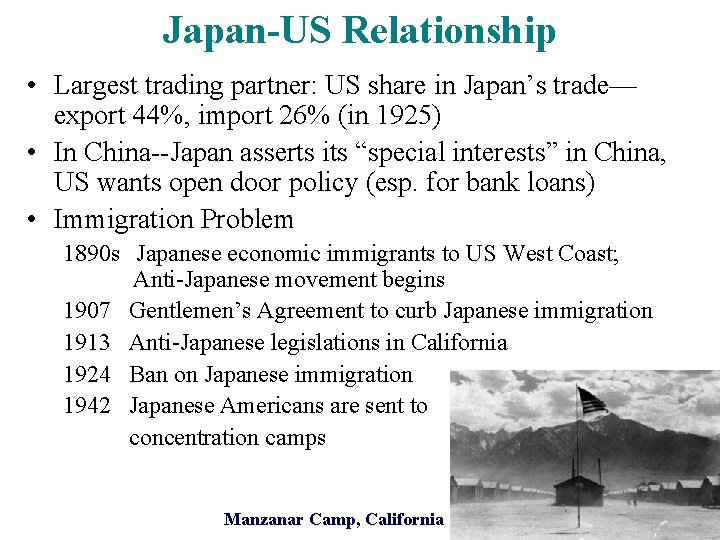
Japan-US Relationship • Largest trading partner: US share in Japan’s trade— export 44%, import 26% (in 1925) • In China--Japan asserts its “special interests” in China, US wants open door policy (esp. for bank loans) • Immigration Problem 1890 s Japanese economic immigrants to US West Coast; Anti-Japanese movement begins 1907 Gentlemen’s Agreement to curb Japanese immigration 1913 Anti-Japanese legislations in California 1924 Ban on Japanese immigration 1942 Japanese Americans are sent to concentration camps Manzanar Camp, California