
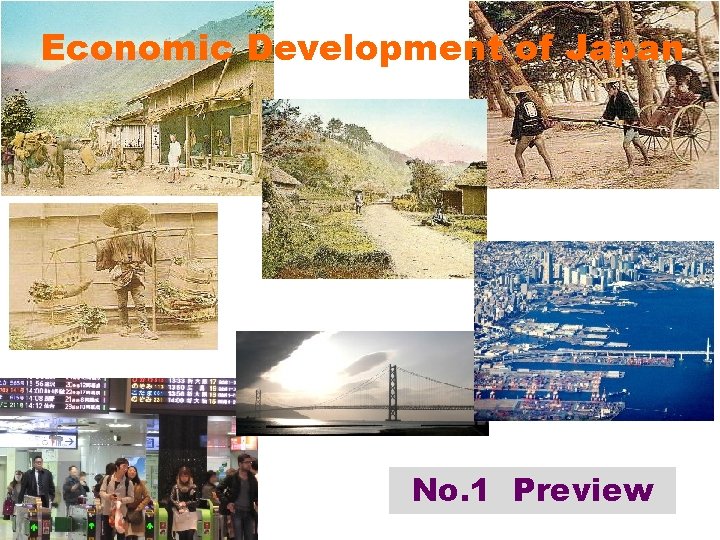
Economic Development of Japan No 1 Preview Introduction



- Slides: 21
Economic Development of Japan No. 1 Preview
Introduction Overview—Why Japan could catch up quickly with the West - Japan’s cumulative and evolutionary history - Private dynamism and effective policy support Meiji Period (late 19 th-early 20 th century) - Gosho, zaibatsu & super-businessmen Policy support Post WW 2 high growth (late 1950 s-60 s) - Active investment & technology absorption, kaizen (productivity) MITI’s industrial policy For more information, please see: • Textbook: Kenichi Ohno, The Economic Development of Japan: The Path Traveled by Japan as a Developing Country, GRIPS Development Forum, 2006; free softcopy available at www. grips. ac. jp/forum/pdf 06/EDJ. pdf • Lecture slides: www. grips. ac. jp/teacher/oono/hp/index. htm
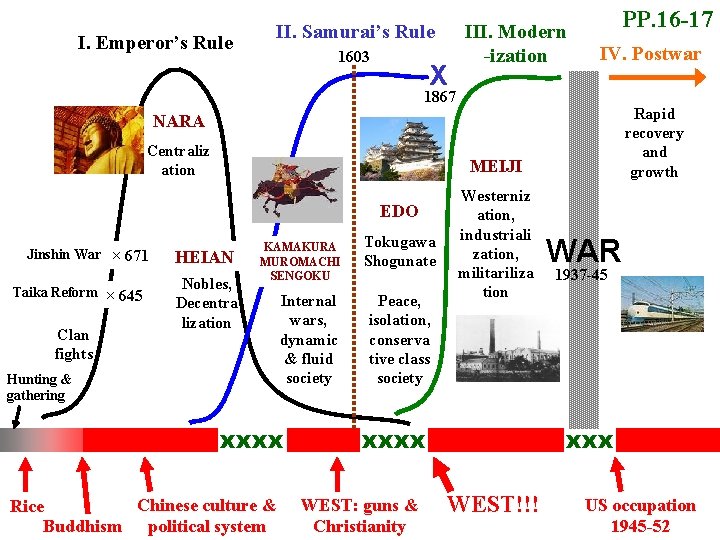
I. Emperor’s Rule II. Samurai’s Rule 1603 X III. Modern -ization PP. 16 -17 IV. Postwar 1867 Rapid recovery and growth NARA Centraliz ation MEIJI EDO Jinshin War × 671 Taika Reform × 645 Clan fights HEIAN Nobles, Decentra lization KAMAKURA MUROMACHI SENGOKU Hunting & gathering Internal wars, dynamic & fluid society xxxx Chinese culture & Rice Buddhism political system Tokugawa Shogunate Peace, isolation, conserva tive class society Westerniz ation, industriali zation, militariliza tion xxxx WEST: guns & Christianity WAR 1937 -45 xxx WEST!!! US occupation 1945 -52
Integration Viewed from Outside WTO, WB, IMF, FTAs, USA… P. 5
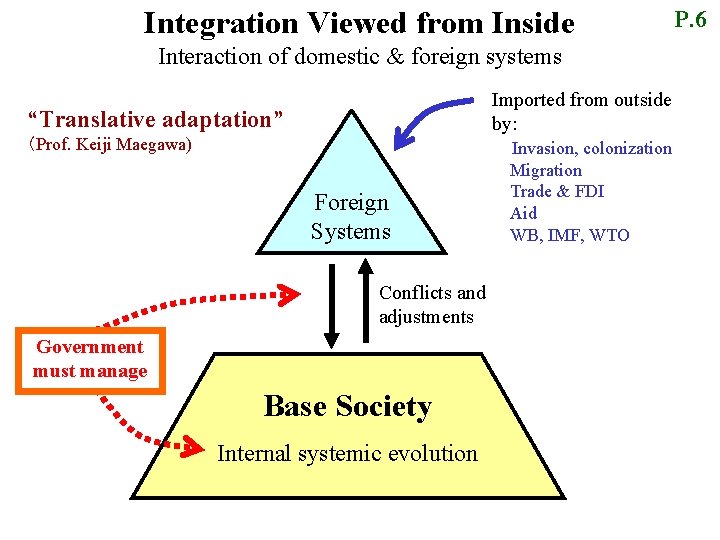
Integration Viewed from Inside Interaction of domestic & foreign systems Imported from outside by: “Translative adaptation” (Prof. Keiji Maegawa) Foreign Systems Conflicts and adjustments Government must manage Base Society Internal systemic evolution Invasion, colonization Migration Trade & FDI Aid WB, IMF, WTO P. 6
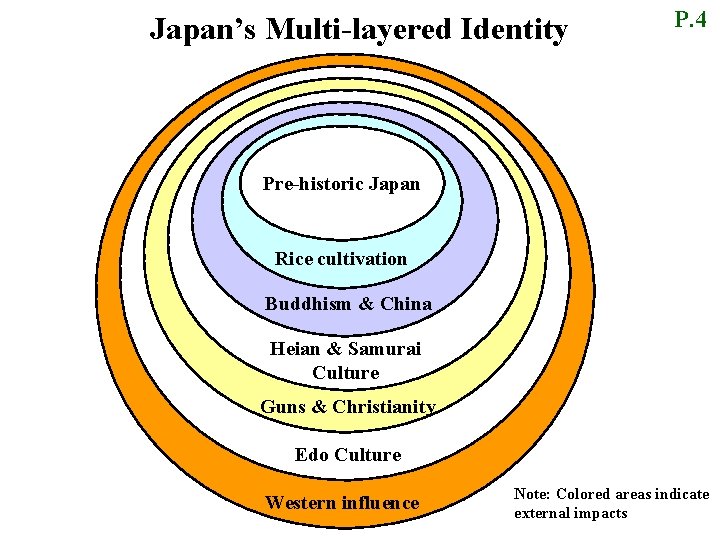
Japan’s Multi-layered Identity P. 4 先史時代の日本 Pre-historic Japan Rice cultivation Buddhism & China Heian & Samurai Culture Guns & Christianity Edo Culture Western influence Note: Colored areas indicate external impacts
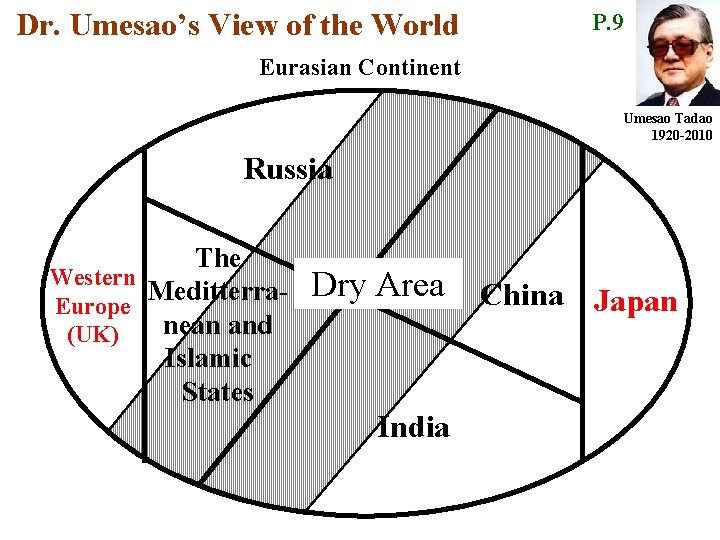
Dr. Umesao’s View of the World P. 9 Eurasian Continent Umesao Tadao 1920 -2010 Russia The Western Meditterra. Europe nean and (UK) Islamic States Dry Area China Japan India
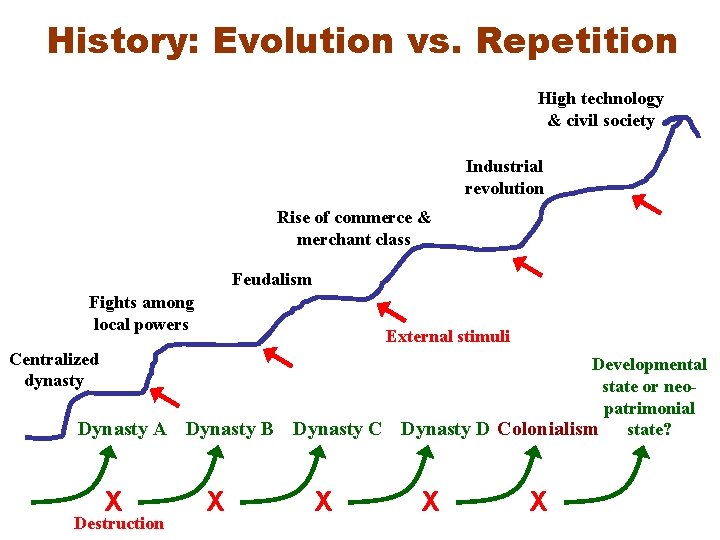
History: Evolution vs. Repetition High technology & civil society Industrial revolution Rise of commerce & merchant class Feudalism Fights among local powers External stimuli Centralized dynasty Dynasty A Dynasty B Dynasty C X Destruction X X Developmental state or neopatrimonial Dynasty D Colonialism state? X X
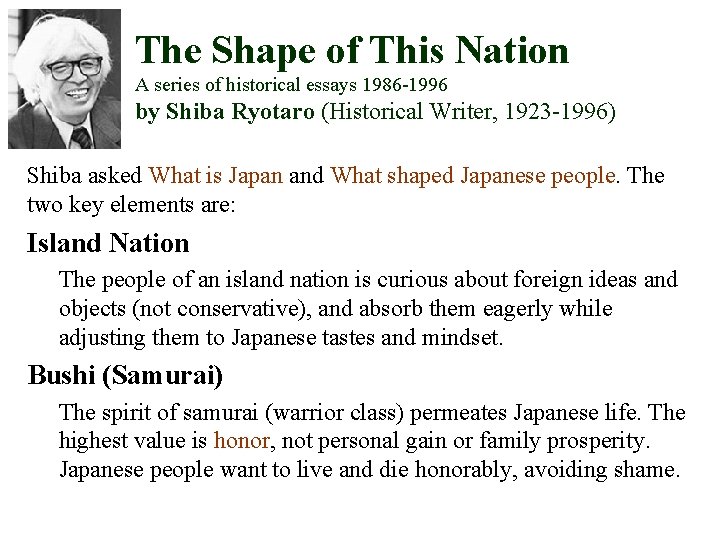
The Shape of This Nation A series of historical essays 1986 -1996 by Shiba Ryotaro (Historical Writer, 1923 -1996) Shiba asked What is Japan and What shaped Japanese people. The two key elements are: Island Nation The people of an island nation is curious about foreign ideas and objects (not conservative), and absorb them eagerly while adjusting them to Japanese tastes and mindset. Bushi (Samurai) The spirit of samurai (warrior class) permeates Japanese life. The highest value is honor, not personal gain or family prosperity. Japanese people want to live and die honorably, avoiding shame.
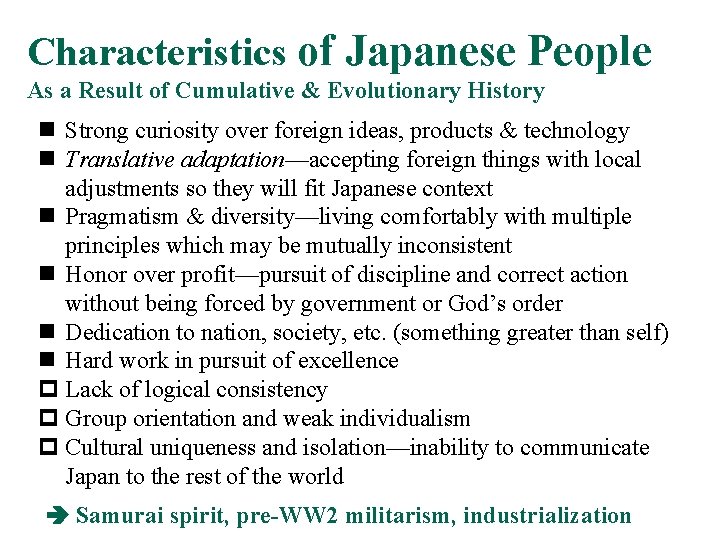
Characteristics of Japanese People As a Result of Cumulative & Evolutionary History n Strong curiosity over foreign ideas, products & technology n Translative adaptation—accepting foreign things with local adjustments so they will fit Japanese context n Pragmatism & diversity—living comfortably with multiple principles which may be mutually inconsistent n Honor over profit—pursuit of discipline and correct action without being forced by government or God’s order n Dedication to nation, society, etc. (something greater than self) n Hard work in pursuit of excellence p Lack of logical consistency p Group orientation and weak individualism p Cultural uniqueness and isolation—inability to communicate Japan to the rest of the world Samurai spirit, pre-WW 2 militarism, industrialization
Cumulative history, Edo achievements, national unity and nationalism Japan’s economic growth was driven primarily by private dynamism while policy was also helpful Private-sector dynamism and entrepreneurship (primary force) Appropriate policy support (supplementary) P. 56 Rapid industrialization especially in Meiji and post WW 2 period Policy was generally successful despite criticisms: --Power monopoly & close linkage with big businesses --Privatization scandal, 1881 --Excessively pro-West --Unfair by today’s standard
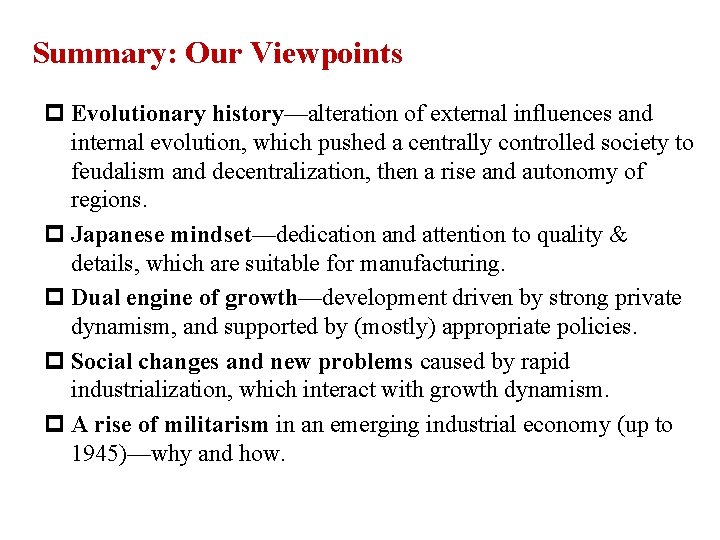
Summary: Our Viewpoints p Evolutionary history—alteration of external influences and internal evolution, which pushed a centrally controlled society to feudalism and decentralization, then a rise and autonomy of regions. p Japanese mindset—dedication and attention to quality & details, which are suitable for manufacturing. p Dual engine of growth—development driven by strong private dynamism, and supported by (mostly) appropriate policies. p Social changes and new problems caused by rapid industrialization, which interact with growth dynamism. p A rise of militarism in an emerging industrial economy (up to 1945)—why and how.
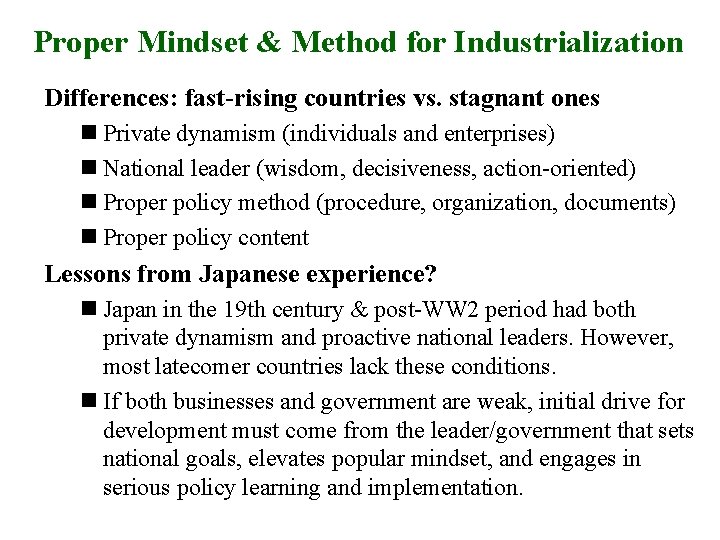
Proper Mindset & Method for Industrialization Differences: fast-rising countries vs. stagnant ones n Private dynamism (individuals and enterprises) n National leader (wisdom, decisiveness, action-oriented) n Proper policy method (procedure, organization, documents) n Proper policy content Lessons from Japanese experience? n Japan in the 19 th century & post-WW 2 period had both private dynamism and proactive national leaders. However, most latecomer countries lack these conditions. n If both businesses and government are weak, initial drive for development must come from the leader/government that sets national goals, elevates popular mindset, and engages in serious policy learning and implementation.
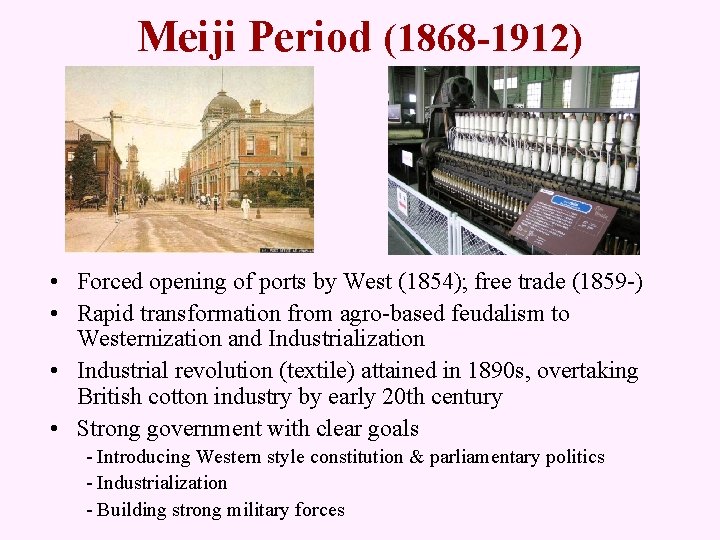
Meiji Period (1868 -1912) • Forced opening of ports by West (1854); free trade (1859 -) • Rapid transformation from agro-based feudalism to Westernization and Industrialization • Industrial revolution (textile) attained in 1890 s, overtaking British cotton industry by early 20 th century • Strong government with clear goals - Introducing Western style constitution & parliamentary politics - Industrialization - Building strong military forces
Post WW 2 High Growth (late 1950 s-60 s) • After war defeat in 1945, planning method was used to jump start the economy (production of coal & steel); inflation was stopped and prices & trade were liberalized around 1950. • High growth was unleashed by strong private dynamism, supported by investment in new technology, kaizen, and gradual trade liberalization. • The Ministry of International Trade and Industry (MITI) was a super-ministry for industrial catch-up, working closely with private firms and business associations.
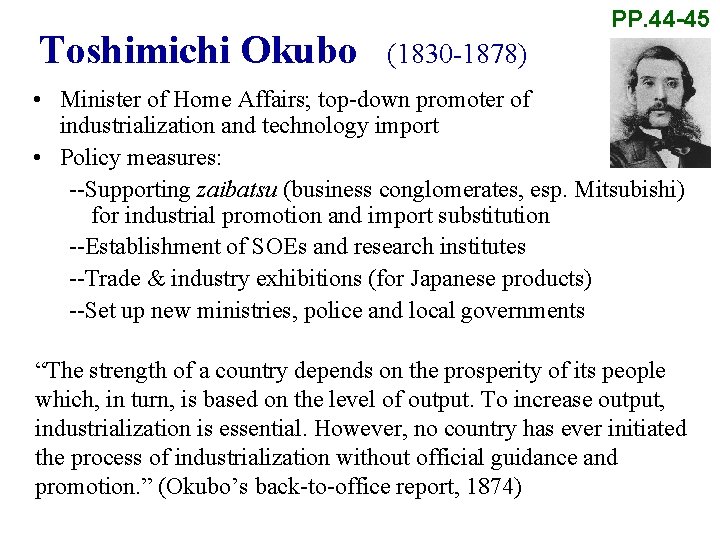
Toshimichi Okubo (1830 -1878) PP. 44 -45 • Minister of Home Affairs; top-down promoter of industrialization and technology import • Policy measures: --Supporting zaibatsu (business conglomerates, esp. Mitsubishi) for industrial promotion and import substitution --Establishment of SOEs and research institutes --Trade & industry exhibitions (for Japanese products) --Set up new ministries, police and local governments “The strength of a country depends on the prosperity of its people which, in turn, is based on the level of output. To increase output, industrialization is essential. However, no country has ever initiated the process of industrialization without official guidance and promotion. ” (Okubo’s back-to-office report, 1874)
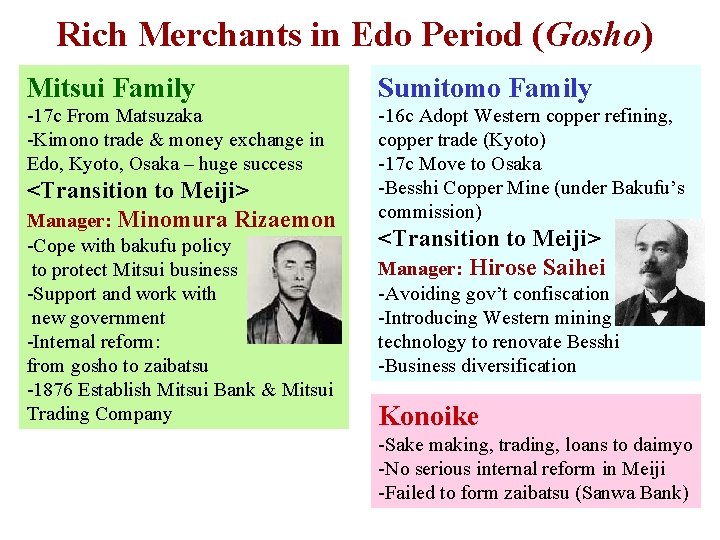
Rich Merchants in Edo Period (Gosho) Mitsui Family Sumitomo Family -17 c From Matsuzaka -Kimono trade & money exchange in Edo, Kyoto, Osaka – huge success -16 c Adopt Western copper refining, copper trade (Kyoto) -17 c Move to Osaka -Besshi Copper Mine (under Bakufu’s commission) <Transition to Meiji> Manager: Minomura Rizaemon -Cope with bakufu policy to protect Mitsui business -Support and work with new government -Internal reform: from gosho to zaibatsu -1876 Establish Mitsui Bank & Mitsui Trading Company <Transition to Meiji> Manager: Hirose Saihei -Avoiding gov’t confiscation -Introducing Western mining technology to renovate Besshi -Business diversification Konoike -Sake making, trading, loans to daimyo -No serious internal reform in Meiji -Failed to form zaibatsu (Sanwa Bank)
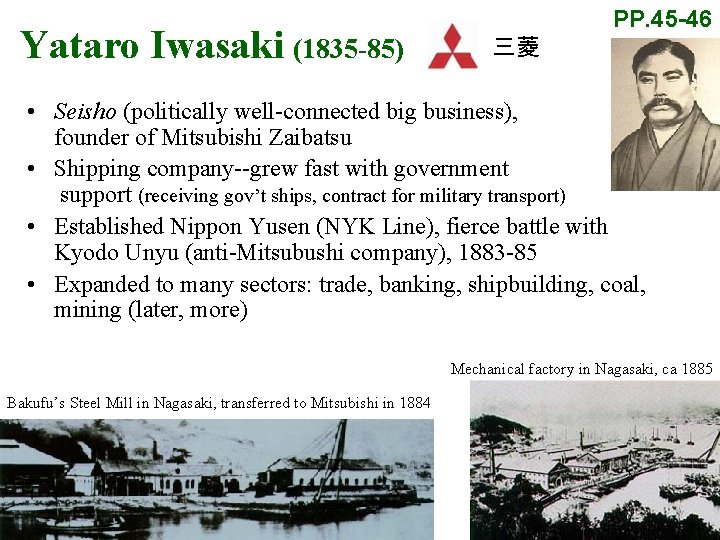
Yataro Iwasaki (1835 -85) PP. 45 -46 三菱 • Seisho (politically well-connected big business), founder of Mitsubishi Zaibatsu • Shipping company--grew fast with government support (receiving gov’t ships, contract for military transport) • Established Nippon Yusen (NYK Line), fierce battle with Kyodo Unyu (anti-Mitsubushi company), 1883 -85 • Expanded to many sectors: trade, banking, shipbuilding, coal, mining (later, more) Mechanical factory in Nagasaki, ca 1885 Bakufu’s Steel Mill in Nagasaki, transferred to Mitsubishi in 1884
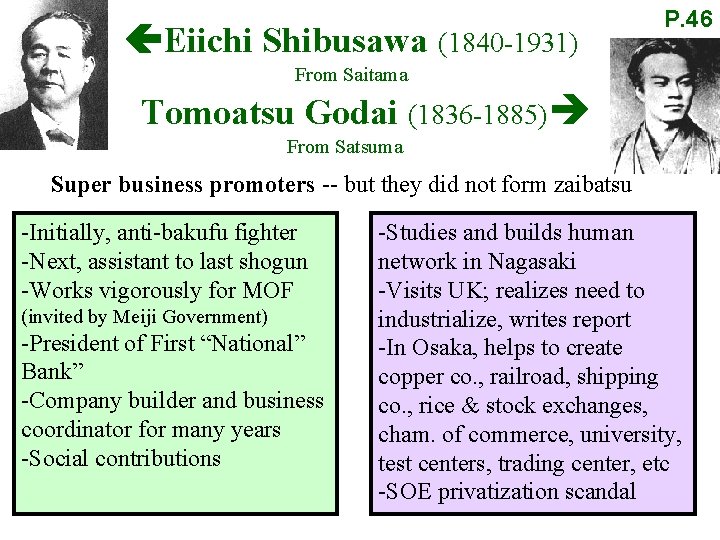
Eiichi Shibusawa (1840 -1931) P. 46 From Saitama Tomoatsu Godai (1836 -1885) From Satsuma Super business promoters -- but they did not form zaibatsu -Initially, anti-bakufu fighter -Next, assistant to last shogun -Works vigorously for MOF (invited by Meiji Government) -President of First “National” Bank” -Company builder and business coordinator for many years -Social contributions -Studies and builds human network in Nagasaki -Visits UK; realizes need to industrialize, writes report -In Osaka, helps to create copper co. , railroad, shipping co. , rice & stock exchanges, cham. of commerce, university, test centers, trading center, etc -SOE privatization scandal
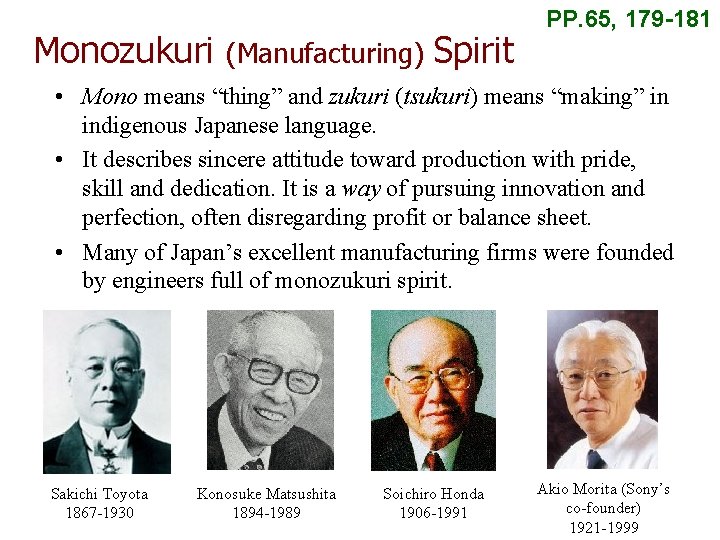
Monozukuri (Manufacturing) Spirit PP. 65, 179 -181 • Mono means “thing” and zukuri (tsukuri) means “making” in indigenous Japanese language. • It describes sincere attitude toward production with pride, skill and dedication. It is a way of pursuing innovation and perfection, often disregarding profit or balance sheet. • Many of Japan’s excellent manufacturing firms were founded by engineers full of monozukuri spirit. Sakichi Toyota 1867 -1930 Konosuke Matsushita 1894 -1989 Soichiro Honda 1906 -1991 Akio Morita (Sony’s co-founder) 1921 -1999
How Toyota Started Car Production n GM & Ford began knock-down production in Japan in the 1920 s. n Kiichiro Toyoda (1894 -1952) was the son of Sakichi Toyoda, the founder of Toyota Textile Machine. After visiting UK & US, he wanted to create a competitive car maker in Japan, but his company did not approve the idea. n He visited many factories, universities & ministries; purchased equipment from Germany & US; and test produced small engines. n In 1933 he reverse-engineered the latest GM Chevrolet, analyzing all components and identifying Japanese companies that could produce them. The Toyota Board finally recognized his effort. n In 1934, US cars were further analyzed & a large factory was built. The engine was modeled after GM, the chassis was Ford-based, and the design was copied from Chrysler. Kiichiro’s engineer friends helped him. After many failures, the engine was finally completed. n The first Toyota car rolled out in May 1935.