
Economic Development Lecture Note 2 13 03 15


- Slides: 111
Economic Development <Lecture Note 2 > 13. 03. 15 ED: Traditional and New Theories of Development * Some parts of this note are summaries of references for teaching purpose only. Semester: Spring 2013 Time: Monday 9: 00~12: 00 am Class Room: No. 322 Professor: Yoo Soo Hong Office Hour: By appointment Mobile: 010 -4001 -8060 E-mail: yshong 123@gmail. com Home P. : //yoosoohong. weebly. com 1
Basic Concepts 2
3
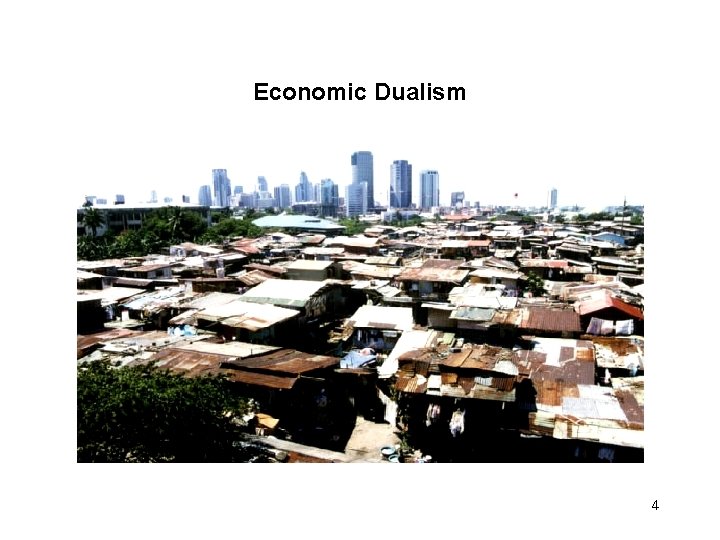
Economic Dualism 4
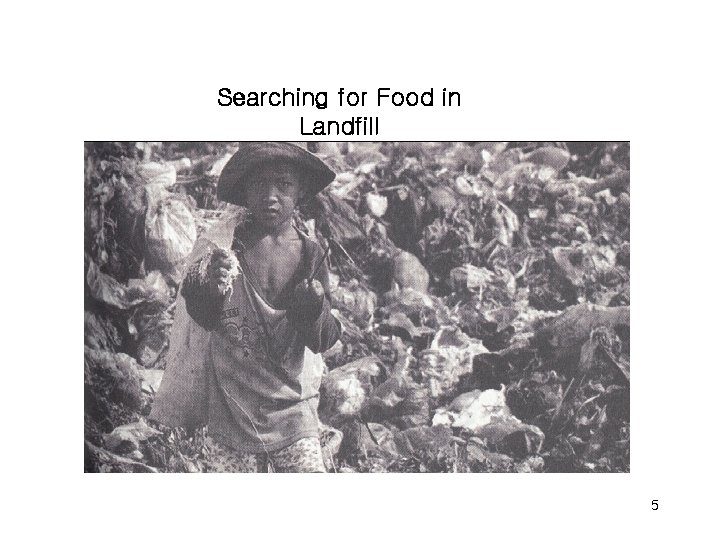
Searching for Food in Landfill 5
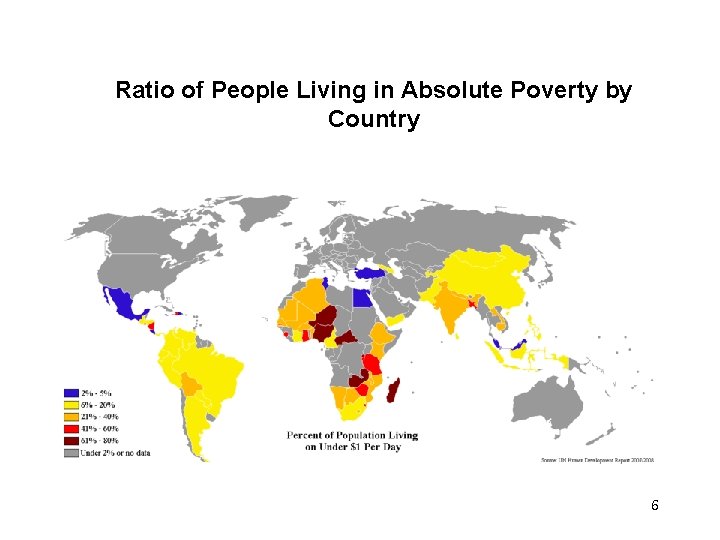
Ratio of People Living in Absolute Poverty by Country 6
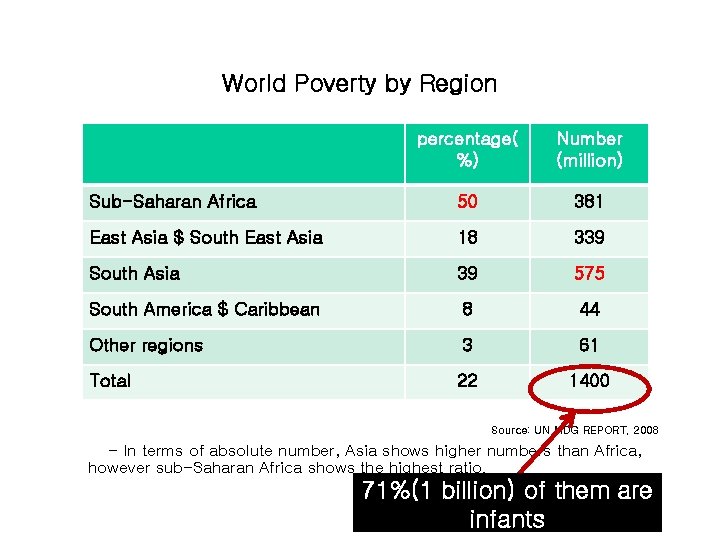
World Poverty by Region percentage( %) Number (million) Sub-Saharan Africa 50 381 East Asia $ South East Asia 18 339 South Asia 39 575 South America $ Caribbean 8 44 Other regions 3 61 Total 22 1400 People living on less than $1 a day Source: UN MDG REPORT, 2008 - In terms of absolute number, Asia shows higher numbers than Africa, however sub-Saharan Africa shows the highest ratio. 71%(1 billion) of them are 7 infants
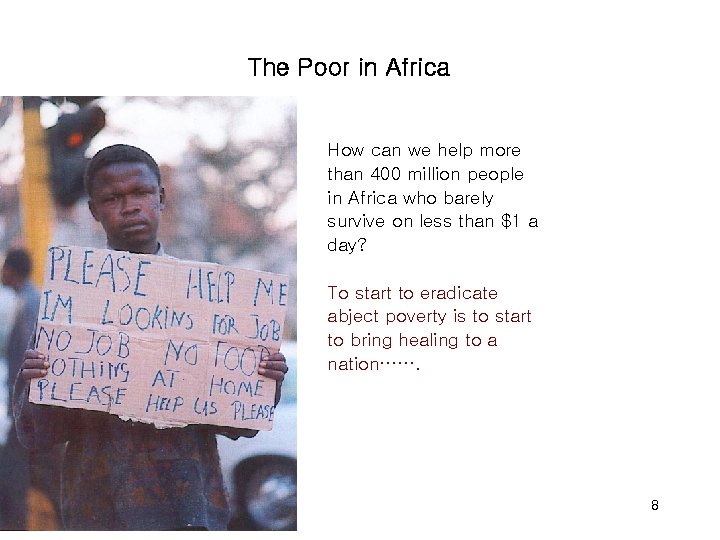
The Poor in Africa How can we help more than 400 million people in Africa who barely survive on less than $1 a day? To start to eradicate abject poverty is to start to bring healing to a nation……. 8
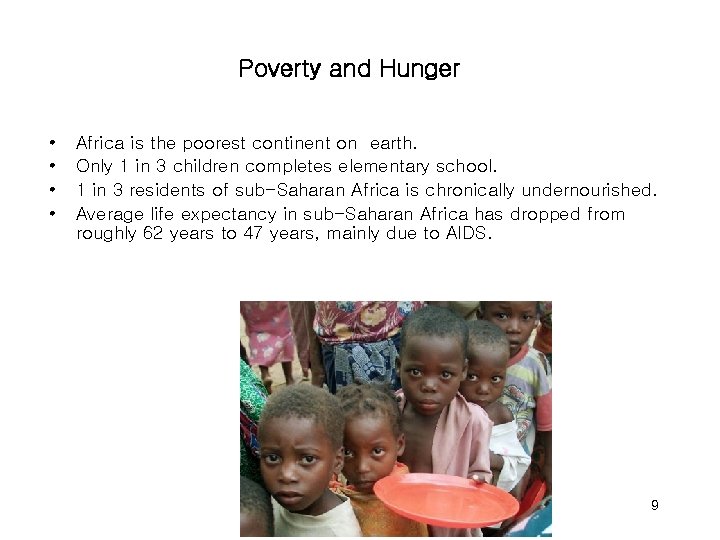
Poverty and Hunger • • Africa is the poorest continent on earth. Only 1 in 3 children completes elementary school. 1 in 3 residents of sub-Saharan Africa is chronically undernourished. Average life expectancy in sub-Saharan Africa has dropped from roughly 62 years to 47 years, mainly due to AIDS. 9
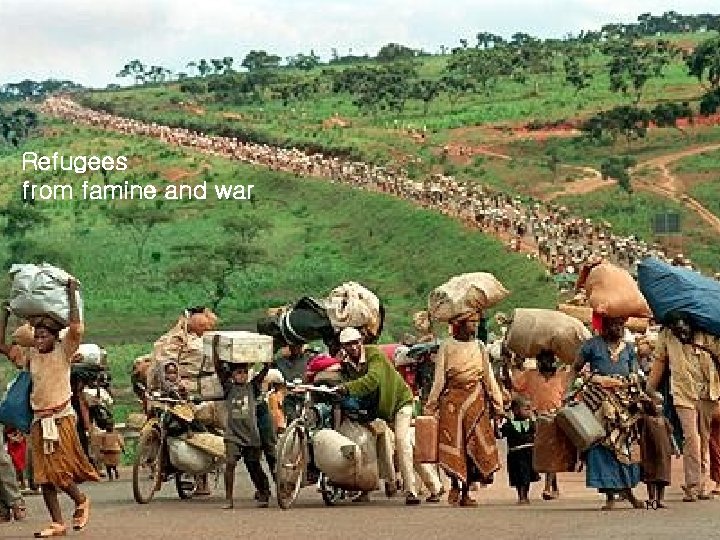
Refugees from famine and war 10
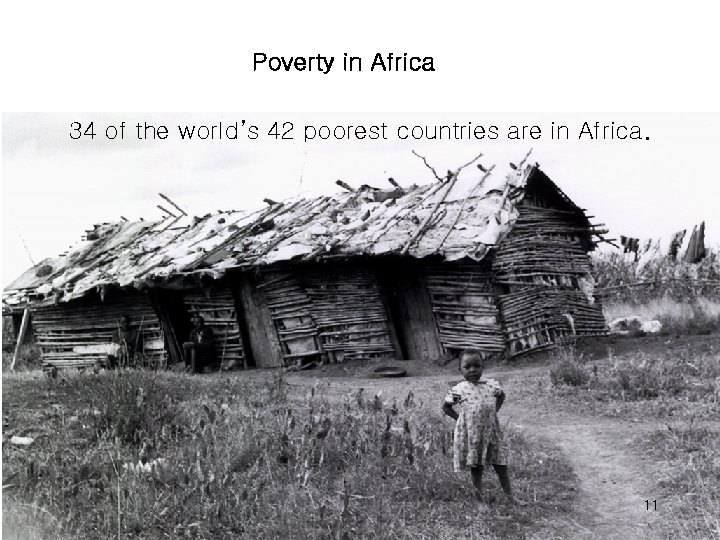
Poverty in Africa 34 of the world’s 42 poorest countries are in Africa. 11
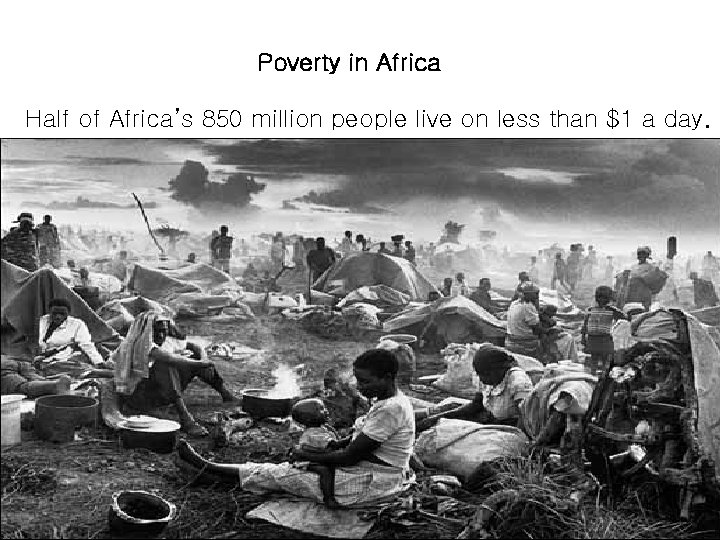
Poverty in Africa Half of Africa’s 850 million people live on less than $1 a day. 12
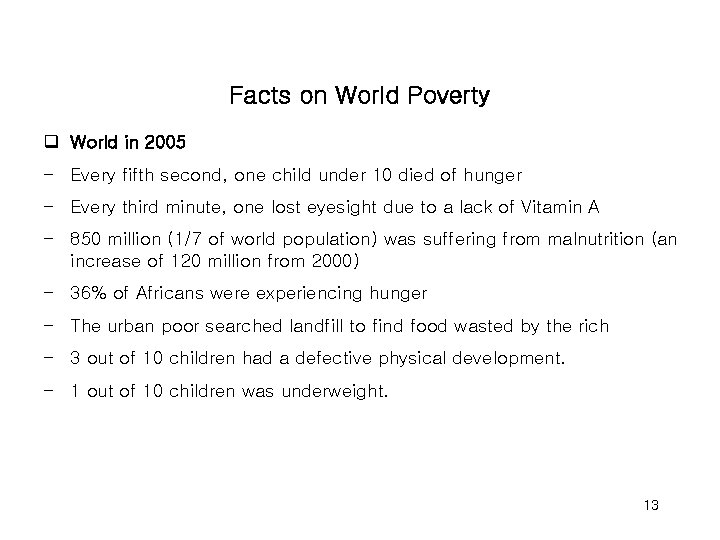
Facts on World Poverty World in 2005 - Every fifth second, one child under 10 died of hunger - Every third minute, one lost eyesight due to a lack of Vitamin A - 850 million (1/7 of world population) was suffering from malnutrition (an increase of 120 million from 2000) - 36% of Africans were experiencing hunger - The urban poor searched landfill to find food wasted by the rich - 3 out of 10 children had a defective physical development. - 1 out of 10 children was underweight. 13
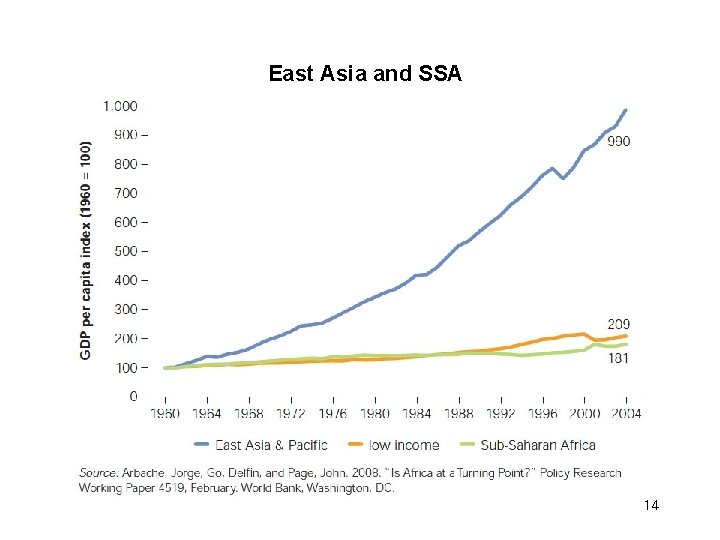
East Asia and SSA 14
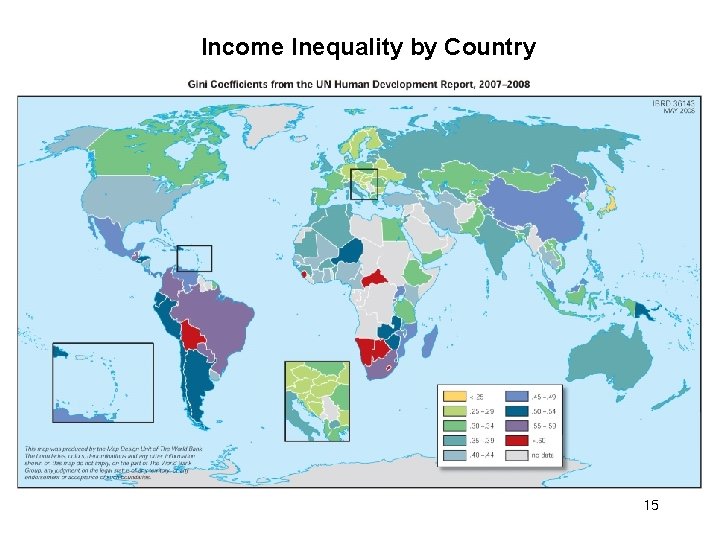
Income Inequality by Country 15
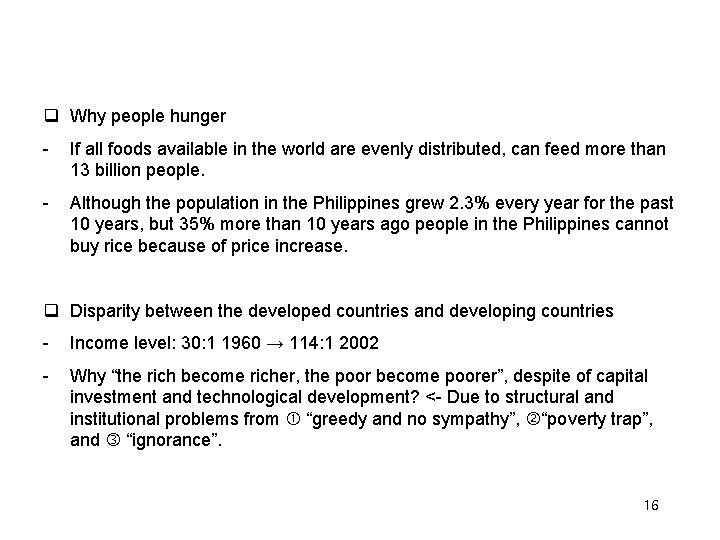
Why people hunger - If all foods available in the world are evenly distributed, can feed more than 13 billion people. - Although the population in the Philippines grew 2. 3% every year for the past 10 years, but 35% more than 10 years ago people in the Philippines cannot buy rice because of price increase. Disparity between the developed countries and developing countries - Income level: 30: 1 1960 → 114: 1 2002 - Why “the rich become richer, the poor become poorer”, despite of capital investment and technological development? <- Due to structural and institutional problems from “greedy and no sympathy”, “poverty trap”, and “ignorance”. 16
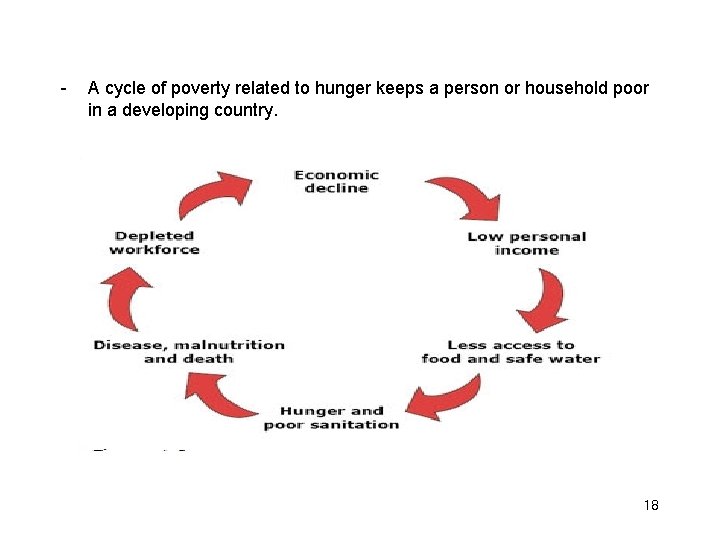
What is the Cycle of Poverty? - The cycle of poverty has been described as a phenomenon where poor families become trapped in poverty for generations. Because they have no or limited access to critical resources, such as education and financial services, subsequent generations are also impoverished. - Due to the many root causes of poverty and the complexity with how poverty is measured and defined, there are multiple cycles of poverty— based on, among other things, economic, social, spiritual and geographical factors. Many cycles overlap or perpetuate new cycles and therefore any attempt to depict the cycle of poverty will be far more simplistic than realistic. - A key goal of development aid, working together with recipients, is to fund new and existing poverty-reduction initiatives that inject positive change into a poverty cycle with the intent of breaking the cycle for the individual, family or community benefiting from that initiative. 17
- A cycle of poverty related to hunger keeps a person or household poor in a developing country. 18
- In most cases, the cycle of poverty is systemic in nature, meaning action needs to be taken to combat the root causes of poverty. For instance, the reduction or cancellation of the national debt for the world's poorest countries will have a potentially dramatic effect on those nations' economies. They can, in turn, spend money on government-funded education for instance, rather than interest payments on a debt they will ultimately never repay. - One cycle of poverty can expand or develop into another. A country's slow economy, and consequently a family's low income, not only means a lack of access to food and safe water, but also means limited or no funds for sending their children to school. 19
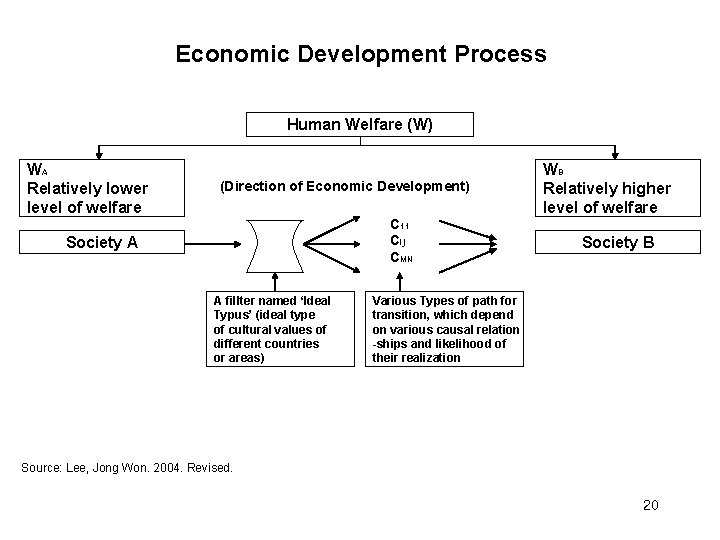
Economic Development Process Human Welfare (W) WA Relatively lower level of welfare (Direction of Economic Development) C 11 Cij CMN Society A A fillter named ‘Ideal Typus’ (ideal type of cultural values of different countries or areas) WB Relatively higher level of welfare Society B Various Types of path for transition, which depend on various causal relation -ships and likelihood of their realization Source: Lee, Jong Won. 2004. Revised. 20
Traditional Theories 21
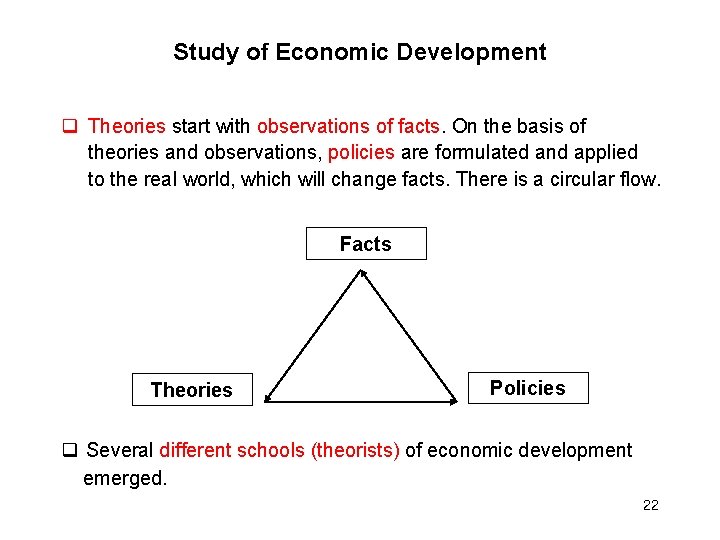
Study of Economic Development Theories start with observations of facts. On the basis of theories and observations, policies are formulated and applied to the real world, which will change facts. There is a circular flow. Facts Theories Policies Several different schools (theorists) of economic development emerged. 22
Development Economics - Development economics is a branch of economics which deals with economic aspects of the development process in low-income countries. - Its focus is not only on methods of promoting economic growth and structural change but also on improving the potential for the mass of the population. - DE involves the creation of theories and methods that aid in the determination of policies and practices and can be implemented at either the domestic or international level. - Unlike in many other fields of economics, approaches in development economics may incorporate social and political factors to devise particular policies. 23
Causes of Underdevelopment □ Characterization • Very easy to focus on characteristics • Underdevelopment is usually characterized by: low per capita incomes, low literacy and educational attainment, lack of basic services such as water and power • But how can we explain (under)development? □ Environmental and internal instability • Old view that absence of development caused by certain physical environments, particular cultural traditions and value systems • Lack of natural resources certainly impediment to development but not impossible - example of Japan, Korea, Singapore, etc. • Instability and other adverse internal situations such as political factors, e. g. central African nations with tribal rivalries and ethnic cleansing • Poor physical environment: lack of rainfall, poor soils also may pose barriers to development. 24
‘Colonialism as Scapegoat’ Explanation • • • Need to view development in historical perspective as sequence of dynamic events and explore roots Colonialism viewed as the cause of disintegration and decline Indigenous population exploited Traditional way of life and self sufficient mode of production have been destroyed. Forced to pay taxes and conscripted labor practices Social differentiation increased: disintegrating force Fatal effects on secondary (manufacturing) and tertiary (service) sectors: import of cheap goods forced indigenous artisans out of work Discouraged modern industrialization Colonial powers extracted wealth for home country such as Netherlands, France, Great Britain, etc. International division of labor and western dominated trading structure was created to take advantage of colonial authority. 25
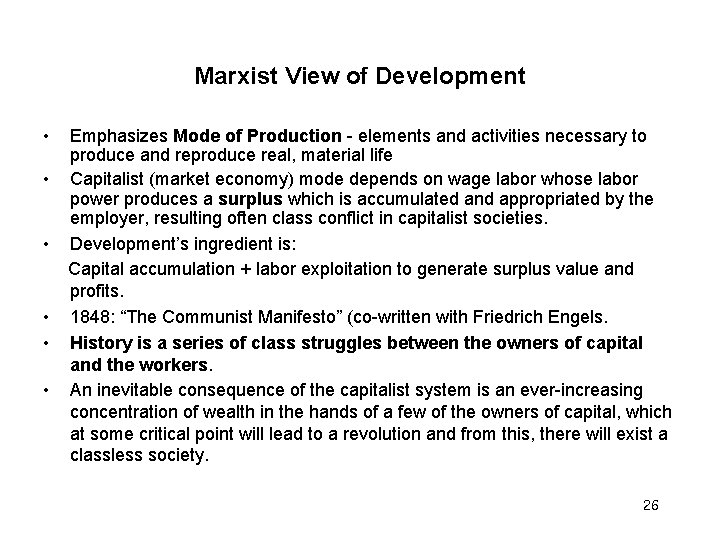
Marxist View of Development • Emphasizes Mode of Production - elements and activities necessary to produce and reproduce real, material life • Capitalist (market economy) mode depends on wage labor whose labor power produces a surplus which is accumulated and appropriated by the employer, resulting often class conflict in capitalist societies. • Development’s ingredient is: Capital accumulation + labor exploitation to generate surplus value and profits. • 1848: “The Communist Manifesto” (co-written with Friedrich Engels. • History is a series of class struggles between the owners of capital and the workers. • An inevitable consequence of the capitalist system is an ever-increasing concentration of wealth in the hands of a few of the owners of capital, which at some critical point will lead to a revolution and from this, there will exist a classless society. 26
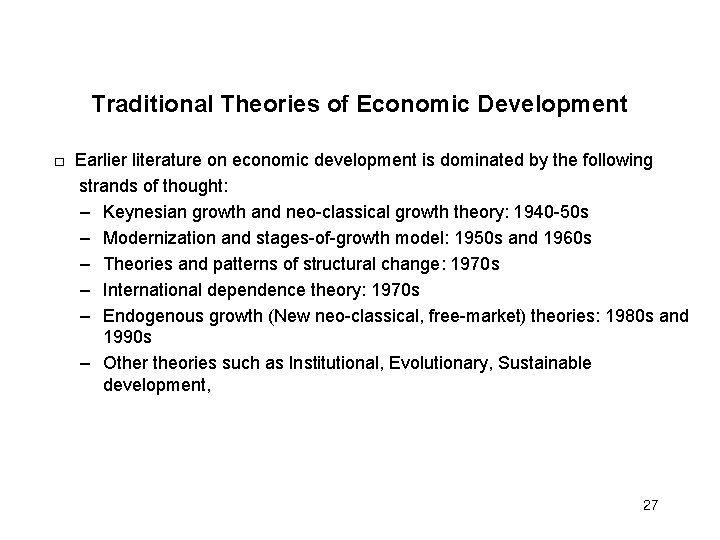
Traditional Theories of Economic Development □ Earlier literature on economic development is dominated by the following strands of thought: – Keynesian growth and neo-classical growth theory: 1940 -50 s – Modernization and stages-of-growth model: 1950 s and 1960 s – Theories and patterns of structural change: 1970 s – International dependence theory: 1970 s – Endogenous growth (New neo-classical, free-market) theories: 1980 s and 1990 s – Other theories such as Institutional, Evolutionary, Sustainable development, 27
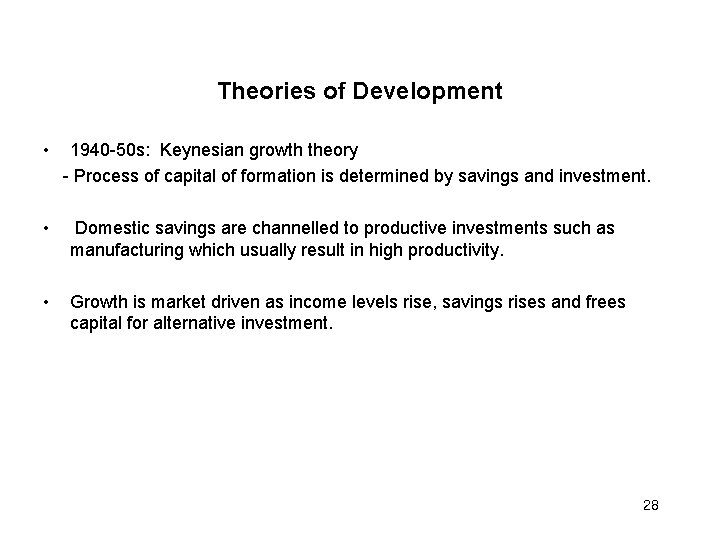
Theories of Development • 1940 -50 s: Keynesian growth theory - Process of capital of formation is determined by savings and investment. • Domestic savings are channelled to productive investments such as manufacturing which usually result in high productivity. • Growth is market driven as income levels rise, savings rises and frees capital for alternative investment. 28
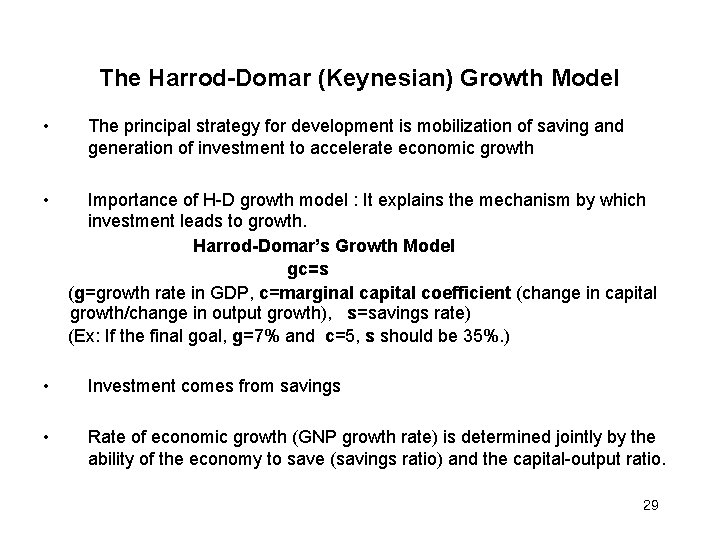
The Harrod-Domar (Keynesian) Growth Model • The principal strategy for development is mobilization of saving and generation of investment to accelerate economic growth • Importance of H-D growth model : It explains the mechanism by which investment leads to growth. Harrod-Domar’s Growth Model gc=s (g=growth rate in GDP, c=marginal capital coefficient (change in capital growth/change in output growth), s=savings rate) (Ex: If the final goal, g=7% and c=5, s should be 35%. ) • Investment comes from savings • Rate of economic growth (GNP growth rate) is determined jointly by the ability of the economy to save (savings ratio) and the capital-output ratio. 29
Obstacles and Constraints - Discussion • Is it really true that GDP growth is proportional to the share of investment expenditure (savings) in GDP? • In reality, low rate of savings in developing countries gives rise to savings gap and capital constraint • (Savings and) investment is a necessary condition for accelerated economic growth but not a sufficient condition. 30
Solow's Neoclassical Model or Exogenous Growth Model • • Solow’s model of economic growth implies that economies will conditionally converge to the same level of income, given that they have the same rates of savings, depreciation, labor force growth, and productivity growth Solow’s model differs from H-D model in the following respects: – Allows for substitution between labor and capital – Assumes that there exist diminishing returns to these inputs – Introduces technology in the growth equation, but technology is exogenous. • Usually the H-D Model and Solow’s Growth Model are regarded as the neoclassical growth model, although Solow’s Model is theoretically more flexible. • An implication of Solow’s Model is convergence of all economies in the long 31 run.
Implications of Solow's Neoclassical Model or Exogenous Growth Model • Impact of increase in productivity: – Raises steady state per capita output through increase in per capital. – In the long-run increase in per capita income takes place at the same rate as productivity/ technical progress Do Economies Converge? • • • Unconditional convergence occurs when poor countries will eventually catch up with the rich countries resulting in similar living standards. Conditional convergence occurs when countries with similar characteristics will converge (savings rate, investment rate, population growth). No convergence occurs when poor countries do not catch up over time and living standards may diverge. 32
Trade in the Neoclassical Growth/Development Theory - These economists argue that international trade can provide a substitute for low domestic aggregate demand. - The only things governments need to do is to position an economy on an autonomous, sustained-growth path is to remove barriers to international trade in commodities. - In this view, domestic and international liberalization programs suffice to bring about sustained economic growth and structural change. 33
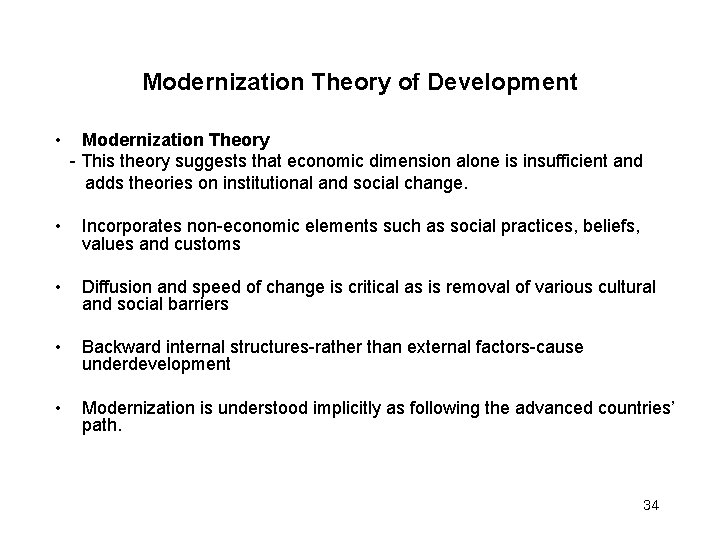
Modernization Theory of Development • Modernization Theory - This theory suggests that economic dimension alone is insufficient and adds theories on institutional and social change. • Incorporates non-economic elements such as social practices, beliefs, values and customs • Diffusion and speed of change is critical as is removal of various cultural and social barriers • Backward internal structures-rather than external factors-cause underdevelopment • Modernization is understood implicitly as following the advanced countries’ path. 34
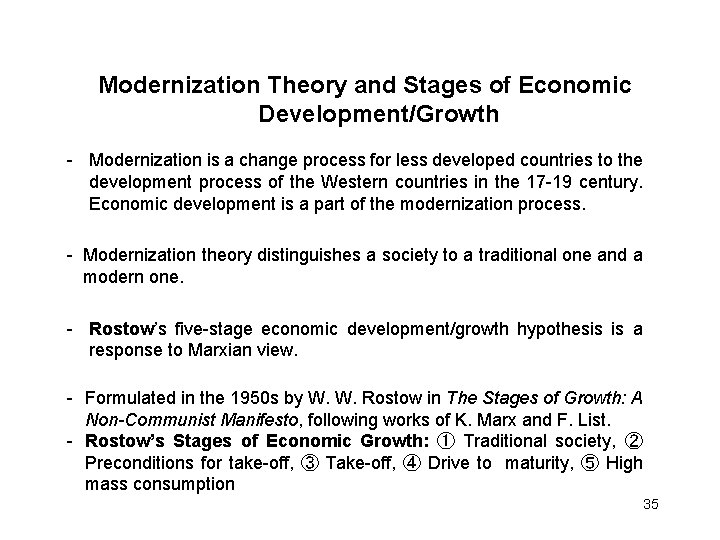
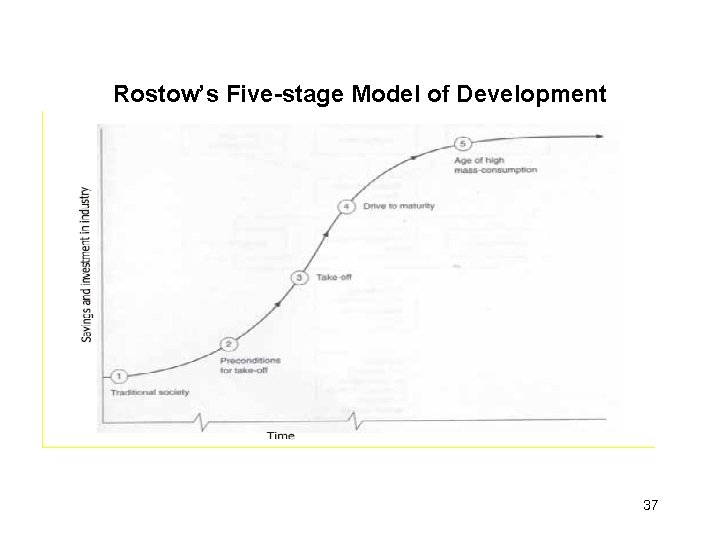
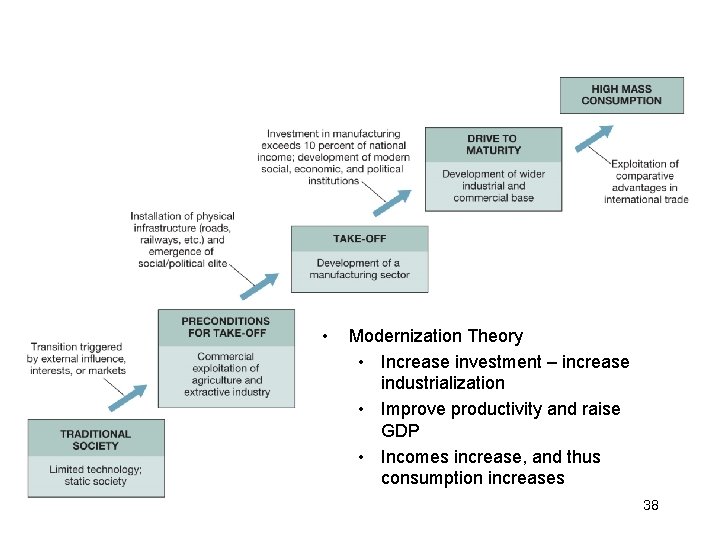
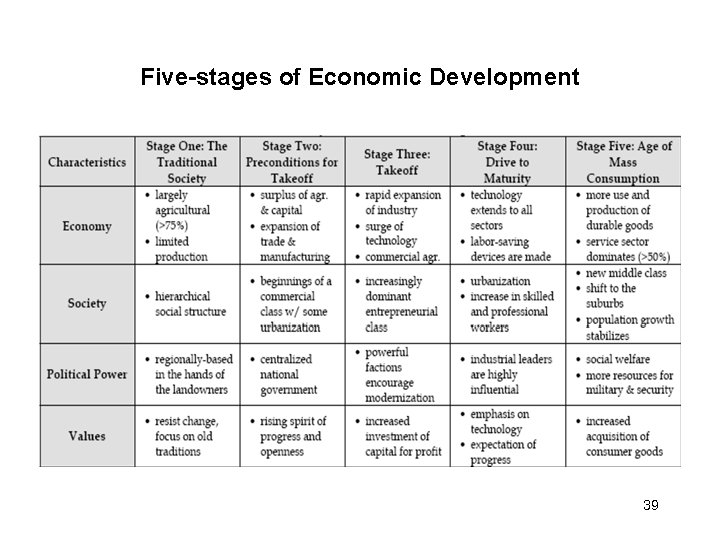
Modernization Theory and Stages of Economic Development/Growth - Modernization is a change process for less developed countries to the development process of the Western countries in the 17 -19 century. Economic development is a part of the modernization process. - Modernization theory distinguishes a society to a traditional one and a modern one. - Rostow’s five-stage economic development/growth hypothesis is a response to Marxian view. - Formulated in the 1950 s by W. W. Rostow in The Stages of Growth: A Non-Communist Manifesto, following works of K. Marx and F. List. - Rostow’s Stages of Economic Growth: ① Traditional society, ② Preconditions for take-off, ③ Take-off, ④ Drive to maturity, ⑤ High mass consumption 35
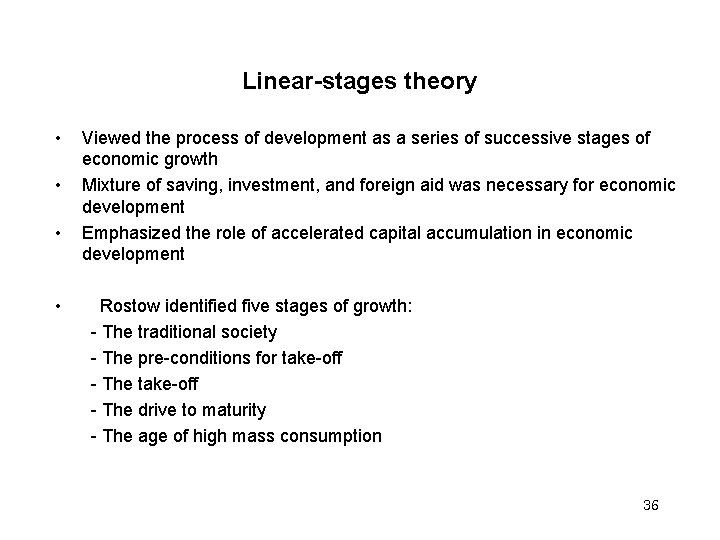
Linear-stages theory • • Viewed the process of development as a series of successive stages of economic growth Mixture of saving, investment, and foreign aid was necessary for economic development Emphasized the role of accelerated capital accumulation in economic development Rostow identified five stages of growth: - The traditional society - The pre-conditions for take-off - The drive to maturity - The age of high mass consumption 36
Rostow’s Five-stage Model of Development 37
• Modernization Theory • Increase investment – increase industrialization • Improve productivity and raise GDP • Incomes increase, and thus consumption increases 38
Five-stages of Economic Development 39
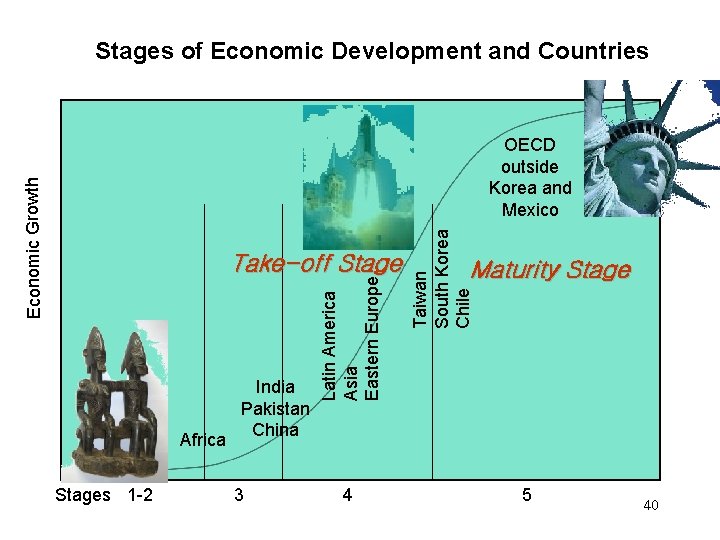
Stages of Economic Development and Countries Africa Stages 1 -2 India Pakistan China 3 Latin America Asia Eastern Europe Take-off Stage 4 Taiwan South Korea Chile Economic Growth OECD outside Korea and Mexico Maturity Stage 5 40
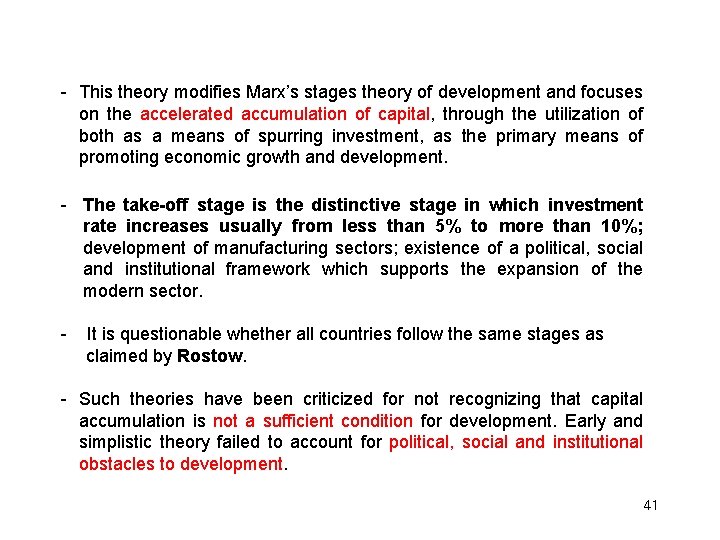
- This theory modifies Marx’s stages theory of development and focuses on the accelerated accumulation of capital, through the utilization of both as a means of spurring investment, as the primary means of promoting economic growth and development. - The take-off stage is the distinctive stage in which investment rate increases usually from less than 5% to more than 10%; development of manufacturing sectors; existence of a political, social and institutional framework which supports the expansion of the modern sector. - It is questionable whether all countries follow the same stages as claimed by Rostow. - Such theories have been criticized for not recognizing that capital accumulation is not a sufficient condition for development. Early and simplistic theory failed to account for political, social and institutional obstacles to development. 41
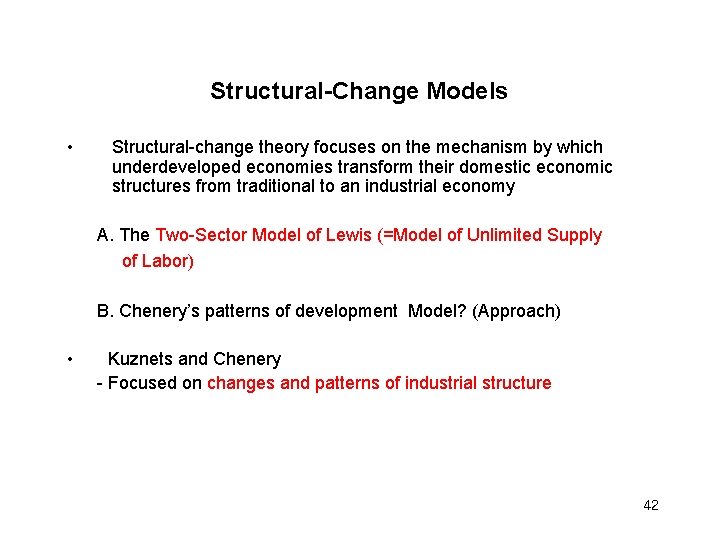
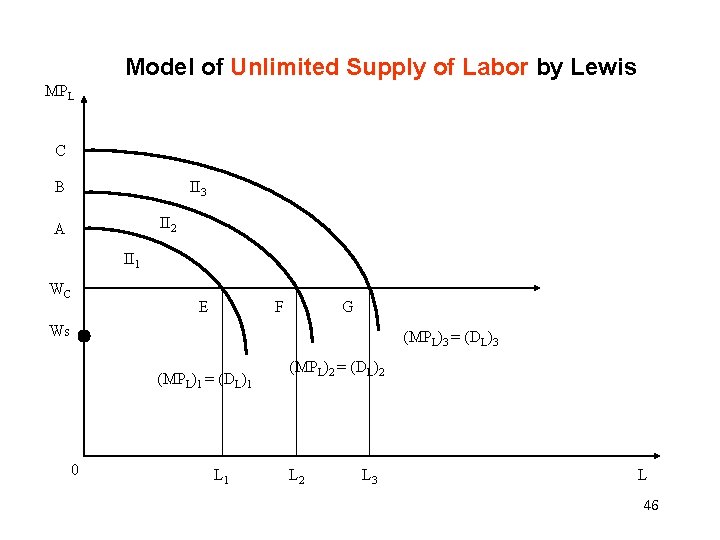
Structural-Change Models • Structural-change theory focuses on the mechanism by which underdeveloped economies transform their domestic economic structures from traditional to an industrial economy A. The Two-Sector Model of Lewis (=Model of Unlimited Supply of Labor) B. Chenery’s patterns of development Model? (Approach) • Kuznets and Chenery - Focused on changes and patterns of industrial structure 42
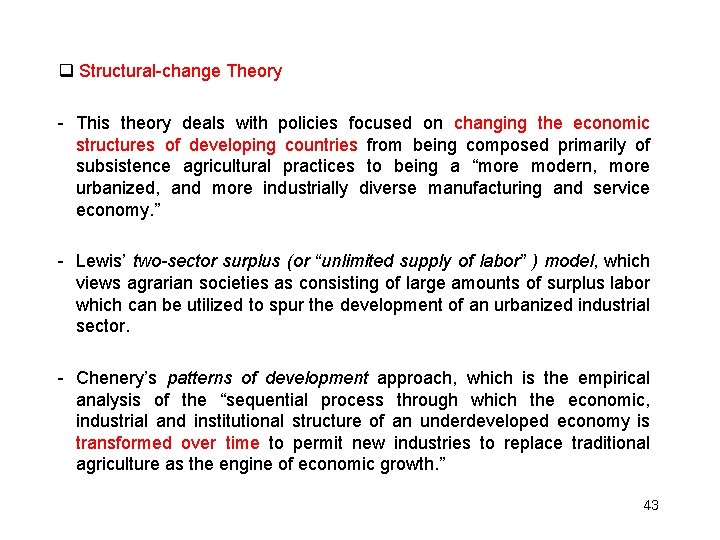
Structural-change Theory - This theory deals with policies focused on changing the economic structures of developing countries from being composed primarily of subsistence agricultural practices to being a “more modern, more urbanized, and more industrially diverse manufacturing and service economy. ” - Lewis’ two-sector surplus (or “unlimited supply of labor” ) model, which views agrarian societies as consisting of large amounts of surplus labor which can be utilized to spur the development of an urbanized industrial sector. - Chenery’s patterns of development approach, which is the empirical analysis of the “sequential process through which the economic, industrial and institutional structure of an underdeveloped economy is transformed over time to permit new industries to replace traditional agriculture as the engine of economic growth. ” 43
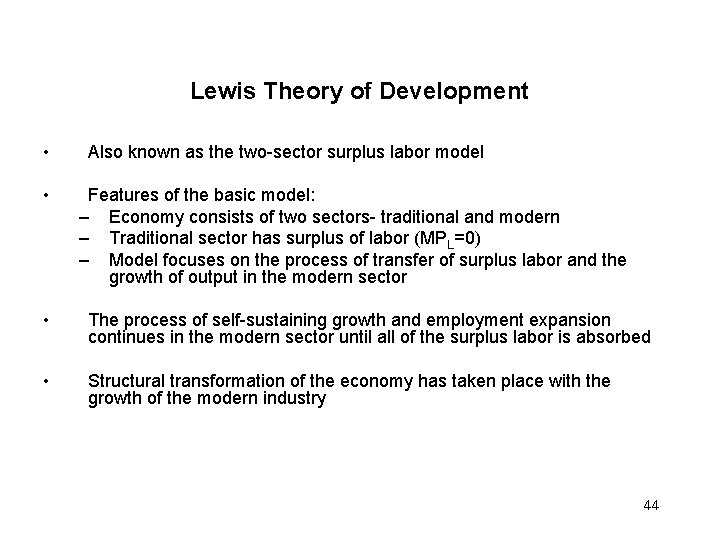
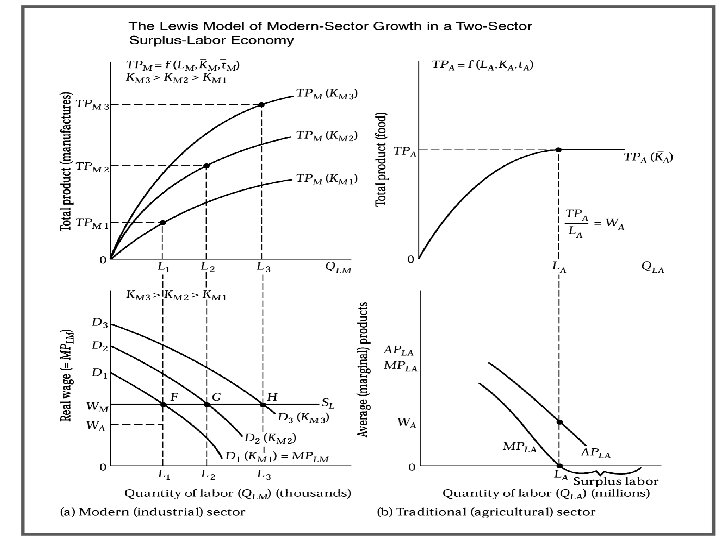
Lewis Theory of Development • • Also known as the two-sector surplus labor model Features of the basic model: – Economy consists of two sectors- traditional and modern – Traditional sector has surplus of labor (MPL=0) – Model focuses on the process of transfer of surplus labor and the growth of output in the modern sector • The process of self-sustaining growth and employment expansion continues in the modern sector until all of the surplus labor is absorbed • Structural transformation of the economy has taken place with the growth of the modern industry 44
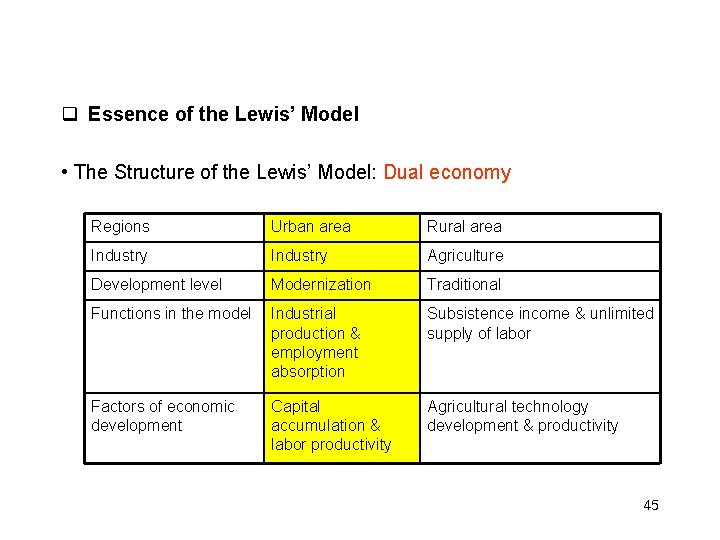
Essence of the Lewis’ Model • The Structure of the Lewis’ Model: Dual economy Regions Urban area Rural area Industry Agriculture Development level Modernization Traditional Functions in the model Industrial production & employment absorption Subsistence income & unlimited supply of labor Factors of economic development Capital accumulation & labor productivity Agricultural technology development & productivity 45
Model of Unlimited Supply of Labor by Lewis MPL C B II 3 II 2 A II 1 WC E F G Ws (MPL)3 = (DL)3 (MPL)1 = (DL)1 0 L 1 (MPL)2 = (DL)2 L 3 L 46
47
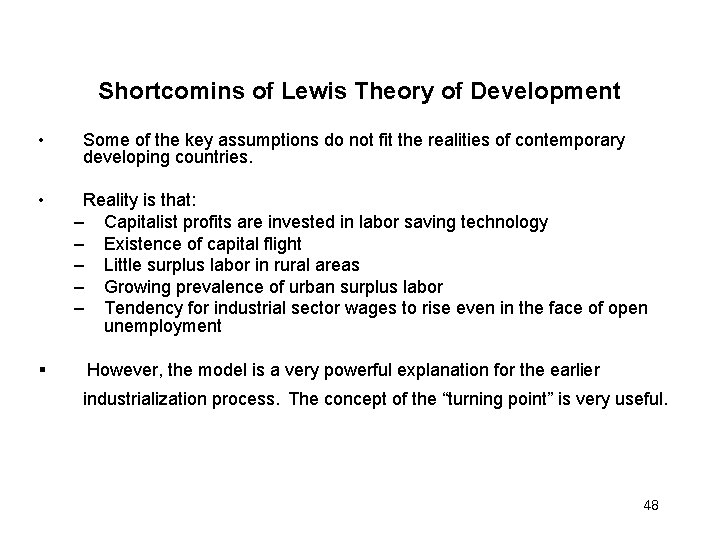
Shortcomins of Lewis Theory of Development • • Some of the key assumptions do not fit the realities of contemporary developing countries. Reality is that: – Capitalist profits are invested in labor saving technology – Existence of capital flight – Little surplus labor in rural areas – Growing prevalence of urban surplus labor – Tendency for industrial sector wages to rise even in the face of open unemployment § However, the model is a very powerful explanation for the earlier industrialization process. The concept of the “turning point” is very useful. 48
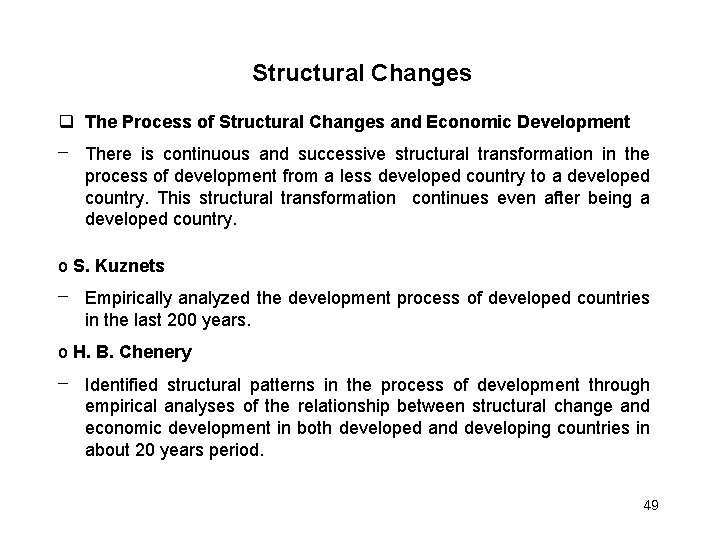
Structural Changes The Process of Structural Changes and Economic Development – There is continuous and successive structural transformation in the process of development from a less developed country to a developed country. This structural transformation continues even after being a developed country. o S. Kuznets – Empirically analyzed the development process of developed countries in the last 200 years. o H. B. Chenery – Identified structural patterns in the process of development through empirical analyses of the relationship between structural change and economic development in both developed and developing countries in about 20 years period. 49
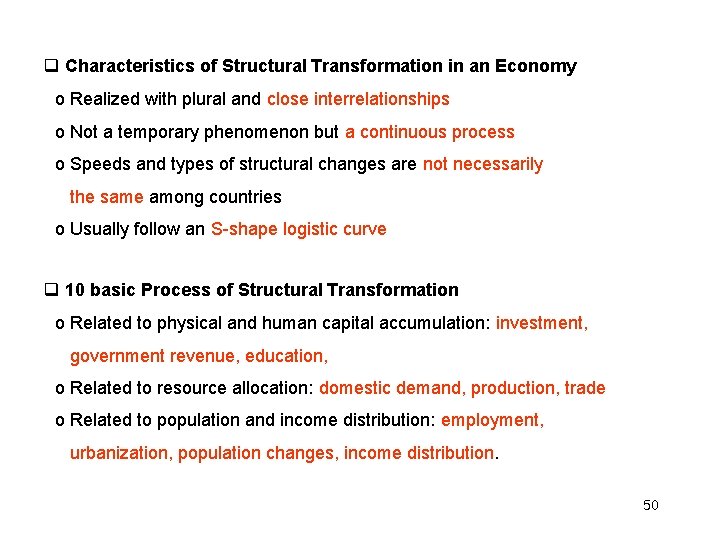
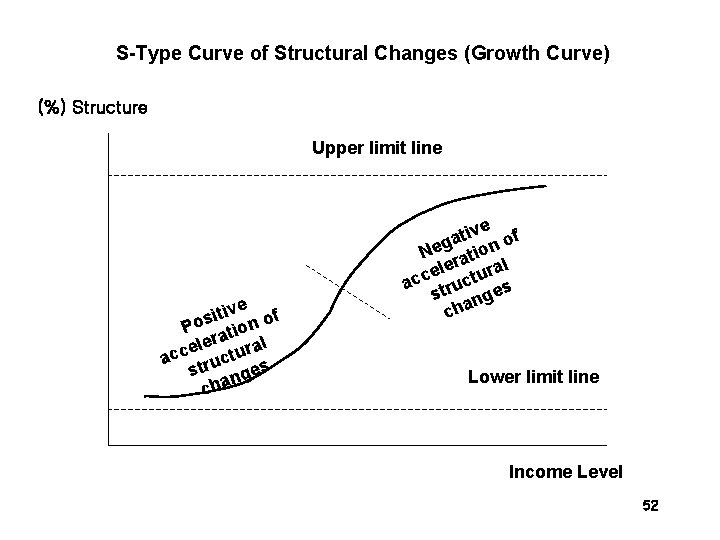
Characteristics of Structural Transformation in an Economy o Realized with plural and close interrelationships o Not a temporary phenomenon but a continuous process o Speeds and types of structural changes are not necessarily the same among countries o Usually follow an S-shape logistic curve 10 basic Process of Structural Transformation o Related to physical and human capital accumulation: investment, government revenue, education, o Related to resource allocation: domestic demand, production, trade o Related to population and income distribution: employment, urbanization, population changes, income distribution. 50
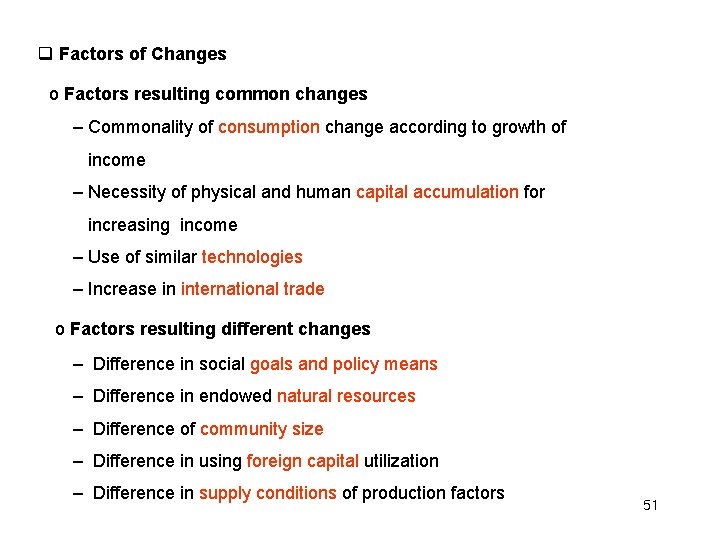
Factors of Changes o Factors resulting common changes – Commonality of consumption change according to growth of income – Necessity of physical and human capital accumulation for increasing income – Use of similar technologies – Increase in international trade o Factors resulting different changes – Difference in social goals and policy means – Difference in endowed natural resources – Difference of community size – Difference in using foreign capital utilization – Difference in supply conditions of production factors 51
S-Type Curve of Structural Changes (Growth Curve) (%) Structure Upper limit line ve f i t i s o Po ation ler ural e c ac truct s s ge n a ch e v i t a of g n e N ratio le ural e c ac truct es s ng a h c Lower limit line Income Level 52
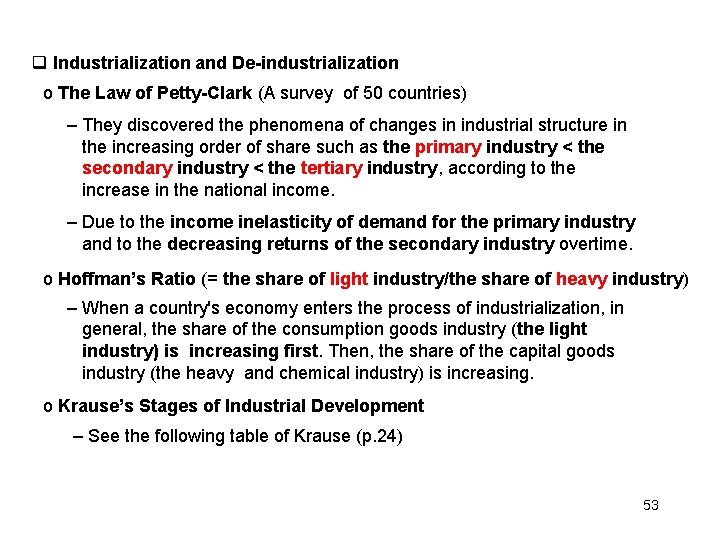
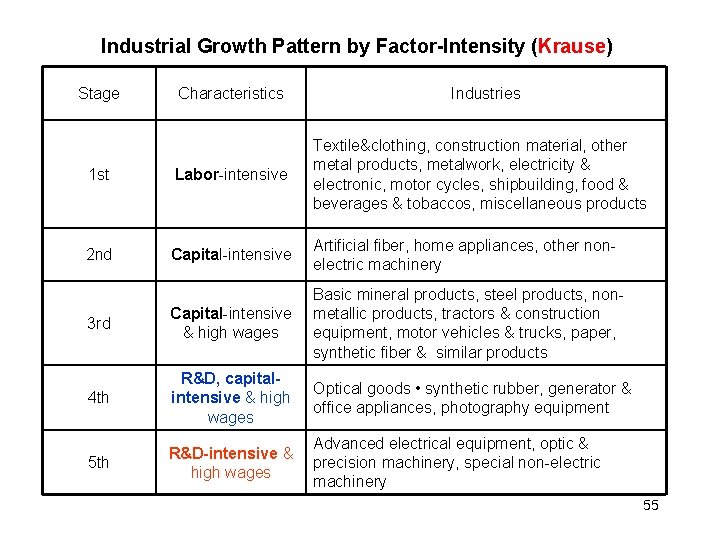
Industrialization and De-industrialization o The Law of Petty-Clark (A survey of 50 countries) – They discovered the phenomena of changes in industrial structure in the increasing order of share such as the primary industry < the secondary industry < the tertiary industry, according to the increase in the national income. – Due to the income inelasticity of demand for the primary industry and to the decreasing returns of the secondary industry overtime. o Hoffman’s Ratio (= the share of light industry/the share of heavy industry) – When a country's economy enters the process of industrialization, in general, the share of the consumption goods industry (the light industry) is increasing first. Then, the share of the capital goods industry (the heavy and chemical industry) is increasing. o Krause’s Stages of Industrial Development – See the following table of Krause (p. 24) 53
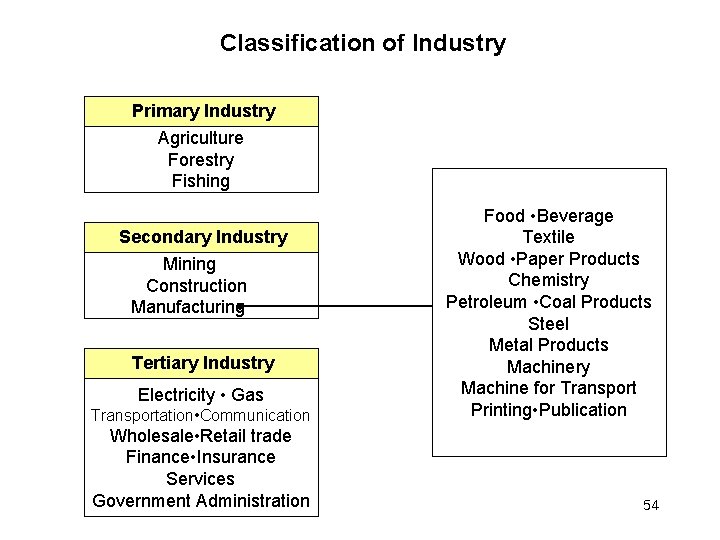
Classification of Industry Primary Industry Agriculture Forestry Fishing Secondary Industry Mining Construction Manufacturing Tertiary Industry Electricity • Gas Transportation • Communication Wholesale • Retail trade Finance • Insurance Services Government Administration Food • Beverage Textile Wood • Paper Products Chemistry Petroleum • Coal Products Steel Metal Products Machinery Machine for Transport Printing • Publication 54
Industrial Growth Pattern by Factor-Intensity (Krause) Stage Characteristics Industries 1 st Labor-intensive Textile&clothing, construction material, other metal products, metalwork, electricity & electronic, motor cycles, shipbuilding, food & beverages & tobaccos, miscellaneous products 2 nd Capital-intensive Artificial fiber, home appliances, other nonelectric machinery 3 rd Capital-intensive & high wages Basic mineral products, steel products, nonmetallic products, tractors & construction equipment, motor vehicles & trucks, paper, synthetic fiber & similar products 4 th R&D, capitalintensive & high wages Optical goods • synthetic rubber, generator & office appliances, photography equipment 5 th Advanced electrical equipment, optic & R&D-intensive & precision machinery, special non-electric high wages machinery 55
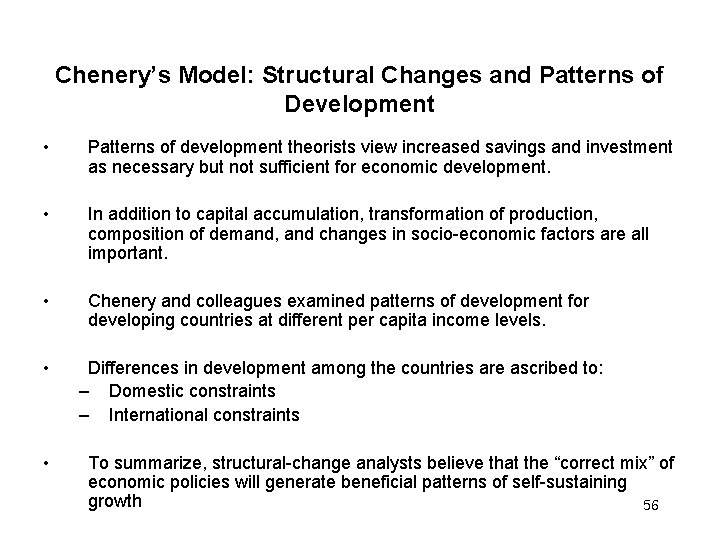
Chenery’s Model: Structural Changes and Patterns of Development • Patterns of development theorists view increased savings and investment as necessary but not sufficient for economic development. • In addition to capital accumulation, transformation of production, composition of demand, and changes in socio-economic factors are all important. • Chenery and colleagues examined patterns of development for developing countries at different per capita income levels. • Differences in development among the countries are ascribed to: – Domestic constraints – International constraints • To summarize, structural-change analysts believe that the “correct mix” of economic policies will generate beneficial patterns of self-sustaining growth 56
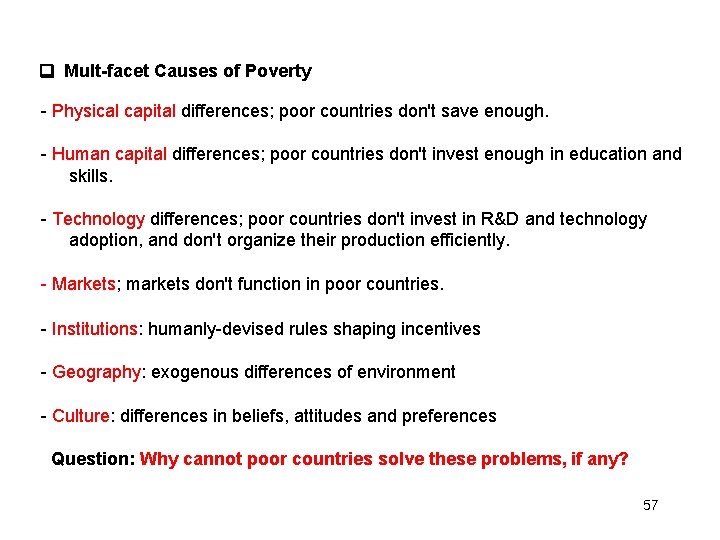
Mult-facet Causes of Poverty - Physical capital differences; poor countries don't save enough. - Human capital differences; poor countries don't invest enough in education and skills. - Technology differences; poor countries don't invest in R&D and technology adoption, and don't organize their production efficiently. - Markets; markets don't function in poor countries. - Institutions: humanly-devised rules shaping incentives - Geography: exogenous differences of environment - Culture: differences in beliefs, attitudes and preferences Question: Why cannot poor countries solve these problems, if any? 57
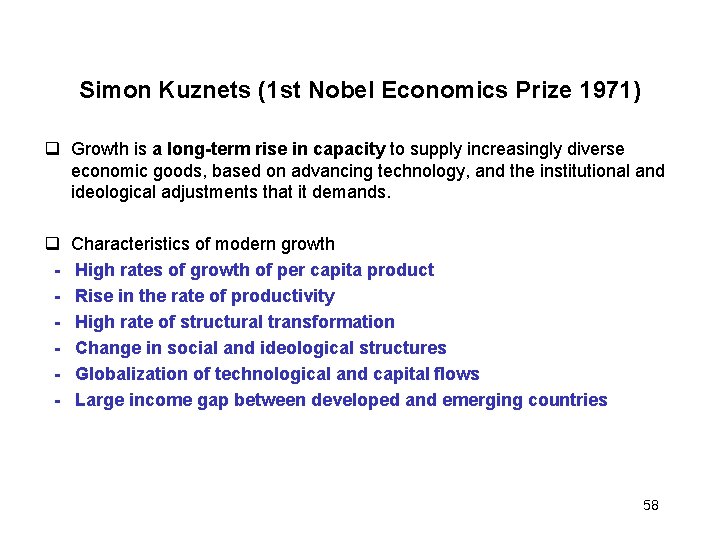
Simon Kuznets (1 st Nobel Economics Prize 1971) Growth is a long-term rise in capacity to supply increasingly diverse economic goods, based on advancing technology, and the institutional and ideological adjustments that it demands. Characteristics of modern growth - High rates of growth of per capita product - Rise in the rate of productivity - High rate of structural transformation - Change in social and ideological structures - Globalization of technological and capital flows - Large income gap between developed and emerging countries 58
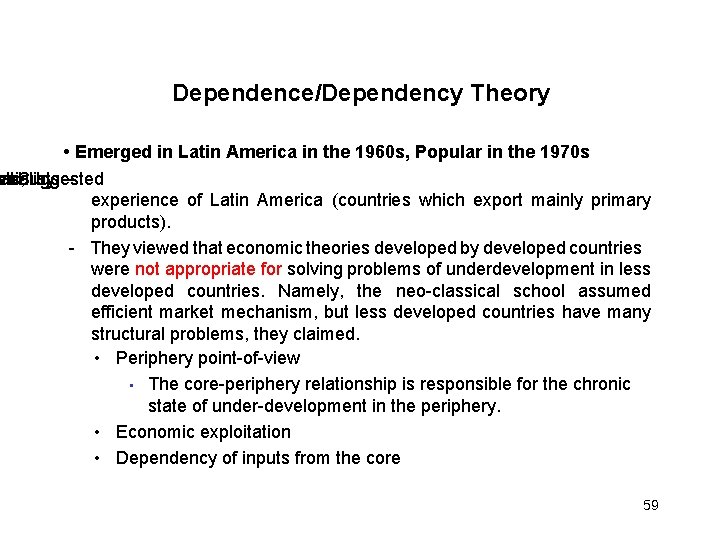
Dependence/Dependency Theory • Emerged in Latin America in the 1960 s, Popular in the 1970 s cal and ocialists sts, Suggested by - experience of Latin America (countries which export mainly primary products). - They viewed that economic theories developed by developed countries were not appropriate for solving problems of underdevelopment in less developed countries. Namely, the neo-classical school assumed efficient market mechanism, but less developed countries have many structural problems, they claimed. • Periphery point-of-view • The core-periphery relationship is responsible for the chronic state of under-development in the periphery. • Economic exploitation • Dependency of inputs from the core 59
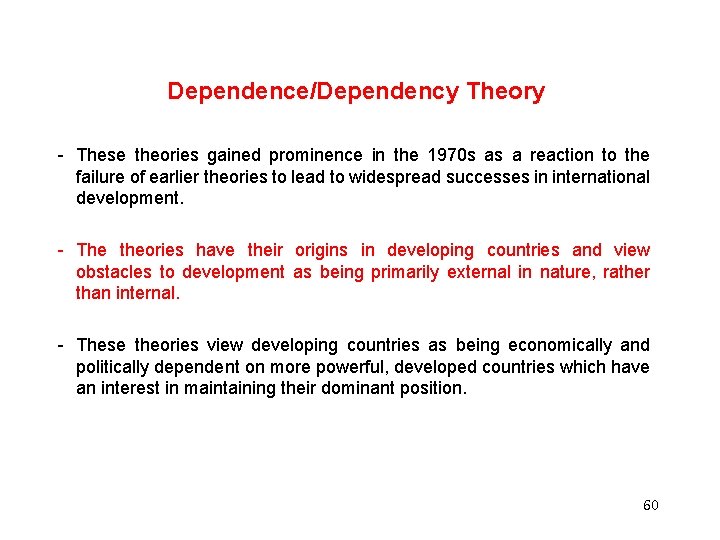
Dependence/Dependency Theory - These theories gained prominence in the 1970 s as a reaction to the failure of earlier theories to lead to widespread successes in international development. - The theories have their origins in developing countries and view obstacles to development as being primarily external in nature, rather than internal. - These theories view developing countries as being economically and politically dependent on more powerful, developed countries which have an interest in maintaining their dominant position. 60
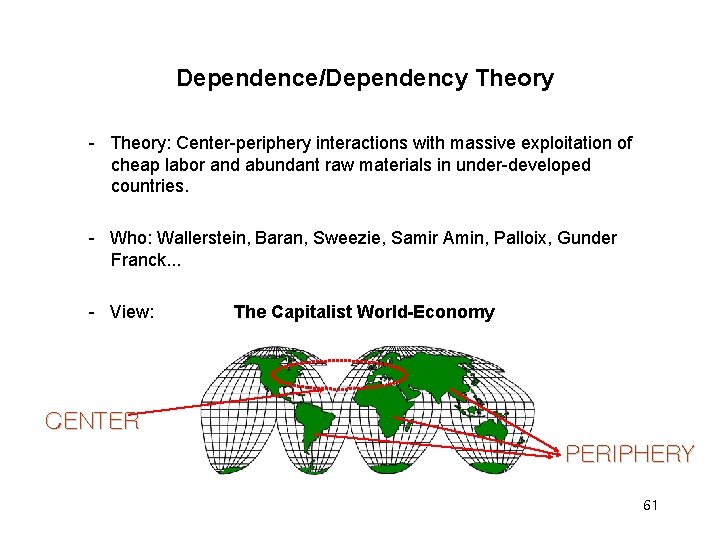
Dependence/Dependency Theory - Theory: Center-periphery interactions with massive exploitation of cheap labor and abundant raw materials in under-developed countries. - Who: Wallerstein, Baran, Sweezie, Samir Amin, Palloix, Gunder Franck. . . - View: The Capitalist World-Economy CENTER PERIPHERY 61
Three Versions of (International) Dependence(y) Theories • Three streams of thought: – Neocolonial dependence model – False-paradigm model – Dualistic-development thesis • The IDT models reject the exclusive emphasis on GNP growth rate as the principal index of development. • Instead they place emphasis on international power balances and on fundamental reforms world-wide. • IDTs view developing countries as beset by institutional, political, and economic rigidities in both domestic and international setup. • The IDTs argue that developing countries are up in a dependence and dominance relationship with rich countries. 62
“On Dependence” • “Dependence is a conditioning situation in which the economies of one group of countries are conditioned by the development and expansion of others. ” • “Dependence, then, is based upon an international division of labor which allows industrial development to take place in some countries, while restricting it in others, whose growth is conditioned by and subjected to the power centers of the world. ” Theotonio Dos Santos 63
A. Neocolonial Dependence Model • • • Outgrowth of Marxist thinking Existence of underdevelopment due to historical evolution of an unequal international capitalist system of rich country-poor country relations Sets up center (developed countries) versus periphery (developing countries) contrast Attempts to become self-reliant and progressive are surpressed by this relationship Moreover certain elites in the developing world (e. g landlords, entrepreneurs, merchants) enjoy high incomes, social status and political power and thus perpetuate inequality and conformity and are rewarded They serve international power groups such as multi-national firms, assistance agencies (World Bank) and other agents 64
B. The False-Paradigm Model • Attributes under development to the faulty and inappropriate advice provided by well-meaning but biased and ethnocentric international “expert advisers” • The policy prescriptions serve the vested interests of existing power groups, both domestic and international C. The Dualistic- Development Thesis • • Dualism represents the existence and persistence of increasing divergences between rich and poor nations and rich and poor peoples at all levels. The concept embraces four key arguments: - Superior and inferior conditions can coexist in a given space at given time - The coexistence is chronic and not transitional - The degrees of the conditions have an inherent tendency to increase - Superior conditions serve to “develop under development” 65
Neocolonial Dependence Model • Outgrowth of Marxist thinking • Existence of underdevelopment due to historical evolution of an unequal international capitalist system of rich country-poor country relations • Sets up center (developed countries) versus periphery (developing countries) contrast • Attempts to become self-reliant and progressive are supressed by this relationship • Moreover certain elites in the developing world (e. g landlords, entrepreneurs, merchants) enjoy high incomes, social status and political power and thus perpetuate inequality and conformity and are rewarded • They serve international power groups such as multi-national firms, 66 assistance agencies (World Bank) and other agents
Dependency View The only kind of social system is a world system, defined as a unit with a single division of labor and multiple cultural systems. The capitalist world-economy emerged in the mid-16 th Century and spread over the entire world. It is characterized by a situation of structural dependence of developing countries under the domination of ‘center-country economies’. The capitalist world-economy’s objective is production for sale in a market in which the aim is to realize the maximum profit. In such a system, production is constantly expanded as long as further production is profitable. Engine of growth: Capitalism is the only mode of production in which the maximization of profit creation is rewarded per se. The ‘rewards’ and ‘penalties’ are mediated through a structure called ‘the market’, that is the principal arena of economic power struggle. Thus the pressure is for constant expansion. 67
The world capitalist system involves not only appropriation of the surplus value by an owner from a worker, but an appropriation of surplus of the whole world-economy by core areas (Britain in the 14 th Century, USA and industrialized countries in the 20 th and 21 st Centuries). Failure of strategy for domestic-oriented (=inward-looking) and import-substitution industrialization - In LAC most of the population live in the absolute poverty status and the main investors in industrial sectors are foreign multinational corporations. 68
• Dependency Development Theory - Main Points • Core-oriented • Attempt to replicate the prosperity of the core in the periphery by encouraging economic growth through industrialization and modernization. • Two assumptions of the core • The periphery should attempt to be like the core in its pathway to development. • The economic problems of the periphery are due to poverty and backwardness. • Development requires separation from the capitalist world-system and economic dependency. • Opposite of neo-liberalism • Popular in Latin America (LA) prior to the LA debt crisis 69
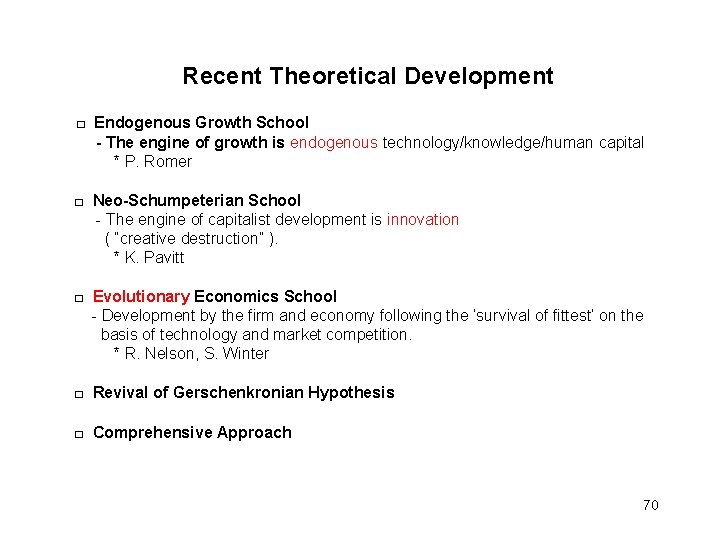
Recent Theoretical Development □ Endogenous Growth School - The engine of growth is endogenous technology/knowledge/human capital * P. Romer □ Neo-Schumpeterian School - The engine of capitalist development is innovation ( “creative destruction” ). * K. Pavitt □ Evolutionary Economics School - Development by the firm and economy following the ‘survival of fittest’ on the basis of technology and market competition. * R. Nelson, S. Winter □ Revival of Gerschenkronian Hypothesis □ Comprehensive Approach 70
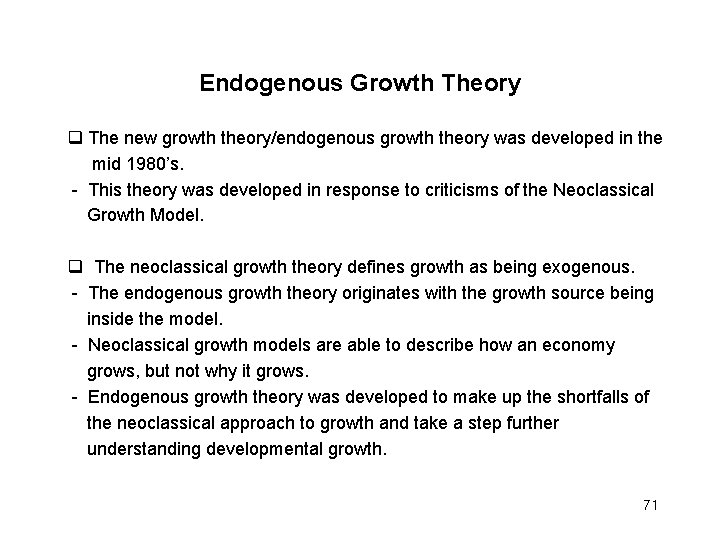
Endogenous Growth Theory The new growth theory/endogenous growth theory was developed in the mid 1980’s. - This theory was developed in response to criticisms of the Neoclassical Growth Model. The neoclassical growth theory defines growth as being exogenous. - The endogenous growth theory originates with the growth source being inside the model. - Neoclassical growth models are able to describe how an economy grows, but not why it grows. - Endogenous growth theory was developed to make up the shortfalls of the neoclassical approach to growth and take a step further understanding developmental growth. 71
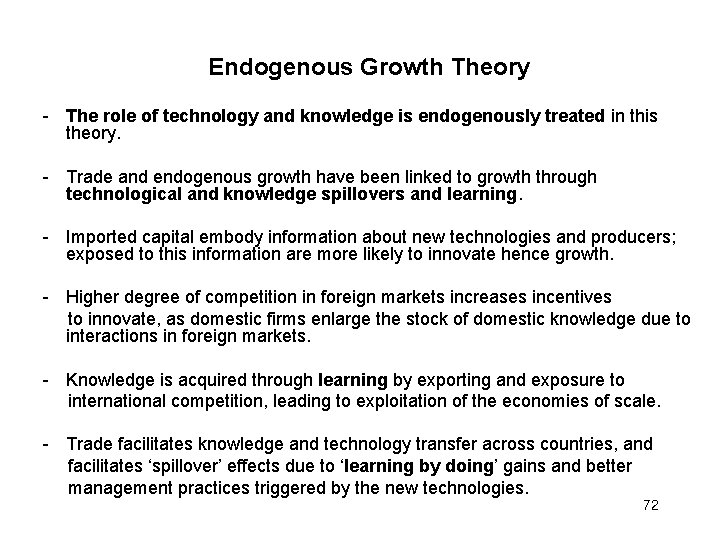
Endogenous Growth Theory - The role of technology and knowledge is endogenously treated in this theory. - Trade and endogenous growth have been linked to growth through technological and knowledge spillovers and learning. - Imported capital embody information about new technologies and producers; exposed to this information are more likely to innovate hence growth. - Higher degree of competition in foreign markets increases incentives to innovate, as domestic firms enlarge the stock of domestic knowledge due to interactions in foreign markets. - Knowledge is acquired through learning by exporting and exposure to international competition, leading to exploitation of the economies of scale. - Trade facilitates knowledge and technology transfer across countries, and facilitates ‘spillover’ effects due to ‘learning by doing’ gains and better management practices triggered by the new technologies. 72
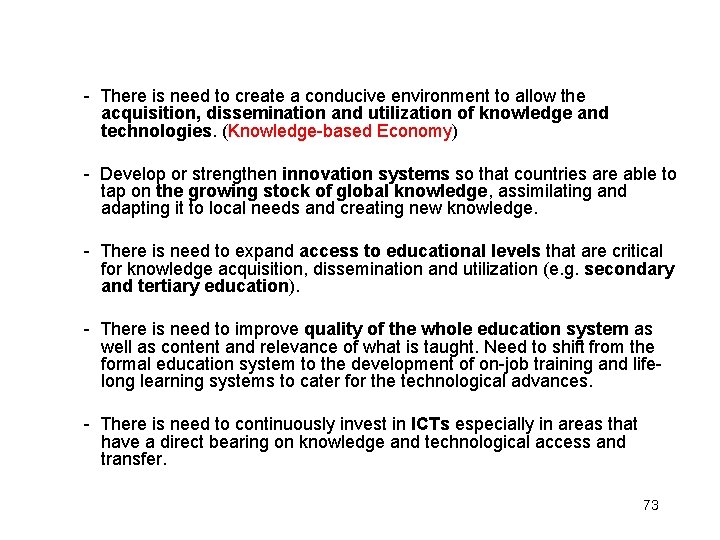
- There is need to create a conducive environment to allow the acquisition, dissemination and utilization of knowledge and technologies. (Knowledge-based Economy) - Develop or strengthen innovation systems so that countries are able to tap on the growing stock of global knowledge, assimilating and adapting it to local needs and creating new knowledge. - There is need to expand access to educational levels that are critical for knowledge acquisition, dissemination and utilization (e. g. secondary and tertiary education). - There is need to improve quality of the whole education system as well as content and relevance of what is taught. Need to shift from the formal education system to the development of on-job training and lifelong learning systems to cater for the technological advances. - There is need to continuously invest in ICTs especially in areas that have a direct bearing on knowledge and technological access and transfer. 73
Visions of Endogenous Growth Theory As an economy growths, organization of the industry increases, potentially providing the opportunities for one of the firms to specialize in one different activity. Firms can now develop differentiated products and compete on the quality of products. Options available to the Government for Policy Implications - Encouraging research and development, in order for firms to continually experience increasing returns and thus grow. 74
The new growth theory relaxes the assumption of diminishing returns to capital. It does so with the new assumption of continuous research and development. With constant or increasing returns, the new growth theory does not conclude that income per capita will converge across world economies. Neoclassical vs. New Growth Theory - The neoclassical growth model of Solow assumed technological progress to be exogenous not because this was a realistic assumption but because it was the only theoretically manageable one. The problem with neoclassical theory is not that it analyzes capital accumulation but that it does not analyze technological progress. - The purpose of endogenous growth theory is to fill this gap in neoclassical theory and to open up technological progress and innovation to systematic analysis, and to study their effects on growth 75
Liberal School Market-based Neo-Liberal Development Theory - Grew in the 1970 s and designed to counteract impact of Keynesianism • • • New emphasis on supply side factors in development - private initiatives and market led growth Move away from demand stimulation (e. g. interest rate manipulation), import substitution, state intervention and centralized planning Gradual industrialization with ‘trickle down’ of benefits to all social classes - Market-based economic policy - Minimum state intervention - Key role of competition 76
Liberal School: The IMF Approach to Economic Growth and Development is economic growth with those conditions that make it sustainable such as social mobilization, good governance, macroeconomic stabilization, institutional development, etc. A country cannot have a sustained economic adjustment unless the government gets its budget in order. Setting the prices right: interest rates, exchange rates, domestic prices, agricultural and commodity prices 77
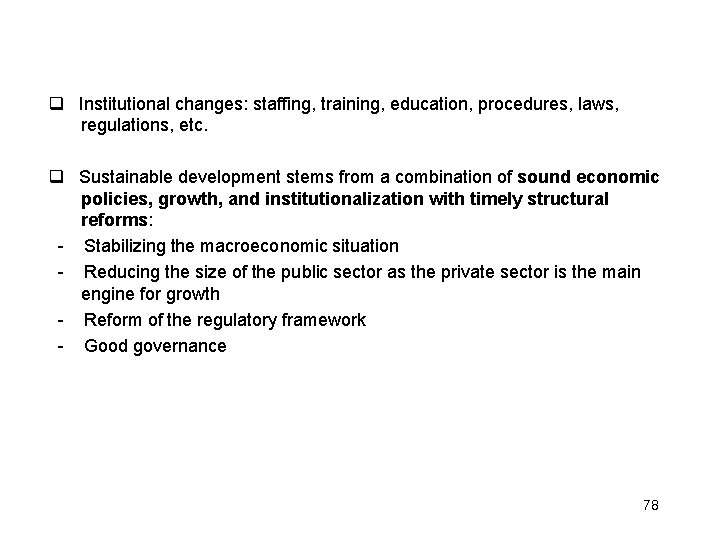
Institutional changes: staffing, training, education, procedures, laws, regulations, etc. Sustainable development stems from a combination of sound economic policies, growth, and institutionalization with timely structural reforms: - Stabilizing the macroeconomic situation - Reducing the size of the public sector as the private sector is the main engine for growth - Reform of the regulatory framework - Good governance 78
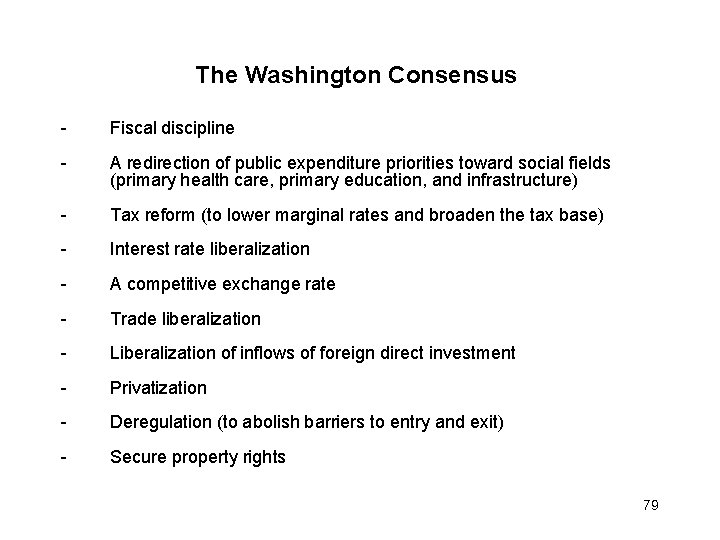
The Washington Consensus - Fiscal discipline - Tax reform (to lower marginal rates and broaden the tax base) - Interest rate liberalization - A competitive exchange rate - Trade liberalization - Liberalization of inflows of foreign direct investment - Privatization - Deregulation (to abolish barriers to entry and exit) - Secure property rights A redirection of public expenditure priorities toward social fields (primary health care, primary education, and infrastructure) 79
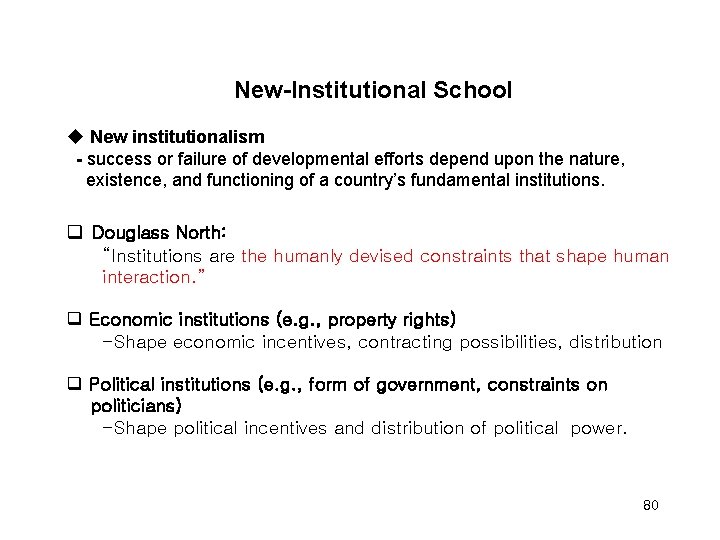
New-Institutional School u New institutionalism - success or failure of developmental efforts depend upon the nature, existence, and functioning of a country’s fundamental institutions. Douglass North: “Institutions are the humanly devised constraints that shape human interaction. ” Economic institutions (e. g. , property rights) -Shape economic incentives, contracting possibilities, distribution Political institutions (e. g. , form of government, constraints on politicians) -Shape political incentives and distribution of political power. 80
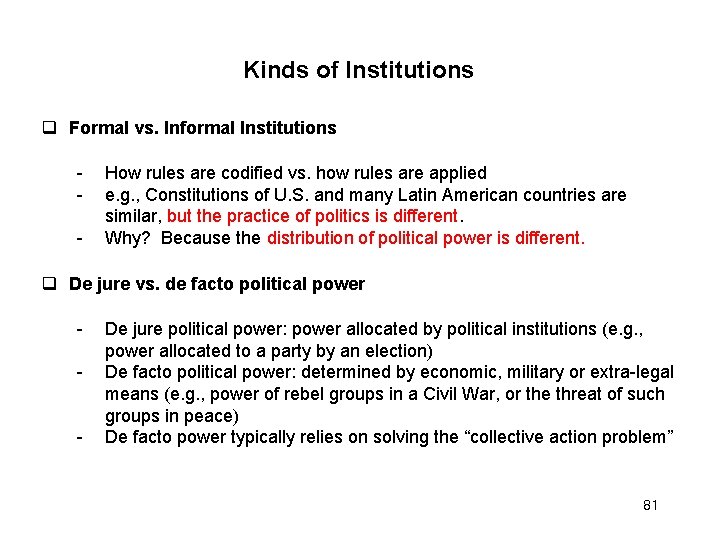
Kinds of Institutions Formal vs. Informal Institutions - How rules are codified vs. how rules are applied e. g. , Constitutions of U. S. and many Latin American countries are similar, but the practice of politics is different. Why? Because the distribution of political power is different. De jure vs. de facto political power - De jure political power: power allocated by political institutions (e. g. , power allocated to a party by an election) De facto political power: determined by economic, military or extra-legal means (e. g. , power of rebel groups in a Civil War, or the threat of such groups in peace) De facto power typically relies on solving the “collective action problem” 81
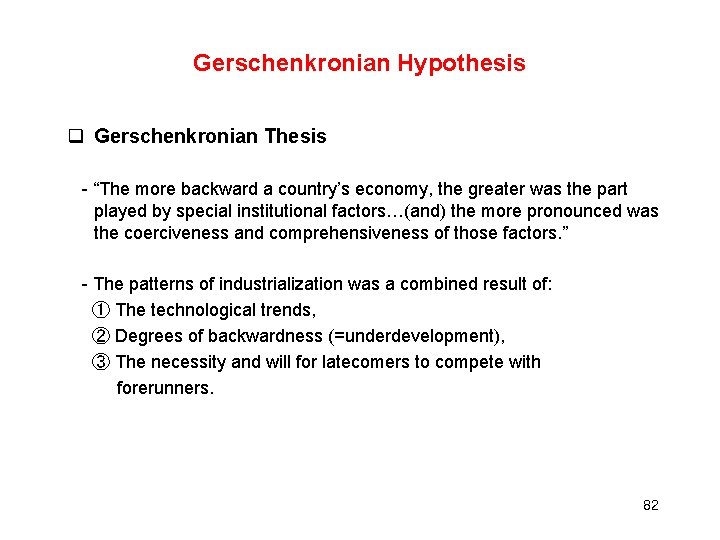
Gerschenkronian Hypothesis Gerschenkronian Thesis - “The more backward a country’s economy, the greater was the part played by special institutional factors…(and) the more pronounced was the coerciveness and comprehensiveness of those factors. ” - The patterns of industrialization was a combined result of: ① The technological trends, ② Degrees of backwardness (=underdevelopment), ③ The necessity and will for latecomers to compete with forerunners. 82
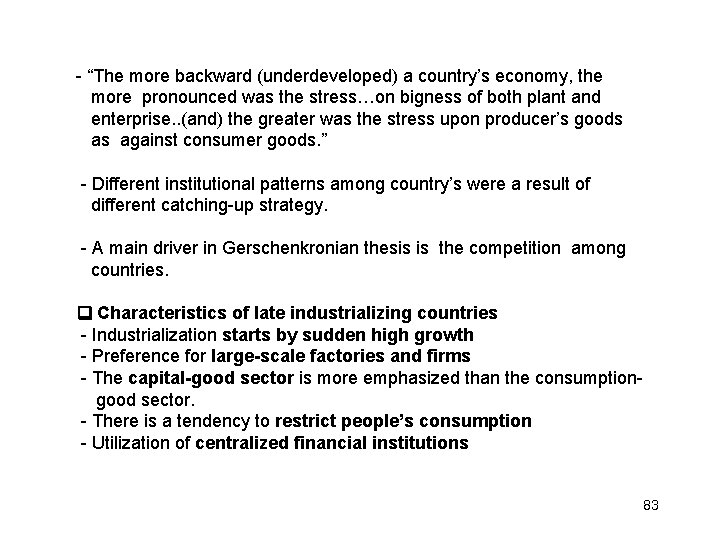
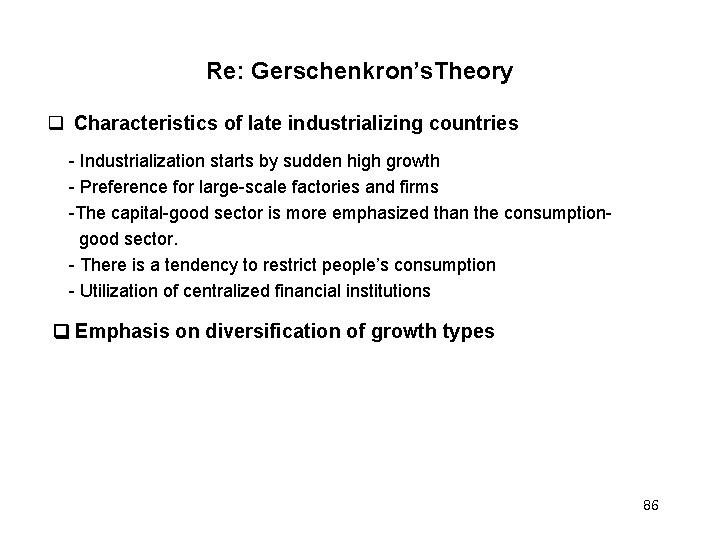
- “The more backward (underdeveloped) a country’s economy, the more pronounced was the stress…on bigness of both plant and enterprise. . (and) the greater was the stress upon producer’s goods as against consumer goods. ” - Different institutional patterns among country’s were a result of different catching-up strategy. - A main driver in Gerschenkronian thesis is the competition among countries. Characteristics of late industrializing countries - Industrialization starts by sudden high growth - Preference for large-scale factories and firms - The capital-good sector is more emphasized than the consumption good sector. - There is a tendency to restrict people’s consumption - Utilization of centralized financial institutions 83
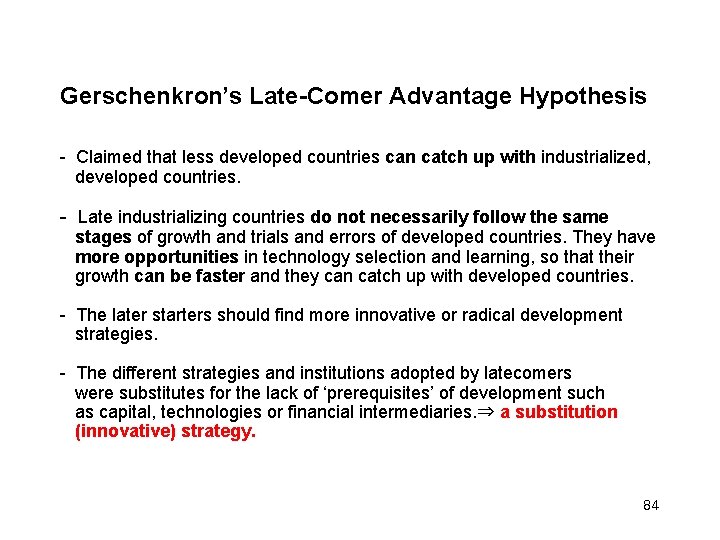
Gerschenkron’s Late-Comer Advantage Hypothesis - Claimed that less developed countries can catch up with industrialized, developed countries. - Late industrializing countries do not necessarily follow the same stages of growth and trials and errors of developed countries. They have more opportunities in technology selection and learning, so that their growth can be faster and they can catch up with developed countries. - The later starters should find more innovative or radical development strategies. - The different strategies and institutions adopted by latecomers were substitutes for the lack of ‘prerequisites’ of development such as capital, technologies or financial intermediaries. ⇒ a substitution (innovative) strategy. 84
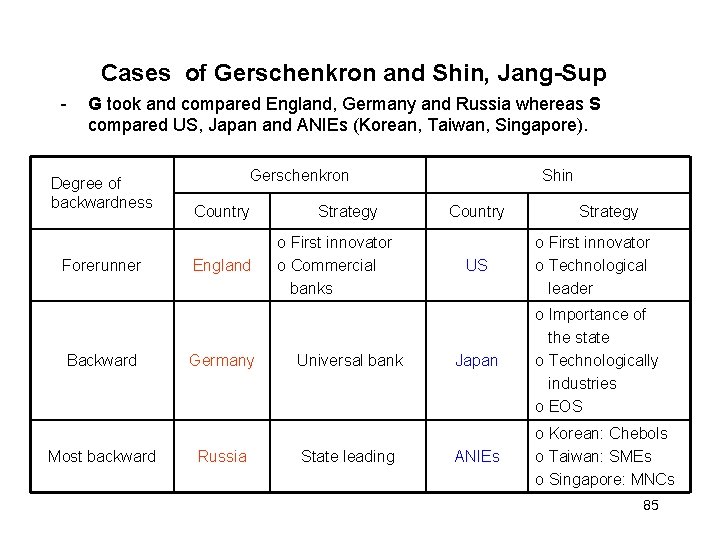
Cases of Gerschenkron and Shin, Jang-Sup - G took and compared England, Germany and Russia whereas S compared US, Japan and ANIEs (Korean, Taiwan, Singapore). Degree of backwardness Forerunner Backward Most backward Gerschenkron Country England Germany Russia Strategy o First innovator o Commercial banks Universal bank State leading Shin Country Strategy US o First innovator o Technological leader Japan o Importance of the state o Technologically industries o EOS ANIEs o Korean: Chebols o Taiwan: SMEs o Singapore: MNCs 85
Re: Gerschenkron’s. Theory Characteristics of late industrializing countries - Industrialization starts by sudden high growth - Preference for large-scale factories and firms -The capital-good sector is more emphasized than the consumption good sector. - There is a tendency to restrict people’s consumption - Utilization of centralized financial institutions Emphasis on diversification of growth types 86
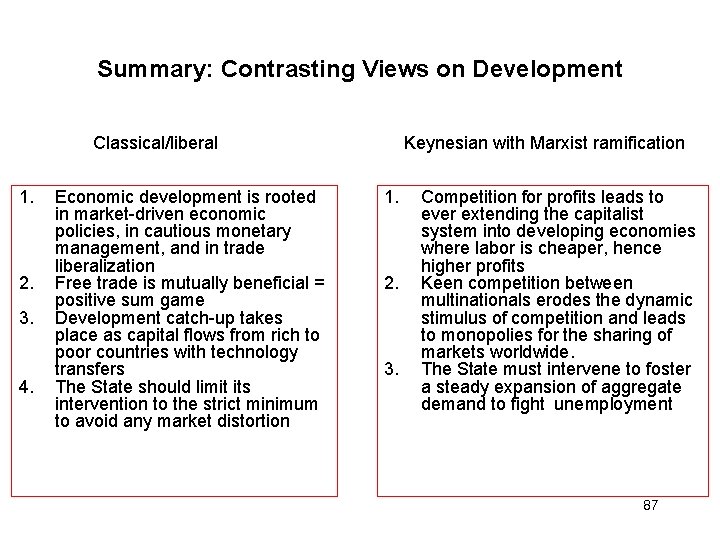
Summary: Contrasting Views on Development Classical/liberal 1. 2. 3. 4. Economic development is rooted in market-driven economic policies, in cautious monetary management, and in trade liberalization Free trade is mutually beneficial = positive sum game Development catch-up takes place as capital flows from rich to poor countries with technology transfers The State should limit its intervention to the strict minimum to avoid any market distortion Keynesian with Marxist ramification 1. 2. 3. Competition for profits leads to ever extending the capitalist system into developing economies where labor is cheaper, hence higher profits Keen competition between multinationals erodes the dynamic stimulus of competition and leads to monopolies for the sharing of markets worldwide. The State must intervene to foster a steady expansion of aggregate demand to fight unemployment 87
Discussion: A Synthesis Towards a New Theory? 88
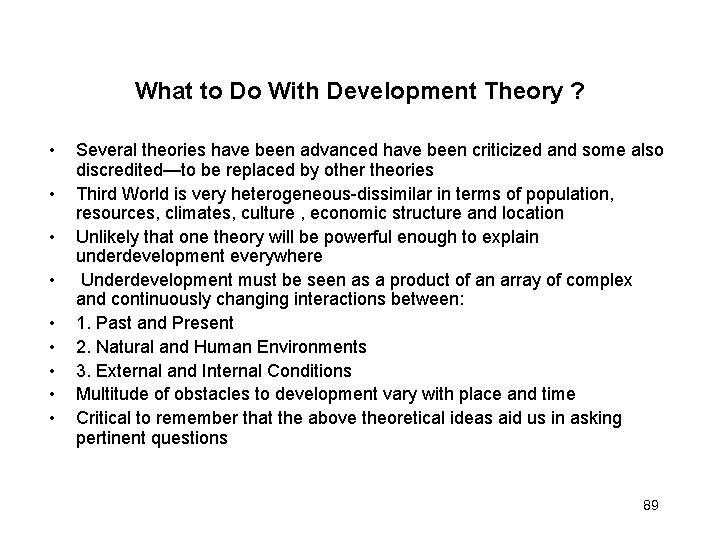
What to Do With Development Theory ? • • • Several theories have been advanced have been criticized and some also discredited—to be replaced by other theories Third World is very heterogeneous-dissimilar in terms of population, resources, climates, culture , economic structure and location Unlikely that one theory will be powerful enough to explain underdevelopment everywhere Underdevelopment must be seen as a product of an array of complex and continuously changing interactions between: 1. Past and Present 2. Natural and Human Environments 3. External and Internal Conditions Multitude of obstacles to development vary with place and time Critical to remember that the above theoretical ideas aid us in asking pertinent questions 89
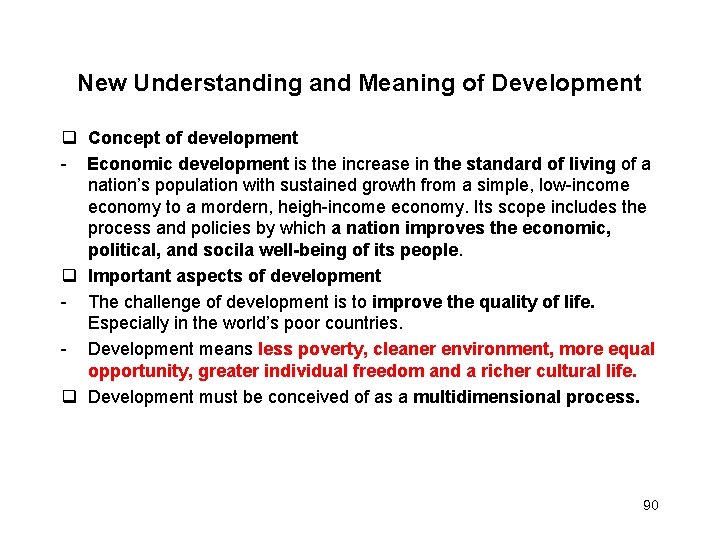
New Understanding and Meaning of Development Concept of development - Economic development is the increase in the standard of living of a nation’s population with sustained growth from a simple, low-income economy to a mordern, heigh-income economy. Its scope includes the process and policies by which a nation improves the economic, political, and socila well-being of its people. Important aspects of development - The challenge of development is to improve the quality of life. Especially in the world’s poor countries. - Development means less poverty, cleaner environment, more equal opportunity, greater individual freedom and a richer cultural life. Development must be conceived of as a multidimensional process. 90
- - Development must involve major changes in social structures, popular attitudes and national institutions as well as acceleration of economic growth, the reduction of inequality and the eradication of poverty. Development must represent the whole set of changes by which an entire social system tuned to the diverse basic needs and desires of individuals and social groups within that system , moves away from a condition of life widely perceived as unsatisfactory toward a situation or condition of life regarded as materially and spiritually better. Development is seen as an economic phenomena in which rapid gains in overall growth would either trickle down to the masses in the form of jobs and other economic opportunities. Development is the reduction or elimination of poverty, inequality and unemployment within the context of a growing economy. The development of people rather than development of things. 91
Three Objectives of Development • Raising peoples’ living levels, i. e. incomes and consumption, levels of food, medical services, education through relevant growth processes • Creating conditions conducive to the growth of peoples’ selfesteem through the establishment of social, political and economic systems and institutions which promote human dignity and respect • Increasing peoples’ freedom to choose by enlarging the range of their choice variables, e. g. varieties of goods and services 92
Core Values of Development Sustenance: The Ability to Meet Basic Needs - When life sustaining basic human needs like food, shelter, health and protection are absent underdevelopment exists. - One clearly has to “have enough in order to be more”. - Purpose of development is to create an environment in which all people can expand their capabilities and opportunities can be enlarged for both the present and future generations. - Real foundation of human development is universalism in acknowledging the life claims of everyone. 93
Beyond GDP is not an Appropriate Measure for Development - It includes economic activities that can reduce the well-being (e. g. , production and consumption of “goods” with negative impact on human health and natural environment) - It does not include all available resources (in particular the resources of households) - It excludes several important factors of well-being (health, education, working conditions, equity, time use, social relations, social cohesion, citizenship, etc) - It ignores essential factors of sustainability of well-being (e. g. , environment, human and social 94
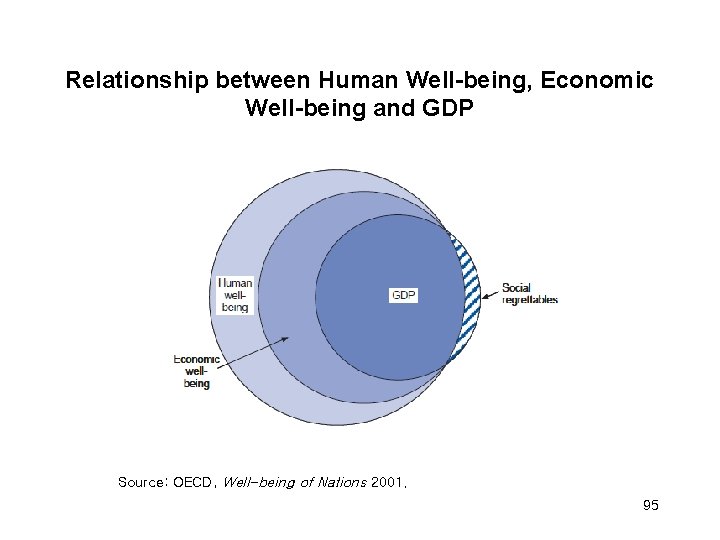
Relationship between Human Well-being, Economic Well-being and GDP Source: OECD, Well-being of Nations 2001. 95
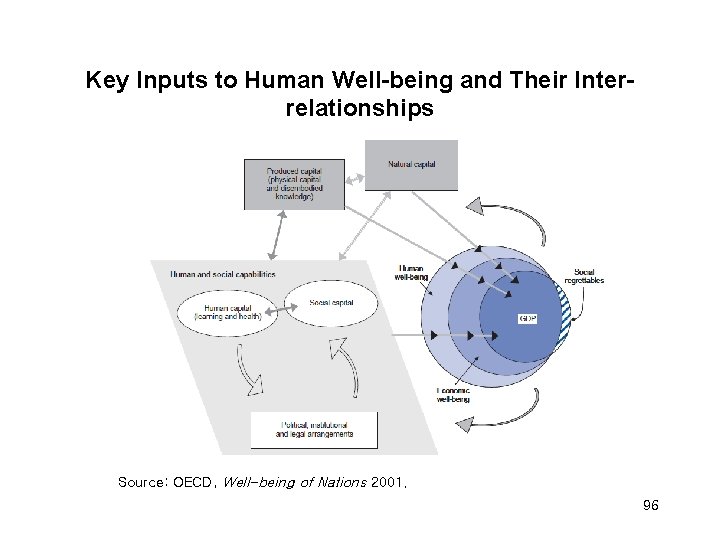
Key Inputs to Human Well-being and Their Interrelationships Source: OECD, Well-being of Nations 2001. 96
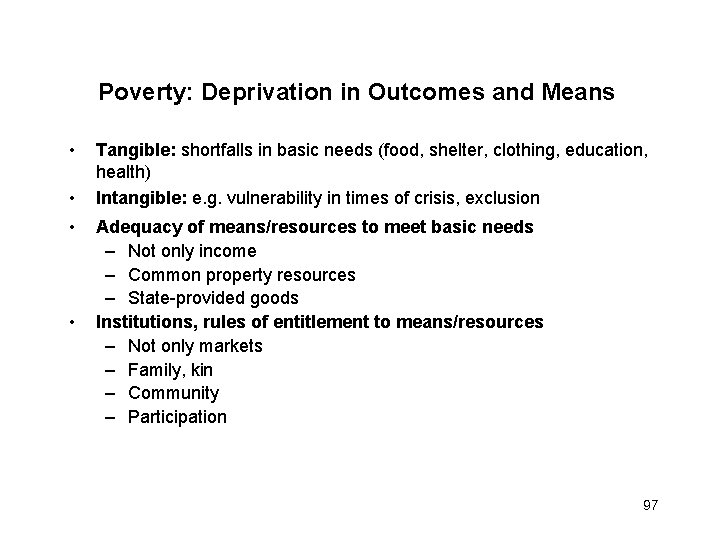
Poverty: Deprivation in Outcomes and Means • • Tangible: shortfalls in basic needs (food, shelter, clothing, education, health) Intangible: e. g. vulnerability in times of crisis, exclusion Adequacy of means/resources to meet basic needs – Not only income – Common property resources – State-provided goods Institutions, rules of entitlement to means/resources – Not only markets – Family, kin – Community – Participation 97
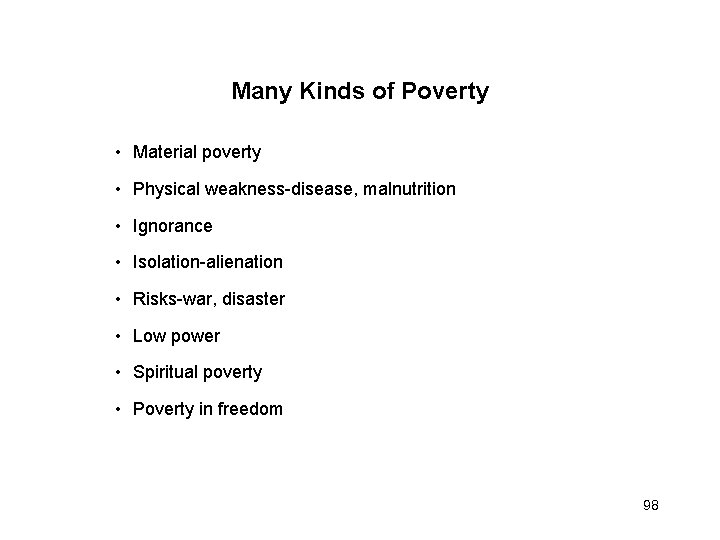
Many Kinds of Poverty • Material poverty • Physical weakness-disease, malnutrition • Ignorance • Isolation-alienation • Risks-war, disaster • Low power • Spiritual poverty • Poverty in freedom 98
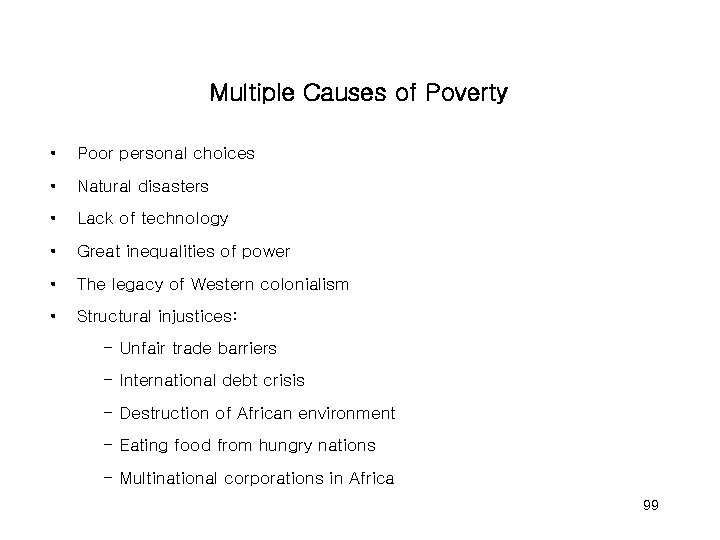
Multiple Causes of Poverty • Poor personal choices • Natural disasters • Lack of technology • Great inequalities of power • The legacy of Western colonialism • Structural injustices: - Unfair trade barriers - International debt crisis - Destruction of African environment - Eating food from hungry nations - Multinational corporations in Africa 99
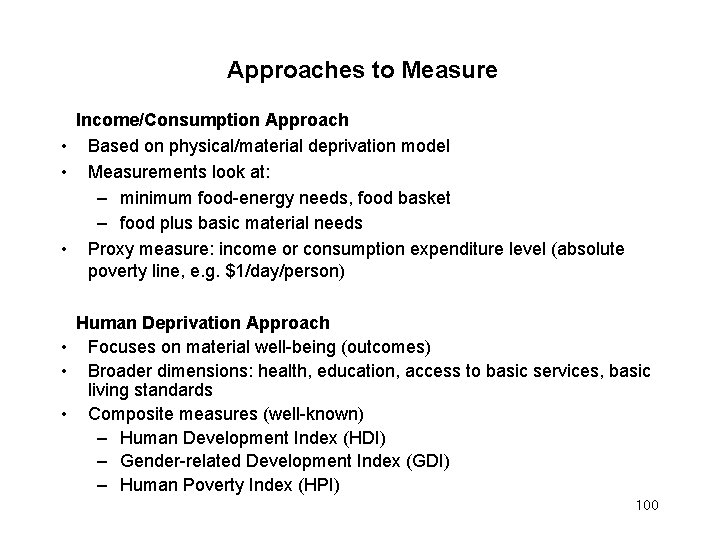
Approaches to Measure Income/Consumption Approach • Based on physical/material deprivation model • Measurements look at: – minimum food-energy needs, food basket – food plus basic material needs • Proxy measure: income or consumption expenditure level (absolute poverty line, e. g. $1/day/person) Human Deprivation Approach • Focuses on material well-being (outcomes) • Broader dimensions: health, education, access to basic services, basic living standards • Composite measures (well-known) – Human Development Index (HDI) – Gender-related Development Index (GDI) – Human Poverty Index (HPI) 100
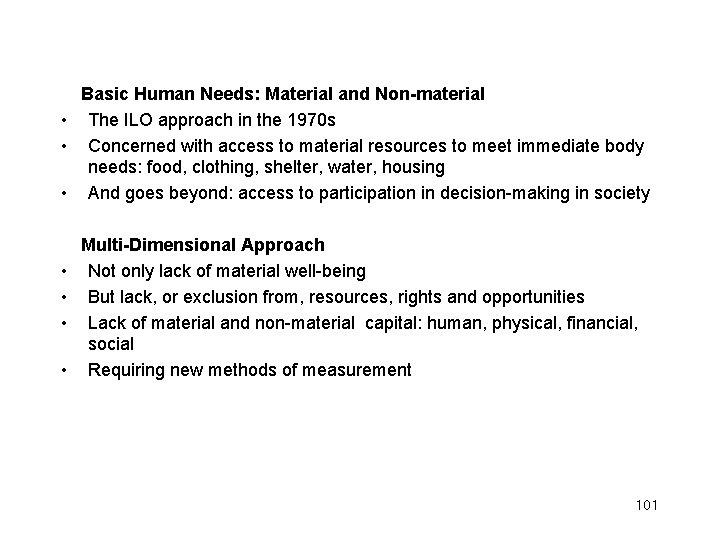
Basic Human Needs: Material and Non-material • The ILO approach in the 1970 s • Concerned with access to material resources to meet immediate body needs: food, clothing, shelter, water, housing • And goes beyond: access to participation in decision-making in society Multi-Dimensional Approach • Not only lack of material well-being • But lack, or exclusion from, resources, rights and opportunities • Lack of material and non-material capital: human, physical, financial, social • Requiring new methods of measurement 101
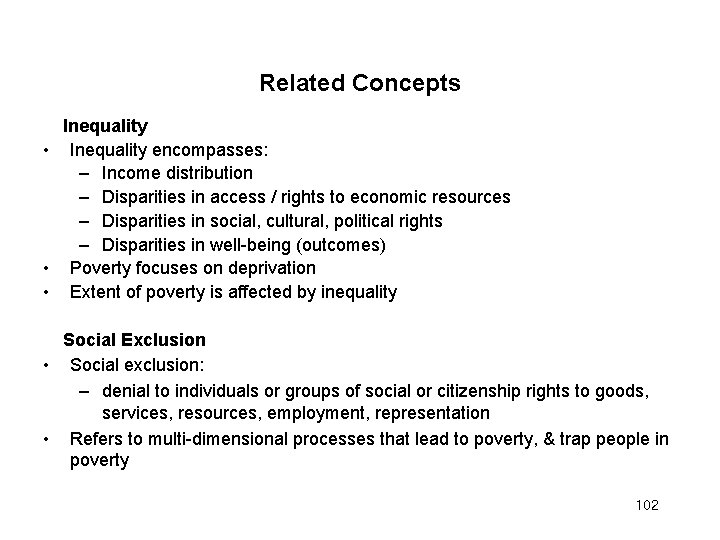
Related Concepts Inequality • Inequality encompasses: – Income distribution – Disparities in access / rights to economic resources – Disparities in social, cultural, political rights – Disparities in well-being (outcomes) • Poverty focuses on deprivation • Extent of poverty is affected by inequality Social Exclusion • Social exclusion: – denial to individuals or groups of social or citizenship rights to goods, services, resources, employment, representation • Refers to multi-dimensional processes that lead to poverty, & trap people in poverty 102
Discrimination • Discrimination: distinction, exclusion, restriction or preference – Based on any social group, e. g. sex, race, colour, language, religion, political opinion, national or social origin – Aimed at nullifying or impairing recognition, enjoyment or execise by all persons on equal footing of all rights and freedoms • A process that could lead to poverty; hampers escape from poverty Vulnerability • Probability of exposure to risks and shocks that could erode income and well-being • The risk that an individual or household will experience an episode of poverty • Risks linked to capacity to insure oneself from effects of risks: physical assets, savings, multiple income sources, social support networks; access to formal safety net, access to credit market 103
Comprehensive Approach Amartya Sen’s ‘Development as Freedom’ - Recent theories revolve around questions about what variables or inputs correlate or affect economic growth the most, including: • Elementary, secondary, or higher education • Government policy stability • Tariffs and subsidies • Fair court systems • Available infrastructure • Availability of medical care • prenatal care and clean water • Ease of entry and exit into trade • Equality of income distribution - Should provide sound government’s macroeconomic policies and all policies that affect the economy, politics and society 104
Economic Growth to Sustainable Development Political order in changing societies - Probing the conditions under which societies undergo rapid and disruptive social and political change. - The primary problem of politics is the lag in the development of political institution behind social and economic change - Growth extends political consciousness, broadens political participation, and increases political demands - Instability stems from rapid social change and rapid mobilization of new groups into politics coupled with slow development of political institutions 105
Sustainable Development • Defined as development that is likely to achieve lasting satisfaction of human needs and improvement of the quality of life and encompasses: • Help for the very poorest who are left with no option but to destroy their environment to survive • Idea of self-reliant development with natural resource constraints • Cost effective development using different economic criteria to the traditional –i. e. development should not degrade environment • Important issues of health control, appropriate technologies, food selfreliance, clean water and shelter for all • People centered activities are necessary- human beings are the resources in the concept 106
Sustainable Development and Environment • Recognizes high “opportunity costs” associated with irreversible environmental damage • Dealing with environmental problems requires solutions sensitive to local social and ecological conditions • Society and nature relations are affected by variations in class, gender and ethnicity • “Reproductive squeeze” forces peasants to intensify production in fragile environments 107
Development by Popular (Human) Development • • Bottom up approaches (as opposed to top-down) to peoples’ participation are important in this view How are various social groups and classes affected by rural-urban, core -periphery and other spatial interactions? Growing importance of “decentralization” of decision-making and authority from center to periphery How does the power structure affect development? Examine sources of empowerment, inequality and discrimination Need to devise more people centered approaches which stress empowerment and participation Empowerment as participatory development seeks to engender selfhelp and self-reliance but also effective collective decision-making 108
Theories of “People-Centered” Development • Avoids ‘grand theories’ and emphasizes solutions viewed in context of development which is part of historical process • Context of development is constantly changing in scale and time • Accommodates geographical and historical diversity • Theory of little use to practitioners of development • Stresses local diversity, human creativity, process of social change through pragmatism, flexibility and context • Not extent of state intervention but comparative advantages of public and private sectors and their complementarity 109
References Commission on Growth and Development. 2008. Growth Report: Strategies for Sustainable Growth and Inclusive Development. World Bank. (PDF. Google) Gerschenkron, Alexander. Economic Backwardness in Historical Perspective. Cambridge, Massachsetts: Harvard University press. Mhbouchet/Ceram. 2008. “Approaches to Economic Development in EMCs: A Polirized Debate”. (PPT. Google) Rapley, John. 2007. (3 rd Ed. ) Understanding Development. London: Lynne Rienner. Sachs, Jeffrey D. 2005. The End of Poverty. New York: Penguin Press. -----------. 2008. Common Wealth: Economics for s Crowded Planet. Shin, Jang-Sup. 1996. The Economics of the Latecomers. London and New York: Routledge. 110
Sen, Amartya. 1999. Development as Freedom. New York: Alfred A. Knopf. Schumpeter, Joseph A. 1934, 1980. Theory of Economic Development. Oxford: Oxford University Press. 111