
Economic Development Lecture 5 Growth Theories III Life
- Slides: 15
Economic Development Lecture 5: Growth Theories III Life Impact | The University of Adelaide University of Papua New Guinea
Lecture 5: Growth Theories III Michael Cornish Overview • Endogenous Growth – Romer Model • Contemporary Models – Coordination Failure – Multiple Equilibria – The Big Push – Kremer’s O-Ring Theory • Recap: Growth Theories Slide 1 University of Papua New Guinea
Lecture 5: Growth Theories III Michael Cornish Endogenous Growth: An Introduction • Decreasing returns to K – An assumption in Harrod Domar Growth Model, Lewis Theory of Development, Neoclassical Growth Model – Implies investment in K should occur wherever there is the least capital – True in long-run, but not always in short -run! Slide 2 University of Papua New Guinea
Lecture 5: Growth Theories III Michael Cornish Endogenous Growth: An Introduction • Flaws in the Neoclassical Growth Model – Conditional convergence in long-run – Assuming technology is constant, any changes to income not caused by short-term shifts in K or L are ‘Solow Residuals’ – Why are Solow Residual so different across countries with similar levels of technology? – Trade and domestic market liberalisation often led to few gains to growth Slide 3 University of Papua New Guinea
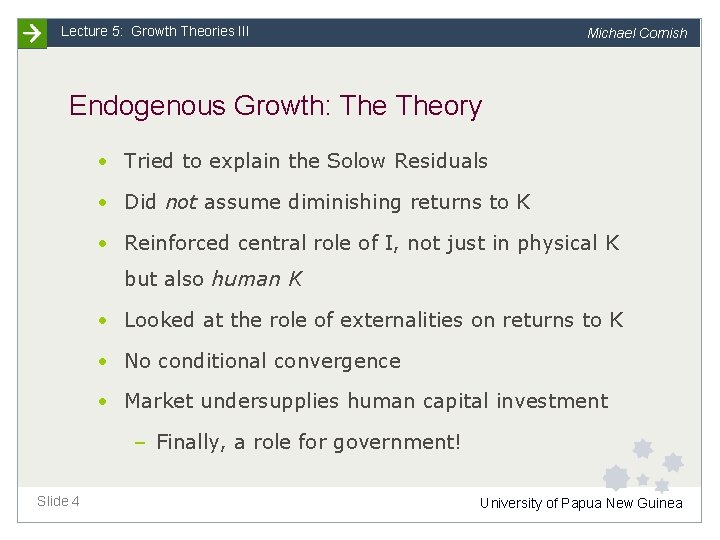
Lecture 5: Growth Theories III Michael Cornish Endogenous Growth: Theory • Tried to explain the Solow Residuals • Did not assume diminishing returns to K • Reinforced central role of I, not just in physical K but also human K • Looked at the role of externalities on returns to K • No conditional convergence • Market undersupplies human capital investment – Finally, a role for government! Slide 4 University of Papua New Guinea
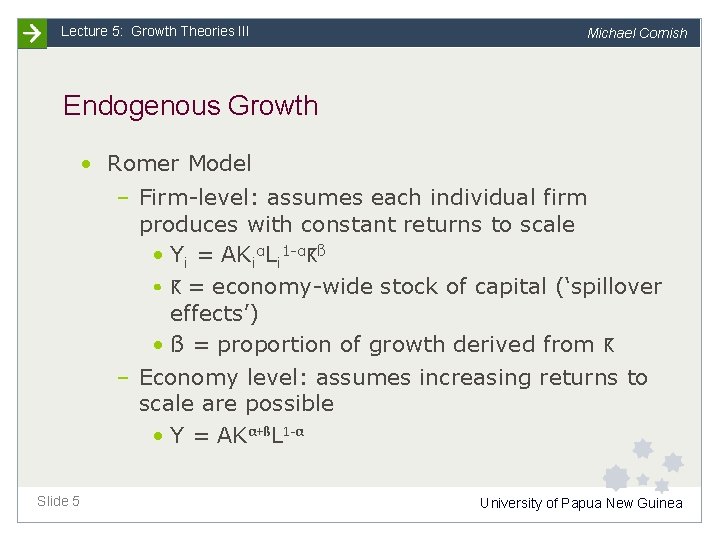
Lecture 5: Growth Theories III Michael Cornish Endogenous Growth • Romer Model – Firm-level: assumes each individual firm produces with constant returns to scale • Yi = AKiαLi 1 -αK ß • K = economy-wide stock of capital (‘spillover effects’) • ß = proportion of growth derived from K – Economy level: assumes increasing returns to scale are possible • Y = AKα+ßL 1 -α Slide 5 University of Papua New Guinea
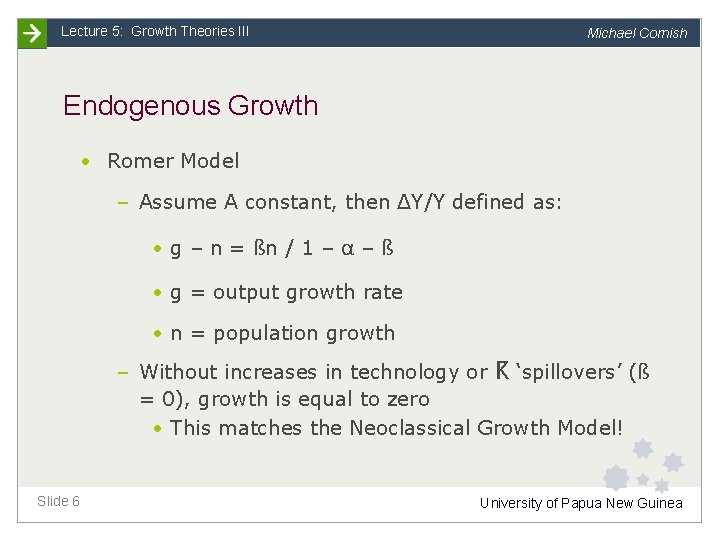
Lecture 5: Growth Theories III Michael Cornish Endogenous Growth • Romer Model – Assume A constant, then ΔY/Y defined as: • g – n = ßn / 1 – α – ß • g = output growth rate • n = population growth – Without increases in technology or K ‘spillovers’ (ß = 0), growth is equal to zero • This matches the Neoclassical Growth Model! Slide 6 University of Papua New Guinea
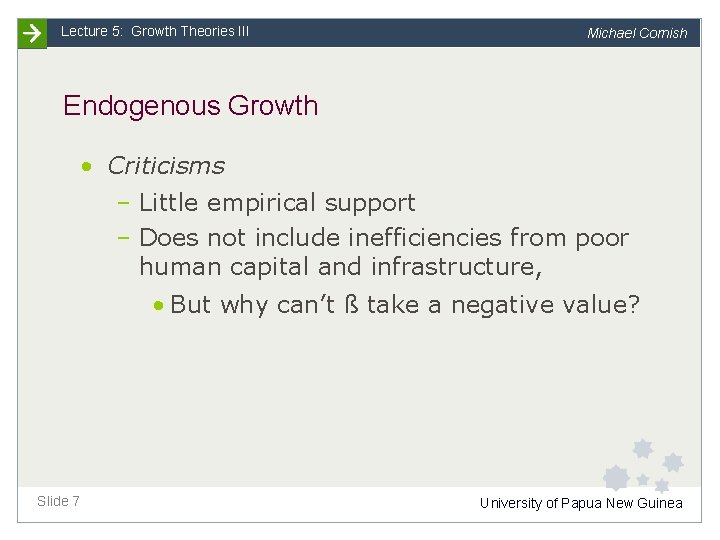
Lecture 5: Growth Theories III Michael Cornish Endogenous Growth • Criticisms – Little empirical support – Does not include inefficiencies from poor human capital and infrastructure, • But why can’t ß take a negative value? Slide 7 University of Papua New Guinea
Lecture 5: Growth Theories III Michael Cornish Contemporary Growth Models • Coordination Failure – Stresses existence of complementarities between necessary conditions for development – ‘Getting everything right, at the same time’ – Communication problems, expectation mismatches – First movement costs – Specialisation and middlemen – A role for government? Slide 8 University of Papua New Guinea
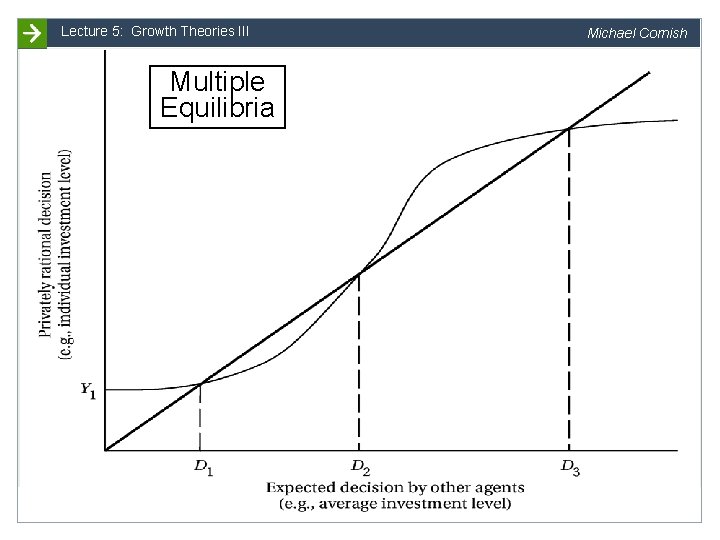
Lecture 5: Growth Theories III Michael Cornish Multiple Equilibria Slide 9 University of Papua New Guinea
Lecture 5: Growth Theories III Michael Cornish Case Study: Latin American Time Slide 10 University of Papua New Guinea
Lecture 5: Growth Theories III Michael Cornish Contemporary Growth Models • The ‘Big Push’ – Economy-wide effort to kick-start development, to get from low equilibrium to high equilibrium • Industrialisation • Inter-temporal effects • Urbanisation • Infrastructure • Training – Super-entrepreneurs Slide 11 University of Papua New Guinea
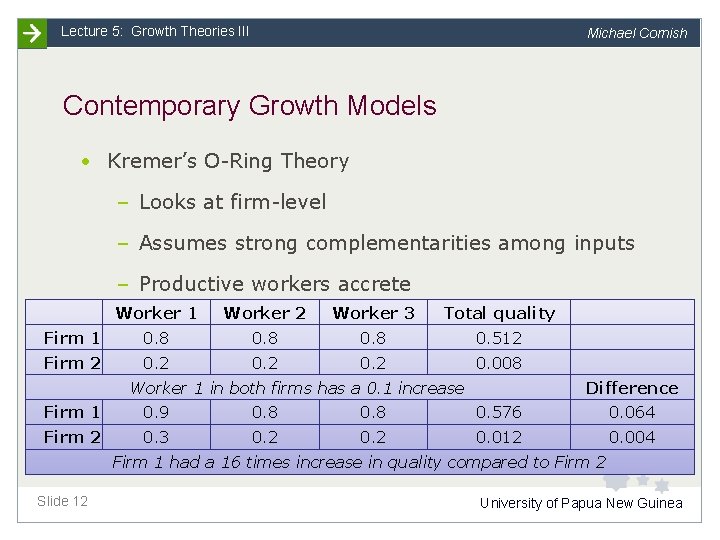
Lecture 5: Growth Theories III Michael Cornish Contemporary Growth Models • Kremer’s O-Ring Theory – Looks at firm-level – Assumes strong complementarities among inputs – Productive workers accrete Worker 1 Worker 2 Worker 3 Total quality Firm 1 0. 8 0. 512 Firm 2 0. 008 Worker 1 in both firms has a 0. 1 increase Difference Firm 1 0. 9 0. 8 0. 576 0. 064 Firm 2 0. 3 0. 2 0. 012 0. 004 Firm 1 had a 16 times increase in quality compared to Firm 2 Slide 12 University of Papua New Guinea
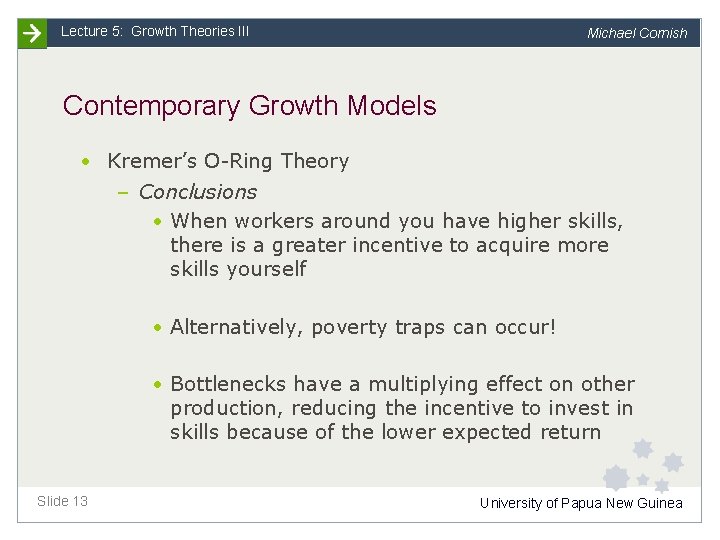
Lecture 5: Growth Theories III Michael Cornish Contemporary Growth Models • Kremer’s O-Ring Theory – Conclusions • When workers around you have higher skills, there is a greater incentive to acquire more skills yourself • Alternatively, poverty traps can occur! • Bottlenecks have a multiplying effect on other production, reducing the incentive to invest in skills because of the lower expected return Slide 13 University of Papua New Guinea
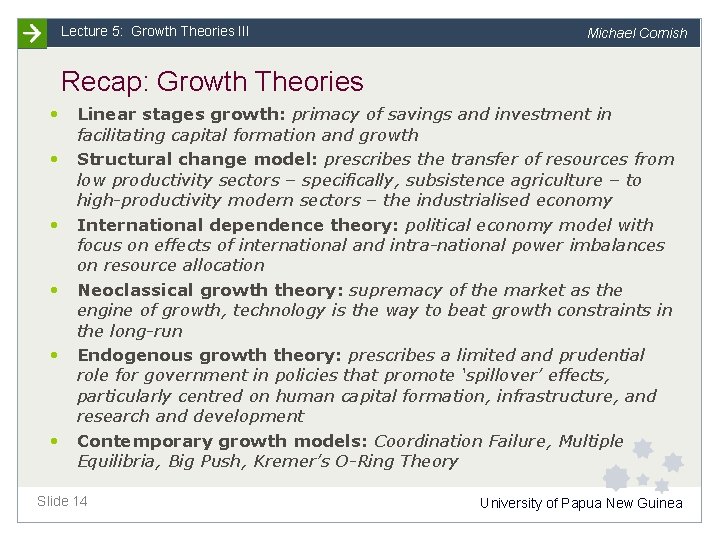
Lecture 5: Growth Theories III Michael Cornish Recap: Growth Theories • Linear stages growth: primacy of savings and investment in facilitating capital formation and growth • Structural change model: prescribes the transfer of resources from low productivity sectors – specifically, subsistence agriculture – to high-productivity modern sectors – the industrialised economy • International dependence theory: political economy model with focus on effects of international and intra-national power imbalances on resource allocation • Neoclassical growth theory: supremacy of the market as the engine of growth, technology is the way to beat growth constraints in the long-run • Endogenous growth theory: prescribes a limited and prudential role for government in policies that promote ‘spillover’ effects, particularly centred on human capital formation, infrastructure, and research and development • Contemporary growth models: Coordination Failure, Multiple Equilibria, Big Push, Kremer’s O-Ring Theory Slide 14 University of Papua New Guinea