
Economic development in Nigeria an overview www teachitgeography

- Slides: 8
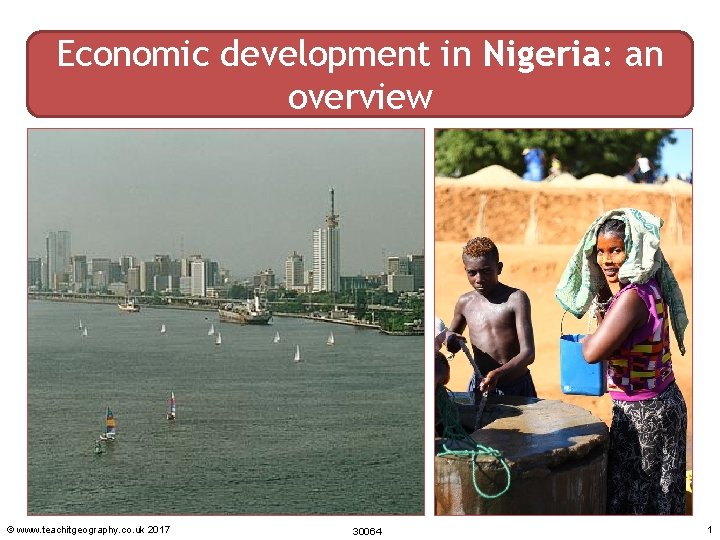
Economic development in Nigeria: an overview © www. teachitgeography. co. uk 2017 30064 1
Open up the word document and use this powerpoint to help you answer the questions © www. teachitgeography. co. uk 2017 30064 2
Economic development in Nigeria • Economic development: process by which a nation improves the economic, political and social well-being of its people. • Measured by Gross Domestic Product (GDP): total value of goods and services produced by a country in a year. • Nigeria is a middle income country/NEE, where globalisation, industrialisation and urbanisation are resulting in economic growth. • In 2016 the GDP per capita was $6000 (under $3650 over a decade ago). • Standards of living are rising and the quality of life improving but economic growth is leading to negative impacts on the environment. What is meant by standard of living? What is meant by quality of life? © www. teachitgeography. co. uk 2017 30064 3
work task Research a different region of Nigeria using the slides below: • • The The rural north rural south main urban area – Lagos main squatter settlement - Makoko Make notes for the region you have been given. Try to consider the question asked and also make general brief notes on the economic development issues in your region, include the positives and negatives for the area. © www. teachitgeography. co. uk 2017 30064 4
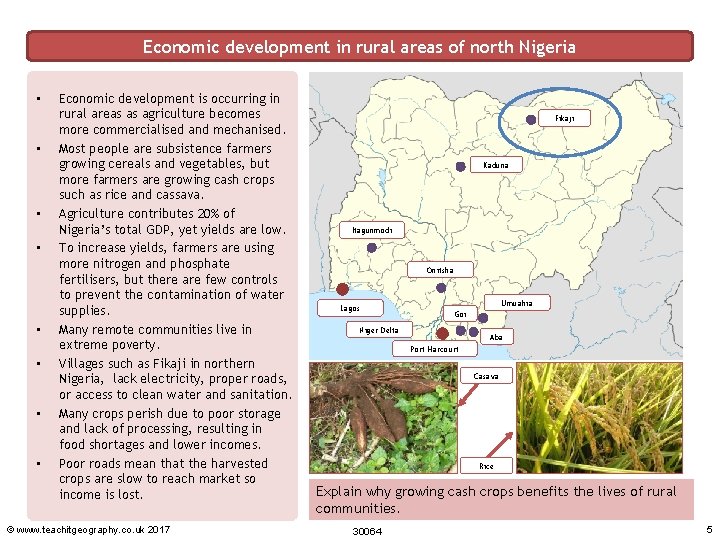
Economic development in rural areas of north Nigeria • • Economic development is occurring in rural areas as agriculture becomes more commercialised and mechanised. Most people are subsistence farmers growing cereals and vegetables, but more farmers are growing cash crops such as rice and cassava. Agriculture contributes 20% of Nigeria’s total GDP, yet yields are low. To increase yields, farmers are using more nitrogen and phosphate fertilisers, but there are few controls to prevent the contamination of water supplies. Many remote communities live in extreme poverty. Villages such as Fikaji in northern Nigeria, lack electricity, proper roads, or access to clean water and sanitation. Many crops perish due to poor storage and lack of processing, resulting in food shortages and lower incomes. Poor roads mean that the harvested crops are slow to reach market so income is lost. © www. teachitgeography. co. uk 2017 Fikaji Kaduna Itagunmodi Onitsha Lagos Umuahia Goi Niger Delta Aba Port Harcourt Casava Rice Explain why growing cash crops benefits the lives of rural communities. 30064 5
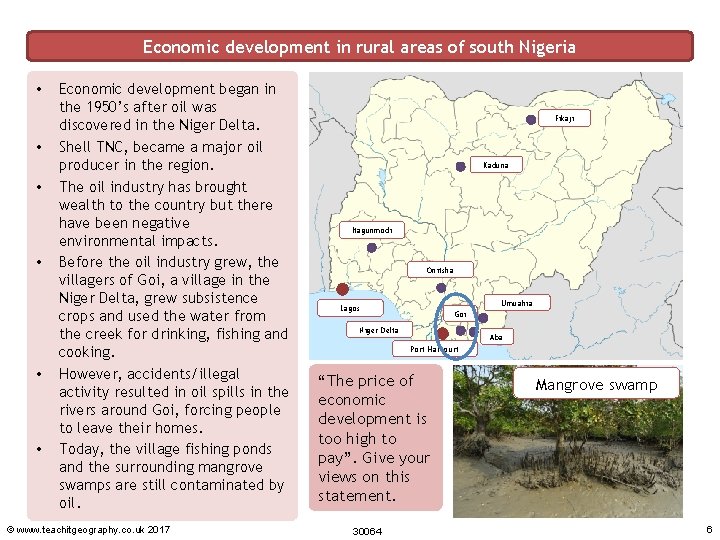
Economic development in rural areas of south Nigeria • • • Economic development began in the 1950’s after oil was discovered in the Niger Delta. Shell TNC, became a major oil producer in the region. The oil industry has brought wealth to the country but there have been negative environmental impacts. Before the oil industry grew, the villagers of Goi, a village in the Niger Delta, grew subsistence crops and used the water from the creek for drinking, fishing and cooking. However, accidents/illegal activity resulted in oil spills in the rivers around Goi, forcing people to leave their homes. Today, the village fishing ponds and the surrounding mangrove swamps are still contaminated by oil. © www. teachitgeography. co. uk 2017 Fikaji Kaduna Itagunmodi Onitsha Umuahia Lagos Goi Niger Delta Aba Port Harcourt “The price of economic development is too high to pay”. Give your views on this statement. 30064 Mangrove swamp 6
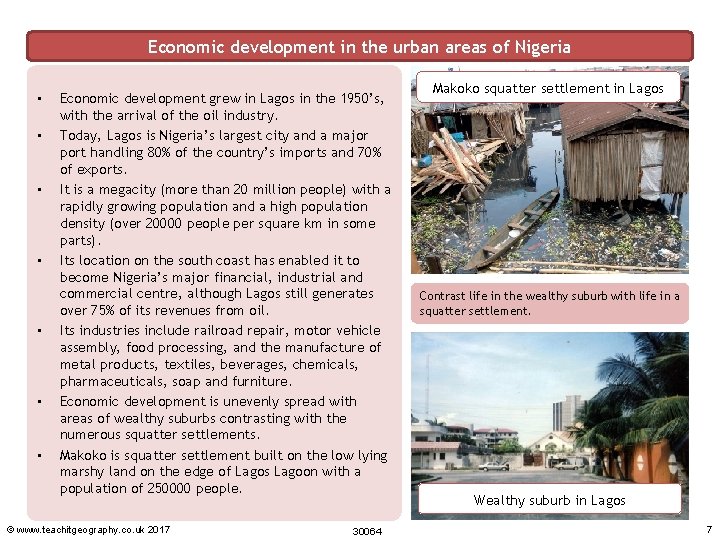
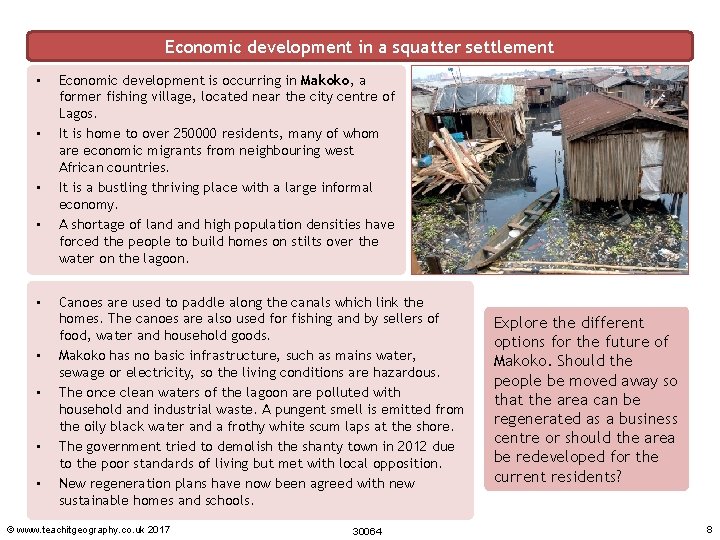
Economic development in the urban areas of Nigeria • • Economic development grew in Lagos in the 1950’s, with the arrival of the oil industry. Today, Lagos is Nigeria’s largest city and a major port handling 80% of the country’s imports and 70% of exports. It is a megacity (more than 20 million people) with a rapidly growing population and a high population density (over 20000 people per square km in some parts). Its location on the south coast has enabled it to become Nigeria’s major financial, industrial and commercial centre, although Lagos still generates over 75% of its revenues from oil. Its industries include railroad repair, motor vehicle assembly, food processing, and the manufacture of metal products, textiles, beverages, chemicals, pharmaceuticals, soap and furniture. Economic development is unevenly spread with areas of wealthy suburbs contrasting with the numerous squatter settlements. Makoko is squatter settlement built on the low lying marshy land on the edge of Lagos Lagoon with a population of 250000 people. © www. teachitgeography. co. uk 2017 30064 Makoko squatter settlement in Lagos Contrast life in the wealthy suburb with life in a squatter settlement. Wealthy suburb in Lagos 7
Economic development in a squatter settlement • • • Economic development is occurring in Makoko, a former fishing village, located near the city centre of Lagos. It is home to over 250000 residents, many of whom are economic migrants from neighbouring west African countries. It is a bustling thriving place with a large informal economy. A shortage of land high population densities have forced the people to build homes on stilts over the water on the lagoon. Canoes are used to paddle along the canals which link the homes. The canoes are also used for fishing and by sellers of food, water and household goods. Makoko has no basic infrastructure, such as mains water, sewage or electricity, so the living conditions are hazardous. The once clean waters of the lagoon are polluted with household and industrial waste. A pungent smell is emitted from the oily black water and a frothy white scum laps at the shore. The government tried to demolish the shanty town in 2012 due to the poor standards of living but met with local opposition. New regeneration plans have now been agreed with new sustainable homes and schools. © www. teachitgeography. co. uk 2017 30064 Explore the different options for the future of Makoko. Should the people be moved away so that the area can be regenerated as a business centre or should the area be redeveloped for the current residents? 8