
Economic Changes and Cycles Chapter 12 Economics Inflation
- Slides: 24
Economic Changes and Cycles Chapter 12 Economics
Inflation & Deflation Section 1
Do Now • Each student will need a textbook today. • Take out paper and the business cycle reading.
Objective • Learn about inflation, deflation, hyperinflation, and the consequences (negative & positive) of both.
Inflation - Review • Inflation is an increase in the price level. • Measured by the change in the CPI. ▫ A positive change = inflation. ▫ A negative change = deflation.
Effects of Hyperinflation in Zimbabwe
Demand-Side Inflation • When the inflation originates on the demand side. • Example: An increase in the money supply causes prices to rise.
Supply-Side Inflation • Example of a cause: A drought lowers the output of food goods.
Effects of Inflation • People on fixed incomes are especially hurt by inflation. • Savers need to look for investments that beat inflation. Banks respond by increasing interest rates on savings accounts. • Turns past decisions into mistakes.
Effects of Inflation • People try to hedge against inflation so resources get diverted away from being used to produce goods & services. ▫ Hedge: To try to avoid or lessen a loss by taking some counterbalancing action.
Deflation • Deflation: A decrease in the price level.
Demand-Side Deflation • When aggregate demand decreases & aggregate supply stays the same. ▫ Example of a cause: A decrease in the money supply.
Supply-Side Deflation • When aggregate supply increases & aggregate demand stays the same. ▫ Example: Technology advancements increase productivity.
An Effect of Deflation • Costs don’t always fall right away. • This means products are more expensive for firms to produce. • Therefore, firms go out of business.
The Business Cycle
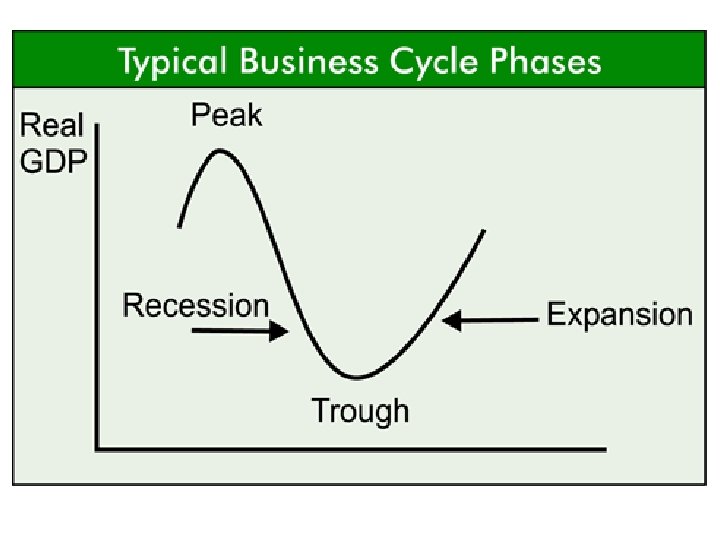
The Business Cycle • Business cycle: Recurrent swings in real GDP.
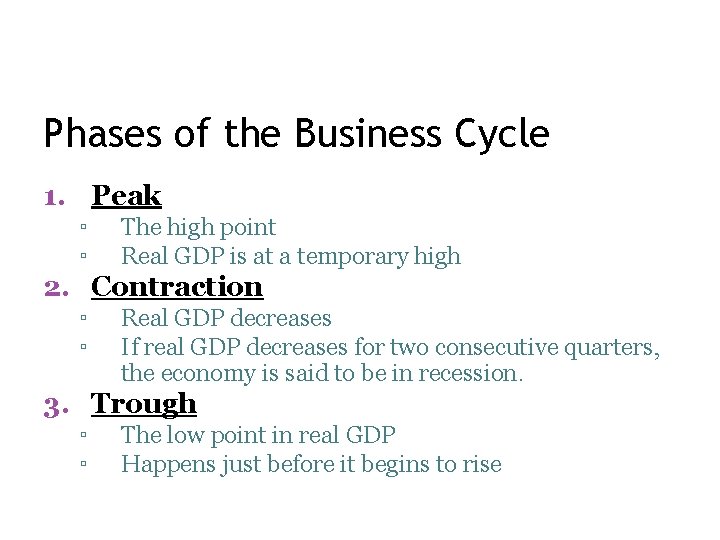
Phases of the Business Cycle 1. Peak ▫ ▫ The high point Real GDP is at a temporary high 2. Contraction ▫ ▫ Real GDP decreases If real GDP decreases for two consecutive quarters, the economy is said to be in recession. 3. Trough ▫ ▫ The low point in real GDP Happens just before it begins to rise
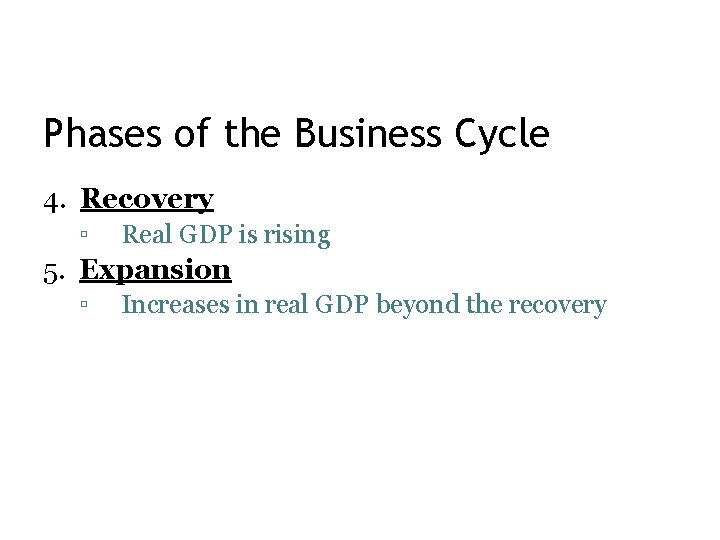
Phases of the Business Cycle 4. Recovery ▫ Real GDP is rising 5. Expansion ▫ Increases in real GDP beyond the recovery
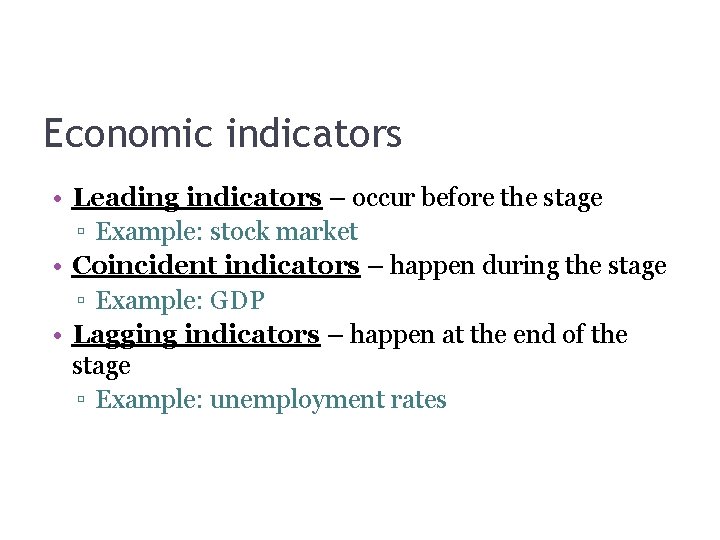
Economic indicators • Leading indicators – occur before the stage ▫ Example: stock market • Coincident indicators – happen during the stage ▫ Example: GDP • Lagging indicators – happen at the end of the stage ▫ Example: unemployment rates
Economic Growth
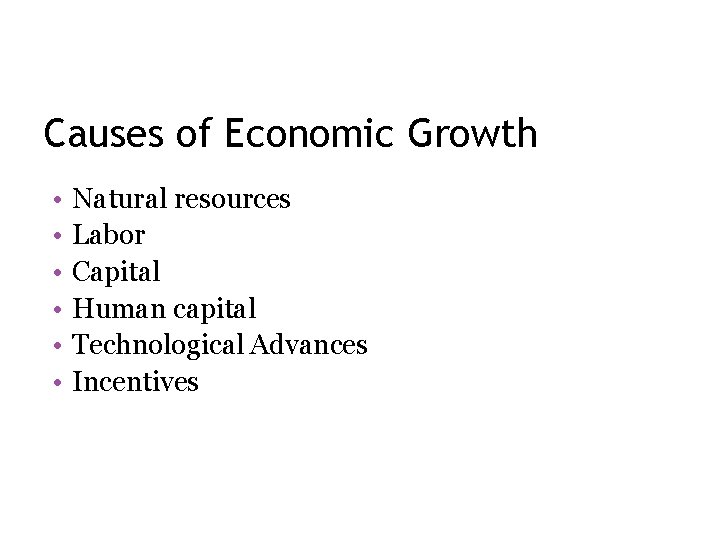
Causes of Economic Growth • • • Natural resources Labor Capital Human capital Technological Advances Incentives
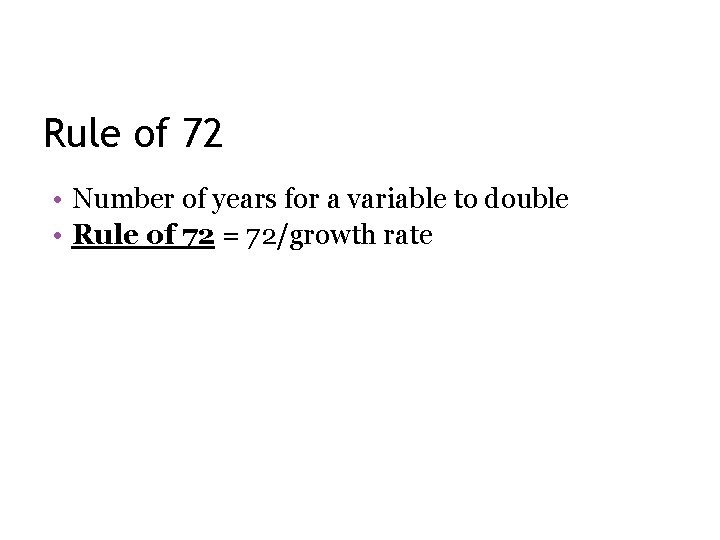
Rule of 72 • Number of years for a variable to double • Rule of 72 = 72/growth rate
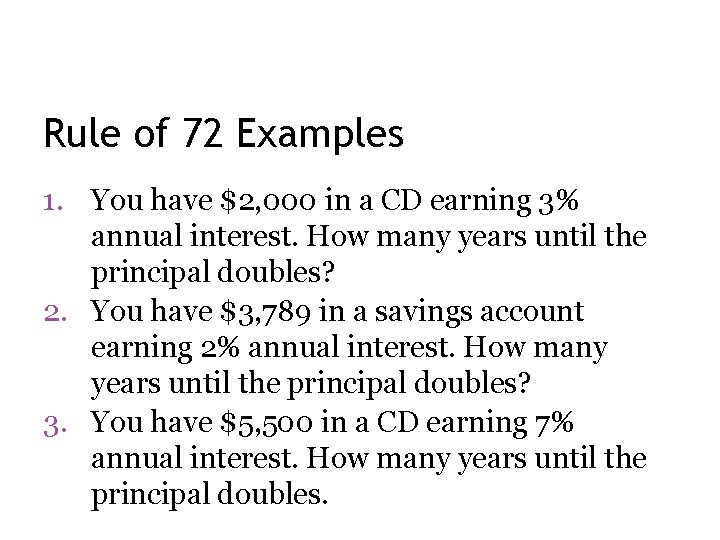
Rule of 72 Examples 1. You have $2, 000 in a CD earning 3% annual interest. How many years until the principal doubles? 2. You have $3, 789 in a savings account earning 2% annual interest. How many years until the principal doubles? 3. You have $5, 500 in a CD earning 7% annual interest. How many years until the principal doubles.