
Economic Analysis of Intellectual Property Rights 1 Introduction

- Slides: 39
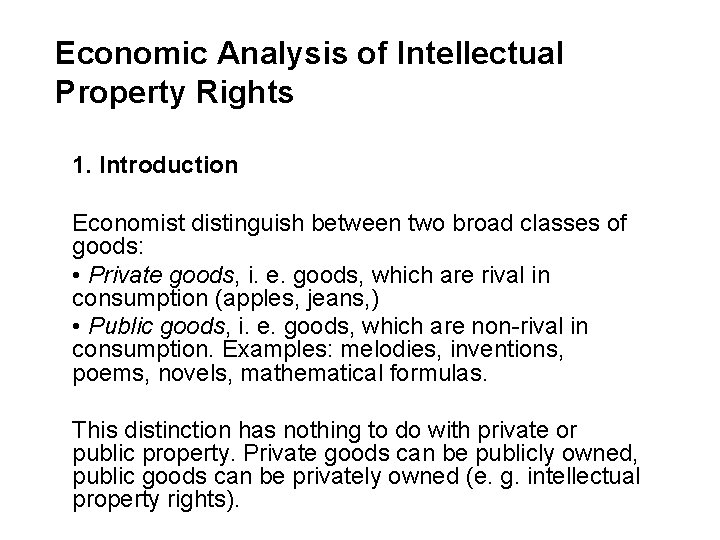
Economic Analysis of Intellectual Property Rights 1. Introduction Economist distinguish between two broad classes of goods: • Private goods, i. e. goods, which are rival in consumption (apples, jeans, ) • Public goods, i. e. goods, which are non-rival in consumption. Examples: melodies, inventions, poems, novels, mathematical formulas. This distinction has nothing to do with private or public property. Private goods can be publicly owned, public goods can be privately owned (e. g. intellectual property rights).
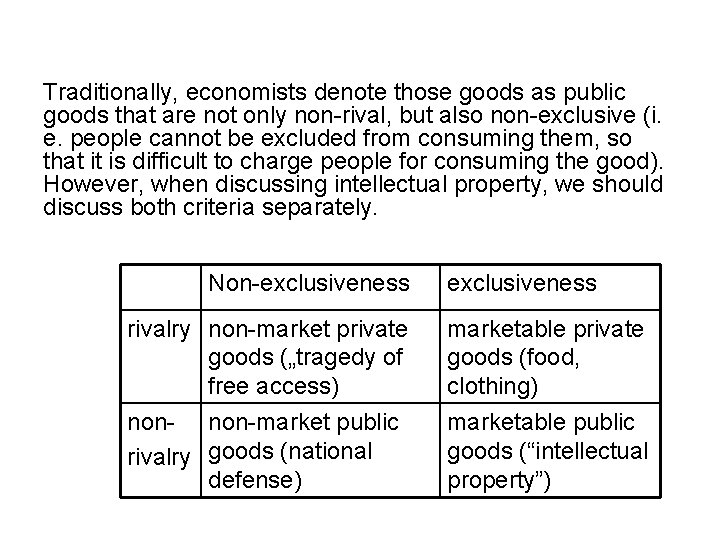
Traditionally, economists denote those goods as public goods that are not only non-rival, but also non-exclusive (i. e. people cannot be excluded from consuming them, so that it is difficult to charge people for consuming the good). However, when discussing intellectual property, we should discuss both criteria separately. Non-exclusiveness rivalry non-market private goods („tragedy of free access) marketable private goods (food, clothing) non-market public rivalry goods (national defense) marketable public goods (“intellectual property”)
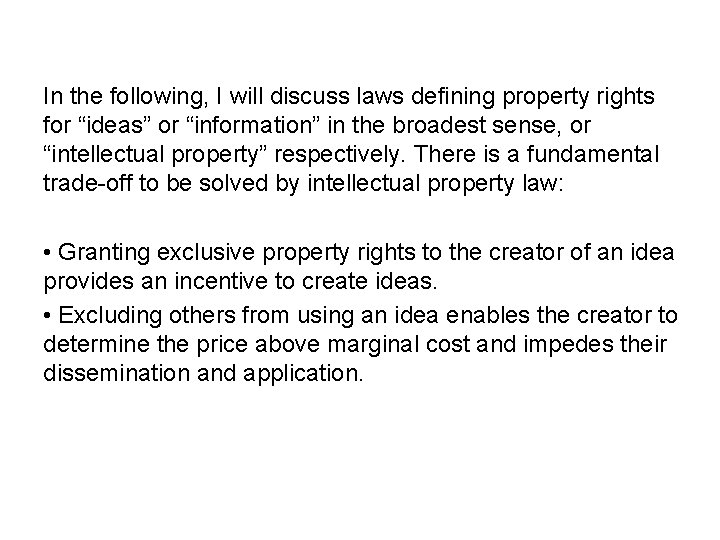
In the following, I will discuss laws defining property rights for “ideas” or “information” in the broadest sense, or “intellectual property” respectively. There is a fundamental trade-off to be solved by intellectual property law: • Granting exclusive property rights to the creator of an idea provides an incentive to create ideas. • Excluding others from using an idea enables the creator to determine the price above marginal cost and impedes their dissemination and application.
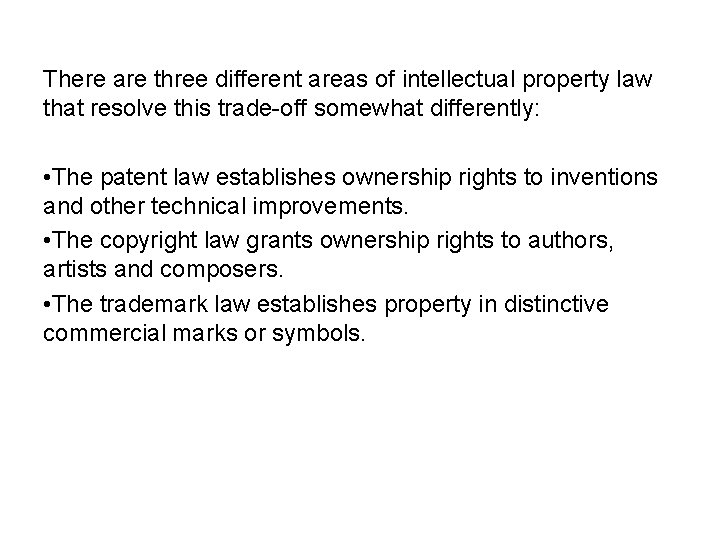
There are three different areas of intellectual property law that resolve this trade-off somewhat differently: • The patent law establishes ownership rights to inventions and other technical improvements. • The copyright law grants ownership rights to authors, artists and composers. • The trademark law establishes property in distinctive commercial marks or symbols.
2. Economic analysis of patent law 2. 1 A world without patent protection Without any patent protection only one option to receive some returns on the investment in research and development remains: secrecy. However, in many cases it is not possible to keep the relevant attributes of an invention secret. It is relatively easy to keep the relevant attributes of process innovations or chemical formulas (Coca Cola) secret, but it is difficult to keep most product innovations secret (competitors will dismantle the product and understand the innovation). Consequence: The incentive to invest in product innovations that are difficult to keep secret will diminish. Many possible innovations of high value for society will not be made.
Even if it is possible to keep the invention secret it is more complicated to conclude and enforce license contracts. Consequence: Lack of division of labor and specialization.
2. 2 Innovation incentives through patent law I – basic model Objective of patent law in the basic model: Induce the representative innovator to trade-off efficiently between dynamic efficiency gains and static efficiency losses by determining an appropriate scope and duration of patent protection.
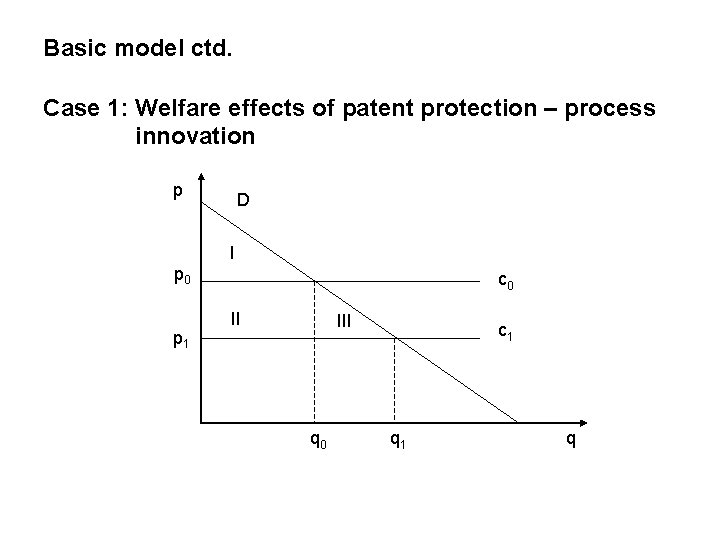
Basic model ctd. Case 1: Welfare effects of patent protection – process innovation p D I p 0 p 1 c 0 II III q 0 c 1 q
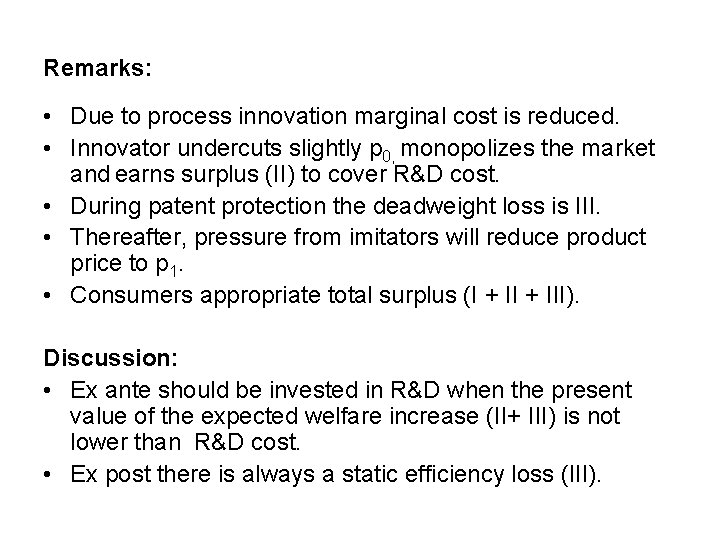
Remarks: • Due to process innovation marginal cost is reduced. • Innovator undercuts slightly p 0, monopolizes the market and earns surplus (II) to cover R&D cost. • During patent protection the deadweight loss is III. • Thereafter, pressure from imitators will reduce product price to p 1. • Consumers appropriate total surplus (I + III). Discussion: • Ex ante should be invested in R&D when the present value of the expected welfare increase (II+ III) is not lower than R&D cost. • Ex post there is always a static efficiency loss (III).
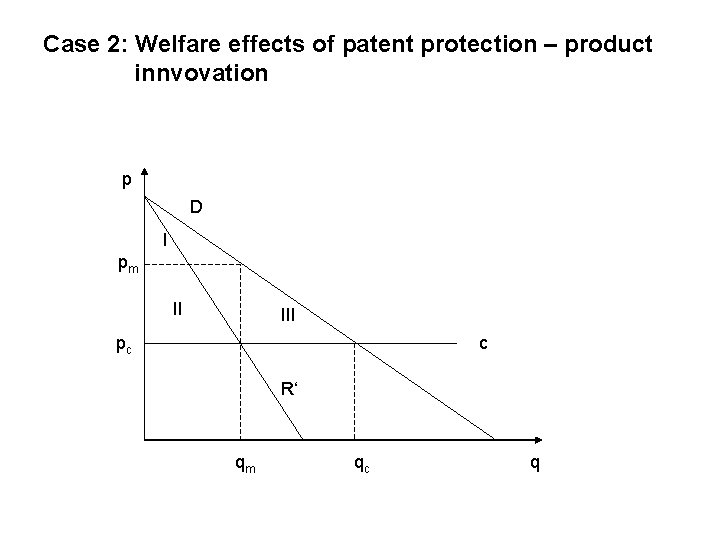
Case 2: Welfare effects of patent protection – product innvovation p D I pm II III pc c R‘ qm qc q
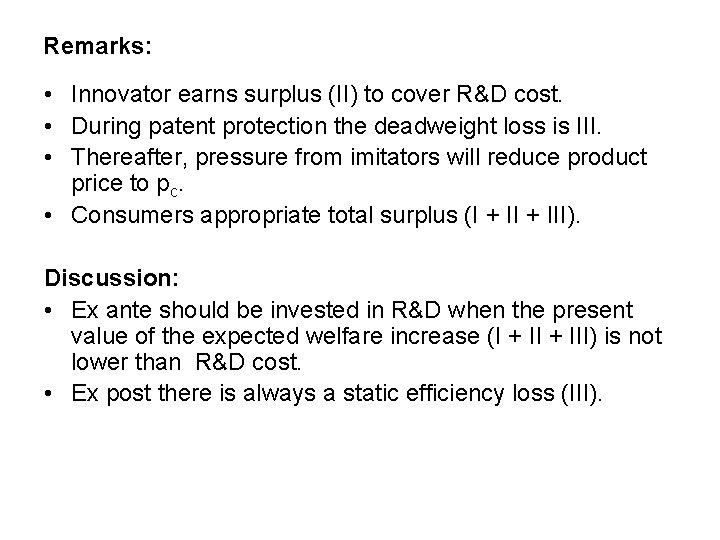
Remarks: • Innovator earns surplus (II) to cover R&D cost. • During patent protection the deadweight loss is III. • Thereafter, pressure from imitators will reduce product price to pc. • Consumers appropriate total surplus (I + III). Discussion: • Ex ante should be invested in R&D when the present value of the expected welfare increase (I + III) is not lower than R&D cost. • Ex post there is always a static efficiency loss (III).
• Patent law resolves the trade-off between underproduction and under-utilization of inventions by determining the duration and the scope of patent protection. • The same innovation incentive can be achieved by increasing the duration (earning surplus II for more periods) or by expanding the scope (earning a higher surplus II period).
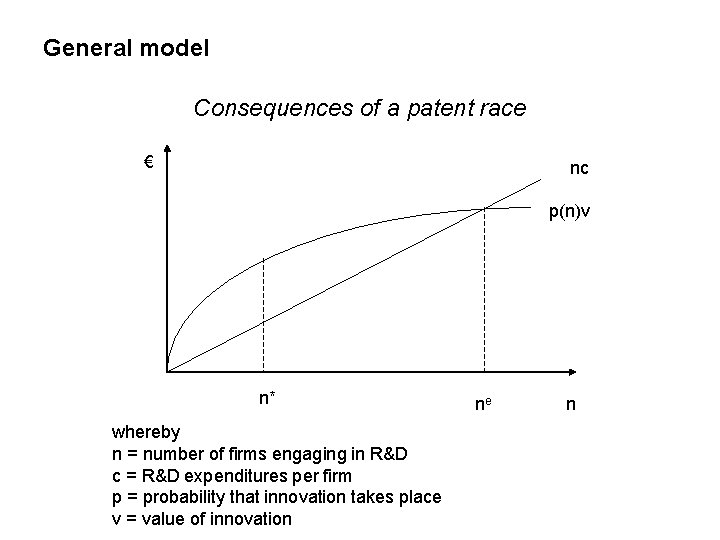
2. 3 Innovation incentives through patent law II – the problem of patent race If there is competition among rival companies at the R&D level patent races and overinvestment in R&D may arise.
Example: Assume the social value of the solution to a specific technical problem (i. e. the present value of the maximum amount of money the users of this invention would be willing to pay) is 1 Million $. Assume further that any company of the relevant industry would be able to solve this problem in suitable time by spending 200, 000 $ for research and development. Obviously, a risk-neutral company will be willing to spend 200, 000 $ for research and development, if the present value of the expected revenue is at least 200, 000 $. Assume, two identical companies compete for the patent and each company calculates a probability of 0. 5 to be the first inventor and to get the patent. Then, the expected revenue from research and development for each company amounts to 0. 5 1 Million + 0. 5 0 = 500, 000 > 200, 000 $. Consequently, both will engage in research and development.
Example ctd. In general, up to five risk-neutral identical companies will be willing to compete for the patent. In this case, the expected revenue for each company equals the cost of research and development: 0. 2 1 Million + 0. 8 0 = 200, 000 $. Result: The invention that could have been done by one company at a research and development cost of 200, 000 $, is made at a social research and development cost of 5 200, 000 = 1 Million, the whole potential surplus is transformed into cost (“over-investment”).
Example ctd. Discussion: • This model (and the numerical example as well) is based on very strong assumptions: (1) it is assumed that the success of R&D does not depend on the number of companies investing in R&D; (2) it is assumed that only the winner of the patent race contributes to social welfare whereas the expenditures for R&D made by the other companies are complete useless. • Under more realistic assumptions (1) the probability to find a solution to the problem will increase with the number of companies investing in R&D, (2) also the losers of the patent race will be able to utilize the results of their R&D-activities for other valuable innovations. • But the tendency to “over-invest” in R&D will continue to exist under these more realistic assumptions. Reason: Each company is only interested in its private benefit of R&D without taking into account that its own R&D-activity reduces the expected revenue of the competing companies (“common pool problem”).
General model Consequences of a patent race € nc p(n)v n* whereby n = number of firms engaging in R&D c = R&D expenditures per firm p = probability that innovation takes place v = value of innovation ne n
2. 4 Innovation incentives through patent law III – sequential innovations Breadth of patent protection refers to how similar another invention can be without infringing upon the patent for the original invention. Consequence: Broad protection encourages fundamental and fast, duplicative research, narrow patents encourage development and slower, complementary research.
Suggestions from an efficiency point of view (Cooter/Ulen): If the social value of investment on fundamental research exceeds the value of investment on developing applications, then patents should be broadened. Conversely, if the social value of investment on developing applications exceeds the value of investment on fundamental research, then patents should be narrowed.
Remark (Cooter/Ulen): Opposite to some US court decisions patent protection for pioneering inventions should be broader for those with little stand-alone value and narrower for those with large standalone value. Structure of the problem can be analysed by a simple example:
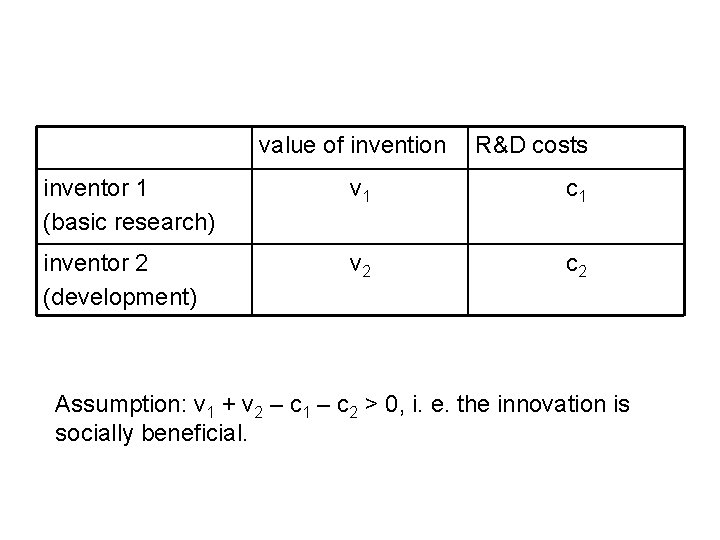
value of invention R&D costs inventor 1 (basic research) v 1 c 1 inventor 2 (development) v 2 c 2 Assumption: v 1 + v 2 – c 1 – c 2 > 0, i. e. the innovation is socially beneficial.
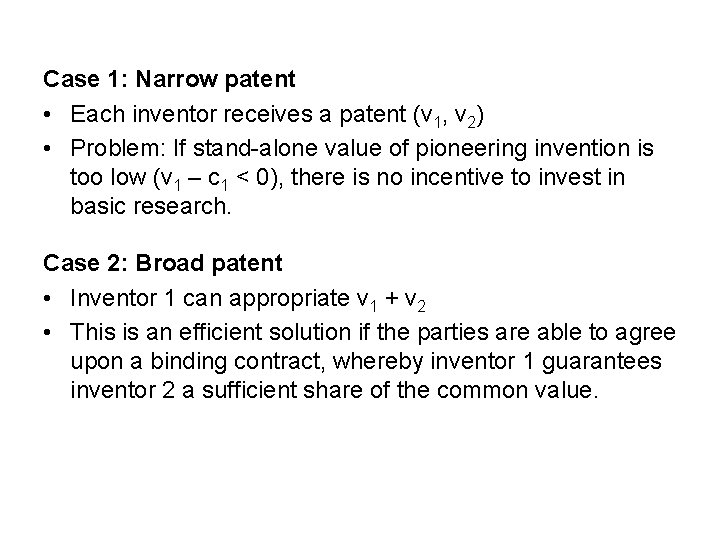
Case 1: Narrow patent • Each inventor receives a patent (v 1, v 2) • Problem: If stand-alone value of pioneering invention is too low (v 1 – c 1 < 0), there is no incentive to invest in basic research. Case 2: Broad patent • Inventor 1 can appropriate v 1 + v 2 • This is an efficient solution if the parties are able to agree upon a binding contract, whereby inventor 1 guarantees inventor 2 a sufficient share of the common value.
2. 5 Innovation incentives through patent law IV – complementary innovations and the “Tragedy of the Anticommons” • Additional incentive problems may arise if several complementary basic inventions that are needed for developing new products are owned by different parties. • Example: fragmented and overlapping patent rights with respect to basic biomedical research findings.
Symmetrical problems (Buchanan/Yoon): • “Tragedy of the Commons”: with open access to scarce resources = overutilization. • “Tragedy of the Anticommons”: with multiple rights to exclude = underutilization (Heller 1998, Heller/Eisenberg 1998). Other examples: Privatization in post-socialist economies, permits that require the approval of several separate overlapping agencies.
Possible solutions to the incentive problem resulting from the “tragedy of the anticommons” in patent protection: • Cross-licensing, i. e. firms agree to share a subset of each other’s patented technologies, • Patent pools, i. e. an arrangement whereby a set of patents is licensed in a single package, for a posted fee, either by a single owner or by an entity especially set up to handle this arrangement.
2. 6 The economic structure of patent law What is protected by patent law? To obtain a patent in a product or process (in Germany: technical invention), it must be shown to be novel, nonobvious, and useful (Shavell 2004, 151 ff. ). Economic justification: • Novelty: static efficiency losses are only justified if innovation is created. • Nonobviousness: Those inventions that require only small R&D investments should not be patented. • Usefulness: Pure strategic patenting should be restricted.
Who receives the patent? Interesting case: independent parallel inventions Two principles: “first-to-invent” (only USA) “first-to-file” (rest of the world)
Scope of patent protection • Different exclusive rights for product patents and process patents • Patent claims determine how similar another invention is allowed to be without infringing the original patent.
Limits of patent protection • Geographic limits national applications required, but: international treaties • Time limits maximal duration of 20 years; however: increasing continuation fees. • Substantial limits exhaustion of patent mandatory license other substantial limits
3. Economic analysis of copyright law • Copyright law grants writers, composers and other artists a property right in their original expression of an idea, not in the idea itself. • Social function of copyright protection: Provision of incentives to create socially beneficial works (such as novels, poems, compositions, paintings, sculptures).
• Without any copyright protection Anyone could buy a copy of the book or of the CD when it first appears and make and sell copies of it. With low copying cost and good quality of the copies authors and publishers face the problem to cover the costs of creating and marketing the work. Result: Underproduction of socially beneficial works. • With too extensive copyright protection Since the creation of new works typically involves borrowing or building on material from a prior body of works as well as adding original expression to it, a too extensive copyright protection would also lead to underproduction of socially beneficial works.
Central trade-off to be solved by copyright law • Balancing the effect of greater copyright protection – in encouraging the creation of new works by reducing copying – against the effect of less protection – in encouraging the creation of new works by reducing the cost of creating them.
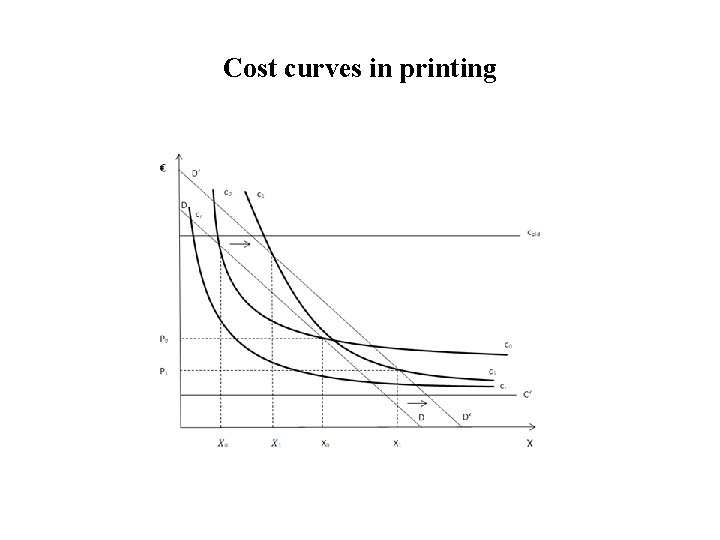
The Emergence of Copyright Law • Invention of movable print typing (Gutenberg, 15 th century) • Consequence: large fixed and relatively low variable cost of printing, i. e. producing copies • Until the 18 th century: only legal protection against unauthorised reprinting = privileges by city or sovereign • Emergence of modern copyright law: Statute of Anne, 1710.
Cost curves in printing
Scope, Duration and Limits • Scope Compared to patent law the scope is narrow. Copyright law merely gives protection against copying the original expression of an idea. Independent duplication of the copyrighted work is not actionable as such. • Duration In Western Europe and in the US (since 1998): creator’s life plus 70 years. The optimal duration involves a problem different from patent protection. Since copyrights are not registered the limited duration of copyrights ameliorates the tracing problem (i. e. to collect information on existing copyright protection).
• Limits …refer to certain cases which allow the use of a work without the permission (with or without payment of compensation) of the right holder. US copyright law: “fair use” German copyright law: catalogue of (explicit) exceptions
Performing-Rights Organizations • One important difference between patent protection and copyright protection is that there are comparatively few users of inventions, but many users of works. Consequently, individual negotiations between creators and users are in many cases prohibitively costly. • For this reason, performing-rights organizations (“Verwertungsgesellschaften”) are acting as mediators between creators and users. • Most important organizations in Germany: GEMA for creators of music, and VG-Wort for book authors.
Technological Developments and the Enforcement of Copyrights • Since the middle of the 20 th century: cheap unauthorised copying with the development of xero-copying, audio- and video-recorders and –cassettes. • Since the end of the 20 th century: dramatic reduction of the cost of unauthorised copying with the development of digitisation and the internet.
Thank you for your attention!