
Economic analysis of droneprovided mobile services Lingjie Duan
Economic analysis of drone-provided mobile services Lingjie Duan Associate Professor Singapore University of Technology and Design (SUTD)
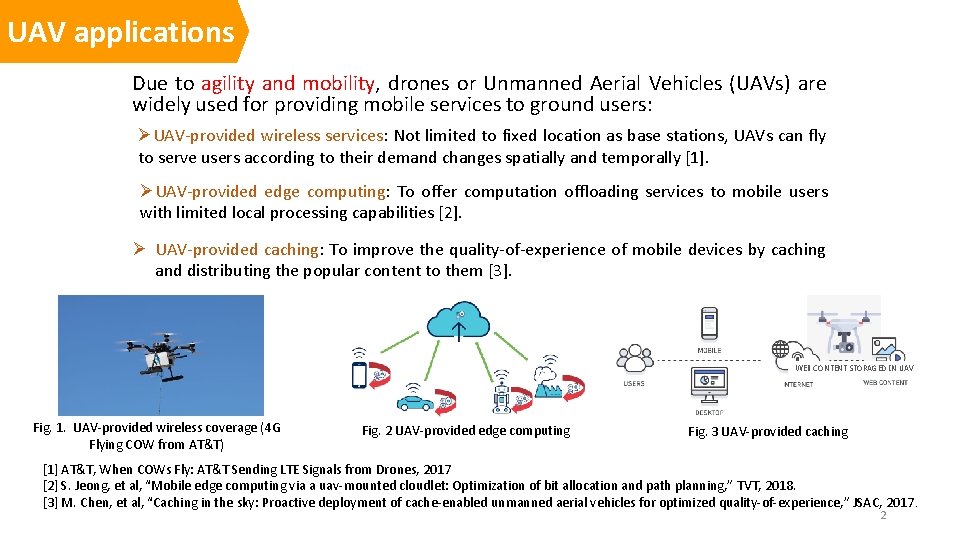
UAV applications Due to agility and mobility, drones or Unmanned Aerial Vehicles (UAVs) are widely used for providing mobile services to ground users: ØUAV-provided wireless services: Not limited to fixed location as base stations, UAVs can fly to serve users according to their demand changes spatially and temporally [1]. ØUAV-provided edge computing: To offer computation offloading services to mobile users with limited local processing capabilities [2]. Ø UAV-provided caching: To improve the quality-of-experience of mobile devices by caching and distributing the popular content to them [3]. WEB CONTENT STORAGED IN UAV Fig. 1. UAV-provided wireless coverage (4 G Flying COW from AT&T) Fig. 2 UAV-provided edge computing Fig. 3 UAV-provided caching [1] AT&T, When COWs Fly: AT&T Sending LTE Signals from Drones, 2017 [2] S. Jeong, et al, “Mobile edge computing via a uav-mounted cloudlet: Optimization of bit allocation and path planning, ” TVT, 2018. [3] M. Chen, et al, “Caching in the sky: Proactive deployment of cache-enabled unmanned aerial vehicles for optimized quality-of-experience, ” JSAC, 2017. 2
UAV services Key challenges for UAV-provided mobile services: Ø Size-limited battery: both flying and servicing cost energy • Longer hovering time helps meet more demands yet leaving less energy for serving users • Tradeoff between hovering time and service capacity Ø Dynamically price the capacity-limited service to ground users for profit-maximization • Challenging under incomplete information about the mobile users’ randomness in arriving and their private service valuations Ø Deploy multiple UAVs to cooperatively serve multiple user clusters or hotspots • Multiple hotspot candidates with different user occurrence rates and flying distances Economic issues of UAV are overlooked in the literature, requiring a novel cross-layer design! 3

Related work Related Work Ø Some related works [4 -5] studying service capacity planning under complete user information: [4] L. Duan, J. Huang, and B. Shou, “Investment and pricing with spectrum uncertainty: A cognitive operator’s perspective, ” IEEE Transactions on Mobile Computing, vol. 11, no. 10, 2011. [5] L. Duan, J. Huang, and B. Shou, “Capacity allocation and pricing strategies for new wireless services, ” Productions and Operations Management, 2016. Ø There are some other works [5 -6] on dynamic pricing schemes of fixed-capacity wireless networks to gradually learn incomplete user information. [6] J. Musacchio and J. Walrand, “Wifi access point pricing as a dynamic game, ” IEEE/ACM Transactions on Networking (TON), 2006. [7] A. Gershkov and B. Moldovanu, Dynamic allocation and pricing: a mechanism design approach, MIT press, 2014. Ø Technically, there is a lack of study for joint capacity planning and dynamic pricing for providing mobile services. Ø Our UAV work presents the joint study • UAV server has interchangeable energy capacities for hovering and servicing to balance • Mobile users to price are randomly moving on the ground under incomplete information 4
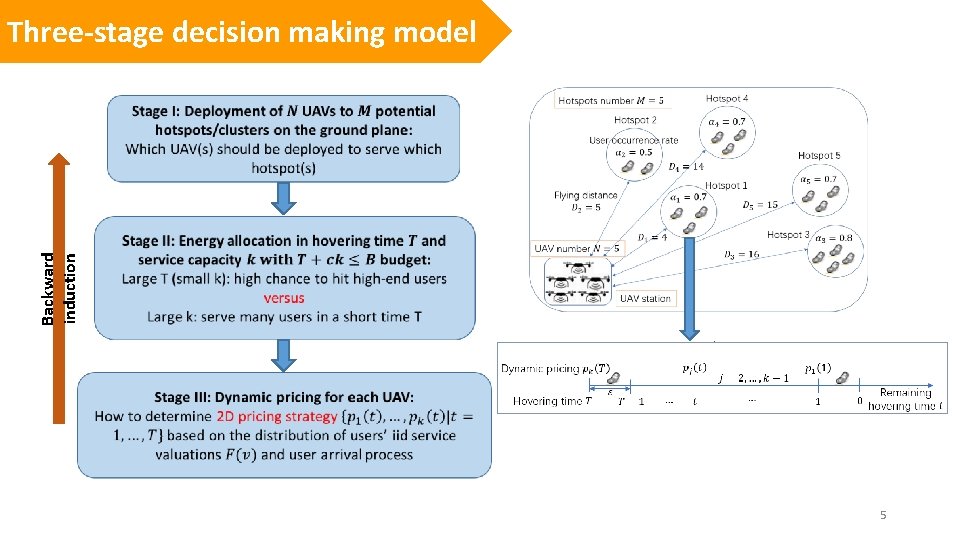
Three-stage decision making model Backward induction 5
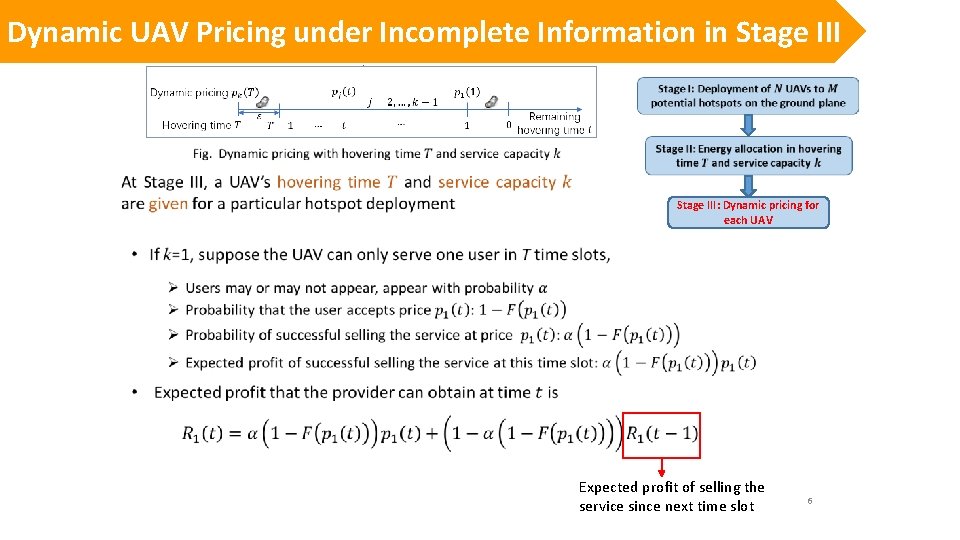
Dynamic UAV Pricing under Incomplete Information in Stage III • Stage III: Dynamic pricing for each UAV Expected profit of selling the service since next time slot 6
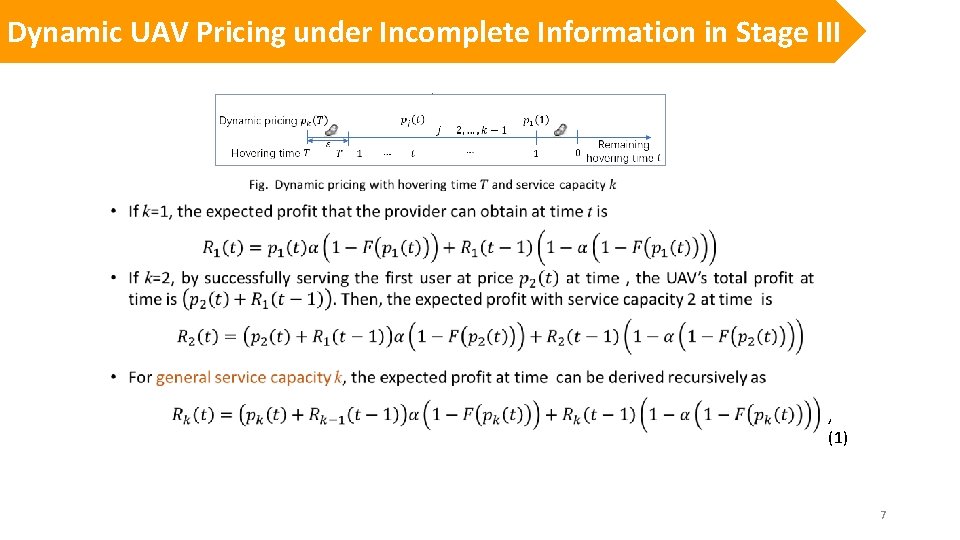
Dynamic UAV Pricing under Incomplete Information in Stage III • , (1) 7
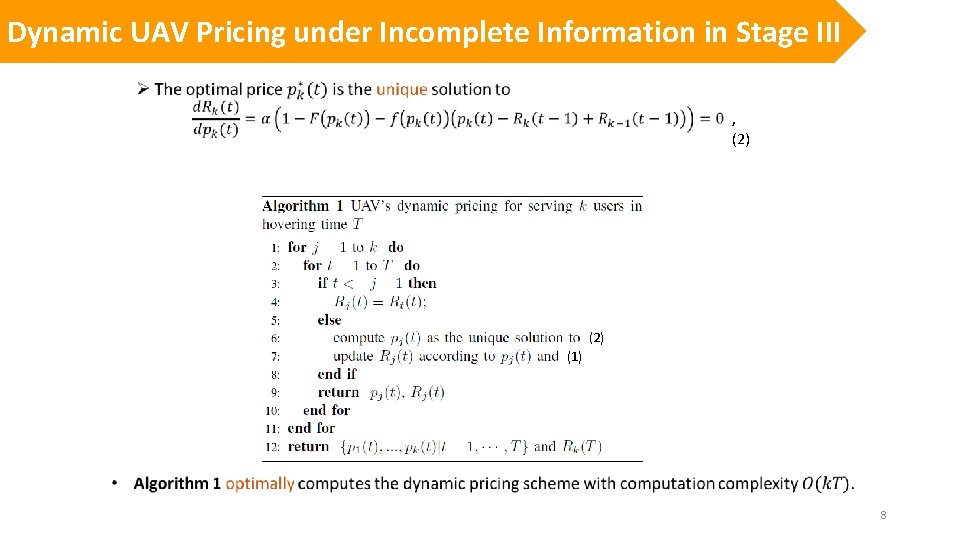
Dynamic • UAV Pricing under Incomplete Information in Stage III , (2) (1) 8
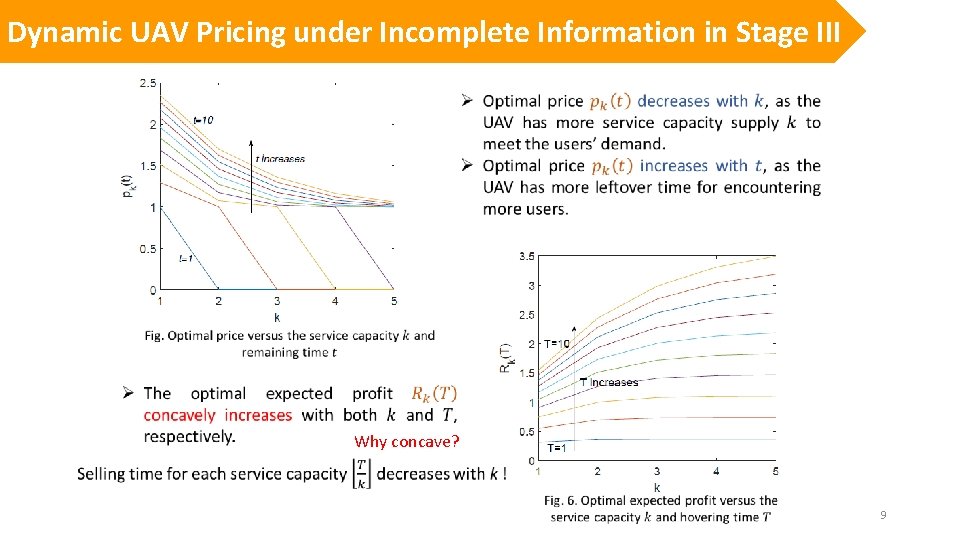
Dynamic UAV Pricing under Incomplete Information in Stage III Why concave? 9
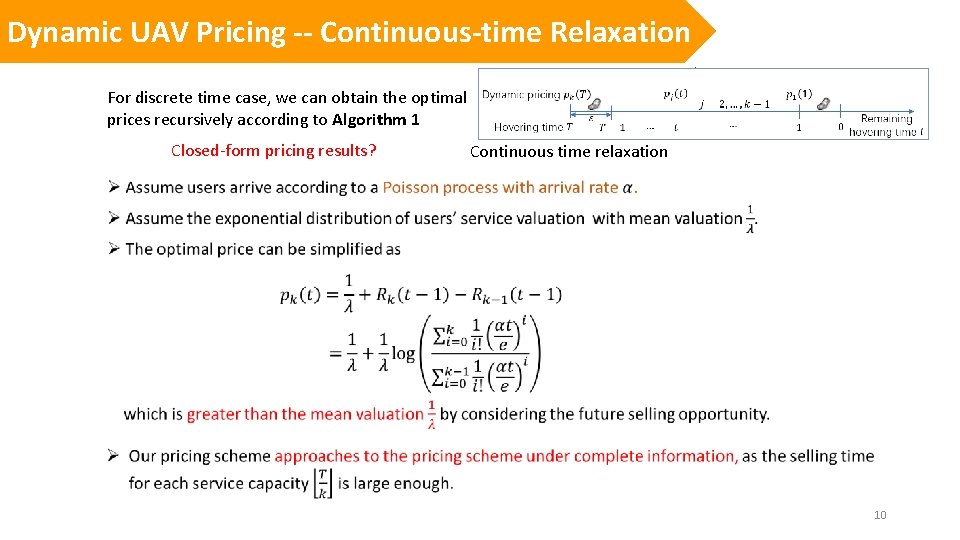
Dynamic UAV Pricing -- Continuous-time Relaxation For discrete time case, we can obtain the optimal prices recursively according to Algorithm 1 Closed-form pricing results? Continuous time relaxation • 10
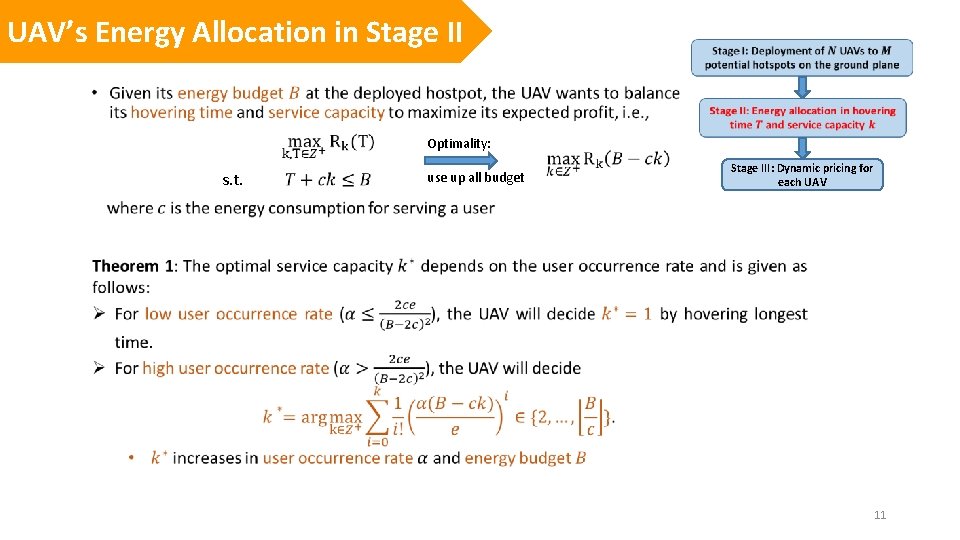
UAV’s Energy Allocation in Stage II • s. t. Optimality: use up all budget Stage III: Dynamic pricing for each UAV 11
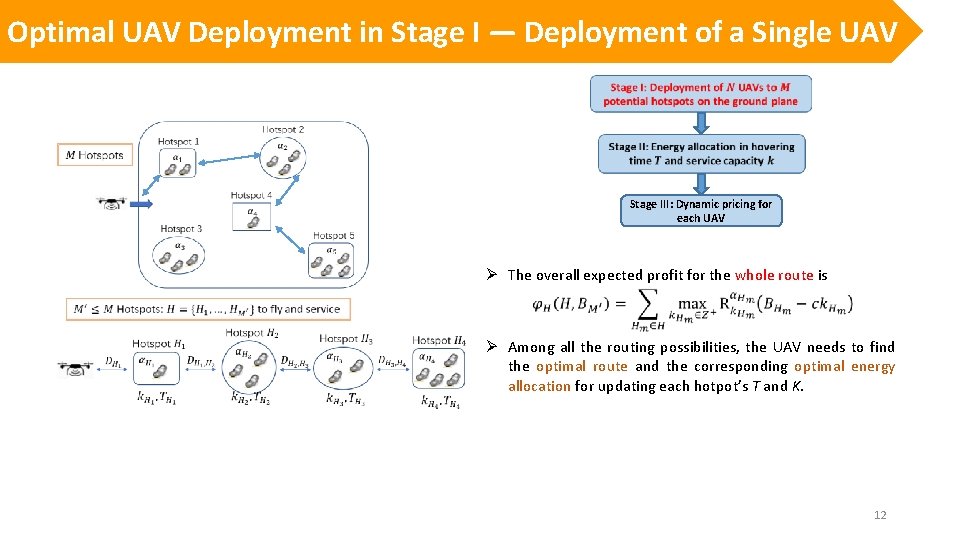
Optimal UAV Deployment in Stage I — Deployment of a Single UAV Stage III: Dynamic pricing for each UAV Ø The overall expected profit for the whole route is Ø Among all the routing possibilities, the UAV needs to find the optimal route and the corresponding optimal energy allocation for updating each hotpot’s T and K. 12
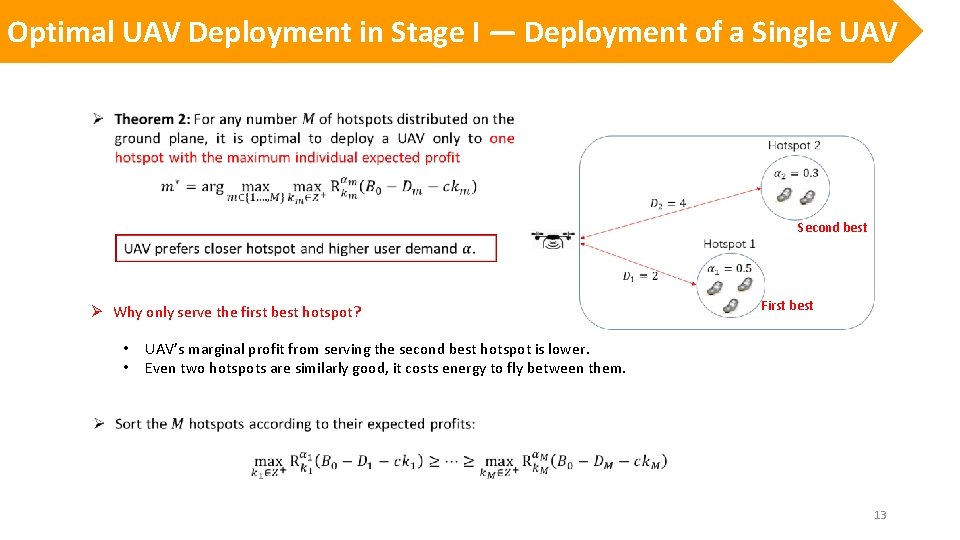
Optimal UAV Deployment in Stage I — Deployment of a Single UAV Second best Ø Why only serve the first best hotspot? • • First best UAV’s marginal profit from serving the second best hotspot is lower. Even two hotspots are similarly good, it costs energy to fly between them. 13
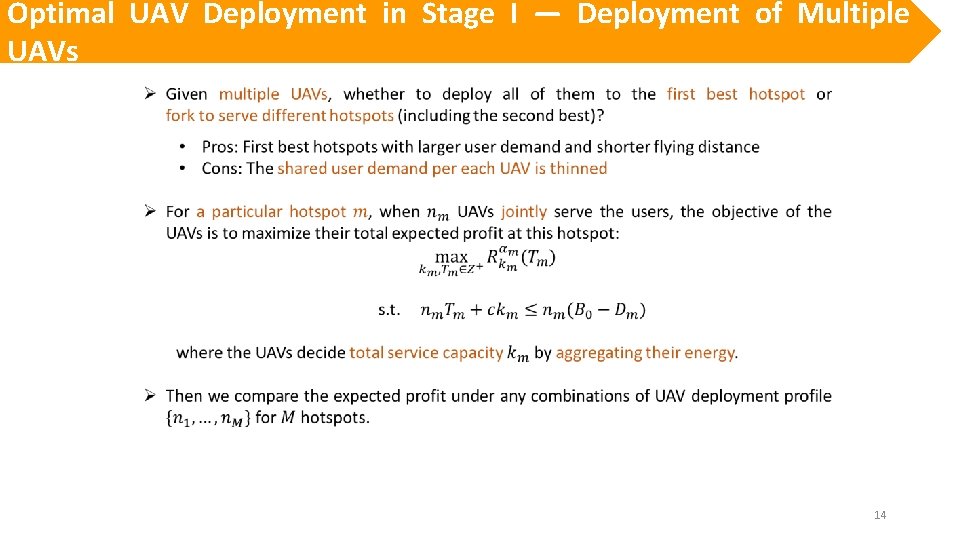
Optimal UAV Deployment in Stage I — Deployment of Multiple UAVs 14
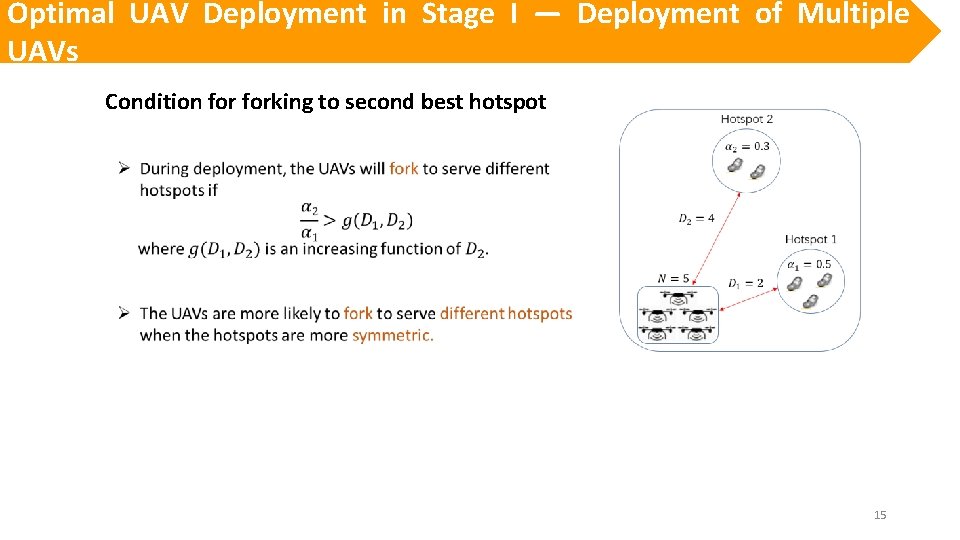
Optimal UAV Deployment in Stage I — Deployment of Multiple UAVs Condition forking to second best hotspot 15
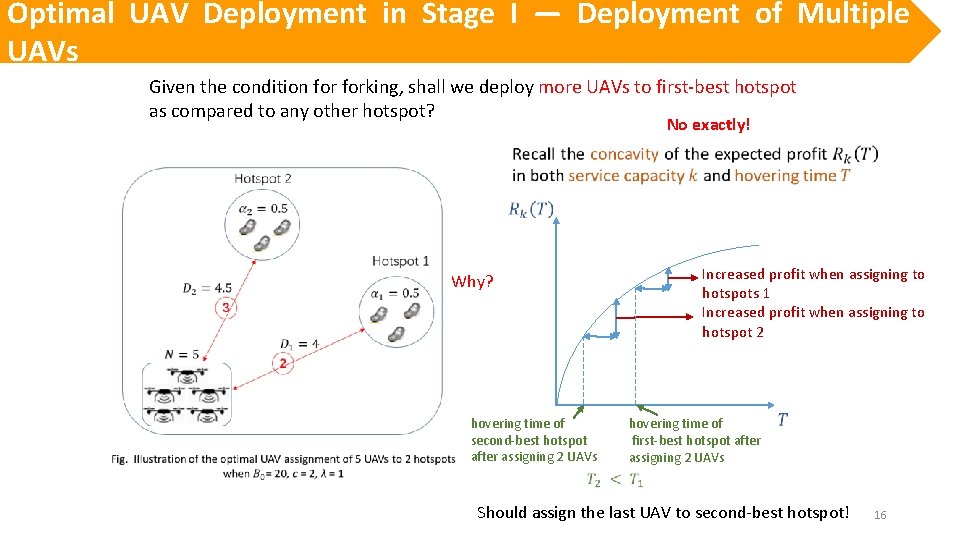
Optimal UAV Deployment in Stage I — Deployment of Multiple UAVs Given the condition forking, shall we deploy more UAVs to first-best hotspot as compared to any other hotspot? No exactly! Why? hovering time of second-best hotspot after assigning 2 UAVs Increased profit when assigning to hotspots 1 Increased profit when assigning to hotspot 2 hovering time of first-best hotspot after assigning 2 UAVs Should assign the last UAV to second-best hotspot! 16
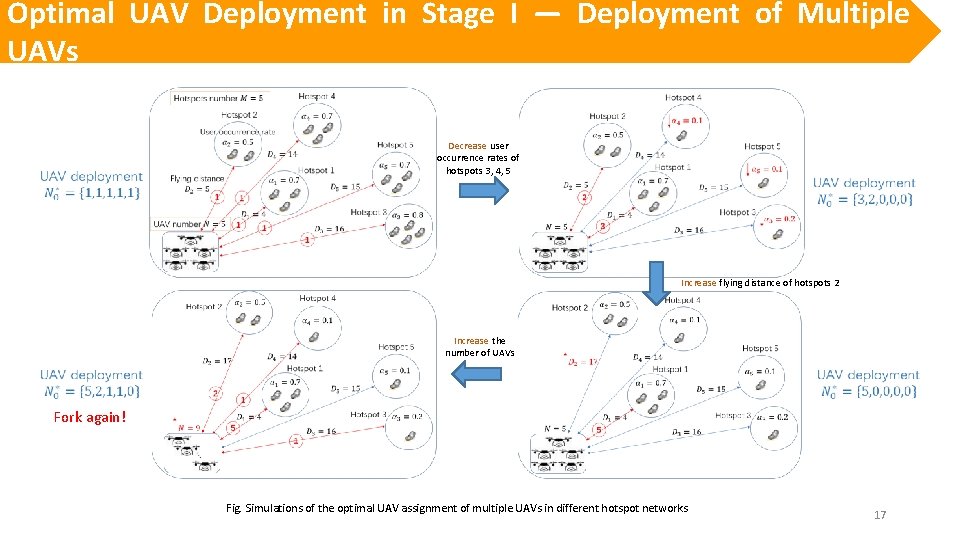
Optimal UAV Deployment in Stage I — Deployment of Multiple UAVs Decrease user occurrence rates of hotspots 3, 4, 5 Increase flying distance of hotspots 2 Increase the number of UAVs Fork again! Fig. Simulations of the optimal UAV assignment of multiple UAVs in different hotspot networks 17
Conclusion Ø First work on economic issues of UAV-provided mobile services • Joint capacity allocation and dynamic pricing for services on the way Ø Dynamic pricing under incomplete information: the UAV should ask for a higher price pk(t) if the leftover hovering time t is longer or its service capacity k is smaller. Ø Its energy allocation to hovering time and service capacity should be balanced at the hotspot: a shorter hovering time T or a larger service capacity k should be allocated as the hotspot’s user occurrence rate increases. Ø Finally, it is optimal for a UAV to only serve the best hotspot. While for multiple UAVs, they prefer to fork to serve different hotspots when hotspots are more symmetric or the UAV number is large. 18
Thanks! More details and findings can be found in X. Wang and L. Duan, “Dynamic pricing and capacity allocation of UAV-provided mobile services, ” in Proc. of IEEE INFOCOM, 2019. X. Wang and L. Duan, “Economic analysis of unmanned aerial vehicle (UAV) provided mobile services, ” under revision at IEEE Transactions on Mobile Computing, 2019. [Online]. Available: https: //arxiv. org/abs/1812. 02910 19
- Slides: 19