
Economic Analysis for Business Chapter 13 Aggregate Demand

Economic Analysis for Business Chapter 13 Aggregate Demand Aggregate Supply
Central point • if you try to push an economy beyond its productive capabilities, it will “overheat” creating an inflationary environment • if there is not enough demand, then the economy will slow and unemployment will rise • worried about inflationary effects of too much demand worried about the employment effects of too little RMIT University • an economy has only so much capacity 2
• The 45 -degree line model, known as the “Keynesian cross diagram” was the core of macroeconomic teaching from the 1940 s through to the early 1970 s • It was all aggregate demand nothing else • But as there were no major recessions, although a few minor downturns, the model continued to be taught in this way because events in the real world had not yet shown it to be dangerously incomplete RMIT University Historical interlude 3
Stagflation of the 1970 s • the causes were very far from having occurred on the demand side • it demonstrated that a demand-side understanding of economic events provided no insight into many of the most important problems an economy might face • Vietnam War • push for much greater spending on social welfare RMIT University • it was in the 1970 s that the first major post-World War II economic downturn occurred 4
Oil Shock and Wage Explosion • and then came: • the oil shock • a worldwide wage explosion • became immediately evident that the Keynesian-cross model could not explain what was taking place RMIT University • economies began to wilt. What was worse there was continuing upwards pressure on the price level 5
Aggregate Demand Aggregate Supply • replaced with aggregate demand aggregate supply curves • AD-AS brought to attention: • the supply side of the economy affected the level of activity • the forces causing inflation RMIT University • Keynesian-cross was therefore replaced 6
• along the curve there are no changes in the underlying conditions of aggregate demand or supply, and most importantly, in the level of wages • schedules of different possible combinations of prices and output over a period of time, say a month or a quarter • nothing much changes in a month or in most quarters RMIT University Understanding AD and AS 7
Shape of the AD-AS Curves • the result is: • higher prices have a negative effect on demand – the higher the price level the less will be demanded • higher prices will have a positive effect on supply – higher prices and more supplied RMIT University • wages are fixed but along both the AD and AS curves the price level is rising 8
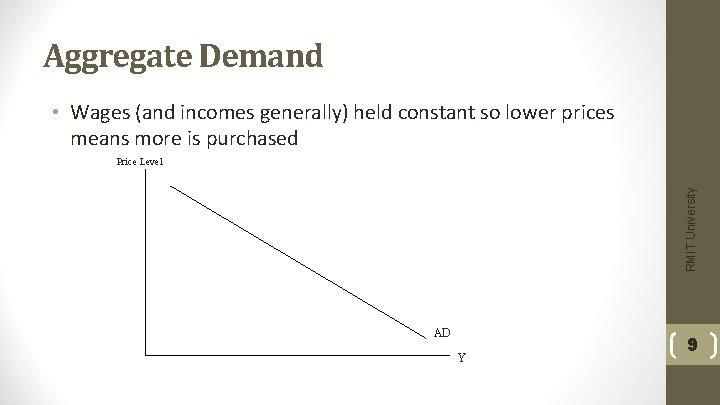
Aggregate Demand • Wages (and incomes generally) held constant so lower prices means more is purchased RMIT University Price Level AD Y 9
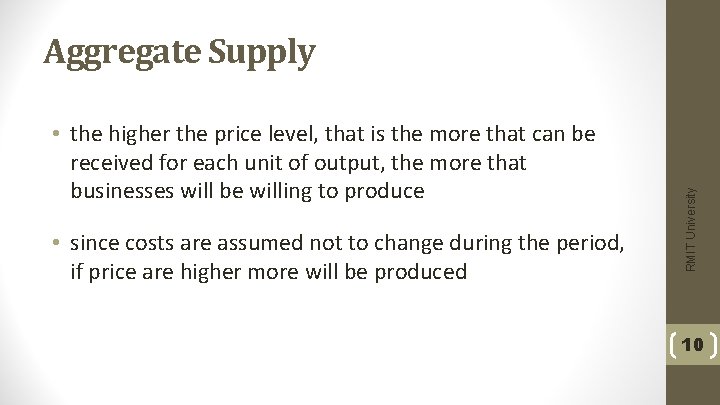
• the higher the price level, that is the more that can be received for each unit of output, the more that businesses will be willing to produce • since costs are assumed not to change during the period, if price are higher more will be produced RMIT University Aggregate Supply 10

Short Run Aggregate Supply (SRAS) • Labour costs held constant so as prices rise more is produced Price Level RMIT University SRAS Y 11
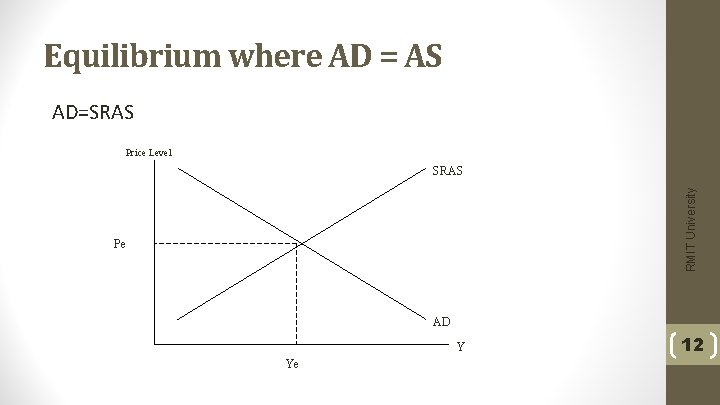
Equilibrium where AD = AS AD=SRAS Price Level RMIT University SRAS Pe AD Y Ye 12
Factors that cause AD to shift • whatever pushes them up, will push the AD curve to the right RMIT University • behind the AD curve are the usual elements of aggregate demand, C, I, G and NX • if these underlying factors fall, then AD moves to the left 13
Factors that cause AS to shift • anything that reduces unit production costs will move the curve to the right, eg technological improvements • anything that raises unit production costs, will move the curve to the left, eg higher wages RMIT University • the position of the AS curve is dependent on production costs 14
Types of Unemployment and the Natural Rate • broadly speaking, three types of unemployment: • frictional • structural • cyclical • each type has the same immediate consequence but are very different for policy purposes RMIT University • To understand modern macroeconomic policy, it is first necessary to understand the modern classification of unemployment 15
Frictional Unemployment • it is the unemployment that exists because economies are dynamic, so that some businesses are shutting down while others are opening up RMIT University • frictional unemployment is the naturally occurring unemployment that cannot be escaped in even the best managed economies • part of the adjustment process • this kind of unemployment is actually healthy for an economy 16
• structural unemployment comes about because not only do people lose their jobs, but the very skills they have are no longer sought by the labour market • those who are structurally unemployed are willing to work but no jobs are available that match the kinds of things they can do RMIT University Structural Unemployment 17
Cyclical Unemployment • most notable characteristic of an economy in recession is the large and often rapid rise in unemployment • when the economy has returned to full employment level, all cyclical forms of unemployment will have disappeared RMIT University • cyclical unemployment is the kind of unemployment associated with downturns in the economy 18
Defining full employment • there will always be frictional and structural unemployment in even the best of economies • cyclical occurs only when the economy is performing below its potential RMIT University • how full employment is defined 19
The central policy dilemma • dilemma is that many of the actions that lower unemployment also tend to raise inflation and vice versa RMIT University • inflation creates massive problems on its own, and must also be avoided 20
Inflation defined • when inflation occurs, the purchasing power of a unit of currency continues to fall • as time passes, each unit of currency buys less than it did in the time period before • creates many problems RMIT University • inflation is a continuous ongoing reduction in the value of money 21
Forms of inflation • creeping 2 -3% growth in prices that most economies now tolerate as an acceptable price to pay for economic growth • to the many thousands of percent annual growth rates that are found during hyperinflations that have catastrophic effects RMIT University • inflation comes in many forms: 22
• Money no longer secure as store of value • Savings are eroded and can be entirely lost • Forward planning within business becomes more difficult • Businesses become more tentative in terms of investment • Investments become less productive as the aim becomes to protect wealth from inflation RMIT University Problems with inflation 23
• Wage increases accelerate and industrial disputation is certain to increase • Lenders are robbed while borrowers receive an unearned return • Debtors receive a windfall return • Interest rates rise to quite high levels • Additional unemployment is created RMIT University More problems with inflation 24
Potential GDP and the Natural Rate of Unemployment • the unemployment rate when GDP growth is at its potential growth rate is described as the natural rate of unemployment – there is only frictional and structural unemployment • the natural rate of unemployment is different in every economy and is determined by those responsible for economic management RMIT University • the level of economic growth when economic activity is at its equilibrium level is described as potential GDP 25
Natural Rate of Unemployment and Long Run Aggregate Supply (LRAS) • if the actual unemployment rate falls below the natural rate, the assumption is that inflation will begin to rise RMIT University • the natural rate has a very important additional characteristic • the rise in inflation will itself set off a series of responses 26
• various groups attempt to defend standard of living by pushing for higher incomes because of the higher prices they face • the higher incomes will push the SRAS curve to the left • the economy cannot for very long break past the barrier imposed by the natural rate of unemployment • it is the upwards limit imposed by technology, existing capital and labour force skills RMIT University Responding to higher inflation 27
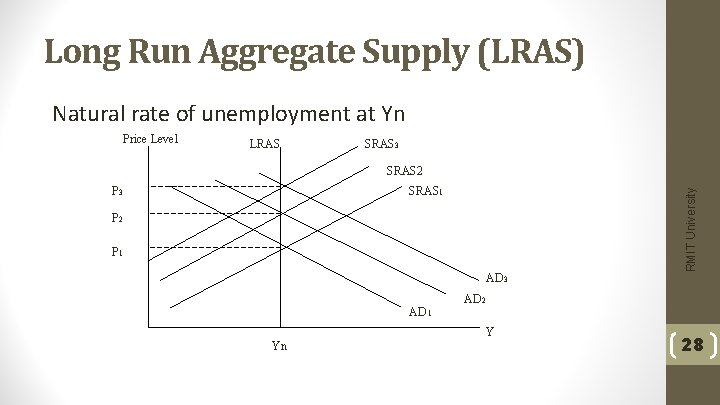
Long Run Aggregate Supply (LRAS) Natural rate of unemployment at Yn Price Level LRAS SRAS 3 P 3 SRAS 1 P 2 P 1 AD 3 RMIT University SRAS 2 AD 1 Y Yn 28
Tracing out Long Run Aggregate Supply • The sequence is: • Sets off inflationary pressures, in particular increases in wages, which push the SRAS curve to the left • The continuous shifting of SRAS in response to upwards movements of AD traces out a series of points which becomes the Long Run Aggregate Supply curve (LRAS) RMIT University • Aggregate demand goes up - AD curve moves right 29
• according to the Phillips Curve relationship, the lower the level of unemployment, the higher would the level of inflation become • the higher the level of unemployment, the lower the rate of inflation • Phillips Curve analysis remains at the heart of the inflationary control policies of central banks RMIT University Phillips Curve 30
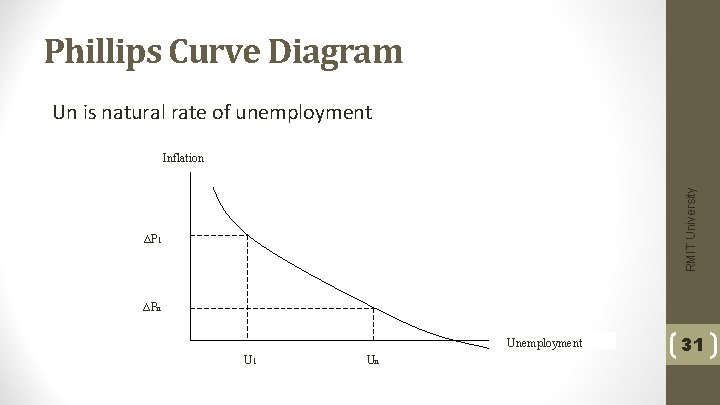
Phillips Curve Diagram Un is natural rate of unemployment RMIT University Inflation ∆P 1 ∆Pn Unemployment U 1 Un 31
Source of anti-inflation policy • theory suggests that: • lower unemployment creates pressure for wage increases and price movements in general • higher unemployment reduces the pressure on wages and prices • anti-inflationary policy has been designed to limit the growth in prices through adjustments to the rate of unemployment RMIT University • there is a choice, a trade off, between higher inflation but lower unemployment on the one hand, and lower inflation but higher unemployment on the other 32
• in every economy those in charge of economic management calculate the natural rate of unemployment in their own economy • this is the rate of unemployment at which the “optimum” rate of inflation will occur • what is this “optimum”? – it is the rate of inflation those in charge are prepared to live with over the longer term RMIT University Optimum inflation rate 33
Shifts in the Phillips Curve • the unemployment rate associated with the optimal rate of inflation will change • with the Phillips Curve having shifted to the left, it is now possible to achieve the same desired inflation rate, but with a lower rate of unemployment • such changes take time RMIT University • the natural rate of unemployment will rise and fall over time depending on various factors that affect how prone an economy is to inflation 34
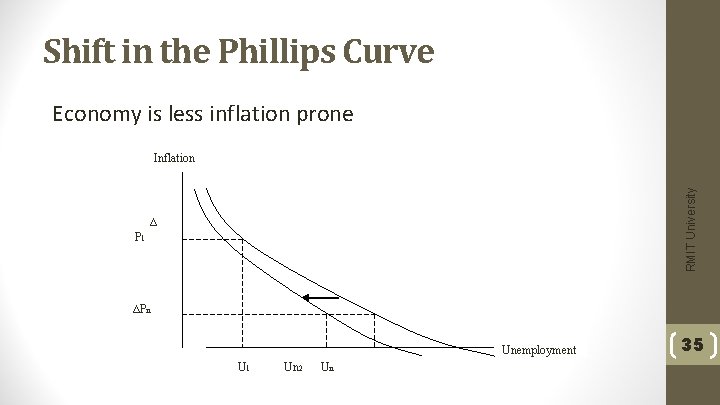
Shift in the Phillips Curve Economy is less inflation prone RMIT University Inflation ∆ P 1 ∆Pn Unemployment U 1 Un 2 Un 35
Economic Utopia • the LRAS curve will move to the right and higher output occurs but with no additional inflationary pressures • at the same time wages and other incomes rise so the AD curve moves from AD 1 to AD 2 • in an ideal world the SRAS 2, AD 2 and LRAS 2 all meet at the same point RMIT University • productivity rises as technology advances, capital is increased and labour force skills improve 36
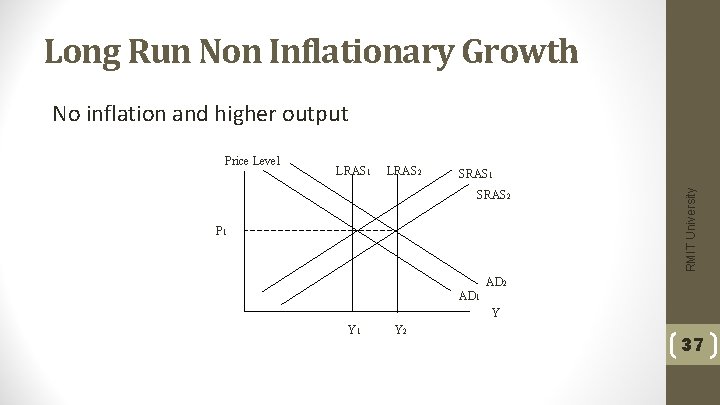
Long Run Non Inflationary Growth No inflation and higher output LRAS 1 LRAS 2 SRAS 1 SRAS 2 P 1 RMIT University Price Level AD 2 AD 1 Y Y 1 Y 2 37
- Slides: 37