
Econometrics I Professor William Greene Stern School of



![Implications of Gauss-Markov Theorem: Var[b*|X] – Var[b|X] is nonnegative definite for any other linear](https://slidetodoc.com/presentation_image/2d747147bff9c8e754156049038eb0f8/image-32.jpg "Implications of Gauss-Markov Theorem: Var[b*|X] – Var[b|X] is nonnegative definite for any other linear")
![Summary: Finite Sample Properties of b (1) Unbiased: E[b]= (2) Variance: Var[b|X] = 2(X](https://slidetodoc.com/presentation_image/2d747147bff9c8e754156049038eb0f8/image-35.jpg "Summary: Finite Sample Properties of b (1) Unbiased: E[b]= (2) Variance: Var[b|X] = 2(X")
![Var[b|X] Estimating the Covariance Matrix for b|X The true covariance matrix is 2 (X’X)-1](https://slidetodoc.com/presentation_image/2d747147bff9c8e754156049038eb0f8/image-47.jpg "Var[b|X] Estimating the Covariance Matrix for b|X The true covariance matrix is 2 (X’X)-1")



- Slides: 72
Econometrics I Professor William Greene Stern School of Business Department of Economics 7 -/72 Part 7: Finite Sample Properties of LS
Econometrics I Part 7 – Finite Sample Properties of Least Squares; Multicollinearity 7 -/72 Part 7: Finite Sample Properties of LS
Terms of Art p p 7 -3/72 Estimates and estimators Properties of an estimator - the sampling distribution “Finite sample” properties as opposed to “asymptotic” or “large sample” properties Scientific principles behind sampling distributions and ‘repeated sampling’ Part 7: Finite Sample Properties of LS
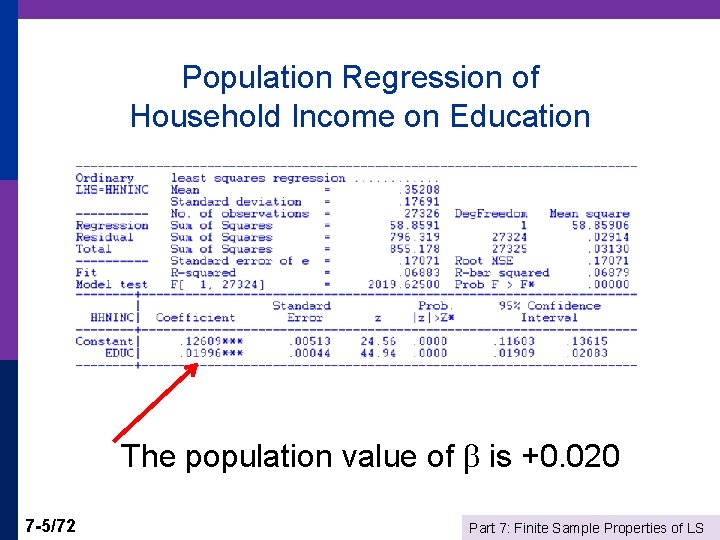
Application: Health Care Panel Data German Health Care Usage Data, 7, 293 Individuals, Varying Numbers of Periods Data downloaded from Journal of Applied Econometrics Archive. There altogether 27, 326 observations. The number of observations per household ranges from 1 to 7. (Frequencies are: 1=1525, 2=2158, 3=825, 4=926, 5=1051, 6=1000, 7=987). Variables in the file are DOCVIS = number of doctor visits in last three months HOSPVIS = number of hospital visits in last calendar year DOCTOR = 1(Number of doctor visits > 0) HOSPITAL = 1(Number of hospital visits > 0) HSAT = health satisfaction, coded 0 (low) - 10 (high) PUBLIC = insured in public health insurance = 1; otherwise = 0 ADDON = insured by add-on insurance = 1; otherswise = 0 HHNINC = household nominal monthly net income in German marks / 10000. (4 observations with income=0 were dropped) HHKIDS = children under age 16 in the household = 1; otherwise = 0 EDUC = years of schooling AGE = age in years MARRIED = marital status For now, treat this sample as if it were a cross section, and as if it were the full population. 7 -4/72 Part 7: Finite Sample Properties of LS
Population Regression of Household Income on Education The population value of is +0. 020 7 -5/72 Part 7: Finite Sample Properties of LS
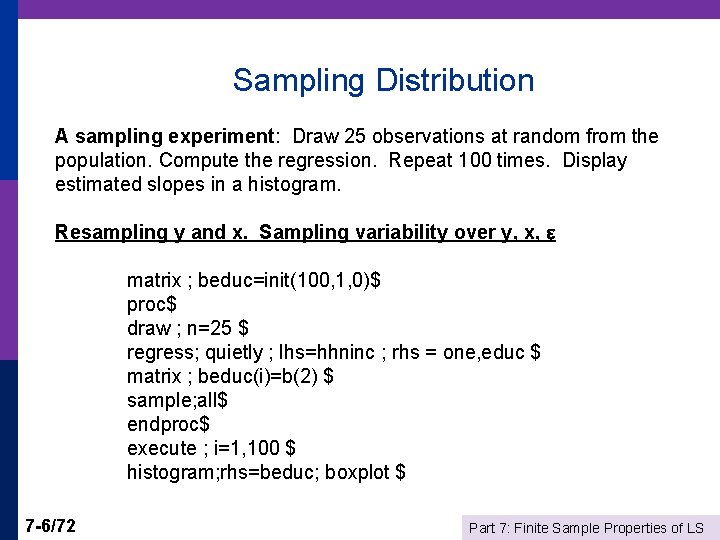
Sampling Distribution A sampling experiment: Draw 25 observations at random from the population. Compute the regression. Repeat 100 times. Display estimated slopes in a histogram. Resampling y and x. Sampling variability over y, x, matrix ; beduc=init(100, 1, 0)$ proc$ draw ; n=25 $ regress; quietly ; lhs=hhninc ; rhs = one, educ $ matrix ; beduc(i)=b(2) $ sample; all$ endproc$ execute ; i=1, 100 $ histogram; rhs=beduc; boxplot $ 7 -6/72 Part 7: Finite Sample Properties of LS
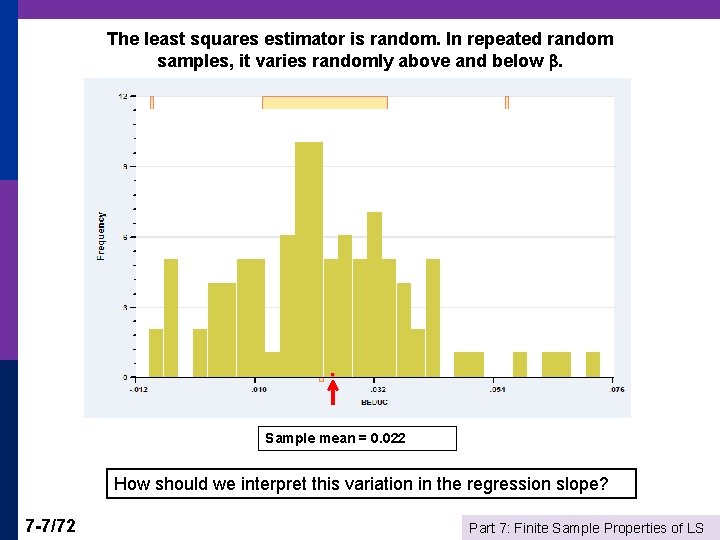
The least squares estimator is random. In repeated random samples, it varies randomly above and below . Sample mean = 0. 022 How should we interpret this variation in the regression slope? 7 -7/72 Part 7: Finite Sample Properties of LS
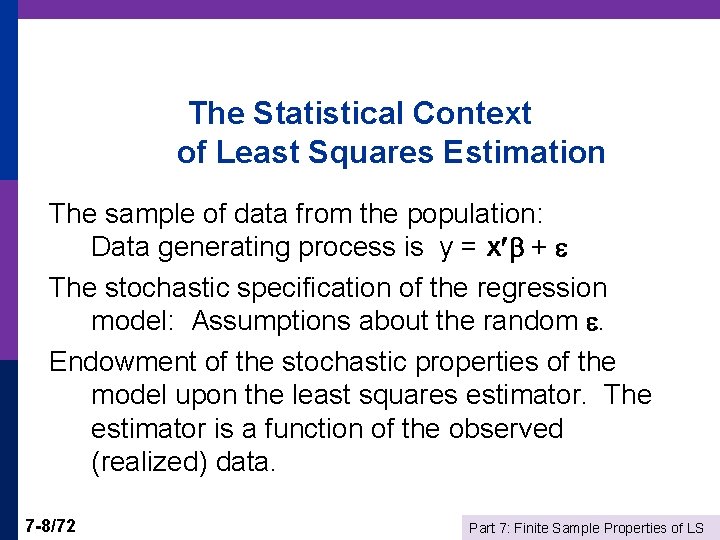
The Statistical Context of Least Squares Estimation The sample of data from the population: Data generating process is y = x + The stochastic specification of the regression model: Assumptions about the random . Endowment of the stochastic properties of the model upon the least squares estimator. The estimator is a function of the observed (realized) data. 7 -8/72 Part 7: Finite Sample Properties of LS
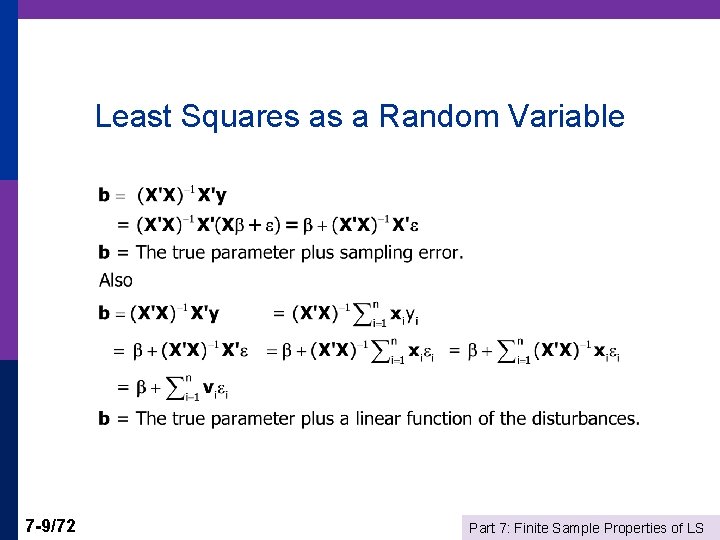
Least Squares as a Random Variable 7 -9/72 Part 7: Finite Sample Properties of LS
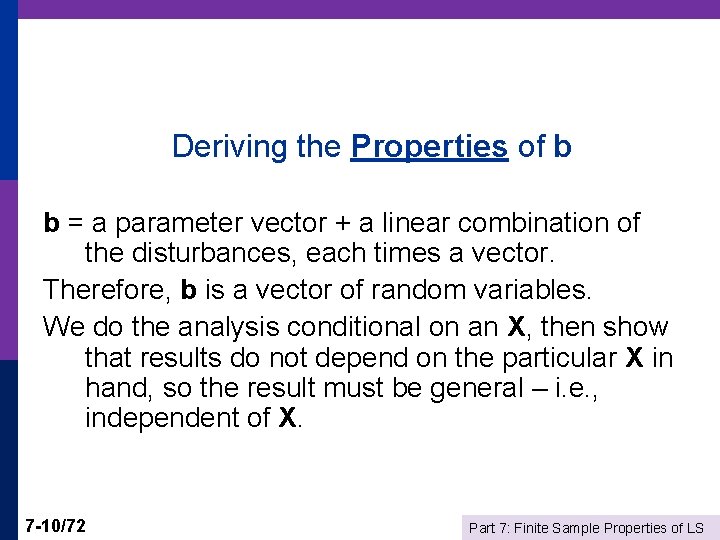
Deriving the Properties of b b = a parameter vector + a linear combination of the disturbances, each times a vector. Therefore, b is a vector of random variables. We do the analysis conditional on an X, then show that results do not depend on the particular X in hand, so the result must be general – i. e. , independent of X. 7 -10/72 Part 7: Finite Sample Properties of LS
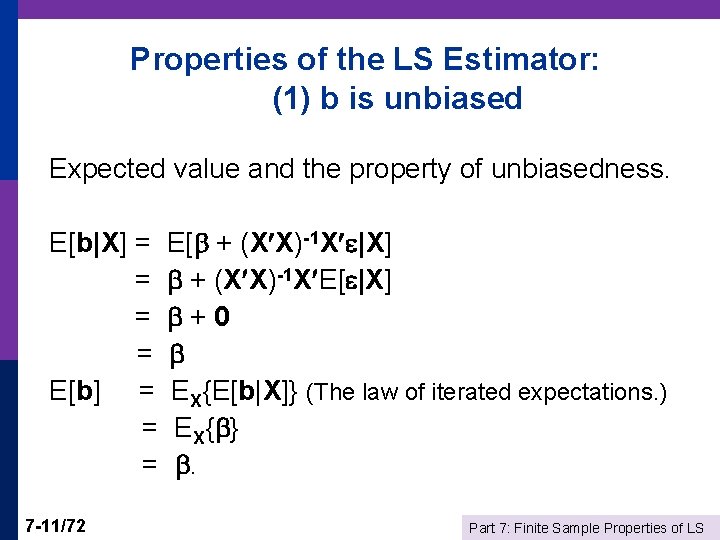
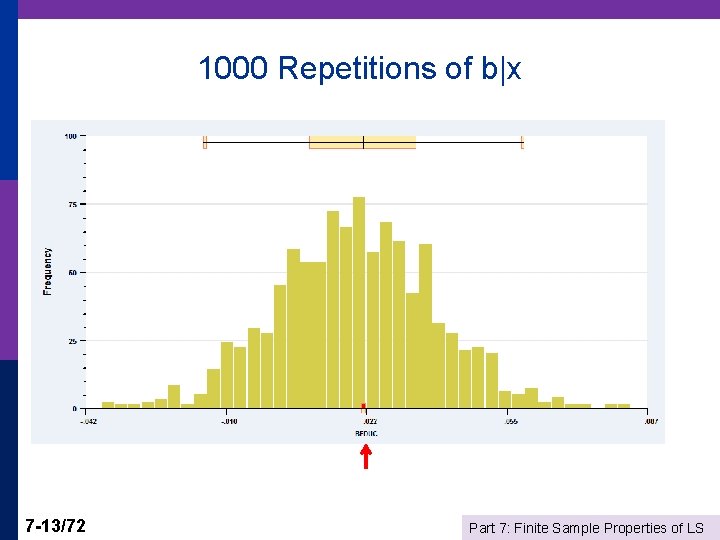
Properties of the LS Estimator: (1) b is unbiased Expected value and the property of unbiasedness. E[b|X] = E[ + (X X)-1 X |X] = + (X X)-1 X E[ |X] = + 0 = E[b] = EX{E[b|X]} (The law of iterated expectations. ) = EX{ } = . 7 -11/72 Part 7: Finite Sample Properties of LS
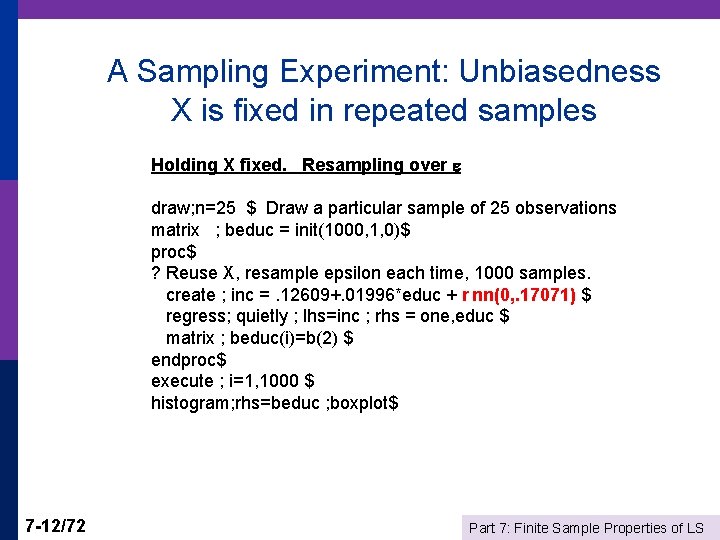
A Sampling Experiment: Unbiasedness X is fixed in repeated samples Holding X fixed. Resampling over draw; n=25 $ Draw a particular sample of 25 observations matrix ; beduc = init(1000, 1, 0)$ proc$ ? Reuse X, resample epsilon each time, 1000 samples. create ; inc =. 12609+. 01996*educ + r nn(0, . 17071) $ regress; quietly ; lhs=inc ; rhs = one, educ $ matrix ; beduc(i)=b(2) $ endproc$ execute ; i=1, 1000 $ histogram; rhs=beduc ; boxplot$ 7 -12/72 Part 7: Finite Sample Properties of LS
1000 Repetitions of b|x 7 -13/72 Part 7: Finite Sample Properties of LS
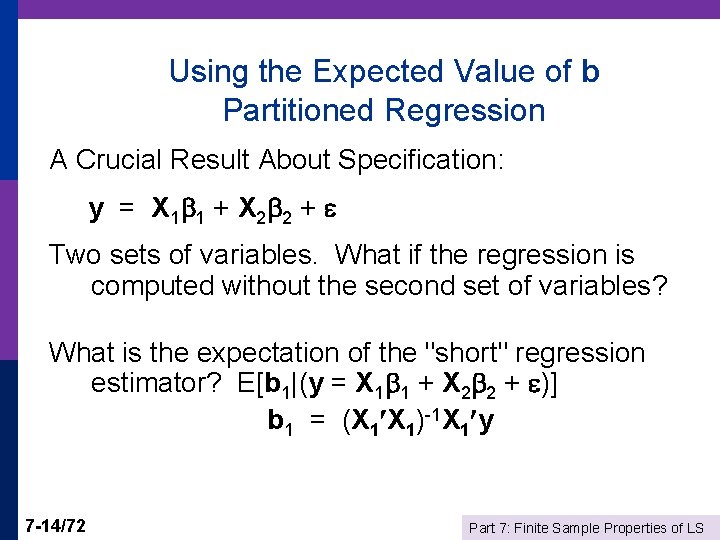
Using the Expected Value of b Partitioned Regression A Crucial Result About Specification: y = X 1 1 + X 2 2 + Two sets of variables. What if the regression is computed without the second set of variables? What is the expectation of the "short" regression estimator? E[b 1|(y = X 1 1 + X 2 2 + )] b 1 = (X 1 X 1)-1 X 1 y 7 -14/72 Part 7: Finite Sample Properties of LS
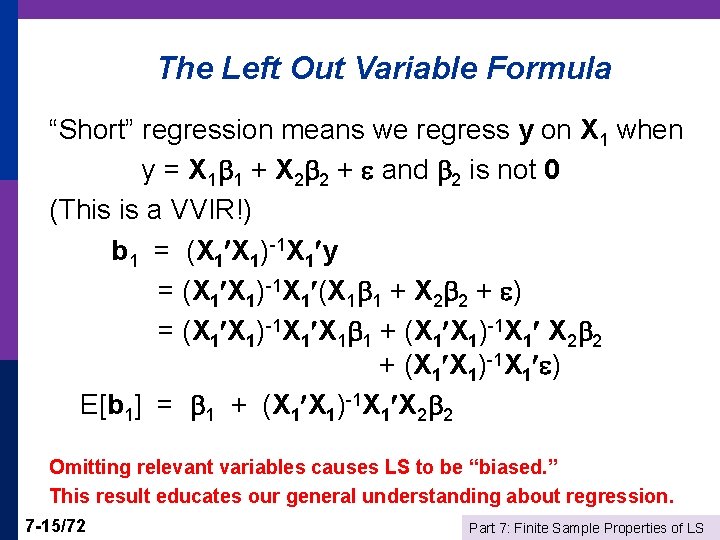
The Left Out Variable Formula “Short” regression means we regress y on X 1 when y = X 1 1 + X 2 2 + and 2 is not 0 (This is a VVIR!) b 1 = (X 1 X 1)-1 X 1 y = (X 1 X 1)-1 X 1 (X 1 1 + X 2 2 + ) = (X 1 X 1)-1 X 1 1 + (X 1 X 1)-1 X 1 X 2 2 + (X 1 X 1)-1 X 1 ) E[b 1] = 1 + (X 1 X 1)-1 X 1 X 2 2 Omitting relevant variables causes LS to be “biased. ” This result educates our general understanding about regression. 7 -15/72 Part 7: Finite Sample Properties of LS
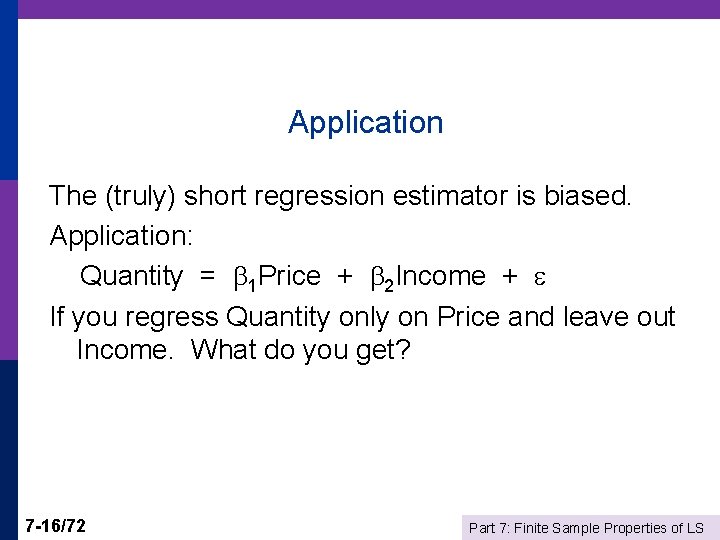
Application The (truly) short regression estimator is biased. Application: Quantity = 1 Price + 2 Income + If you regress Quantity only on Price and leave out Income. What do you get? 7 -16/72 Part 7: Finite Sample Properties of LS
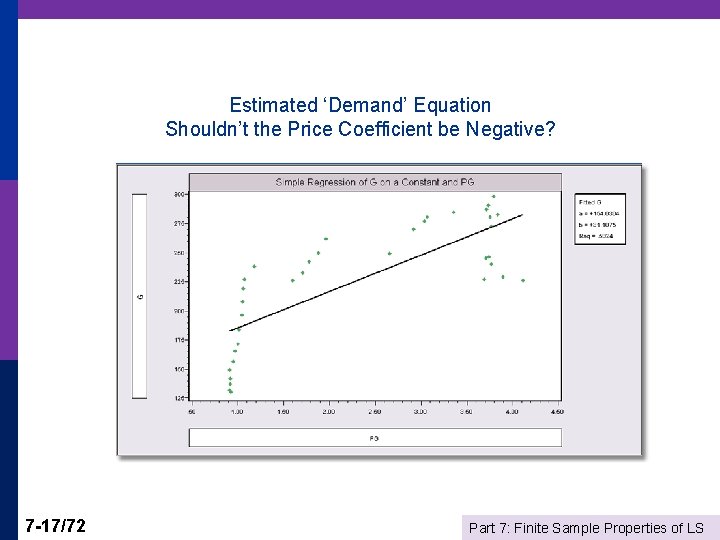
Estimated ‘Demand’ Equation Shouldn’t the Price Coefficient be Negative? 7 -17/72 Part 7: Finite Sample Properties of LS
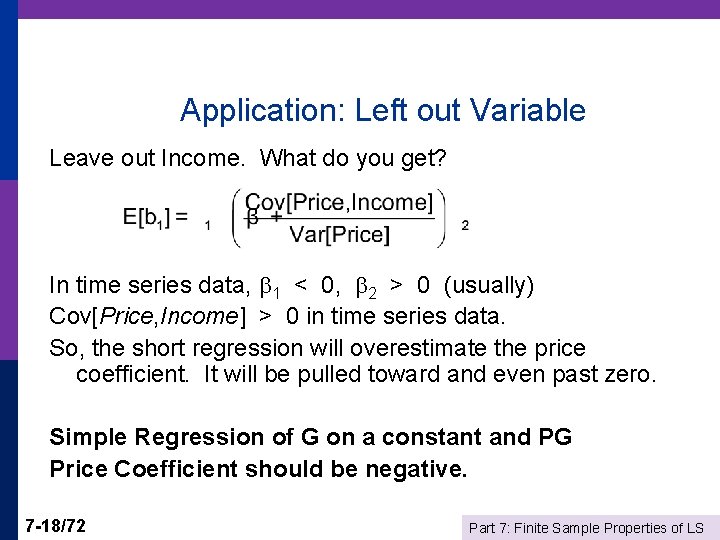
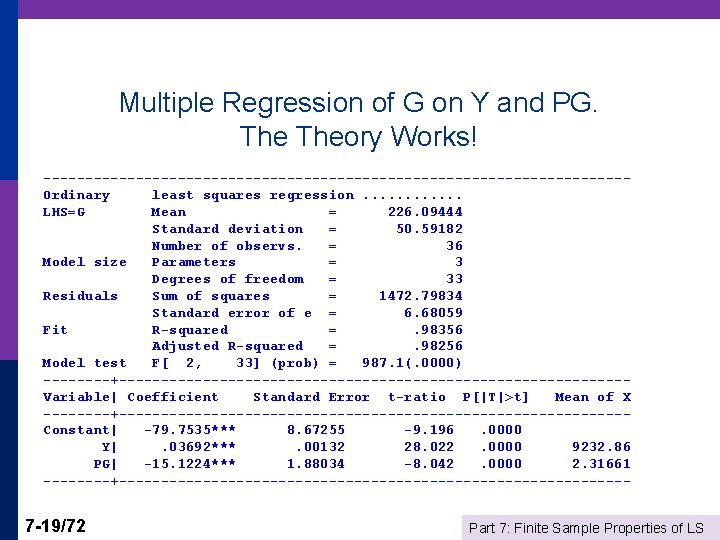
Application: Left out Variable Leave out Income. What do you get? In time series data, 1 < 0, 2 > 0 (usually) Cov[Price, Income] > 0 in time series data. So, the short regression will overestimate the price coefficient. It will be pulled toward and even past zero. Simple Regression of G on a constant and PG Price Coefficient should be negative. 7 -18/72 Part 7: Finite Sample Properties of LS
Multiple Regression of G on Y and PG. Theory Works! -----------------------------------Ordinary least squares regression. . . LHS=G Mean = 226. 09444 Standard deviation = 50. 59182 Number of observs. = 36 Model size Parameters = 3 Degrees of freedom = 33 Residuals Sum of squares = 1472. 79834 Standard error of e = 6. 68059 Fit R-squared =. 98356 Adjusted R-squared =. 98256 Model test F[ 2, 33] (prob) = 987. 1(. 0000) ----+------------------------------Variable| Coefficient Standard Error t-ratio P[|T|>t] Mean of X ----+------------------------------Constant| -79. 7535*** 8. 67255 -9. 196. 0000 Y|. 03692***. 00132 28. 022. 0000 9232. 86 PG| -15. 1224*** 1. 88034 -8. 042. 0000 2. 31661 ----+------------------------------- 7 -19/72 Part 7: Finite Sample Properties of LS
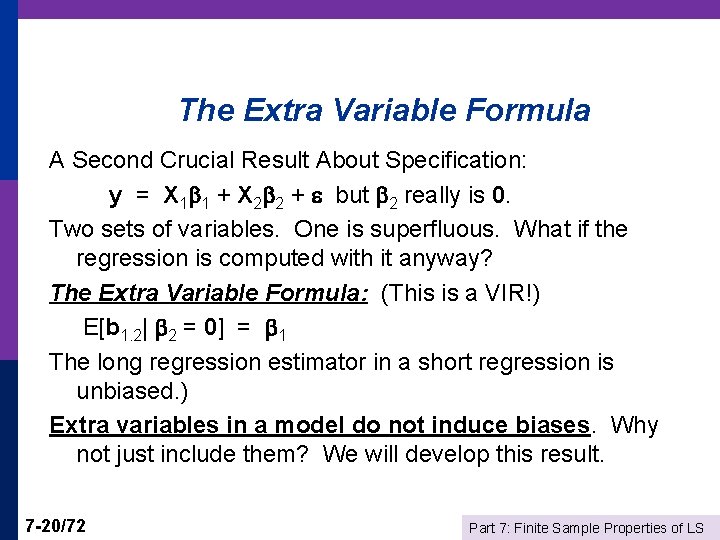
The Extra Variable Formula A Second Crucial Result About Specification: y = X 1 1 + X 2 2 + but 2 really is 0. Two sets of variables. One is superfluous. What if the regression is computed with it anyway? The Extra Variable Formula: (This is a VIR!) E[b 1. 2| 2 = 0] = 1 The long regression estimator in a short regression is unbiased. ) Extra variables in a model do not induce biases. Why not just include them? We will develop this result. 7 -20/72 Part 7: Finite Sample Properties of LS
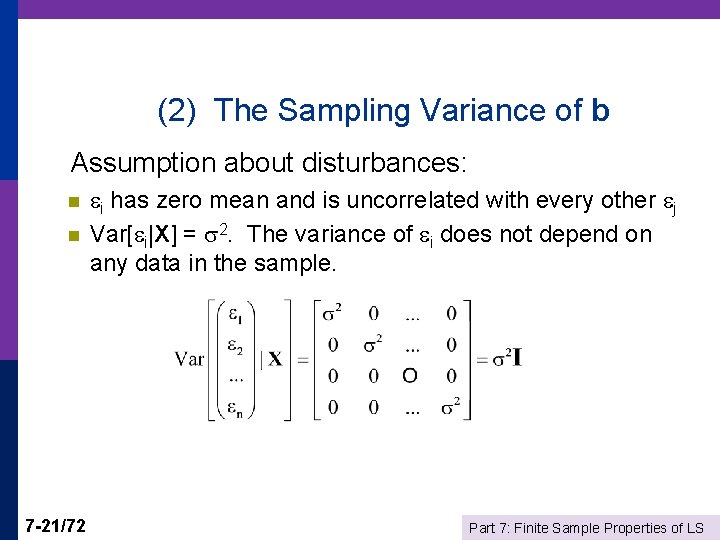
(2) The Sampling Variance of b Assumption about disturbances: n n 7 -21/72 i has zero mean and is uncorrelated with every other j Var[ i|X] = 2. The variance of i does not depend on any data in the sample. Part 7: Finite Sample Properties of LS
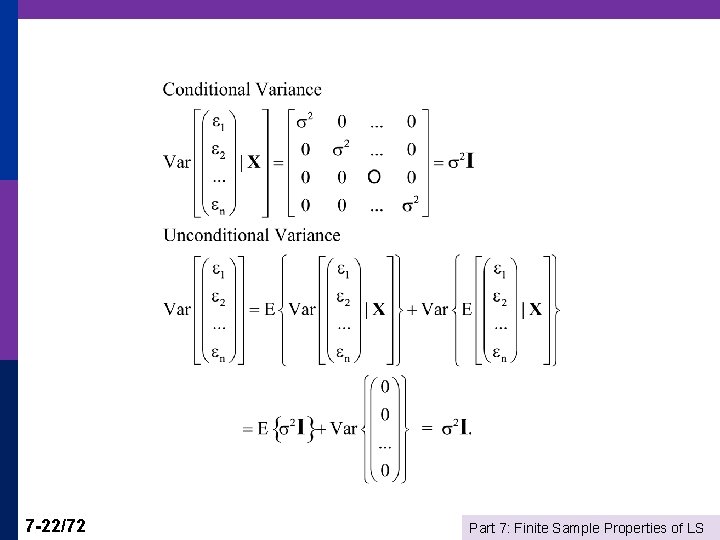
7 -22/72 Part 7: Finite Sample Properties of LS
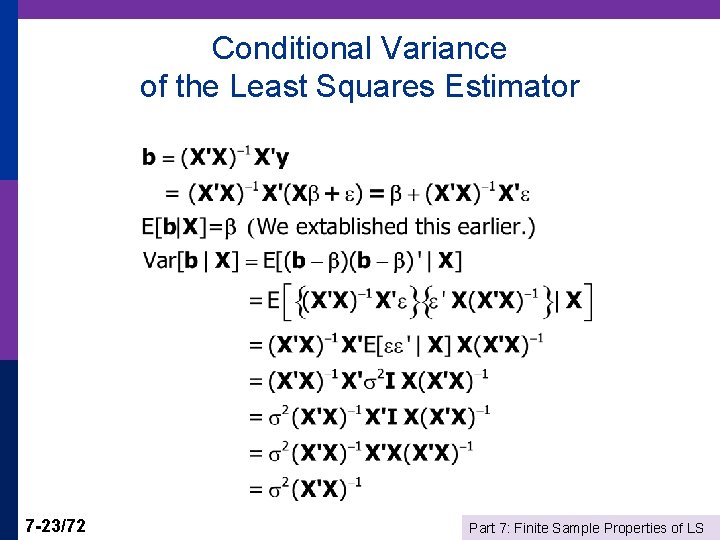
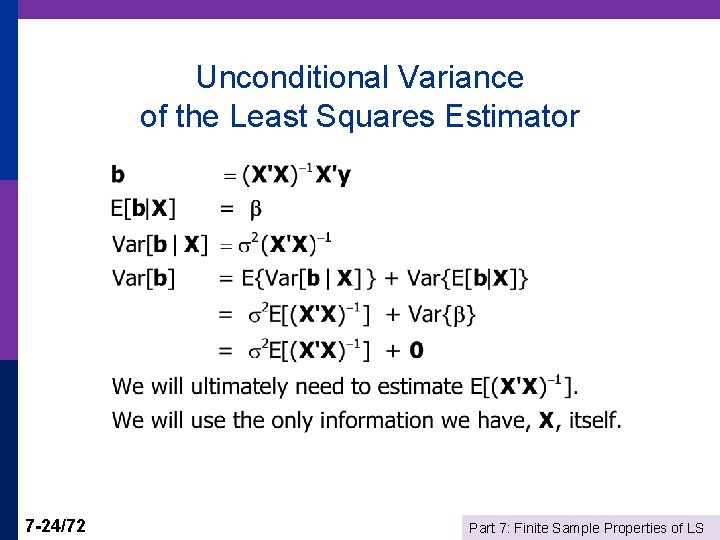
Conditional Variance of the Least Squares Estimator 7 -23/72 Part 7: Finite Sample Properties of LS
Unconditional Variance of the Least Squares Estimator 7 -24/72 Part 7: Finite Sample Properties of LS
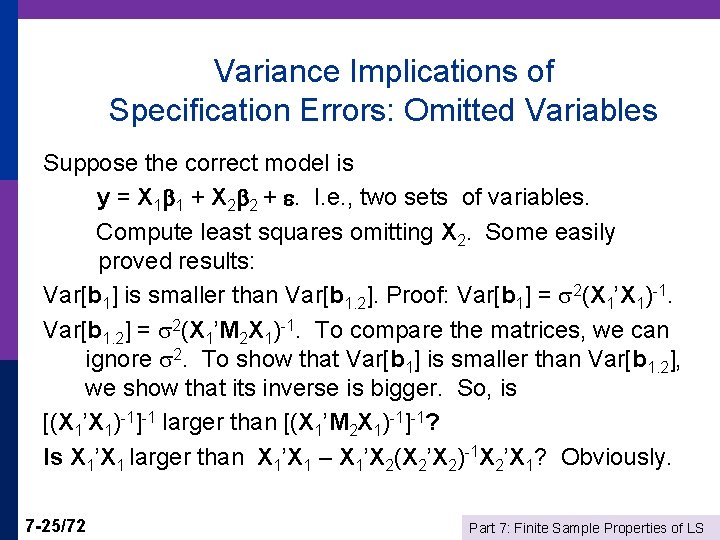
Variance Implications of Specification Errors: Omitted Variables Suppose the correct model is y = X 1 1 + X 2 2 + . I. e. , two sets of variables. Compute least squares omitting X 2. Some easily proved results: Var[b 1] is smaller than Var[b 1. 2]. Proof: Var[b 1] = 2(X 1’X 1)-1. Var[b 1. 2] = 2(X 1’M 2 X 1)-1. To compare the matrices, we can ignore 2. To show that Var[b 1] is smaller than Var[b 1. 2], we show that its inverse is bigger. So, is [(X 1’X 1)-1]-1 larger than [(X 1’M 2 X 1)-1]-1? Is X 1’X 1 larger than X 1’X 1 – X 1’X 2(X 2’X 2)-1 X 2’X 1? Obviously. 7 -25/72 Part 7: Finite Sample Properties of LS
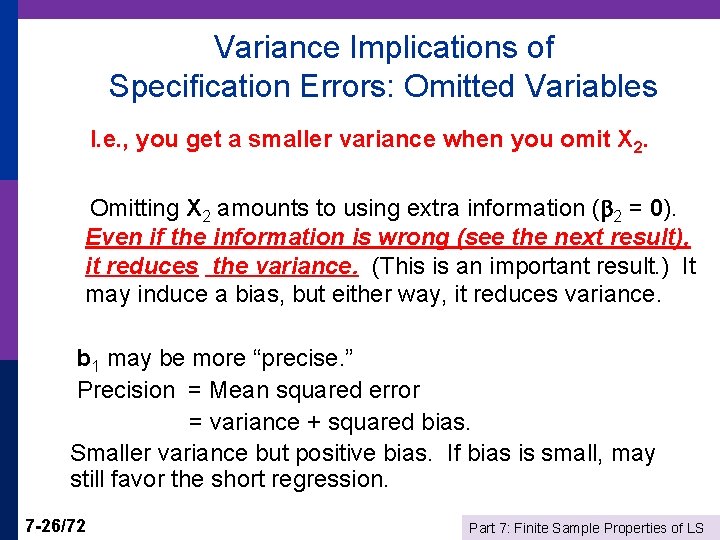
Variance Implications of Specification Errors: Omitted Variables I. e. , you get a smaller variance when you omit X 2. Omitting X 2 amounts to using extra information ( 2 = 0). Even if the information is wrong (see the next result), it reduces the variance. (This is an important result. ) It may induce a bias, but either way, it reduces variance. b 1 may be more “precise. ” Precision = Mean squared error = variance + squared bias. Smaller variance but positive bias. If bias is small, may still favor the short regression. 7 -26/72 Part 7: Finite Sample Properties of LS
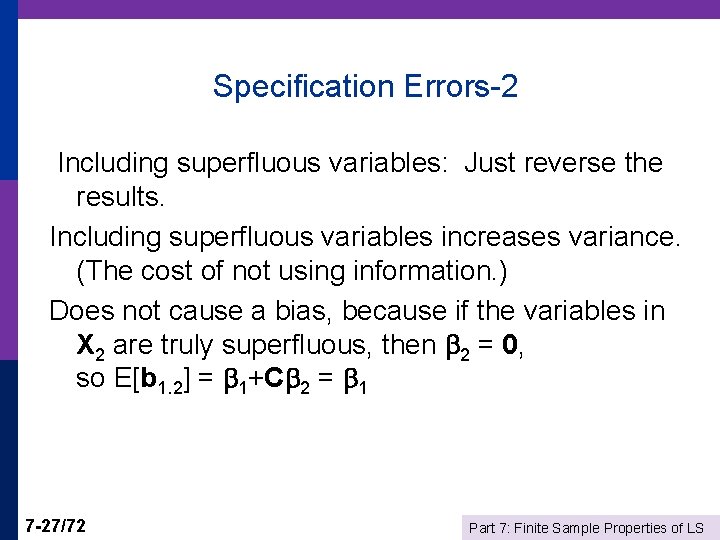
Specification Errors-2 Including superfluous variables: Just reverse the results. Including superfluous variables increases variance. (The cost of not using information. ) Does not cause a bias, because if the variables in X 2 are truly superfluous, then 2 = 0, so E[b 1. 2] = 1+C 2 = 1 7 -27/72 Part 7: Finite Sample Properties of LS
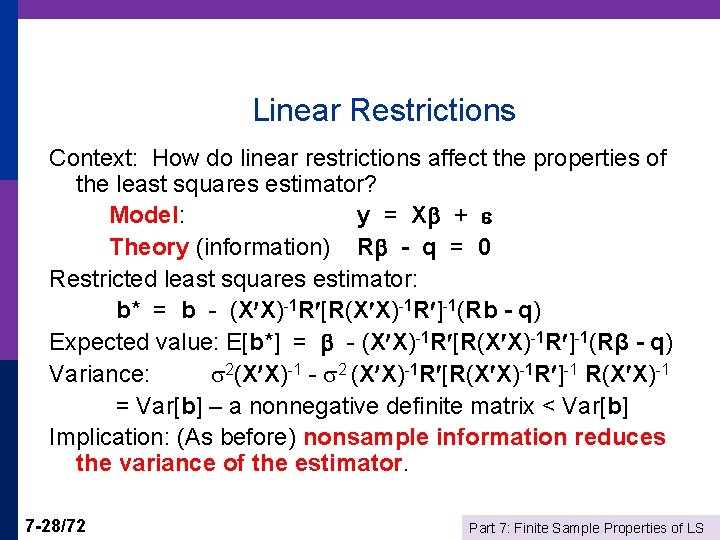
Linear Restrictions Context: How do linear restrictions affect the properties of the least squares estimator? Model: y = X + Theory (information) R - q = 0 Restricted least squares estimator: b* = b - (X X)-1 R [R(X X)-1 R ]-1(Rb - q) Expected value: E[b*] = - (X X)-1 R [R(X X)-1 R ]-1(Rβ - q) Variance: 2(X X)-1 - 2 (X X)-1 R [R(X X)-1 R ]-1 R(X X)-1 = Var[b] – a nonnegative definite matrix < Var[b] Implication: (As before) nonsample information reduces the variance of the estimator. 7 -28/72 Part 7: Finite Sample Properties of LS
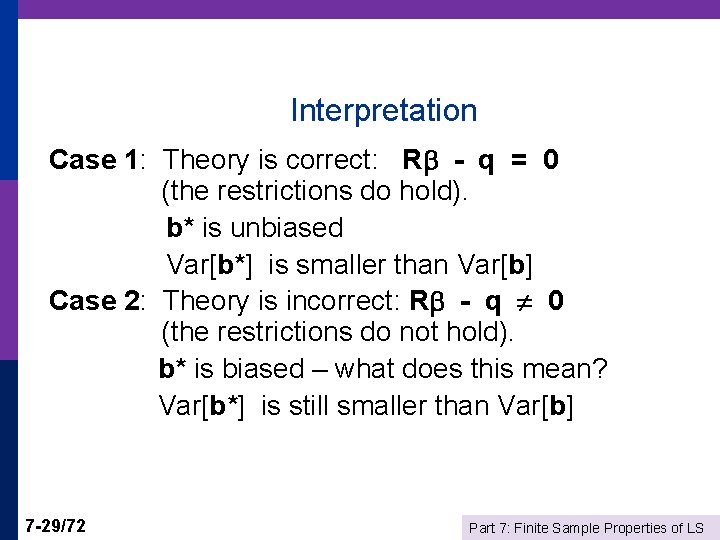
Interpretation Case 1: Theory is correct: R - q = 0 (the restrictions do hold). b* is unbiased Var[b*] is smaller than Var[b] Case 2: Theory is incorrect: R - q 0 (the restrictions do not hold). b* is biased – what does this mean? Var[b*] is still smaller than Var[b] 7 -29/72 Part 7: Finite Sample Properties of LS
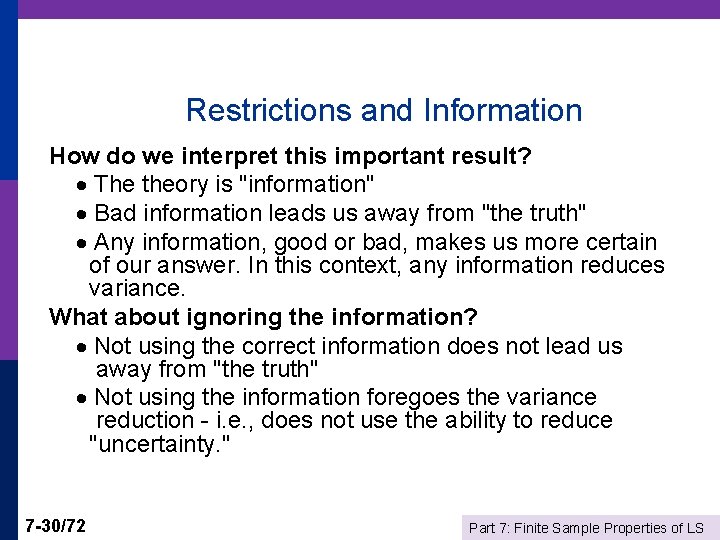
Restrictions and Information How do we interpret this important result? The theory is "information" Bad information leads us away from "the truth" Any information, good or bad, makes us more certain of our answer. In this context, any information reduces variance. What about ignoring the information? Not using the correct information does not lead us away from "the truth" Not using the information foregoes the variance reduction - i. e. , does not use the ability to reduce "uncertainty. " 7 -30/72 Part 7: Finite Sample Properties of LS
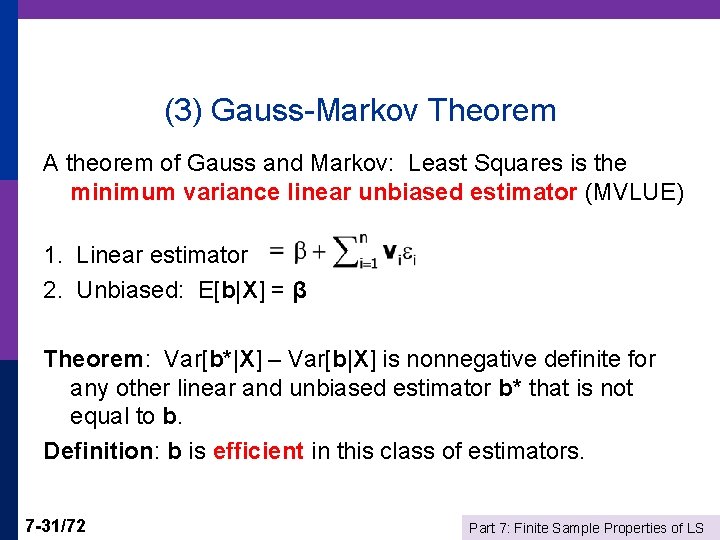
(3) Gauss-Markov Theorem A theorem of Gauss and Markov: Least Squares is the minimum variance linear unbiased estimator (MVLUE) 1. Linear estimator 2. Unbiased: E[b|X] = β Theorem: Var[b*|X] – Var[b|X] is nonnegative definite for any other linear and unbiased estimator b* that is not equal to b. Definition: b is efficient in this class of estimators. 7 -31/72 Part 7: Finite Sample Properties of LS
Implications of Gauss-Markov Theorem: Var[b*|X] – Var[b|X] is nonnegative definite for any other linear and unbiased estimator b* that is not equal to b. Implies: p bk = the kth particular element of b. Var[bk|X] = the kth diagonal element of Var[b|X] Var[bk|X] < Var[bk*|X] for each coefficient. p c b = any linear combination of the elements of b. Var[c b|X] < Var[c b*|X] for any nonzero c and b* that is not equal to b. p 7 -32/72 Part 7: Finite Sample Properties of LS
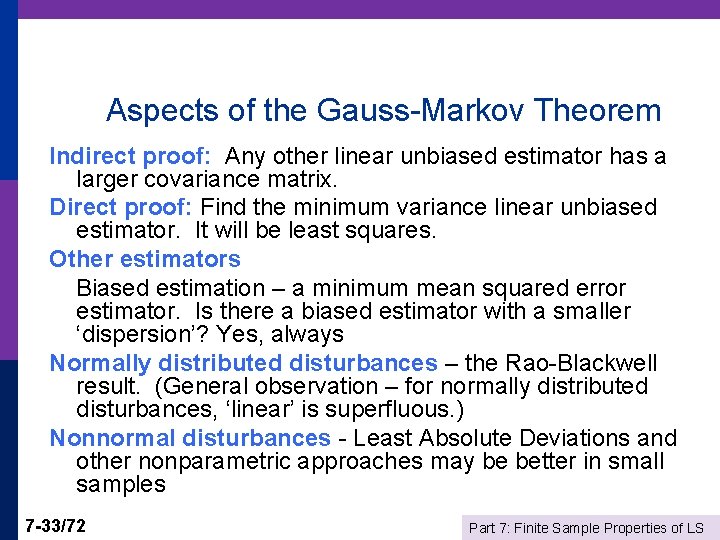
Aspects of the Gauss-Markov Theorem Indirect proof: Any other linear unbiased estimator has a larger covariance matrix. Direct proof: Find the minimum variance linear unbiased estimator. It will be least squares. Other estimators Biased estimation – a minimum mean squared error estimator. Is there a biased estimator with a smaller ‘dispersion’? Yes, always Normally distributed disturbances – the Rao-Blackwell result. (General observation – for normally distributed disturbances, ‘linear’ is superfluous. ) Nonnormal disturbances - Least Absolute Deviations and other nonparametric approaches may be better in small samples 7 -33/72 Part 7: Finite Sample Properties of LS
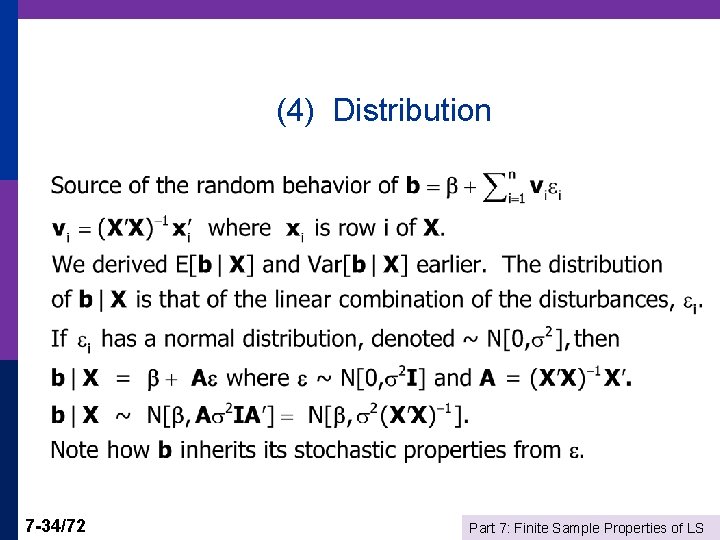
(4) Distribution 7 -34/72 Part 7: Finite Sample Properties of LS
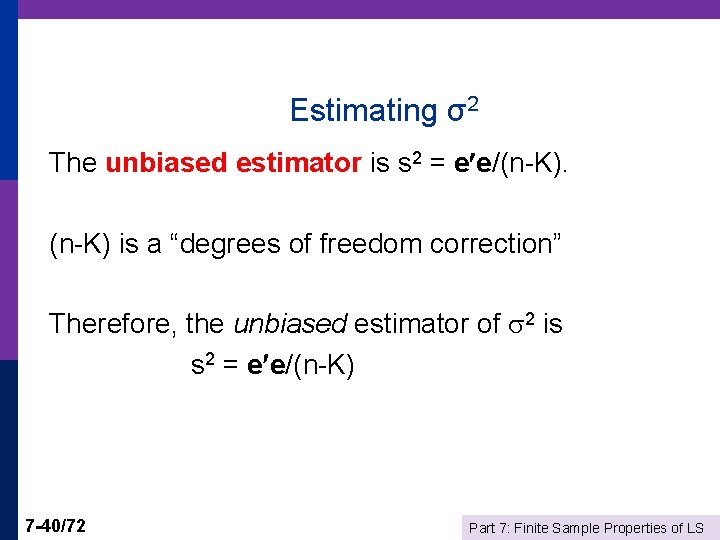
Summary: Finite Sample Properties of b (1) Unbiased: E[b]= (2) Variance: Var[b|X] = 2(X X)-1 (3) Efficiency: Gauss-Markov Theorem with all implications (4) Distribution: Under normality, b|X ~ Normal[ , 2(X X)-1 ] (Without normality, the distribution is generally unknown. ) 7 -35/72 Part 7: Finite Sample Properties of LS
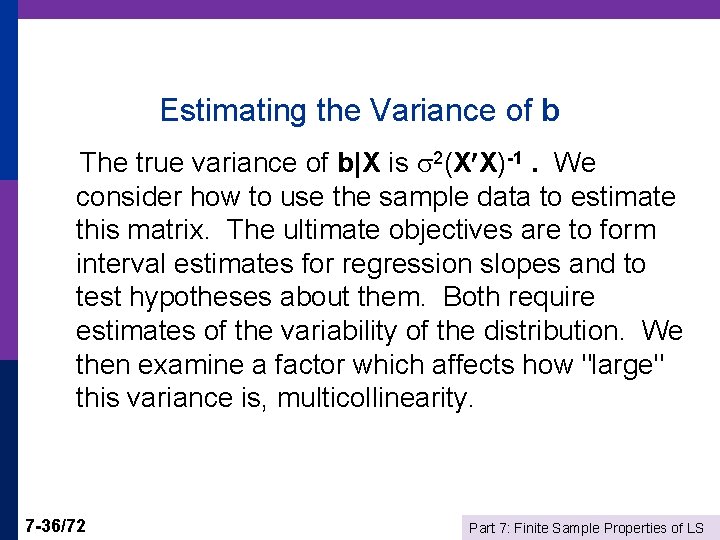
Estimating the Variance of b The true variance of b|X is 2(X X)-1. We consider how to use the sample data to estimate this matrix. The ultimate objectives are to form interval estimates for regression slopes and to test hypotheses about them. Both require estimates of the variability of the distribution. We then examine a factor which affects how "large" this variance is, multicollinearity. 7 -36/72 Part 7: Finite Sample Properties of LS
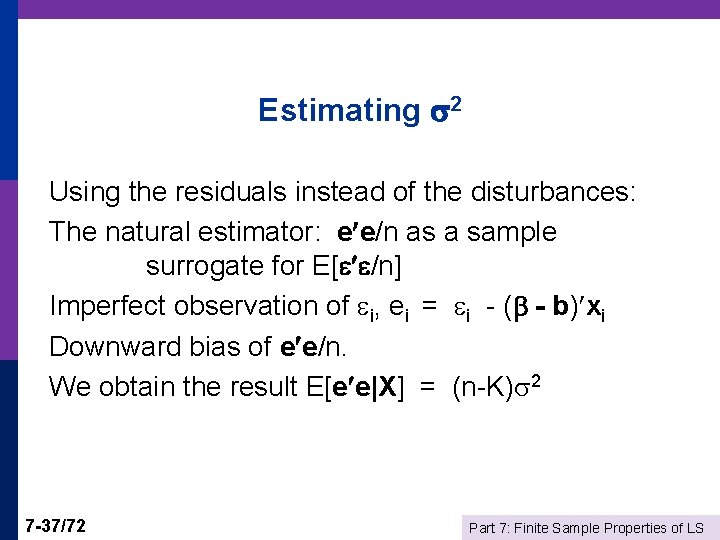
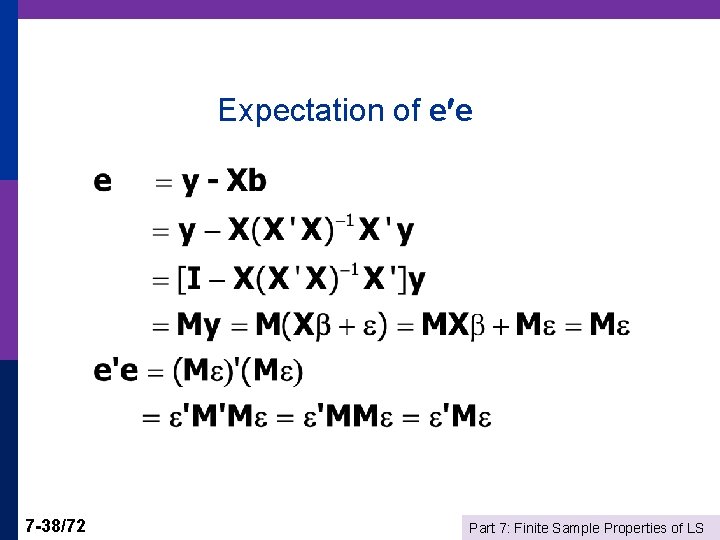
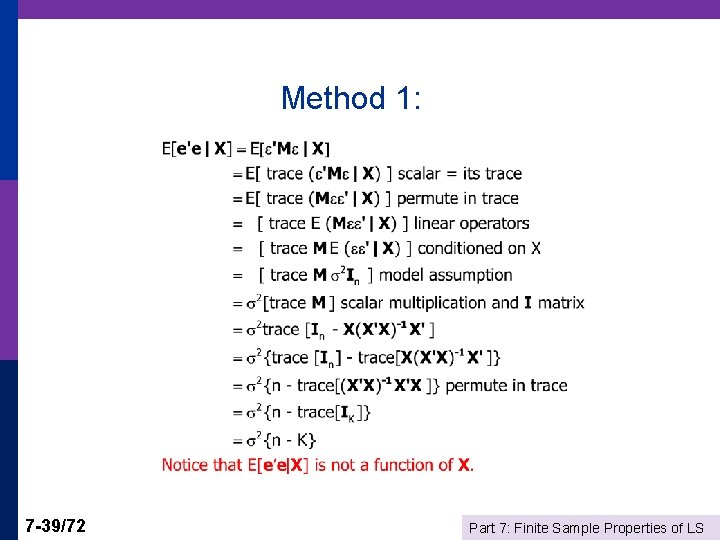
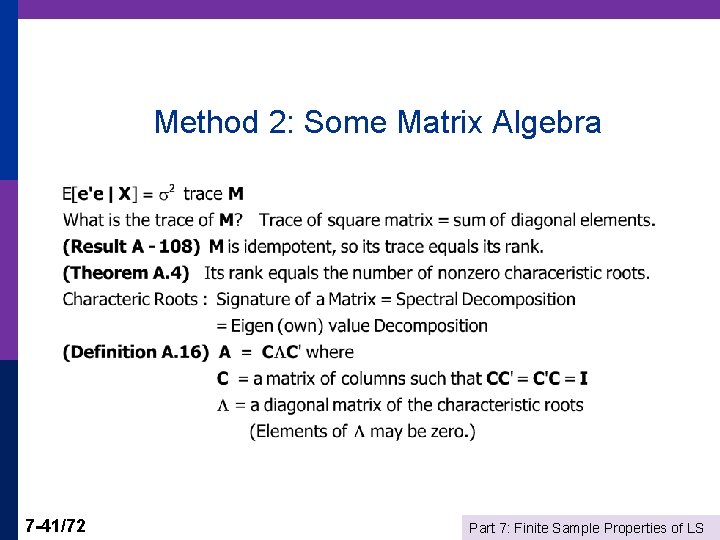
Estimating 2 Using the residuals instead of the disturbances: The natural estimator: e e/n as a sample surrogate for E[ /n] Imperfect observation of i, ei = i - ( - b) xi Downward bias of e e/n. We obtain the result E[e e|X] = (n-K) 2 7 -37/72 Part 7: Finite Sample Properties of LS
Expectation of e e 7 -38/72 Part 7: Finite Sample Properties of LS
Method 1: 7 -39/72 Part 7: Finite Sample Properties of LS
Estimating σ2 The unbiased estimator is s 2 = e e/(n-K). (n-K) is a “degrees of freedom correction” Therefore, the unbiased estimator of 2 is s 2 = e e/(n-K) 7 -40/72 Part 7: Finite Sample Properties of LS
Method 2: Some Matrix Algebra 7 -41/72 Part 7: Finite Sample Properties of LS
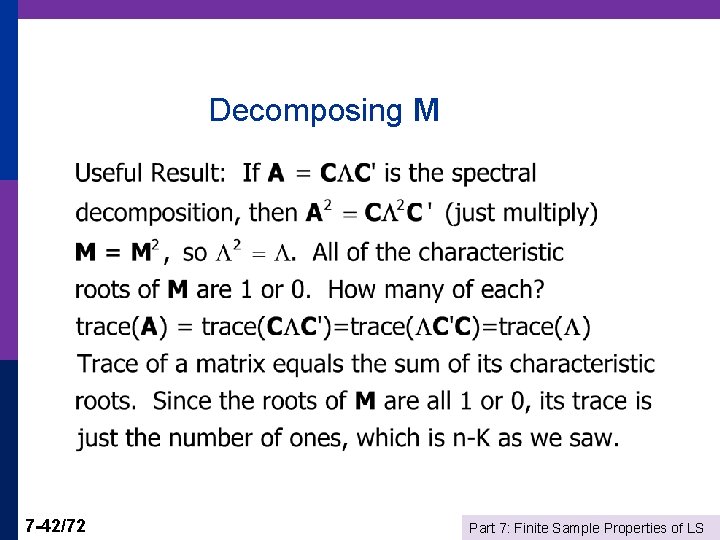
Decomposing M 7 -42/72 Part 7: Finite Sample Properties of LS
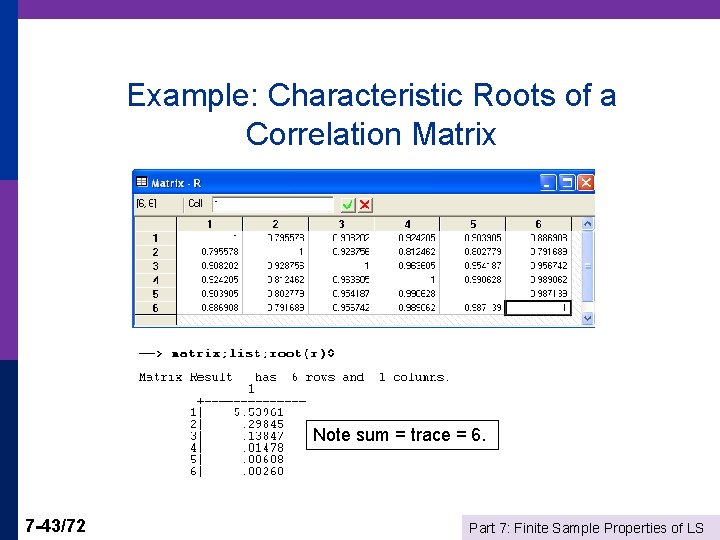
Example: Characteristic Roots of a Correlation Matrix Note sum = trace = 6. 7 -43/72 Part 7: Finite Sample Properties of LS
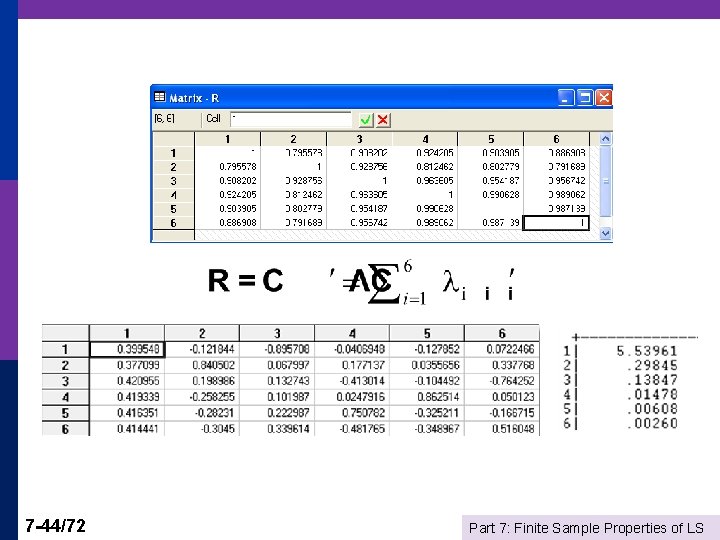
7 -44/72 Part 7: Finite Sample Properties of LS
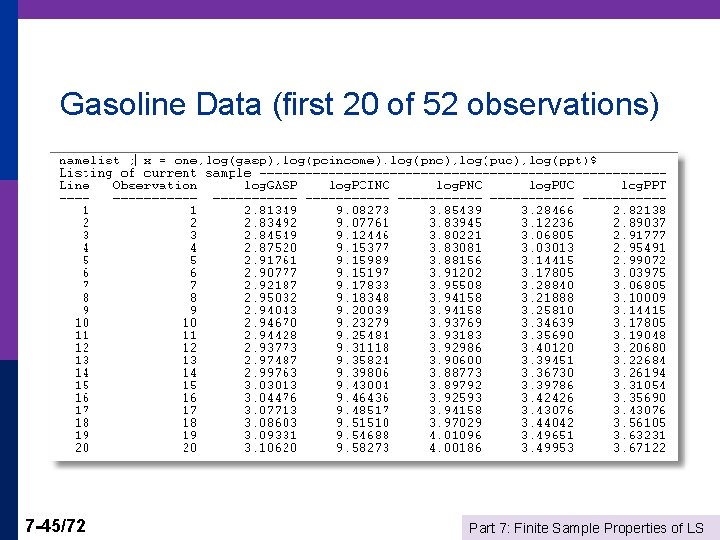
Gasoline Data (first 20 of 52 observations) 7 -45/72 Part 7: Finite Sample Properties of LS
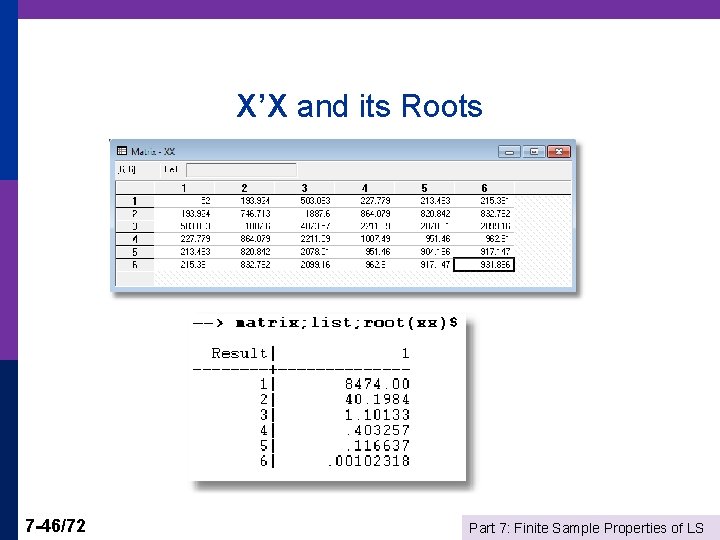
X’X and its Roots 7 -46/72 Part 7: Finite Sample Properties of LS
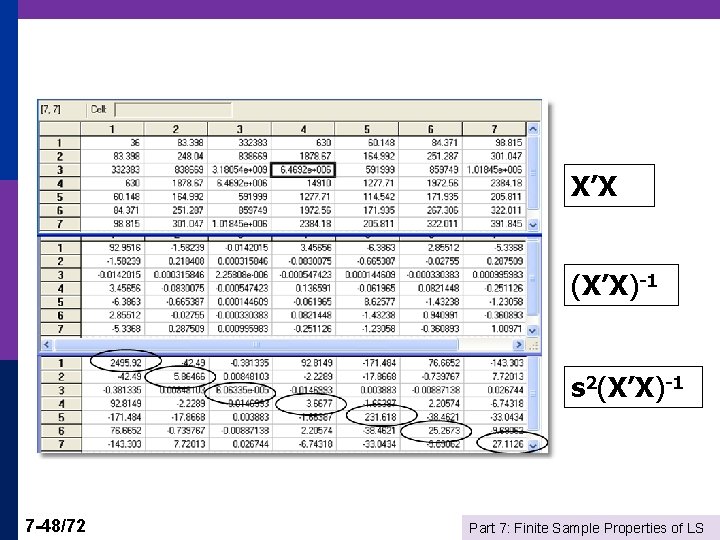
Var[b|X] Estimating the Covariance Matrix for b|X The true covariance matrix is 2 (X’X)-1 The natural estimator is s 2(X’X)-1 “Standard errors” of the individual coefficients are the square roots of the diagonal elements. 7 -47/72 Part 7: Finite Sample Properties of LS
X’X (X’X)-1 s 2(X’X)-1 7 -48/72 Part 7: Finite Sample Properties of LS
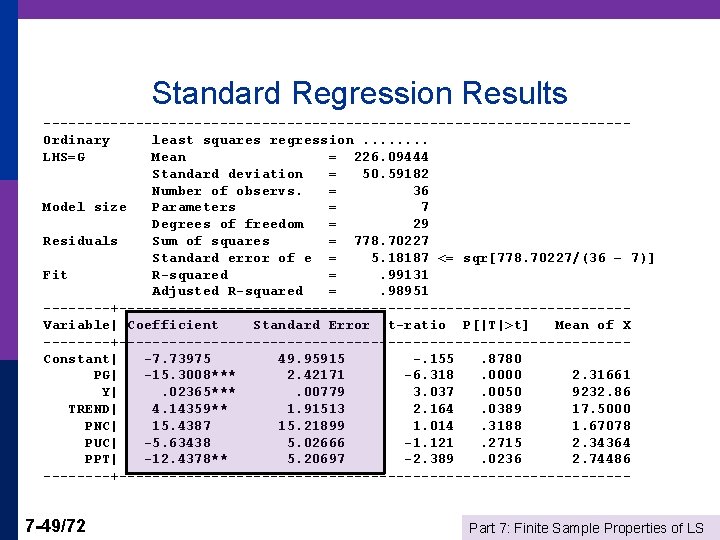
Standard Regression Results -----------------------------------Ordinary least squares regression. . . . LHS=G Mean = 226. 09444 Standard deviation = 50. 59182 Number of observs. = 36 Model size Parameters = 7 Degrees of freedom = 29 Residuals Sum of squares = 778. 70227 Standard error of e = 5. 18187 <= sqr[778. 70227/(36 – 7)] Fit R-squared =. 99131 Adjusted R-squared =. 98951 ----+------------------------------Variable| Coefficient Standard Error t-ratio P[|T|>t] Mean of X ----+------------------------------Constant| -7. 73975 49. 95915 -. 155. 8780 PG| -15. 3008*** 2. 42171 -6. 318. 0000 2. 31661 Y|. 02365***. 00779 3. 037. 0050 9232. 86 TREND| 4. 14359** 1. 91513 2. 164. 0389 17. 5000 PNC| 15. 4387 15. 21899 1. 014. 3188 1. 67078 PUC| -5. 63438 5. 02666 -1. 121. 2715 2. 34364 PPT| -12. 4378** 5. 20697 -2. 389. 0236 2. 74486 ----+------------------------------- 7 -49/72 Part 7: Finite Sample Properties of LS
Multicollinearity 7 -50/72 Part 7: Finite Sample Properties of LS
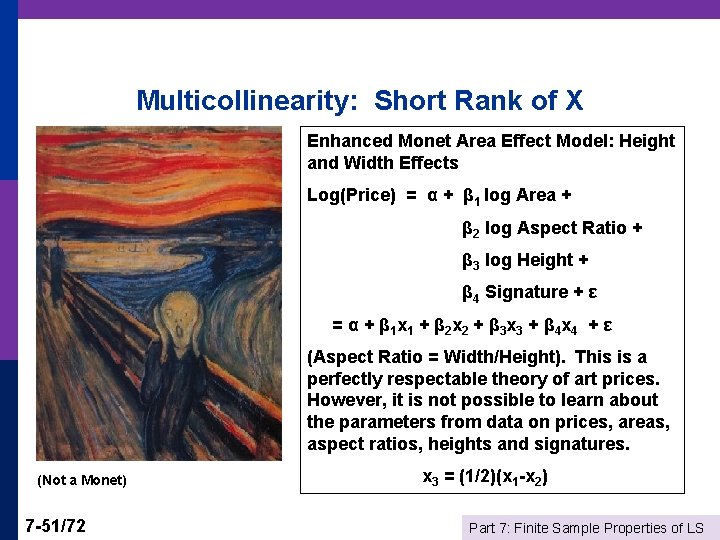
Multicollinearity: Short Rank of X Enhanced Monet Area Effect Model: Height and Width Effects Log(Price) = α + β 1 log Area + β 2 log Aspect Ratio + β 3 log Height + β 4 Signature + ε = α + β 1 x 1 + β 2 x 2 + β 3 x 3 + β 4 x 4 + ε (Aspect Ratio = Width/Height). This is a perfectly respectable theory of art prices. However, it is not possible to learn about the parameters from data on prices, areas, aspect ratios, heights and signatures. (Not a Monet) 7 -51/72 x 3 = (1/2)(x 1 -x 2) Part 7: Finite Sample Properties of LS
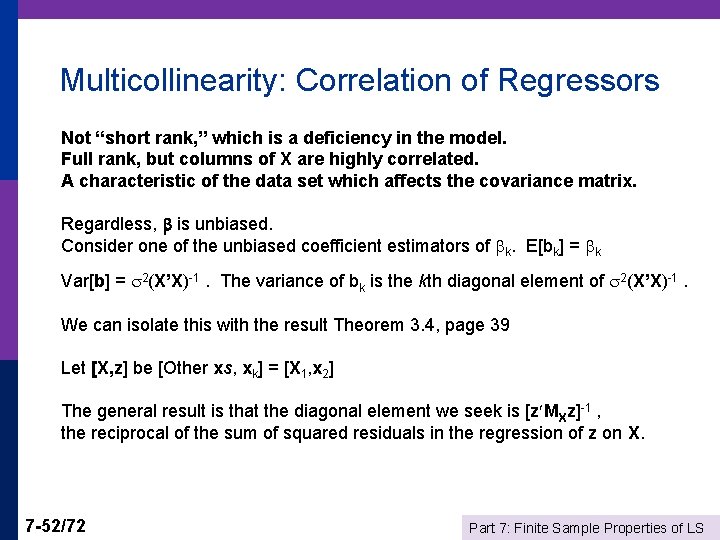
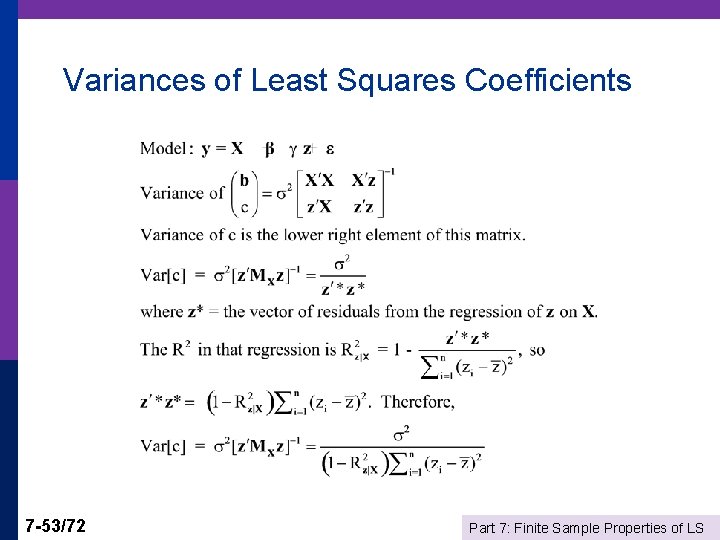
Multicollinearity: Correlation of Regressors Not “short rank, ” which is a deficiency in the model. Full rank, but columns of X are highly correlated. A characteristic of the data set which affects the covariance matrix. Regardless, is unbiased. Consider one of the unbiased coefficient estimators of k. E[bk] = k Var[b] = 2(X’X)-1. The variance of bk is the kth diagonal element of 2(X’X)-1. We can isolate this with the result Theorem 3. 4, page 39 Let [X, z] be [Other xs, xk] = [X 1, x 2] The general result is that the diagonal element we seek is [z MXz]-1 , the reciprocal of the sum of squared residuals in the regression of z on X. 7 -52/72 Part 7: Finite Sample Properties of LS
Variances of Least Squares Coefficients 7 -53/72 Part 7: Finite Sample Properties of LS
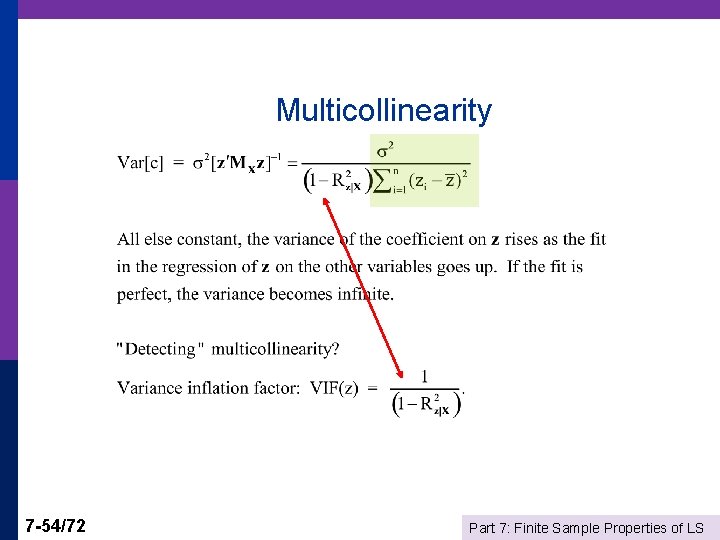
Multicollinearity 7 -54/72 Part 7: Finite Sample Properties of LS
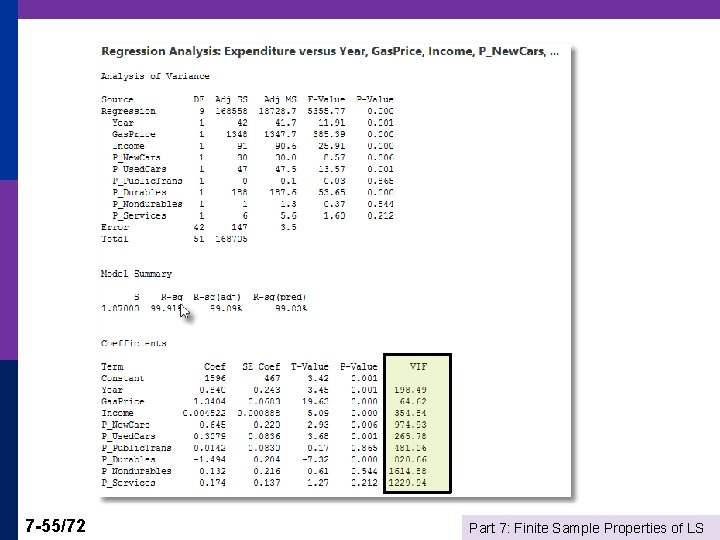
7 -55/72 Part 7: Finite Sample Properties of LS
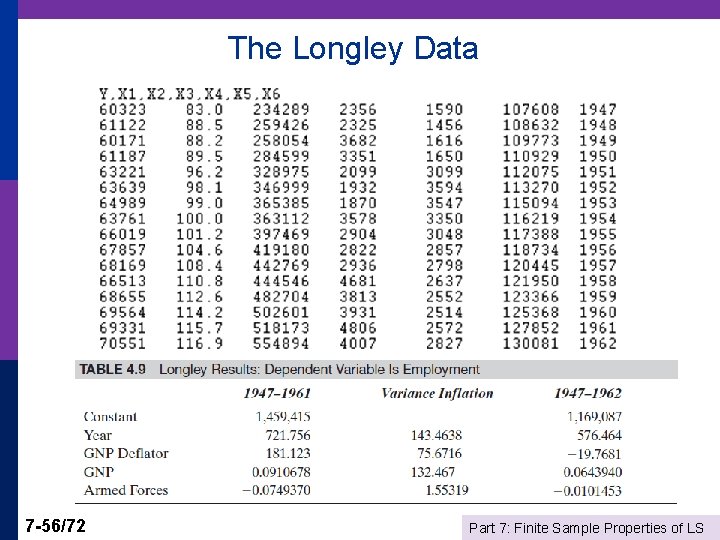
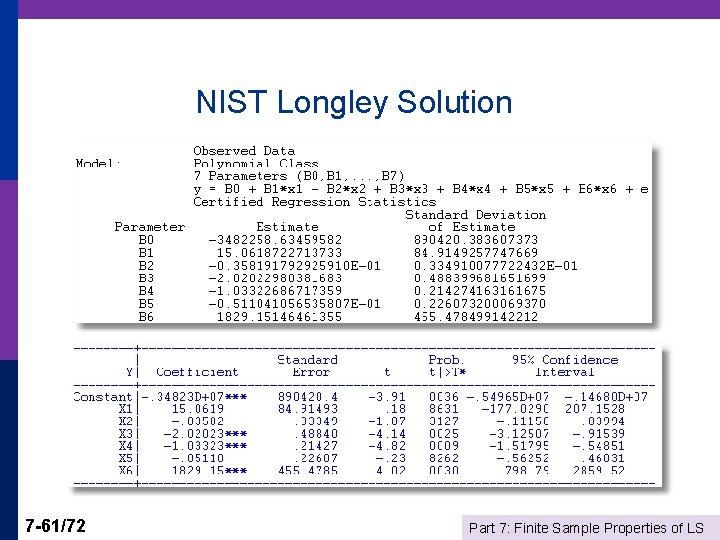
The Longley Data 7 -56/72 Part 7: Finite Sample Properties of LS
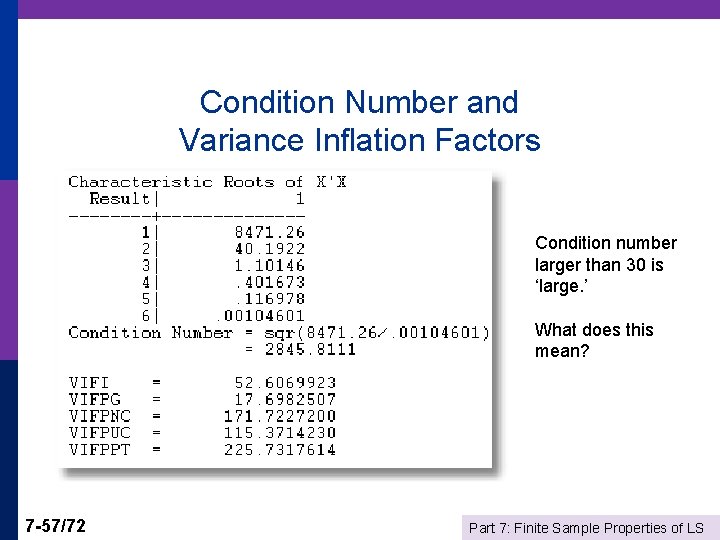
Condition Number and Variance Inflation Factors Condition number larger than 30 is ‘large. ’ What does this mean? 7 -57/72 Part 7: Finite Sample Properties of LS
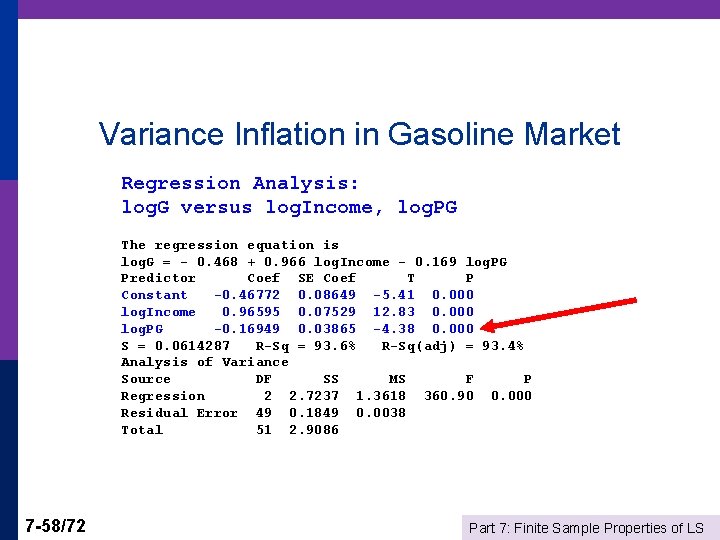
Variance Inflation in Gasoline Market Regression Analysis: log. G versus log. Income, log. PG The regression equation is log. G = - 0. 468 + 0. 966 log. Income - 0. 169 log. PG Predictor Coef SE Coef T P Constant -0. 46772 0. 08649 -5. 41 0. 000 log. Income 0. 96595 0. 07529 12. 83 0. 000 log. PG -0. 16949 0. 03865 -4. 38 0. 000 S = 0. 0614287 R-Sq = 93. 6% R-Sq(adj) = 93. 4% Analysis of Variance Source DF SS MS F P Regression 2 2. 7237 1. 3618 360. 90 0. 000 Residual Error 49 0. 1849 0. 0038 Total 51 2. 9086 7 -58/72 Part 7: Finite Sample Properties of LS
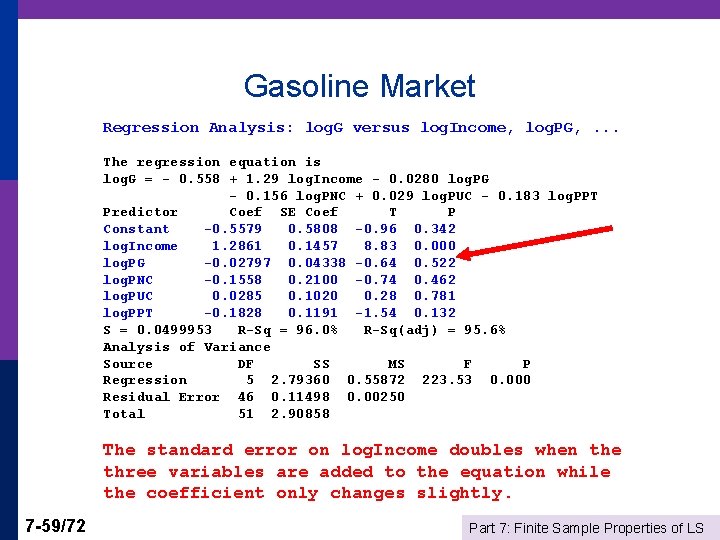
Gasoline Market Regression Analysis: log. G versus log. Income, log. PG, . . . The regression equation is log. G = - 0. 558 + 1. 29 log. Income - 0. 0280 log. PG - 0. 156 log. PNC + 0. 029 log. PUC - 0. 183 log. PPT Predictor Coef SE Coef T P Constant -0. 5579 0. 5808 -0. 96 0. 342 log. Income 1. 2861 0. 1457 8. 83 0. 000 log. PG -0. 02797 0. 04338 -0. 64 0. 522 log. PNC -0. 1558 0. 2100 -0. 74 0. 462 log. PUC 0. 0285 0. 1020 0. 28 0. 781 log. PPT -0. 1828 0. 1191 -1. 54 0. 132 S = 0. 0499953 R-Sq = 96. 0% R-Sq(adj) = 95. 6% Analysis of Variance Source DF SS MS F P Regression 5 2. 79360 0. 55872 223. 53 0. 000 Residual Error 46 0. 11498 0. 00250 Total 51 2. 90858 The standard error on log. Income doubles when the three variables are added to the equation while the coefficient only changes slightly. 7 -59/72 Part 7: Finite Sample Properties of LS
7 -60/72 Part 7: Finite Sample Properties of LS
NIST Longley Solution 7 -61/72 Part 7: Finite Sample Properties of LS
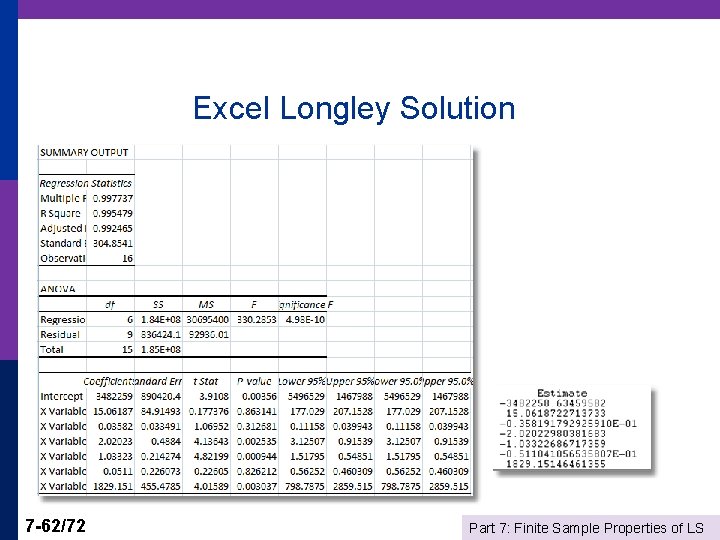
Excel Longley Solution 7 -62/72 Part 7: Finite Sample Properties of LS
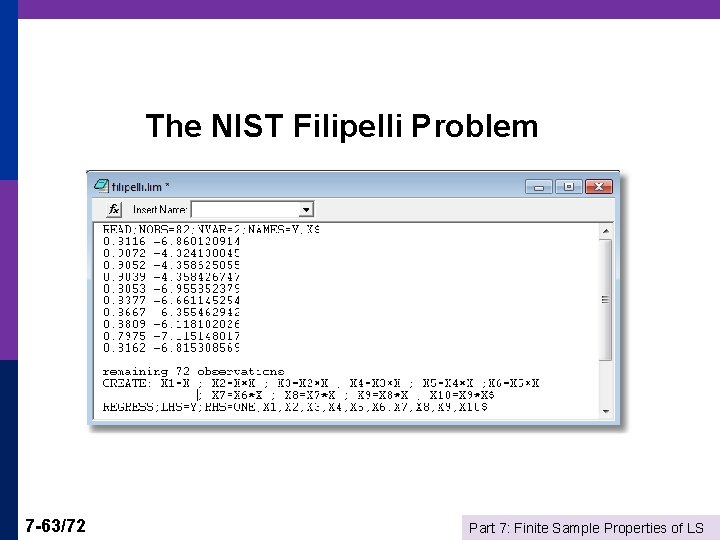
The NIST Filipelli Problem 7 -63/72 Part 7: Finite Sample Properties of LS
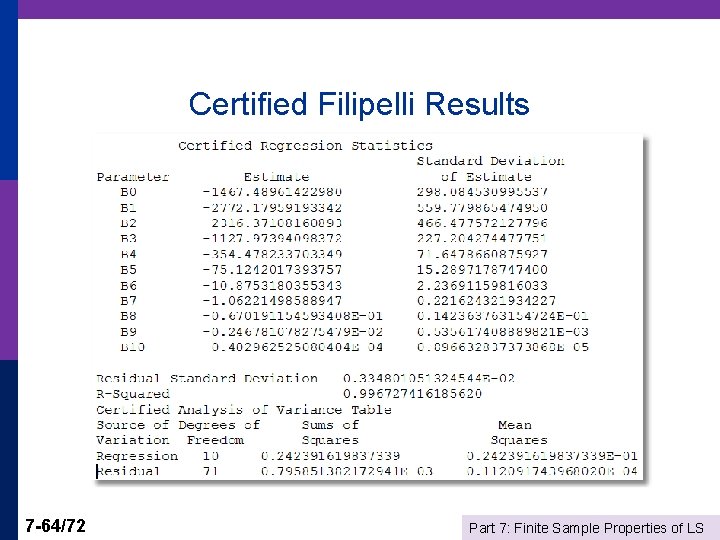
Certified Filipelli Results 7 -64/72 Part 7: Finite Sample Properties of LS
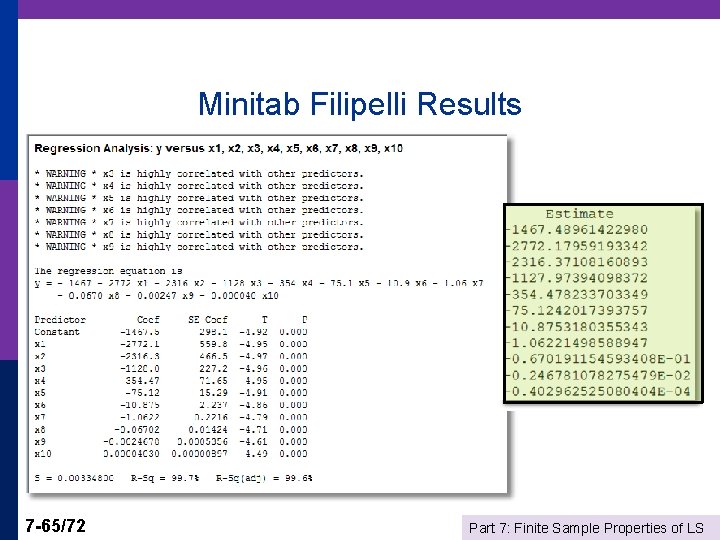
Minitab Filipelli Results 7 -65/72 Part 7: Finite Sample Properties of LS
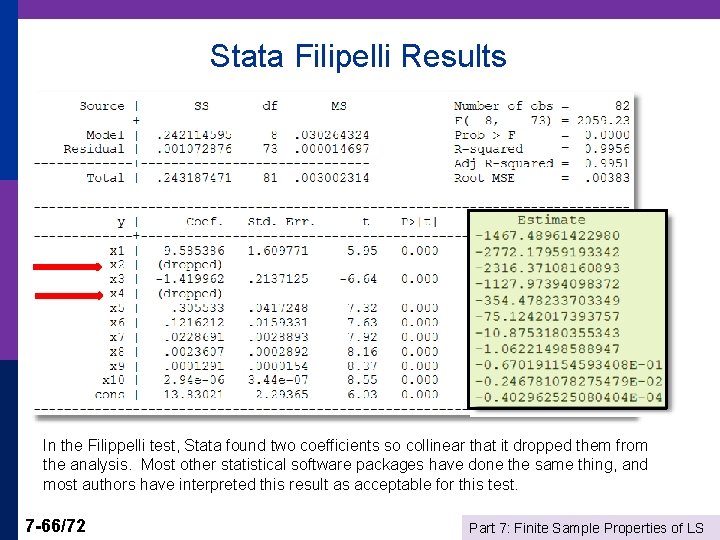
Stata Filipelli Results In the Filippelli test, Stata found two coefficients so collinear that it dropped them from the analysis. Most other statistical software packages have done the same thing, and most authors have interpreted this result as acceptable for this test. 7 -66/72 Part 7: Finite Sample Properties of LS
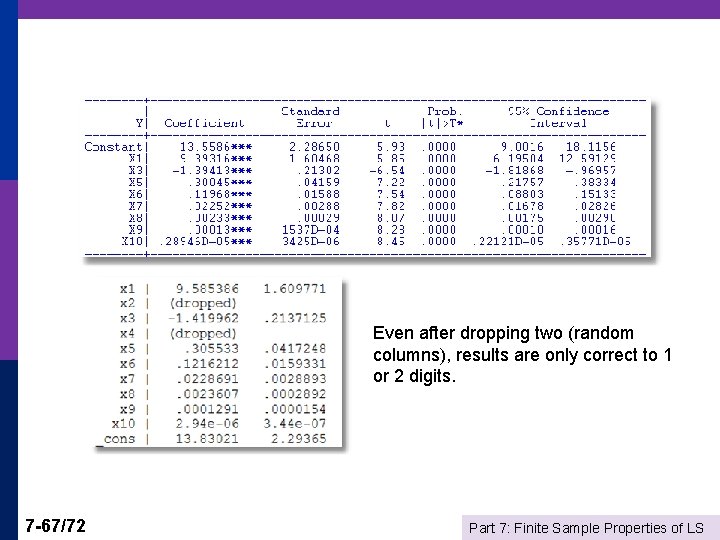
Even after dropping two (random columns), results are only correct to 1 or 2 digits. 7 -67/72 Part 7: Finite Sample Properties of LS
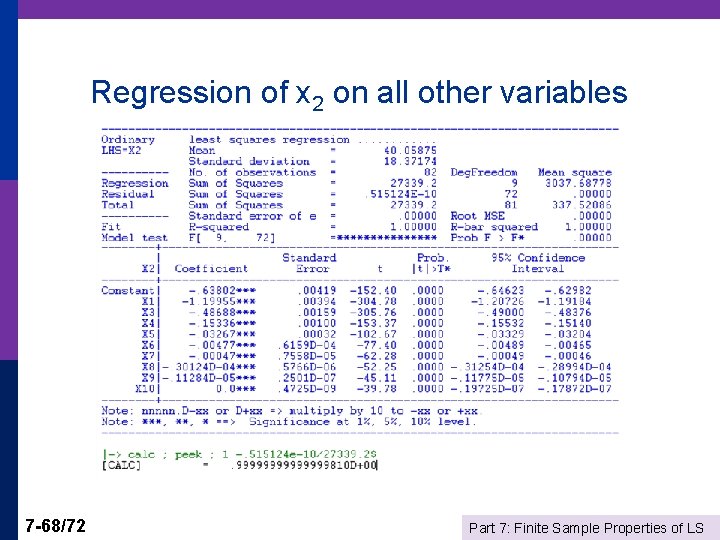
Regression of x 2 on all other variables 7 -68/72 Part 7: Finite Sample Properties of LS
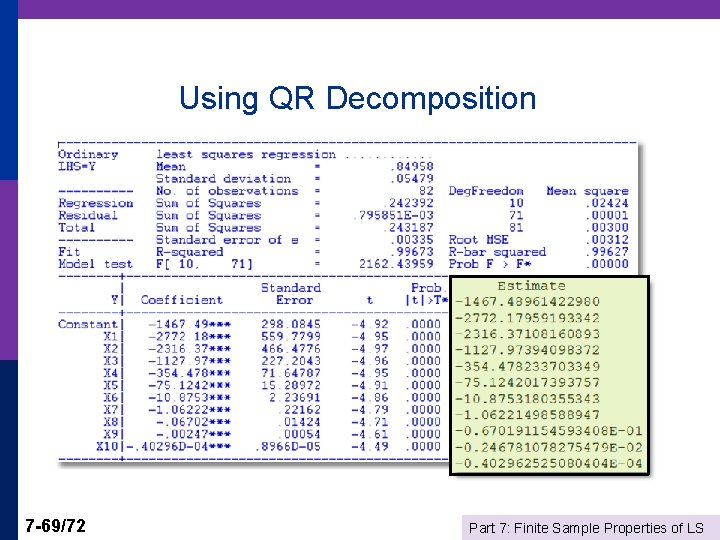
Using QR Decomposition 7 -69/72 Part 7: Finite Sample Properties of LS
Multicollinearity There is no “cure” for collinearity. Estimating something else is not helpful (principal components, for example). There are “measures” of multicollinearity, such as the condition number of X and the variance inflation factor. Best approach: Be cognizant of it. Understand its implications for estimation. What is better: Include a variable that causes collinearity, or drop the variable and suffer from a biased estimator? Mean squared error would be the basis for comparison. Some generalities. Assuming X has full rank, regardless of the condition, b is still unbiased Gauss-Markov still holds 7 -70/72 Part 7: Finite Sample Properties of LS
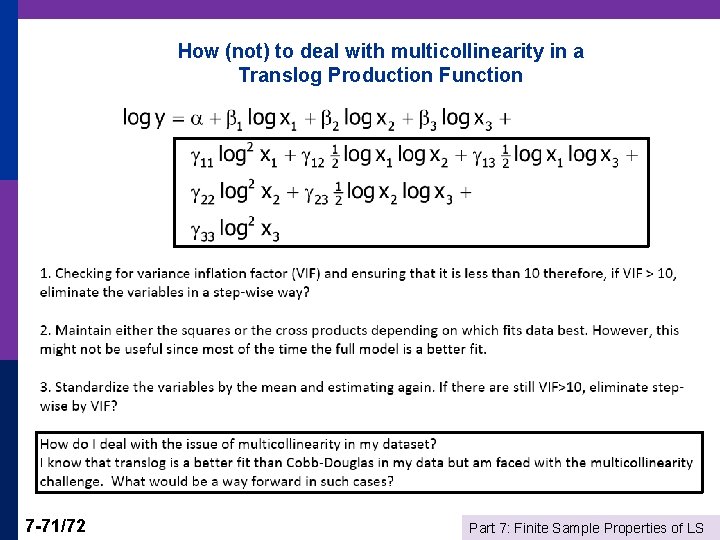
How (not) to deal with multicollinearity in a Translog Production Function 7 -71/72 Part 7: Finite Sample Properties of LS
I have a sample of 24025 observations in a logit model. Two predictors are highly collinear (pairwaise corr. 96; p<. 001); vif are about 12 for each of them; average vif is 2. 63; condition number is 10. 26; determinant of correlation matrix is 0. 0211; the two lowest eigen vales are 0. 0792 and 0. 0427. Centering/standardizing variables does not change the story. Note: most obs are zeros for these two variables; I only have approx 600 non-zero obs for these two variables on a total of 24. 025 obs. Both variable coefficients are significant and must be included in the model (as per specification). -- Do I have a problem of multicollinearity? ? -- Does the large sample size attenuate this concern, even if I have a correlation of. 96? -- What could I look at to ascertain that the consequences of multi-collinearity are not a problem? -- Is there any reference I might cite, to say that given the sample size, it is not a problem? I hope you might help, because I am really in trouble!!! 7 -72/72 Part 7: Finite Sample Properties of LS