
Econometrics I Professor William Greene Stern School of

![Heckman’s Control Function Approach p p Y = xβ + δT + E[ε|T] +](https://slidetodoc.com/presentation_image_h/c8af98640e85a98a54311689072c9d57/image-20.jpg "Heckman’s Control Function Approach p p Y = xβ + δT + E[ε|T] +")




- Slides: 51
Econometrics I Professor William Greene Stern School of Business Department of Economics 13 -/47 Part 13: Endogeneity
Econometrics I Part 13 – Endogeneity: Applications 13 -/47 Part 13: Endogeneity
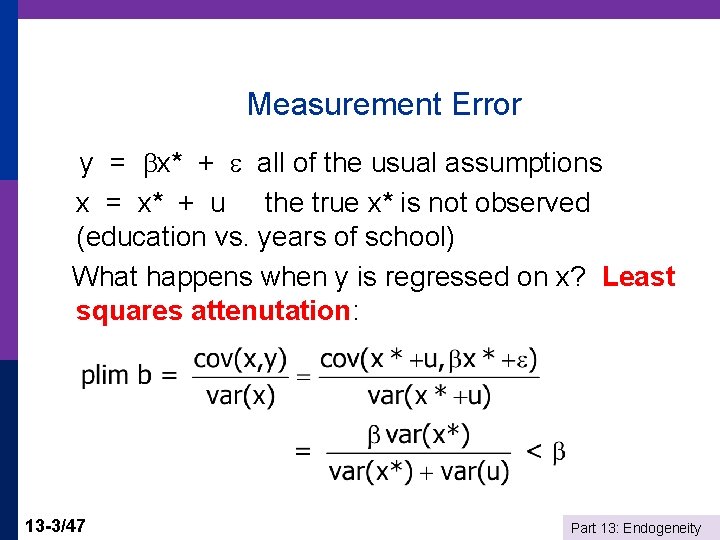
Measurement Error y = x* + all of the usual assumptions x = x* + u the true x* is not observed (education vs. years of school) What happens when y is regressed on x? Least squares attenutation: 13 -3/47 Part 13: Endogeneity
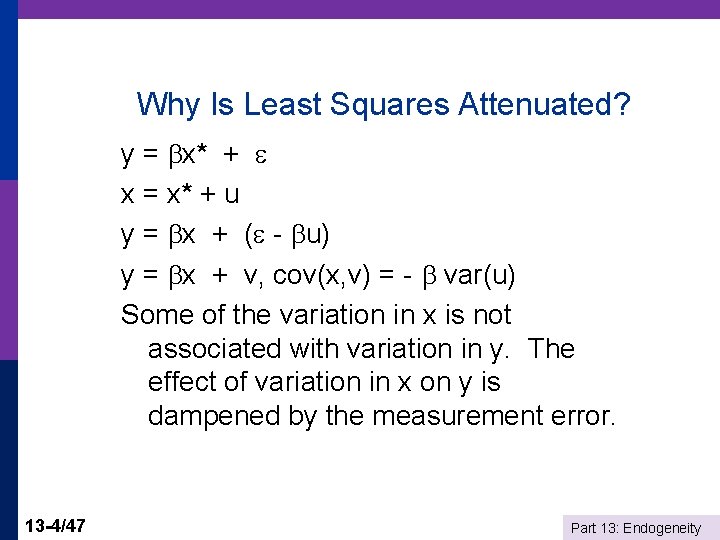
Why Is Least Squares Attenuated? y = x* + x = x* + u y = x + ( - u) y = x + v, cov(x, v) = - var(u) Some of the variation in x is not associated with variation in y. The effect of variation in x on y is dampened by the measurement error. 13 -4/47 Part 13: Endogeneity
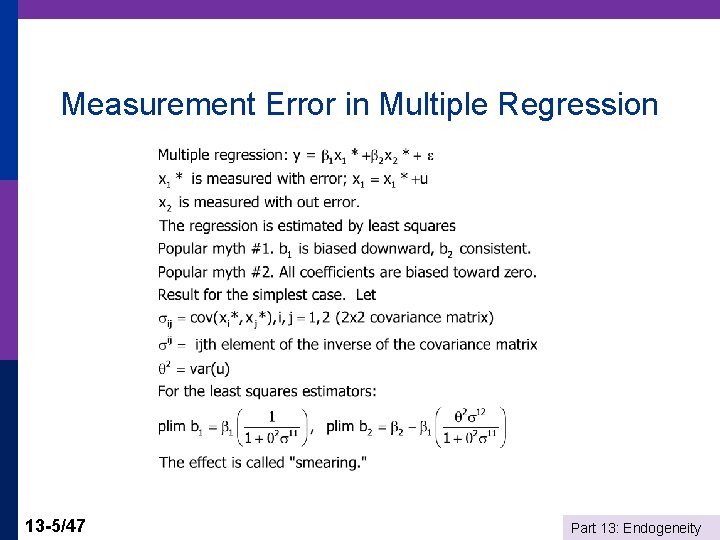
Measurement Error in Multiple Regression 13 -5/47 Part 13: Endogeneity
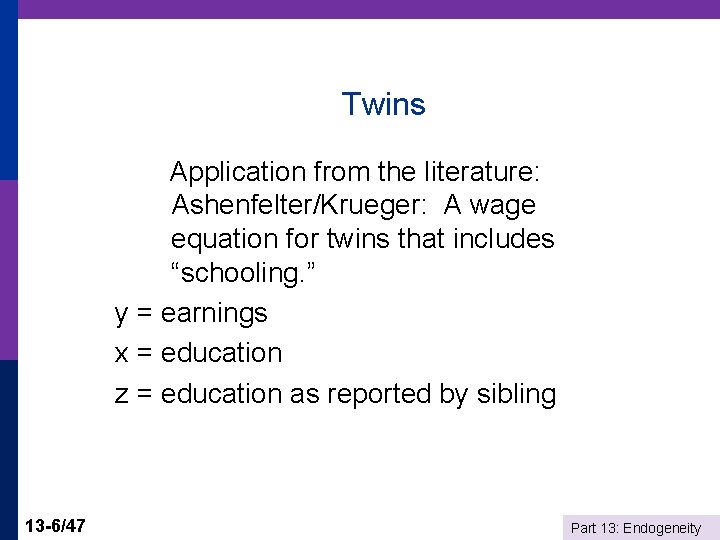
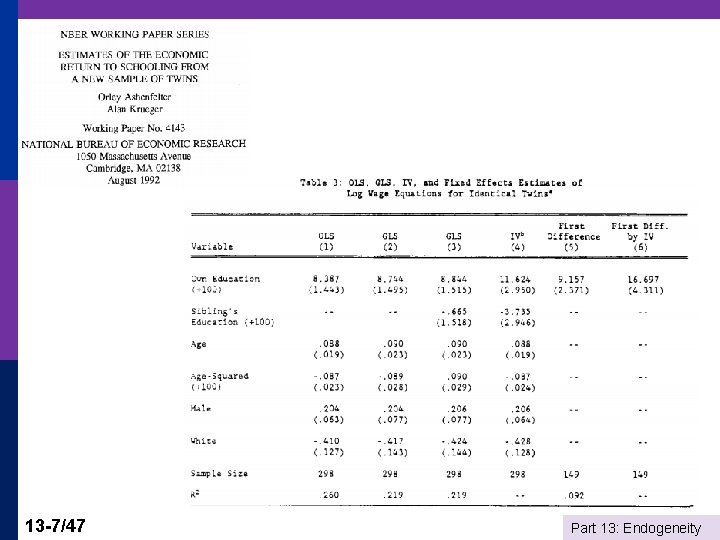
Twins Application from the literature: Ashenfelter/Krueger: A wage equation for twins that includes “schooling. ” y = earnings x = education z = education as reported by sibling 13 -6/47 Part 13: Endogeneity
13 -7/47 Part 13: Endogeneity
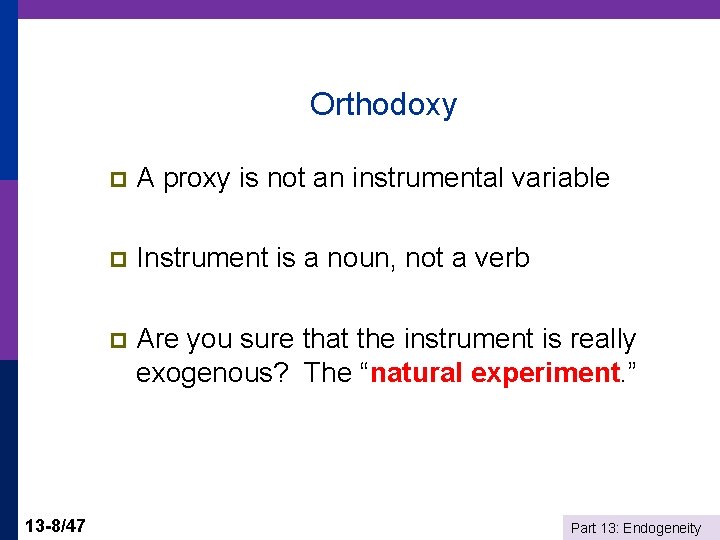
Orthodoxy 13 -8/47 p A proxy is not an instrumental variable p Instrument is a noun, not a verb p Are you sure that the instrument is really exogenous? The “natural experiment. ” Part 13: Endogeneity
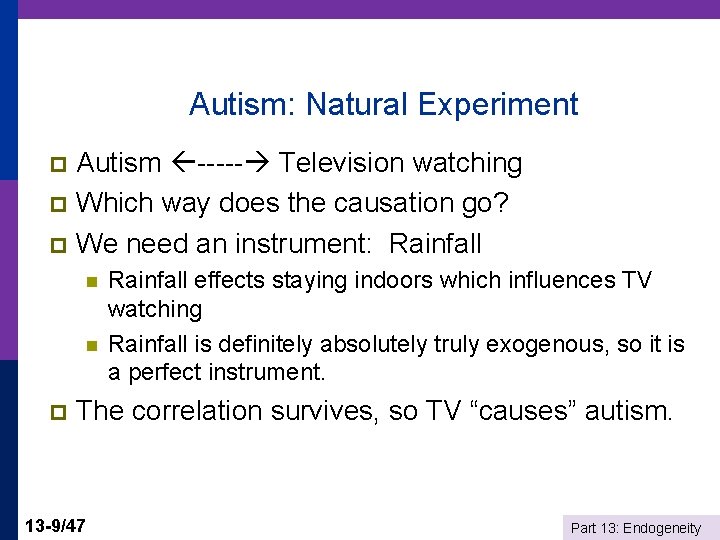
Autism: Natural Experiment Autism ----- Television watching p Which way does the causation go? p We need an instrument: Rainfall p n n p Rainfall effects staying indoors which influences TV watching Rainfall is definitely absolutely truly exogenous, so it is a perfect instrument. The correlation survives, so TV “causes” autism. 13 -9/47 Part 13: Endogeneity
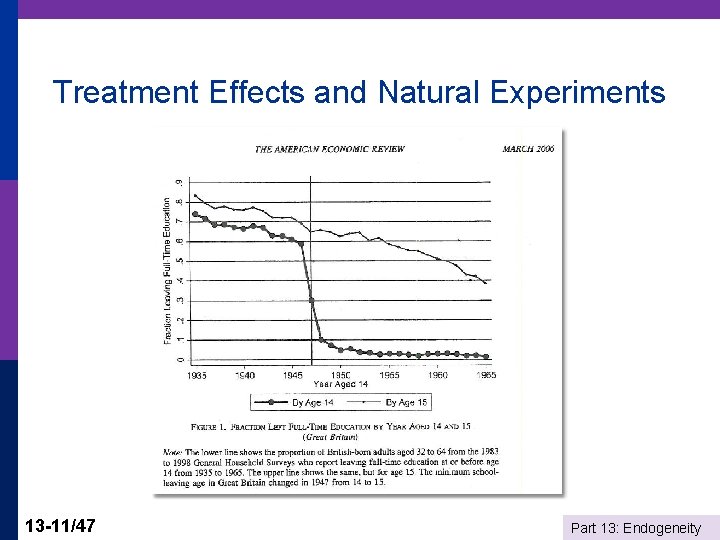
Treatment Effect p Earnings and Education: Effect of an additional year of schooling p Estimating Average and Local Average Treatment Effects of Education when Compulsory Schooling Laws Really Matter n n n 13 -10/47 Philip Oreopoulos AER, 96, 1, 2006, 152 -175 Also American Economic Journal, September, 2017 Part 13: Endogeneity
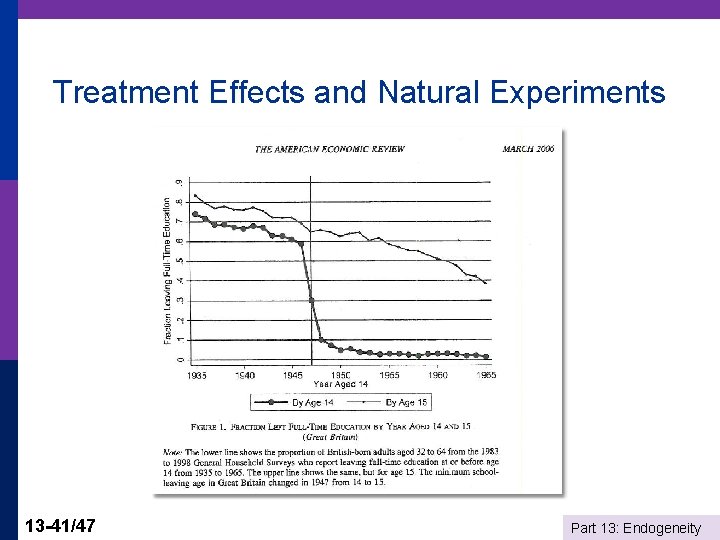
Treatment Effects and Natural Experiments 13 -11/47 Part 13: Endogeneity
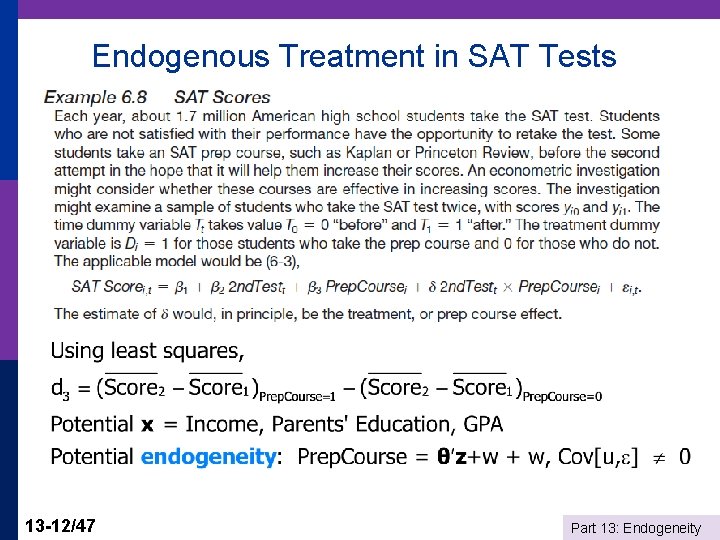
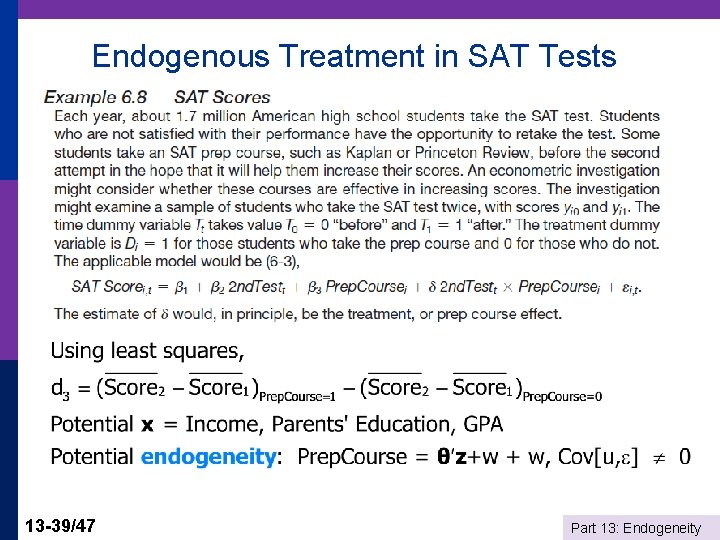
Endogenous Treatment in SAT Tests 13 -12/47 Part 13: Endogeneity
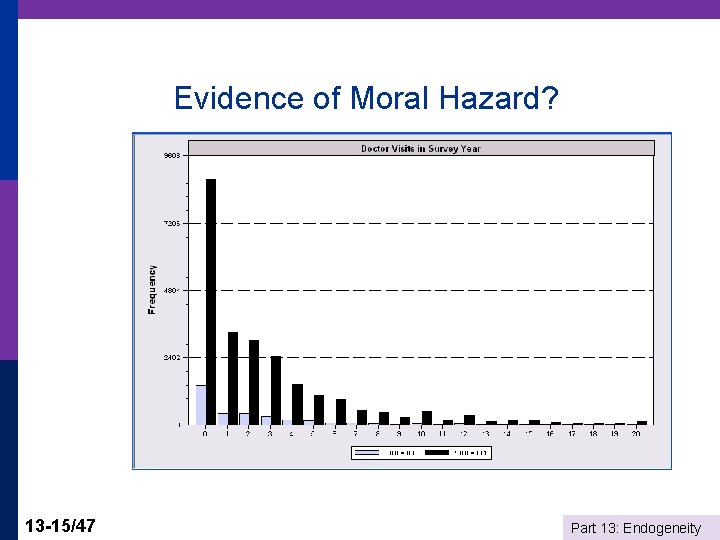
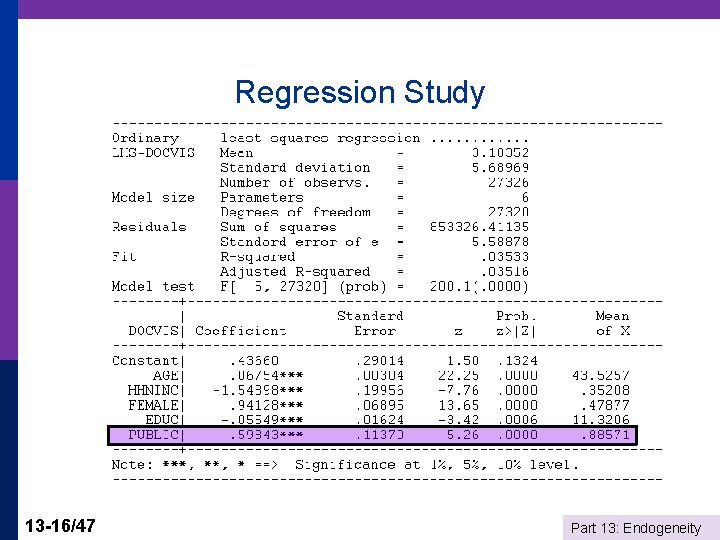
Some Conventional Approaches A study of moral hazard Riphahn, Wambach, Million: “Incentive Effects in the Demand for Healthcare” Journal of Applied Econometrics, 2003 Did the presence of the ADDON insurance influence the demand for health care – doctor visits and hospital visits? For a simple example, we examine the PUBLIC insurance (89%) instead of ADDON insurance (2%). 13 -13/47 Part 13: Endogeneity
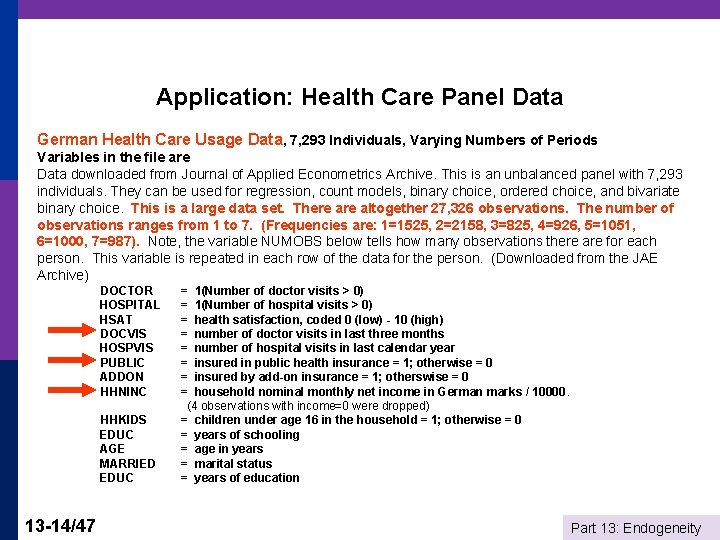
Application: Health Care Panel Data German Health Care Usage Data, 7, 293 Individuals, Varying Numbers of Periods Variables in the file are Data downloaded from Journal of Applied Econometrics Archive. This is an unbalanced panel with 7, 293 individuals. They can be used for regression, count models, binary choice, ordered choice, and bivariate binary choice. This is a large data set. There altogether 27, 326 observations. The number of observations ranges from 1 to 7. (Frequencies are: 1=1525, 2=2158, 3=825, 4=926, 5=1051, 6=1000, 7=987). Note, the variable NUMOBS below tells how many observations there are for each person. This variable is repeated in each row of the data for the person. (Downloaded from the JAE Archive) DOCTOR = 1(Number of doctor visits > 0) HOSPITAL = 1(Number of hospital visits > 0) HSAT = health satisfaction, coded 0 (low) - 10 (high) DOCVIS = number of doctor visits in last three months HOSPVIS = number of hospital visits in last calendar year PUBLIC = insured in public health insurance = 1; otherwise = 0 ADDON = insured by add-on insurance = 1; otherswise = 0 HHNINC = household nominal monthly net income in German marks / 10000. (4 observations with income=0 were dropped) HHKIDS = children under age 16 in the household = 1; otherwise = 0 EDUC = years of schooling AGE = age in years MARRIED = marital status EDUC = years of education 13 -14/47 Part 13: Endogeneity
Evidence of Moral Hazard? 13 -15/47 Part 13: Endogeneity
Regression Study 13 -16/47 Part 13: Endogeneity
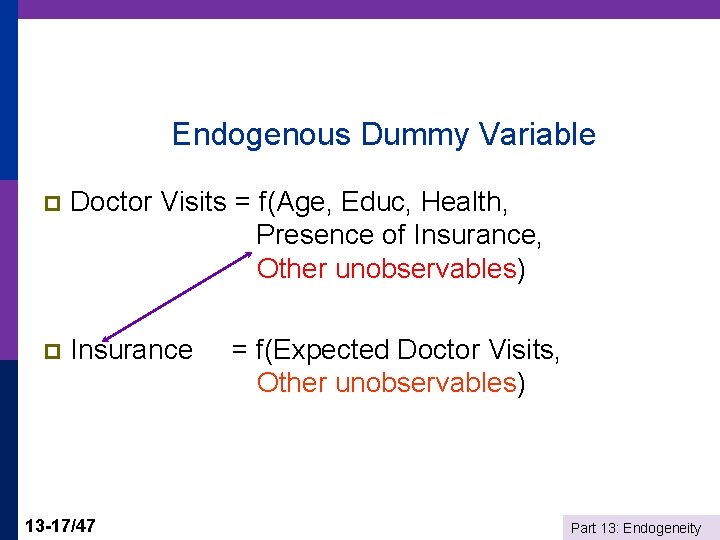
Endogenous Dummy Variable p Doctor Visits = f(Age, Educ, Health, Presence of Insurance, Other unobservables) p Insurance = f(Expected Doctor Visits, Other unobservables) 13 -17/47 Part 13: Endogeneity
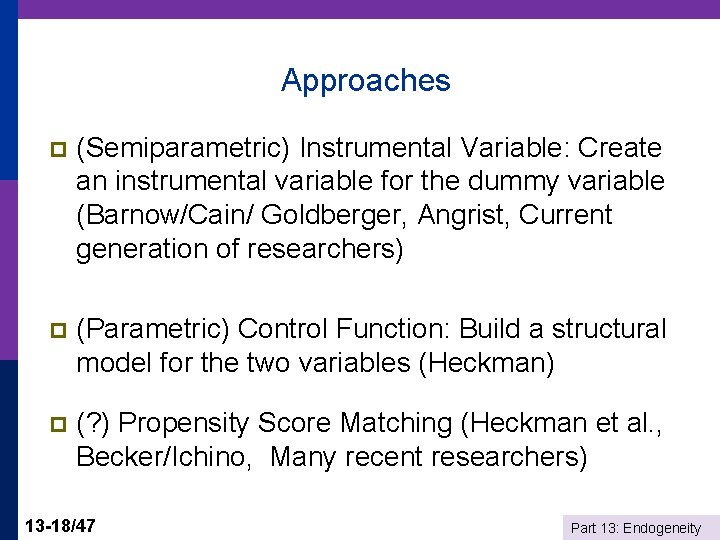
Approaches p (Semiparametric) Instrumental Variable: Create an instrumental variable for the dummy variable (Barnow/Cain/ Goldberger, Angrist, Current generation of researchers) p (Parametric) Control Function: Build a structural model for the two variables (Heckman) p (? ) Propensity Score Matching (Heckman et al. , Becker/Ichino, Many recent researchers) 13 -18/47 Part 13: Endogeneity
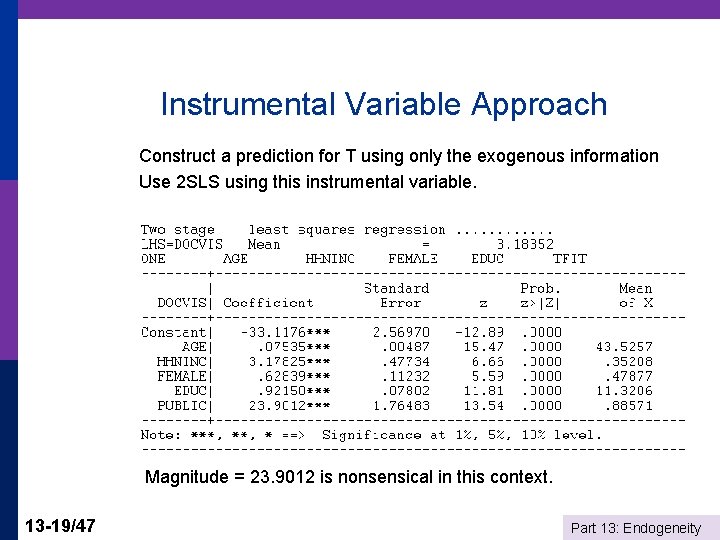
Instrumental Variable Approach Construct a prediction for T using only the exogenous information Use 2 SLS using this instrumental variable. Magnitude = 23. 9012 is nonsensical in this context. 13 -19/47 Part 13: Endogeneity
Heckman’s Control Function Approach p p Y = xβ + δT + E[ε|T] + {ε - E[ε|T]} λ = E[ε|T] , computed from a model for whether T = 0 or 1 Magnitude = 11. 1200 is nonsensical in this context. 13 -20/47 Part 13: Endogeneity
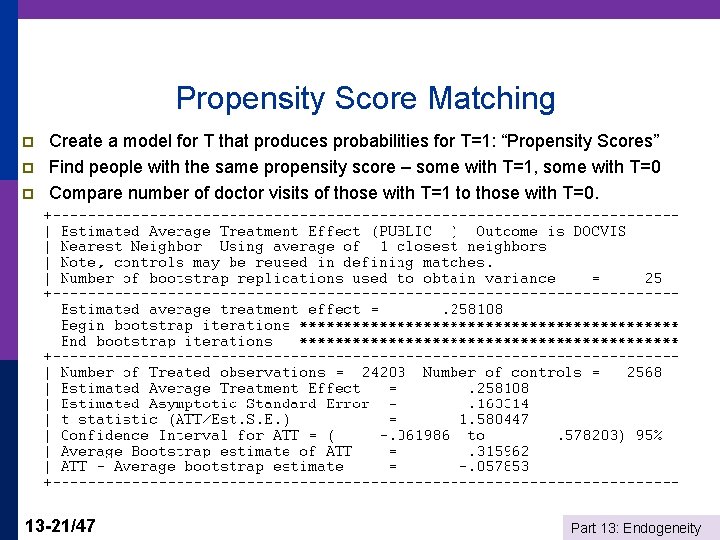
Propensity Score Matching p p p Create a model for T that produces probabilities for T=1: “Propensity Scores” Find people with the same propensity score – some with T=1, some with T=0 Compare number of doctor visits of those with T=1 to those with T=0. 13 -21/47 Part 13: Endogeneity
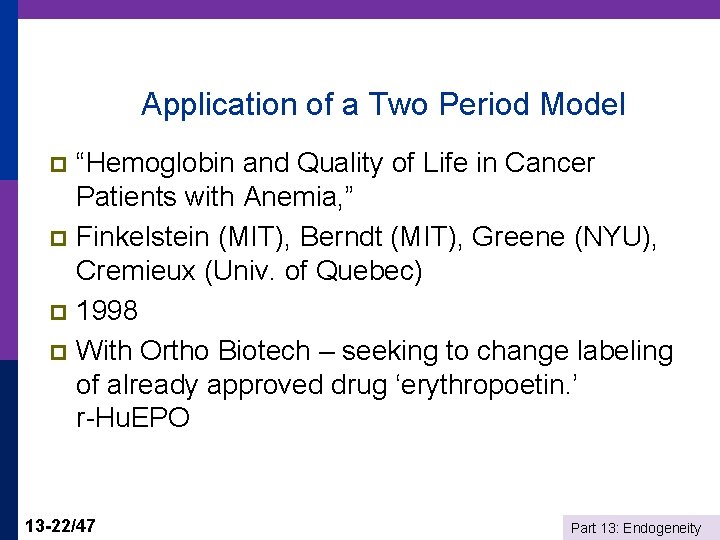
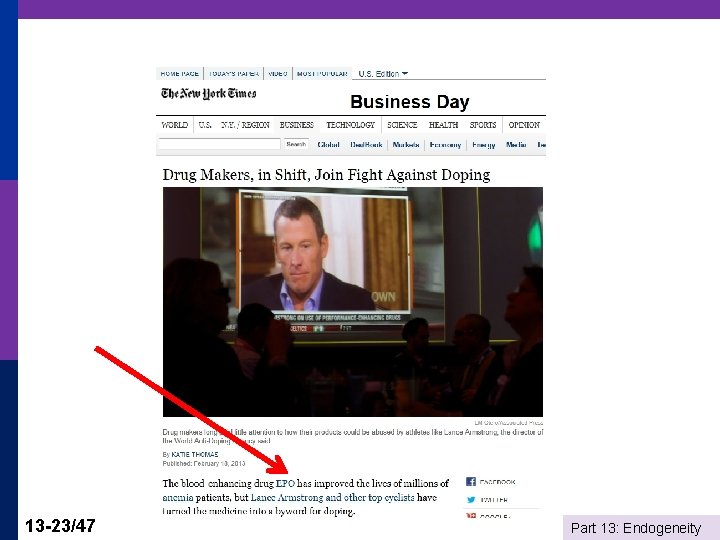
Application of a Two Period Model “Hemoglobin and Quality of Life in Cancer Patients with Anemia, ” p Finkelstein (MIT), Berndt (MIT), Greene (NYU), Cremieux (Univ. of Quebec) p 1998 p With Ortho Biotech – seeking to change labeling of already approved drug ‘erythropoetin. ’ r-Hu. EPO p 13 -22/47 Part 13: Endogeneity
13 -23/47 Part 13: Endogeneity
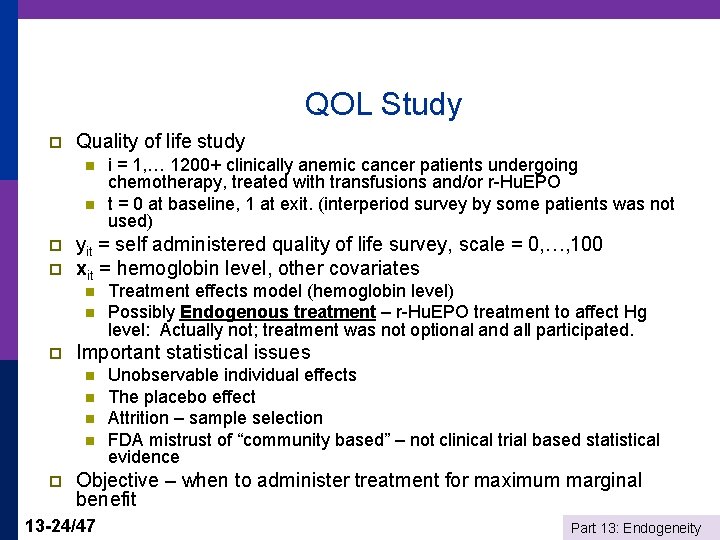
QOL Study p Quality of life study n n p p yit = self administered quality of life survey, scale = 0, …, 100 xit = hemoglobin level, other covariates n n p Treatment effects model (hemoglobin level) Possibly Endogenous treatment – r-Hu. EPO treatment to affect Hg level: Actually not; treatment was not optional and all participated. Important statistical issues n n p i = 1, … 1200+ clinically anemic cancer patients undergoing chemotherapy, treated with transfusions and/or r-Hu. EPO t = 0 at baseline, 1 at exit. (interperiod survey by some patients was not used) Unobservable individual effects The placebo effect Attrition – sample selection FDA mistrust of “community based” – not clinical trial based statistical evidence Objective – when to administer treatment for maximum marginal benefit 13 -24/47 Part 13: Endogeneity
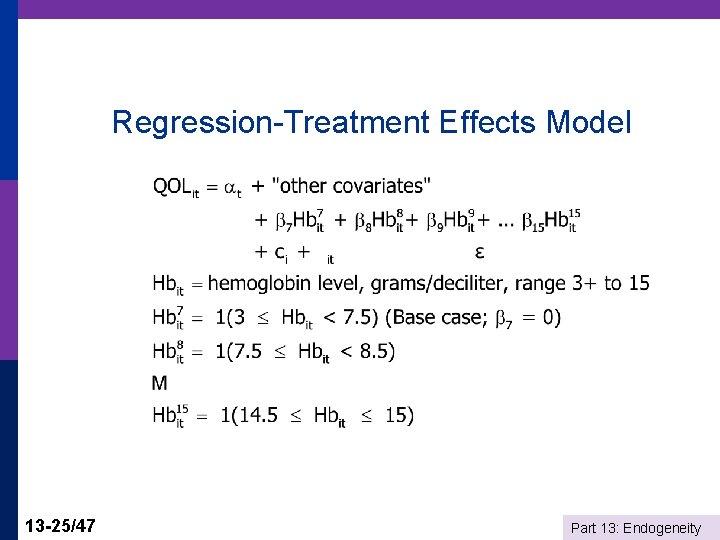
Regression-Treatment Effects Model 13 -25/47 Part 13: Endogeneity
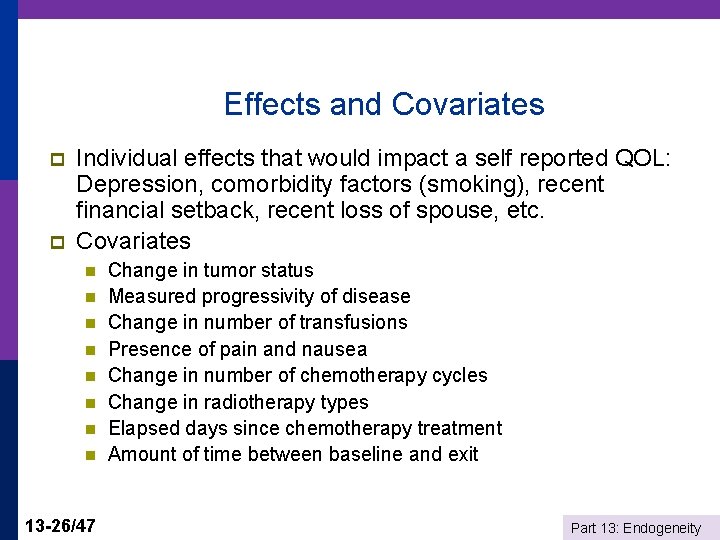
Effects and Covariates p p Individual effects that would impact a self reported QOL: Depression, comorbidity factors (smoking), recent financial setback, recent loss of spouse, etc. Covariates n n n n 13 -26/47 Change in tumor status Measured progressivity of disease Change in number of transfusions Presence of pain and nausea Change in number of chemotherapy cycles Change in radiotherapy types Elapsed days since chemotherapy treatment Amount of time between baseline and exit Part 13: Endogeneity
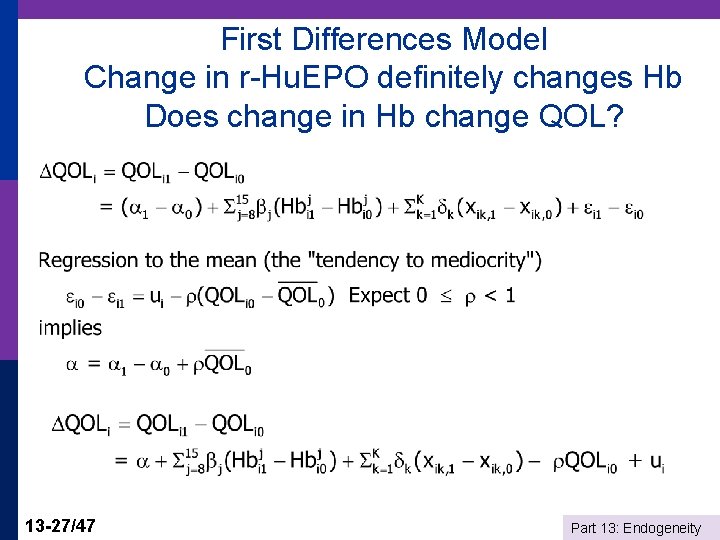
First Differences Model Change in r-Hu. EPO definitely changes Hb Does change in Hb change QOL? 13 -27/47 Part 13: Endogeneity
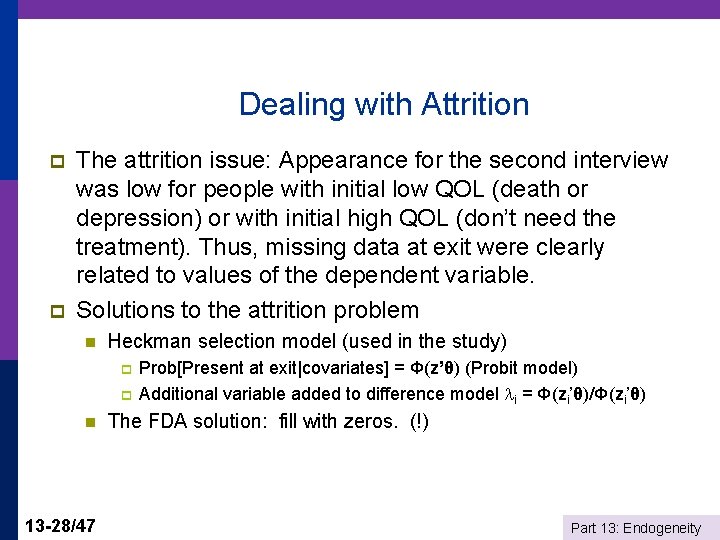
Dealing with Attrition p p The attrition issue: Appearance for the second interview was low for people with initial low QOL (death or depression) or with initial high QOL (don’t need the treatment). Thus, missing data at exit were clearly related to values of the dependent variable. Solutions to the attrition problem n Heckman selection model (used in the study) p p n 13 -28/47 Prob[Present at exit|covariates] = Φ(z’θ) (Probit model) Additional variable added to difference model i = Φ(zi’θ)/Φ(zi’θ) The FDA solution: fill with zeros. (!) Part 13: Endogeneity
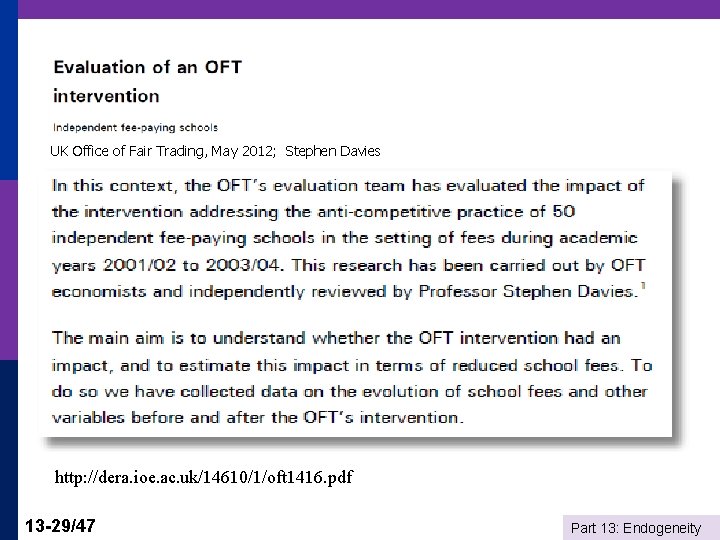
UK Office of Fair Trading, May 2012; Stephen Davies http: //dera. ioe. ac. uk/14610/1/oft 1416. pdf 13 -29/47 Part 13: Endogeneity
Outcome is the fees charged. Activity is collusion on fees. 13 -30/47 Part 13: Endogeneity
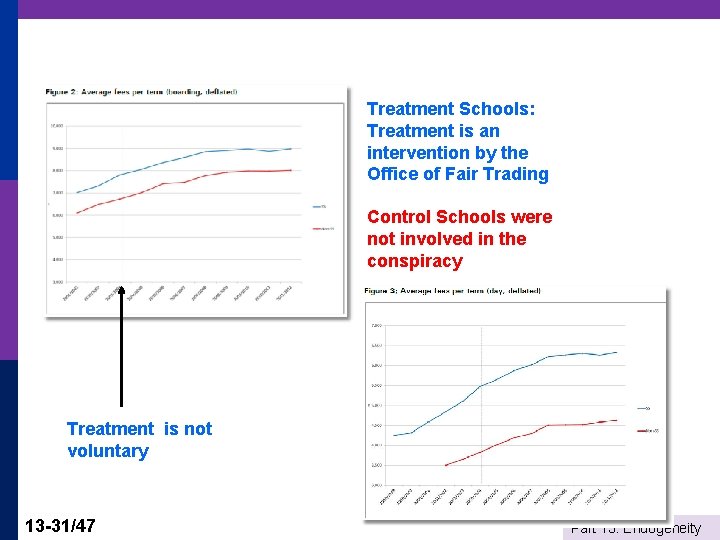
Treatment Schools: Treatment is an intervention by the Office of Fair Trading Control Schools were not involved in the conspiracy Treatment is not voluntary 13 -31/47 Part 13: Endogeneity
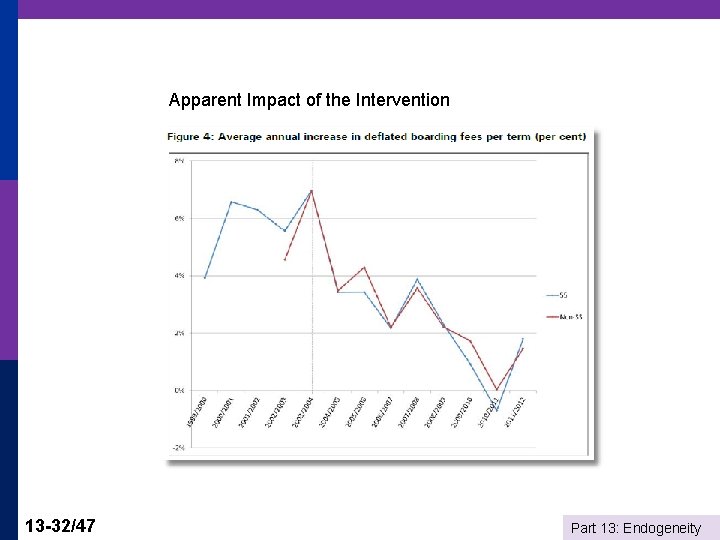
Apparent Impact of the Intervention 13 -32/47 Part 13: Endogeneity
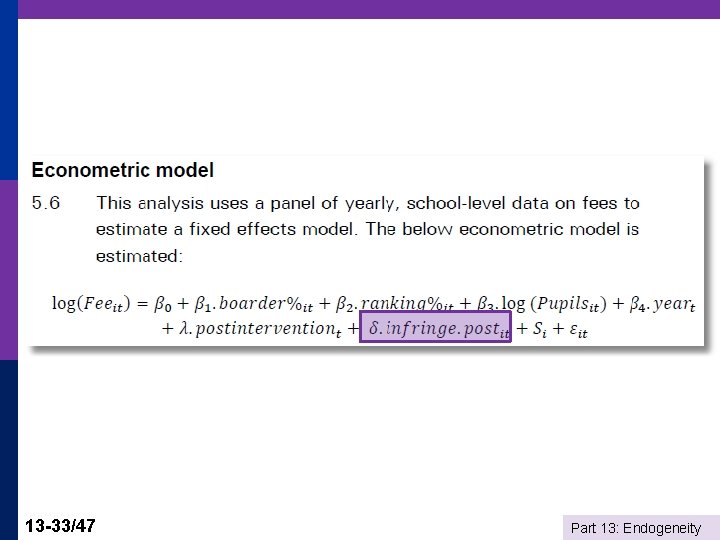
13 -33/47 Part 13: Endogeneity
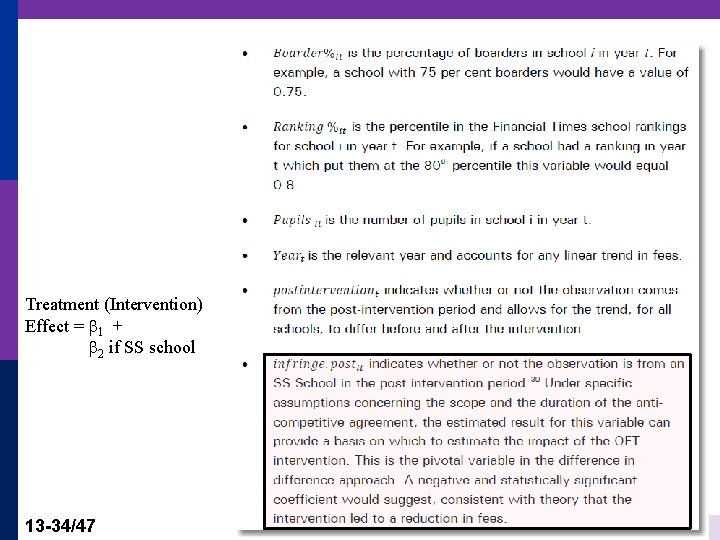
Treatment (Intervention) Effect = 1 + 2 if SS school 13 -34/47 Part 13: Endogeneity
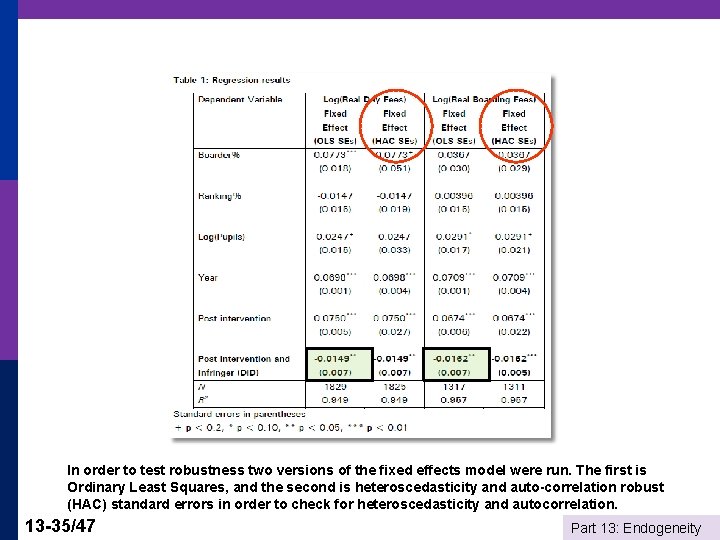
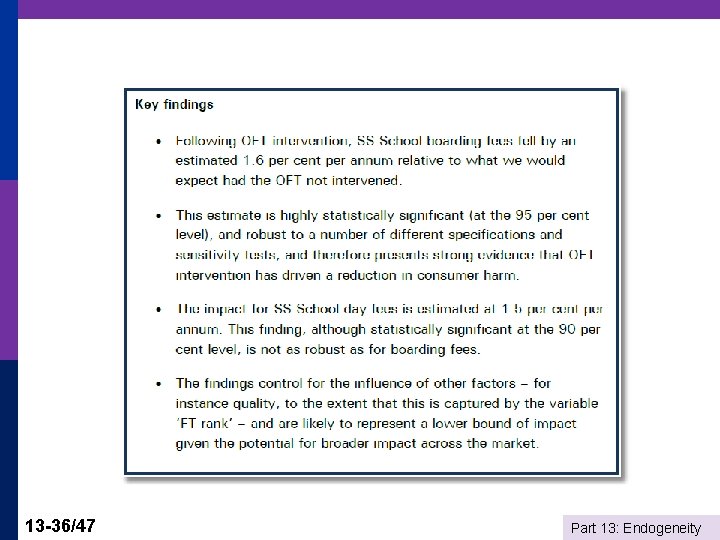
In order to test robustness two versions of the fixed effects model were run. The first is Ordinary Least Squares, and the second is heteroscedasticity and auto-correlation robust (HAC) standard errors in order to check for heteroscedasticity and autocorrelation. 13 -35/47 Part 13: Endogeneity
13 -36/47 Part 13: Endogeneity
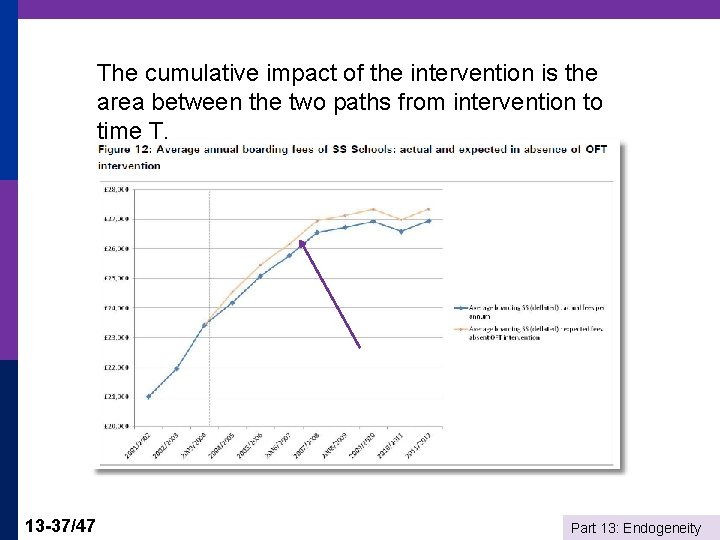
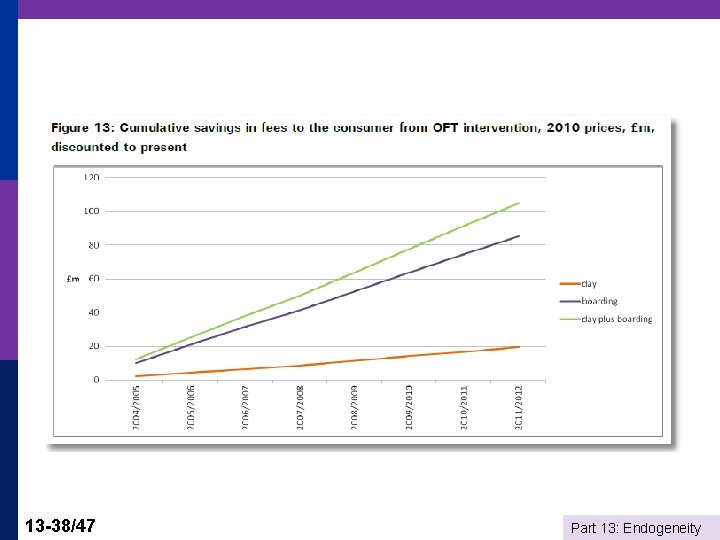
The cumulative impact of the intervention is the area between the two paths from intervention to time T. 13 -37/47 Part 13: Endogeneity
13 -38/47 Part 13: Endogeneity
Endogenous Treatment in SAT Tests 13 -39/47 Part 13: Endogeneity
Treatment Effect p Earnings and Education: Effect of an additional year of schooling p Estimating Average and Local Average Treatment Effects of Education when Compulsory Schooling Laws Really Matter n n 13 -40/47 Philip Oreopoulos AER, 96, 1, 2006, 152 -175 Part 13: Endogeneity
Treatment Effects and Natural Experiments 13 -41/47 Part 13: Endogeneity
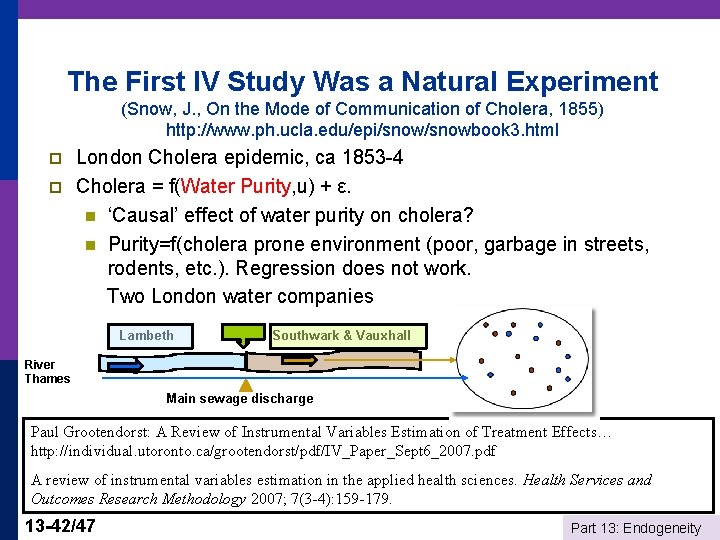
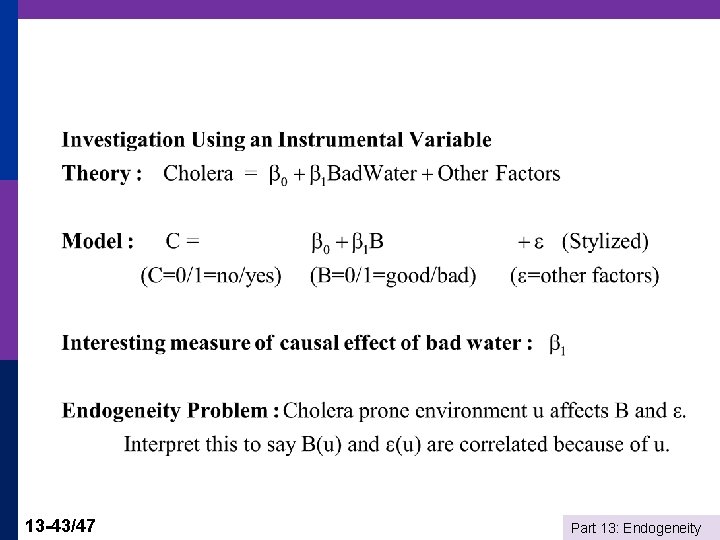
The First IV Study Was a Natural Experiment (Snow, J. , On the Mode of Communication of Cholera, 1855) http: //www. ph. ucla. edu/epi/snowbook 3. html p p London Cholera epidemic, ca 1853 -4 Cholera = f(Water Purity, u) + ε. n ‘Causal’ effect of water purity on cholera? n Purity=f(cholera prone environment (poor, garbage in streets, rodents, etc. ). Regression does not work. Two London water companies Lambeth Southwark & Vauxhall River Thames Main sewage discharge Paul Grootendorst: A Review of Instrumental Variables Estimation of Treatment Effects… http: //individual. utoronto. ca/grootendorst/pdf/IV_Paper_Sept 6_2007. pdf A review of instrumental variables estimation in the applied health sciences. Health Services and Outcomes Research Methodology 2007; 7(3 -4): 159 -179. 13 -42/47 Part 13: Endogeneity
13 -43/47 Part 13: Endogeneity
13 -44/47 Part 13: Endogeneity
13 -45/47 Part 13: Endogeneity
13 -46/47 Part 13: Endogeneity
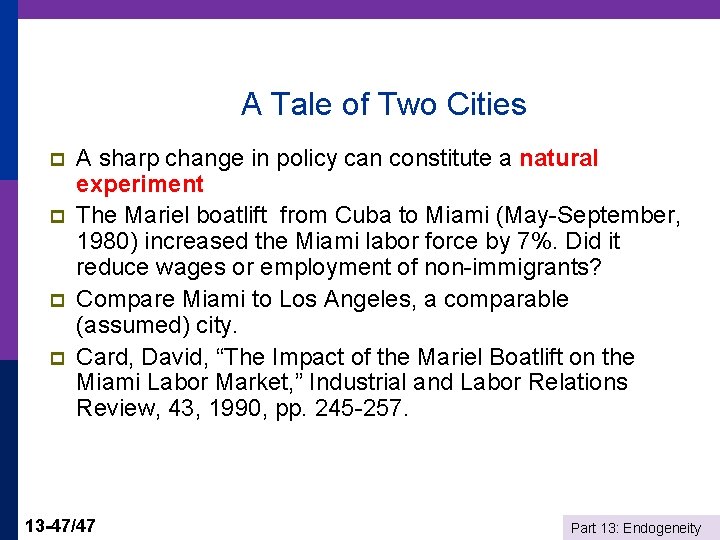
A Tale of Two Cities p p A sharp change in policy can constitute a natural experiment The Mariel boatlift from Cuba to Miami (May-September, 1980) increased the Miami labor force by 7%. Did it reduce wages or employment of non-immigrants? Compare Miami to Los Angeles, a comparable (assumed) city. Card, David, “The Impact of the Mariel Boatlift on the Miami Labor Market, ” Industrial and Labor Relations Review, 43, 1990, pp. 245 -257. 13 -47/47 Part 13: Endogeneity
Difference in Differences 13 -48/47 Part 13: Endogeneity
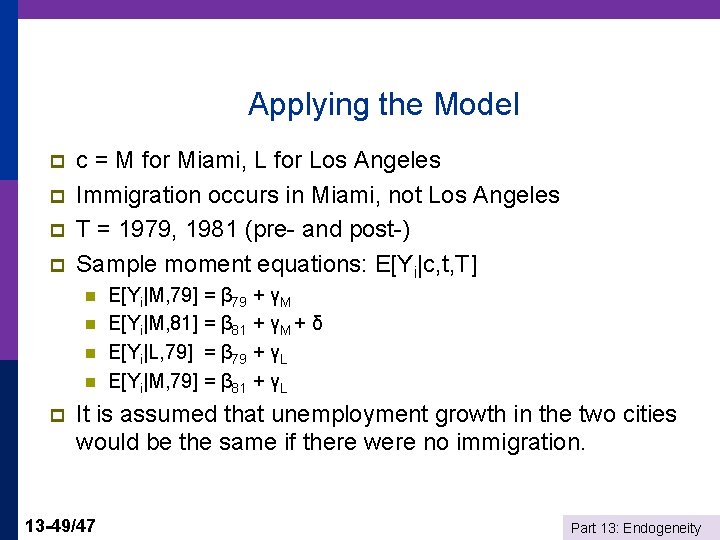
Applying the Model p p c = M for Miami, L for Los Angeles Immigration occurs in Miami, not Los Angeles T = 1979, 1981 (pre- and post-) Sample moment equations: E[Yi|c, t, T] n n p E[Yi|M, 79] = β 79 + γM E[Yi|M, 81] = β 81 + γM + δ E[Yi|L, 79] = β 79 + γL E[Yi|M, 79] = β 81 + γL It is assumed that unemployment growth in the two cities would be the same if there were no immigration. 13 -49/47 Part 13: Endogeneity
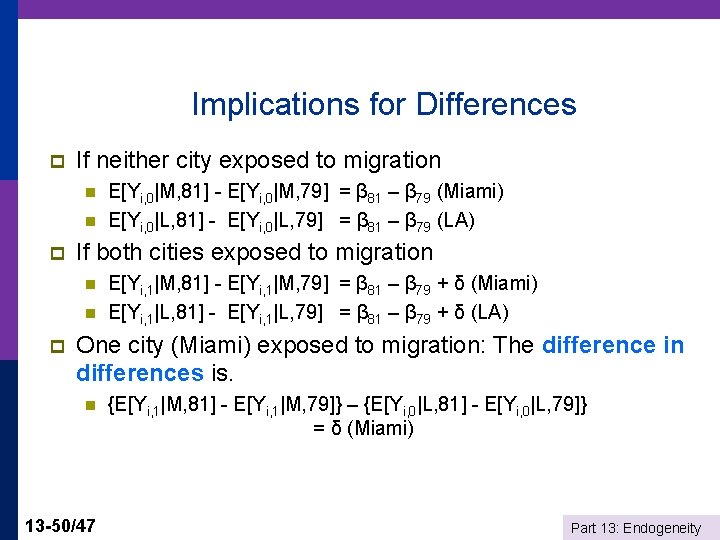
Implications for Differences p If neither city exposed to migration n n p If both cities exposed to migration n n p E[Yi, 0|M, 81] - E[Yi, 0|M, 79] = β 81 – β 79 (Miami) E[Yi, 0|L, 81] - E[Yi, 0|L, 79] = β 81 – β 79 (LA) E[Yi, 1|M, 81] - E[Yi, 1|M, 79] = β 81 – β 79 + δ (Miami) E[Yi, 1|L, 81] - E[Yi, 1|L, 79] = β 81 – β 79 + δ (LA) One city (Miami) exposed to migration: The difference in differences is. n 13 -50/47 {E[Yi, 1|M, 81] - E[Yi, 1|M, 79]} – {E[Yi, 0|L, 81] - E[Yi, 0|L, 79]} = δ (Miami) Part 13: Endogeneity
Autism: Natural Experiment Autism ----- Television watching p Which way does the causation go? p We need an instrument: Rainfall p n n p Rainfall effects staying indoors which influences TV watching Rainfall is definitely absolutely truly exogenous, so it is a perfect instrument. The correlation survives, so TV “causes” autism. 13 -51/47 Part 13: Endogeneity