
Econ 427 lecture 23 slides Intro to Cointegration

- Slides: 7
Econ 427 lecture 23 slides Intro to Cointegration and Error Correction Models Byron Gangnes
Cointegration • To integrated series are said to be cointegrated when there is a linear combination of the two series that is stationary • This will happen, when y and x share a common stochastic trend. • The classic examples is consumption and income. Look at a graph. • This also generalizes to more than two variables Byron Gangnes
Cointegration • Cointegration has some nice properties, in particular parameter estimates are super-consistent. – This means that the estimates converge to the true value at a faster-than-normal rate. – We are not “throwing away” potentially important information about the levels by differencing the data. • The problem is that cointegration tests have nonstandard distributions, like we saw for unit root tests. Byron Gangnes
Bivariate Cointegration • yt and xt are cointegrated if there is some parameter, beta, such that this linear combination is stationary. • We use Augmented Dicky-Fuller tests to find out whether this is the case. – Have to consult special tables for this. Then cointegrating relationship is given by: Byron Gangnes
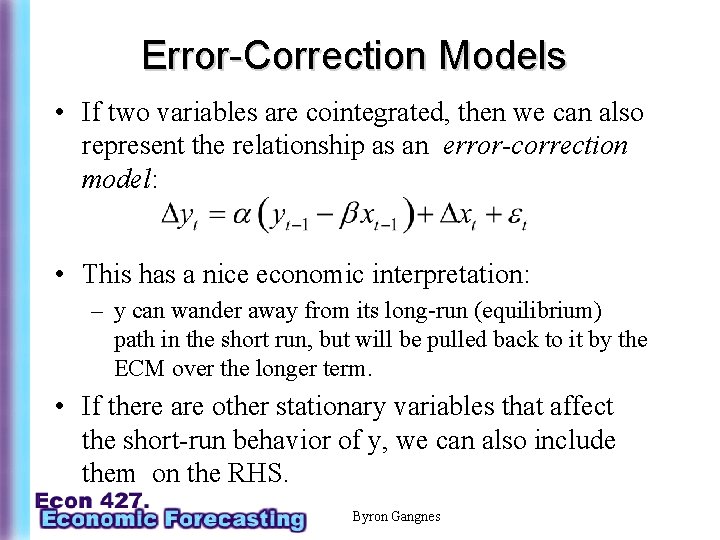
Error-Correction Models • If two variables are cointegrated, then we can also represent the relationship as an error-correction model: • This has a nice economic interpretation: – y can wander away from its long-run (equilibrium) path in the short run, but will be pulled back to it by the ECM over the longer term. • If there are other stationary variables that affect the short-run behavior of y, we can also include them on the RHS. Byron Gangnes
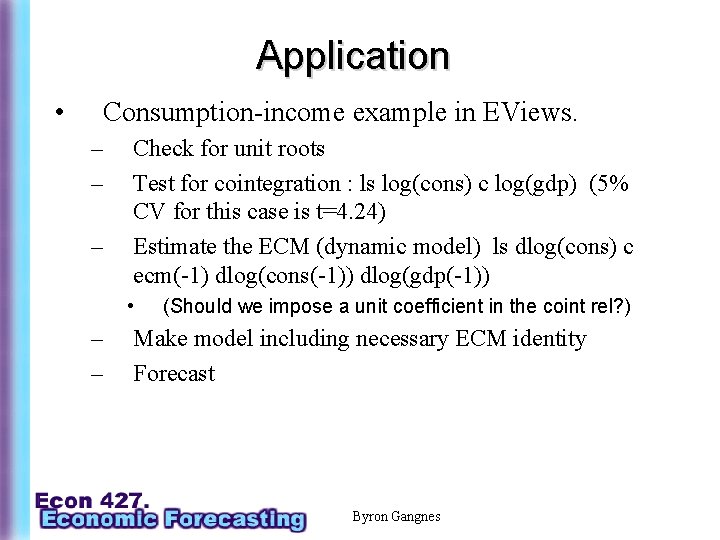
Application • Consumption-income example in EViews. – – – Check for unit roots Test for cointegration : ls log(cons) c log(gdp) (5% CV for this case is t=4. 24) Estimate the ECM (dynamic model) ls dlog(cons) c ecm(-1) dlog(cons(-1)) dlog(gdp(-1)) • – – (Should we impose a unit coefficient in the coint rel? ) Make model including necessary ECM identity Forecast Byron Gangnes
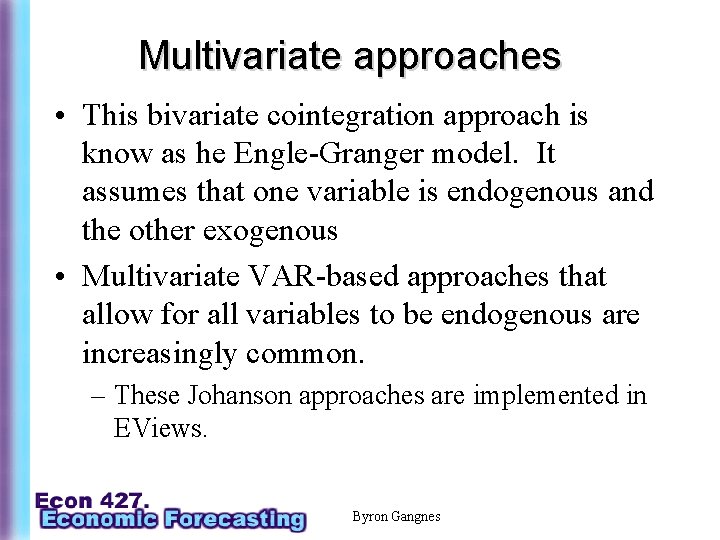
Multivariate approaches • This bivariate cointegration approach is know as he Engle-Granger model. It assumes that one variable is endogenous and the other exogenous • Multivariate VAR-based approaches that allow for all variables to be endogenous are increasingly common. – These Johanson approaches are implemented in EViews. Byron Gangnes