
Econ 427 lecture 14 slides Forecasting with MA
- Slides: 6
Econ 427 lecture 14 slides Forecasting with MA Models Byron Gangnes
Optimal forecast • One which, given the available information, has the smallest average loss. – This will normally be the conditional mean (the mean given that we are a particular time period, t; i. e. given an “information set”): • The best linear forecast will then be the linear approximation to this, called the linear projection, Remember the info set will generally be current and past values of y and innovations (epsilons). Byron Gangnes
Optimal forecast for MA • Like before (Chs. 5 and 6), we calculate the optimal point forecast by writing down the process at period T+h and then “projecting it” on the information available at time T. – Book’s MA(2) example: • Write out the process at time T+1: • Projecting this on the time T info set, (remember that expectations of future innovs are zero) Byron Gangnes
Optimal forecast for MA • For period T+2: • Projecting this on the time T info set, • And so forth… So for periods beyond T+2, Why is that? an MA(q) process is not forecastable more than q steps ahead. Why? Recall Autocorr function drops to 0 after q steps Byron Gangnes
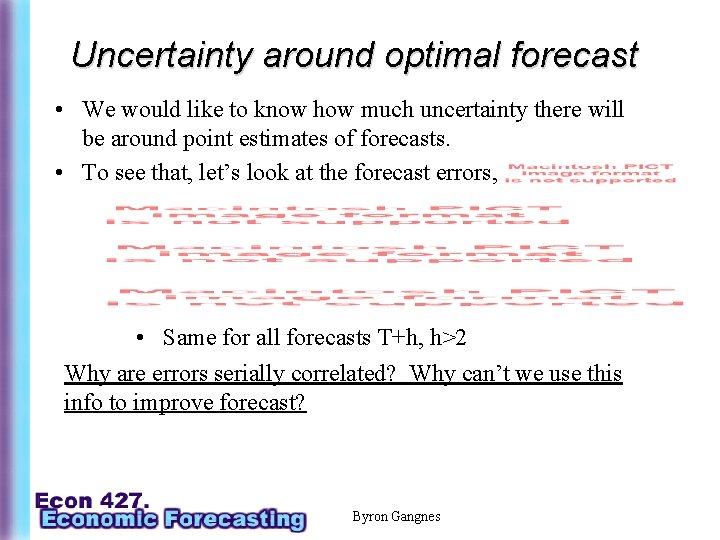
Uncertainty around optimal forecast • We would like to know how much uncertainty there will be around point estimates of forecasts. • To see that, let’s look at the forecast errors, • Same for all forecasts T+h, h>2 Why are errors serially correlated? Why can’t we use this info to improve forecast? Byron Gangnes
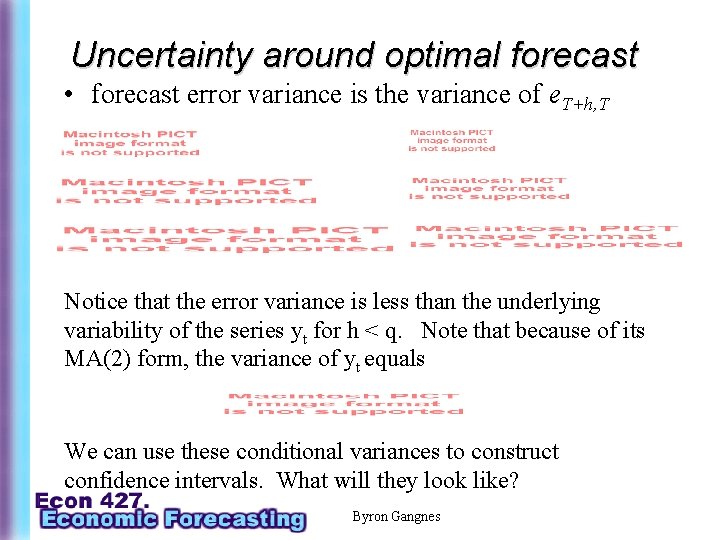
Uncertainty around optimal forecast • forecast error variance is the variance of e. T+h, T Notice that the error variance is less than the underlying variability of the series yt for h < q. Note that because of its MA(2) form, the variance of yt equals We can use these conditional variances to construct confidence intervals. What will they look like? Byron Gangnes