
Econ 281 Intermediate Microeconomics Consumer Behavior Theory of

Econ 281 Intermediate Microeconomics • Consumer Behavior • Theory of the Firm • Various Market Structures Lorne Priemaza, M. A. Lorne. priemaza@ualberta. ca Various material courtesy of Katharine Rockette and Wiley & Sons INC.
Chapter 1 ØWhat is economics? ØMicroeconomics and Macroeconomics ØEconomic Tools ØPositive and Normative Analysis
What Is Economics? • Economics is the science that deals with choices about the allocation of limited resources to satisfy unlimited wants. Limited Resources Choices Unlimited Wants Outcome
Microeconomics and Macroeconomics • Microeconomics -from the Greek mikros meaning small -studies economic behavior of individual decision makers (people, firms, etc. ) -What price should Apple charge for Ipods? -How much Game of Thrones should Kim watch? -How does owning an Ipod and watching Game of Thrones affect Jon’s utility?
Microeconomics and Macroeconomics • Macroeconomics -from the Greek makros meaning large -studies aggregate economic behavior (nation, world, business cycles, etc. ) -What should the tax on MP 3 players be? -Should the federal government subsidize tv shows filmed in Canada? -How does MP 3 and tv demand fluctuate?
Economics and Models • “Economists work with models. ” -Life is too complicated for an economist to analyze all at once -In order to analyze one aspect of life, economists build a simplified model to represent that aspect of life -The results of the model are then tested against real life -Models require assumptions
Economics and Assumptions • “Assume there’s a can opener!” -Every economic model relies on assumptions (much like a house relies on foundations) -ie: Assume people are rational; assume firm A understands people’s tastes -If the assumptions are invalid, the model suffers -ie: Assume all students read the text
Exogenous and Endogenous Variables • Exogenous Variables -values that are taken as given -values that are decided outside the model Ie: GIVEN that Joe’s input (material) costs are $10 per shoe (exogenous variable), how much should he sell shoes for?
Exogenous and Endogenous Variables • Endogenous Variables -values that are determined within the model Ie: What price (endogenous variable) should Joe charge for shoes and what quantity demanded (endogenous variable) will he face?
Exogenous and Endogenous Variables • Relationship Model John is trying to woo his sweetheart Jenni. -Jenni’s feelings towards John are exogenous -John’s attempts to woo Jenni are endogenous -Jenni’s reaction is endogenous
Mathematical Tools -Economic agents react rationally or irrationally given their available information. -Economists assume agents react rationally to maximize their utility/profit or minimize their work/cost using: ØConstrained Optimization ØEquilibrium Analysis ØComparative Statics
Mathematical Tools • Constrained Optimization -People and firms operate using limited resources (time, money, etc. ). -Constrained Optimization maximizes utility, profit, etc. given a constraint (time, money, etc)
Constrained Optimization Example Dr. House enjoys two things: riding his motorcycle and saving lives. Unfortunately, he cannot do both at the same time. Therefore Greg’s model is: Max U(Riding, Lives) ->Objective Function Subject to the constraint (s. t. ) Hour Per Day = 8 = Riding + Lives
House Optimization Example One may say House should spend his full 8 hours on riding or saving lives; whichever he likes more. But House probably enjoys the first few hours of riding his bike or saving lives more than the last few hours. We’re concerned with MARGINAL happiness. (Happiness gained from the last hour’s activity)
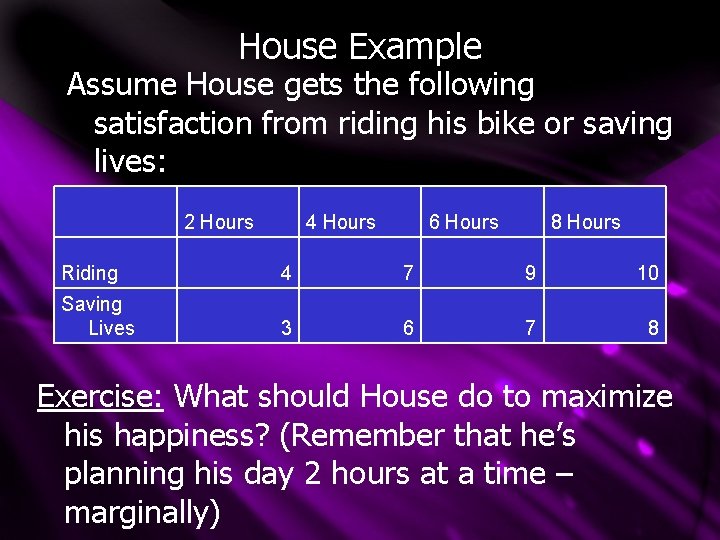
House Example Assume House gets the following satisfaction from riding his bike or saving lives: 2 Hours 4 Hours 6 Hours 8 Hours Riding 4 7 9 10 Saving Lives 3 6 7 8 Exercise: What should House do to maximize his happiness? (Remember that he’s planning his day 2 hours at a time – marginally)
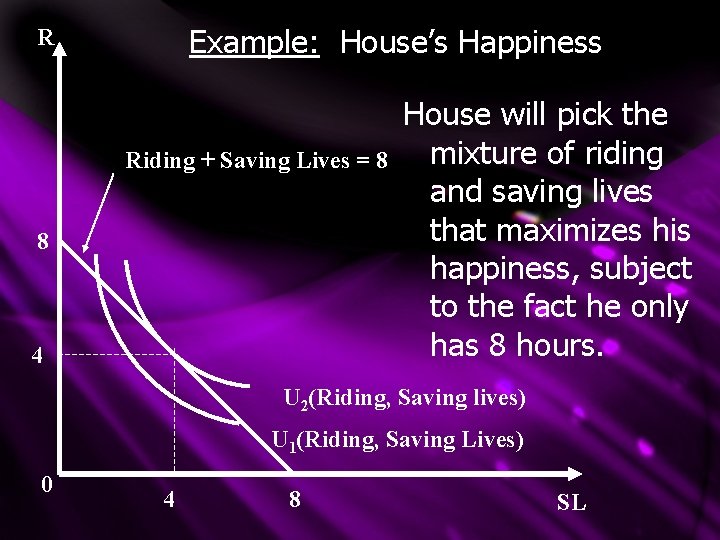
Example: House’s Happiness R Riding + Saving Lives = 8 8 4 House will pick the mixture of riding and saving lives that maximizes his happiness, subject to the fact he only has 8 hours. U 2(Riding, Saving lives) U 1(Riding, Saving Lives) 0 4 8 SL
Dealing with the marginal Assume that you bought a lemon car – a 2002 Pontiac Sunfire that has caused you nothing but problems. You paid $8, 000 for it and have spent $2000 in repairs over the last year. Your kartoflemonometer just broke and will cost $1000 to fix. After this last job you’ve basically replaced the entire car. On the other hand, you can buy a reliable 2007 Honda CR-V for $7000. What do you do?
Dealing with the marginal If you fix your Pontiac, it will have cost you a total of $11, 000 to buy a car that works, whereas the Honda would have cost you a total of $7000. But right now you already have the Pontiac. To get a car that works, you need an ADDITIONAL $1, 000 or an ADDITIONAL $7, 000. You will fix the Pontiac. Rational people deal with marginal decisions.
Mathematical Tools • Equilibrium Analysis -Equilibrium is a state that will continue indefinitely as long as exogenous factors don’t change -If a variable is higher than equilibrium, market forces will pull it down, -If a variable is lower than equilibrium, market forces will pull it up
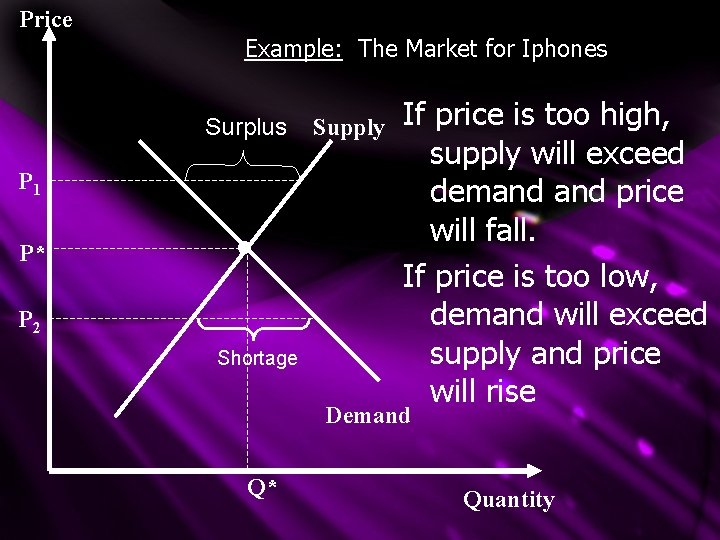
Price Example: The Market for Iphones Surplus P 1 P* • P 2 Shortage Supply If price is too high, supply will exceed demand price will fall. If price is too low, demand will exceed supply and price will rise Demand Q* Quantity
Mathematical Tools • Comparative Statics -In the real world, many exogenous variables are moving at the same time; affecting many endogenous variables -Comparative Statics aims to measure the effect a change in one exogenous variable on one endogenous variable.
Comparative Statics Example Originally, assume that the i. Pad market is in equilibrium, with Qsupply = QDemand. Originally, we have equilibrium price and quantity. Assume that due to a lifting of tarrifs, i. Pad input costs have decreased. Analyze this effect on equilibrium price and quantity.
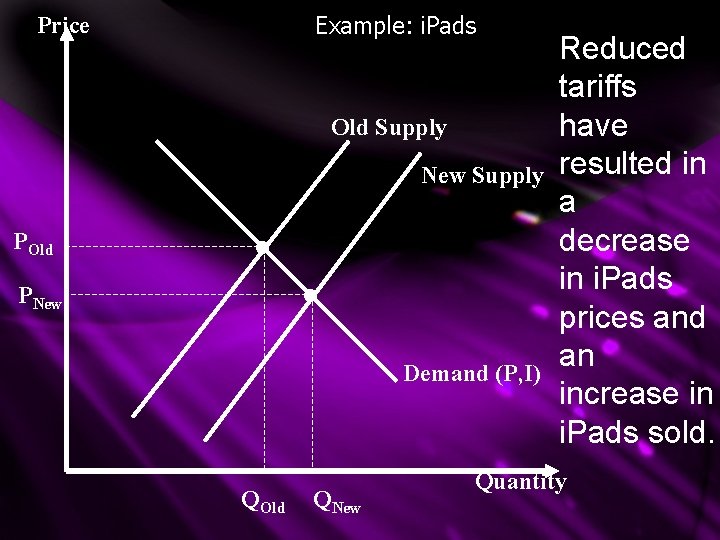
Example: i. Pads Price Old Supply New Supply POld • PNew • Demand (P, I) QOld QNew Reduced tariffs have resulted in a decrease in i. Pads prices and an increase in i. Pads sold. Quantity
Positive and Normative Analysis • In order to carry out effective policy, the policy maker must understand how the economy works • The is called POSITIVE ECONOMICS; The economics of facts & theory -ie: Minimum wage increases causes unemployment increases
Positive and Normative Analysis • In order to conduct policy, the policy maker must have some goals in mind • NORMATIVE ECONOMICS is the study of what the goals of the economy should be -ie: We should lower the minimum wage in order to lower unemployment
Positive and Normative Analysis • Positive economics is important to understand the economy • Normative economics is important to policy makers • Classify the following: – “When the price of the Xbox Onerises, more people buy the Playstation 4. ” – “We should buy Lorne a Playstation 4 to increase his utility. ”
- Slides: 26