
Econ 101 Introduction to Microeconomics Why study Economics






- Slides: 39
Econ 101 Introduction to Microeconomics • Why study Economics? • What’s it all about? Lorne Priemaza, M. A. Lorne. priemaza@ualberta. ca
What’s it all about? • Not: business or finance • Not: the stock market • Economics examines issues from a social perspective : Social Science – Analysis of human behavior – Close relative of psychology and sociology • Economics = Social Studies + Math
DEFINITION • 1. ECONOMICS – The study of how individuals & societies allocate limited resources to satisfy unlimited wants – The study of how choices are made & coordinated
What’s it all about? SCOPE • MICROECONOMICS – scarcity – supply & demand • markets • consumer • producer • changes/impacts – efficiency – technology – resources • MACROECONOMICS – business cycles – unemployment/ employment – inflation – trade, international markets (global economy)
SCOPE • MICROECONOMICS – The study of the decisions and interactions of individual people & businesses, & the effects of government regulation & taxes on prices & quantities of goods & services. • MACROECONOMICS – The study of the national economy & the global economy, the way that overall economic variables fluctuate & grow, & the effects of government actions on them.
DEFINITION • 1. ECONOMICS – The study of the problems that arise from scarcity, & of the institutions that resolve the inescapable conflicts over the uses of scarce resources.
DEFINITION • 2. ECONOMIC RESOURCES: – people or things that possess the ability to help produce commodities (goods & services) that people value.
DEFINITION • 2. ECONOMIC RESOURCES: – i) LAND (natural resources) : sites : productive items on or under the earth’s surface
DEFINITION • 2. ECONOMIC RESOURCES: – ii) LABOUR : productive people & their efforts to produce goods & services
DEFINITION • 2. ECONOMIC RESOURCES: – iii) PHYSICAL CAPITAL – all human made items used to produce goods & services. (produced means of production) - ie: Computers and Factories – not: Money
DEFINITION • 2. ECONOMIC RESOURCES: – iv) HUMAN CAPITAL – characterization of the education and training of workers (productivity of workers) - ie: years of university or years of job experience or innate ability
DEFINITION • 2. ECONOMIC RESOURCES: – v) Other: ENTREPRENEURIAL ABILITY : the innovator, the risk bearer, the initiator
RETURNS TO RESOURCES • Rent, Wages, Interest, Profit: – Rent is income earned by land – Wages are income earned by labour – Interest is income earned by capital – Profit is income earned by entrepreneurs
DEFINITION • 3. Scarcity • Peoples’ wants are greater than the economy’s ability to produce desirable goods & services ‘scarcity’ scarce (limited) resources unlimited wants (always want more) Scarce Resources + Unlimited Wants = Choice
Scarcity ≠ Poverty • A homeless man who wants to eat but cannot faces scarcity • A university student who wants to own a Mustang convertible but cannot faces scarcity • A millionaire who wants to be Prime Minister but cannot faces scarcity (only one spot available)
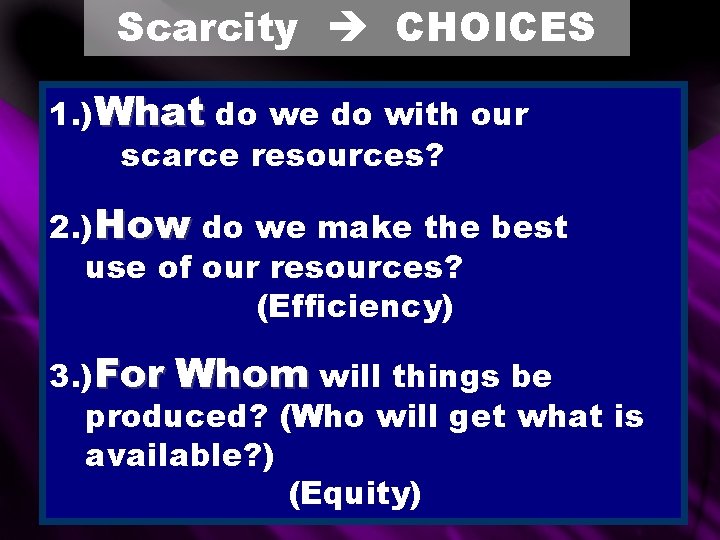
Scarcity CHOICES 1. )What do we do with our scarce resources? 2. )How do we make the best use of our resources? (Efficiency) 3. )For Whom will things be produced? (Who will get what is available? ) (Equity)
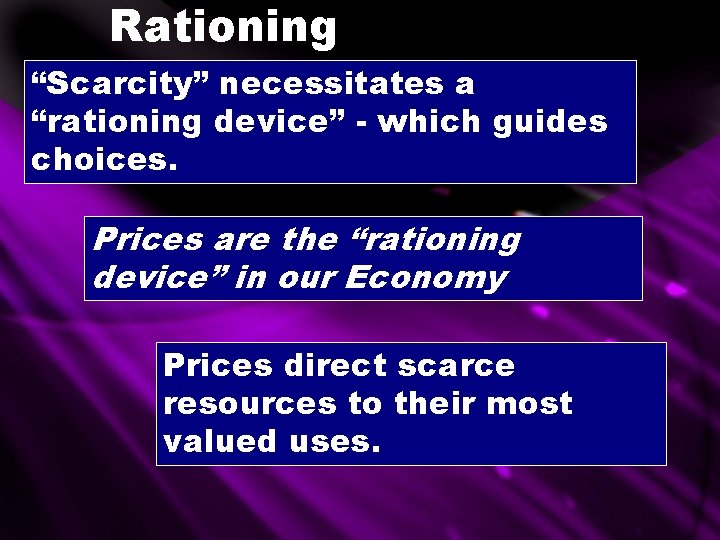
Rationing “Scarcity” necessitates a “rationing device” - which guides choices. Prices are the “rationing device” in our Economy Prices direct scarce resources to their most valued uses.
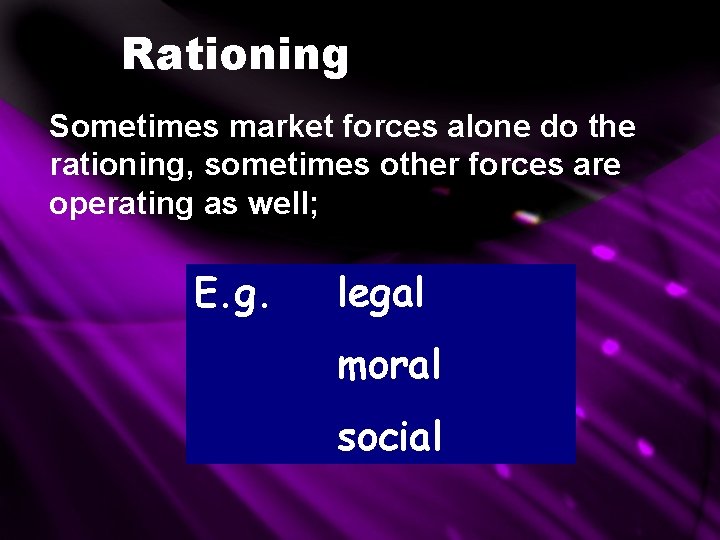
Rationing Sometimes market forces alone do the rationing, sometimes other forces are operating as well; E. g. legal moral social
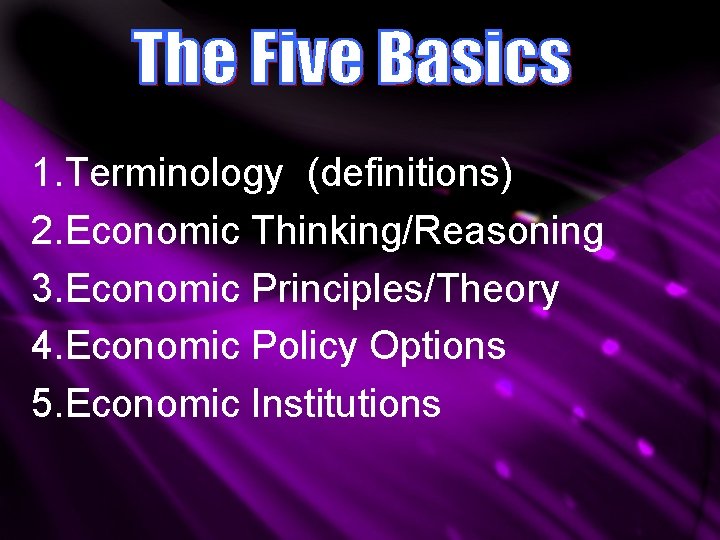
1. Terminology (definitions) 2. Economic Thinking/Reasoning 3. Economic Principles/Theory 4. Economic Policy Options 5. Economic Institutions
Basics: 1. ) Terminology • The language of Economics. • The world through “economics” glasses • You need to learn French to participate in a French literature class • You need to learn chemical notation to succeed in Chemistry • You need economic language to understand Economics
Basics 2. ) Economic Reasoning • Choices made under conditions of scarcity involve tradeoffs: – advantages and disadvantages: costs and benefits: incentives and disincentives. • Economic reasoning is making decisions by comparing costs and benefits.
The Rationality Assumption An individual makes decisions based on maximizing his or her own self-interest. Therefore People do not intentionally make decisions that would leave them worse off
Non-Satiation Assumption More goods are always preferable to fewer goods; people are never satiated Ø People will always pick a job with the highest wage Ø People will always eat 10 pieces of pizza instead of 1
Costs and Benefits • The relevant costs and benefits to economic reasoning are the expected incremental or additional costs incurred and the expected incremental or additional benefits of a decision – That is only the costs and benefits that will be affected by the decision are considered – ADDITTIONAL costs or ADDITIONAL benefits
Marginal Cost, Marginal Benefit • M. C. (marginal cost) is the extra cost associated with the additional activity…. • M. B. (marginal benefit) is the extra benefit associated with the additional activity…. • $’s are used to measure these in order to facilitate comparisons
No Sunk Costs • Sunk Costs – Have already been incurred and will not change as a result of the decision you are about to make. – Represent past decisions. – Are therefore not counted in a cost benefit decision – Ie: Cost of factory, rental costs, training costs, membership costs
ECONOMIC DECISION MAKING RULE: (COST/BENEFIT) • If the benefits of an action exceed the costs DO IT • If the costs of an action exceed the benefits DON’T DO IT • In the case of more than one alternative CHOOSE THE ACTION WITH THE GREATEST NET ADVANTAGE
Opportunity Cost • The basis of economic cost benefit analysis • When a choice is made in favour of one alternative, another alternative is given up • The next best alternative that is given up when a choice is made is called the opportunity cost of the choice.
THE OPPORTUNITY COST of an action is the next best foregone alternative.
Cost Benefit Exercise: Example of economic decision making in action: Should I Go To University? • Consider the “marginal” costs: and the “marginal” benefits of this decision. • Consider the Opportunity Cost
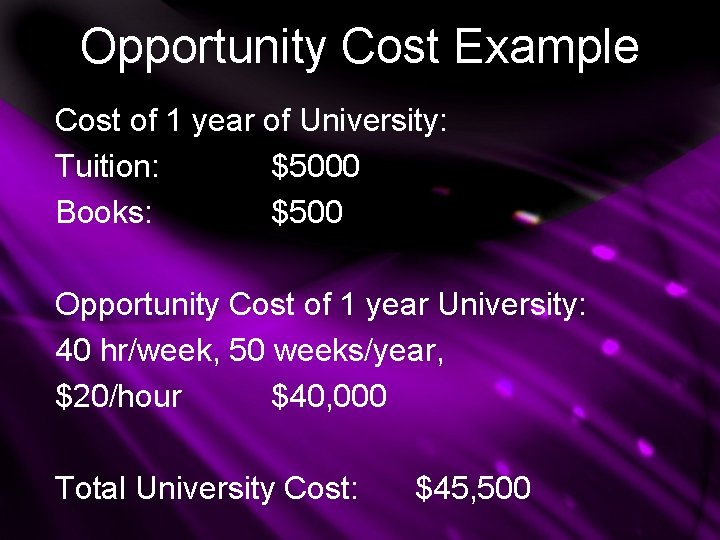
Opportunity Cost Example Cost of 1 year of University: Tuition: $5000 Books: $500 Opportunity Cost of 1 year University: 40 hr/week, 50 weeks/year, $20/hour $40, 000 Total University Cost: $45, 500
Basics: 3. )Theory • Simplified statement/ generalization about some part of the economy, based on assumptions – Assumptions define the circumstances under which a theory is likely to apply • ceteris paribus assumption -everything else held constant • Abstraction from reality • Helps us to understand/explains some part of the economy
Theory Assumptions • Assumptions b. Why make Assumptions? Set the Stage Simplify b. In order you understand a theory, you must understand the assumptions underlying theory.
Theory • Method – observe patterns in raw data • generalize about the observed pattern • Model: – name for more specific statement of a theory
Testing Theories • It is wrong to judge the validity of a theory on the basis of • the “unrealistic” assumptions. • how closely it represents reality. • A model is “good” if it yields usable predictions and explanations of the real world – when a model is no longer supported by factual evidence, it is “no good” – we need a new theory
Basics: 4) Policy • In order to carry out effective policy, the policy maker must understand how the economy works • The is called POSITIVE ECONOMICS; The economics of facts & theory -ie: Minimum wage increase causes unemployment increase
Basics: 4) Policy • In order to conduct policy, the policy maker must have some goals in mind • NORMATIVE ECONOMICS is the study of what the goals of the economy should be -ie: We should lower the minimum wage in order to lower unemployment
Basics: 4) Policy • Formulated to achieve the normative GOALS for the economy – Efficiency: use all our resources, (full employment), use them in the best way possible. – Equity in the distribution of income – Economic Growth – Stability: stable prices, stable growth – Full Employment: Everyone looking for a job finds one fairly quickly
Basics 5. ) Economic Institutions • Economic Institutions emerge from a complicated combination of historical circumstance & economic, cultural, social & political pressures. • Corporations, governments and cultural norms are all economic institutions. They differ significantly among nations • Institutions give models context