
ECommerce The Second Wave Fifth Annual Edition Chapter
- Slides: 49
E-Commerce: The Second Wave Fifth Annual Edition Chapter 3: Selling on the Web: Revenue Models and Building a Web Presence Electronic Commerce: The Second Wave, Fifth Annual Edition
OUTCOMES At the end, student should know: • Revenue models • How some companies move from one revenue model to another to achieve success • Revenue strategy issues that companies face when selling on the Web Electronic Commerce: The Second Wave, Fifth Annual Edition 2
OUTCOMES • Creating an effective business presence on the Web • Web site usability • Communicating effectively with customers on the Web Electronic Commerce: The Second Wave, Fifth Annual Edition 3
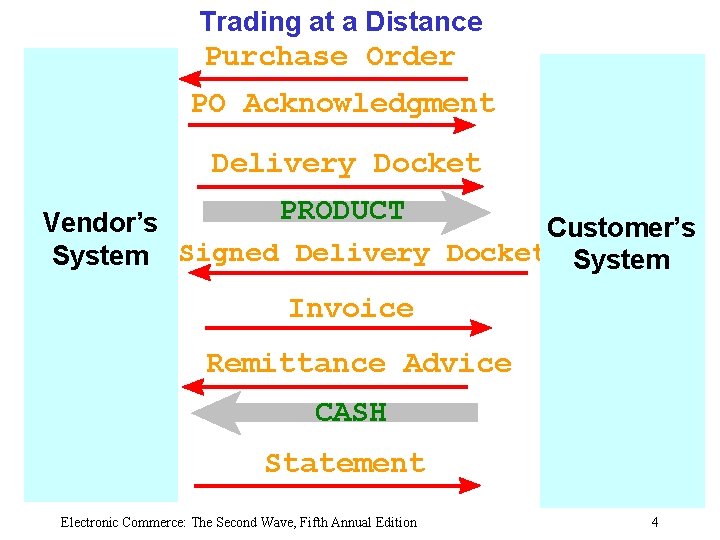
Trading at a Distance Purchase Order PO Acknowledgment Delivery Docket PRODUCT Vendor’s Customer’s System Signed Delivery Docket System Invoice Remittance Advice CASH Statement Electronic Commerce: The Second Wave, Fifth Annual Edition Information exchanges in trading 4
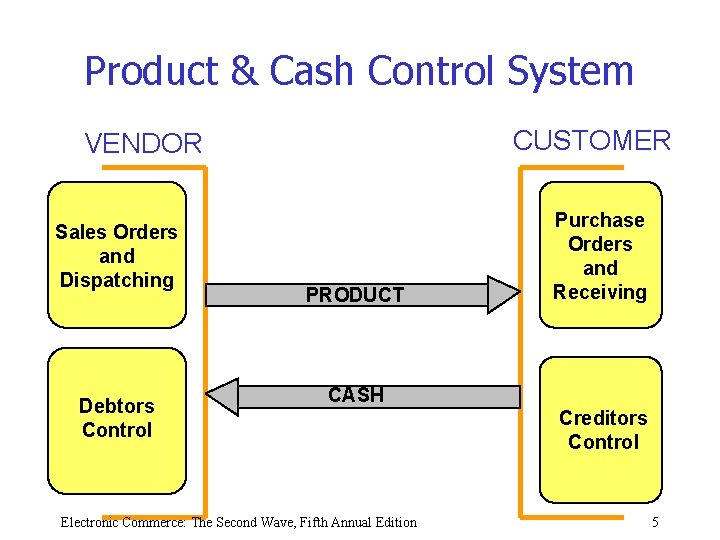
Product & Cash Control System CUSTOMER VENDOR Sales Orders and Dispatching Debtors Control PRODUCT Purchase Orders and Receiving CASH Electronic Commerce: The Second Wave, Fifth Annual Edition Creditors Control 5
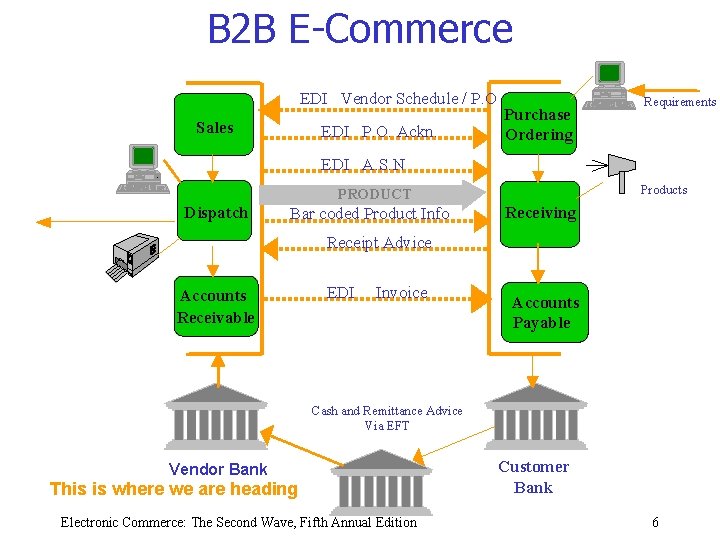
B 2 B E-Commerce VENDOR CUSTOMER EDI Vendor Schedule / P. O. Enter Shipment Details Sales EDI P. O. Ackn. Purchase Ordering Dispatch Bar coded Product Info Requirements Scan Bar coded Products EDI A. S. N. PRODUCT Requirements Enter Receiving Receipt Advice Print Bar code Labels Accounts Receivable EDI Invoice Accounts Payable Cash and Remittance Advice Via EFT Customer Bank Vendor Bank This is where we are heading Electronic Commerce: The Second Wave, Fifth Annual Edition A. C. H 6
Revenue Models • Revenue model of selling goods and services on the Web – Based on mail order catalog revenue model that predates the Web • Mail order or catalog model – Proven to be successful for wide variety of consumer items • Web catalog revenue model – Taking the catalog model to the Web Electronic Commerce: The Second Wave, Fifth Annual Edition 7
Computers and Consumer Electronics • Apple, Dell, Gateway, and Sun Microsystems – Have had great success selling on the Web • Dell – Created value by designing entire business around offering high degree of configuration flexibility to its customers Electronic Commerce: The Second Wave, Fifth Annual Edition 8
Books, Music, and Videos • Retailers using the Web catalog model to sell books, music, and videos – Among the most visible examples of electronic commerce • Jeff Bezos – Formed Amazon. com • Jason and Matthew Olim – Formed online music store they called CDnow – Used the Web catalog revenue model Electronic Commerce: The Second Wave, Fifth Annual Edition 9
Luxury Goods • People are still reluctant to buy through a Web site • Web sites of Vera Wang and Versace – Constructed to provide information to shoppers, not to generate revenue • Web site of Evian – Designed for a select, affluent group of customers Electronic Commerce: The Second Wave, Fifth Annual Edition 10
Clothing Retailers • Lands’ End – Pioneered idea of online Web shopping assistance with its Lands’ End Live feature in 1999 • Personal shopper – Intelligent agent program that learns customer’s preferences and makes suggestions • Virtual model – Graphic image built from customer measurements Electronic Commerce: The Second Wave, Fifth Annual Edition 11
Flowers and Gifts • 1 -800 -Flowers – Created online extension to its telephone order business • Chocolatier Godiva – Offers business gift plans on its site Electronic Commerce: The Second Wave, Fifth Annual Edition 12
Digital Content Revenue Models • Firms that own intellectual property – Have embraced the Web as a new and highly efficient distribution mechanism • Lexis. com – Provides full-text search of court cases, laws, patent databases, and tax regulations • Pro. Quest – Sells digital copies of published documents Electronic Commerce: The Second Wave, Fifth Annual Edition 13
Advertising-Supported Revenue Models • Broadcasters provide free programming to an audience along with advertising messages • Success of Web advertising hampered by – No consensus has emerged on how to measure and charge for site visitor views • Stickiness of a Web site: ability to keep visitors and attract repeat visitors – Very few Web sites have sufficient visitors to interest large advertisers Electronic Commerce: The Second Wave, Fifth Annual Edition 14
Web Portals • Web directory – A listing of hyperlinks to Web Pages • Portal or Web portal – Site used as a launching point to enter the Web – Almost always includes a Web directory and search engine – Example: Yahoo, AOL, Altavista Electronic Commerce: The Second Wave, Fifth Annual Edition 15
Advertising-Subscription Mixed Revenue Models • Subscribers – Pay a fee and accept some level of advertising – Typically subjected to much less advertising • Used by – The New York Times and The Wall Street Journal Electronic Commerce: The Second Wave, Fifth Annual Edition 16
Advertising-Subscription Mixed Revenue Models (continued) • Business Week – Offers some free content at its Business Week online site – Requires visitors to buy subscription to Business Week print magazine Electronic Commerce: The Second Wave, Fifth Annual Edition 17
Fee-for-Transaction Revenue Models • Businesses offer services and charge a fee based on number or size of transactions processed • Disintermediation – Removal of an intermediary from value chain • Reintermediation – Introduction of a new intermediary Electronic Commerce: The Second Wave, Fifth Annual Edition 18
Fee-for-Service Revenue Models • Fee based on value of service provided • Services – Range from games and entertainment to financial advice • Online games – Growing number of sites include premium games in their offerings – Site visitors must pay to play these premium games Electronic Commerce: The Second Wave, Fifth Annual Edition 19
Fee-for-Service Revenue Models (Continued) • Concerts and films – As more households obtain broadband access to the Internet • Companies are providing streaming video of concerts and films to paying subscribers • Professional Services – State laws • One of the main forces preventing U. S. professionals from extending their practices to the Web Electronic Commerce: The Second Wave, Fifth Annual Edition 20
Revenue Models in Transition • Subscription to Advertising-Supported Model – Microsoft founded its Slate magazine Web site • An upscale news and current events publication • Charged annual subscription fee after a limited free introductory period • Was unable to draw sufficient number of paid subscribers • Now operated as an advertising-supported site Electronic Commerce: The Second Wave, Fifth Annual Edition 21
Advertising-Supported to Advertising. Subscription Mixed Model • Salon. com – Operated for several years as an advertisingsupported site – Now offers optional subscription version of its site – Subscription offering • Motivated by company’s inability to raise additional money from investors Electronic Commerce: The Second Wave, Fifth Annual Edition 22
Advertising-Supported to Fee-for. Services Model • Xdrive Technologies – Opened its original advertising-supported Web site in 1999 – Offered free disk storage space online to users – After two years, was unable to pay costs of providing the service with the advertising revenue generated – Later switched to a subscription-supported model Electronic Commerce: The Second Wave, Fifth Annual Edition 23
Advertising-Supported to Subscription Model • Northern Light – Founded in August 1997 as a search engine with a twist – Revenue model • Combination of advertising-supported model plus a fee-based information access service – January 2002 • Converted to a new revenue model that was primarily subscription supported Electronic Commerce: The Second Wave, Fifth Annual Edition 24
Multiple Transitions • Encyclopædia Britannica – Original offerings • The Britannica Internet Guide – Free Web navigation aid • Encyclopædia Britannica Online – Available for a subscription fee or as part of CD package – 1999 • Converted to a free, advertiser-supported site – 2001 • Returned to a mixed model Electronic Commerce: The Second Wave, Fifth Annual Edition 25
Revenue Strategy Issues • Channel conflict – Occurs whenever sales activities on a company’s Website interfere with existing sales outlets – Also called cannibalization • Channel cooperation – Giving customers access to the company’s products through a coordinated presence in all distribution channels Electronic Commerce: The Second Wave, Fifth Annual Edition 26
Strategic Alliances and Channel Distribution Management • Strategic alliance – When two or more companies join forces to undertake an activity over a long period of time • Account aggregation services – Increase propensity of customers to return to the site • Channel distribution managers – Companies that take over responsibility for a particular product line within a retail store Electronic Commerce: The Second Wave, Fifth Annual Edition 27
Creating an Effective Web Presence • An organization’s presence – The public image it conveys to its stakeholders • Stakeholders of a firm – Include its customers, suppliers, employees, stockholders, neighbors, and the general public Electronic Commerce: The Second Wave, Fifth Annual Edition 28
Achieving Web Presence Goals • Objectives of the business – Attracting visitors to the Web site – Making the site interesting enough that visitors stay and explore – Convincing visitors to follow the site’s links to obtain information Electronic Commerce: The Second Wave, Fifth Annual Edition 29
Achieving Web Presence Goals (Continued) • Objectives of the business – Creating an impression consistent with the organization’s desired image – Building a trusting relationship with visitors – Reinforcing positive images that the visitor might already have about the organization – Encouraging visitors to return to the site Electronic Commerce: The Second Wave, Fifth Annual Edition 30
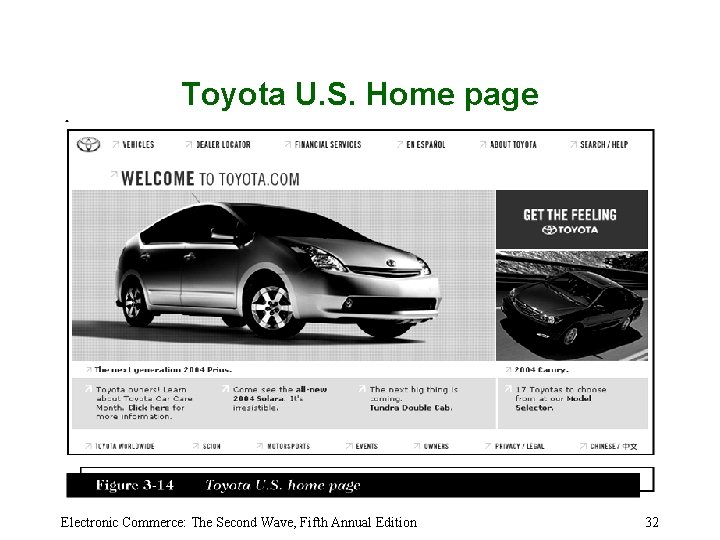
Profit-Driven Organizations • Toyota site – A good example of an effective Web presence – Provides links to • Detailed information about each vehicle model • A dealer locator page • Information about the company and the financing services it offers Electronic Commerce: The Second Wave, Fifth Annual Edition 31
Toyota U. S. Home page Electronic Commerce: The Second Wave, Fifth Annual Edition 32
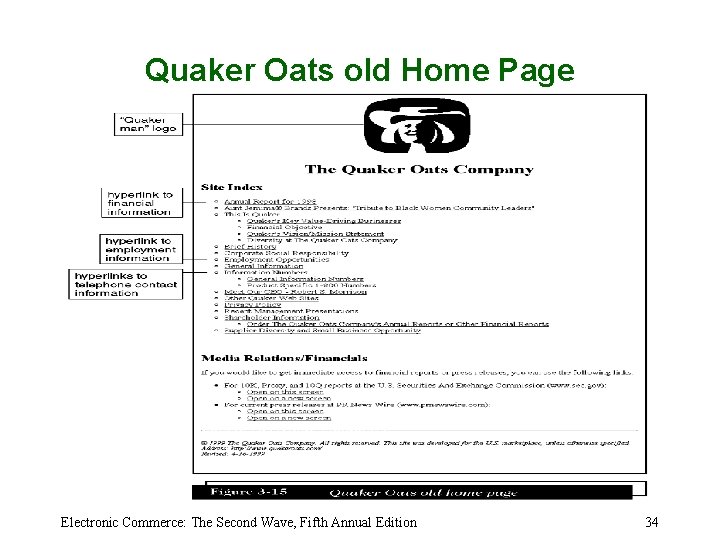
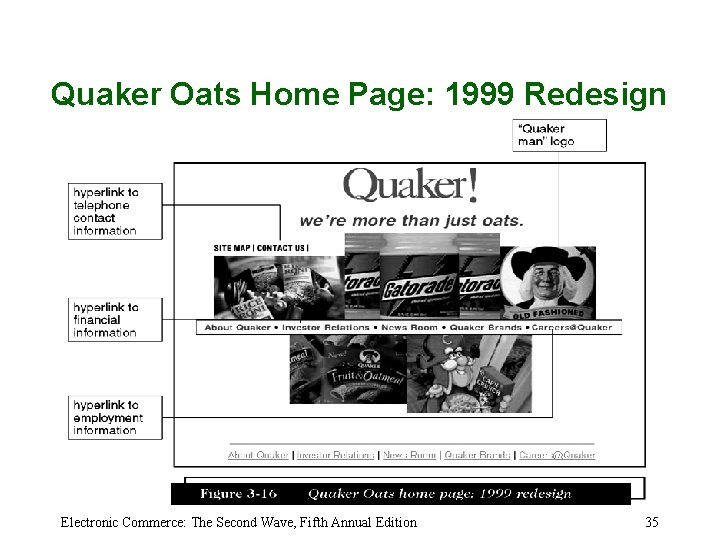
Profit-Driven Organizations (Continued) • Quaker Oats – Web site does not offer a particularly strong sense of corporate presence – Site is a straightforward presentation of links to information about the firm – Redesigned site • Essentially the same as previous version Electronic Commerce: The Second Wave, Fifth Annual Edition 33
Quaker Oats old Home Page Electronic Commerce: The Second Wave, Fifth Annual Edition 34
Quaker Oats Home Page: 1999 Redesign Electronic Commerce: The Second Wave, Fifth Annual Edition 35
Not-for-Profit Organization • Key goal for the Web sites – Information dissemination • Key element on any successful electronic commerce Web site – Combination of information dissemination and a two-way contact channel Electronic Commerce: The Second Wave, Fifth Annual Edition 36
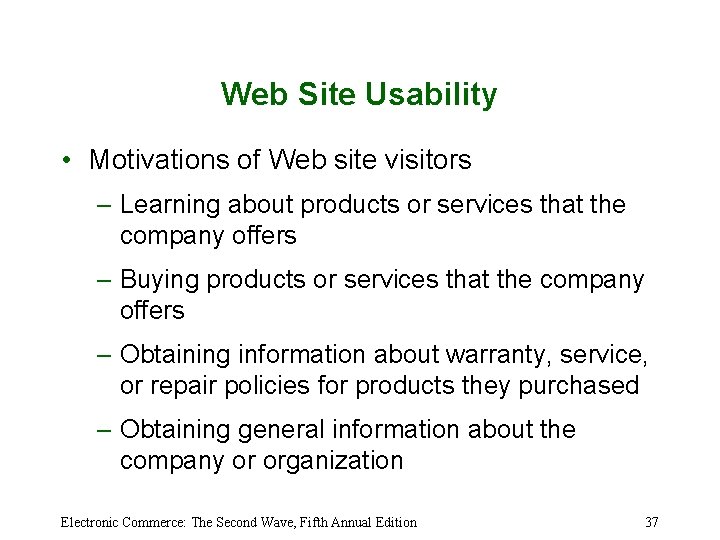
Web Site Usability • Motivations of Web site visitors – Learning about products or services that the company offers – Buying products or services that the company offers – Obtaining information about warranty, service, or repair policies for products they purchased – Obtaining general information about the company or organization Electronic Commerce: The Second Wave, Fifth Annual Edition 37
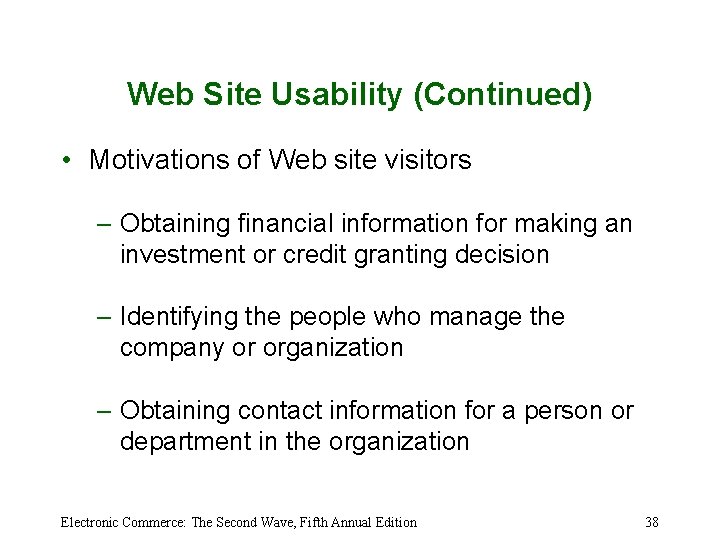
Web Site Usability (Continued) • Motivations of Web site visitors – Obtaining financial information for making an investment or credit granting decision – Identifying the people who manage the company or organization – Obtaining contact information for a person or department in the organization Electronic Commerce: The Second Wave, Fifth Annual Edition 38
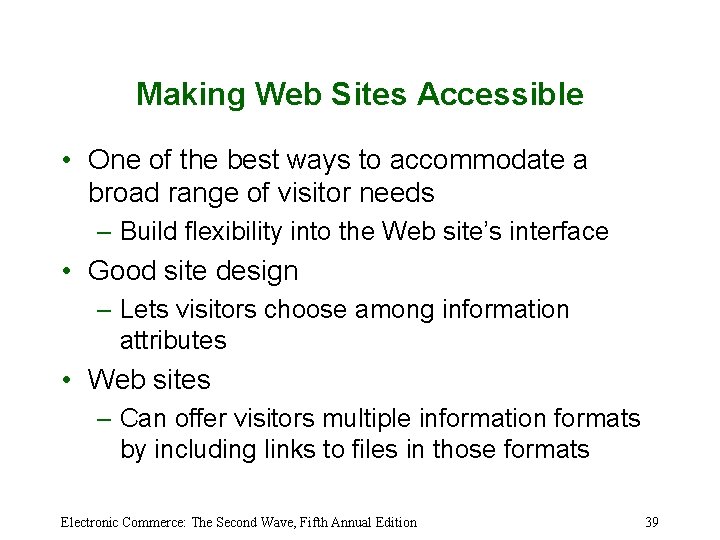
Making Web Sites Accessible • One of the best ways to accommodate a broad range of visitor needs – Build flexibility into the Web site’s interface • Good site design – Lets visitors choose among information attributes • Web sites – Can offer visitors multiple information formats by including links to files in those formats Electronic Commerce: The Second Wave, Fifth Annual Edition 39
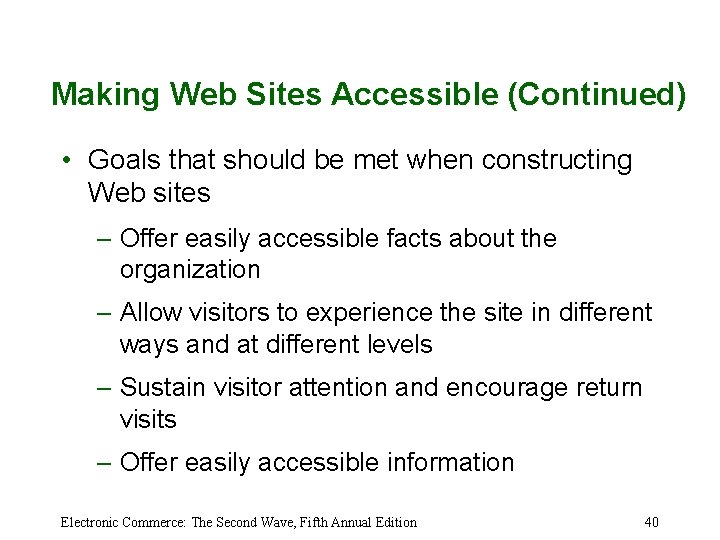
Making Web Sites Accessible (Continued) • Goals that should be met when constructing Web sites – Offer easily accessible facts about the organization – Allow visitors to experience the site in different ways and at different levels – Sustain visitor attention and encourage return visits – Offer easily accessible information Electronic Commerce: The Second Wave, Fifth Annual Edition 40
Trust and Loyalty • Studies by business researchers – A 5 percent increase in customer loyalty can yield profit increases between 25% and 80% • Repetition of satisfactory service – Can build customer loyalty • Customer service – A problem for many electronic commerce sites Electronic Commerce: The Second Wave, Fifth Annual Edition 41
Usability Testing • Companies that have done usability tests – Conduct focus groups – Watch how different customers navigate through a series of Web site test designs • Cost of usability testing – Low compared to total cost of a Web site design or overhaul Electronic Commerce: The Second Wave, Fifth Annual Edition 42
Customer-Centric Web Site Design • Putting the customer at the center of all site designs • Guidelines – Design site around how visitors will navigate the links – Allow visitors to access information quickly – Avoid using inflated marketing statements Electronic Commerce: The Second Wave, Fifth Annual Edition 43
Customer-Centric Web Site Design (Continued) • Guidelines – Avoid using business jargon and terms that visitors might not understand – Be consistent in use of design features and colors – Make sure navigation controls are clearly labeled – Test text visibility on smaller monitors – Conduct usability tests Electronic Commerce: The Second Wave, Fifth Annual Edition 44
Connecting With Customers • Personal contact model – Firm’s employees individually search for, qualify, and contact potential customers • Prospecting – Personal contact approach to identifying and reaching customers • Mass media approach – Firms prepare advertising and promotional materials about the firm and its products Electronic Commerce: The Second Wave, Fifth Annual Edition 45
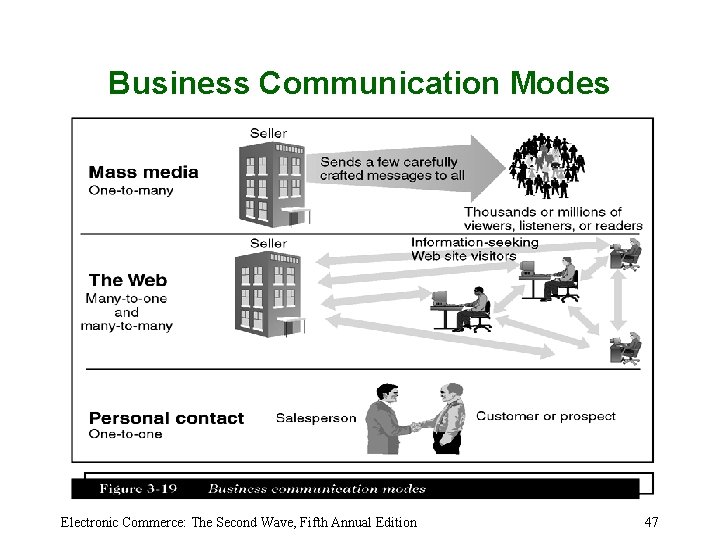
Connecting With Customers (Continued) • Addressable media – Advertising efforts directed to a known addressee – Also called mass media • One-to-many communication model – Communication flows from one advertiser to many potential buyers • One-to-one communication model – Both buyer and seller participate in information exchange Electronic Commerce: The Second Wave, Fifth Annual Edition 46
Business Communication Modes Electronic Commerce: The Second Wave, Fifth Annual Edition 47
Summary • Models used to generate revenue on the Web – Web catalog, digital content sales – Advertising-supported – Advertising-subscription mixed – Fee-for-transaction and fee-for-service • Companies undertaking electronic commerce initiatives to – Form strategic alliances – Contract with channel distribution managers Electronic Commerce: The Second Wave, Fifth Annual Edition 48
Summary • Firms – Must understand how the Web differs from other media • Enlisting help of users when building test versions of the Web site – A good way to create a site that represents the organization well • Firms must also – Understand nature of communication on the Web Electronic Commerce: The Second Wave, Fifth Annual Edition 49