
Ecommerce course Fundamentals of Ecommerce The Constitution of

![Refrences [1] Qin Z. , Li S D. An Compendium to E-Commerce. Beijing: Higher](https://slidetodoc.com/presentation_image_h2/c8b3ca7b009cd01bc513225671b8100c/image-11.jpg "Refrences [1] Qin Z. , Li S D. An Compendium to E-Commerce. Beijing: Higher")
- Slides: 11
E-commerce course: Fundamentals of E-commerce The Constitution of the E-commerce Client Intelligence (CI)
Client Intelligence (CI) Some specialists mentioned the notion of client intelligence in research. They classified it into three categories: the first one is the research on function, contents and essence of client intelligence. Mark Allen Smith equals client intelligence to client analysis. Analyzing the relationship between client intelligence and CRM, Paul Clark in BO Company thinks that client intelligence is where the wisdom of CRM is. The second is the research on realization of client intelligence.
Jim Berkowitz puts forward that business intelligence is the foundation of CRM. The other valuable point is that the analysis is made about the components of CRM, regarding OLAP, database, and data mining technology as the indispensable components for business intelligence. The third one is the research closely related to client intelligence. Emma Chablo points out that client knowledge is an important part of CRM while marketing data intelligence is the part to provide CRM the real client knowledge. He defines marketing data intelligence as using data-driven marketing metrics and technology to improve the understanding of clients and products, and to deal with the data and accordingly help CRM make strategic
Because different people do research on it from different perspectives, it is difficult to sum up a convincing definition. There is one thing in common below: few people have done research on client intelligence from the perspective of the role that knowledge plays in making client-related decisions. As a matter of fact, only by doing research on knowledge can people discover the essential contents of client intelligence. In this book, client intelligence is the creative use of clients information, an integration of concepts, methodology, process and software of decision-making and overall operation capacity to help enterprises improve clients relationship.
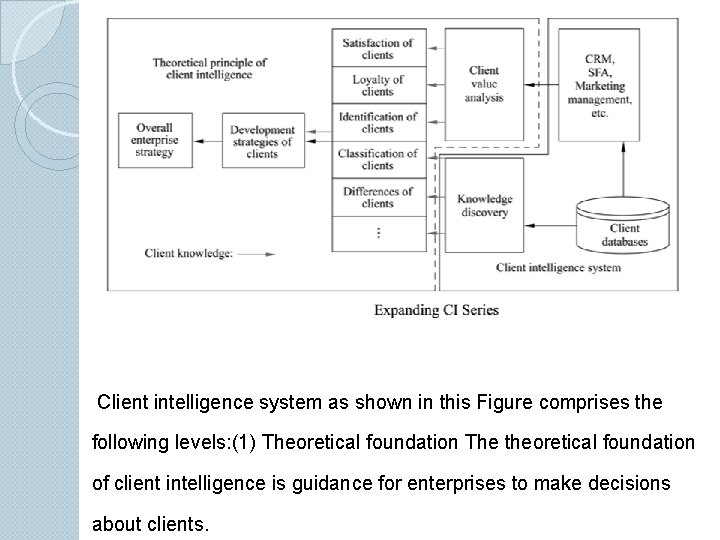
Client intelligence system as shown in this Figure comprises the following levels: (1) Theoretical foundation The theoretical foundation of client intelligence is guidance for enterprises to make decisions about clients.
It includes not only theories and measures by which enterprises analyze and treat clients, but client value analysis from the perspective of clients and enterprises respectively. Through analysis on consumption behaviors, satisfaction, interest rate, etc. enterprises reach the goal of scientific decision-making and rationality. Analysis on clients value is tremendously supportive to client-related activities. For example, such activities as customer identification, customer segmentation, customer differentiation, customer satisfaction and so on will be goal-oriented and guide a correct client relation with support of the analysis on client value.
(2) information system It is the physical foundation for CI system, and is reflection in software which has strong capacity to make decision and analysis and in information system platform gearing to the special application field. (3) data analysis As a series of computation, devices or models, it intends to obtain high-quality data or information about theme concerned, then involve in using analytical computation, devices or models automatically or by hand to help people analyze information, reach a conclusion, form a hypothesis and test a hypothesis. (4) knowledge discovery Same as level (3) above, it is also a series of computation, tools or models. It intends to transform data into information, then into knowledge through discovery, or directly transform data into knowledge.
(5) strategic level It intends to apply information or knowledge to such aspects as improving decision-making, operational capacity, enterprises’ construction model, etc. The strategic level is a combination of a series of concepts, methods and processes for improving the enterprises’ capacity to make decisions by use of information from many sources and application experience and hypothesis. By obtaining, managing and analyzing information, it provides all the staffs the access to knowledge so as to improve the capacity of strategic decision-making and tactic decision-making.
The strategy for client development refers to the client-centered development strategy, taking into account the resources inside the enterprises and environmental elements outside enterprise and reaching the final goal of maximizing the life periodical value of the clients. The client development strategy must be supported by other strategies like aimed market, marketing combination, market competition, accounting, coordination, organization, talents and so on. Client-centered development strategy cannot substitute for the overall strategy of an enterprise, while it is the most valuable strategy for reference in the overall strategy.
As a system framework based on the controllability of CI theory, CI system includes information system, data analysis, knowledge discovery in CI series. Therefore, CI series can also be shown simply by basic CI theory and CI system based on CI theory. CRM system based on CI is one of the CI systems presented in this book. All in all, CI aims at transforming the information in the enterprises to competitive advantage, improving its capacity to make decisions, the efficiency and accuracy of decision-making. To fulfill this aim, CI must have the computation, model and process for realizing the transfer from data analysis to knowledge discovery while theme of decision-making has to be extremely general.
Refrences [1] Qin Z. , Li S D. An Compendium to E-Commerce. Beijing: Higher Education Press, 2001. [2] Qin Z. , Xie G T. , Li S D. , & Jia X L. ECommerce System Structure and System Design. Xi’an: Xi’an Jiaotong University Press, 2001. [3] Qin Z. , Han Y. & Yan L X. Computer System Intergration and E-commerce. Xi’an: Xi’an Jiaotong University Press, 2001. [4] Qin Z. , Wang Z M. & Bao F M. Design Practice of Virtual Network. Xi’an: Xi’an Jiaotong University Press, 2001. [5] Qin Z. , Liu X Y. & Wang LR. Case Study on E-commerce. Xi’an: Xi’an Jiaotong University Press, 2001. [6] Qin Z. , Wang Y L. , Zhang L. & Wei M T. Virtual Business Management. Xi’an: Xi’an Jiaotong University Press, 2001. [7] K. Laudon, C. Traver. E-Commerce: Business, Technology, Society (3 rd Edition). Prentice-Hall, Inc. NJ, USA. 2006. [8] William G. Page. Jr. A Handbook of Oracle 8/8 i Development and Application (the first edition) Beijing: Machinery Industry Press, 2000. [9] Wang Q. , Qiu R J. & Wang H W. The Design and Achievement of Client’s Information Management System. Information Techniques, Issue 7, 2000, & Issue 87, 2000, 1820. [10] F. Damanpour. E-business E-commerce Evolution: Perspective and Strategy. Managerial Finance. Vol. 27 (7): 16 -33, 2001. [11] Yu Z T. , Song L Z. Che W G. & Guo J Y. The Strategies of Database Techniques in Shopping Vehicles on Internet. Computer Application, No. 8, Vol (20), 2000, 6668. [12] W. David. E-commerce: Strategy, Technologies And Applications. TATA MCGRA, India, 2000. [13] Zhang C X. , Tang J G. & Xie Y F. The Establishment of Bamboo Product Information System Database and the Design of Information Inquiry Function. Journal of Najing Forestry University Sum No. 70, Volume 12, 1996. [14] Daniel I. Joshi, Pavel A. A Complete Collection of References for Java Programmers. (the first edition) Beijing: China Water Conservancy and Hydroelectricity Press, 1999. [15] E. Turban, C. Cohen, I. M. Copi et al. Introduction to E-Commerce. Pearson Education, NJ, USA, 2003. [16] Yen-Liang Chang, Chen, S. Chyun-Chyi Chen, I. Workflow process Definition and Their Applications in E-commerce. Multimedia Software Engineering, 2000. Proceedings. International Symposium on, 2000, 193200. [17] Weaver, A. C. Vetter, R. J. Whinston, A. B. Swigger, K. The future of E-commerce. Computer, Volume: 33 Issue: 10, Oct. 2000, 3031. [18] S. Korper, J. Ellis. The E-commerce Book: Building the E-empire. Morgan Kaufmann, San Fransisco, USA, 2001. [19] Bhaskaran, K. Jen-Yao Chung Das, R. Heath, T. Kumaran, S. Nandi, P. An E-business Integration & Collaboration Platform for b 2 b E-commerce. Advanced Issues of E-Commerce and Web-Based Information Systems, WECWIS 2001, Third International Workshop on, 2001, 120122. [20] A. Panagariya. E-Commerce, WTO and Developing Countries. World Economy, Vol. 23 (8): 959978, 2002. [21] Pi Y. On Technological Crime in the Field of Finance. Legal Science Review, 2000. [22] Qu X W. Crime on Internet and Its Containing. Legal Science Study, 2000. [23] Wang Y. A Brief Analysis on E-commerce Law Issues. Legal Science Review, 2000. [24] Wi J P. E-commerce in China: Problems and Their Countermeasures. China Computer Paper, 1999. [25] Venkatraman, Mahadevan; Singh, Munindar P. Verifying Compliance with Commitment Protocols. Autonomous Agents and Multi-Agent Systems; 13872532; No. 3 (2), 1999. [26] Shaw, Michael J. Electronic Commerce: Review of Critical Research Issues. Information Systems Frontiers; 13873326; No. 1 (1), 1999. [27] Garrett, S. G. E. ; Skevington, P. J. An Introduction to Electronic Commerce. BT Technology Journal; 13583948˗No. 3 (17), 1999. [28] Unitt, M. , Jones, I. C. EDI-The Grand Daddy of Electronic Commerce. BT Technology Journal; 13583948; No. 3 (17), 1999. [29] Trask, N. T. Meyerstein, M. V. Smart Cards in Electronic Commerce. BT Technology Journal; 13583948; No. 3 (17), 1999. [30] S. S. Y. Shim, V. S. Pendyala, M. Sundaram, J. Z. Gao, Business-to-Business E-Commerce Frameworks. Computer, vol. 33(10): 4047, 2000. [31] D. Kinyon. Quarterly retail ecommerce sales: 4 th quarter 2007. US Census Bureau News 2008, CB 08 -24. [32] A. K. Ghosh, T. M. Swaminatha. Software security and privacy risks in mobile e-commerce. Communications of the ACM, Vol. 44(2): 5157, 2001. [33] S. Hawk. A Comparison of B 2 C E-Commerce in Developing Countries. Electronic Commerce Research, Vol. 4(3): 181199, 2004. [34] Lu X D. Making and Implementing E-commerce Strategies with Chinese Characteristics. Dongyue Series, 2001(01): 6063. [35] Liu J. Key Points and Measures of E-commerce Strategies in Canana. Global Watch of Science and Technology and Economy, 2000(6): 1415. [36] Tian H. Japan Plans to Be the Most Advanced Country in IT within Five Years. East Web. [37] He D G. Catching up with and Surpassing America: the Dream of Japanese IT Revolution. Army Paper, May 16 th, 2002. [38] Japan Publicizes New IT Strategies of the Year 2002. People’s Daily, June 28 th. 2001. [39] A. Tsalgatidou, J. Veijalainen.