
Ecommerce Business Models and Concepts Slide 2 1
E-commerce Business Models and Concepts Slide 2 -1
Learning Objectives n n n Identify the key components of e-commerce business models Describe the major B 2 C business models Describe the major B 2 B business models Recognize business models in other emerging areas of e-commerce Understand key business concepts and strategies applicable to e-commerce Slide 2 -2
E-commerce Business Models— Introduction Business model – set of planned activities designed to result in a profit in a marketplace n Business plan – document that describes a firm’s business model n E-commerce business model – aims to use and leverage the unique qualities of Internet and Web n Slide 2 -3
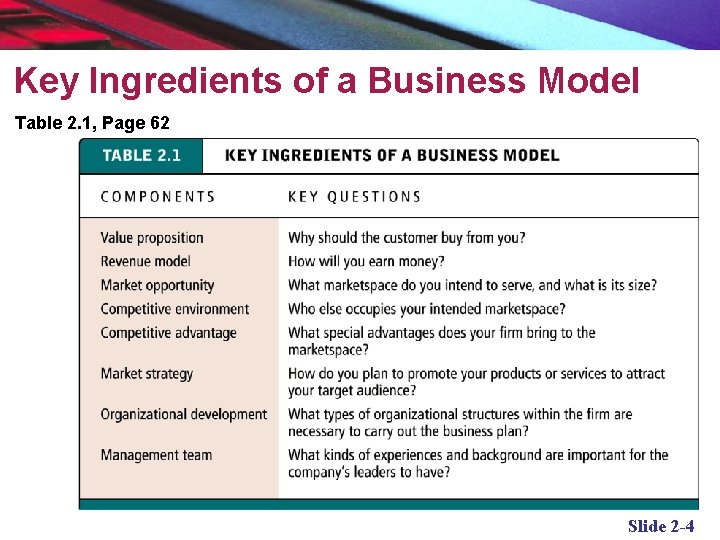
Key Ingredients of a Business Model Table 2. 1, Page 62 Slide 2 -4
Value Proposition Defines how a company’s product or service fulfills the needs of customers n Questions to ask: § Why will customers choose to do business with your firm instead of another? § What will your firm provide that others do not or cannot? n Examples of successful value propositions include: § Personalization/customization § Reduction of product search costs § Reduction of price discover costs § Facilitation of transactions by managing product delivery n Slide 2 -5
Revenue Model Describes how the firm will earn revenue, generate profits, and produce a superior return on invested capital n Terms financial model and revenue model often used interchangeably n Major types: § Advertising revenue model § Subscription revenue model § Transaction fee revenue model § Sales revenue model § Affiliate revenue model n Slide 2 -6
Advertising Revenue Model Web site that offers content, services and/or products also provides a forum for advertisements and receives fees from advertisers n Example: Yahoo. com n Slide 2 -7
Subscription Revenue Model Web site that offers users content or services charges a subscription fee for access to some or all of its offerings n Examples: § Consumer Reports Online § Yahoo! Platinum n Slide 2 -8
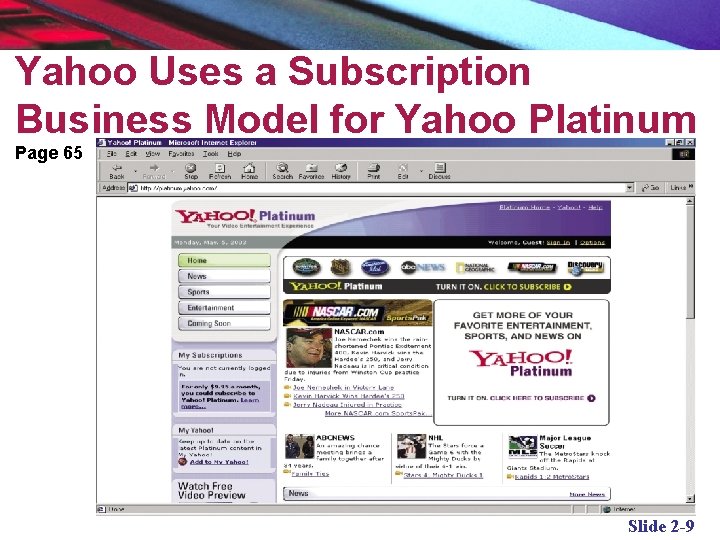
Yahoo Uses a Subscription Business Model for Yahoo Platinum Page 65 Slide 2 -9
Transaction Fee Revenue Model Company that receives a fee for enabling or executing a transaction n Examples: § e. Bay. com § E-Trade. com n Slide 2 -10
Sales Revenue Model Company derives revenue by selling goods, information, or services to customers n Examples: § Amazon. com § LLBean. com § Gap. com n Slide 2 -11
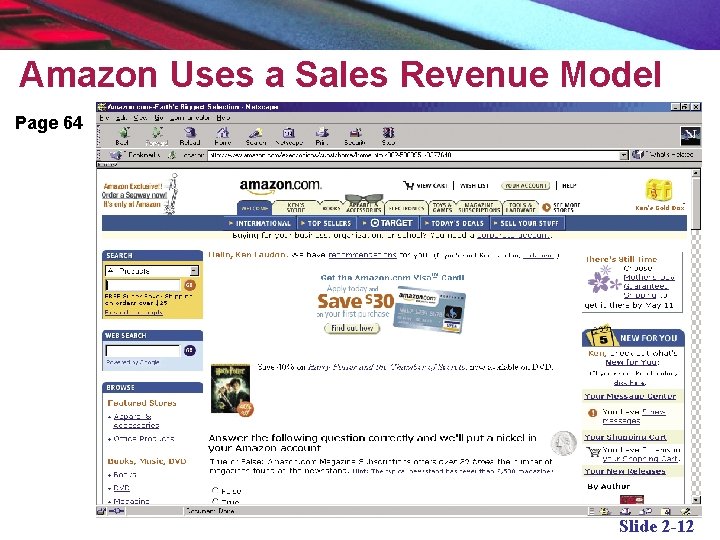
Amazon Uses a Sales Revenue Model Page 64 Slide 2 -12
Affiliate Revenue Model Sites that steer business to an “affiliate” receive a referral fee or percentage of the revenue from any resulting sales n Example: § My. Points. com n Slide 2 -13
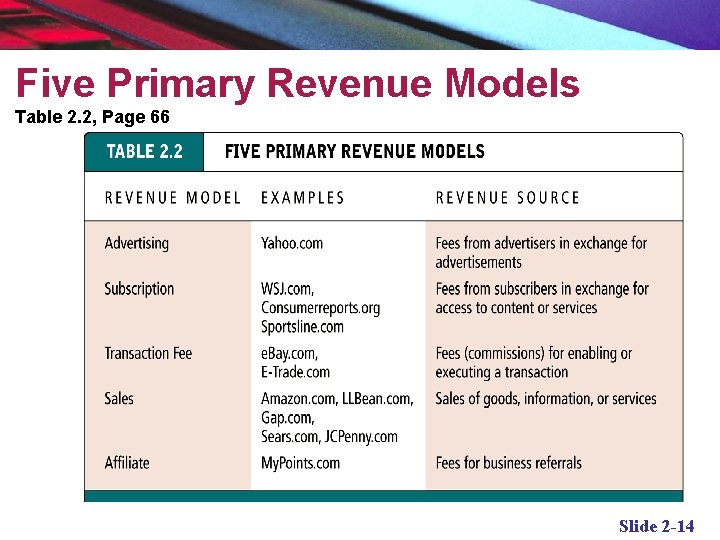
Five Primary Revenue Models Table 2. 2, Page 66 Slide 2 -14
Market Opportunity Refers to a company’s intended marketspace and the overall potential financial opportunities available to the firm in that marketspace n Marketspace – the area of actual or potential commercial value in which a company intends to operate n Realistic market opportunity is defined by revenue potential in each of market niches in which company hopes to compete n Slide 2 -15
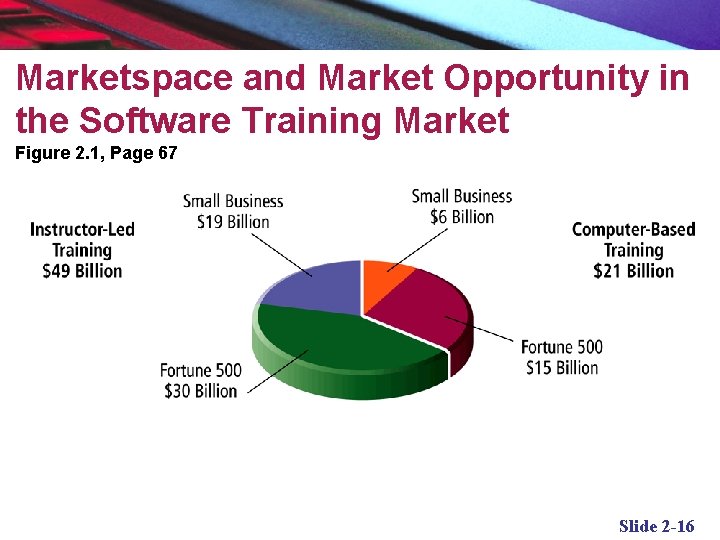
Marketspace and Market Opportunity in the Software Training Market Figure 2. 1, Page 67 Slide 2 -16
Competitive Environment Refers to the other companies selling similar products and operating in the same marketspace n Influenced by: § how many competitors are active § how large their operations are § what market share for each competitor is § how profitable these firms are § how they price their products n Slide 2 -17
Competitive Environment (cont’d) Direct competitors – companies that sell products or services that are very similar and into the same market segment § Example: Priceline. com and Travelocity. com n Indirect competitors – companies that may be in different industries but that still compete indirectly because their products can substitute for one another § Example: CNN. com and ESPN. com n Slide 2 -18
Competitive Advantage Achieved when firm can produce a superior product and/or bring product to market at a lower price than most, or all, of competitors n Firms achieve competitive advantage when they are able to obtain differential access to the factors of production that are denied to competitors n Asymmetry – when one participant in a market has more resources than others n Slide 2 -19
Competitive Advantage (cont’d) Types of competitive advantage include: § First mover advantage – results from a firm being first into a marketplace § Unfair competitive advantage – occurs when one firm develops an advantage based on a factor that other firms cannot purchase n Companies leverage their competitive assets when they use their competitive advantages to achieve more advantage in surrounding markets n Slide 2 -20
Market Strategy A plan that details how a company intends to enter a new market and attract customers n Best business concepts will fail if not properly marketed to potential customers n Slide 2 -21
Organizational Development Describes how the company will organize the work that needs to be accomplished n Work is typically divided into functional departments n Move from generalists to specialists as the company grows n Slide 2 -22
Management Team Employees of the company responsible for making the business model work n Strong management team gives instant credibility to outside investors n A strong management team may not be able to salvage a weak business model, but should be able to change the model and redefine the business as it becomes necessary n Slide 2 -23
Categorizing E-commerce Business Models: Some Difficulties No one correct way n We categorize business models according to e-commerce sector (B 2 C, B 2 B, C 2 C) n Type of e-commerce technology used can also affect classification of a business model n Some companies use multiple business models n Slide 2 -24
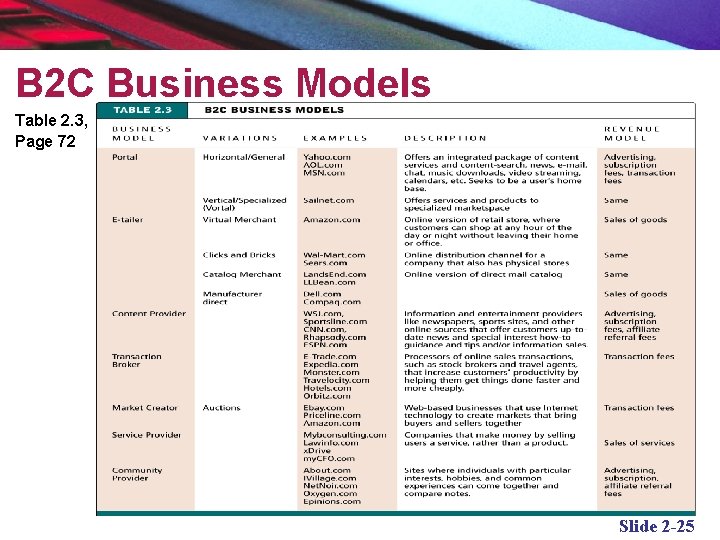
B 2 C Business Models Table 2. 3, Page 72 Slide 2 -25
B 2 C Business Models: Portal Offers powerful search tools plus an integrated package of content and services n typically utilizes a combines subscription/advertising revenues/transaction fee model n May be general or specialized (vortal) n Slide 2 -26
B 2 C Business Models: E-tailer Online version of traditional retailer n Types include: § Virtual merchants (online retail store only) § Clicks and bricks (online distribution channel for a company that also has physical stores) § Catalog merchants (online version of direct mail catalog) § Manufacturer-direct (manufacturer selling directly over the Web) n Slide 2 -27
B 2 C Business Models: Content Provider Information and entertainment companies that provide digital content over the Web n Second largest source of B 2 C e-commerce revenue in 2002 n Typically utilizes an subscription, pay for download, or advertising revenue model n Syndication a variation of standard content provider model n Slide 2 -28
B 2 C Business Models: Transaction Broker Processes online transactions for consumers n Primary value proposition – saving of time and money n Typical revenue model – transaction fee n Industries using this model: n Financial services n Travel services n Job placement services n Slide 2 -29
B 2 C Business Model: Market Creator Uses Internet technology to create markets that bring buyers and sellers together n Examples: § Priceline. com § e. Bay. com n Typically uses a transaction fee revenue model n Slide 2 -30
B 2 C Business Model: Service Provider Offers services online n Value proposition – valuable, convenient, time -saving, low-cost alternatives to traditional service providers n Revenue models – subscription fees or onetime payment n Slide 2 -31
B 2 C Business Models: Community Provider Sites that create a digital online environment where people with similar interests can transact, communicate, and receive interest-related information. n Typically rely on a hybrid revenue model n Examples: § Epinions. com § Oxygen. com § About. com n Slide 2 -32
- Slides: 32