
ECommerce BBA Hons Course Overview Introduction Lectures 1
E-Commerce BBA (Hons) Course Overview & Introduction Lectures 1, 2, 3 Course Lecturer: Farhan Mir © Farhan Mir 2014 IMS
Lectures 123 Administration Introducing Myself (which you already know) Course Introduction Few Words on Articles & Additional Readings Suggestions and criticism about previous semesters Suggestion for future course of action E-Business Overview My Own Website as Online Resource Center (www. themirs. org) © Farhan Mir 2014 IMS
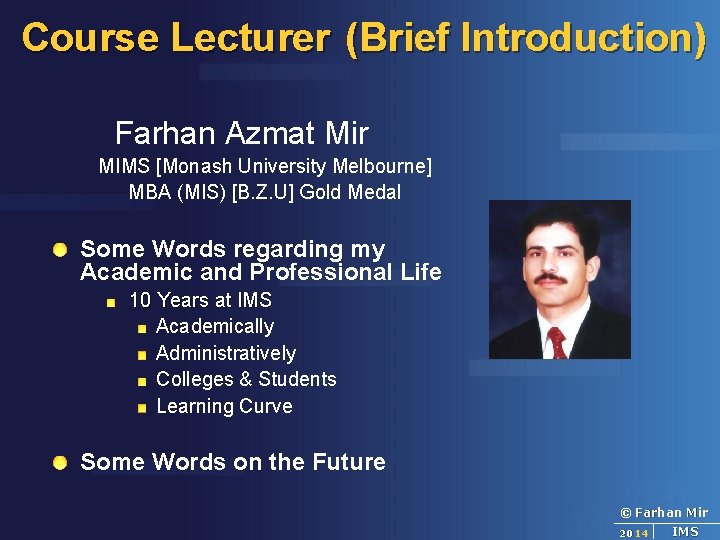
Course Lecturer (Brief Introduction) Farhan Azmat Mir MIMS [Monash University Melbourne] MBA (MIS) [B. Z. U] Gold Medal Some Words regarding my Academic and Professional Life 10 Years at IMS Academically Administratively Colleges & Students Learning Curve Some Words on the Future © Farhan Mir 2014 IMS
Current Responsibilities at IMS Advisor Students (Evening) All issues and queries relating to evening programs including BBA-IT, MBA (Banking) and MBA (Executive) Coordination of all academic and extra-curricular functions relating to evening programs including “Formal Orientations", "Welcome & Farewells Parties" Coordinator BBA-Eve Program Curriculum Development and Review All office documentation (Course Files and Quality documents) Coordination with Permanent & Visiting Faculty members Student application and documentation evaluation Class Scheduling and Monitoring © Farhan Mir 2014 IMS
My Introduction: Consultation Method v Best through e-mail address (farhanmir_99@hotmail. com) OR In case of submission of assignment through email (farhanmir@bzu. edu. pk) v After/before lectures on lecture day OR Announced Timings in case of Assignments or Reports © Farhan Mir 2014 IMS
My Introduction: Interests Sports Social & Cultural Change History & Art Personality Development Religion Creativity & New Ideas © Farhan Mir 2014 IMS
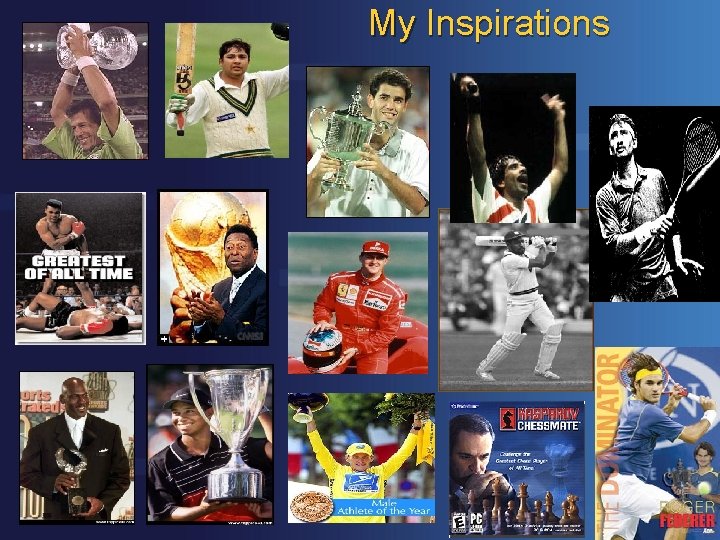
My Inspirations © Farhan Mir 2014 IMS
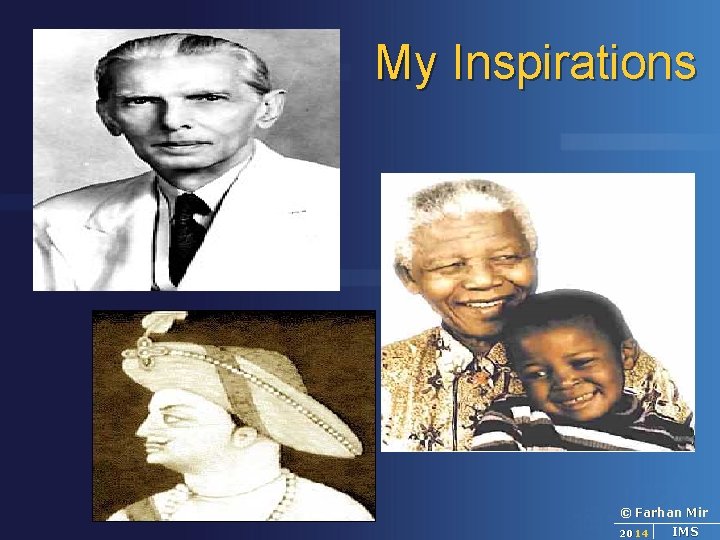
My Inspirations © Farhan Mir 2014 IMS
Favourite Quotes "Champions aren't made in gyms. Champions are made from something they have deep inside them: A desire, a dream, a vision. They have to have last-minute stamina, they have to be a little faster, they have to have the skill and the will. But the will must be stronger than the skill. " - Muhammad Ali © Farhan Mir 2014 IMS
Favourite Quotes “You are educated. Your certification is in your degree. You may think of it as the ticket to the good life. Let me ask you to think of an alternative. Think of it as your ticket to change the world”. (Tom Brokaw) © Farhan Mir 2014 IMS
Course Administration & Requirements © Farhan Mir 2014 IMS
Course Administration Exams and Assessment Basically 2 exams method Mid & Final 30 Mid 50 Final 20 Sess Eliminating one Exam suggests that there is a clear room for more practical work (so you must start getting worried about it !!!) © Farhan Mir 2014 IMS
Lecture Notes Available from Photostat shop before lectures or preferably one day before the start of new week Usually the lecture material will cover the topics of one week Lecture Notes also now available online on the given website address (www. themirs. org/ec. html) Lecture Notes will not be in detail format rather these will contain topics of discussion and important announcements regarding assessments. Most Importantly Lecture Notes are just a supporting material and students must not forget to read books for detail and complete understanding (In case of Management as a subject you need to do extensive reading on topics under discussion & look for majority of web sites for practical know how) © Farhan Mir 2014 IMS
Course Administration Sessionals Written assignments (Small Tasks) (details in coming lectures) Critiques on Articles (a one page summary on an article related to the discussion topic and trends in E-Commerce Idea is to initiate research oriented writing not “cut-copypaste” Attendance, Presentations, Quiz & Class Discussion & Participation (as a regular activity) Volunteer presentations (you must not be that familiar with this kind of stuff but you need to respond to it quickly!) Sessional’s loot sale Formal Presentations in groups and if you want to take it one step ahead you could arrange small seminars for other classes (preferably your juniors) on given “Research Topics” © Farhan Mir 2014 IMS
How to get more marks? Requirements Overall Class Attitude Things to Avoid (Referencing, Cut-Copy. Paste Culture, Carelessness, leg-pulling) Things to do (Innovation, Confidence, Work Attitude) Sense of Maturity and continuous learning © Farhan Mir 2014 IMS
One of the Major Sessionals Case Study Presentation Students in groups of 5 -6 will choose an e-Business (Preferably a Pakistani Organization) Case should be developed on the given format (A model format will be discussed in upcoming lectures) Students need to develop a proper case study using the case study development guidelines Eventually will present their findings in the shape of a Presentation in front of the class or classes on Multimedia Students need to submit both Hard (Printed) and Soft copies (Computer files) of the Case itself and that of the Power. Point Presentation This is day 1 so you can start working now! I will myself present at least one Case Study well before the presentation schedule so that you people have an idea © Farhan Mir 2014 IMS
Past Student Case Studies Harley Davidson (Motor Bike Company) PIA (Travel Industry) UBL (Banking Online) World Expeditions (Tourism & Travel) Ufone(Telecommunication) IBM (Computer Giant) © Farhan Mir 2014 IMS
Course Orientation Basically Theoretical focus Introduction of Concepts and Issues regarding EBusiness (This subject is developed in case study mode: it means that there are lot of case studies) But The practical orientation will also be a major focus of the course (this will include practical demonstration on multimedia) Lecture notes will include more graphical explanation of things to give more practical orientation about concepts & applications especially the websites of major e-Businesses Formal Presentation from Students will also work in this regard Video or Audio Presentation will also be part of the lectures © Farhan Mir 2014 IMS
Examination I personally believe in “thorough studies” so usually no choices given in the exam Every thing discussed, during the class or given as reading material, could be part of the exams Questions will be formulated in a way to examine both bookish as well as conceptual thinking Other details will be given close to Mid I will try to follow my simple rule that is “ I’ll be very friendly in the lectures and very strict in the exam hall (believe me no chance of misconduct…)” © Farhan Mir 2014 IMS
Text & References Focus will be on topics rather Chapters of any text Many Text/books are available in market Efraim Turban, Jae Lee, David King, Ting-Peng Liang & Deborrah Turban. (2010). “Electronic Commerce: A Managerial Perspective” (Sixth Edition). Prentice Hall International Mostly things will be taught from the Text but students need to broaden their view and consult as many additional references as possible (Preferably available in local market and from the Internet) © Farhan Mir 2014 IMS
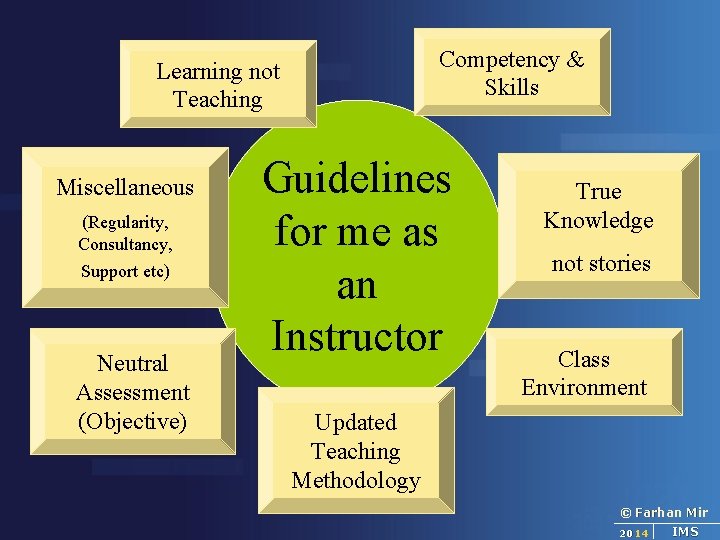
Competency & Skills Learning not Teaching Miscellaneous (Regularity, Consultancy, Support etc) Neutral Assessment (Objective) Guidelines for me as an Instructor True Knowledge not stories Class Environment Updated Teaching Methodology © Farhan Mir 2014 IMS
Overview of Electronic Commerce & EBusiness © Farhan Mir 2014 IMS
EC Definitions & Concepts Electronic Commerce (EC) is the process of buying, selling, or exchanging products, services, and information via computer networks EC defined from these perspectives Communications Business process Service Online Collaborations Community © Farhan Mir 2014 IMS
E-Business Definitions & Concepts E-business is a broader definition of EC that includes not just the buying and selling of goods and services, but also Servicing customers (Value Added Information) Collaborating with business partners (Alliances /Networks) Conducting electronic transactions within an organization (Intra-Business Activities) Non-Profit Activities (Community Building) © Farhan Mir 2014 IMS
E-Business Quote from Lou Gerstner, former IBM’s CEO: “E-Business is all about speed, globalization, enhanced productivity, reaching new customers, and sharing knowledge across institutions for competitive advantage. ” © Farhan Mir 2014 IMS
Introduction What is E-Business? Simple definition: Any business carried out in electronic form. “The complex fusion of business processes, enterprise applications, and organizational structure to create a highperformance business model. ” (Kalakota and Robinson) © Farhan Mir 2014 IMS
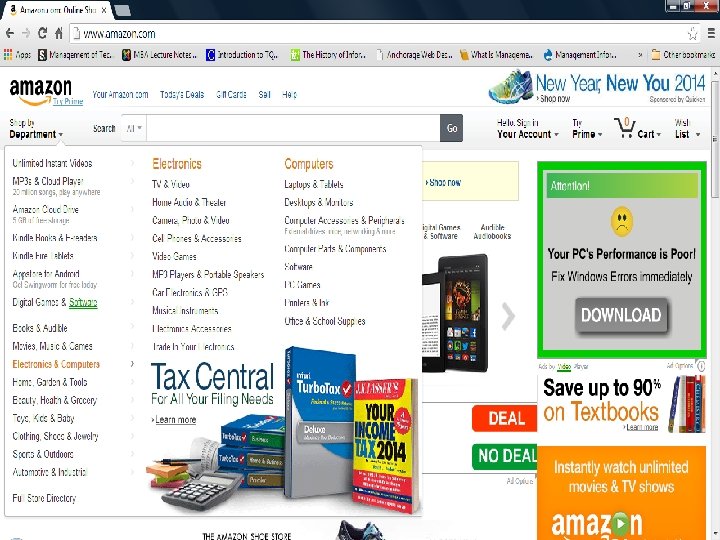
Examples of E-Business Yahoo e. Bay Amazon Priceline Sears Virtual University of Pakistan © Farhan Mir 2014 IMS
Examples of E-Commerce Online Auctions - OLX ATM machines? ? ? - Banks Billing KIOSKs – NADRA Online Transactions – Online Banking Attendance Systems – Wide range of Industries EFPOS and Magnetic Cards © Farhan Mir 2014 IMS
© Farhan Mir 2014 IMS
© Farhan Mir 2014 IMS
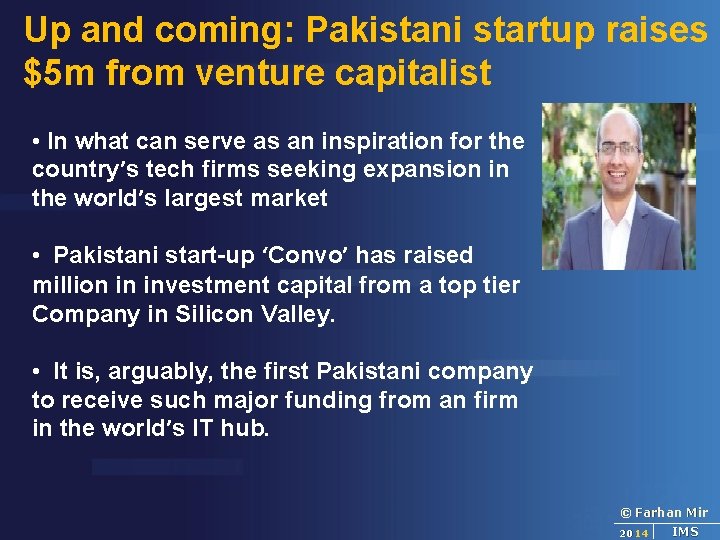
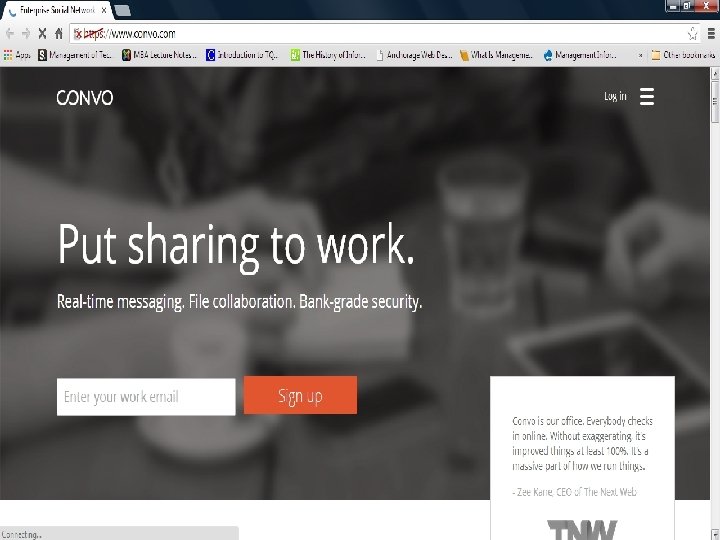
Up and coming: Pakistani startup raises $5 m from venture capitalist • In what can serve as an inspiration for the country’s tech firms seeking expansion in the world’s largest market • Pakistani start-up ‘Convo’ has raised million in investment capital from a top tier Company in Silicon Valley. • It is, arguably, the first Pakistani company to receive such major funding from an firm in the world’s IT hub. © Farhan Mir 2014 IMS
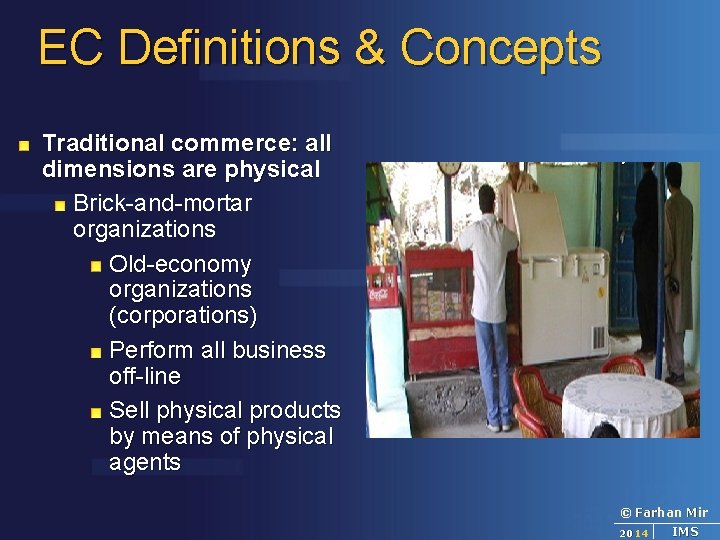
EC Definitions & Concepts Traditional commerce: all dimensions are physical Brick-and-mortar organizations Old-economy organizations (corporations) Perform all business off-line Sell physical products by means of physical agents © Farhan Mir 2014 IMS
EC Definitions & Concepts Pure EC: all dimensions are digital Pure online (virtual) organizations New-economy organization Sell products or services only online Partial EC: a mix of digital and physical dimensions Click-and-mortar organizations Conduct EC activities Do their primary business in the physical world © Farhan Mir 2014 IMS
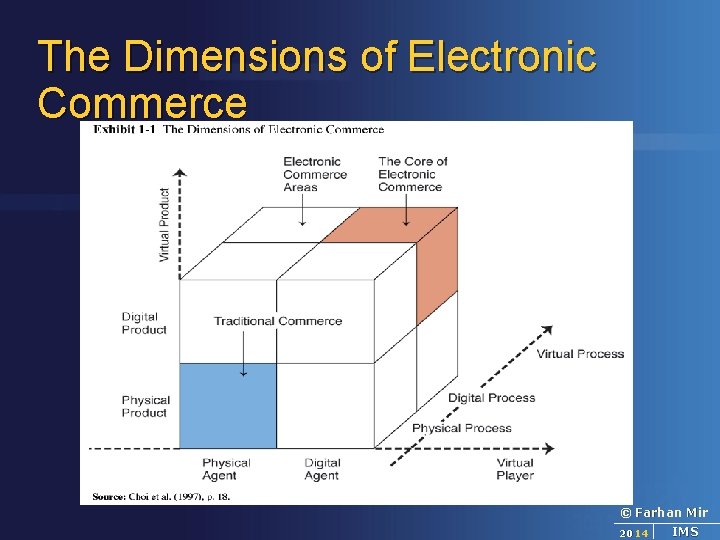
The Dimensions of Electronic Commerce © Farhan Mir 2014 IMS
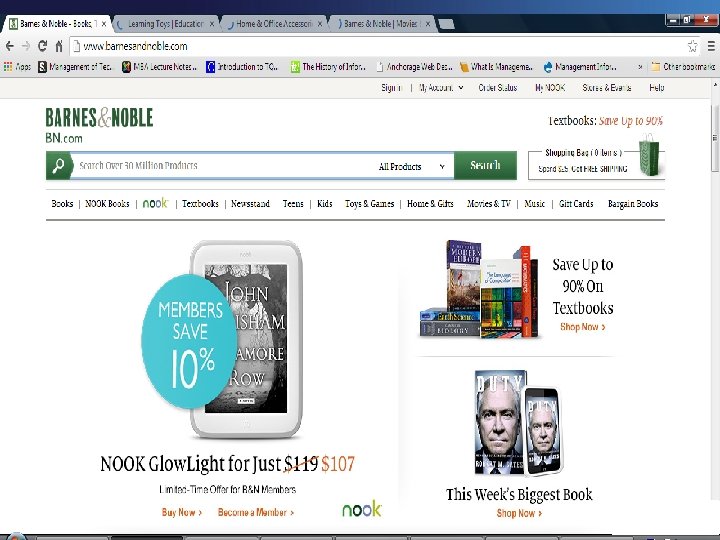
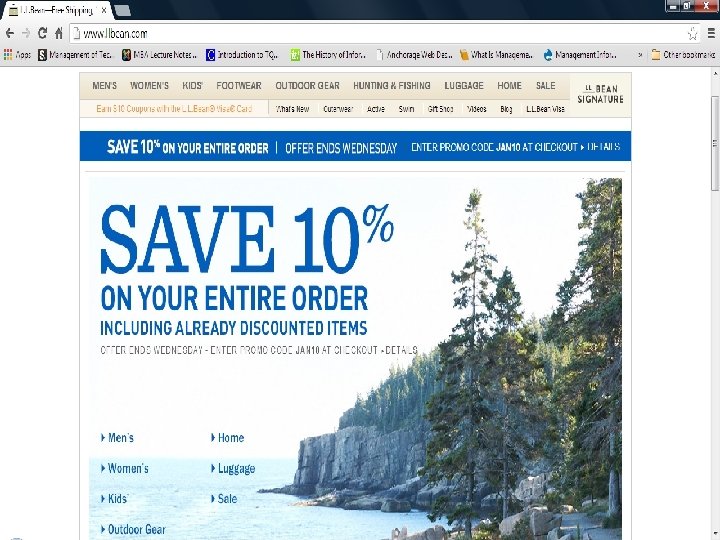
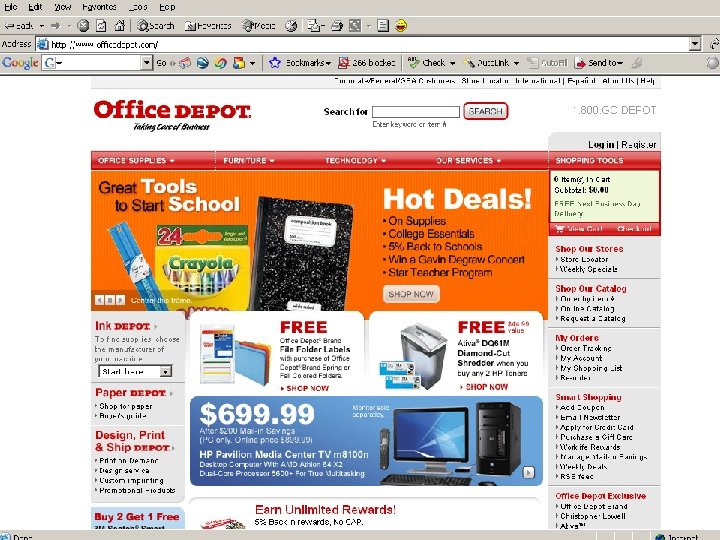
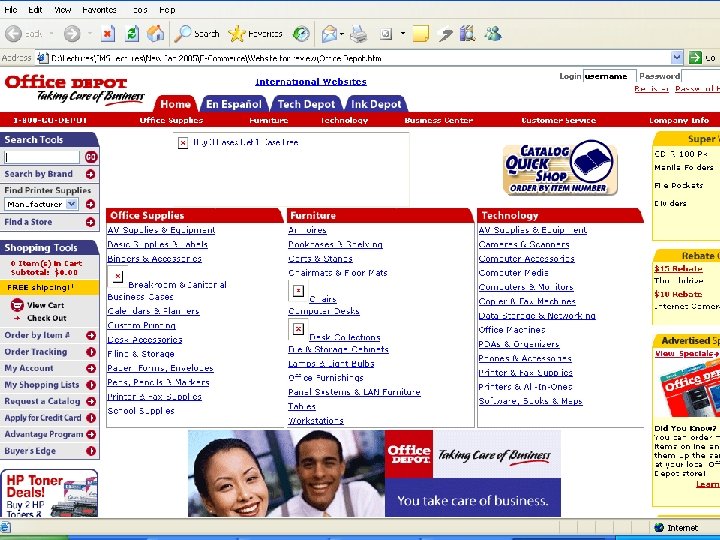
Physical to Virtual Interfacing Old-economy companies are extending their reach by offering on-line services (catalogs, commodities, and e-services), Office Depot (Office supplies; #2 web retailer, after Amazon) (www. officedepot. com) & (www. amazon. com) LL Bean (Catalog sales; Dogs are in at LL Bean) (www. llbean. com) Barnes and Noble(Booksellers) (www. bn. com) Boeing Parts Network (24/7 parts for airlines) (www. boeing. com/assocproducts/direct/bd_home. html) Outreach to customers. Commodities sell well in e-space. © Farhan Mir 2014 IMS
© Farhan Mir 2014 IMS
© Farhan Mir 2014 IMS
© Farhan Mir 2014 IMS
© Farhan Mir 2014 IMS
EC Definitions & Concepts Internet vs. Non-Internet EC Use of Websites to advertise, Buy & Sell Much cheaper and highly accessible Non-Internet EC VANs—value-added networks LANs—local area networks Single computerized machines Using a smart card in a vending machine Using a cell phone to make an online purchase © Farhan Mir 2014 IMS
The EC Framework and Field An EC Framework EC applications supported by infrastructure and 5 support areas People Public policy Technical standards and protocols Business partners (mutual collaboration) Support services © Farhan Mir 2014 IMS
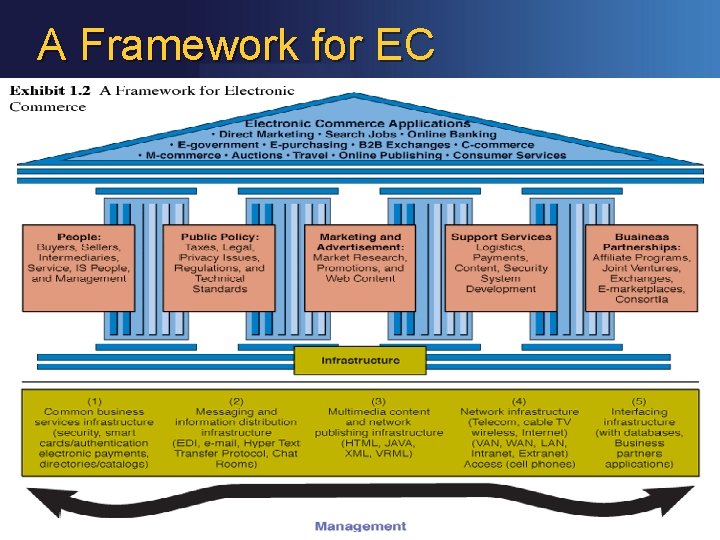
A Framework for EC © Farhan Mir 2014 IMS
Classification of EC by the Nature of the Transaction Business-to-business (B 2 B) : EC model in which all of the participants are businesses or other organizations Business-to-consumer (B 2 C): EC model in which businesses sell to individual shoppers Business-to-business-to-consumer (B 2 B 2 C): EC model in which a business provides some product or service to a client business; the client business maintains its own customers, to whom the product or service is provided © Farhan Mir 2014 IMS
Examples! Business-to-Consumer (B 2 C) Yahoo! (www. yahoo. com) - (aggregator) leading portal and most visited e-space! Mc. Afee (www. mcafee. com) Software subscription services for virus scanning. Software purchase, delivery and update, example is: Copernic (www. copernic. com) Digital Content Services; example is: Sony Music (www. sony. com) © Farhan Mir 2014 IMS
Classification of EC by the Nature of the Transaction Consumer-to-business(C 2 B): individuals who use the Internet to sell products or services to organizations and /or seek sellers to bid on products or services they need Consumer-to-consumer (C 2 C) : consumers sell directly to other consumers © Farhan Mir 2014 IMS
Examples! Consumer-to-Consumer (C 2 C) Ebay (www. ebay. com) - (facilitator) electronic auctions with consumers handling transaction and shipping. Napster (www. napster. com) - (facilitator) peer-to-peer music exchange; courts not happy. Groove Networks (www. groove. com) (facilitator) secure peer-to-peer collaboration services. Founded by Ray Ozzie, the creator of Lotus Notes. © Farhan Mir 2014 IMS
Classification of EC by the Nature of the Transaction Mobile commerce (m-commerce)—EC transactions and activities conducted in a wireless environment Location-commerce—(l-commerce) m-commerce transactions targeted to individuals in specific locations, at specific times © Farhan Mir 2014 IMS
Classification of EC by the Nature of the Transaction Intrabusiness (organizational) EC: EC category that includes all internal organizational activities that involve the exchange of goods, services, or information among various units and individuals in an organization © Farhan Mir 2014 IMS
Classification of EC by the Nature of the Transaction Business-to-employee (B 2 E): EC model in which an organization delivers services, information, or products to its individual employees Collaborative commerce (c-commerce): EC model in which individual or groups communicate or collaborate online E-government: Government-to-citizens (G 2 C): EC model in which a government entity buys or provides good, services, or information to businesses or individual citizens © Farhan Mir 2014 IMS
Interdisciplinary Nature of EC Marketing Computer sciences Consumer behavior and psychology Finance Economics Management information systems Accounting and auditing Management Business law and ethics Others © Farhan Mir 2014 IMS
The Benefits of EC Benefits to Organizations Expands the marketplace to national and international markets Decreases the cost of creating, processing, distributing, storing and retrieving paperbased information Allows reduced inventories and overhead by facilitating pull-type supply chain management © Farhan Mir 2014 IMS
Benefits of EC Benefits to consumers Enables consumers to shop or do other transactions 24 hours a day, all year round from almost any location Provides consumers with more choices Provides consumers with less expensive products and services by allowing them to shop in many places and conduct quick comparisons – Not sure in every case © Farhan Mir 2014 IMS
Benefits of EC Allows quick delivery of products and services (in some cases) especially with digitized products Consumers can receive relevant and detailed information in seconds, rather than in days or weeks Makes it possible to participate in virtual auctions Allows consumers to interact with other consumers in electronic communities and exchange ideas as well as compare experiences – Tripadvisor. com Facilitates competition, which results in © Farhan Mir substantial discounts IMS 2014
Benefits of EC Benefits to society Enables more individuals to work at home, and to do less traveling for shopping, resulting in less traffic on the roads, and lower air pollution Allows some merchandise to be sold at lower prices, benefiting less affluent people Enables people in Third World countries and rural areas to enjoy products and services which otherwise are not available to them Facilitates delivery of public services at a reduced cost, increases effectiveness, and/or improves quality © Farhan Mir 2014 IMS
The Limitations of EC Technical limitations There is a lack of universally accepted standards for quality, security, and reliability The telecommunications bandwidth is insufficient Software development tools are still evolving There are difficulties in integrating the Internet and EC software with some existing (especially legacy) applications and databases. Special Web servers in addition to the network servers are needed (added cost). Internet accessibility is still expensive and/or inconvenient © Farhan Mir 2014 IMS
Brief History of ECommerce Some major shifts from 70 s till now © Farhan Mir 2014 IMS
Brief History of EC EC applications first developed in the early 1970 s Electronic funds transfer (EFT) Limited to: Large corporations Financial institutions A few other daring businesses © Farhan Mir 2014 IMS
Brief History of EC Electronic data interchange (EDI)— electronic transfer of documents: Purchase orders Invoices E-payments between firms doing business Enlarged pool of participants to include: Manufacturers Retailers Service providers © Farhan Mir 2014 IMS
Brief History of EC Interorganizational systems (IOS) Stock trading Travel reservation systems Internet became more commercialized in the early 1990 s Almost all medium-and large-sized organization in the world now has a Web site Most large corporations have comprehensive portals © Farhan Mir 2014 IMS
Brief History of EC EC Successes Pure online e. Bay Veri. Sign AOL Checkpoint Click-and-mortar GE IBM Intel Schwab EC Failures E-tailors began to fail in 1999 This does not mean that EC’s days are numbered Large EC companies like Amazon. com are expanding but success or failure is not certain © Farhan Mir 2014 IMS
The Future of EC Web 2. 0 The second-generation of Internet-based services that let people collaborate and share information online in perceived new ways— such as social networking sites, wikis, and communication tools © Farhan Mir 2014 IMS
Social and Business Networks Social Networks Web sites that connect people with specified interests by providing free services such as photo presentation, e-mail, blogging, etc. Business-oriented networks are social networks whose primary objective is to facilitate business © Farhan Mir 2014 IMS
The Concept of Digital Economy An Introduction © Farhan Mir 2014 IMS
The Digital Revolution and the Economic Impact of EC In the Digital Revolution the economy is based on digital technologies including: Digital communication networks Computers Software Other related information technologies Also called: Internet economy New economy Web economy © Farhan Mir 2014 IMS
The Digital Revolution and the Economic Impact of EC Digital networking and communication infrastructures provide a global platform where people and organizations: Interact Communicate Collaborate Search for information © Farhan Mir 2014 IMS
The Digital Revolution and the Economic Impact of EC The global platform includes these characteristics A vast array of digitizable products Consumers and firms conduct financial transactions digitally Microprocessors and networking capabilities embedded in physical goods © Farhan Mir 2014 IMS
The Digital Revolution and the Economic Impact of EC This convergence enables all types of information (data, audio, video, etc. ) to be stored, processed, and transmitted over networks to many destinations worldwide Web-based EC systems are accelerating the digital revolution by providing competitive advantage to organizations © Farhan Mir 2014 IMS
Contributions of EC towards modern Organizations Types of Pressures and EC as a solution © Farhan Mir 2014 IMS
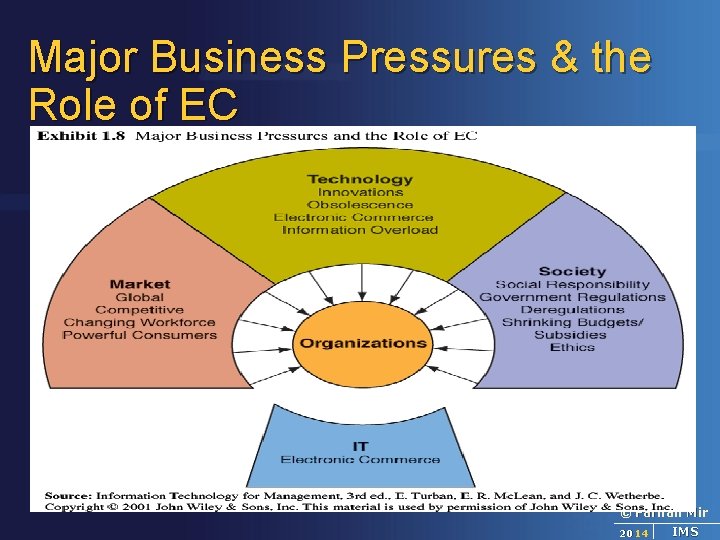
Major Business Pressures & the Role of EC © Farhan Mir 2014 IMS
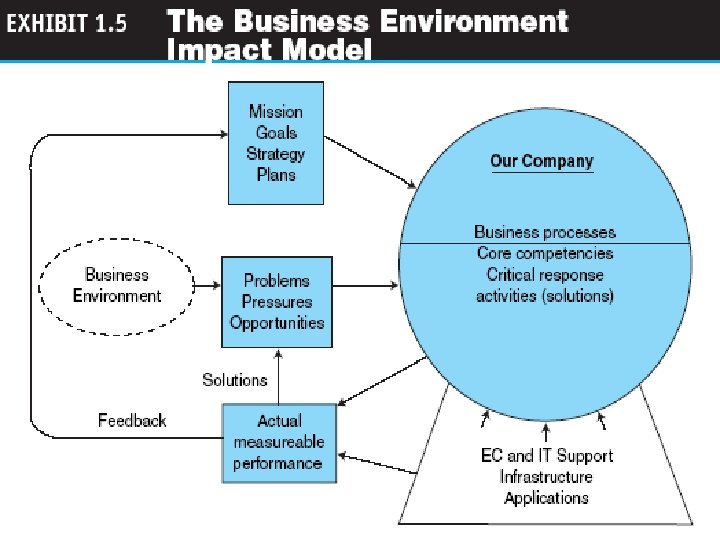
© Farhan Mir 2014 IMS
Organizational Responses Supply chain improvements Help reduce supply chain delays, inventories and eliminate other inefficiencies Mass customization—production of large quantities of customized items Business problem is how to efficiently provide customization EC is an ideal facilitator of mass customization by enabling electronic ordering to reach the production facility in minutes © Farhan Mir 2014 IMS
Putting It All Together The first step is to put in the right connective networks The vast majority of EC is done on computers connected to: Internet Intranet--An internal corporate or government network that uses Internet tools, such as Web browsers, and Internet protocols Extranet--A network that uses the Internet to link multiple intranets © Farhan Mir 2014 IMS
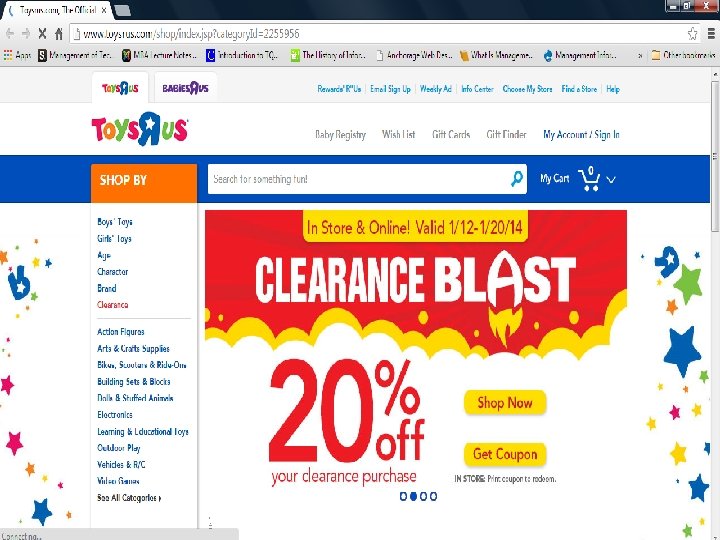
Putting It All Together Major concern of today’s companies—how to transform themselves to take part in digital economy Example: Toys, Inc. Uses intranet for internal communications, collaboration, dissemination of information Networked to e-marketspaces and large corporations Corporate portal for communication and collaboration with business partners © Farhan Mir 2014 IMS
© Farhan Mir 2014 IMS
EC Business Models Revenue model Description of how the company or an EC project will earn revenue Value proposition The benefits a company can derive from using EC © Farhan Mir 2014 IMS
EC Business Models Functions of a Business Model 1. Articulate a customer value proposition 2. Identify a market segment 3. Define the venture’s specific value chain structure 4. Estimate the cost structure and profit potential 5. 6. Describe the venture’s positioning within the value network linking suppliers and customers Formulate the venture’s competitive strategy © Farhan Mir 2014 IMS
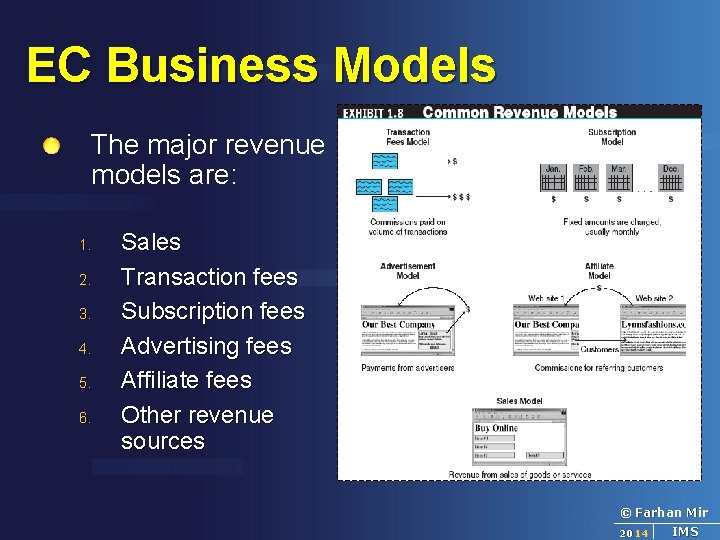
EC Business Models The major revenue models are: 1. 2. 3. 4. 5. 6. Sales Transaction fees Subscription fees Advertising fees Affiliate fees Other revenue sources © Farhan Mir 2014 IMS
EC Business Models 1 -78 © Farhan Mir 2014 IMS
EC Business Models Typical EC Business Models Online direct marketing Electronic tendering systems. Name your own price Find the best price Affiliate marketing Viral marketing Group purchasing Online auctions Product and service customization Electronic marketplaces and exchanges Information brokers (informediaries) Bartering Deep discounting Membership Value-chain integrators Value-chain service providers Supply chain improvers Social networks, communities, and blogging Direct sale by manufacturers Negotiation © Farhan Mir 2014 IMS
EC Business Models tendering (bidding) system Model in which a buyer requests would-be sellers to submit bids; the lowest bidder wins name-your-own-price model Model in which a buyer sets the price he or she is willing to pay and invites sellers to supply the good or service at that price affiliate marketing An arrangement whereby a marketing partner (a business, an organization, or even an individual) refers consumers to the selling company’s Web site viral marketing Word-of-mouth marketing in which customers promote a © Farhan Mir product or service to friends or other people 2014 IMS
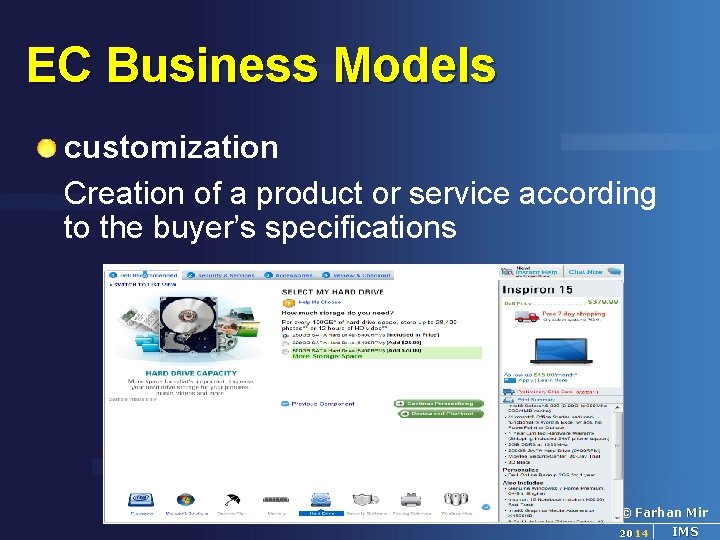
EC Business Models customization Creation of a product or service according to the buyer’s specifications © Farhan Mir 2014 IMS
Managerial Issues ● ● ● ● Is it real? Why is B 2 B e-commerce so attractive? There are so many EC failures—how can one avoid them? How do we transform our organization into a digital one? How can we exploit social/business networking? What should be my company’s strategy toward EC? What are the top challenges of EC? © Farhan Mir 2014 IMS
- Slides: 82