
eCOMMA Data Specialist BM 03 Problem Management eCOMMA
e-COMMA Data Specialist BM 03: Problem Management e-COMMA | Data Specialist | BM 03: Problem Management 1
Data Specialist| BM 03: Problem Management Training Contents 1. Problem Management: definition and key elements 1. What is problem management? 2. Examples of problems: users problems and technical problems 3. Benefits of problem management 4. Problem Management Process 2. Best Practices in Problem Management for Data Specialists 1. Privacy and Data Protection 2. Dos and Don’ts 3. General Data Protection Regulation 3. Documentation standards 4. Change Management e-COMMA | Data Specialist | BM 03: Problem Management 2
Data Specialist| BM 03: Problem Management Sources and further reading CIAPE(2016), En-youth teacher, How to create an e-business E-le@d project (2014 -2017) , E-leadership community https: //www. linkedin. com/pulse/itil-guide-problem-management-segment-1 -saeid-s-lakelayeh/ https: //www. linkedin. com/pulse/itil-guide-problem-management-section-2 -saeid-s-lakelayeh/ https: //www. linkedin. com/pulse/itil-guide-problem-management-section-3 -saeid-s-lakelayeh/ https: //www. linkedin. com/pulse/itil-guide-problem-management-section-4 -saeid-s-lakelayeh/ https: //www. scnsoft. com/blog/problem-management-in-servicenow https: //www. linkedin. com/pulse/8 -steps-change-management-e-commerce-sonia-varkey-bsc-mba/ http: //www. ibmbigdatahub. com/infographic/extracting-business-value-4 -vs-big-data http: //www. business 2 community. com/big-data-and-analytics-value-chain-cross-section-0589031 https: //www. linkedin. com/pulse/20140814193544 -49814607 -dynamic-pricing-the-future-of-ecommerce-in-indi a e-COMMA | Data Specialist | BM 03: Problem Management 3
Data Specialist| BM 03 DS: Problem Management Sources and further reading David A. Schweidel, 2017, Profiting from the Data Economy. James Fahl, 2017, Data Analytics. Kim A. J. (2000): Community building on the web. Peachpit press. Michael Devellano, 2017, Automate and Grow. Philip Kotler, 2017, Marketing 4. 0: Moving from Traditional to Digital. S. Fan et al. (2015): Demystifying Big Data Analytics for Business Intelligence Through the Lens of Marketing Mix. Wysocki K. R. (2009): Effective project magagement: Traditional, Agile, Extreme. Wiley. e-COMMA | Data Specialist | BM 03: Problem Management 4
e-COMMA 1 Problem Management e-COMMA | Data Specialist | BM 03: Problem Management 5
1. Problem Management 1. 1. What is problem management? The goal of problem management is to minimize both the number and severity of incidents and potential problems to the business/organisation. In the context of e-commerce development, problem management should aim to reduce the adverse impact of incidents and problems that are caused by errors within the IT infrastructure, and to prevent recurrence of incidents related to these errors. e-COMMA | Data Specialist | BM 03: Problem Management 6
1. Problem Management 1. 1. What is problem management? • Problems should be addressed in priority order with higher priority given to the resolution of problems that can cause serious disruption to critical IT services. • Problem management’s responsibility is to ensure that incident information is documented in such a way that it is readily available to support all problem management activities. e-COMMA | Data Specialist | BM 03: Problem Management 7
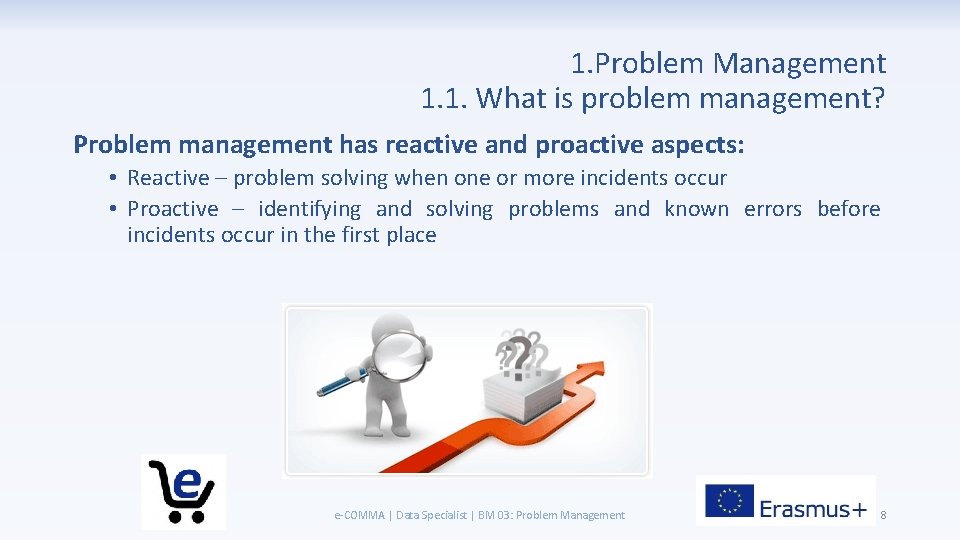
1. Problem Management 1. 1. What is problem management? Problem management has reactive and proactive aspects: • Reactive – problem solving when one or more incidents occur • Proactive – identifying and solving problems and known errors before incidents occur in the first place e-COMMA | Data Specialist | BM 03: Problem Management 8
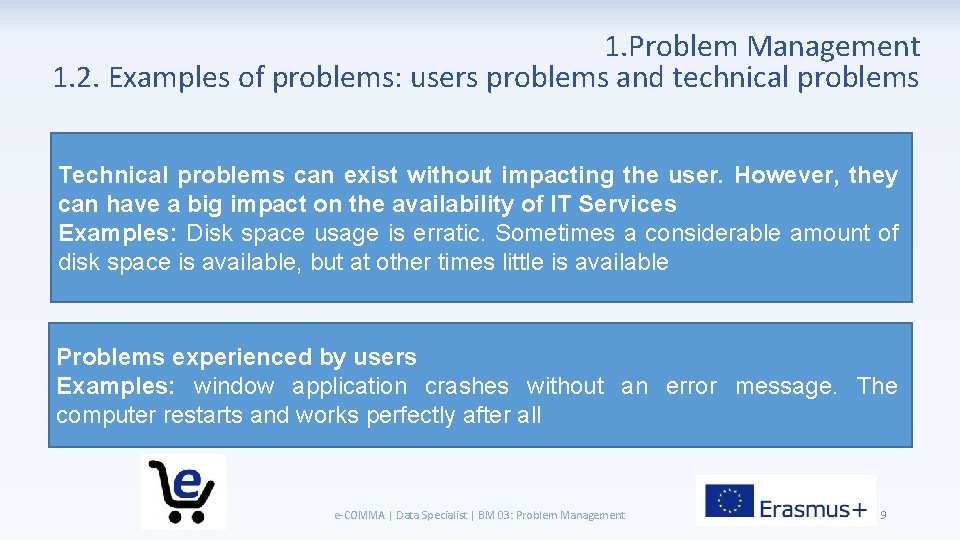
1. Problem Management 1. 2. Examples of problems: users problems and technical problems Technical problems can exist without impacting the user. However, they can have a big impact on the availability of IT Services Examples: Disk space usage is erratic. Sometimes a considerable amount of disk space is available, but at other times little is available Problems experienced by users Examples: window application crashes without an error message. The computer restarts and works perfectly after all e-COMMA | Data Specialist | BM 03: Problem Management 9
1. Problem Management 1. 3. Benefits of problem management Problem management: • Increases quality of the IT service • Reduce accidents • Reduce problems and their impact • Improve organization know-how and learning e-COMMA | Data Specialist | BM 03: Problem Management 10
1. Problem Management 1. 3. Benefits of problem management Problem management benefits can be weakened by: • • the absence of a good incident control process the failure to link incident records with problem/error records a lack of management or leadership commitment, an inability to determine accurately the impact on the business/organisation of incidents and problems e-COMMA | Data Specialist | BM 03: Problem Management 11

1. Problem Management 1. 4. Problem Management Process How does Problem management work? Problem management works by using analysis techniques to identify the cause of the problem. To achieve its goal, problem management aims to: • Identify the root cause – problem control • Initiate actions to improve and correct the situation – error control e-COMMA | Data Specialist | BM 03: Problem Management 12
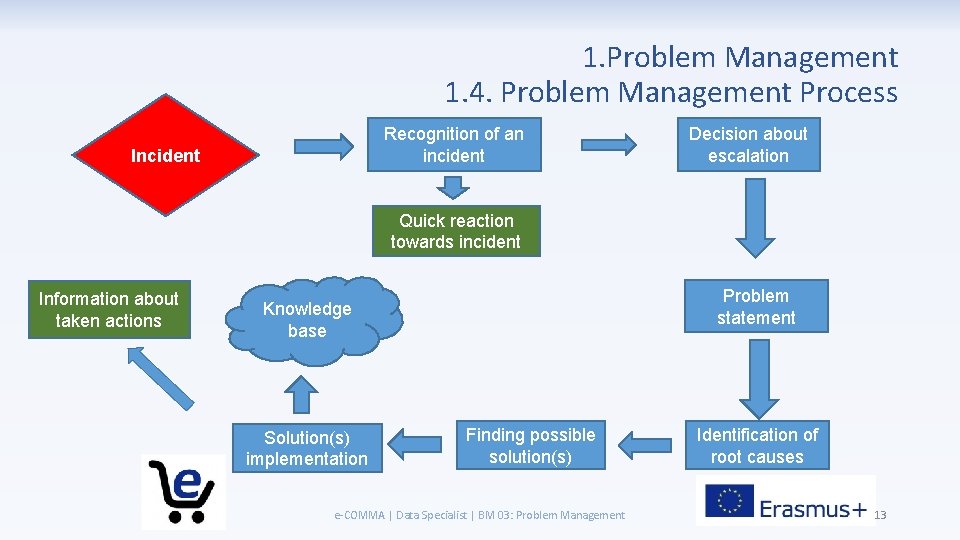
1. Problem Management 1. 4. Problem Management Process Recognition of an incident Incident Decision about escalation Quick reaction towards incident Information about taken actions Problem statement Knowledge base Solution(s) implementation Finding possible solution(s) e-COMMA | Data Specialist | BM 03: Problem Management Identification of root causes 13
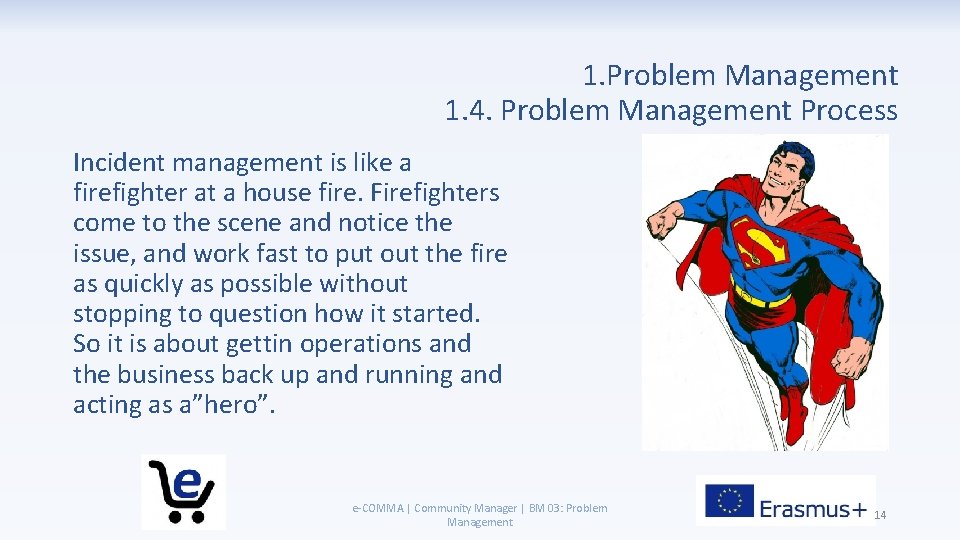
1. Problem Management 1. 4. Problem Management Process Incident management is like a firefighter at a house fire. Firefighters come to the scene and notice the issue, and work fast to put out the fire as quickly as possible without stopping to question how it started. So it is about gettin operations and the business back up and running and acting as a”hero”. e-COMMA | Community Manager | BM 03: Problem Management 14
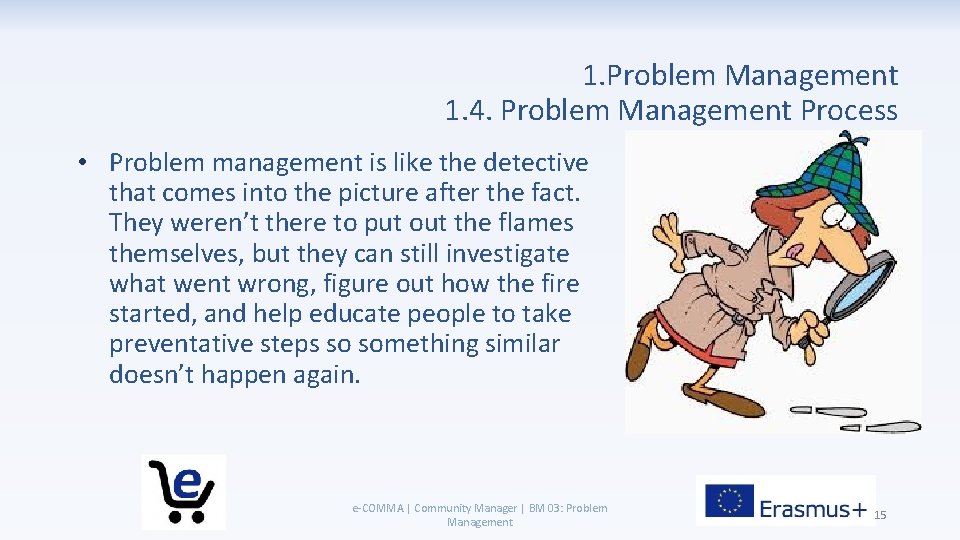
1. Problem Management 1. 4. Problem Management Process • Problem management is like the detective that comes into the picture after the fact. They weren’t there to put out the flames themselves, but they can still investigate what went wrong, figure out how the fire started, and help educate people to take preventative steps so something similar doesn’t happen again. e-COMMA | Community Manager | BM 03: Problem Management 15
1. Problem Management 1. 3 Problem Management Process Quick reaction towards incidents It is better for incident management to answer the real questions and tell customers that the cause is being investigated (by problem management) and list all the steps that have been put in place to mitigate the risk of a recurrence and minimise the impact should it recur while the cause is being investigated You may issue an incident report that states: • the basic facts of the incident (duration, business impact, any ongoing effects, how it was resolved); • what preventive measure or workaround is in place; • what additional monitoring or alerting has been implemented; • who is on standby to respond to a recurrence; • the symptoms to watch out for; • that the incident has been handed over to problem management for root cause analysis. e-COMMA | Data Specialist | BM 03: Problem Management 16
1. Problem Management 1. 3 Problem Management Process Decision about escalation • Sometimes we have to escalate in projects/ actions, in order to overcome problems • The general meaning of Escalation is: Increase in magnitude or intensity by bypassing the immediate person. • Escalation is a formal process to highlight the issue at hand to a higher authority as per the escalation mechanism. • You need to take decision about escalation if something is blocking the project and is beyond your control. e-COMMA | Data Specialist | BM 03: Problem Management 17
1. Problem Management 1. 3 Problem Management Process • • Problem statement An incomplete problem definition tends to be caused by the belief that the problem is obvious, which is the result of the false assumption that everyone perceives the same thing. The following questions are used to describe the problem: Identity (What) – What went wrong? What expected outcome was incorrect? Location (Where) – Where does the problem occur? Time (When) – When did the problem start to occur? How frequently has the problem occurred? What is the chronology of events? Size (Extent) – What is the size of the problem? How many parts are affected? What is/was the impact? Why does it matter? e-COMMA | Data Specialist | BM 03: Problem Management e-COMMA | Community Manager | BM 03: Problem Management 18
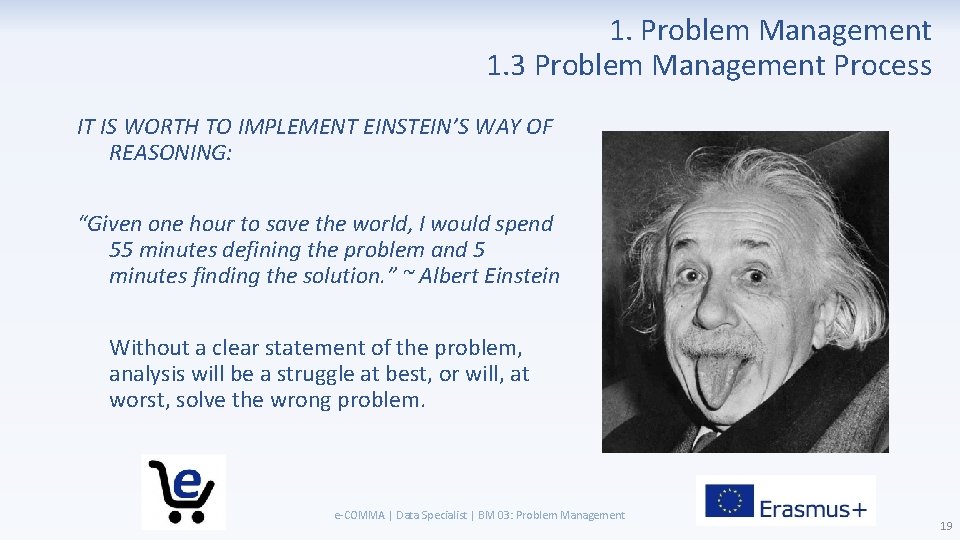
1. Problem Management 1. 3 Problem Management Process IT IS WORTH TO IMPLEMENT EINSTEIN’S WAY OF REASONING: “Given one hour to save the world, I would spend 55 minutes defining the problem and 5 minutes finding the solution. ” ~ Albert Einstein Without a clear statement of the problem, analysis will be a struggle at best, or will, at worst, solve the wrong problem. e-COMMA | Data Specialist | BM 03: Problem Management 19
1. Problem Management 1. 3 Problem Management Process Root causes After formulating the problem statement you need to make a list of all possible root causes that is as complete as you can make it. Ask these questions: • What sequence of events leads to the problem? • What conditions allow the problem to occur? • What other problems surround the occurrence of the central problem? e-COMMA | Data Specialist | BM 03: Problem Management 20
1. Problem Management 1. 3 Problem Management Process Root causes – supporting investigation tools Five Whys • It is a short-hand description of the more general question and answer techniques. • It is often stated that you should get to root cause by the fifth question. • It is useful as a test to make sure you really have a root cause and there is not something else behind it. If you cannot answer why, you can be pretty sure you are at the end of the chain. e-COMMA | Data Specialist | BM 03: Problem Management 21
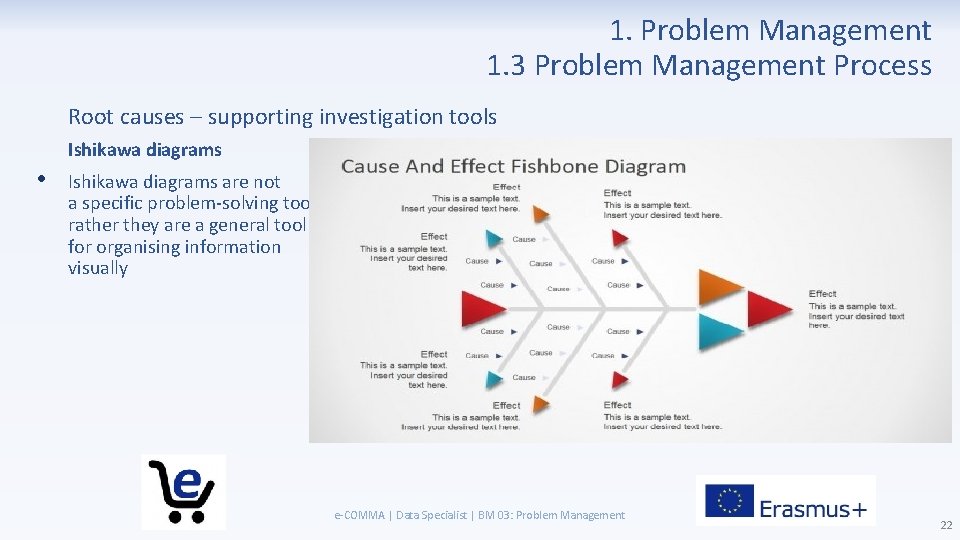
1. Problem Management 1. 3 Problem Management Process Root causes – supporting investigation tools Ishikawa diagrams • Ishikawa diagrams are not a specific problem-solving tool; rather they are a general tool for organising information visually e-COMMA | Data Specialist | BM 03: Problem Management 22
1. Problem Management 1. 3 Problem Management Process • • Finding a solution to a problem involves constructing a course of action that will transform your current situation into one where your objective has been achieved. To determine how the situation should be changed the root cause of each failure chosen for action must be analyzed. Even with a single, obvious solution, it is necessary to compare the solution, its costs and its resource requirements against the ‘do nothing’ option, as well against for what other purposes that budget could be used. Each action that you propose will be intended to achieve a particular effect. In doing so it may also have side-effects, which can be desirable or undesirable. e-COMMA | Data Specialist | BM 03: Problem Management 23
1. Problem Management 1. 3 Problem Management Process • • Questions to be asked: What actions might work around this problem? What actions might fix this problem? Could this problem be the result of another problem? Have changes been made to the service or system recently that may have created the problem? e-COMMA | Data Specialist | BM 03: Problem Management 24
1. Problem Management 1. 3 Problem Management Process Solution implementation Problem management is ineffective if the solution haven’t been implemented successfully. You need to prepare a detailed plan including: • What can you do to prevent the problem from happening again? • How will the solution be implemented? • Who will be responsible for it? • What are the risks of implementing the solution? Usually to solve the probem, a group of actions need to be taken. e-COMMA | Data Specialist | BM 03: Problem Management 25
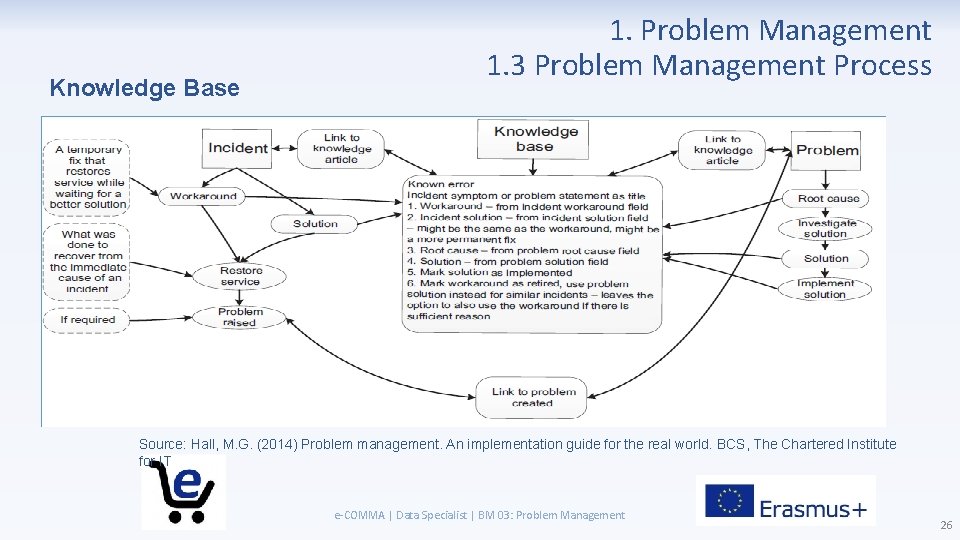
Knowledge Base 1. Problem Management 1. 3 Problem Management Process Source: Hall, M. G. (2014) Problem management. An implementation guide for the real world. BCS, The Chartered Institute for IT e-COMMA | Data Specialist | BM 03: Problem Management 26
1. Problem Management 1. 3 Problem Management Process If you have solved the problem, and your solution works, it would be good to keep the knowledge about it in your company. If the same problem arises and the root causes of it are the same, you may use the solution. To do it, describe: • Incidents • The ways of reactions towards incidents • Root problems • Reaction to the problems (how we resolved them) In the future we may use this knowledge and improve our processes to avoid occurence of the same incidents. e-COMMA | Data Specialist | BM 03: Problem Management 27
e-COMMA 2 Best Practices in Problem Management for Data Specialists e-COMMA | Data Specialist | BM 03: Problem Management 28
2. Best Practices in Problem Management for Data Specialists 2. 1. Privacy and Data Protection The privacy and protection of our data is not a right easily relinquished. This right has been recently put to the test with the fast growth of social media tools, such as Facebook, Linkedin, Twitter, etc. The backlash against Facebook’s lops on their privacy policies has opened the debate on how to best market your audience and at the same time respect the privacy laws. e. g. in the case of Facebook, users seemed to be unable to completely delete their personal information if they no longer wished to use this social platform. e-COMMA | Data Specialist | BM 03: Problem Management 29
2. Best Practices in Problem Management for Data Specialists 2. 1. Privacy and Data Protection The best marketing and promotional results can only be obtained when the targeted audience has expressed their wish to be reached for a specific purpose. Direct marketing can be effective through different tools and approaches, but there also some key legislative rules that have to be respected when doing so. By being lawful you will also discover that you will be providing a direct marketing that is correctly targeted and with the opportunities to expand your current database. e-COMMA | Data Specialist | BM 03: Problem Management 30
2. Best Practices in Problem Management for Data Specialists 2. 1. Privacy and Data Protection For a marketing mix that complies with the data protection and privacy rules, make sure that recipients have given consent 4 to receive direct marketing and that an opt-out feature (unsubscribe option) is always included. Marketers should always strive to ensure that privacy choices are respected and that direct marketing is sent only to willing recipients that have given their consent. Consent does not have to be written but as a best practice, a written proof that clearly states the direct marketing purposes should be ensured. e-COMMA | Data Specialist | BM 03: Problem Management 31
2. Best Practices in Problem Management for Data Specialists 2. 2. Dos and Don’ts A clear understating of the best practices, on how to create and maintain databases and how to best reach your audience, is fundamental. These best practices will assist you in correctly marketing your audience. The Do’s To collect data for a database, state the organization’s name, products and services, the aim of the use of the information and if it will be transmitted to a third party. If sharing marketing lists with other organisations, all individuals should be informed in advance regarding who, when and how data will be shared with. Information and data should be used for a specific database and have a specific time frame for its use. For example, to renew the information on your current database an annual email to confirm the information should be applied. e-COMMA | Data Specialist | BM 03: Problem Management 32
2. Best Practices in Problem Management for Data Specialists 2. 2. Dos and Don’ts A clear understating of the best practices, on how to create and maintain databases and how to best reach your audience, is fundamental. These best practices will assist you in correctly marketing your audience. The Do’s Aim at always holding a written statement of the permission to use the data. Avoid using already ticked boxes for permission forms. All individuals have the legal right to stop their personal information being used for direct marketing. Follow up promptly on these requests and specify on your database why and when it was declare to no longer use the data. Always provide a simple, cost free opt-out (unsubscribe) option that is clearly visible and explicit in its wording. e-COMMA | Data Specialist | BM 03: Problem Management 33
2. Best Practices in Problem Management for Data Specialists 2. 2. Dos and Don’ts A clear understating of the best practices, on how to create and maintain databases and how to best reach your audience, is fundamental. These best practices will assist you in correctly marketing your audience. The Do’s Create or widen databases for a specific use by using a sign up mechanism (opt-in option/subscribe). For example, this sign up mechanism can be included on a website and linked to different messages in order to maximise its use. Use flagship events or retention campaigns to create specific databases according with what the delegates/members have a specific interest in. For example, use a simple fill-in form or include it on the event survey/evaluation. e-COMMA | Data Specialist | BM 03: Problem Management 34
2. Best Practices in Problem Management for Data Specialists 2. 2. Dos and Don’ts A clear understating of the best practices, on how to create and maintain databases and how to best reach your audience, is fundamental. These best practices will assist you in correctly marketing your audience. The Don’ts Do not transfer data outside the European Economic Area unless there is adequate protection for the personal information being transferred, an organisation is willing to take on full responsibility. Do not transfer data or database(s) to other entities or third parties unless all individuals have given permission. Do not sell database unless you have the commercial rights to do so. e-COMMA | Data Specialist | BM 03: Problem Management 35
2. Best Practices in Problem Management for Data Specialists 2. 3. General Data Protection Regulation Why is understanding privacy risk and General Data Protection Regulation (GDPR) important? Board focus: • Senior leadership focus and accountability • Auditor/ industry/ client/ consumer focus Client and supplier focus: • Increasing contractual protection demanded for data violation and loss • Indemnities for privacy risks • Extension of obligations to sub-contractors • Concern around cloud computing and use of third parties • Focus on data transfers/ privacy shield (replacing Safe Harbor)/ model clauses Internal focus: • Protection of employee data is crucial and a central focus for good governance e-COMMA | Data Specialist | BM 03: Problem Management 36
2. Best Practices in Problem Management for Data Specialists 2. 3. General Data Protection Regulation What does GDRP means for business ? • • • Increased Regulatory oversight: Regulators have made clear there will be no grace period before enforcement of GDPR begins in May 2018 Increased Reputational risk: Major fines and enforcement action will attract attention from industry, press and clients Need to focus on Privacy by Design: Embed good data governance within your business practices and systems Privacy matters: The protection of personal data is everyone’s problem – not just an issue for the IT community or lawyers Global approach: More and more countries now have privacy laws – getting ready for GDPR will assist operating companies in complying with other privacy laws. e-COMMA | Data Specialist | BM 03: Problem Management 37
2. Best Practices in Problem Management for Data Specialists 2. 3. General Data Protection Regulation Why does GDRP impact businesses that are non-EU ? The GDPR applies to organisations established outside the EU if they (either as controller or processor): • Process the personal data of EU residents when offering them goods or services; or • Monitor the behaviour of EU residents (tracking/ profiling) If you are involved in: • Handling data belonging to EU customers • Providing services impacting EU customers • Providing services which will involve handling EU customer data • Advising on data collection practices which may involve the EU You will be subject to GDPR wherever you are located GDPR is much more stringent than current privacy laws so you need to understand how it affects you. e-COMMA | Data Specialist | BM 03: Problem Management 38

2. Best Practices in Problem Management for Data Specialists 2. 3. General Data Protection Regulation What does this mean for you in practice - top 5 business issues? 1) You need to understand what “personal data” is; and what personal data are you collecting, processing and transferring 2) Do you need consent? 3) You need to consider contractual arrangements with suppliers and clients to reflect GDPR requirements 4) You need to understand the rights of EU citizens and think about “privacy by design” 5) You need to understand the impact of Security Breaches e-COMMA | Data Specialist | BM 03: Problem Management 39
2. Best Practices in Problem Management for Data Specialists 2. 3. General Data Protection Regulation What is “personal data” under GDPR and what are you collecting/processing/ transferring? What are “sensitive” categories of personal data? • Racial/ ethnic origin • Political opinions • Religious beliefs • Trade Union membership • Genetic/ biometric data • Health or sex life • Sexual orientation • Criminal data e-COMMA | Data Specialist | BM 03: Problem Management 40
2. Best Practices in Problem Management for Data Specialists 2. 3. General Data Protection Regulation What is “personal data” under GDPR and what are you collecting/ processing/ transferring? To demonstrate compliance with GDPR, you need to perform a Personal Data Inventory and record: • The categories of personal data collected or received • The source of the data • The consent mechanisms applied to collection of personal data • Which systems in the organisation contain personal data collected from EU citizens • The purpose of processing the data • Who has access to the personal data • Personal data transfers • What security protocols are in place to protect the personal data e-COMMA | Data Specialist | BM 03: Problem Management 41
2. Best Practices in Problem Management for Data Specialists 2. 3. General Data Protection Regulation How do we deal with consent? Why does this topic matter? Each and every data processing activity requires a lawful basis to avoid the risk of incurring substantial fines. There are several lawful bases for data processing and consent provides one such basis Consent means: • Freely given, specific, informed and unambiguous indication of the data subject’s wishes by which he or she, by a statement or clear affirmative action, signifies agreement to the processing of personal data relating to him or her When should you rely on consent? • When consent is required under GDPR or e. Privacy law (e. g direct marketing) How do you get it? • Pop-ups and dialogs that require an affirmative step - no pre-ticked boxes, no conditions, no inaction • Use clear, plain language and make consent granular • Separate consent from other items (e. g agreement to website Ts & Cs) • Privacy by design: Withdrawal at any time • Document consents obtained - including time/ date, information presented and how consent was expressed e-COMMA | Data Specialist | BM 03: Problem Management 42
2. Best Practices in Problem Management for Data Specialists 2. 3. General Data Protection Regulation What happens if there is a breach? Notification to EU regulators within 72 hours (if acting as “controller”) of becoming aware of a breach i. e. a loss of personal data plus potential notification to affected individuals. Companies must keep register of all data breaches Fines are huge: up to 4% global turnover Enforcement: Requirement to delete data, ongoing reporting to DPAs etc. e-COMMA | Data Specialist | BM 03: Problem Management 43
2. Best Practices in Problem Management for Data Specialists 2. 3. General Data Protection Regulation Security breach risks The increased collection and transfer of data exposes companies to a heightened risk of data breaches and regulation. Costs of a Data Breach include: • Fines • Investigation and Forensics • Notification Costs • Call Center Hotline/ Website • Credit Protection/ Monitoring • PR/ Communications • Settlements/ Judgments/ Compensatory Awards • Lost Business/ Customer Churn • Impact on Stock Price • Mandatory Audits • Remediation/ Security Improvements e-COMMA | Data Specialist | BM 03: Problem Management 44
e-COMMA 3 Documentation Standards e-COMMA | Data Specialist | BM 03: Problem Management 45
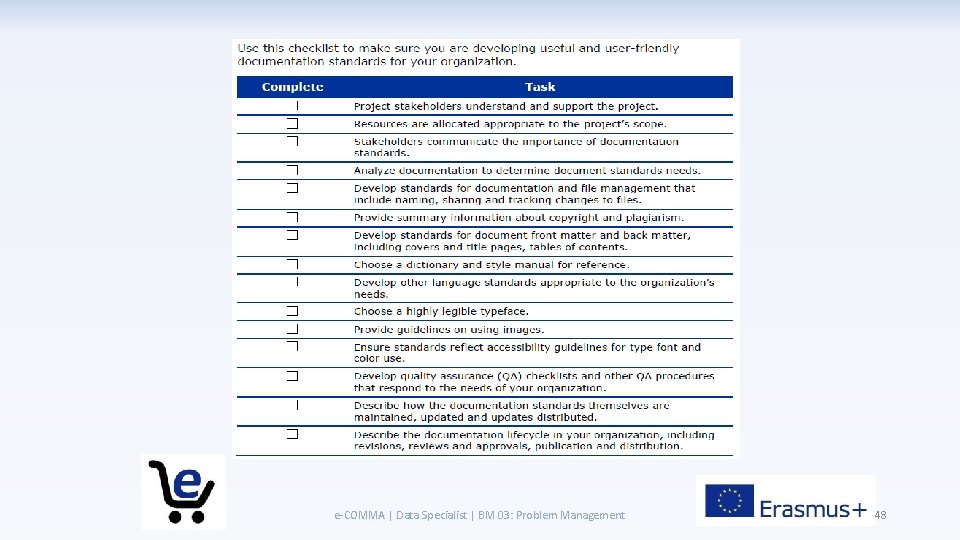
3. Documentation Standards • • Documentation standards address the following topics: Document creation, file naming, saving and sharing Writing, language usage and style Organization-specific content and style Design, format and production guidelines Accessibility for users of differing abilities Quality assurance and accuracy Document lifecycle: development, approval, distribution, review and revision e-COMMA | Data Specialist | BM 03: Problem Management 46
3. Documentation Standards • Documented information and communication often represent the organization to others and may be a matter of public record. Equally important, documentation is the chief means of formal communication within the organization. • Documentation standards are the foundation of professional, trustworthy communication. • Finally, documentation standards guide all aspects of product development so that staff produce consistently high-quality documents as efficiently as possible. e-COMMA | Data Specialist | BM 03: Problem Management 47
e-COMMA | Data Specialist | BM 03: Problem Management 48
e-COMMA 4 Change Management e-COMMA | Data Specialist | BM 03: Problem Management 49
3. Change Management Finding a solution to a problem involves some kind of change within the organisation to be realized and formulated that could include a new product or service, capability, technology improvement, process maturity uplift, etc. Change is defined as modification of any element of the organization. Change management is the pipe through which new or updated elements get into the production environment, and it is usually these elements that cause the problem. e-COMMA | Data Specialist | BM 03: Problem Management Remember: Change is a process, not an event! 50
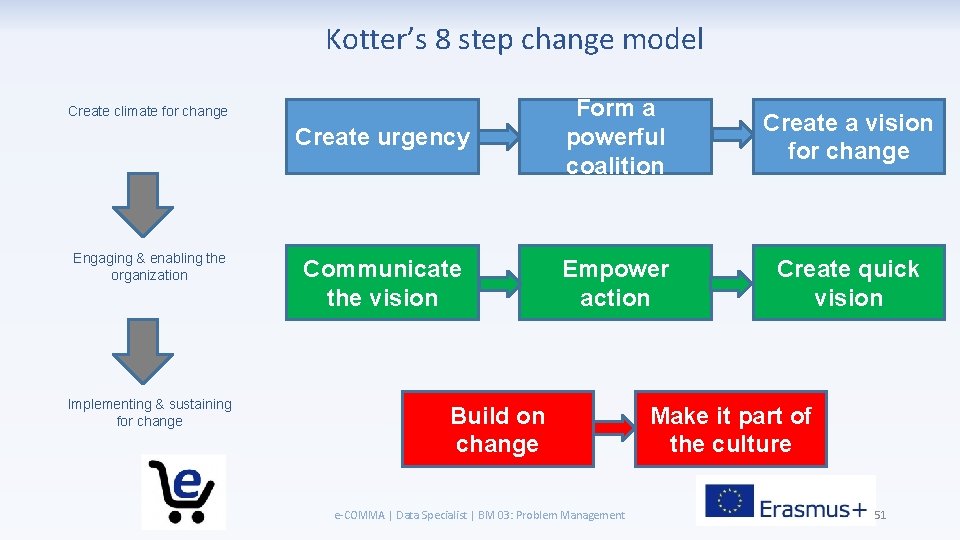
Kotter’s 8 step change model Create urgency Form a powerful coalition Create a vision for change Communicate the vision Empower action Create quick vision Create climate for change Engaging & enabling the organization Implementing & sustaining for change Build on change e-COMMA | Data Specialist | BM 03: Problem Management Make it part of the culture 51
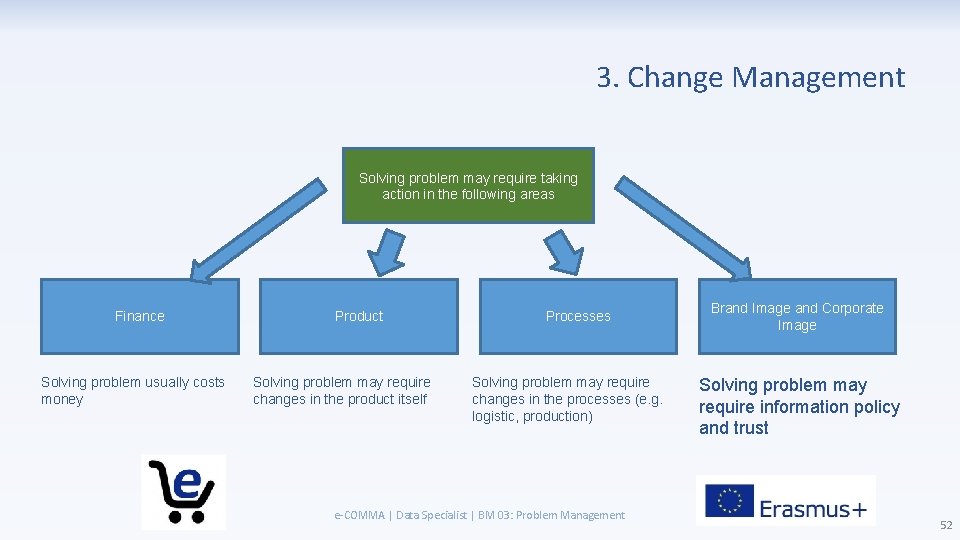
3. Change Management Solving problem may require taking action in the following areas Finance Solving problem usually costs money Product Solving problem may require changes in the product itself Processes Solving problem may require changes in the processes (e. g. logistic, production) e-COMMA | Data Specialist | BM 03: Problem Management Brand Image and Corporate Image Solving problem may require information policy and trust 52
3. Change Management • • Concerning change management, the organization is composed of four sub-systems, which are all dependent on each other. These are: The work. This is the actual day-to-day activities carried out by individuals. Process design, pressures on the individual and available rewards must all be considered under this element. The people. This is about the skills and characteristics of the people who work in an organization. What are their expectations, what are their backgrounds? The formal organization. This refers to the structure, systems and policies in place. How are things formally organized? The informal organization. This consists of all the unplanned, unwritten activities that emerge over time such as power, influence, values and norms. e-COMMA | Data Specialist | BM 03: Problem Management 53
3. Change Management If you change one component, such as the type of work done in an organization, you need to attend to the other three components too: • How does the work now align with individual skills? (the people) • How does a change in the task line up with the way work is organized right now? (the formal organization) • What informal activities and areas of influence could be affected by this change in the task? (the informal organization) e-COMMA | Data Specialist | BM 03: Problem Management 54
- Slides: 54