
Ecology Review Chapter 52 Intro to Ecology Distribution

Ecology Review
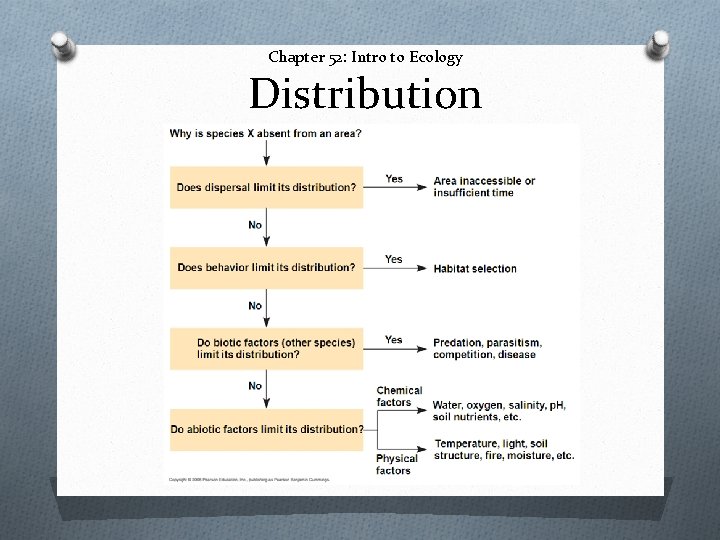
Chapter 52: Intro to Ecology Distribution
The Role of Abiotic Factors in the Formation of Land Biomes O Main defining abiotic factor is climate O Long-term; involving temperature, precipitation, sunlight, & wind O Macroclimate: patterns on the global, regional, or local level. Ex) winds, currents, mountains, water O Microclimates: small-scale environmental variations. Ex) under a log
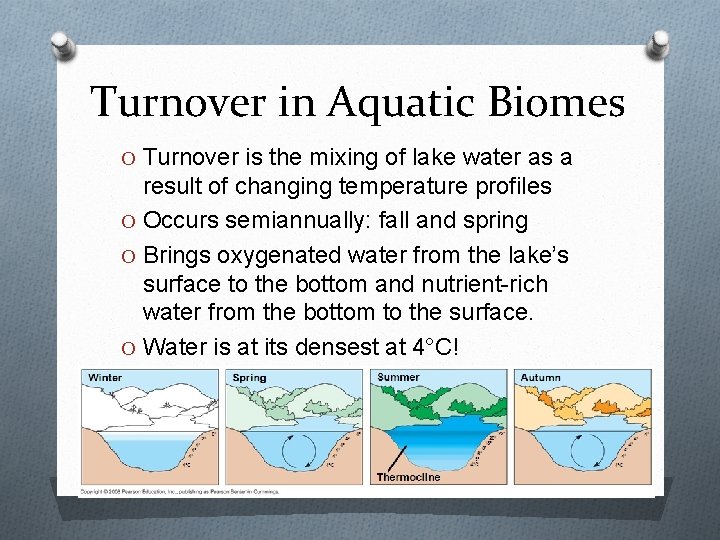
Turnover in Aquatic Biomes O Turnover is the mixing of lake water as a result of changing temperature profiles O Occurs semiannually: fall and spring O Brings oxygenated water from the lake’s surface to the bottom and nutrient-rich water from the bottom to the surface. O Water is at its densest at 4°C!
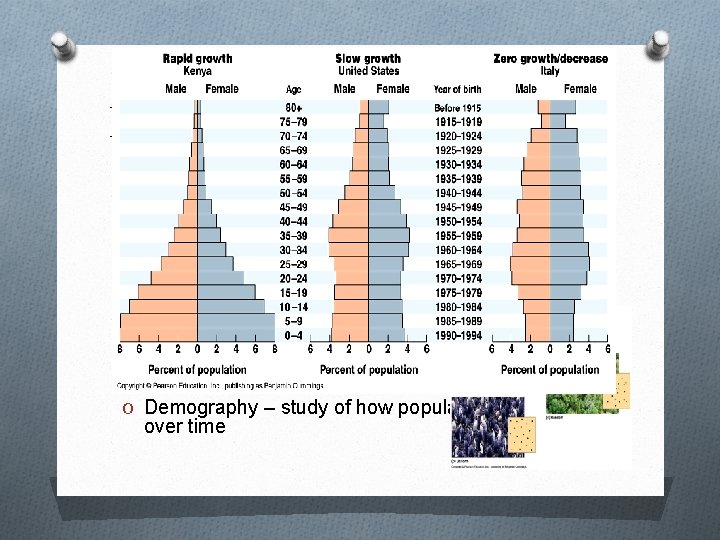
Chapter 53: Population Ecology Population Characteristics O Population Density - # of individuals / unit of area O Counts O Sample size estimates O Indirect indicators – droppings, nests, etc. O Mark-recapture O Increases with births/immigration and decreases with deaths/emigration O Dispersion – pattern of spacing O Clumped O Uniform O Random O Demography – study of how populations change over time
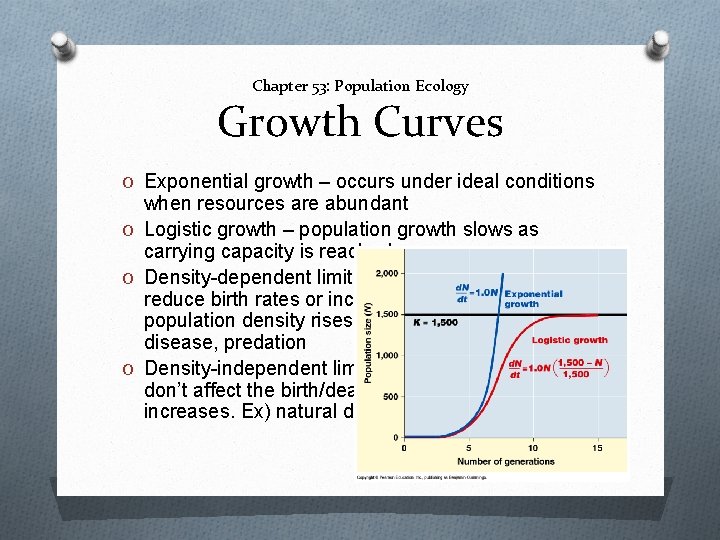
Chapter 53: Population Ecology Growth Curves O Exponential growth – occurs under ideal conditions when resources are abundant O Logistic growth – population growth slows as carrying capacity is reached O Density-dependent limiting factors – factors that reduce birth rates or increase death rates as population density rises. Ex) competition, space, disease, predation O Density-independent limiting factors – factors that don’t affect the birth/death rate as density increases. Ex) natural disasters
Chapter 54: Community Ecology Interspecific Competition O Occurs between different groups of species O Can be +, -, or neutral (0) O Competition (-/-) O Predation (+/-) O Symbiosis O Mutualism (+/+) O Commensalism (+/0) O Parasitism (+/-)
Chapter 54: Community Ecology Keystone Species O Dominant species – most abundant O Keystone species – not necessarily abundant but have a pivotal ecological role or niche O Elimination of a keystone species could change the whole dynamic of the ecosystem
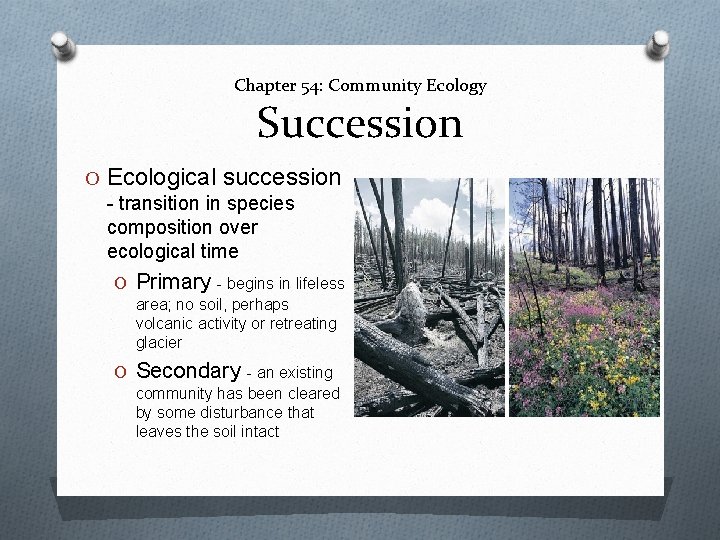
Chapter 54: Community Ecology Succession O Ecological succession - transition in species composition over ecological time O Primary - begins in lifeless area; no soil, perhaps volcanic activity or retreating glacier O Secondary - an existing community has been cleared by some disturbance that leaves the soil intact
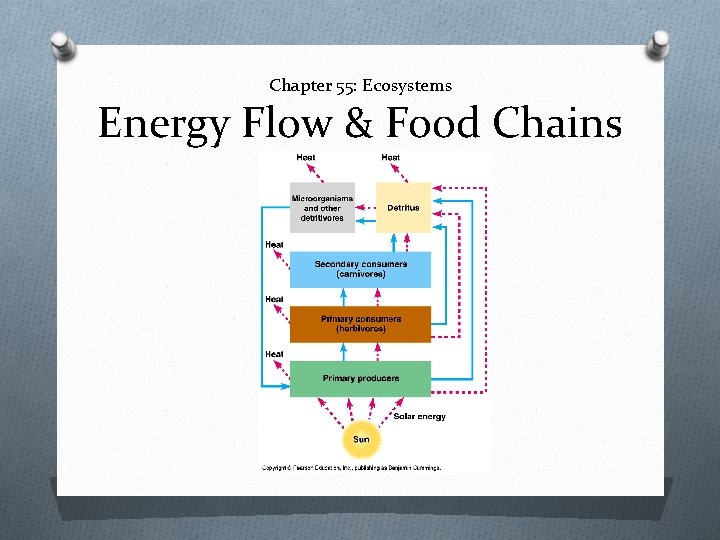
Chapter 55: Ecosystems Energy Flow & Food Chains
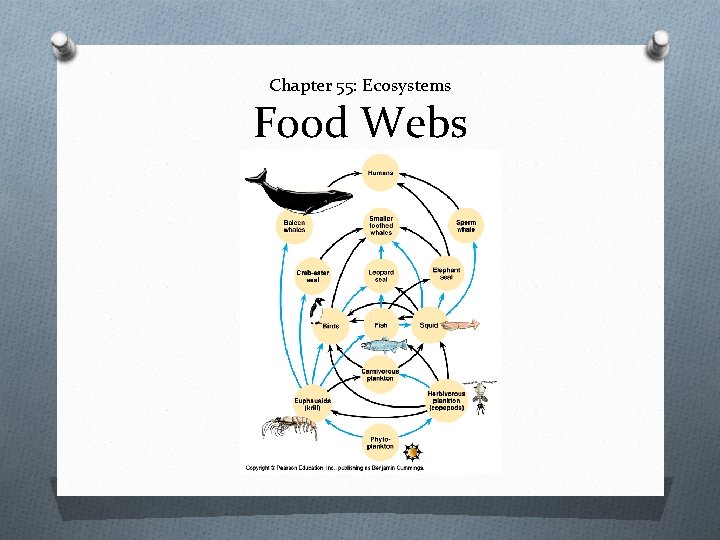
Chapter 55: Ecosystems Food Webs
Chapter 55: Ecosystems Primary Productivity O Primary production – the amount of light energy converted into chemical energy by autotrophs O Provides and energy budget for the ecosystem – only what is made can be used O Gross Primary Productivity (GPP) – Total of all chemical energy made, but not all is available to consumers (plants need energy too) O Net Primary Production (NPP) = GPP – energy used for cellular respiration by producer (R) O NPP = GPP – R O In many ecosystems, NPP is about ½ of GPP!
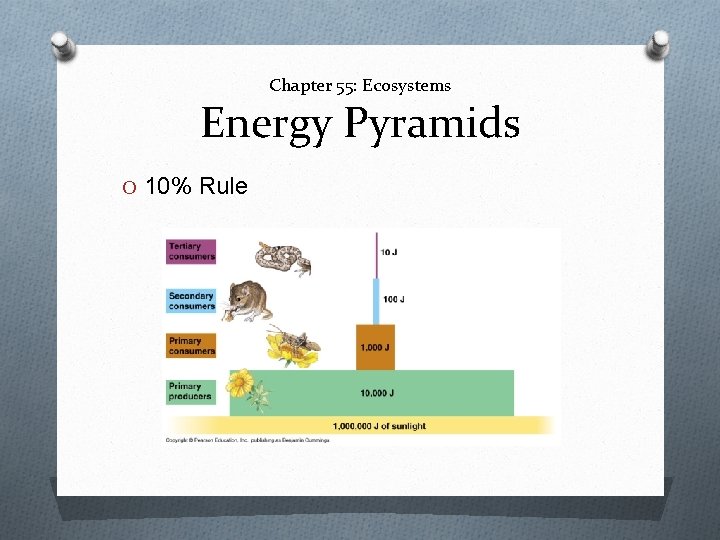
Chapter 55: Ecosystems Energy Pyramids O 10% Rule
Chapter 55 & 56: Ecosystems & Conservation Human Interference O Acid rain O Biological magnification O Greenhouse effect vs. global warming O Ozone layer destruction O Threats to biodiversity O Habitat loss O Invasive species O Overexploitation
- Slides: 14