
ECOLOGY MARCH 2020 MS COOK OBJECTIVES FOR THIS
ECOLOGY: MARCH 2020 MS. COOK
OBJECTIVES FOR THIS UNIT: Students will be able to recall and illustrate the levels of ecological hierarchy, including species, population, community, ecosystem, biome, and biosphere. (Knowledge, BIO. 5. 1) Students will be able to develop and use models to describe the flow of energy and amount of biomass through food chains, food webs, and food pyramids. (Application/Synthesis, BIO. 5. 4) Students will be able to evaluate symbiotic relationships (e. g. , mutualism, parasitism, and commensalism) and other co-evolutionary (e. g. , predator-prey, cooperation, competition, and mimicry) relationships within specific environments. (Evaluation, BIO. 5. 5) Students will be able to analyze models of the cycling of matter (e. g. , carbon, nitrogen, phosphorus, and water) and evaluate the ability of the cycles to maintain health and sustainability of the ecosystem. (Analysis, BIO. 5. 2) Students will be able to investigate and evaluate primary and secondary ecological succession using local, real world examples. (Evaluation, BIO. 5. 7)
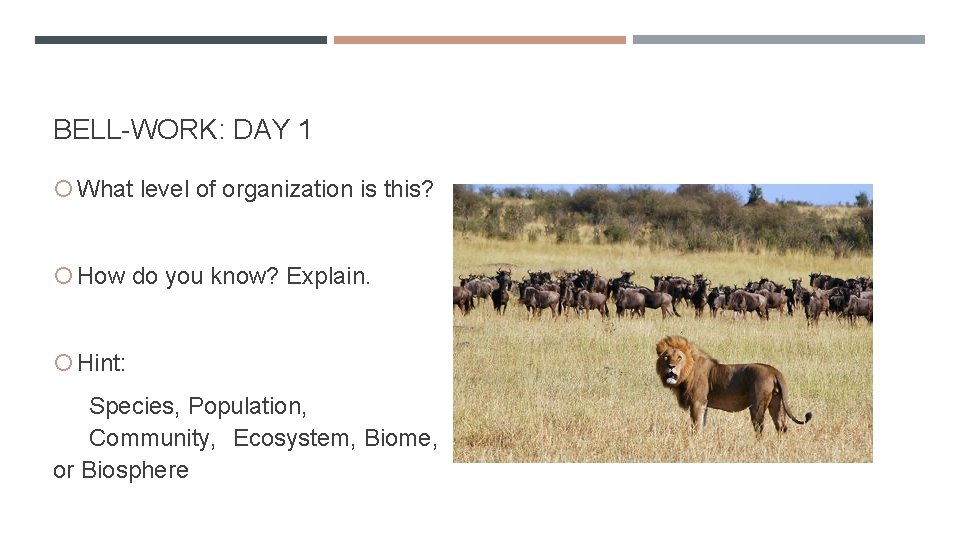
BELL-WORK: DAY 1 What level of organization is this? How do you know? Explain. Hint: Species, Population, Community, Ecosystem, Biome, or Biosphere
VOCABULARY REVIEW: 1. Species: Narrowest division of classification that produces fertile offspring and usually would not naturally mate outside of its species (Biotic only) 2. Population: a particular species living in a particular area (Biotic only) 3. Community: populations living in a particular area (Biotic only) 4. Ecosystem: a community and all of its nonliving things too (Abiotic and Biotic) 5. Biome: large terrestrial (land) area characterized by the plant and animal life that live there as well as the climate in the area. Aquatic (water) area characterized by the plant and animal life that live there. 6. Biosphere: the living earth that only makes up 5% of the total earth 7. Biotic: living things 8. Abiotic: nonliving things
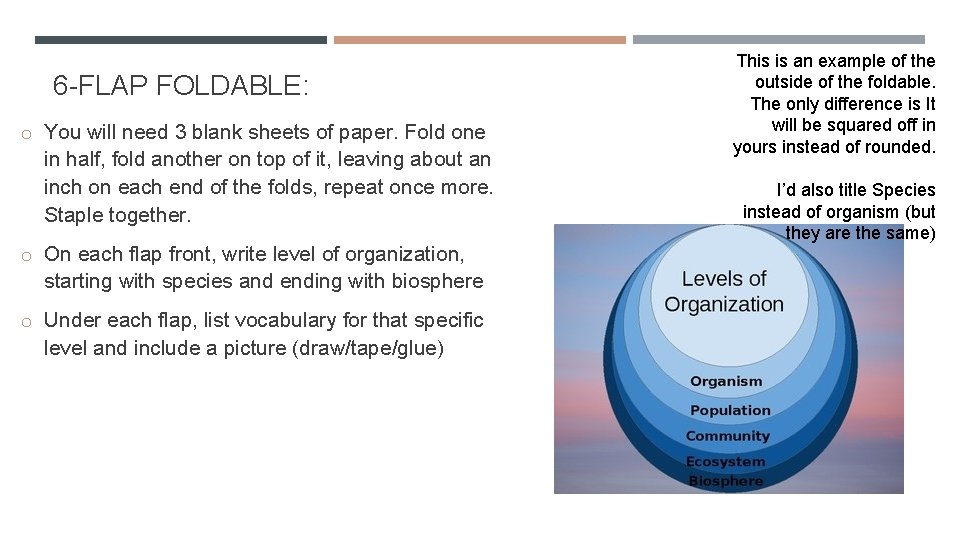
6 -FLAP FOLDABLE: o You will need 3 blank sheets of paper. Fold one in half, fold another on top of it, leaving about an inch on each end of the folds, repeat once more. Staple together. o On each flap front, write level of organization, starting with species and ending with biosphere o Under each flap, list vocabulary for that specific level and include a picture (draw/tape/glue) This is an example of the outside of the foldable. The only difference is It will be squared off in yours instead of rounded. I’d also title Species instead of organism (but they are the same)
BIOMES: Divide a plain sheet of copy/notebook paper evenly into a chart. 6 rows (left to right), 6 columns (Up and Down) Add headers above each column: Biome, Location, Climate & Characteristics, Plants, Animals Fill in each of the following in a biome row: Tundra Desert Tropical Rain Forest Deciduous Forest Taiga Grassland & Savanna
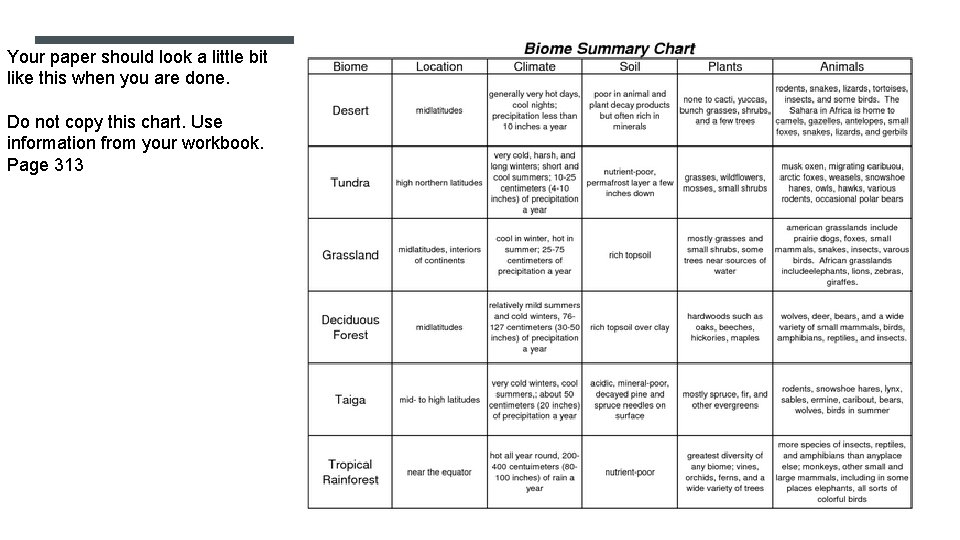
Your paper should look a little bit like this when you are done. Do not copy this chart. Use information from your workbook. Page 313
BELL-WORK: DAY 2 Using the following words, fill in vocabulary for notes: (13 words) Producer/autotroph Primary consumer Secondary consumer Apex predator Heterotroph Saprotroph/decomposer Predation Competition Parasitism Commensalism Mutualism Cooperation Mimicry
VOCABULARY: 1. ________- organism that makes its own food usually by using energy directly from the sun 2. ________- a consumer that eats producers 3. ________- a consumer that eats a primary consumer 4. ________- animal (usually carnivore) at the end of the food chain that has no natural predators 5. ________- organism that cannot make its own food; it must eat 6. ________- organism that breaks down dead or decaying organisms 7. ________- the capturing of prey by a predator; predator-prey relationship 8. ________- two or more organisms trying to use the same resources at the same time and same place 9. ________- symbiotic relationship in which one species benefits and the other is harmed 10. _______- symbiotic relationship in which one species benefits and the other is neither harmed or helped 11. _______- cooperative relationship in which two different species benefit from their relationship with each other 12. ________ - relationship within certain populations to work together for a common goal 13. _______- protective resemblance (adaptation) that causes an animal to look like something that its predators would rather avoid than eat
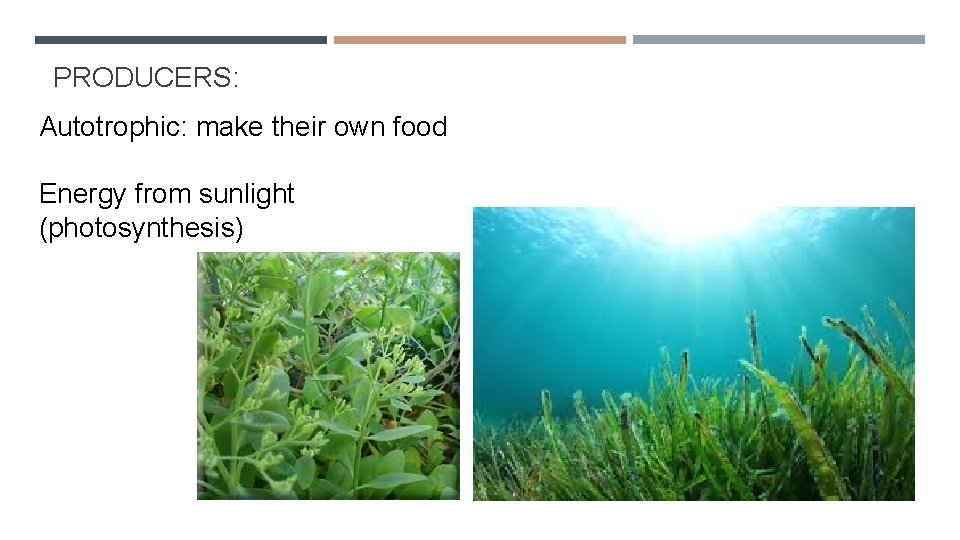
PRODUCERS: Autotrophic: make their own food Energy from sunlight (photosynthesis)
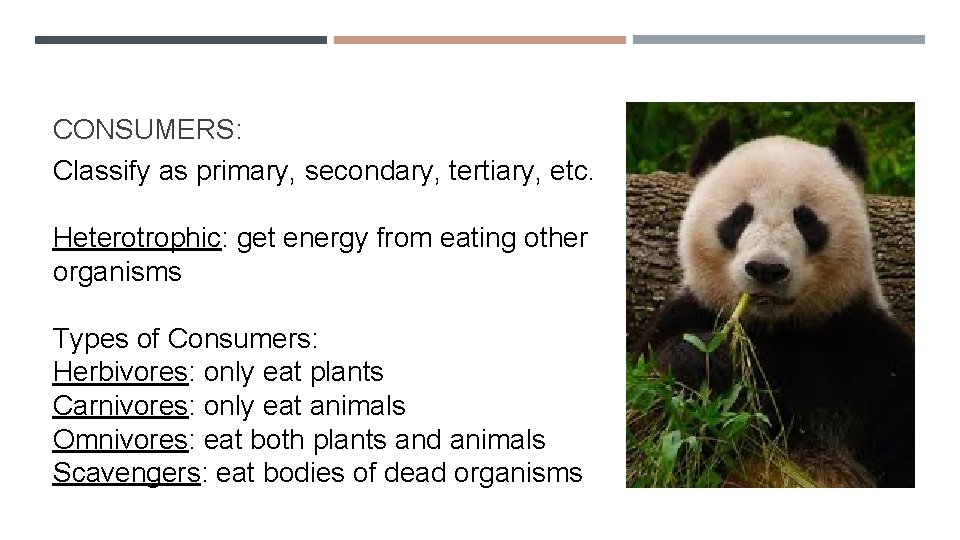
CONSUMERS: Classify as primary, secondary, tertiary, etc. Heterotrophic: get energy from eating other organisms Types of Consumers: Herbivores: only eat plants Carnivores: only eat animals Omnivores: eat both plants and animals Scavengers: eat bodies of dead organisms
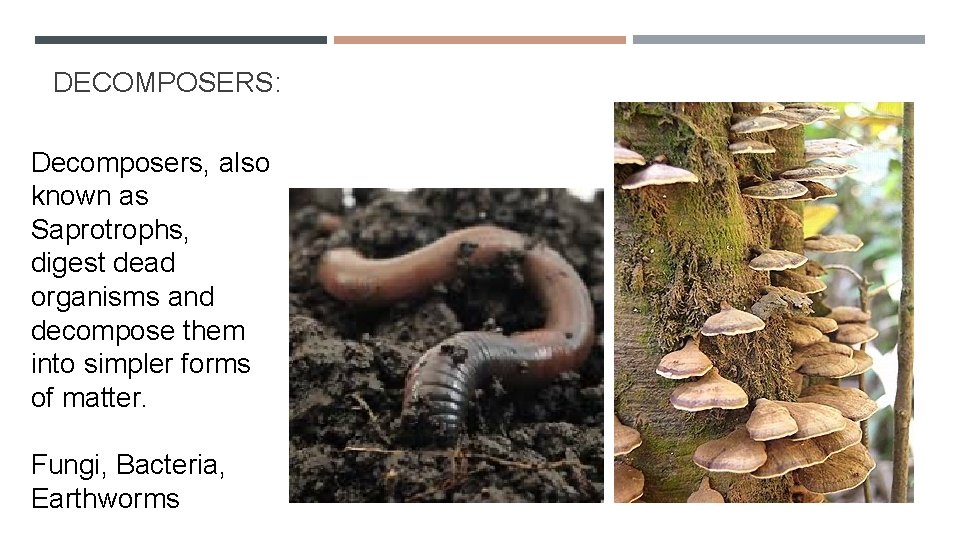
DECOMPOSERS: Decomposers, also known as Saprotrophs, digest dead organisms and decompose them into simpler forms of matter. Fungi, Bacteria, Earthworms
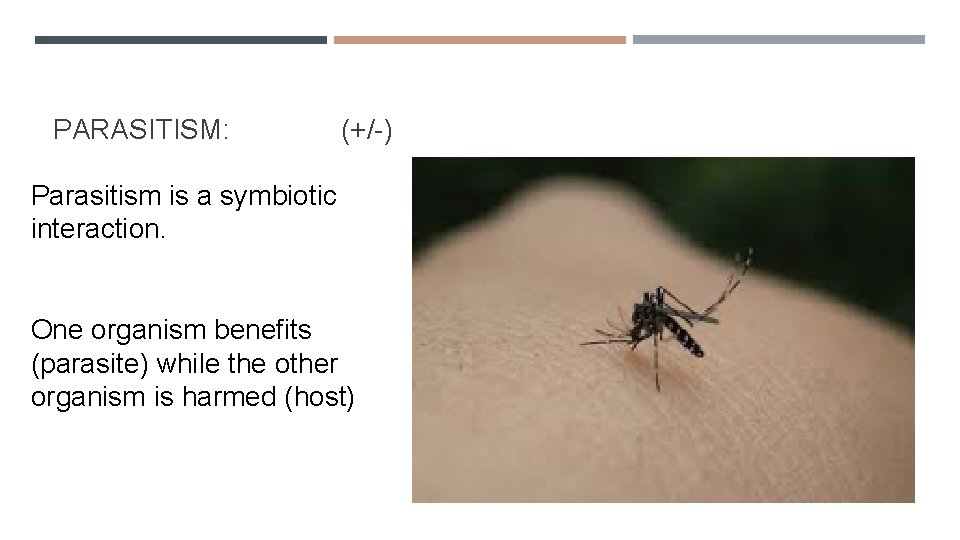
PARASITISM: (+/-) Parasitism is a symbiotic interaction. One organism benefits (parasite) while the other organism is harmed (host)
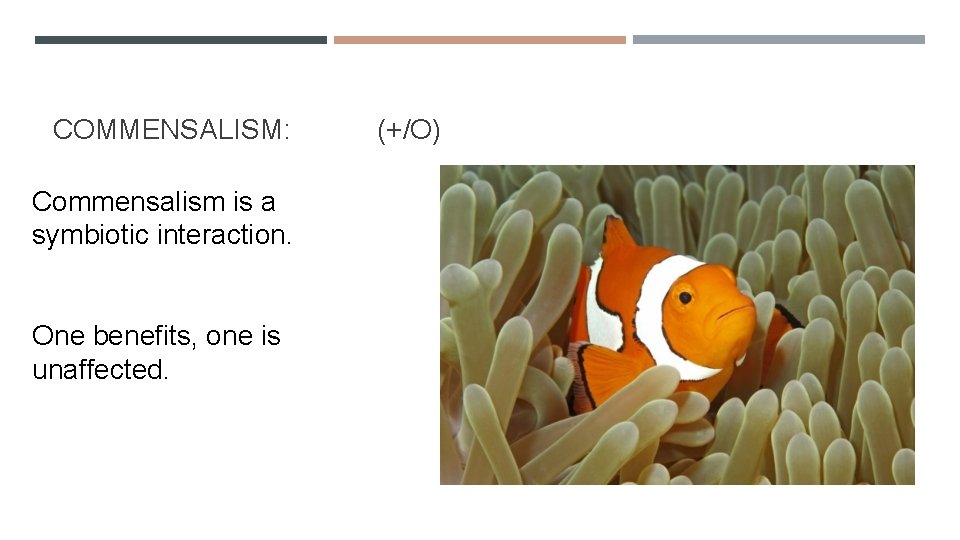
COMMENSALISM: Commensalism is a symbiotic interaction. One benefits, one is unaffected. (+/O)
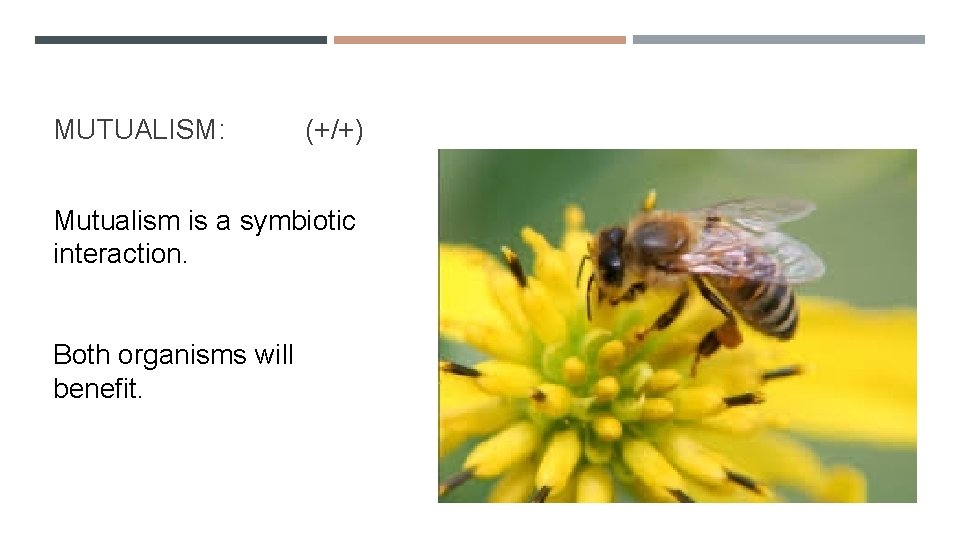
MUTUALISM: (+/+) Mutualism is a symbiotic interaction. Both organisms will benefit.
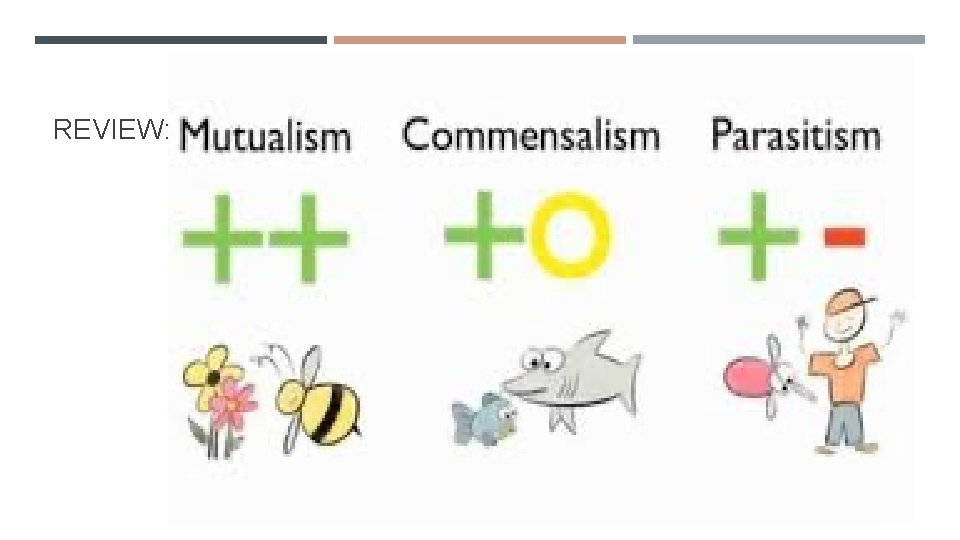
REVIEW:
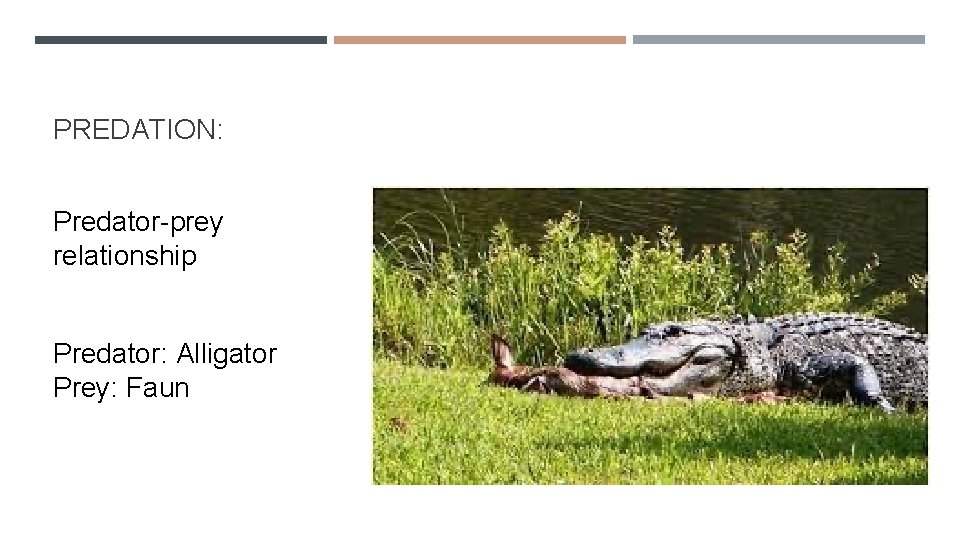
PREDATION: Predator-prey relationship Predator: Alligator Prey: Faun
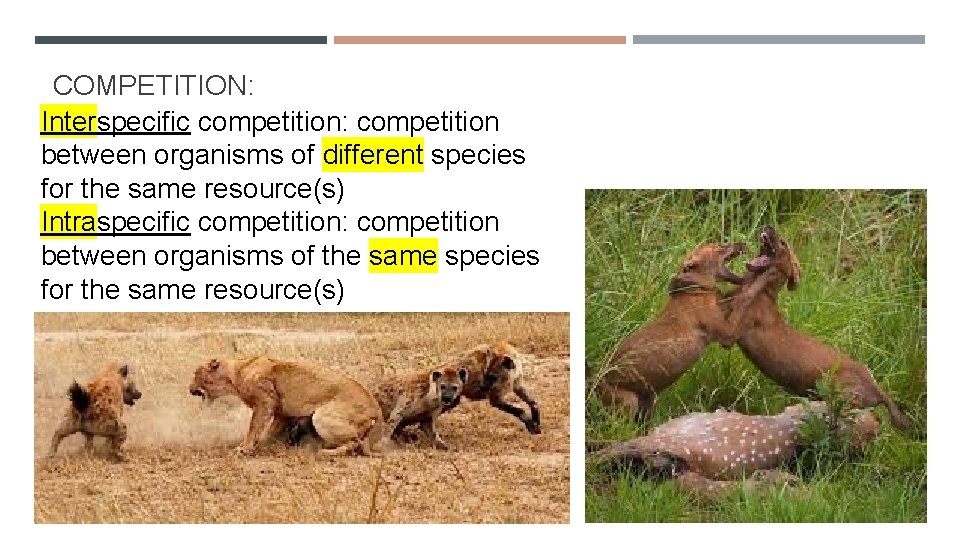
COMPETITION: Interspecific competition: competition between organisms of different species for the same resource(s) Intraspecific competition: competition between organisms of the same species for the same resource(s)
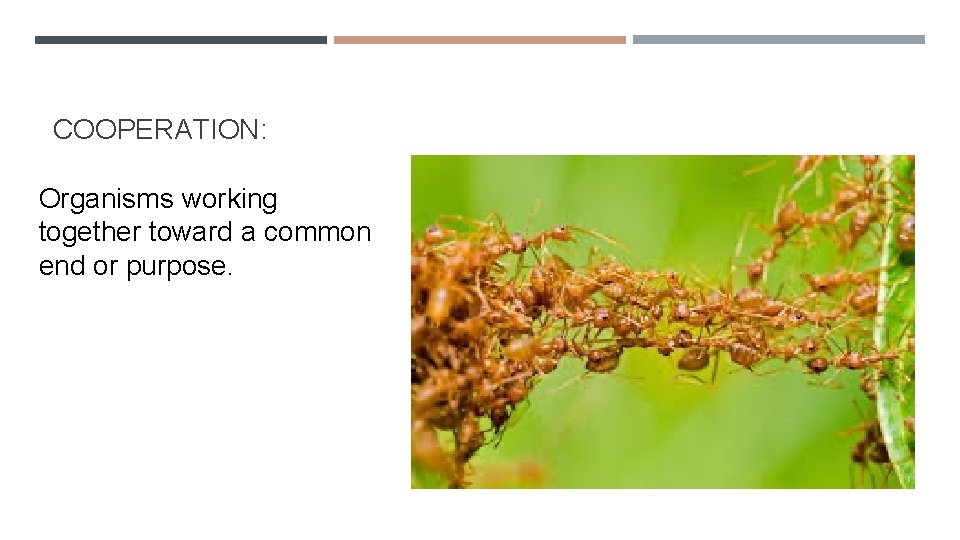
COOPERATION: Organisms working together toward a common end or purpose.
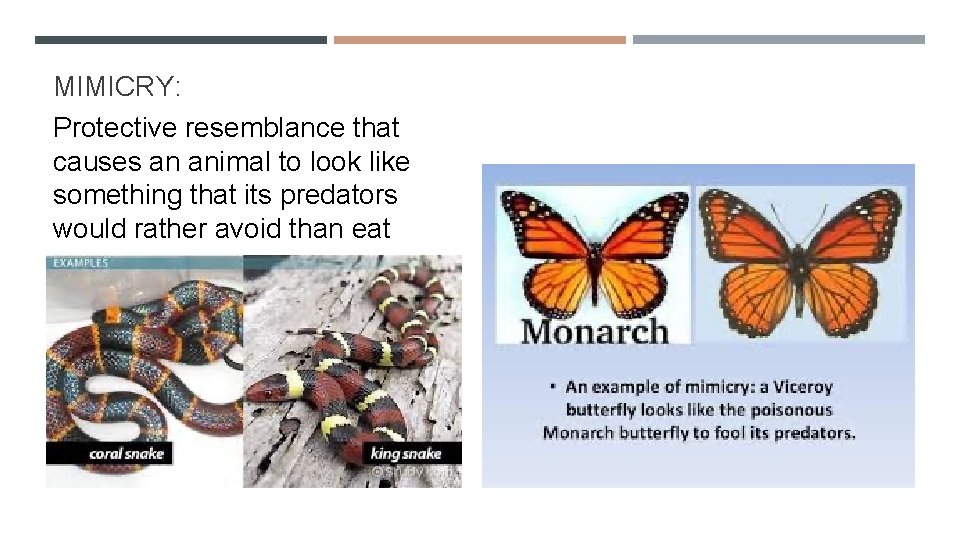
MIMICRY: Protective resemblance that causes an animal to look like something that its predators would rather avoid than eat
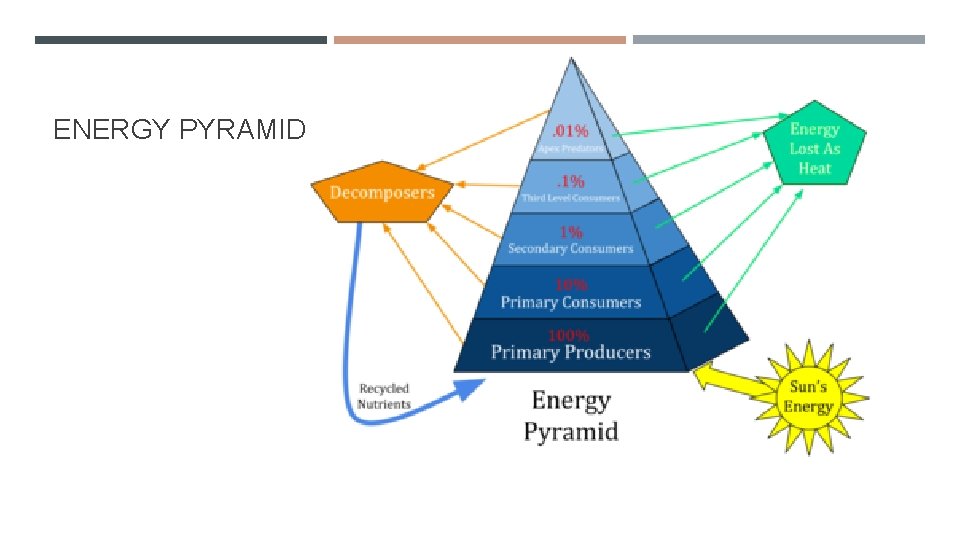
ENERGY PYRAMID
WHAT IS A FOOD CHAIN/FOOD WEB/ENERGY PYRAMID? In your own words, tell me what these are and draw an example of each. Food Chain: Food web: Energy Pyramid: Write these in your notes. Explain what they are in your own words. Interdependence: Carrying Capacity: Limiting Factors:
FOOD CHAIN PRACTICE: Sort these into a proper chain. Tertiary consumer, , producer, , secondary consumer, , decomposer, , apex predator, , primary consumer, Place these in corresponding places within the food chain: Snake, grasshopper, frog, grass, hawk, bacteria Draw a picture of each with arrows pointing to the “eater” Should look like this: Producer (grass) primary consumer (grasshopper) secondary consumer (frog) tertiary consumer (snake) apex predator (hawk) decomposer (bacteria)
EXIT TICKET: DAY 2 1. What would happen if all the decomposers went on “strike” and stopped working? 2. Name two things that you learned today. 3. What is something you need a little more help with?
HOMEWORK DUE AT END OF UNIT. Pages 349 -352 in workbook (after day 2) Pages 365 -368 in workbook (after day 3) Work on packet at home as well.
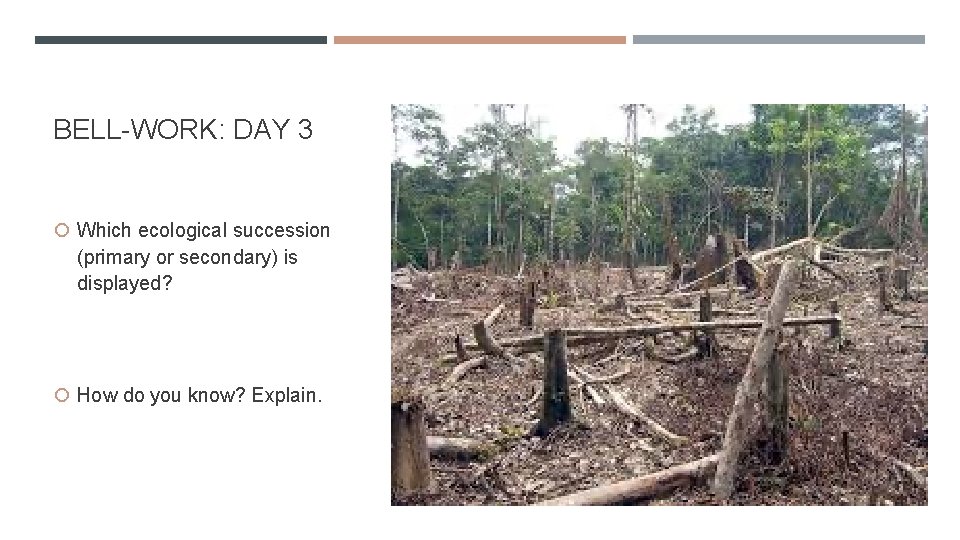
BELL-WORK: DAY 3 Which ecological succession (primary or secondary) is displayed? How do you know? Explain.
READ WORKBOOK PAGES 353 -354, 356 -358, 361 -362, & 364. DRAW EACH CYCLE. Water Cycle Carbon Cycle Nitrogen Cycle Phosphorus Cycle
SUCCESSION: T-CHART Reading on page 369 -372 Put T-chart in notes. Primary: Secondary: Pioneer species Soil No soil Does not take as long as primary (no soil Takes a very long time (soil has to form) Volcanic rock, matter, metal forming stage) Fire, flood, etc.
EXIT TICKET: DAY 3 1. Draw the carbon cycle. Name two things you learned today.
- Slides: 29