
Ecology l Chapter 51 Behavioral Biology Behavior l
Ecology l Chapter 51 ~ Behavioral Biology
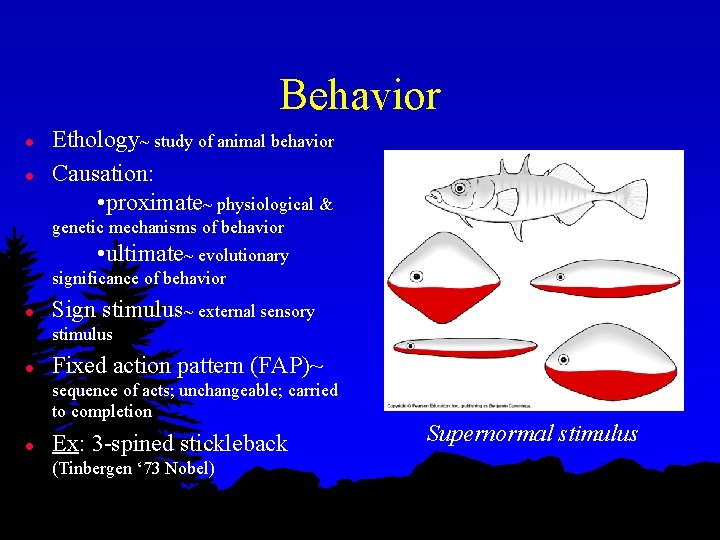
Behavior l l Ethology~ study of animal behavior Causation: • proximate~ physiological & genetic mechanisms of behavior • ultimate~ evolutionary significance of behavior l Sign stimulus~ external sensory stimulus l Fixed action pattern (FAP)~ sequence of acts; unchangeable; carried to completion l Ex: 3 -spined stickleback (Tinbergen ‘ 73 Nobel) Supernormal stimulus
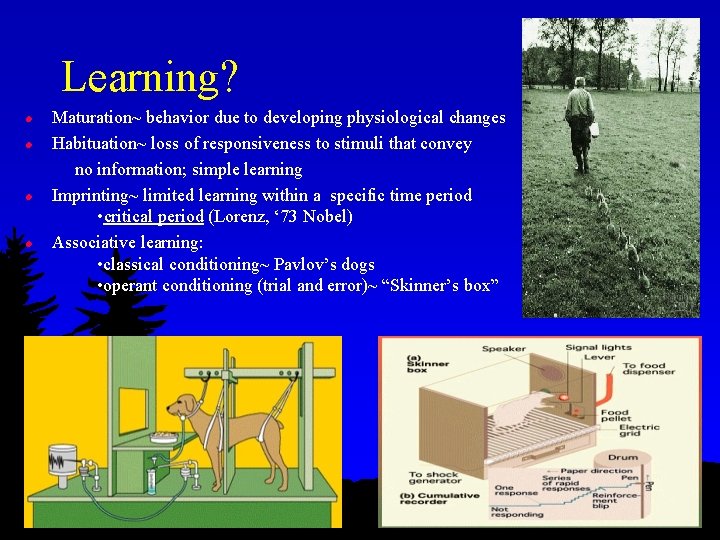
Learning? l l Maturation~ behavior due to developing physiological changes Habituation~ loss of responsiveness to stimuli that convey no information; simple learning Imprinting~ limited learning within a specific time period • critical period (Lorenz, ‘ 73 Nobel) Associative learning: • classical conditioning~ Pavlov’s dogs • operant conditioning (trial and error)~ “Skinner’s box”
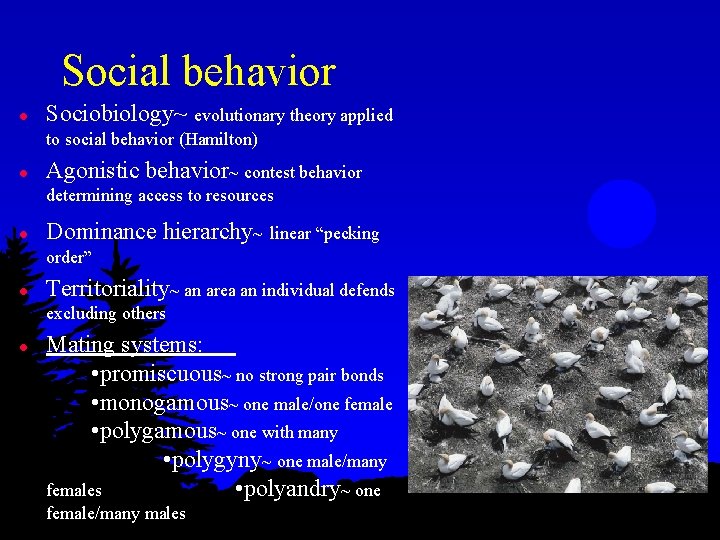
Social behavior l Sociobiology~ evolutionary theory applied to social behavior (Hamilton) l Agonistic behavior~ contest behavior determining access to resources l Dominance hierarchy~ linear “pecking order” l Territoriality~ an area an individual defends excluding others l Mating systems: • promiscuous~ no strong pair bonds • monogamous~ one male/one female • polygamous~ one with many • polygyny~ one male/many females • polyandry~ one female/many males

Altruistic behavior l Inclusive fitness~ total effect an individual has on proliferating its genes by its own offspring and aid to close relatives l Coefficient of relatedness~ proportion of genes that are identical because of common ancestors l Kin selection~ aiding related individuals altruistically l Reciprocal altruism~ exchange of aid; humans?
- Slides: 5