
Ecology Introduction The flow of matter and energy
- Slides: 25
Ecology Introduction The flow of matter and energy through an ecosystem.
b. Develop and use models to analyze the cycling of matter and flow of energy within ecosystems through the processes of photosynthesis and respiration. • Arranging components of a food web according to energy flow. • Comparing the quantity of energy in the steps of an energy pyramid. • Explaining the need for cycling of major biochemical elements (C, O, N, P, and H). 02/26/07
d. Design a solution to reduce the impact of a human activity on the environment. (Clarification statement: Human activities may include chemical use, natural resources consumption, introduction of non-native species, greenhouse gas production. ) 02/26/07
What are we learning? Standard Element: SB 5. b b. Develop and use models to analyze the cycling of matter and flow of energy within ecosystems through the processes of photosynthesis and respiration. • Arranging components of a food web according to energy flow. • Comparing the quantity of energy in the steps of an energy pyramid. • Explaining the need for cycling of major biochemical elements (C, O, N, P, and H).
d. Design a solution to reduce the impact of a human activity on the environment. (Clarification statement: Human activities may include chemical use, natural resources consumption, introduction of non-native species, greenhouse gas production. ) 02/26/07
What's alive? • Characteristics of Living things – Require food for energy to carry out life processes – Use energy to maintain homeostasis – Respond to stimuli in their environment – Reproduce similar offspring, passing genetic information to them – Made of cells • Biotic – living things • Nonliving things are called Abiotic
What is Ecology? n The scientific study of interactions among organisms and between organisms in their environment, or surroundings n Factors involved in ecology n Abiotic (non-living) ex. Sunlight, water, gravity, temperature, soil n Biotic (living)-plants, animals, bacteria, fungi
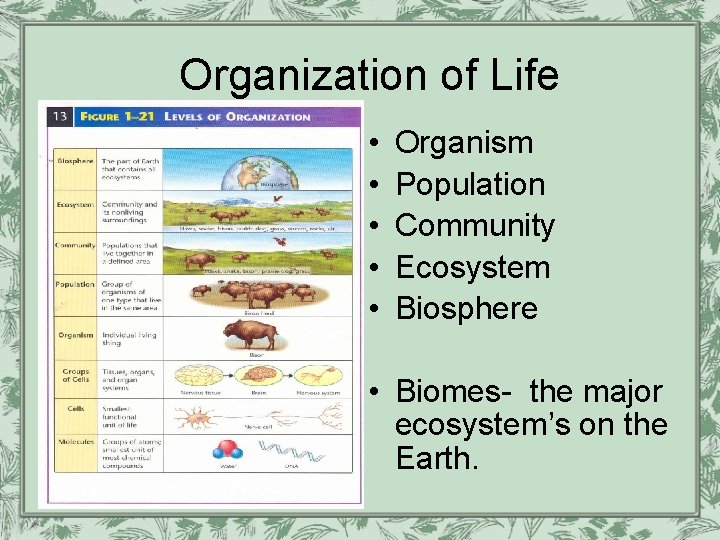
Levels of Organization n n Organism- A living thing- (singular) Population n Community n n All the members of a community plus the abiotic (physical) factors influencing them Community interacting with abiotic factors Biome n n All the members of the different interacting species in an area More than one population interacting Ecosystem n n All the members of one species in an area. Same species same place Group of ecosystems that have the same climate and similar dominant communities Biosphere
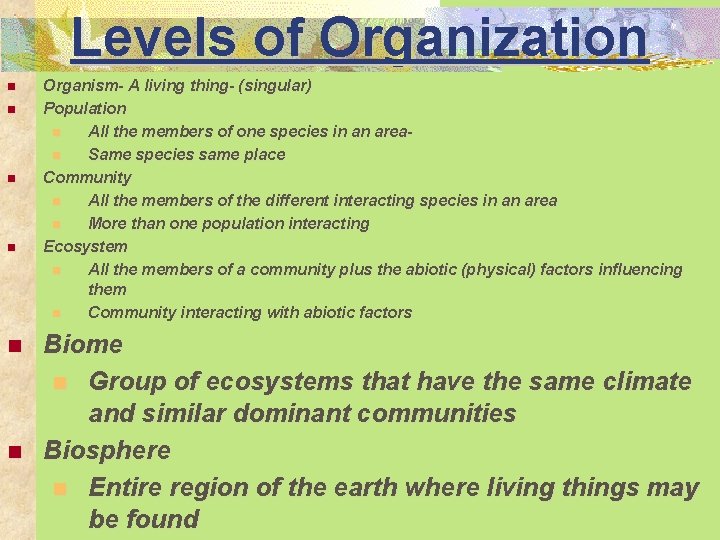
Levels of Organization n n n Organism- A living thing- (singular) Population n All the members of one species in an arean Same species same place Community n All the members of the different interacting species in an area n More than one population interacting Ecosystem n All the members of a community plus the abiotic (physical) factors influencing them n Community interacting with abiotic factors Biome n Group of ecosystems that have the same climate and similar dominant communities Biosphere n Entire region of the earth where living things may be found
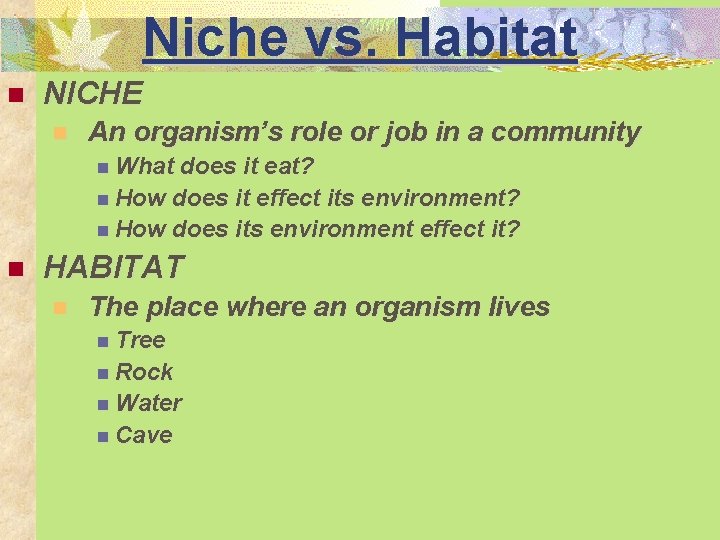
Niche vs. Habitat n NICHE n An organism’s role or job in a community n What does it eat? n How does it effect its environment? n How does its environment effect it? n HABITAT n The place where an organism lives n Tree n Rock n Water n Cave
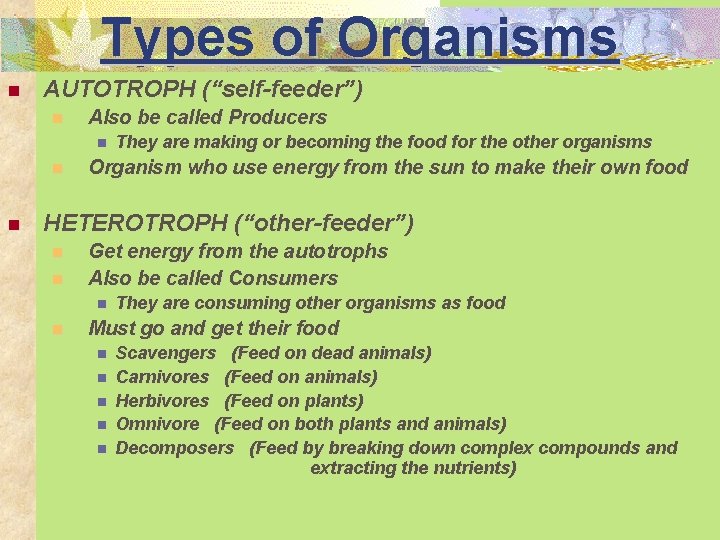
Types of Organisms n AUTOTROPH (“self-feeder”) n Also be called Producers n n n They are making or becoming the food for the other organisms Organism who use energy from the sun to make their own food HETEROTROPH (“other-feeder”) n n Get energy from the autotrophs Also be called Consumers n n They are consuming other organisms as food Must go and get their food n n n Scavengers (Feed on dead animals) Carnivores (Feed on animals) Herbivores (Feed on plants) Omnivore (Feed on both plants and animals) Decomposers (Feed by breaking down complex compounds and extracting the nutrients)
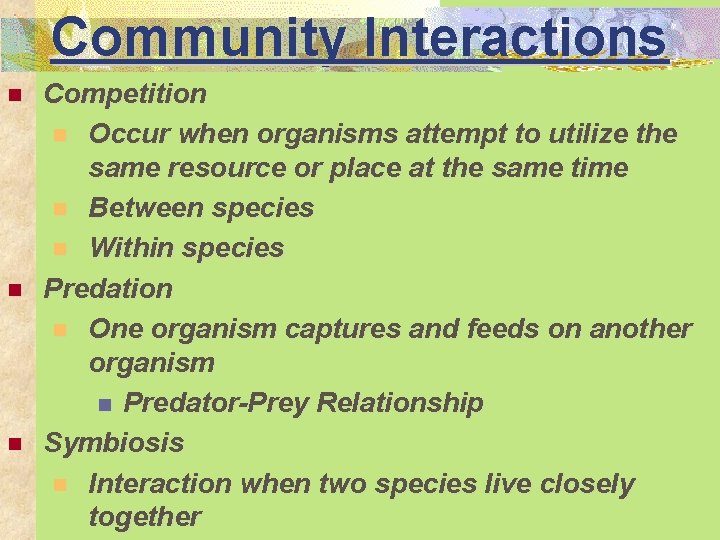
Community Interactions n n n Competition n Occur when organisms attempt to utilize the same resource or place at the same time n Between species n Within species Predation n One organism captures and feeds on another organism n Predator-Prey Relationship Symbiosis n Interaction when two species live closely together
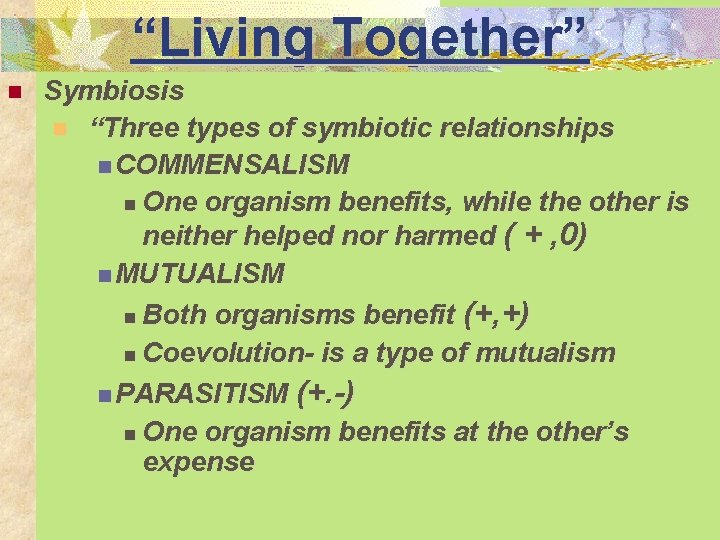
“Living Together” n Symbiosis n “Three types of symbiotic relationships n COMMENSALISM n One organism benefits, while the other is neither helped nor harmed ( + , 0) n MUTUALISM n Both organisms benefit (+, +) n Coevolution- is a type of mutualism n PARASITISM (+. -) n One organism benefits at the other’s expense
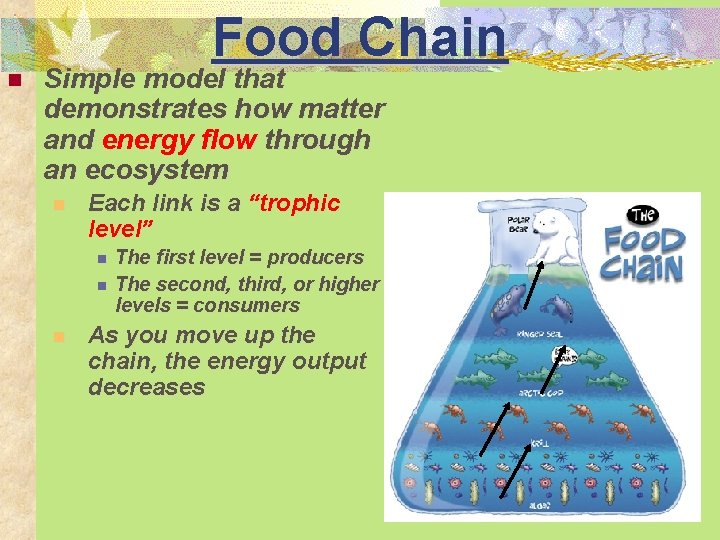
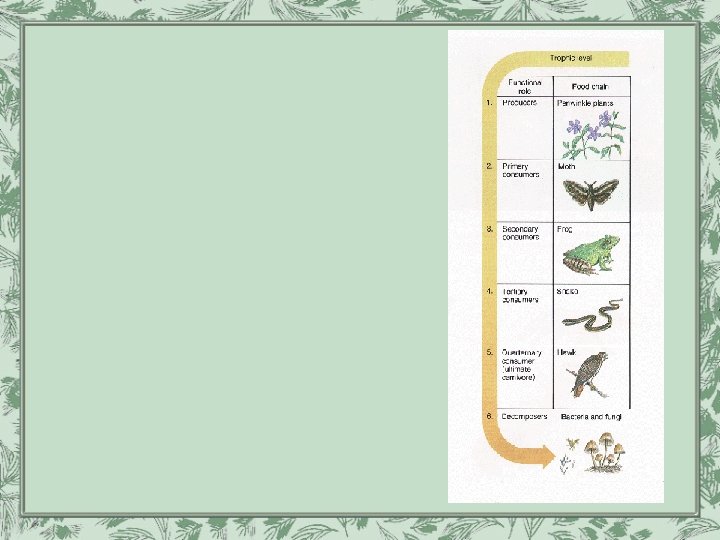
n Food Chain Simple model that demonstrates how matter and energy flow through an ecosystem n Each link is a “trophic level” n n n The first level = producers The second, third, or higher levels = consumers As you move up the chain, the energy output decreases
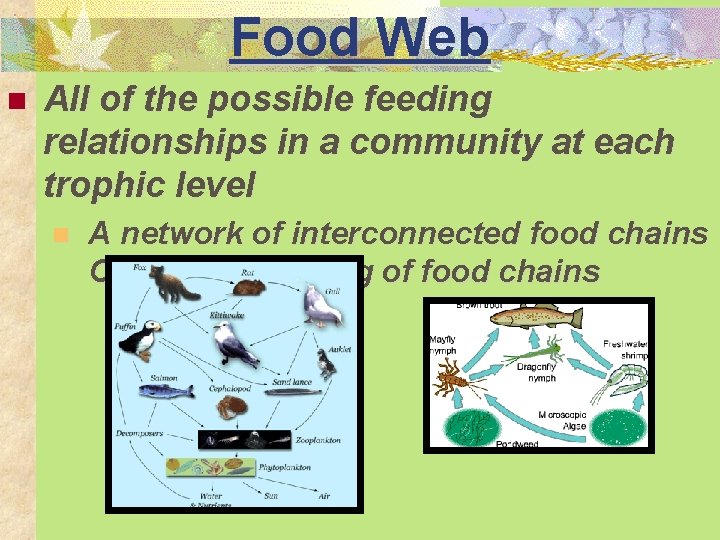
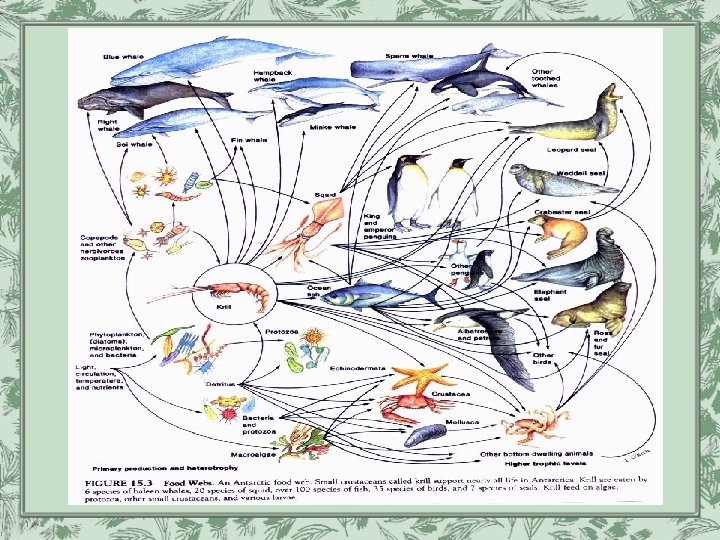
Food Web n All of the possible feeding relationships in a community at each trophic level n A network of interconnected food chains OR an overlapping of food chains
Organization of Life • • • Organism Population Community Ecosystem Biosphere • Biomes- the major ecosystem’s on the Earth.
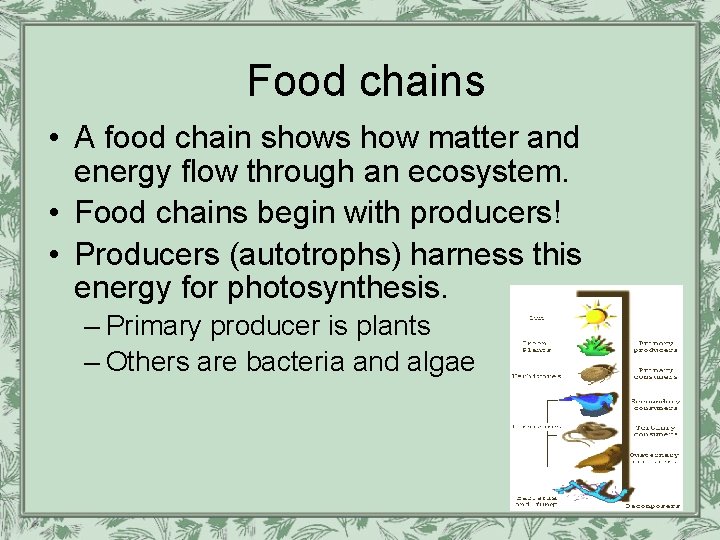
Food chains • A food chain shows how matter and energy flow through an ecosystem. • Food chains begin with producers! • Producers (autotrophs) harness this energy for photosynthesis. – Primary producer is plants – Others are bacteria and algae
Food Chains… • Consumers (heterotrophs) are eat other consumers for energy – Herbivores- only eat plants – Carnivores- eat meat (other consumers) – Omnivores -eat everything – Scavenger- eat dead things • Decomposers are a special type of consumer that break down the dead and waste. They recycle the essential nutrients.
Trophic levels • Organisms are grouped according to their source of energy. • Each organism in a food chain represent a different trophic level.
A food web • Many food chains tied together (overlapping food chains) • Many organisms feed on more than one species.
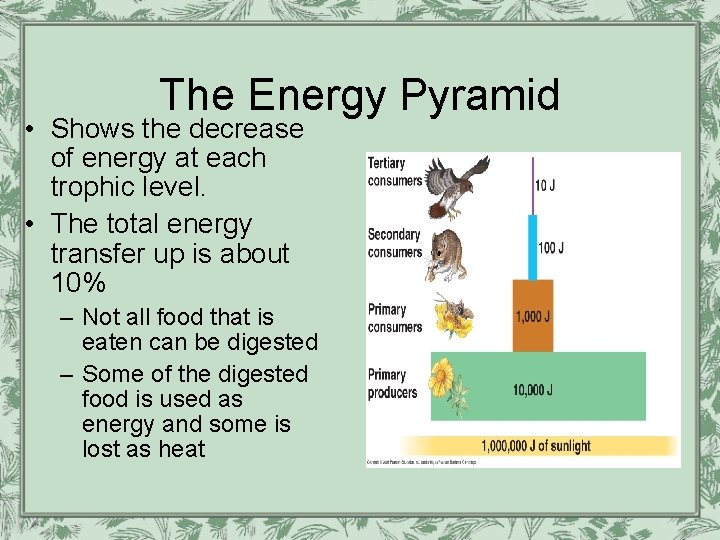
The Energy Pyramid • Shows the decrease of energy at each trophic level. • The total energy transfer up is about 10% – Not all food that is eaten can be digested – Some of the digested food is used as energy and some is lost as heat
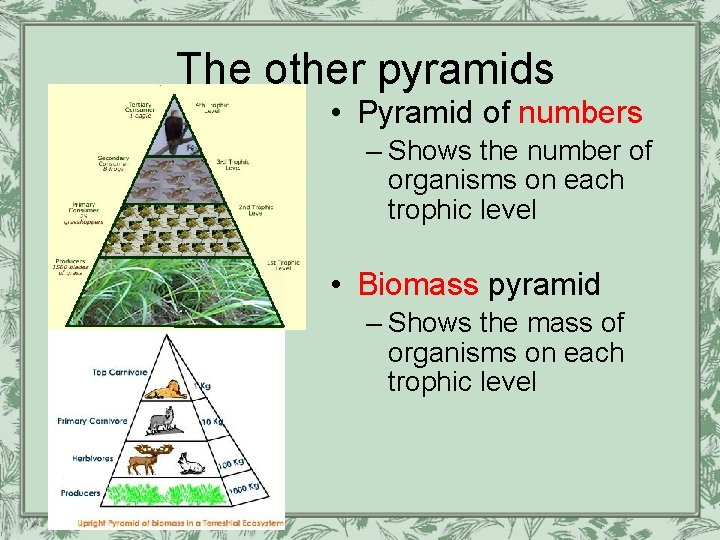
The other pyramids • Pyramid of numbers – Shows the number of organisms on each trophic level • Biomass pyramid – Shows the mass of organisms on each trophic level
The Elements • The elements that are the components in all organic molecules must be recycled because there a finite amount on our planet. • The elements are: – Carbon (C) – Oxygen (O) – Hydrogen (H) – Nitrogen (N) – Phosphorus (P)