
Ecology Ecology The interaction between organisms and their
Ecology
Ecology �The interaction between organisms and their environment.
Levels of Organization 1. Biosphere- All life on Earth 2. Biome- All ecosystems in the same climate 3. Ecosystem- different groups of organisms plus their environment 4. Community- different populations that live together 5. Population- all members of the same species that live together 6. Individual- a single organism
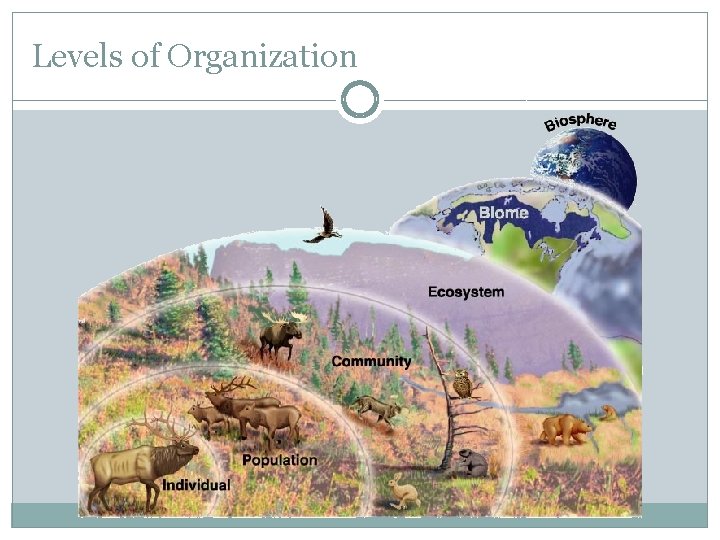
Levels of Organization
Energy Flow �The main source of energy for life on Earth is the Sun. That energy is used by producers at the base of the food chain. Consumers then eat the producers and the energy is passed along.
Energy Flow �Producers, also called autotrophs. Make carbohydrates from inorganic substances in two different ways: Photosynthesis �Ex. ) -produces energy from sunlight. Plants Chemosynthesis -produces energy from chemicals. �Ex. ) Some types of bacteria
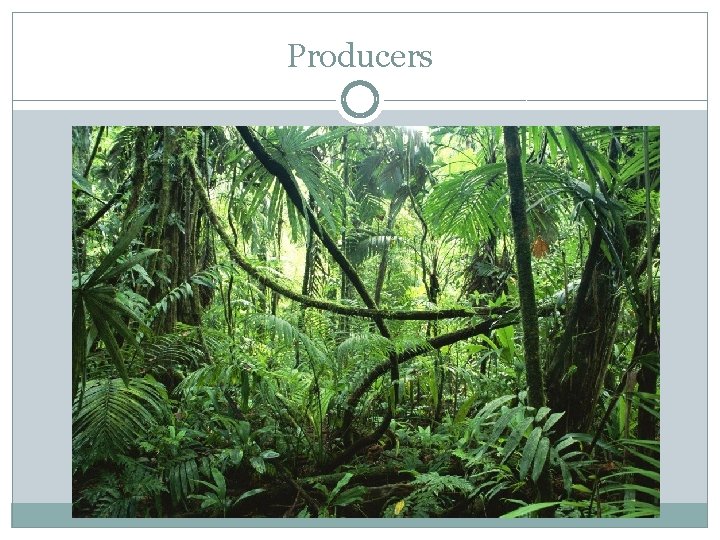
Producers
Energy Flow �Consumers, also called heterotrophs. Rely on other organisms for food. Herbivores eat plants � Ex. ) Omnivores eat both plants and animals � Ex. ) Lions/wolves Detritivores eat dead matter � Ex. ) Humans/bears Carnivores eat animals � Ex. ) Deer Earthworms Decomposers break down decaying matter � Ex. ) Bacteria/fungi
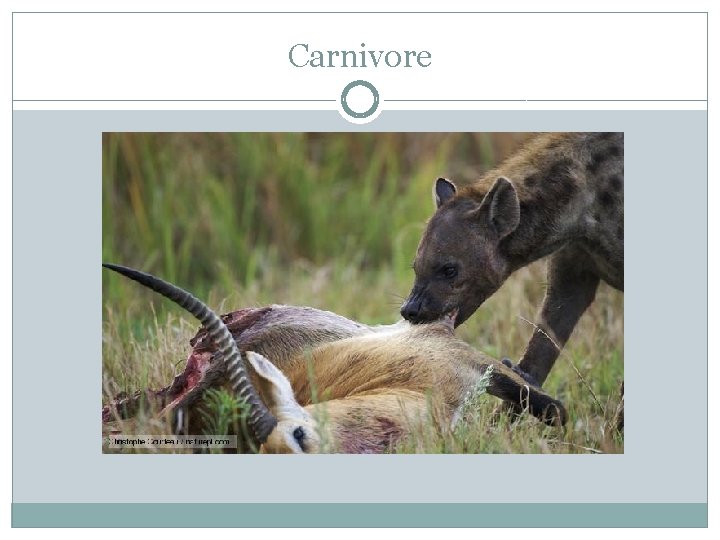
Carnivore
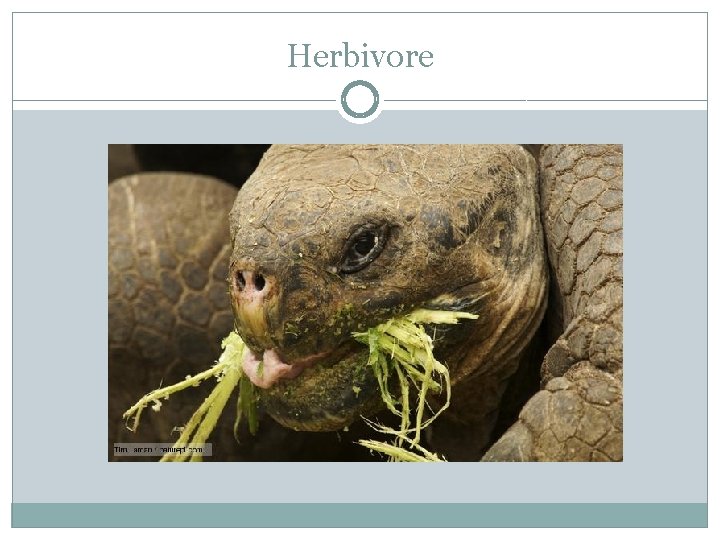
Herbivore
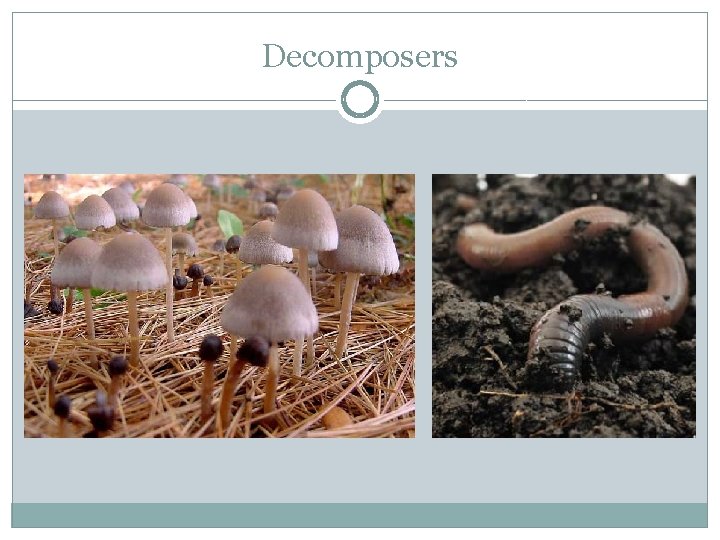
Decomposers
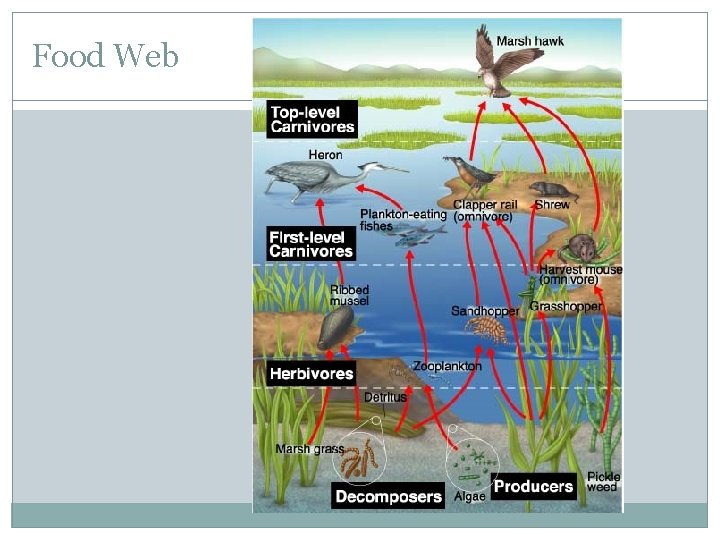
Food Web
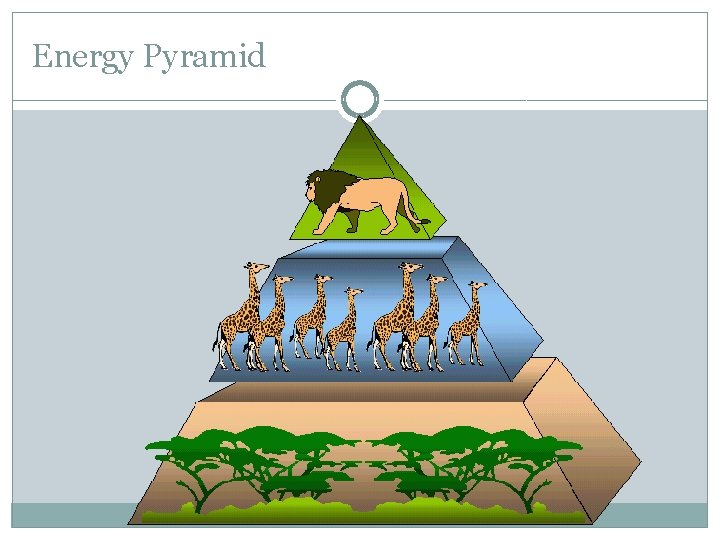
Energy Flow �Each successive step in a food chain or web is called a trophic level. Energy exchange between each trophic level is considered to be inefficient. This is because only about 10% of energy is stored within the tissues of an organism and passed along to a consumer. �The remaining energy is used for growth, metabolism, respiration reproduction, and some is lost as heat.
Energy Pyramids �Pyramid by biomass- shows the amount of living tissue in each level. �Pyramid by numbers- shows the number of organisms in each level. �Examples: Trees in a forest might have a high biomass, but relatively low numbers. Algae in a pond might have a low biomass, but high numbers of individuals.
Energy Pyramid
Water Cycle- required for life processes. Enters the atmosphere through evaporation and transpiration. Leaves the atmosphere through precipitation. Cycles through organisms, run-off, ground water and plant roots.
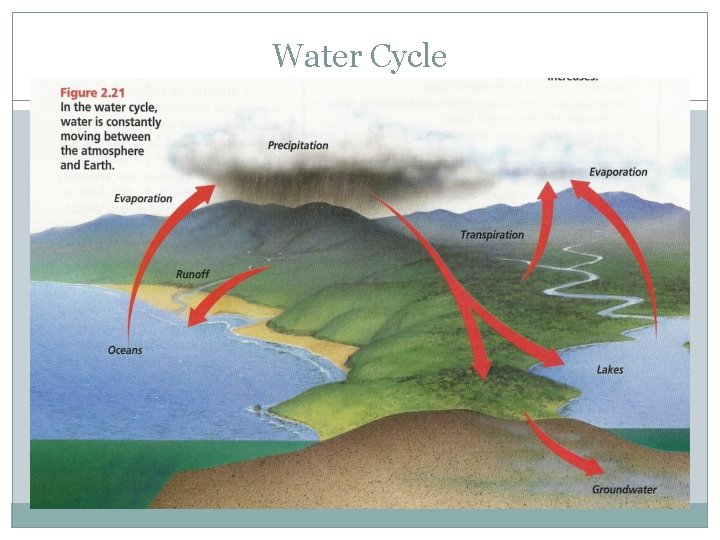
Water Cycle
Carbon Cycle- key ingredient in making living tissues; also needed for photosynthesis and respiration. Enters the atmosphere through respiration, volcanic activity and burning. Leaves the atmosphere through photosynthesis. Cycles through erosion, feeding, and decomposition.
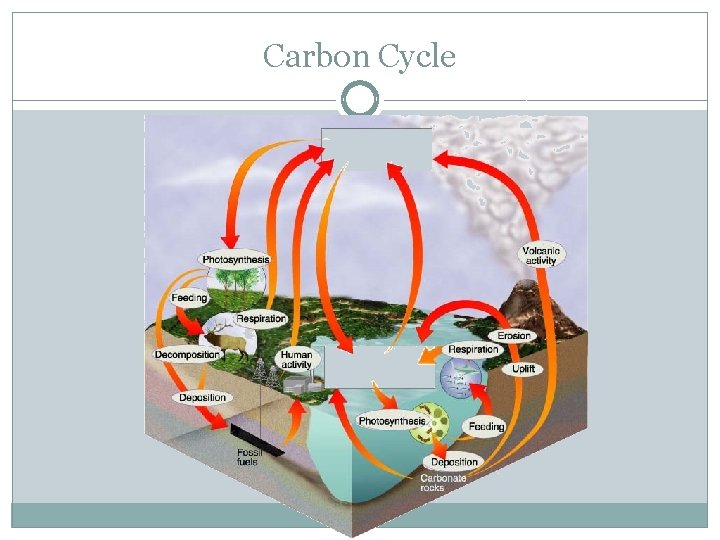
Carbon Cycle
Nitrogen Cycle- required for making amino acids and building proteins. Enters the atmosphere through denitrification. This is when bacteria break down nitrates and nitrites into nitrogen gas. Cycles through nitrogen fixation. This is when bacteria break down ammonia into nitrates and nitrites. Much of this type of bacteria is found on the roots of legumes, or bean plants. Ammonia is a by-product of animal waste and decay. Human use of fertilizers also distributes nitrogen.
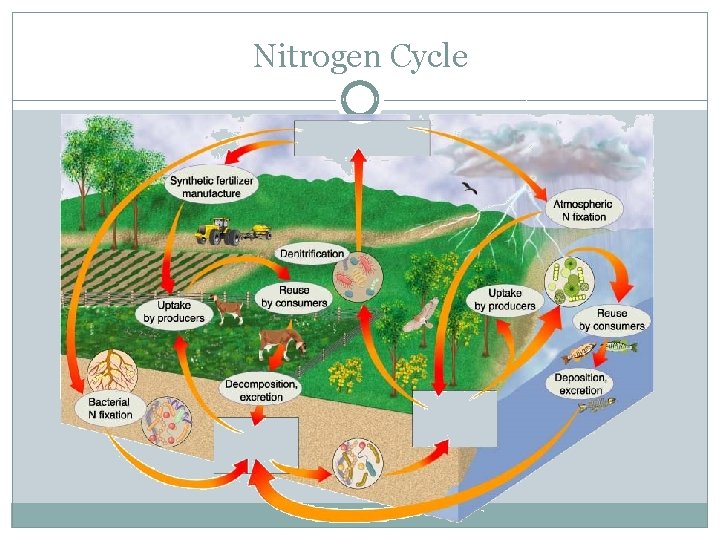
Nitrogen Cycle
Phosphorus Cycle- used to build DNA and RNA molecules. Does not cycle through the atmosphere. Cycles between organisms and the soil through plants.
Limiting Productivity A single nutrient that can control the numbers of producers in an area, or primary productivity, is called a limiting nutrient. Algal blooms can form as a result of fertilizer run-off which may suddenly increase the algae’s limiting nutrients. If there are not enough consumers in an area to eat the algae, this can disrupt the balance of an ecosystem.
Interactions Among Organisms �Competition- animals compete, for food, territory, or mates. �Predation-one animal hunts and kills another food. �Symbiosis -animals use each other for various purposes.
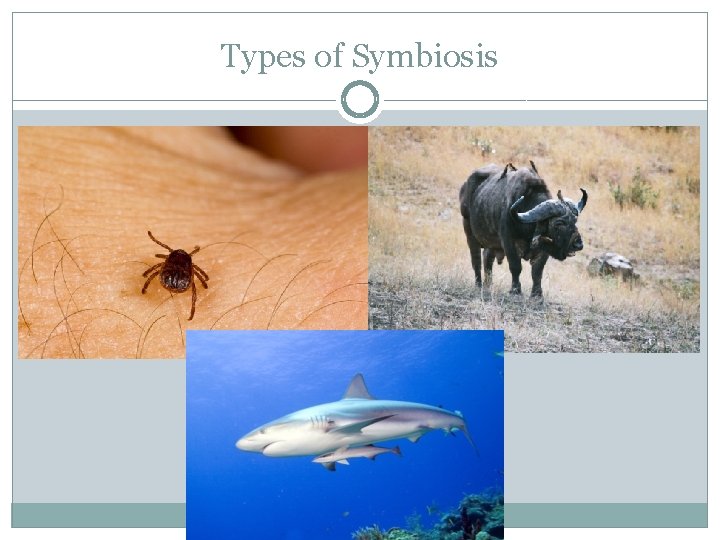
Types of Symbiosis �Mutualism: both benefit Ex. ) Flowers and insects, birds and cows �Commensalism: one benefits while another is unaffected Ex. ) Lions and hyenas �Parasitism: one benefits while another is harmed Ex. ) Tapeworms and dogs
Types of Symbiosis
Keystone Species �A species that plays a more important role in their ecosystem �If a keystone species is lost, the ecosystem could collapse. �Examples: Predators Pollinators Engineers
Biotic Factors �Living influences of an ecosystem Includes: all organisms (plants, animals, fungi…even germs!)
Abiotic Factors �Non-living influences of an ecosystem Includes: air, water, temperature, sunlight and minerals
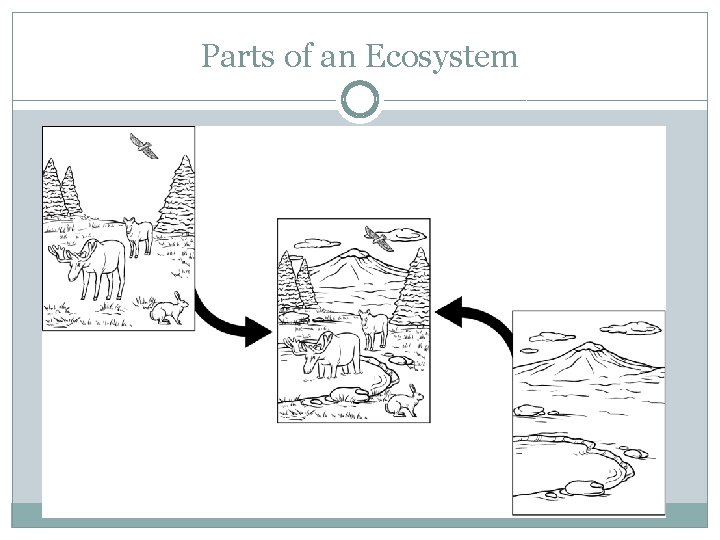
Parts of an Ecosystem
Limiting Factors �Factors that cause a population’s growth to slow or stop. �May depend on the number of organisms in an area (density-dependent) or may occur regardless of population size (densityindependent)
Limiting Factors Density-dependent Density-independent �Competition �Weather �Predation �Seasons �Parasitism �Natural disasters �Disease �Human activity
Competition �Occurs when organisms share a limited resource �The competitive exclusion principle states that two species who share the same resources and niche cannot coexist �Resource partitioning allows organisms to coexist by dividing a resource based on differences in behavior, time, space or morphology (anatomy).
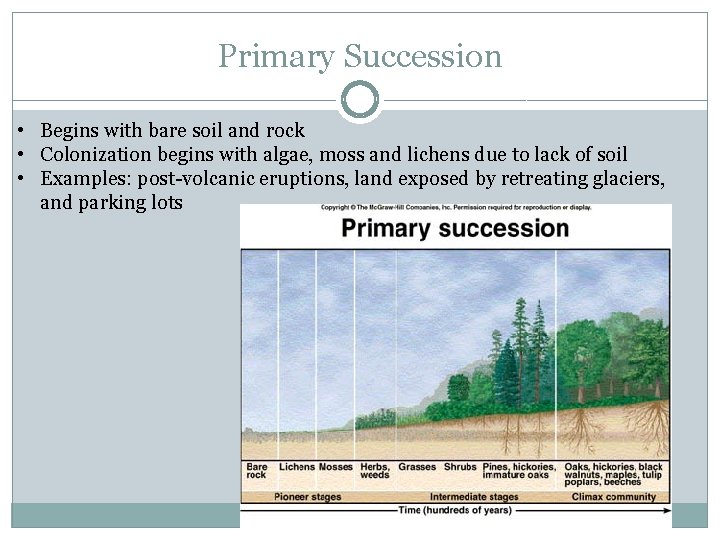
Primary Succession • Begins with bare soil and rock • Colonization begins with algae, moss and lichens due to lack of soil • Examples: post-volcanic eruptions, land exposed by retreating glaciers, and parking lots
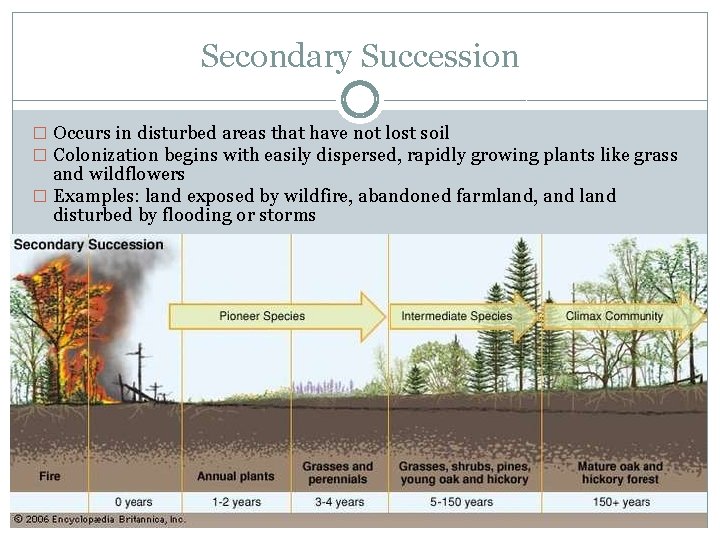
Secondary Succession � Occurs in disturbed areas that have not lost soil � Colonization begins with easily dispersed, rapidly growing plants like grass and wildflowers � Examples: land exposed by wildfire, abandoned farmland, and land disturbed by flooding or storms
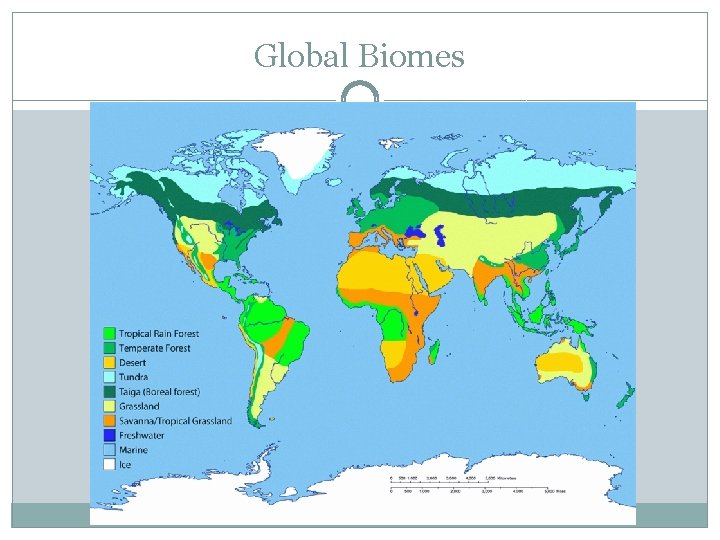
Global Biomes
Terrestrial Biomes �Taiga-snowy, coniferous forests of Canada and Siberia �Temperate Rainforests-rainy coniferous forests of the Pacific Northwest US �Temperate Seasonal Forests-Forests dominated by deciduous trees that lose their leaves seasonally (NC!) �Tropical Rainforests-Equatorial broadleaf evergreen forests that receive lots of rainfall like the Amazon �Shrubland- relatively hot and dry climates dominated by shrubs and bushes; found in the Southwestern coasts of the US
Terrestrial Biomes (continued) � Temperate Grassland-mild temperatures and rainfall that is not high enough to support numerous trees; American prairie � Savanna-grasslands with a seasonal change in precipitation; think African safari! � Desert-receives very low levels of precipitation despite temperature; the Sahara in Africa, Sonoran Desert of US, Gobi Desert in China and Great Victoria Desert of Australia � Tundra-cold with low precipitation; a layer of permafrost exists under topsoil; grasses, but no trees; near polar regions
Factors Influencing Terrestrial Biomes Factors that influence terrestrial biomes: 1. Latitude: More sunlight near the Equator and less seasonal change. 2. Altitude: Temperatures drop as you go up in elevation. 3. Rainfall: Winds move weather from west to east in general across the United States. 4. Geography: Mountains can block clouds and rainfall causing the rain shadow effect.
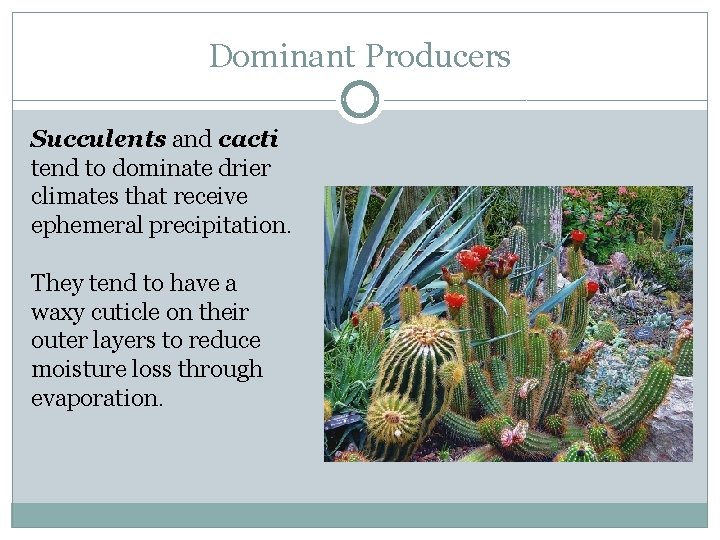
Dominant Producers Succulents and cacti tend to dominate drier climates that receive ephemeral precipitation. They tend to have a waxy cuticle on their outer layers to reduce moisture loss through evaporation.
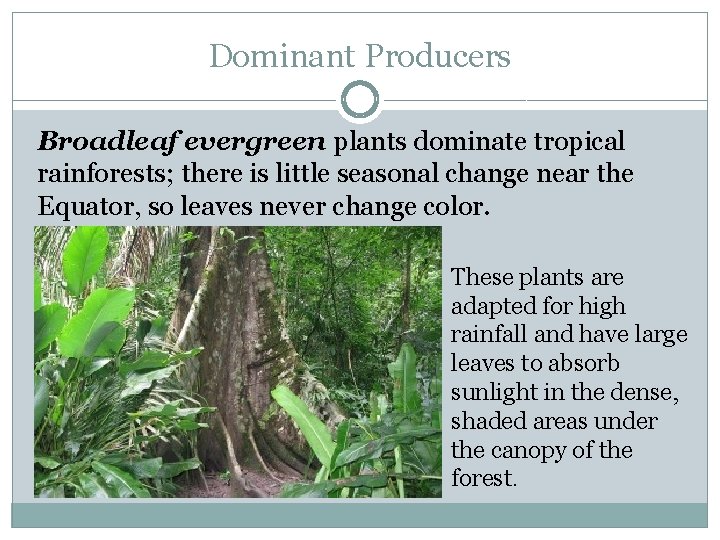
Dominant Producers Broadleaf evergreen plants dominate tropical rainforests; there is little seasonal change near the Equator, so leaves never change color. These plants are adapted for high rainfall and have large leaves to absorb sunlight in the dense, shaded areas under the canopy of the forest.
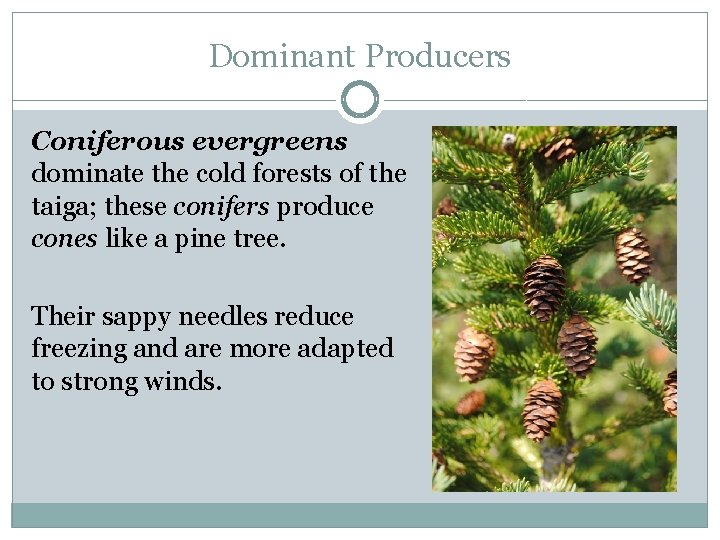
Dominant Producers Coniferous evergreens dominate the cold forests of the taiga; these conifers produce cones like a pine tree. Their sappy needles reduce freezing and are more adapted to strong winds.
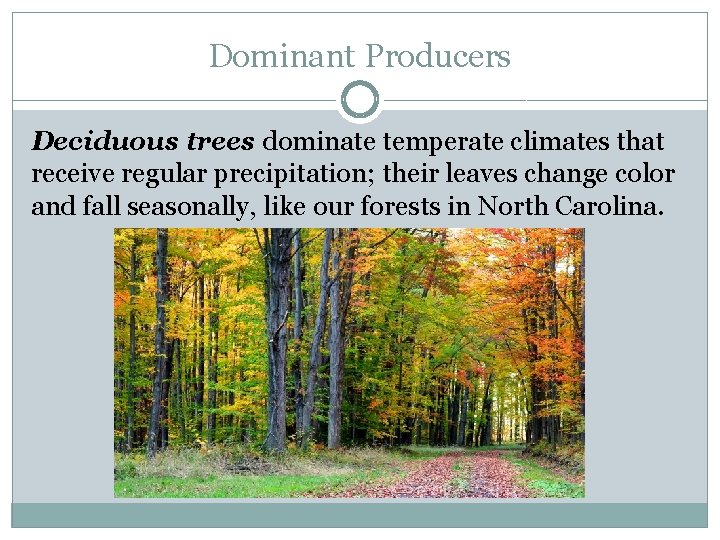
Dominant Producers Deciduous trees dominate temperate climates that receive regular precipitation; their leaves change color and fall seasonally, like our forests in North Carolina.
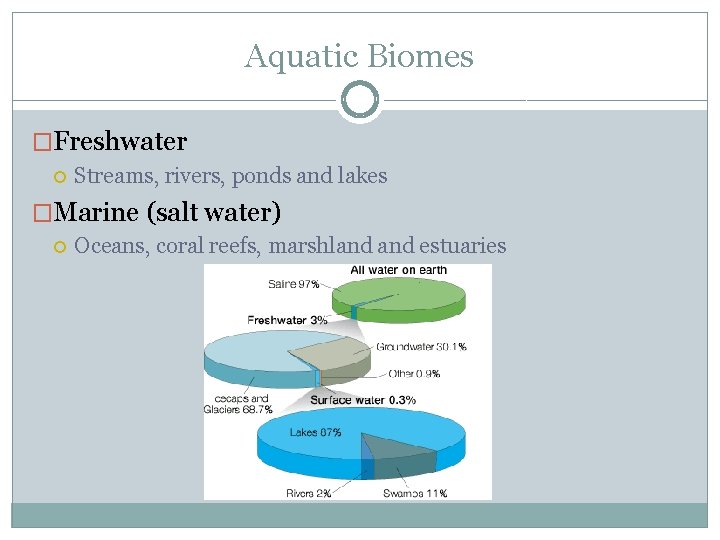
Aquatic Biomes �Freshwater Streams, rivers, ponds and lakes �Marine (salt water) Oceans, coral reefs, marshland estuaries
Aquatic Biomes �Factors that influence aquatic biomes: Sunlight: more sunlight near the Equator Temperature: higher temperatures at water surface Salinity: higher concentration of salt in areas of high evaporation/near Equator Turbidity: sediment in water can lead to cloudiness and less photosynthesis/fewer producers Depth: pressure increases with depth; fewer organisms are adapted for changing pressure Nutrients: nutrients are more available along coastlines, at river deltas, and through the upwelling of cold, nutrient rich water
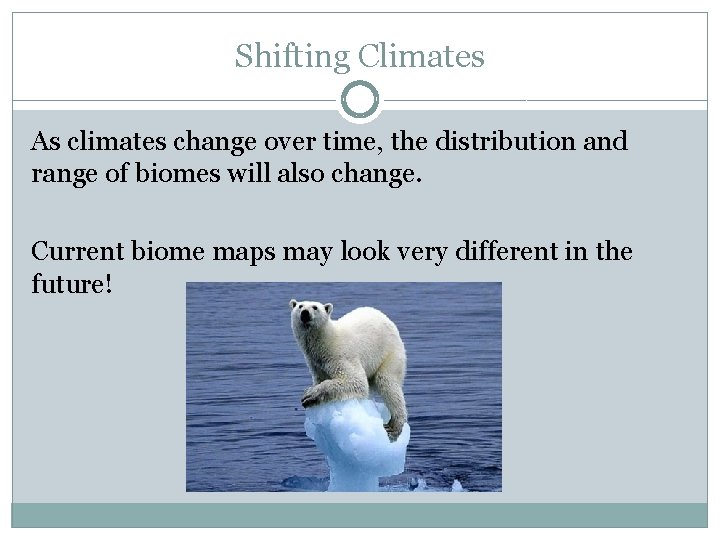
Shifting Climates As climates change over time, the distribution and range of biomes will also change. Current biome maps may look very different in the future!
- Slides: 46