
Ecology Ecological Succession and Population Density Population Characteristics

- Slides: 25
Ecology: Ecological Succession and Population Density
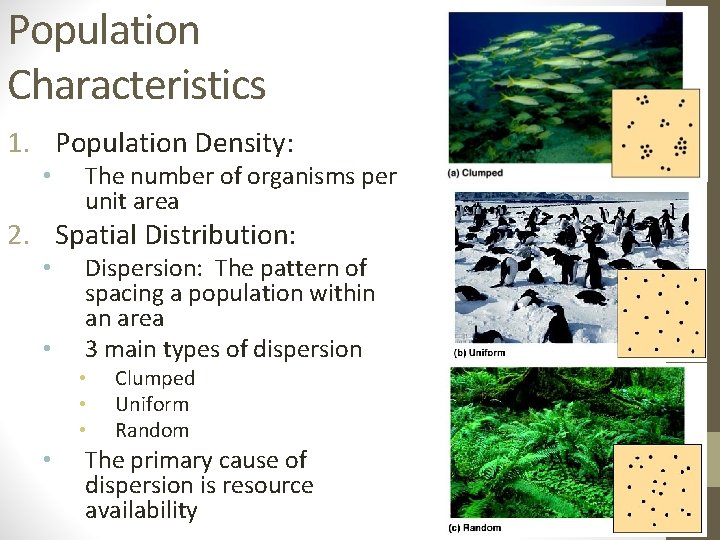
Population Characteristics 1. Population Density: • The number of organisms per unit area 2. Spatial Distribution: • • Dispersion: The pattern of spacing a population within an area 3 main types of dispersion • • Clumped Uniform Random The primary cause of dispersion is resource availability
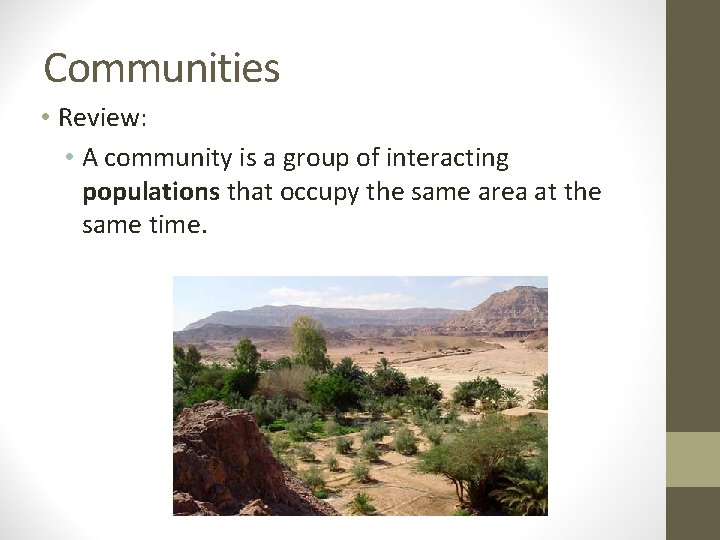
Communities • Review: • A community is a group of interacting populations that occupy the same area at the same time.
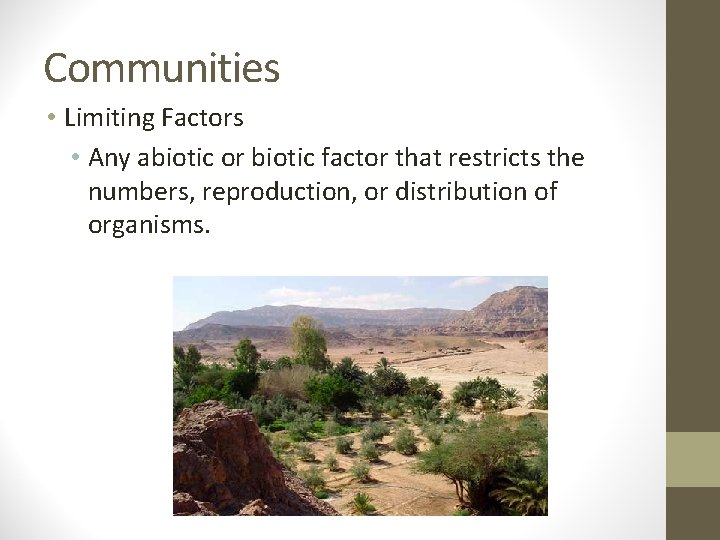
Communities • Limiting Factors • Any abiotic or biotic factor that restricts the numbers, reproduction, or distribution of organisms.
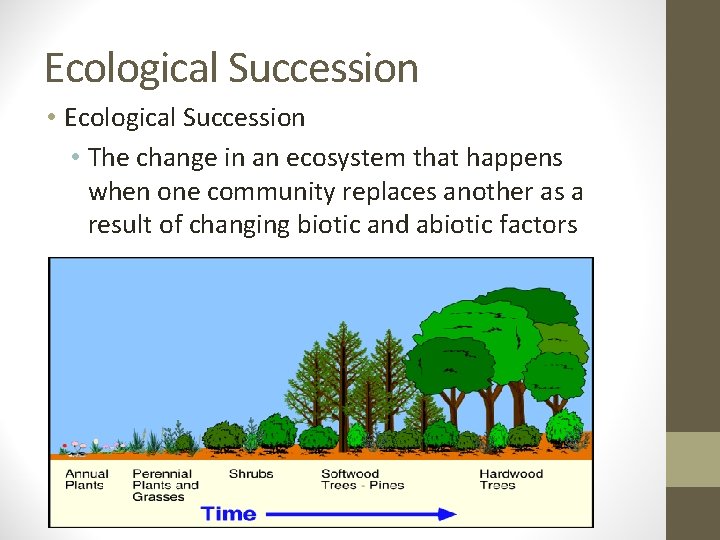
Ecological Succession • The change in an ecosystem that happens when one community replaces another as a result of changing biotic and abiotic factors
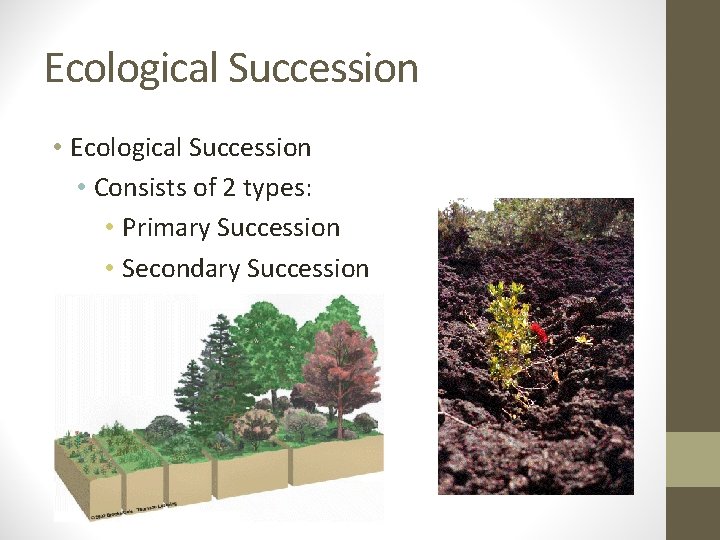
Ecological Succession • Consists of 2 types: • Primary Succession • Secondary Succession
Ecological Succession • Ecological Succession: Primary • The establishment of a community in an area of exposed rock that does not have topsoil is called Primary Succession. • It occurs very slowly at first
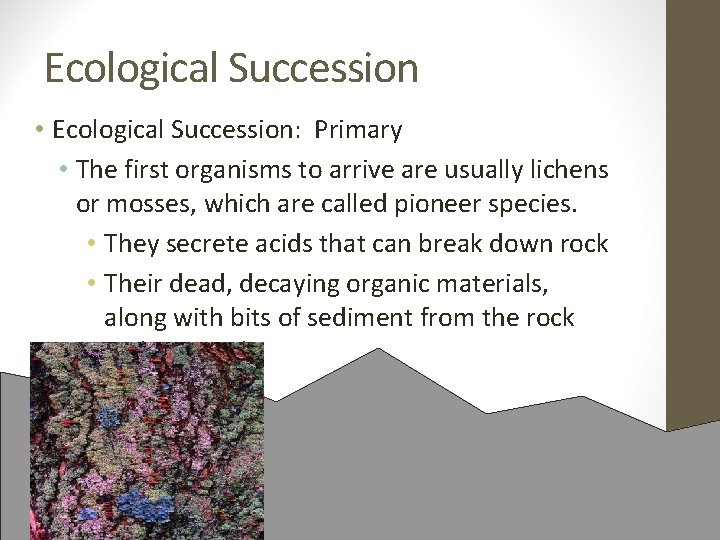
Ecological Succession • Ecological Succession: Primary • The first organisms to arrive are usually lichens or mosses, which are called pioneer species. • They secrete acids that can break down rock • Their dead, decaying organic materials, along with bits of sediment from the rock make up soil.
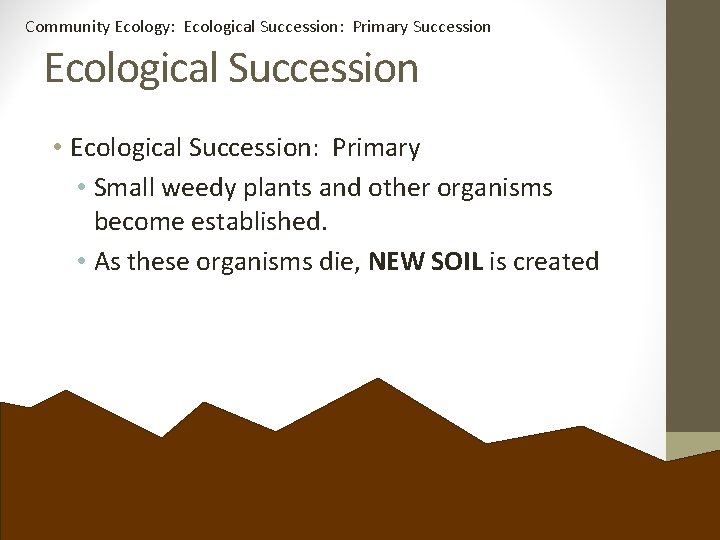
Community Ecology: Ecological Succession: Primary Succession Ecological Succession • Ecological Succession: Primary • Small weedy plants and other organisms become established. • As these organisms die, NEW SOIL is created
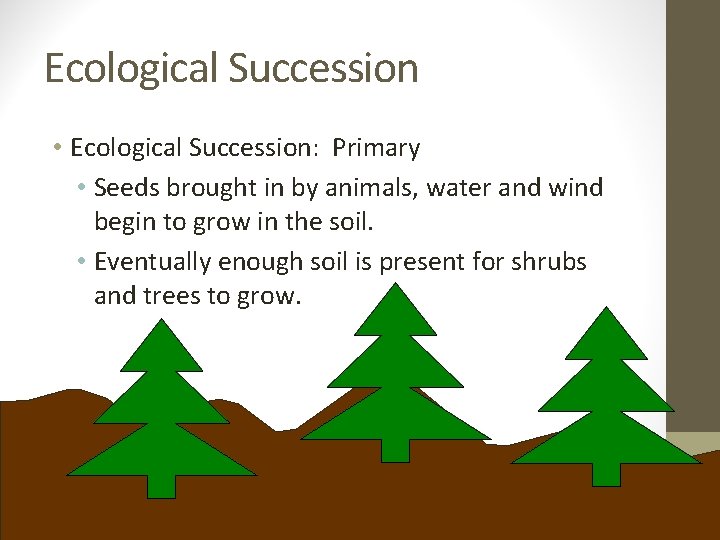
Ecological Succession • Ecological Succession: Primary • Seeds brought in by animals, water and wind begin to grow in the soil. • Eventually enough soil is present for shrubs and trees to grow.
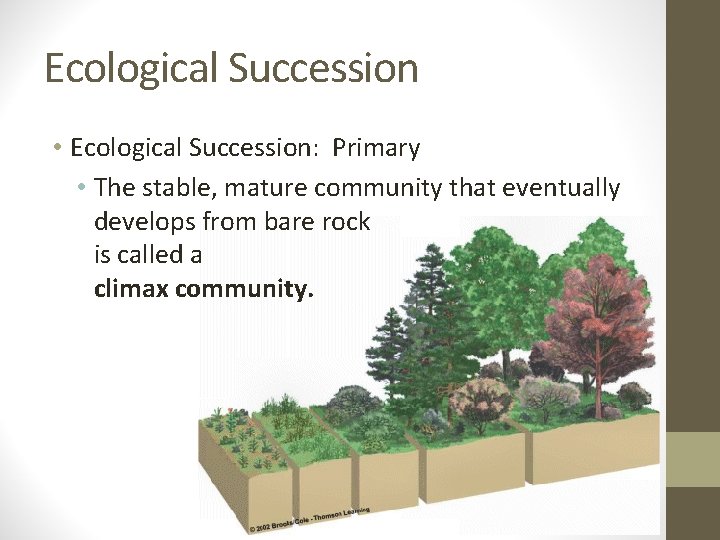
Ecological Succession • Ecological Succession: Primary • The stable, mature community that eventually develops from bare rock is called a climax community.
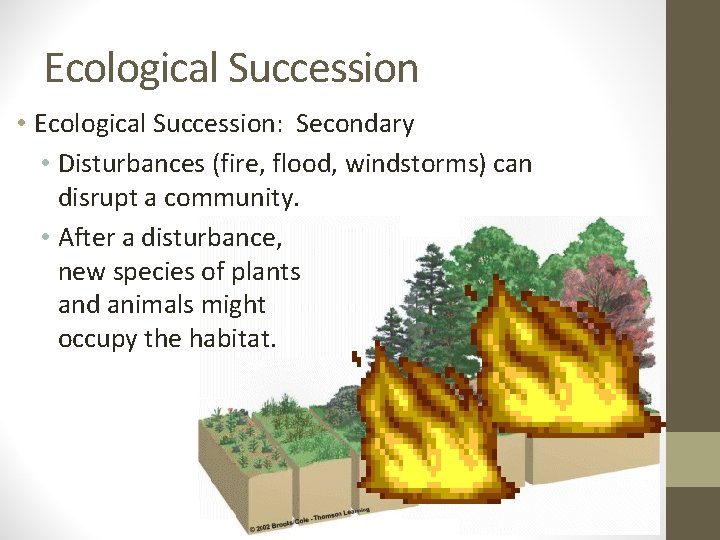
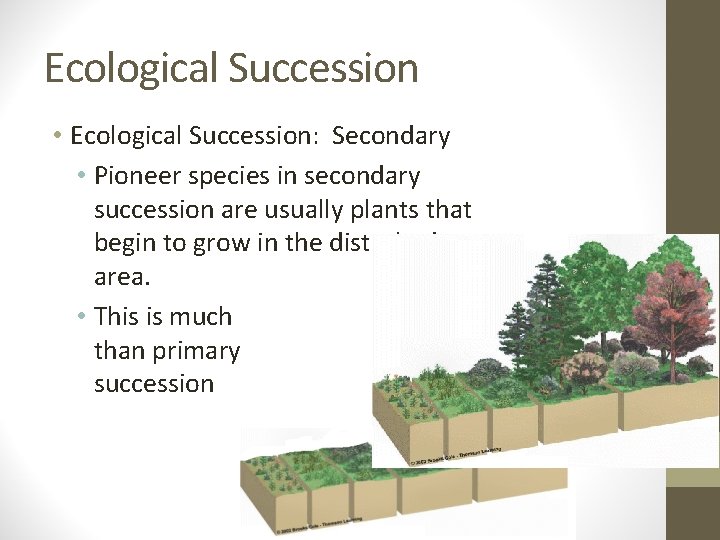
Ecological Succession • Ecological Succession: Secondary • Disturbances (fire, flood, windstorms) can disrupt a community. • After a disturbance, new species of plants and animals might occupy the habitat.
Ecological Succession • Ecological Succession: Secondary • Pioneer species in secondary succession are usually plants that begin to grow in the disturbed area. • This is much faster than primary succession
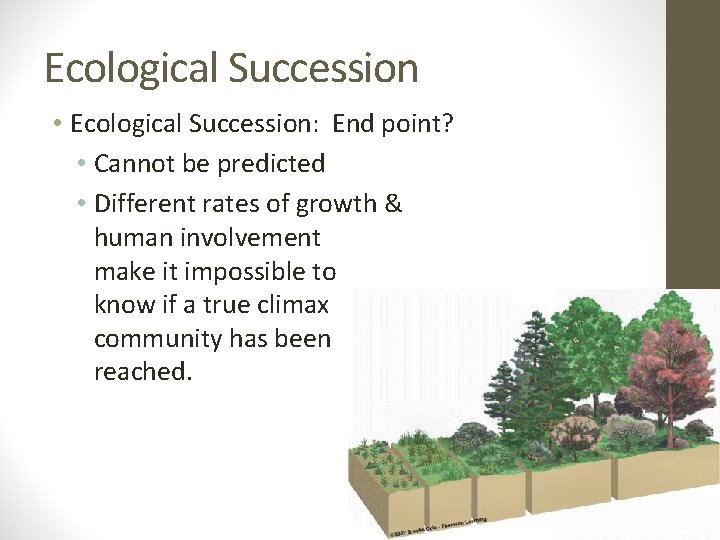
Ecological Succession • Ecological Succession: End point? • Cannot be predicted • Different rates of growth & human involvement make it impossible to know if a true climax community has been reached.
Population Limiting Factors 3. Population growth rate • How fast a given population grows • Factors that influence this are: • Birth Rate • Mortality – Death Rate) • Emigration (the number of individuals AWAY FROM a population) • Immigration (the number of individuals MOVING TO a population)
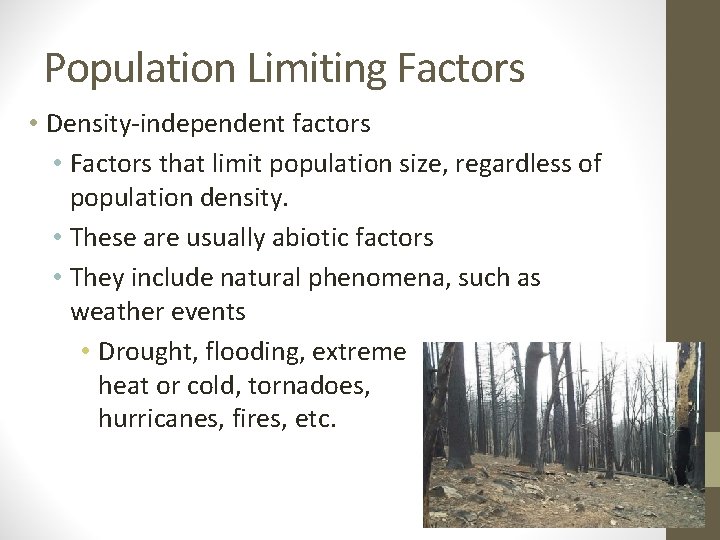
Population Limiting Factors • Density-independent factors • Factors that limit population size, regardless of population density. • These are usually abiotic factors • They include natural phenomena, such as weather events • Drought, flooding, extreme heat or cold, tornadoes, hurricanes, fires, etc.
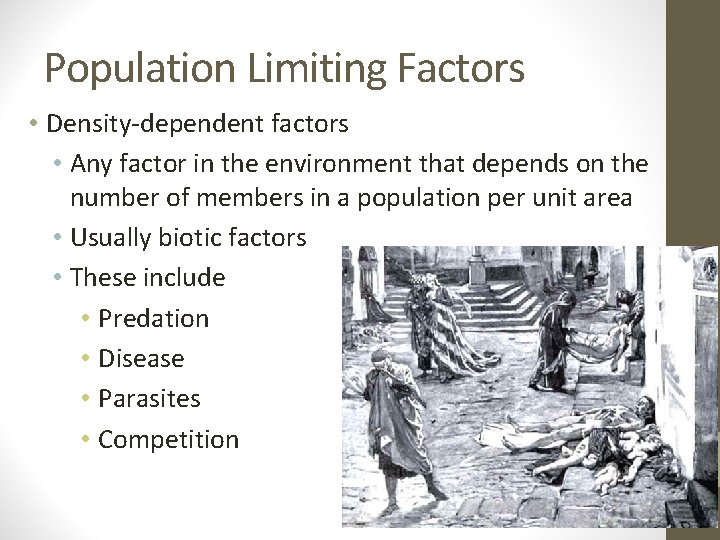
Population Limiting Factors • Density-dependent factors • Any factor in the environment that depends on the number of members in a population per unit area • Usually biotic factors • These include • Predation • Disease • Parasites • Competition
Population Limiting Factors • Population growth models • Limits to exponential growth • Population Density (the number of individuals per unit of land area or water volume) increases as well • Competition follows as nutrients and resources are used up • The limit to population size that a particular environment can support is called carrying capacity (k)
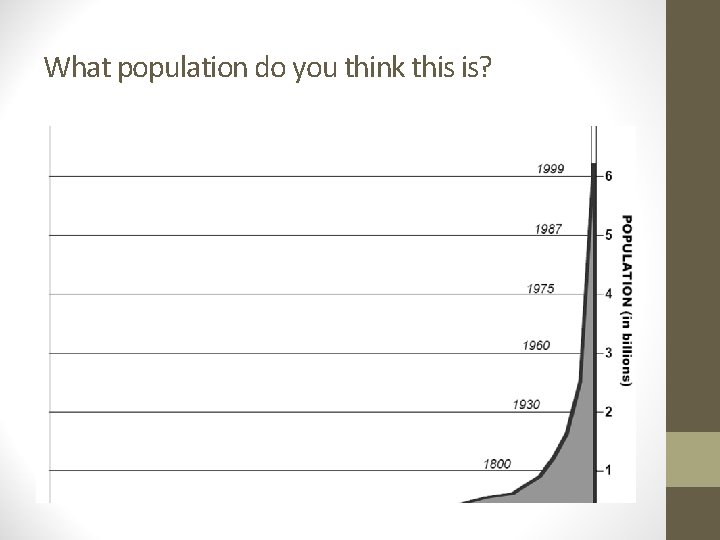
What population do you think this is?
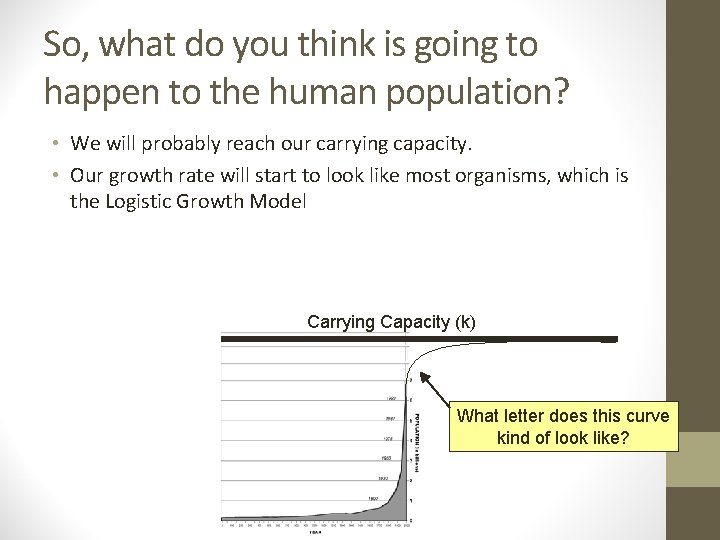
So, what do you think is going to happen to the human population? • We will probably reach our carrying capacity. • Our growth rate will start to look like most organisms, which is the Logistic Growth Model Carrying Capacity (k) What letter does this curve kind of look like?
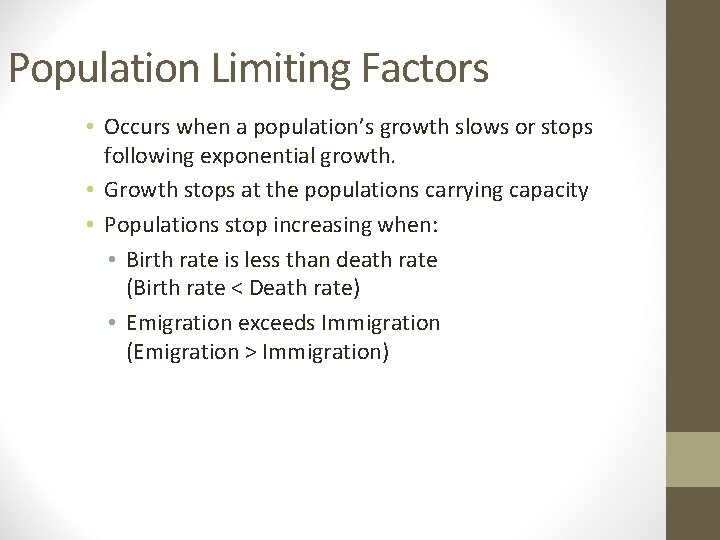
Population Limiting Factors • Occurs when a population’s growth slows or stops following exponential growth. • Growth stops at the populations carrying capacity • Populations stop increasing when: • Birth rate is less than death rate (Birth rate < Death rate) • Emigration exceeds Immigration (Emigration > Immigration)
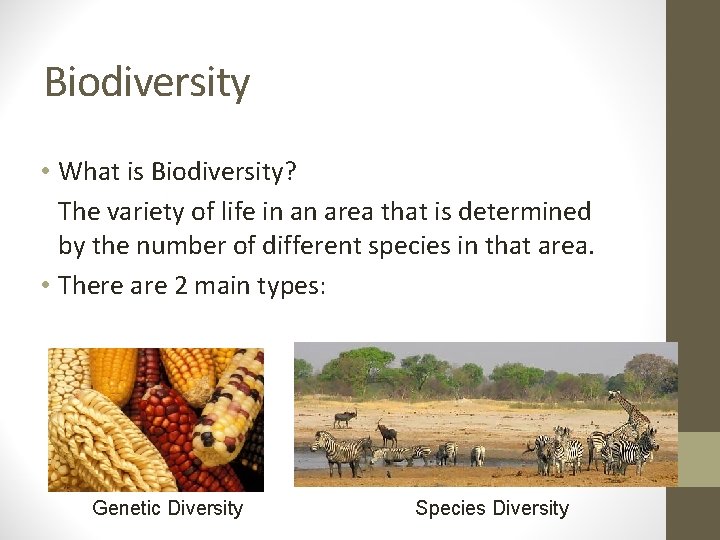
Biodiversity • What is Biodiversity? The variety of life in an area that is determined by the number of different species in that area. • There are 2 main types: Genetic Diversity Species Diversity
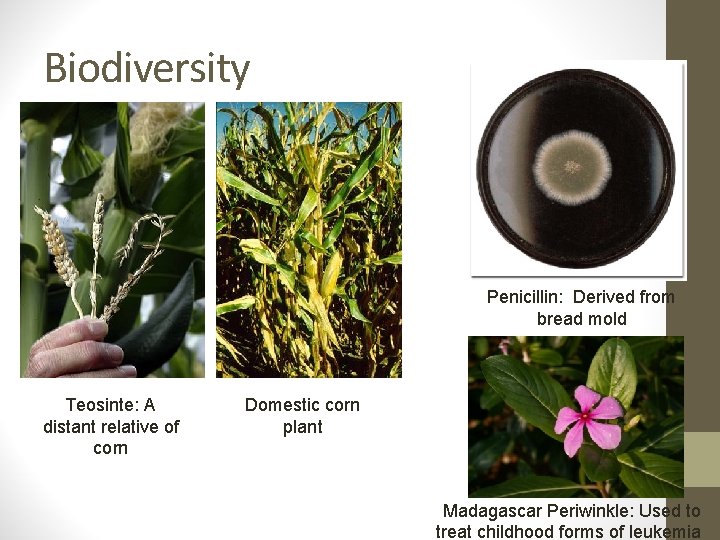
Biodiversity Penicillin: Derived from bread mold Teosinte: A distant relative of corn Domestic corn plant Madagascar Periwinkle: Used to treat childhood forms of leukemia
Extinction Rates • The gradual process of becoming extinct is known as background extinction. • Mass extinctions: When a large percentage of all living species become extinct in a relatively short period of time. • 250 MYA: Over 90% of species died
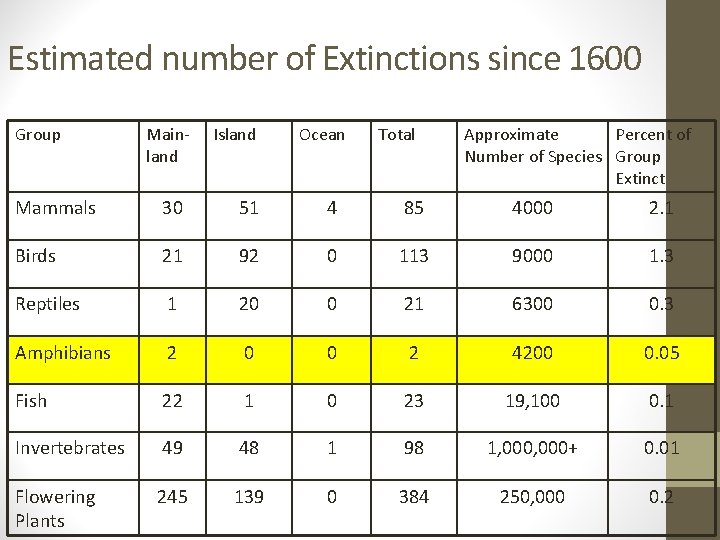
Estimated number of Extinctions since 1600 Group Mainland Island Ocean Total Approximate Percent of Number of Species Group Extinct Mammals 30 51 4 85 4000 2. 1 Birds 21 92 0 113 9000 1. 3 Reptiles 1 20 0 21 6300 0. 3 Amphibians 2 0 0 2 4200 0. 05 Fish 22 1 0 23 19, 100 0. 1 Invertebrates 49 48 1 98 1, 000+ 0. 01 Flowering Plants 245 139 0 384 250, 000 0. 2