
Ecology BIO C 322 Concept of Limiting Factors
Ecology – BIO C 322 Concept of Limiting Factors

Concept of Limiting Factors • A condition approaching/exceeding limits of tolerance Limiting factor (biotic/abiotic). • e. g. light, temp, rain, air, radiations, nutrients. • Under stable conditions, the constituent approaching minimum is the limiting factor Liebig law of the minimum. • Liebig’s experiment with crops: Yield decided by scarce nutrient (Zn), not abundant ones (CO 2 & H 2 O).
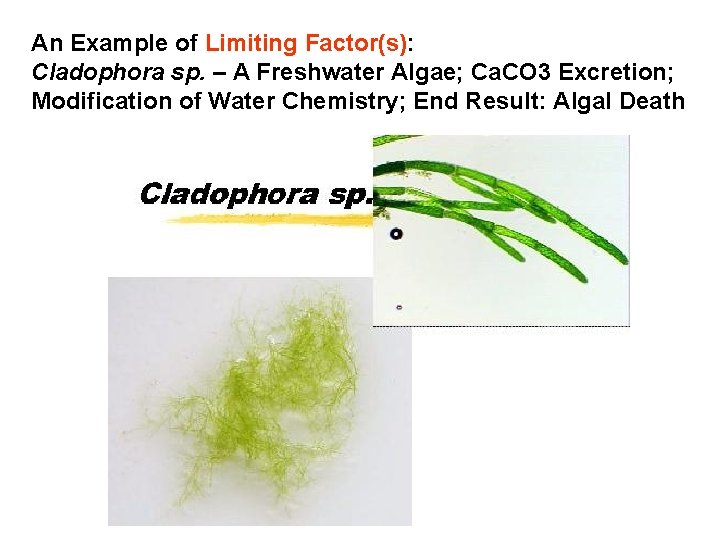
An Example of Limiting Factor(s): Cladophora sp. – A Freshwater Algae; Ca. CO 3 Excretion; Modification of Water Chemistry; End Result: Algal Death
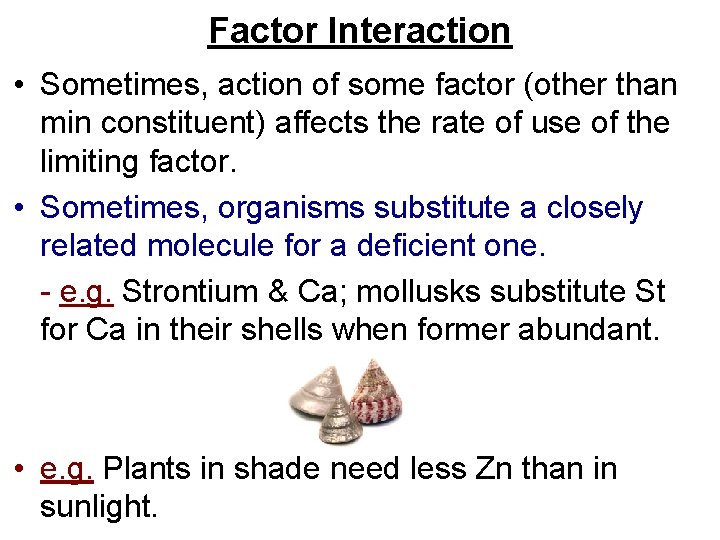
Factor Interaction • Sometimes, action of some factor (other than min constituent) affects the rate of use of the limiting factor. • Sometimes, organisms substitute a closely related molecule for a deficient one. - e. g. Strontium & Ca; mollusks substitute St for Ca in their shells when former abundant. • e. g. Plants in shade need less Zn than in sunlight.
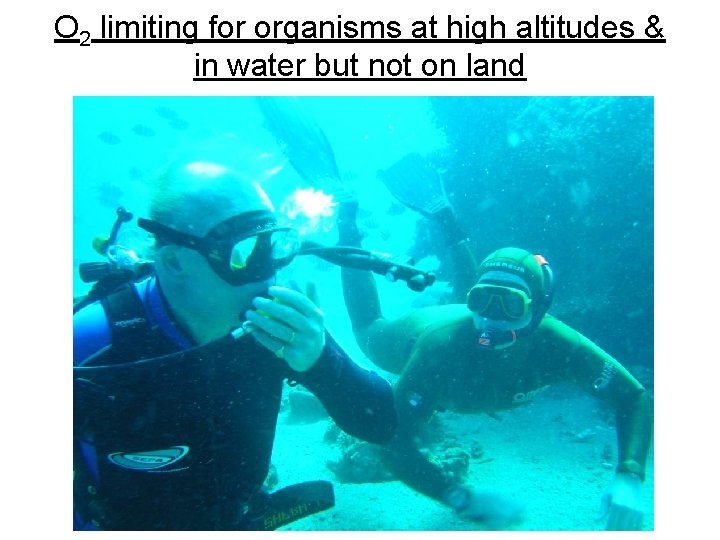
O 2 limiting for organisms at high altitudes & in water but not on land
Limits of Tolerance • Limiting effect of min, also max constituent Shelford law of tolerance. • Stress ecology – Stress tests. • All abiotic/physical requirements within tolerance limits for an organism, but the organism may still fail. - Why?
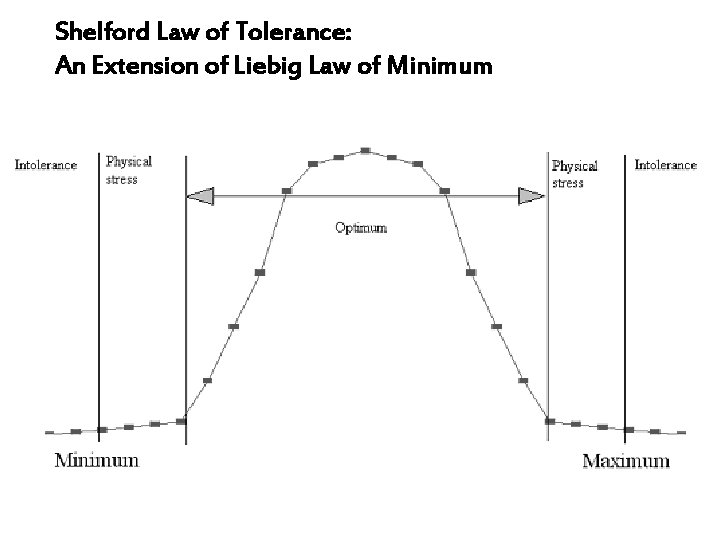
Shelford Law of Tolerance: An Extension of Liebig Law of Minimum
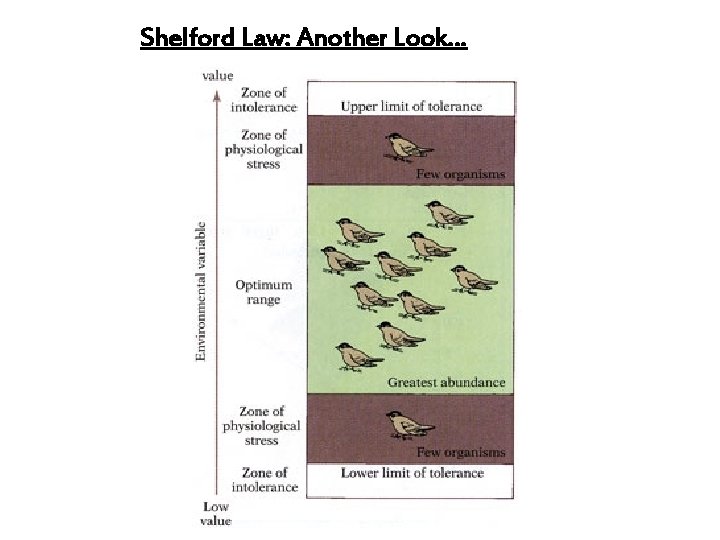
Shelford Law: Another Look…
Derivatives of Shelford Law • Organisms may have wide range of tolerance for one factor, narrow for another. • Those with wide tolerance ranges for limiting factors most widely distributed. • When conditions are not optimal for a species w. r. t. one factor, limits of tolerance may be reduced for other factors. - e. g. Soil nitrogen limiting resistance of grass to drought is reduced.
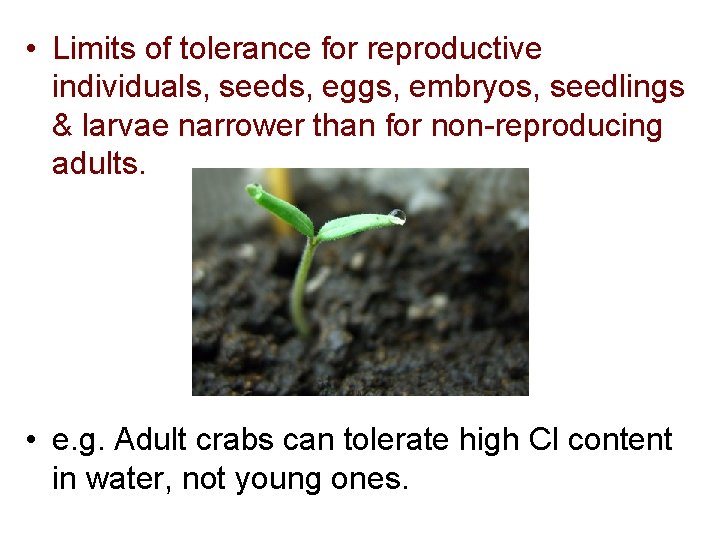
• Limits of tolerance for reproductive individuals, seeds, eggs, embryos, seedlings & larvae narrower than for non-reproducing adults. • e. g. Adult crabs can tolerate high Cl content in water, not young ones.
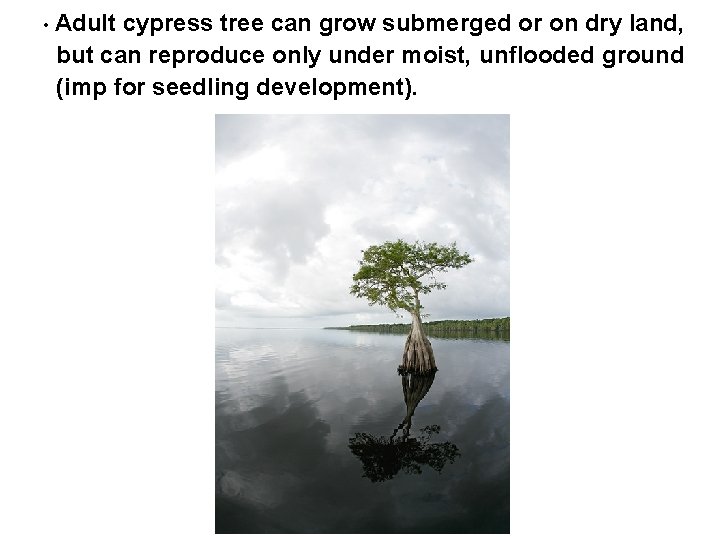
• Adult cypress tree can grow submerged or on dry land, but can reproduce only under moist, unflooded ground (imp for seedling development).
Steno- (Narrow) vs Eury- (Broad) • Terms denoting relative degrees of tolerance. - Stenothermal-eurythermal Temperature; - Stenohydric-euryhydric Water; - Stenohaline-euryhaline Salinity; - Stenophagic-euryphagic Food; - Stenoecious-euryecious Habitat selection.
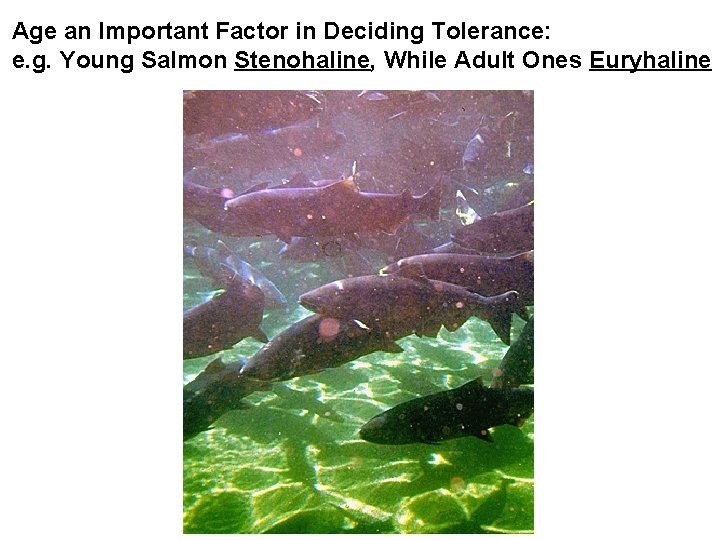
Age an Important Factor in Deciding Tolerance: e. g. Young Salmon Stenohaline, While Adult Ones Euryhaline
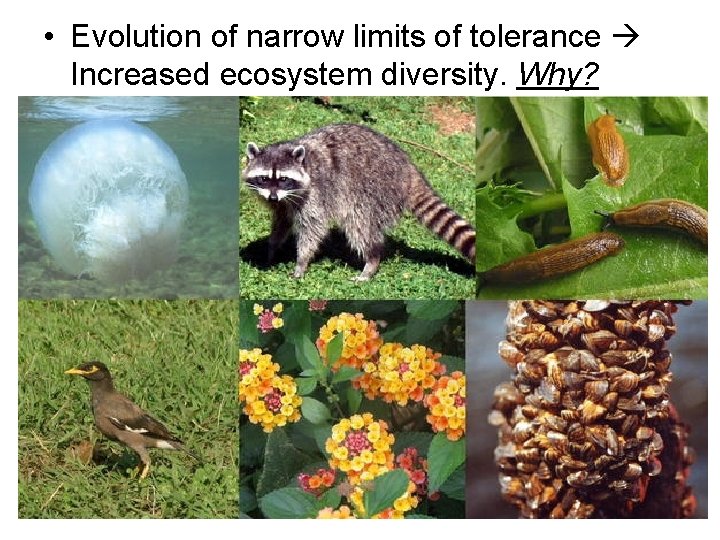
• Evolution of narrow limits of tolerance Increased ecosystem diversity. Why?
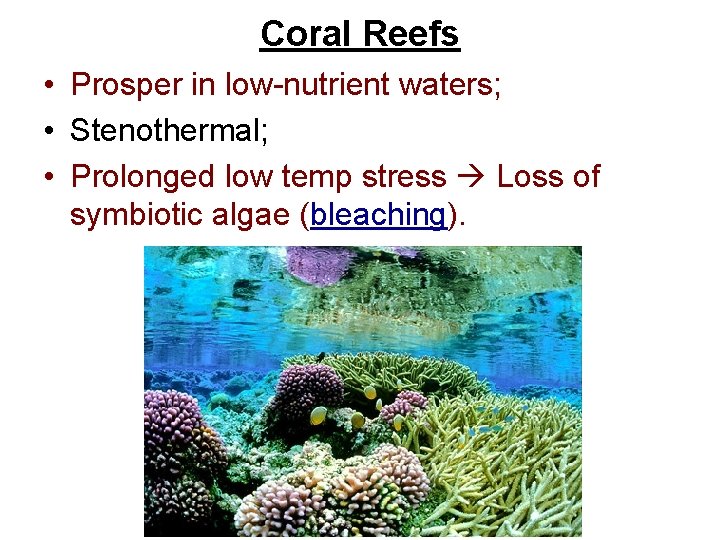
Coral Reefs • Prosper in low-nutrient waters; • Stenothermal; • Prolonged low temp stress Loss of symbiotic algae (bleaching).
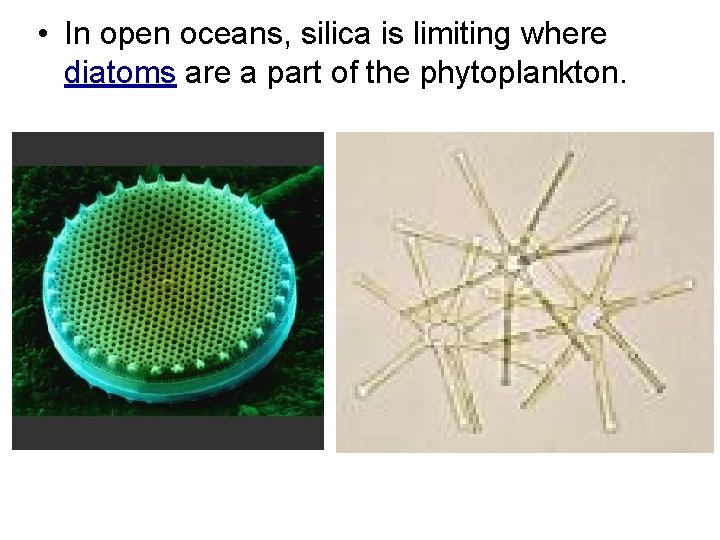
• In open oceans, silica is limiting where diatoms are a part of the phytoplankton.
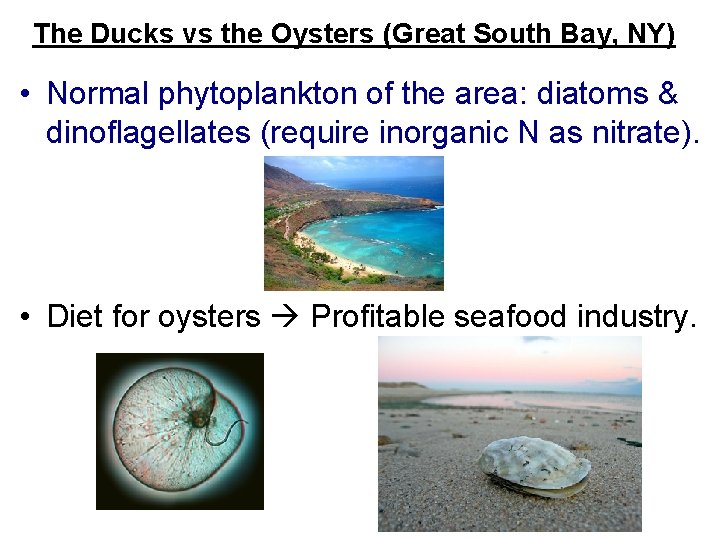
The Ducks vs the Oysters (Great South Bay, NY) • Normal phytoplankton of the area: diatoms & dinoflagellates (require inorganic N as nitrate). • Diet for oysters Profitable seafood industry.
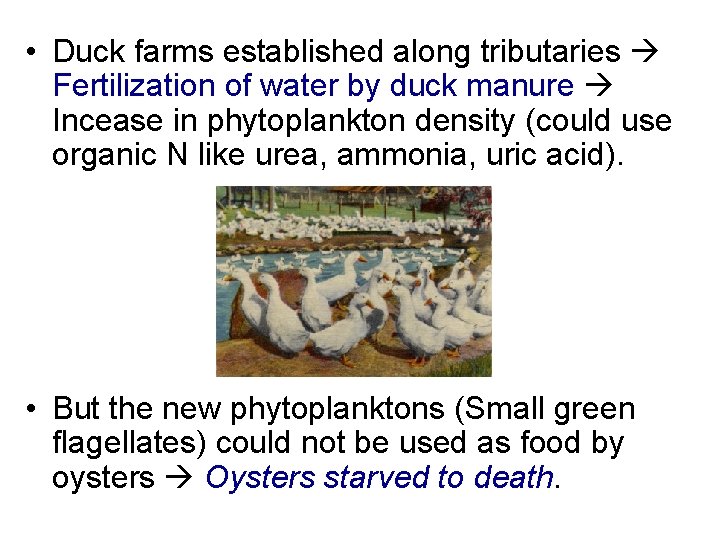
• Duck farms established along tributaries Fertilization of water by duck manure Incease in phytoplankton density (could use organic N like urea, ammonia, uric acid). • But the new phytoplanktons (Small green flagellates) could not be used as food by oysters Oysters starved to death.
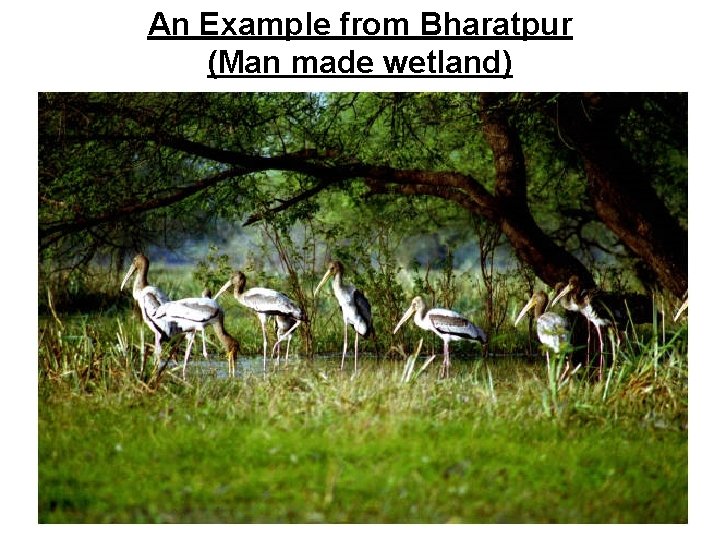
An Example from Bharatpur (Man made wetland)
• Geese (Rajahansas) fly in after rains; fly out in spring to breed in Himalayas, C. Asia. • Also habitat to ducks, storks, cranes. • Some ecologists persuaded Government to ban grazing in the area – unaesthetic, insecure. • No scientific evidence presented. • Grazing banned in Nov, 1982. • Futile protest by villagers.
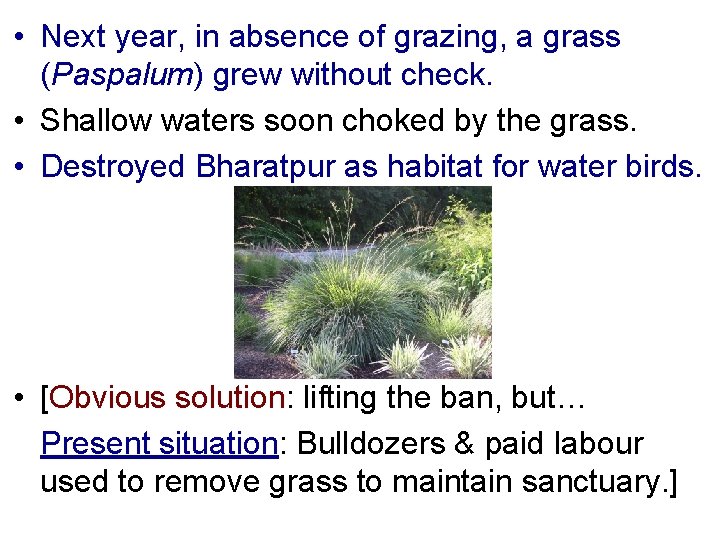
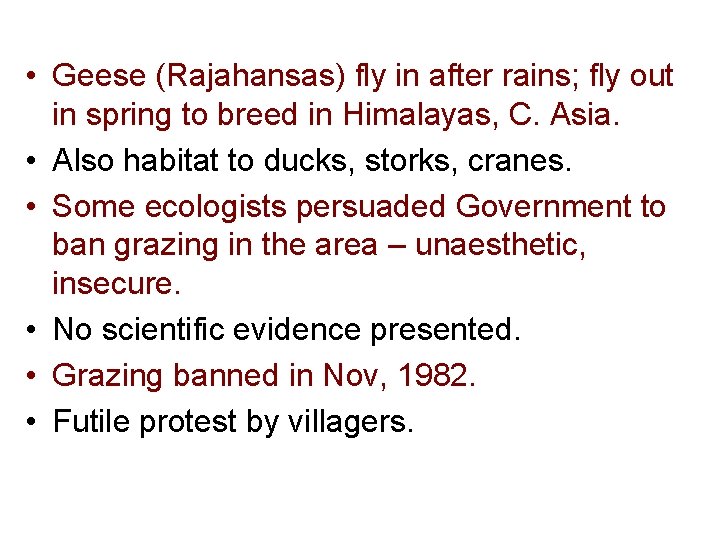
• Next year, in absence of grazing, a grass (Paspalum) grew without check. • Shallow waters soon choked by the grass. • Destroyed Bharatpur as habitat for water birds. • [Obvious solution: lifting the ban, but… Present situation: Bulldozers & paid labour used to remove grass to maintain sanctuary. ]
Factor Compensation • Factor compensation: Organisms adapt & modify environment to reduce the limiting effects of temp, light, water etc. • Ecotypes: Genetically differentiated subspecies or local populations adapted to a particular set of environmental conditions. • Acclimation: Phsiological adjustment without genetic fixation.
Determining Genetic Fixation in Ecotypes • Prairie grasses of same species transplanted into experimental gardens from different locations (Reciprocal transplant). • Timing of growth & reproduction was found adapted to area from which the grass came.
Study of Achillea millefolium (Yarrow) • Grows from down in the valleys to high altitudes in Sierra Mountains. • Low altitude plants: taller. • High altitude plants: shorter. • Seeds of both varieties planted in the same garden at sea level Retention of tall & short statures. • Conclusion: Genetic fixation had occurred.
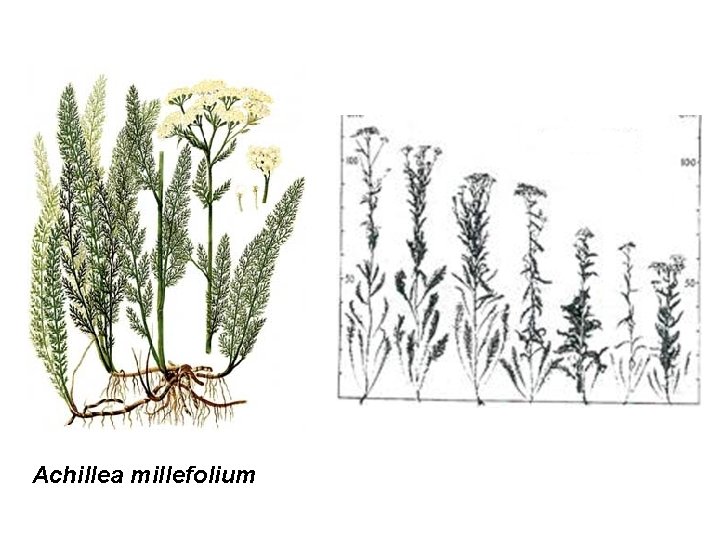
Achillea millefolium
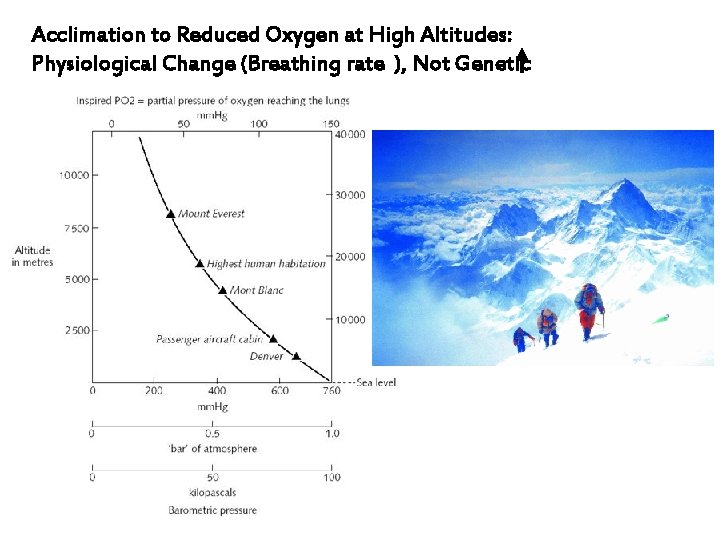
Acclimation to Reduced Oxygen at High Altitudes: Physiological Change (Breathing rate ), Not Genetic
Timing of Response • Biological clock = Circadian rhythm = Ability of an organism to time & repeat functions at 24 -hour intervals. • Photoperiod an imp regulator causing growth/flowering in plants; migration & breeding in birds/mammals; feeding behaviour. • Photoperiod can be artificially changed to get desired behaviour.
- Slides: 27