
Ecological Validity in Assessment Ecologically valid assessments are

- Slides: 10
Ecological Validity in Assessment • Ecologically valid assessments are sensitive to – chronological and developmental ages – medical status – physical and sensory abilities – education – occupation – cognitive level – and cultural, socioeconomic, and linguistic backgrounds
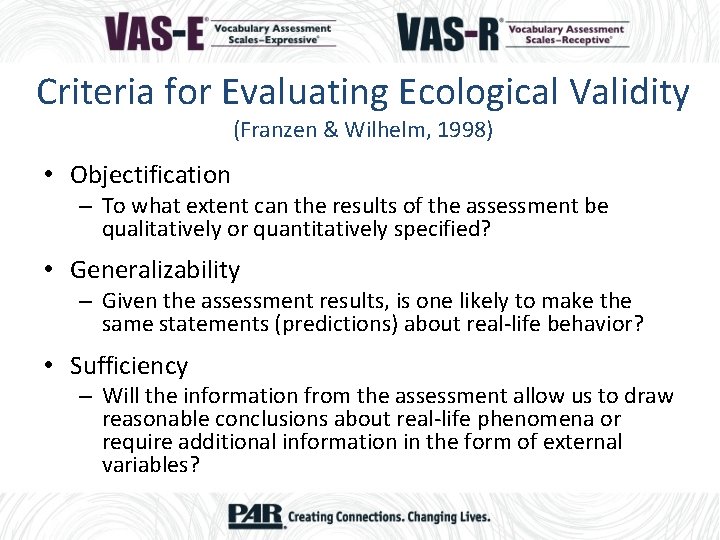
Criteria for Evaluating Ecological Validity (Franzen & Wilhelm, 1998) • Objectification – To what extent can the results of the assessment be qualitatively or quantitatively specified? • Generalizability – Given the assessment results, is one likely to make the same statements (predictions) about real-life behavior? • Sufficiency – Will the information from the assessment allow us to draw reasonable conclusions about real-life phenomena or require additional information in the form of external variables?
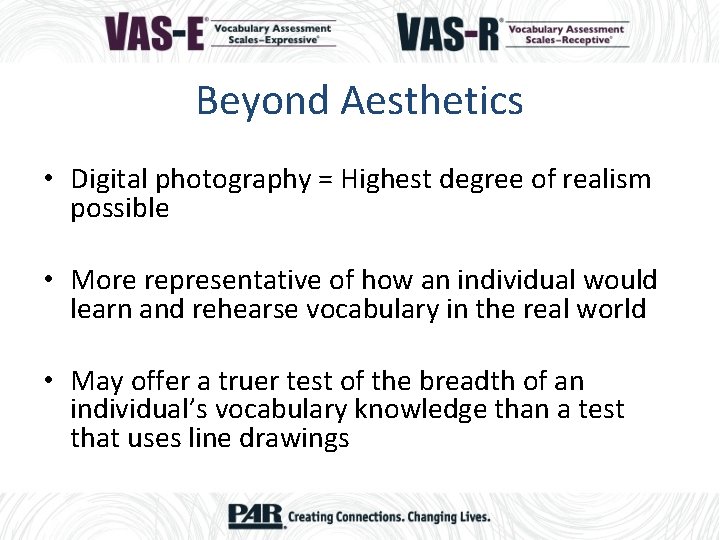
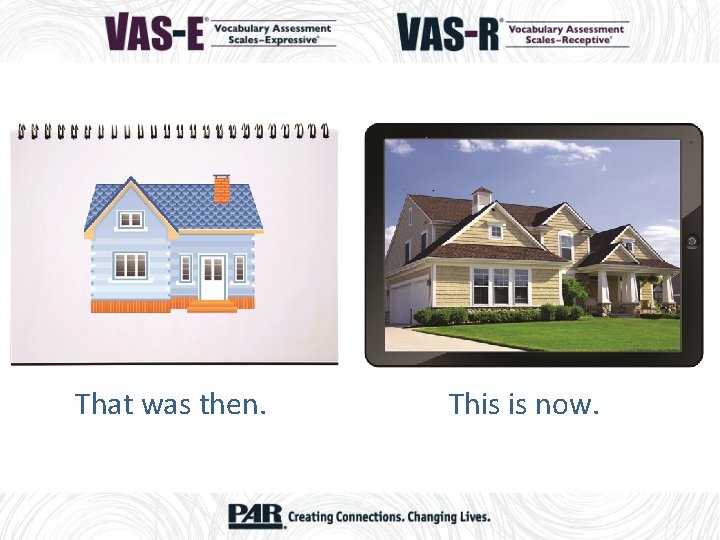
Beyond Aesthetics • Digital photography = Highest degree of realism possible • More representative of how an individual would learn and rehearse vocabulary in the real world • May offer a truer test of the breadth of an individual’s vocabulary knowledge than a test that uses line drawings
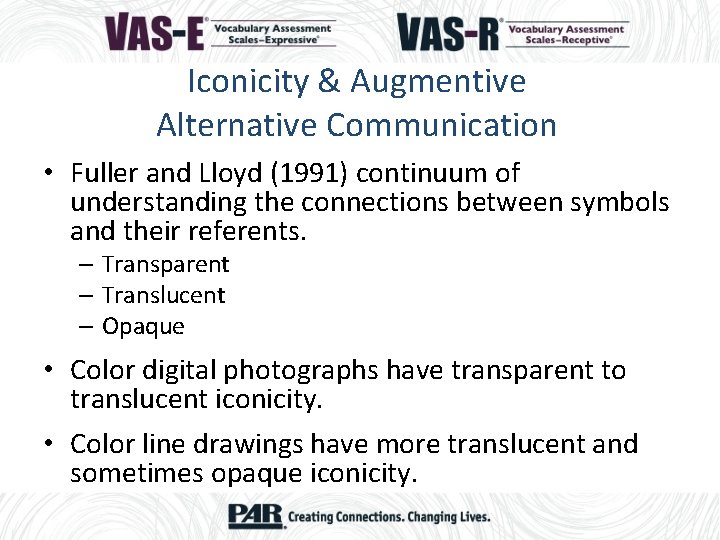
Iconicity & Augmentive Alternative Communication • Fuller and Lloyd (1991) continuum of understanding the connections between symbols and their referents. – Transparent – Translucent – Opaque • Color digital photographs have transparent to translucent iconicity. • Color line drawings have more translucent and sometimes opaque iconicity.
That was then. This is now.
• Digital or paper stimuli – Digital for use on your tablet or paper for traditional assessment • Greater ecological validity – Full-color digital photographs provide the highest degree of realism possible • Enhanced skill assessment – Composite and discrepancy scores enhance ability to assess differences between expressive and receptive skills
• Assessment throughout the lifespan – Suitable for evaluating ages 2. 5 to 95 years, offers both age- and grade-based norms • Monitor effectiveness of interventions – Co-normed with equivalent parallel forms; provides change scores for measuring growth over time and in response to targeted interventions
Normative Sample • Collected Summer of 2010 to Summer of 2012 • Post-stratification weighting based on 2009 Census �N = 2678 individuals from 30 states • 28 age groups – 2. 5 to 95 years • 14 grades – pre-K to 12 th grade – Split into fall (n = 835) and spring (n = 816)
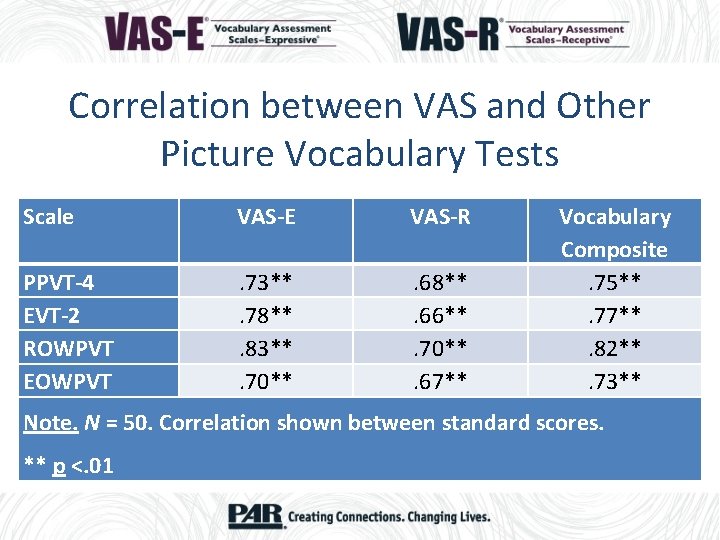
Correlation between VAS and Other Picture Vocabulary Tests Scale VAS-E VAS-R PPVT-4 EVT-2 ROWPVT EOWPVT . 73**. 78**. 83**. 70** . 68**. 66**. 70**. 67** Vocabulary Composite. 75**. 77**. 82**. 73** Note. N = 50. Correlation shown between standard scores. ** p <. 01