
Ecological Sustainability what can models tell us CSCI
Ecological Sustainability: what can models tell us? CSCI 1210 Fall 2003 Note: please don’t forget the online student evaluations!
What is sustainability? n Humans living in a way that does not diminish Earth’s capacity to sustain life n Alternatively: living within Earth’s ecological carrying capacity Are we going through a global ecological crisis?
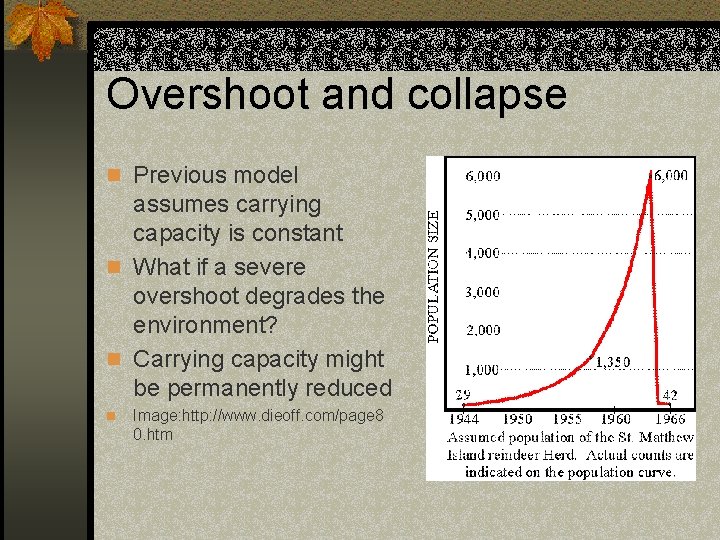
Overshoot and collapse n Previous model assumes carrying capacity is constant n What if a severe overshoot degrades the environment? n Carrying capacity might be permanently reduced n Image: http: //www. dieoff. com/page 8 0. htm
Humans are different… n Human carrying capacity is hard to define, because… 1. Technological changes affect food production 2. Complex social factors affect population
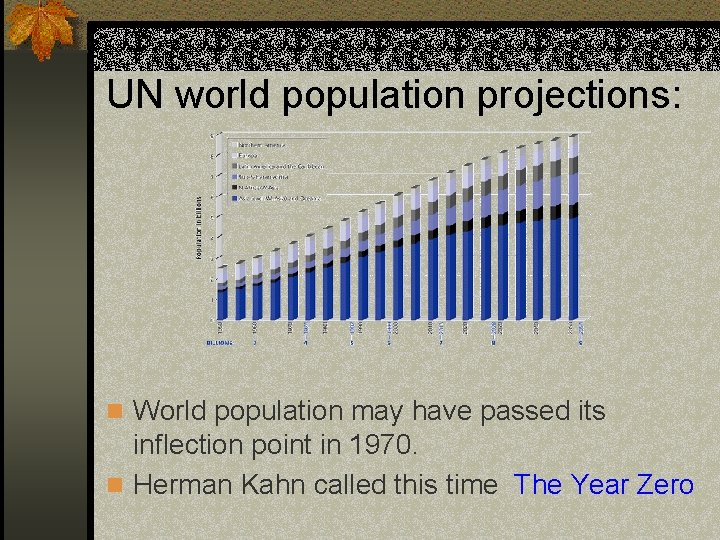
UN world population projections: n World population may have passed its inflection point in 1970. n Herman Kahn called this time The Year Zero

World 3: The Nightmare Scenario n World 3 model created by MIT systems group for the Club of Rome n Model updated, 1990 Graphic: www. dieoff. com
Malthus in, Malthus out! n Nonrenewable resources run out… n Capital is diverted to resource extraction n Less capital for agriculture n Yields fall, leading to famine and death n Is this realistic? ?
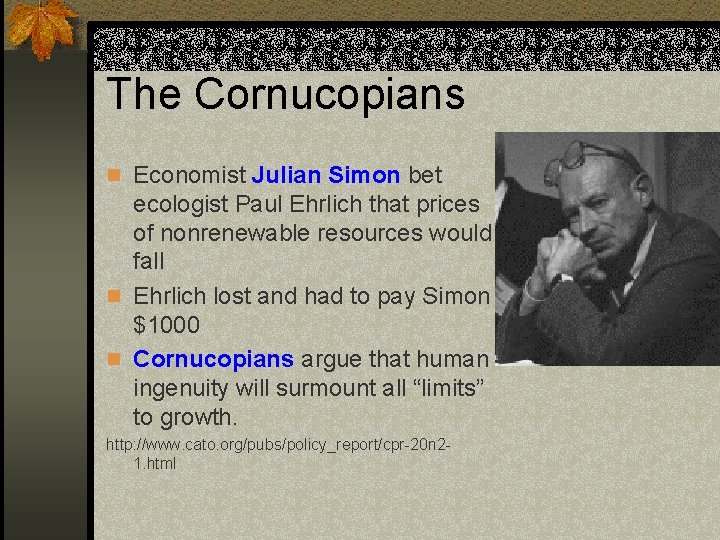
The Cornucopians n Economist Julian Simon bet ecologist Paul Ehrlich that prices of nonrenewable resources would fall n Ehrlich lost and had to pay Simon $1000 n Cornucopians argue that human ingenuity will surmount all “limits” to growth. http: //www. cato. org/pubs/policy_report/cpr-20 n 21. html
Are there limits? n Simon and climatologist Steven Schneider offered to bet Simon $1000 on each of 15 ecological indicators getting worse over time. n Simon declined this bet. n The limits to growth are not industrial resources, but ecological resources n The real limit may be the ability of Earth to absorb pollution
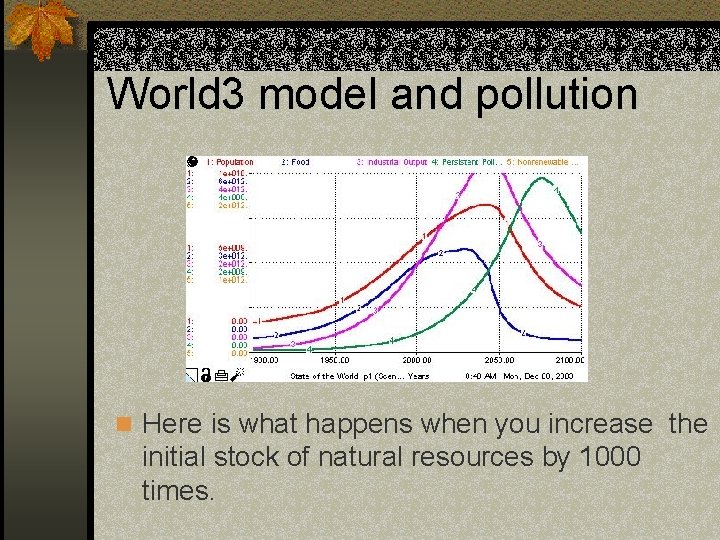
World 3 model and pollution n Here is what happens when you increase the initial stock of natural resources by 1000 times.
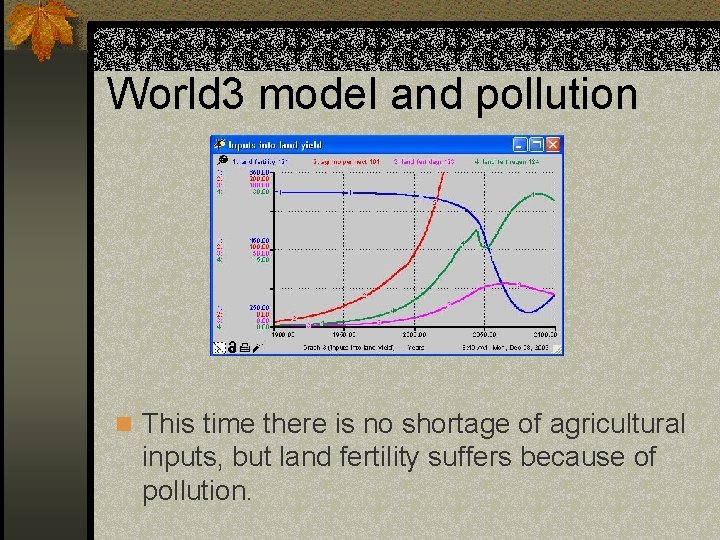
World 3 model and pollution n This time there is no shortage of agricultural inputs, but land fertility suffers because of pollution.
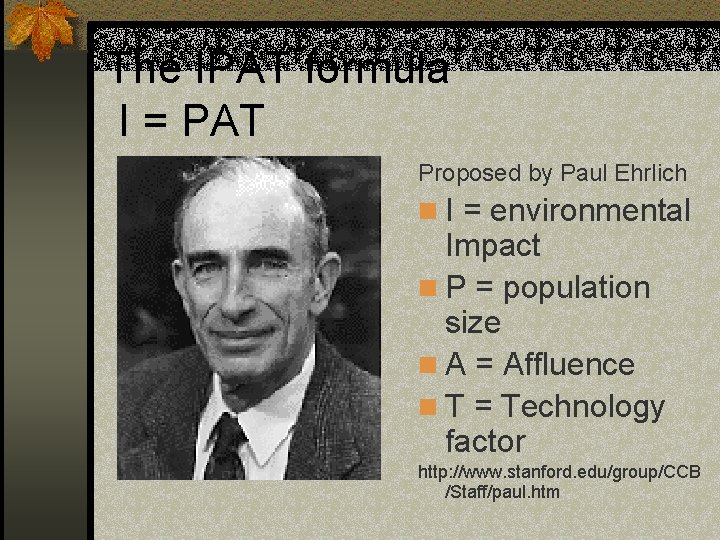
The IPAT formula I = PAT Proposed by Paul Ehrlich n I = environmental Impact n P = population size n A = Affluence n T = Technology factor http: //www. stanford. edu/group/CCB /Staff/paul. htm
IPAT: a conceptual model n Population is not the only factor n An American has more environmental impact than a Bangladeshi or Chinese n To reduce environmental impact we must control P, A, T or all three n Problem with IPAT: no defined measure of total impact I
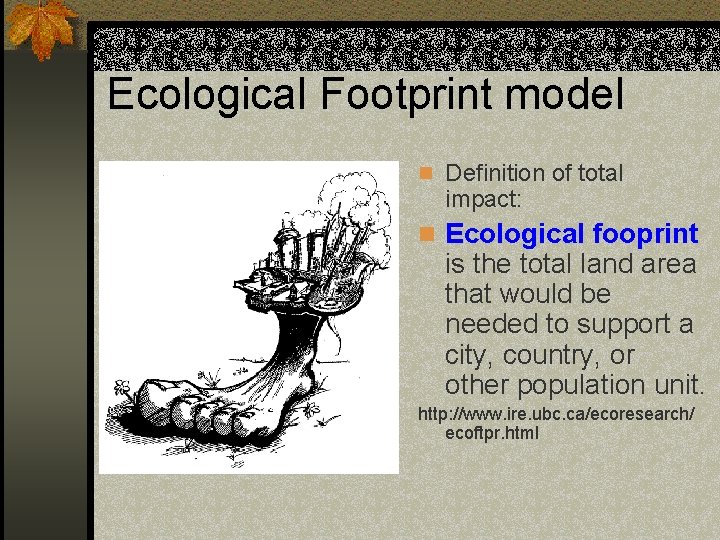
Ecological Footprint model n Definition of total impact: n Ecological fooprint is the total land area that would be needed to support a city, country, or other population unit. http: //www. ire. ubc. ca/ecoresearch/ ecoftpr. html
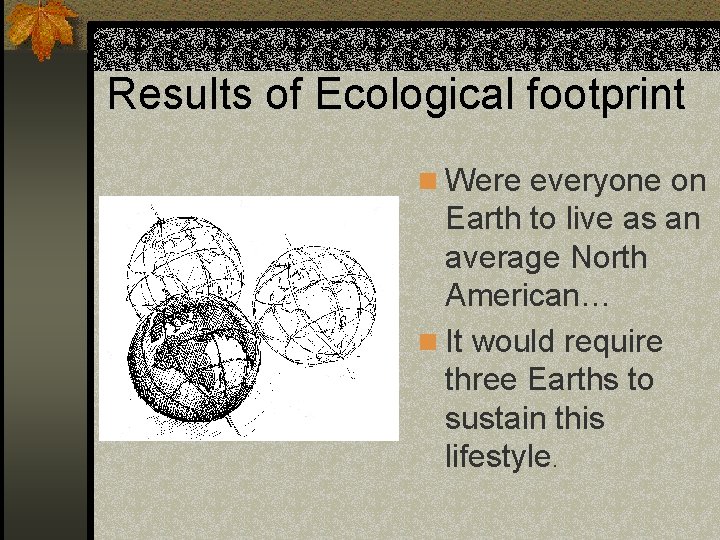
Results of Ecological footprint n Were everyone on Earth to live as an average North American… n It would require three Earths to sustain this lifestyle.
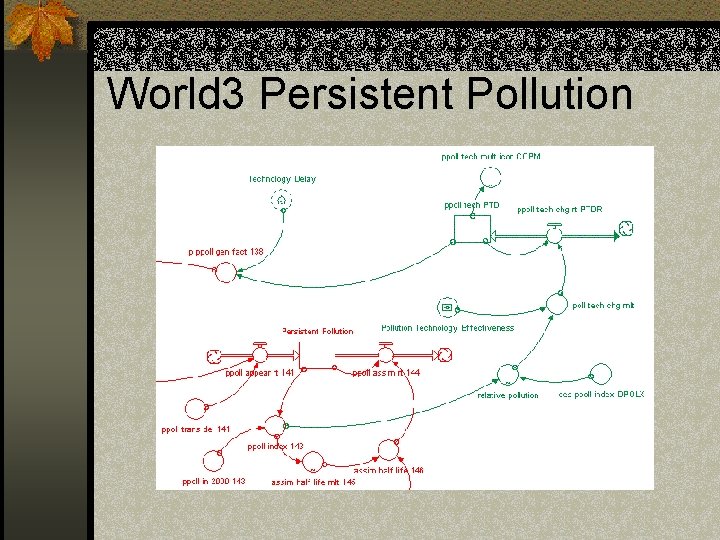
World 3 Persistent Pollution
World 3 pollution model n In World 3, the world reacts to pollution problems after the pollution has already become a problem n Inevitable delays in inventing and deploying technology cause overshoot. n Pollution technology is modeled as a stock. You can add more technology but cannot make qualitative changes.
Real-world pollution response n In order to avoid overshoot, societies try to deal with pollution problems before they become severe n In the long term, qualitative changes (redesigning technology) is more powerful than adding filters to the back end of the smokestack
Ecological safety factor? n Many scientists believe that humans should use at most 50% of Earth’s ecological capacity n This gives us a safety margin in case our calculations are off n It also leaves some room for other living things to share our planet
The Big Question: n. How much do humans have to change in order to live within Earth’s carrying capacity?
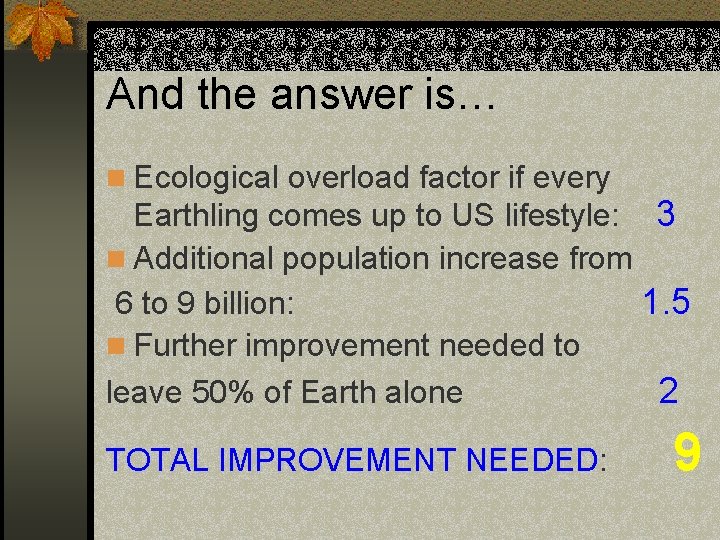
And the answer is… n Ecological overload factor if every Earthling comes up to US lifestyle: 3 n Additional population increase from 6 to 9 billion: 1. 5 n Further improvement needed to leave 50% of Earth alone 2 TOTAL IMPROVEMENT NEEDED: 9
What does this mean? n We need at least a 9 -fold reduction in the amount of pollution caused by each dollar of economic activity n Design school: Factor Ten n Another design school: Zero Waste
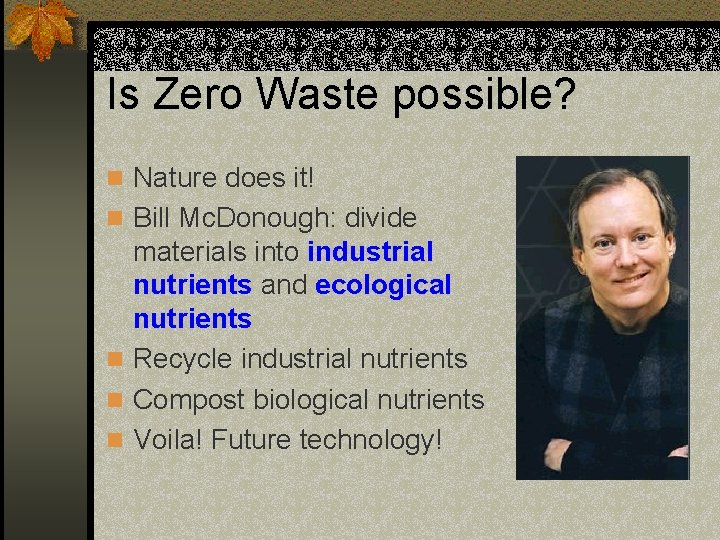
Is Zero Waste possible? n Nature does it! n Bill Mc. Donough: divide materials into industrial nutrients and ecological nutrients n Recycle industrial nutrients n Compost biological nutrients n Voila! Future technology!
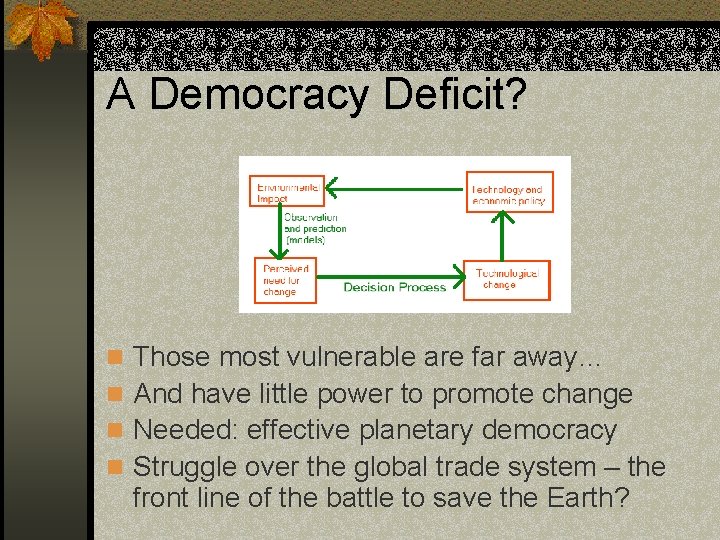
A Democracy Deficit? n Those most vulnerable are far away… n And have little power to promote change n Needed: effective planetary democracy n Struggle over the global trade system – the front line of the battle to save the Earth?
Acknowledgements n DOE vs EIA Hubbert curves: http: //www. dieoff. org/page 177. htm n Hubbert curves from http: //www. hubbertpeak. com
- Slides: 25