
Ecological Modernization Theory EMT Studying Environmental Change in

- Slides: 19
Ecological Modernization Theory (EMT): Studying Environmental Change in Reflexive Modernity Guest-lecture Gent University 18 November 2008 Gert Spaargaren: Environmental Policy Group; Wageningen University www. enp. wur. nl
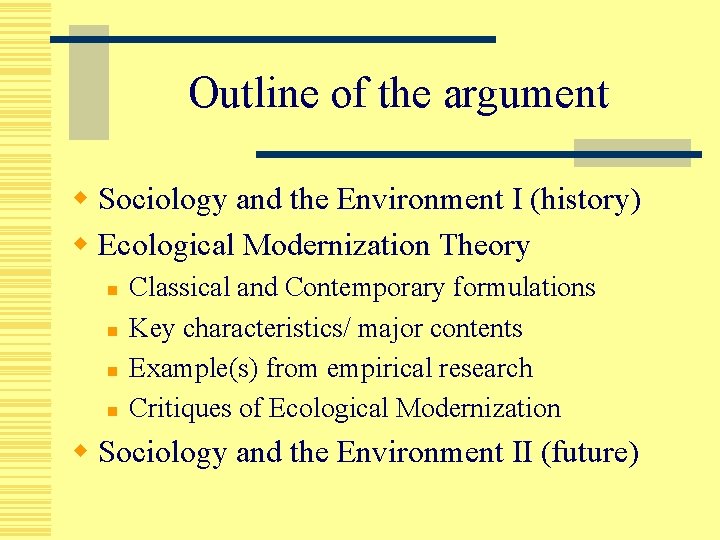
Outline of the argument w Sociology and the Environment I (history) w Ecological Modernization Theory n n Classical and Contemporary formulations Key characteristics/ major contents Example(s) from empirical research Critiques of Ecological Modernization w Sociology and the Environment II (future)
Ulrich Beck at recent Sociology Meeting in Jena w “Seitdem als unstrittig gilt, das der Klimawandel menschengemacht ist und katastrophale Folgen fűr Natur and Gesellschaft hat, werden die Karten in Gesellschaft und Politik neu gemischt, und zwar weltweit” (Beck, 2008, 41) w [“Since it is generally accepted that climate change is (wo)man-made and brings along disastrous consequences for society and nature, the cards in both society and politics are rearranged, even at the global level”].
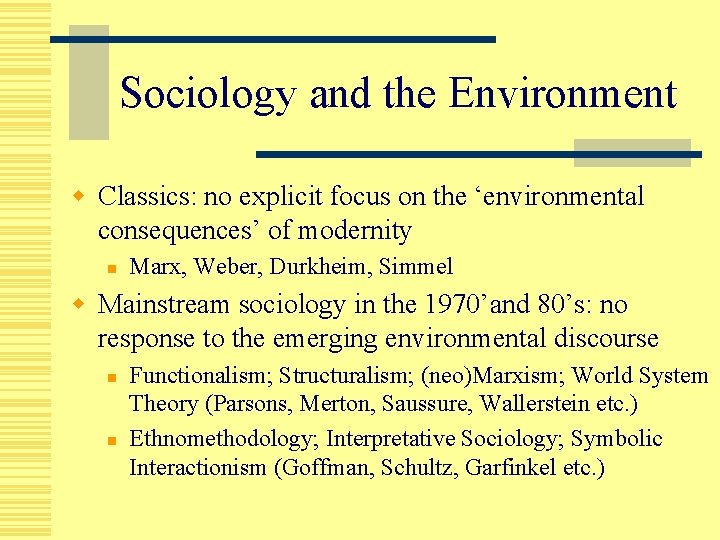
Sociology and the Environment w Classics: no explicit focus on the ‘environmental consequences’ of modernity n Marx, Weber, Durkheim, Simmel w Mainstream sociology in the 1970’and 80’s: no response to the emerging environmental discourse n n Functionalism; Structuralism; (neo)Marxism; World System Theory (Parsons, Merton, Saussure, Wallerstein etc. ) Ethnomethodology; Interpretative Sociology; Symbolic Interactionism (Goffman, Schultz, Garfinkel etc. )
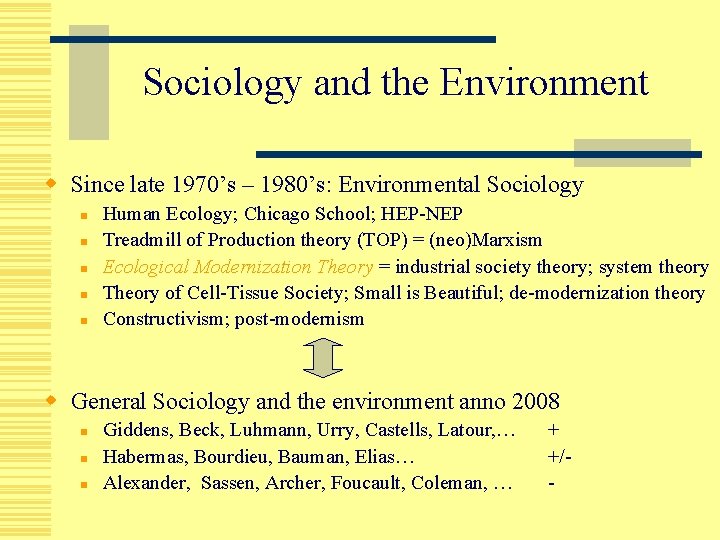
Sociology and the Environment w Since late 1970’s – 1980’s: Environmental Sociology n n n Human Ecology; Chicago School; HEP-NEP Treadmill of Production theory (TOP) = (neo)Marxism Ecological Modernization Theory = industrial society theory; system theory Theory of Cell-Tissue Society; Small is Beautiful; de-modernization theory Constructivism; post-modernism w General Sociology and the environment anno 2008 n n n Giddens, Beck, Luhmann, Urry, Castells, Latour, … Habermas, Bourdieu, Bauman, Elias… Alexander, Sassen, Archer, Foucault, Coleman, … + +/-
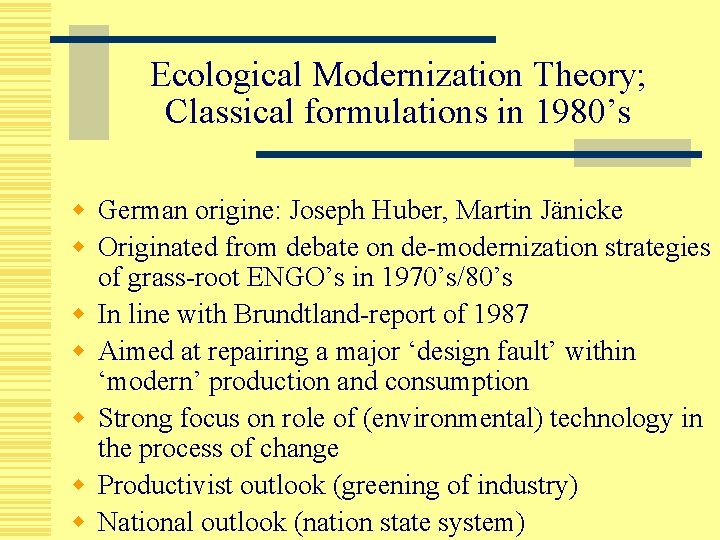
Ecological Modernization Theory; Classical formulations in 1980’s w German origine: Joseph Huber, Martin Jänicke w Originated from debate on de-modernization strategies of grass-root ENGO’s in 1970’s/80’s w In line with Brundtland-report of 1987 w Aimed at repairing a major ‘design fault’ within ‘modern’ production and consumption w Strong focus on role of (environmental) technology in the process of change w Productivist outlook (greening of industry) w National outlook (nation state system)
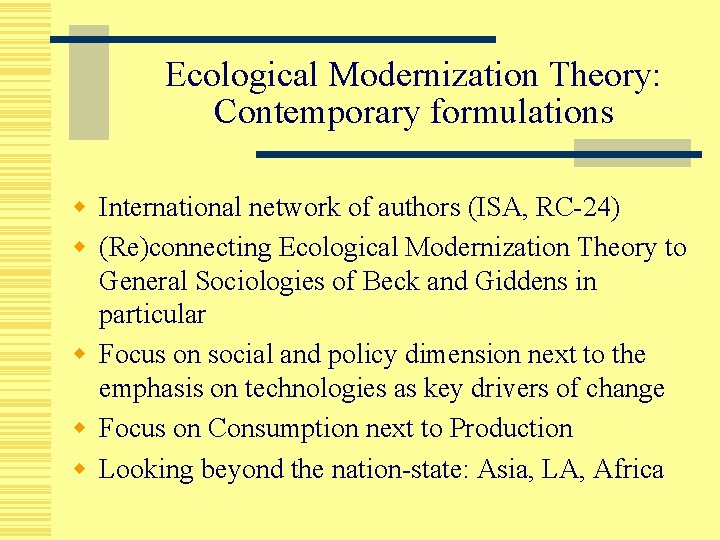
Ecological Modernization Theory: Contemporary formulations w International network of authors (ISA, RC-24) w (Re)connecting Ecological Modernization Theory to General Sociologies of Beck and Giddens in particular w Focus on social and policy dimension next to the emphasis on technologies as key drivers of change w Focus on Consumption next to Production w Looking beyond the nation-state: Asia, LA, Africa
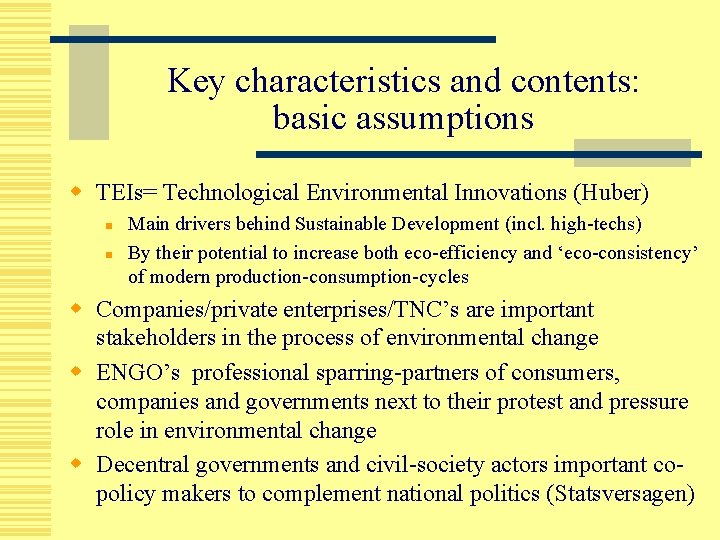
Key characteristics and contents: basic assumptions w TEIs= Technological Environmental Innovations (Huber) n n Main drivers behind Sustainable Development (incl. high-techs) By their potential to increase both eco-efficiency and ‘eco-consistency’ of modern production-consumption-cycles w Companies/private enterprises/TNC’s are important stakeholders in the process of environmental change w ENGO’s professional sparring-partners of consumers, companies and governments next to their protest and pressure role in environmental change w Decentral governments and civil-society actors important copolicy makers to complement national politics (Statsversagen)
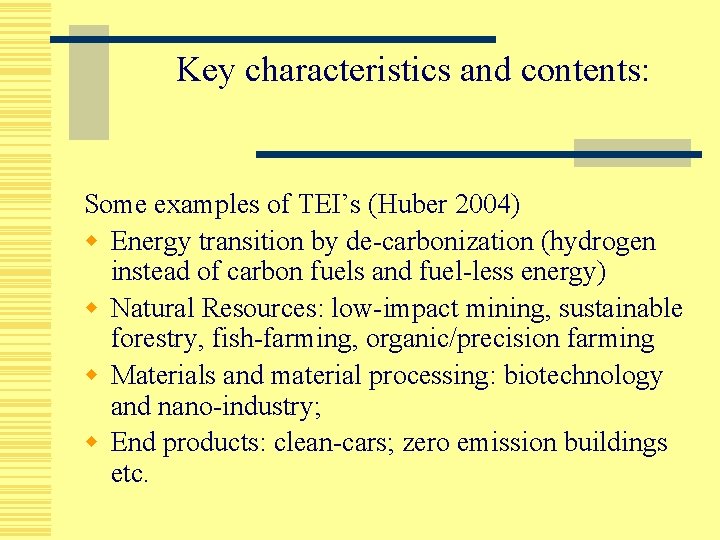
Key characteristics and contents: Some examples of TEI’s (Huber 2004) w Energy transition by de-carbonization (hydrogen instead of carbon fuels and fuel-less energy) w Natural Resources: low-impact mining, sustainable forestry, fish-farming, organic/precision farming w Materials and material processing: biotechnology and nano-industry; w End products: clean-cars; zero emission buildings etc.
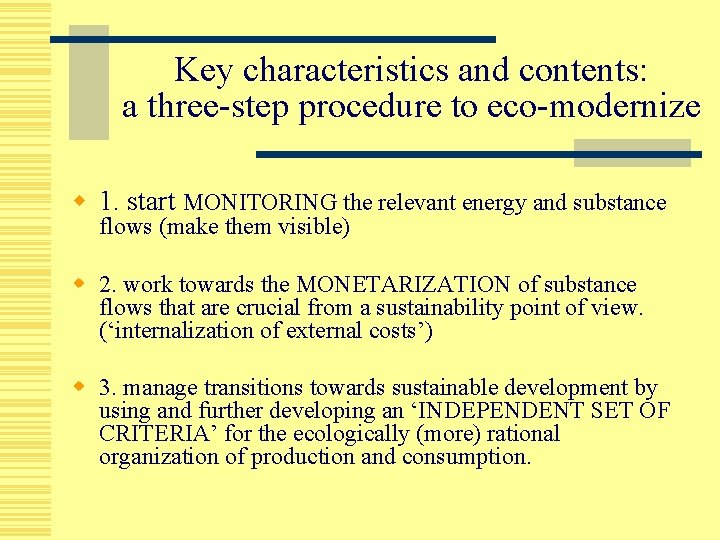
Key characteristics and contents: a three-step procedure to eco-modernize w 1. start MONITORING the relevant energy and substance flows (make them visible) w 2. work towards the MONETARIZATION of substance flows that are crucial from a sustainability point of view. (‘internalization of external costs’) w 3. manage transitions towards sustainable development by using and further developing an ‘INDEPENDENT SET OF CRITERIA’ for the ecologically (more) rational organization of production and consumption.
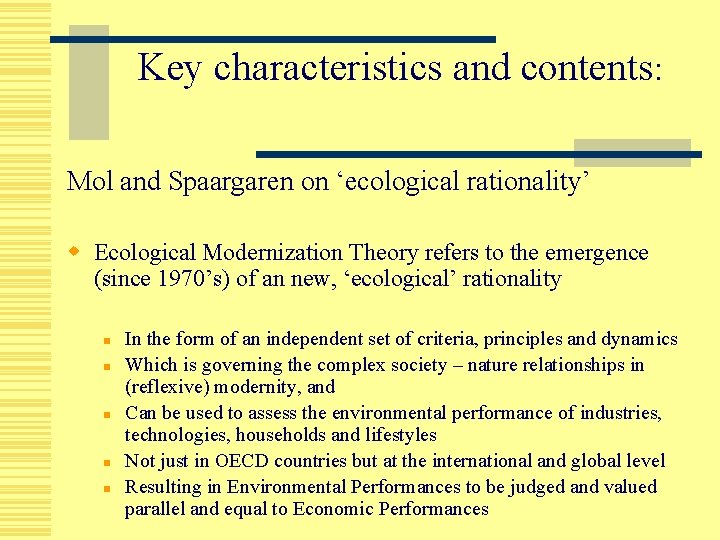
Key characteristics and contents: Mol and Spaargaren on ‘ecological rationality’ w Ecological Modernization Theory refers to the emergence (since 1970’s) of an new, ‘ecological’ rationality n n n In the form of an independent set of criteria, principles and dynamics Which is governing the complex society – nature relationships in (reflexive) modernity, and Can be used to assess the environmental performance of industries, technologies, households and lifestyles Not just in OECD countries but at the international and global level Resulting in Environmental Performances to be judged and valued parallel and equal to Economic Performances
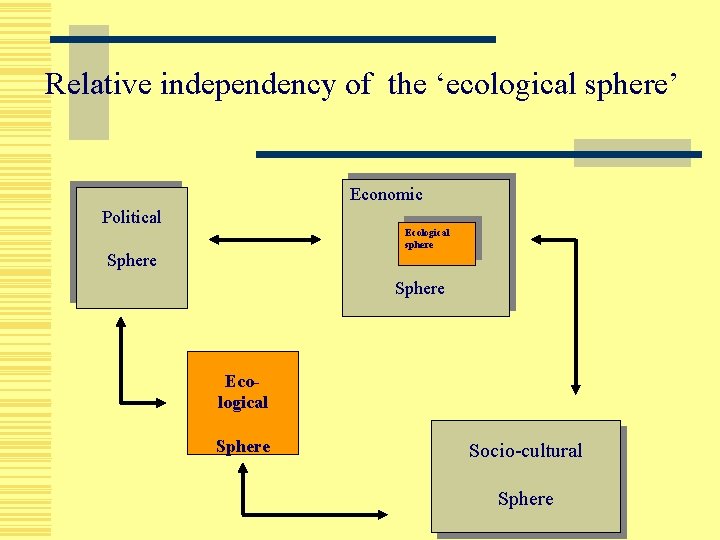
Relative independency of the ‘ecological sphere’ Economic Political Ecological sphere Sphere Ecological Sphere Socio-cultural Sphere
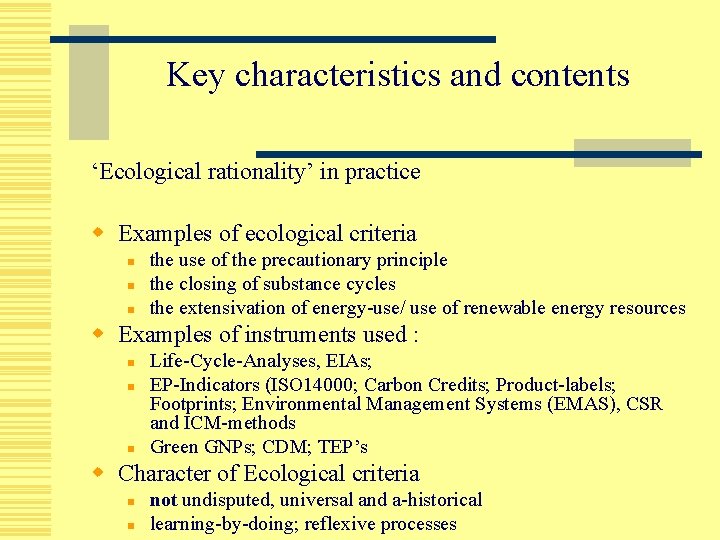
Key characteristics and contents ‘Ecological rationality’ in practice w Examples of ecological criteria n n n the use of the precautionary principle the closing of substance cycles the extensivation of energy-use/ use of renewable energy resources w Examples of instruments used : n n n Life-Cycle-Analyses, EIAs; EP-Indicators (ISO 14000; Carbon Credits; Product-labels; Footprints; Environmental Management Systems (EMAS), CSR and ICM-methods Green GNPs; CDM; TEP’s w Character of Ecological criteria n n not undisputed, universal and a-historical learning-by-doing; reflexive processes
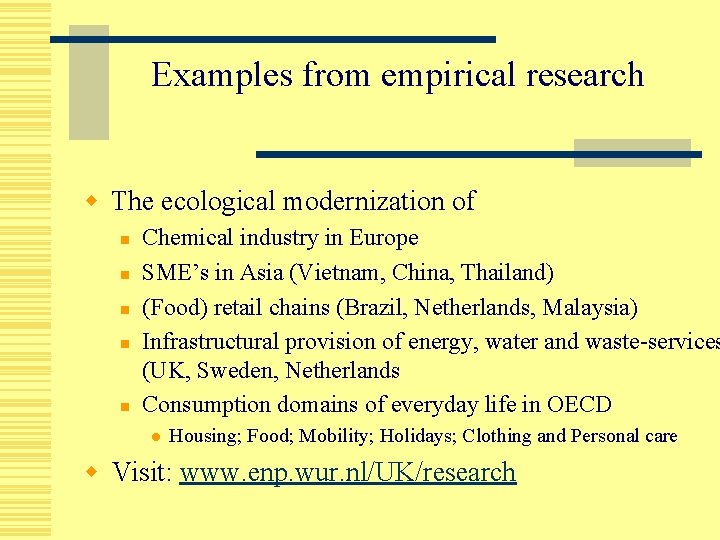
Examples from empirical research w The ecological modernization of n n n Chemical industry in Europe SME’s in Asia (Vietnam, China, Thailand) (Food) retail chains (Brazil, Netherlands, Malaysia) Infrastructural provision of energy, water and waste-services (UK, Sweden, Netherlands Consumption domains of everyday life in OECD l Housing; Food; Mobility; Holidays; Clothing and Personal care w Visit: www. enp. wur. nl/UK/research
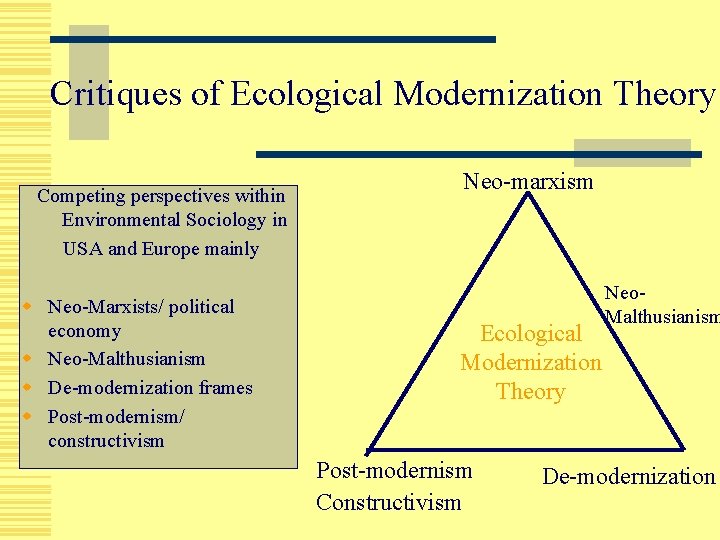
Critiques of Ecological Modernization Theory Competing perspectives within Environmental Sociology in USA and Europe mainly w Neo-Marxists/ political economy w Neo-Malthusianism w De-modernization frames w Post-modernism/ constructivism Neo-marxism Ecological Modernization Theory Post-modernism Constructivism Neo. Malthusianism De-modernization
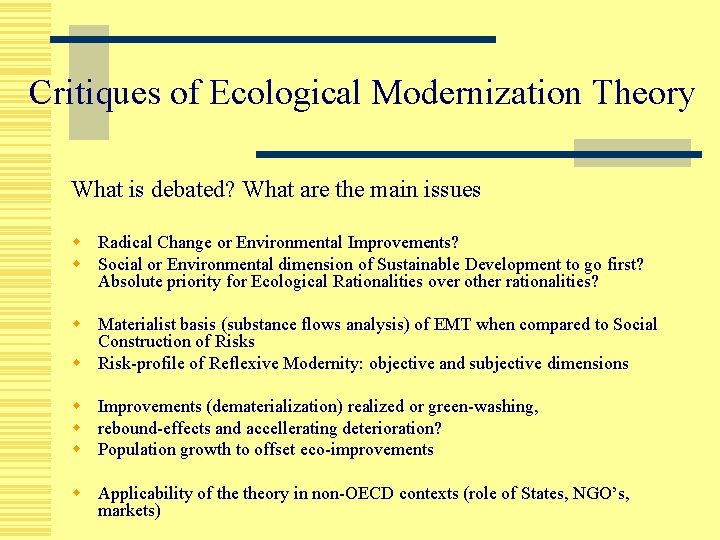
Critiques of Ecological Modernization Theory What is debated? What are the main issues w Radical Change or Environmental Improvements? w Social or Environmental dimension of Sustainable Development to go first? Absolute priority for Ecological Rationalities over other rationalities? w Materialist basis (substance flows analysis) of EMT when compared to Social Construction of Risks w Risk-profile of Reflexive Modernity: objective and subjective dimensions w Improvements (dematerialization) realized or green-washing, w rebound-effects and accellerating deterioration? w Population growth to offset eco-improvements w Applicability of theory in non-OECD contexts (role of States, NGO’s, markets)
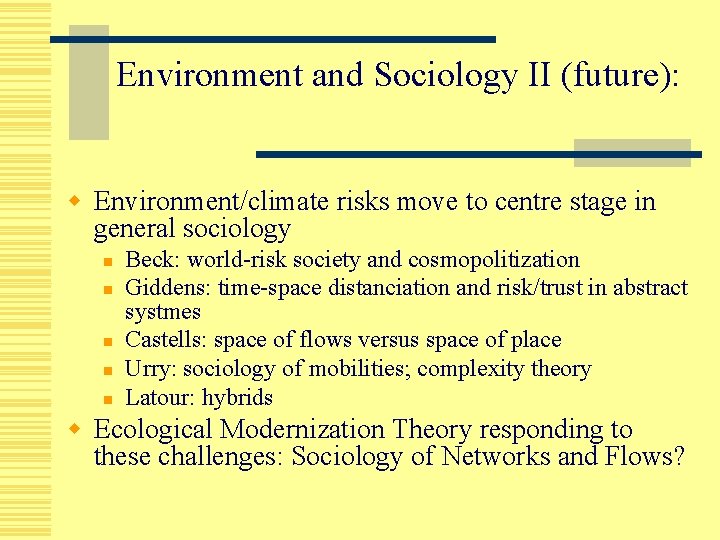
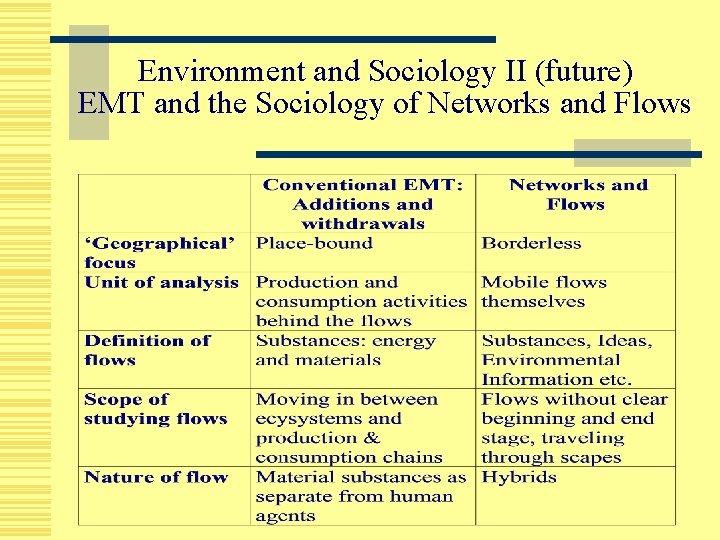
Environment and Sociology II (future): w Environment/climate risks move to centre stage in general sociology n n n Beck: world-risk society and cosmopolitization Giddens: time-space distanciation and risk/trust in abstract systmes Castells: space of flows versus space of place Urry: sociology of mobilities; complexity theory Latour: hybrids w Ecological Modernization Theory responding to these challenges: Sociology of Networks and Flows?
Environment and Sociology II (future) EMT and the Sociology of Networks and Flows
Thanks for your attention and questions The eyes of the Panda can do more than one hour of lecturing…. (Etienne Vermeersch)