
Ecological Modernization Environmental Innovation What is the Role









- Slides: 26
Ecological Modernization & Environmental Innovation: What is the Role of Environmental Regulation? Jacqueline Lam, Postdoctoral Fellow Prof. Peter Hills, Director The Kadoorie Institute The University of Hong Kong
Env Innovation & Economic Performance l Ecological Modernization & Environmental innovation l l Adoption of EI has the potential of l l l Environmental Innovation (EI) considered as a critical means to achieve both economic gain and environmental performance in the Ecological Modernization Theory (EMT). Reducing emissions and the consumption of resources Improving the eco-efficiency to bring about better competitiveness Purpose of this paper l l To investigate the conditions that govern the adaptation and diffusion of TEI and policies that can mostly effectively stimulate the industry to engage in TEI To understand what role do environmental regulations play in the promotion of TEI
Defining Environmental Innovation l General Definitions on Environmental Innovation Measures of relevant actors which help develop new ideas, behaviour, products and processes, apply or introduce them and which contribute to a reduction of environmental burdens, an improvement in resource efficiency as well as economic gains (Porter and Van der Linde, 1995 b; Gouldson and Murphy, 1998; Rennings, 2000) l This study focuses on EM-based Technological Environmental Innovation which refers to: Any new techniques or technologies that have beneficial effects on the environment and (potentially) brings about an improvement on the economy (or company’s economic performance)
TEI Conditions
TEI Conditions l l The adoption/diffusion of TEI is determined by economic, firm-internal and contextual factors. Apart from costs, many other factors prevent the adoption/diffusion of TEI l l market failures and barriers, such as negative externality, knowledge spillover, information asymmetry, and technological lock-in (Jaffe, Newell and Stavins, 2000) firm capability, managerial & organizational norms and attitutdes, and stakeholder pressure
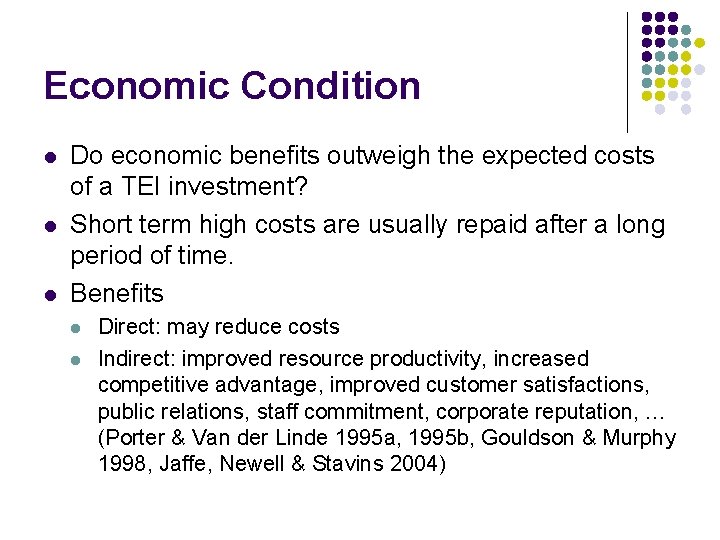
Economic Condition l l l Do economic benefits outweigh the expected costs of a TEI investment? Short term high costs are usually repaid after a long period of time. Benefits l l Direct: may reduce costs Indirect: improved resource productivity, increased competitive advantage, improved customer satisfactions, public relations, staff commitment, corporate reputation, … (Porter & Van der Linde 1995 a, 1995 b, Gouldson & Murphy 1998, Jaffe, Newell & Stavins 2004)
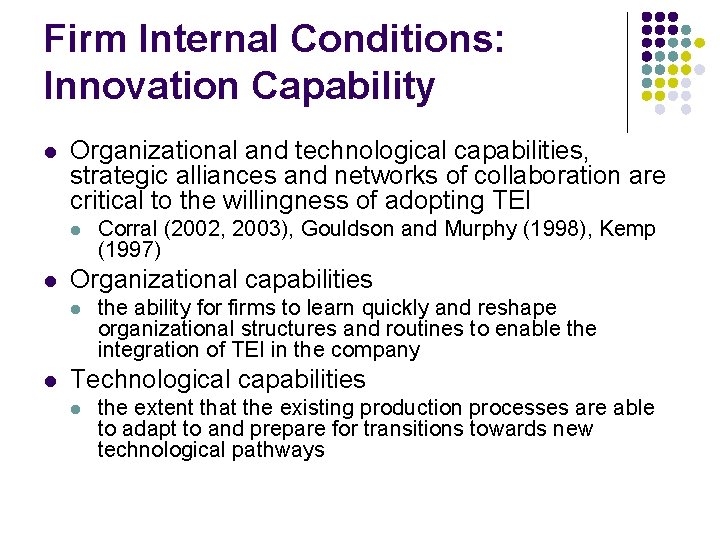
Firm Internal Conditions: Innovation Capability l Organizational and technological capabilities, strategic alliances and networks of collaboration are critical to the willingness of adopting TEI l l Organizational capabilities l l Corral (2002, 2003), Gouldson and Murphy (1998), Kemp (1997) the ability for firms to learn quickly and reshape organizational structures and routines to enable the integration of TEI in the company Technological capabilities l the extent that the existing production processes are able to adapt to and prepare for transitions towards new technological pathways
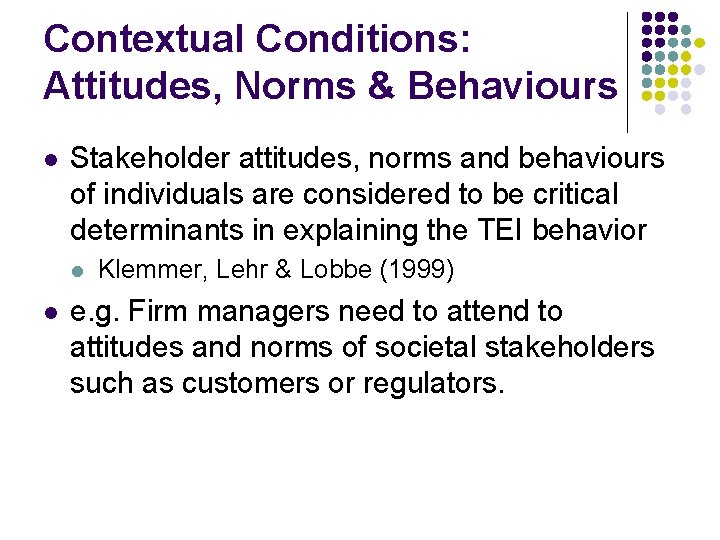
Contextual Conditions: Attitudes, Norms & Behaviours l Stakeholder attitudes, norms and behaviours of individuals are considered to be critical determinants in explaining the TEI behavior l l Klemmer, Lehr & Lobbe (1999) e. g. Firm managers need to attend to attitudes and norms of societal stakeholders such as customers or regulators.
How do different Env. Regulation address these TEI conditions?
Traditional Env. Regulatory Approach (TERA) l The Traditional Env. Regulatory Approach (TERA) is dominated by command-control regulation (C&C REG), characterized by rules, hierarchy, control, deterrence and specialization. (Fiorino, 2006). l l l impedes innovation, inflexible, legalistic, fragmented, … Passively required to meet standards Firms are not encouraged to go beyond the prescribed level even if they have the capacity as no benefits can be reaped from such efforts.
EM-based environmental policy (II) l l Incentive-based measures to motivate businesses to engage in continuous enhancement of environmental performance Increasingly replaced by market-based and voluntary measures l Incentive-driven l Capability-building However, the success of incentive-based and voluntary measures depend on l the willingness of firms to commit to TEI l the removal of barriers such as uncertainty, negative externality, spillover problem, info. asymmetry. Regulation, if carefully designed, is still a very important and necessary tool to complement non-regulatory measures and catalyze the adoption of TEI.
Question l l l What kind of env. regulation should we promote? We see merits of TERA and EM-based policy in creating favourable innovation conditions for bringing about TEI. Synergy of both l l l Pressure (Regulation); Motivation (Regulation + EM-Based) Incentive (Regulation + EM-Based) Capability (Regulation + EM-Based)
Properly-designed Env. Regulation l l l Porter & van der Linde (1995) argue that properly-designed environmental regulation (PD REG) may not only benefit the environment but also the regulated industries by forcing industry to innovate and thus increase productivity and resource efficiency. “WIN-WIN” Hypothesis To avoid the negative consequence of C&C REG in the past, they note that good env. regulations that foster TEI should be designed in such a way that l create maximum opportunity for industries to innovate, l be technology-forcing instead of technology-setting, and l leave little rooms for uncertainty at every stage during the regulatory process.
New Environment Regulatory Approach (NERA) l accommodates non-regulatory instruments to enhance economic incentives and capabilities of the business, and to mobilize change l replace traditional environmental regulations with new environmental regulations that are innovation-oriented, and are properly-designed and implemented l l to reduce the negative impacts of traditional C&C REG to enhance the favourable innovation conditions governing TEI
New Environment Regulatory Approach (NERA) l Accommodates non-regulatory instruments for enhancing the TEI conditions l l l Economic Firm-internal Contextual
Characteristics of PD REG (I) Goal-setting l l focus on long-term goals to steer regulated firms towards the most innovative solution, instead of forcing them to adopt particular technologies (technology-setting) or environmental standards (standard-setting). Stringency l l provide a strong impetus for regulated firms to strive for higher environmental performance. Flexibility l l increase the flexibility for regulated firms in terms of how they achieve the regulatory target.
Characteristics of PD REG (II) l l l l Incentive-driven couples environmental regulations with other incentive-based instruments, e. g. tradeable permits, or credit system, in promoting continuous environmental improvement Participatory encourage industrial participation in the design of phase-in periods, the content of regulations, trust-building, and selfregulatory behaviours, such as information disclosure. Capability-enhanced enhance organizational and technological competence, by complementing with voluntary programmes in the form of technical assistance, demonstration projects and training programmes and technological consulting services Consistency, Certainty, …
Case Study Zero Emission Bus Regulation in California
ZBus l The ZBus regulation is picked for the following reasons: l l l Demonstrate the adoption of TEI Display some characteristics of the NERA Achieve some initiate success on achieving environmental improvements while potentially creates some competitiveness for companies.
Zero Emission Bus Regulation Background (CARB 2009) l l l Adopted in Feb 2000 & modified in Jun 2004 Goal - Encourage a bus fleet with increasing replacement by zero emission vehicles Fuel Cell Buses had demonstrated ability to meet performance needs
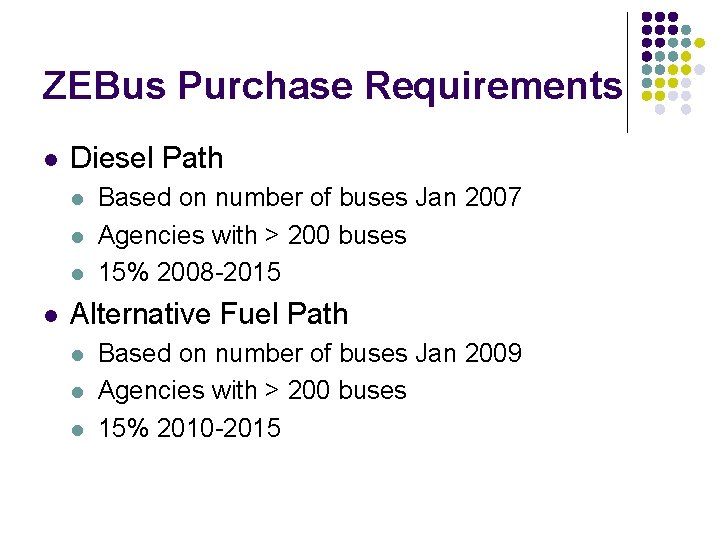
ZEBus Purchase Requirements l Diesel Path l l Based on number of buses Jan 2007 Agencies with > 200 buses 15% 2008 -2015 Alternative Fuel Path l l l Based on number of buses Jan 2009 Agencies with > 200 buses 15% 2010 -2015
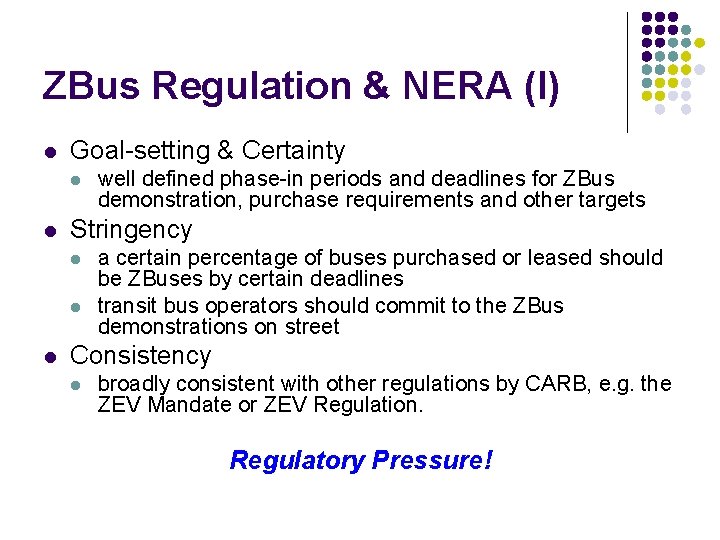
ZBus Regulation & NERA (I) l Goal-setting & Certainty l l Stringency l l l well defined phase-in periods and deadlines for ZBus demonstration, purchase requirements and other targets a certain percentage of buses purchased or leased should be ZBuses by certain deadlines transit bus operators should commit to the ZBus demonstrations on street Consistency l broadly consistent with other regulations by CARB, e. g. the ZEV Mandate or ZEV Regulation. Regulatory Pressure!
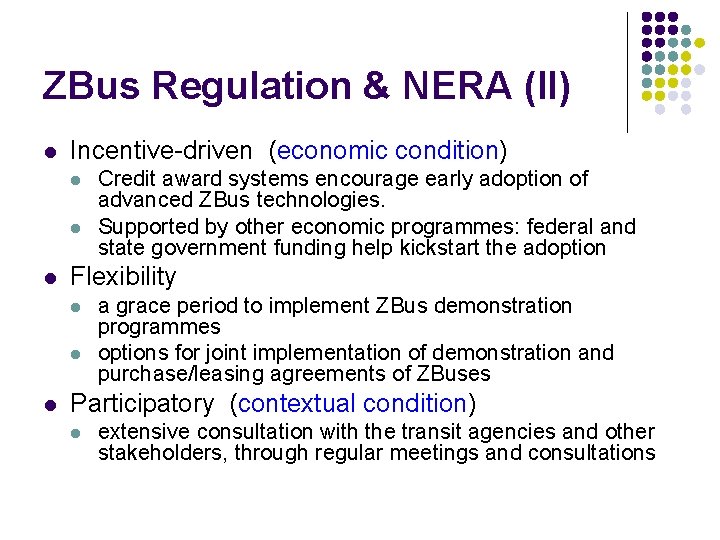
ZBus Regulation & NERA (II) l Incentive-driven (economic condition) l l l Flexibility l l l Credit award systems encourage early adoption of advanced ZBus technologies. Supported by other economic programmes: federal and state government funding help kickstart the adoption a grace period to implement ZBus demonstration programmes options for joint implementation of demonstration and purchase/leasing agreements of ZBuses Participatory (contextual condition) l extensive consultation with the transit agencies and other stakeholders, through regular meetings and consultations
ZBus Regulation & NERA (III) l Capability-enhanced (firm-internal condition) l l joint implementation between transit agencies creates opportunities for inter-organizational learning and sharing of funding and resources. Supported by California Fuel Cell Partnerships(Ca. FCP) l provides opportunities for transit agencies to team up auto manufacturers, energy companies, fuel cell technology companies and government agencies at the local, state and federal levels in fuel cell bus demonstration.
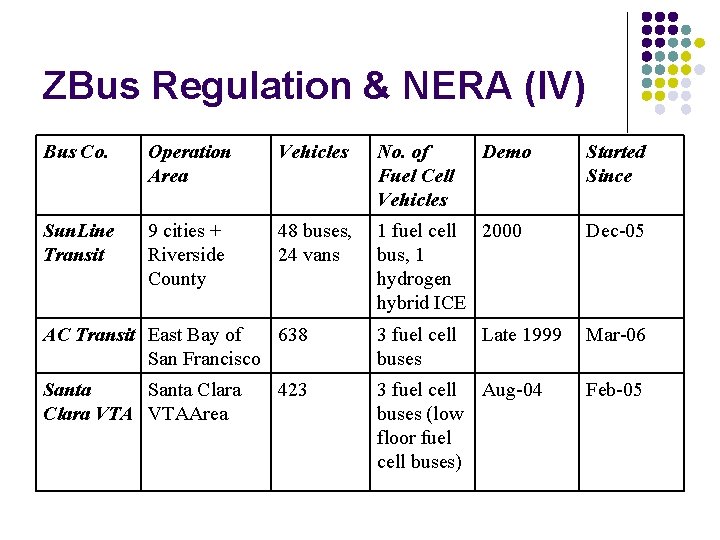
ZBus Regulation & NERA (IV) Bus Co. Operation Area Vehicles No. of Fuel Cell Vehicles Sun. Line Transit 9 cities + Riverside County 48 buses, 24 vans 1 fuel cell 2000 bus, 1 hydrogen hybrid ICE Dec-05 AC Transit East Bay of 638 San Francisco 3 fuel cell buses Mar-06 Santa Clara VTAArea 3 fuel cell Aug-04 buses (low floor fuel cell buses) 423 Demo Late 1999 Started Since Feb-05
THANK YOU! Questions and comments are welcomed.